Ford Freestyle (2007 year). Manual - part 50
 

  Index      Ford     Ford Freestyle - service manual 2007 year in english


Search            


Content   ..  48  49  50  51   ..


Ford Freestyle (2007 year). Manual - part 50


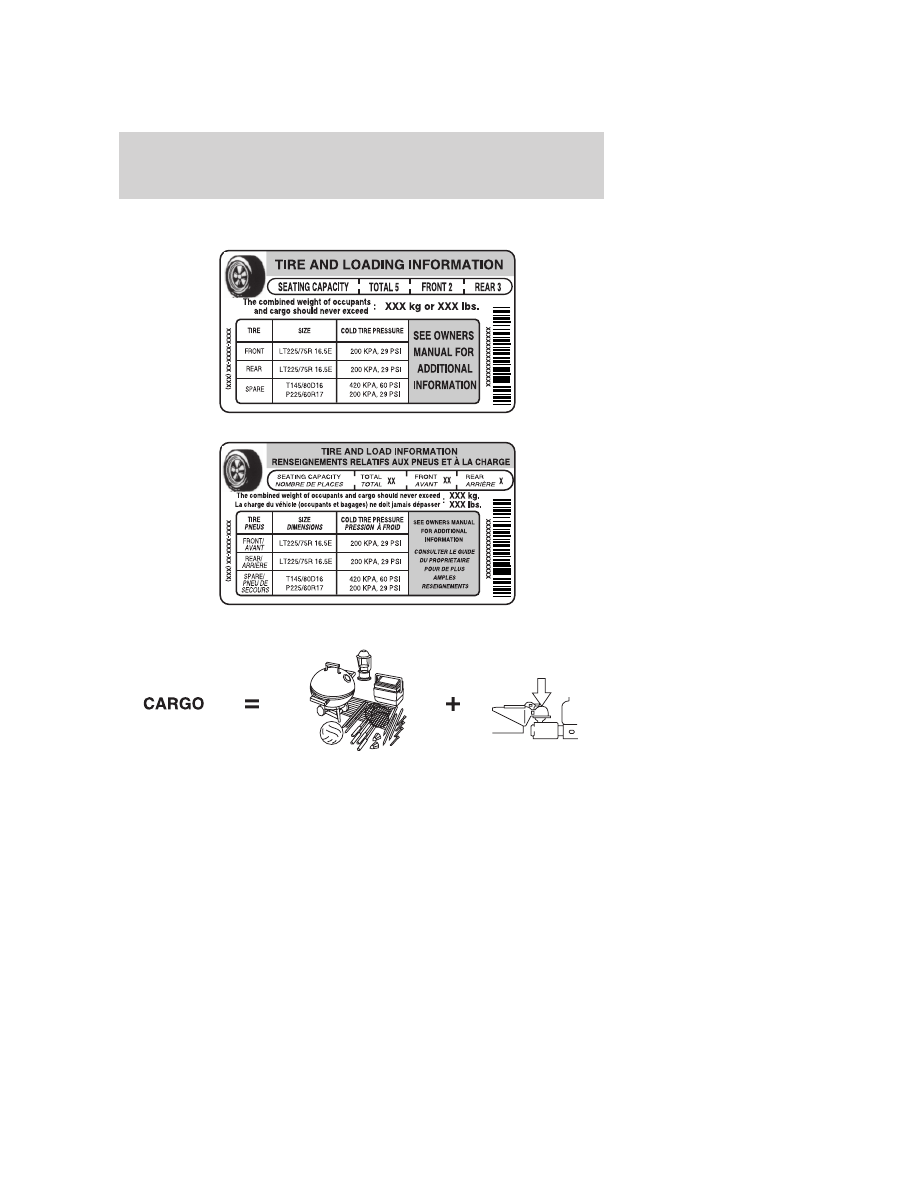
Example only:

Cargo Weight – includes all weight added to the Base Curb Weight,
including cargo and optional equipment. When towing, trailer tongue load
or king pin weight is also part of cargo weight.

GAW (Gross Axle Weight) – is the total weight placed on each axle
(front and rear) – including vehicle curb weight and all payload.

Tires, Wheels and Loading

202

GAWR (Gross Axle Weight Rating) – is the maximum allowable
weight that can be carried by a single axle (front or rear). These
numbers are shown on the Safety Compliance Certification Label
located on the B-Pillar or the edge of the driver’s door. The total
load on each axle must never exceed its GAWR.

GVW (Gross Vehicle Weight) – is the Vehicle Curb Weight + cargo +
passengers.

GVWR (Gross Vehicle Weight
Rating) 
– is the maximum
allowable weight of the fully loaded
vehicle (including all options,
equipment, passengers and cargo).
The GVWR is shown on the
Safety Compliance Certification
Label located on the B-Pillar or
the edge of the driver’s door.
The GVW must never exceed the
GVWR.

Exceeding the Safety Compliance Certification Label vehicle
weight rating limits could result in substandard vehicle handling

or performance, engine, transmission and/or structural damage, serious
damage to the vehicle, loss of control and personal injury.

Tires, Wheels and Loading

203

GCW (Gross Combined Weight) – is the weight of the loaded vehicle
(GVW) plus the weight of the fully loaded trailer.

GCWR (Gross Combined Weight Rating) – is the maximum allowable
weight of the vehicle and the loaded trailer – including all cargo and
passengers – that the vehicle can handle without risking damage.
(Important: The towing vehicles’ braking system is rated for operation at
GVWR, not at GCWR. Separate functional brakes should be used for safe
control of towed vehicles and for trailers where the GCW of the towing
vehicle plus the trailer exceed the GVWR of the towing vehicle. The
GCW must never exceed the GCWR.

Do not exceed the GVWR or the GAWR specified on the Safety
Compliance Certification Label.

Do not use replacement tires with lower load carrying capacities
than the originals because they may lower the vehicle’s GVWR

and GAWR limitations. Replacement tires with a higher limit than the
originals do not increase the GVWR and GAWR limitations.

Exceeding any vehicle weight rating limitation could result in
serious damage to the vehicle and/or personal injury.

Steps for determining the correct load limit:

1. Locate the statement “The combined weight of occupants and cargo
should never exceed XXX kg or XXX lbs.” on your vehicle’s placard.

Tires, Wheels and Loading

204

2. Determine the combined weight of the driver and passengers that will
be riding in your vehicle.

3. Subtract the combined weight of the driver and passengers from XXX
kg or XXX lbs.

4. The resulting figure equals the available amount of cargo and luggage
load capacity. For example, if the “XXX” amount equals 1,400 lbs. and
there will be five 150 lb. passengers in your vehicle, the amount of
available cargo and luggage load capacity is 650 lbs. (1400–750 (5 x 150)
= 650 lb.). In metric units (635–340 (5 x 68) = 295 kg.)

5. Determine the combined weight of luggage and cargo being loaded on
the vehicle. That weight may not safely exceed the available cargo and
luggage load capacity calculated in Step 4.

6. If your vehicle will be towing a trailer, load from your trailer will be
transferred to your vehicle. Consult this manual to determine how this
reduces the available cargo and luggage load capacity of your vehicle.

The following gives you a few examples on how to calculate the available
amount of cargo and luggage load capacity:
• Another example for your vehicle with 1400 lb. (635 kg) of cargo and

luggage capacity. You decide to go golfing. Is there enough load
capacity to carry you, 4 of your friends and all the golf bags? You and
four friends average 220 lb. (99 kg) each and the golf bags weigh
approximately 30 lb. (13.5 kg) each. The calculation would be: 1400 –
(5 x 220) – (5 x 30) = 1400 – 1100 – 150 = 150 lb. Yes, you have
enough load capacity in your vehicle to transport four friends and
your golf bags. In metric units, the calculation would be: 635 kg —
(5 x 99 kg) — (5 x 13.5 kg) = 635 — 495 — 67.5 = 72.5 kg.

• A final example for your vehicle with 1400 lb. (635 kg) of cargo and

luggage capacity. You and one of your friends decide to pick up
cement from the local home improvement store to finish that patio
you have been planning for the past 2 years. Measuring the inside of
the vehicle with the rear seat folded down, you have room for 12-100 lb.
(45 kg) bags of cement. Do you have enough load capacity to transport
the cement to your home? If you and your friend each weigh 220 lb.
(99 kg), the calculation would be: 1400 – (2 x 220) – (12 x 100) =
1400 – 440 – 1200 = – 240 lb. No, you do not have enough cargo
capacity to carry that much weight. In metric units, the calculation
would be: 635 kg — (2 x 99 kg) — (12 x 45 kg) = 635 — 198 — 540
= —103 kg. You will need to reduce the load weight by at least 240 lb.
(104 kg). If you remove 3-100 lb. (45 kg) cement bags, then the load
calculation would be:

Tires, Wheels and Loading

205


Content   ..  48  49  50  51   ..