Ford Focus Electric (2018 year). Manual - part 3
 

  Index      Ford     Ford Focus Electric - service manual 2018 year in english


Search            


Content   ..  1  2  3  4  ..


Ford Focus Electric (2018 year). Manual - part 3


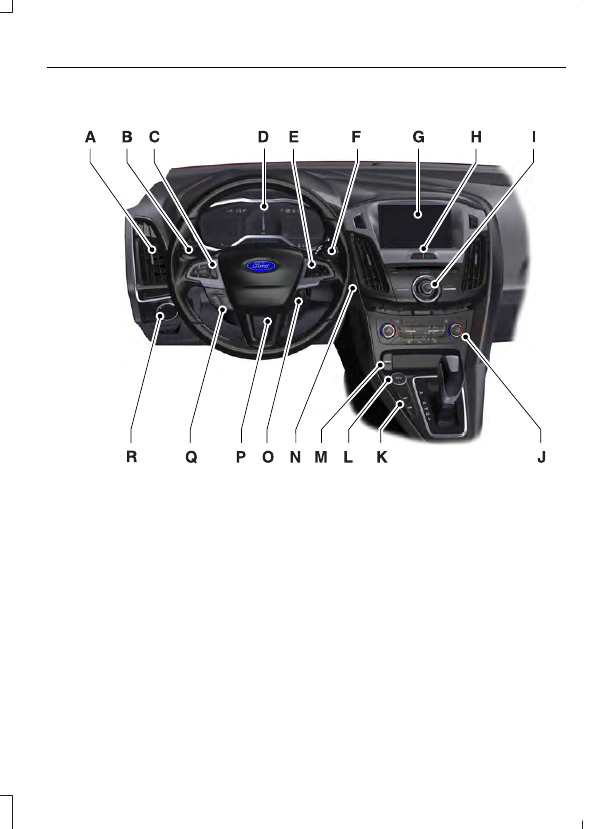
INSTRUMENT PANEL OVERVIEW

E188835

Air vents.

A

Direction indicators.  See Direction Indicators (page 69).

B

Information display control.  See Information Display Control (page 63).

C

Instrument cluster.  See Instrument Cluster (page 75).

D

Information display control.

E

Wiper lever.  See Wipers and Washers (page 64).

F

Information and entertainment display.

G

Hazard flasher switch.  See Hazard Flashers (page 145).

H

Audio unit.  See Audio Unit (page 224).

I

Climate controls.  See Climate Control (page 94).

J

Parking aid switch.  See Parking Aids (page 126).

K

Auxiliary power point.  See Auxiliary Power Points (page 105).

L

GENERAL INFORMATION

See the following sections for directions
on how to properly use safety restraints
for children.

WARNINGS

Always make sure your child is
secured properly in a device that is
appropriate for their height, age and

weight. Child safety restraints must be
bought separately from your vehicle.
Failure to follow these instructions and
guidelines may result in an increased risk
of serious injury or death to your child.

All children are shaped differently.
The National Highway Traffic Safety
Administration and other safety

organizations, base their recommendations
for child restraints on probable child height,
age and weight thresholds, or on the
minimum requirements of the law. We
recommend that you check with a NHTSA
Certified Child Passenger Safety

WARNINGS

Technician (CPST) to make sure that you
properly install the child restraint in your
vehicle and that you consult your
pediatrician to make sure you have a child
restraint appropriate for your child. To
locate a child restraint fitting station and
CPST, contact NHTSA toll free at
1-888-327-4236 or go to
www.nhtsa.dot.gov. In Canada, contact
Transport Canada toll free at
1-800-333-0371 or go to www.tc.gc.ca to
find a Child Car Seat Clinic in your area.
Failure to properly restrain children in child
restraints made especially for their height,
age and weight, may result in an increased
risk of serious injury or death to your child.

On hot days, the temperature inside
the vehicle can rise very quickly.
Exposure of people or animals to

these high temperatures for even a short
time can cause death or serious heat
related injuries, including brain damage.
Small children are particularly at risk.

Recommendations for Safety Restraints for Children

Recommended restraint

type

Child size, height, weight, or age

Child

Use a child safety seat

(sometimes called an

infant carrier, convertible

seat, or toddler seat).

Children weighing 40 lb (18 kg) or less

(generally age four or younger).

Infants or

toddlers

Use a belt-positioning

booster seat.

Children who have outgrown or no longer

properly fit in a child safety seat (gener-

ally children who are less than 4 ft. 9 in.

(1.45 m) tall, are greater than age four

and less than age 12, and between 40 lb

(18 kg) and 80 lb (36 kg) and upward to

100 lb (45 kg) if recommended by your

child restraint manufacturer).

Small children

Use a vehicle safety belt

having the lap belt snug

and low across the hips,

shoulder belt centered

across the shoulder and

chest, and seatback

upright.

Children who have outgrown or no longer

properly fit in a belt-positioning booster

seat (generally children who are at least

4 ft. 9 in. (1.45 m) tall or greater than

80 lb (36 kg) or 100 lb (45 kg) if recom-

mended by child restraint manufacturer).

Larger children

You are required by law to properly use
safety seats for infants and toddlers in
the United States and Canada.

Many states and provinces require that
small children use approved booster
seats until they reach age eight, a
height of 4 feet 9 inches (1.45 meters)
tall, or 80 lb (36 kg). Check your local
and state or provincial laws for specific
requirements about the safety of
children in your vehicle.

When possible, always properly
restrain children 12 years of age and
under in a rear seating position of your
vehicle. Accident statistics suggest that
children are safer when properly
restrained in the rear seating positions
than in a front seating position.  See
Front Passenger Sensing System
(page 37).

INSTALLING CHILD
RESTRAINTS

Child Restraints

E142594


Content   ..  1  2  3  4  ..