Ford F-650/750 (2018 year). Manual - part 30
 

  Index      Ford     Ford F-650/750 - service manual 2018 year in english


Search            


Content   ..  28  29  30  31   ..


Ford F-650/750 (2018 year). Manual - part 30


Parking Brake Light Illumination Due
to Low Air Pressure

If the air pressure becomes too low at any
time during vehicle operation, the parking
brake may apply and the parking brake
light turns on.

If the parking brake applies due to low air
pressure, immediate service is required to
the parking brake system.

Releasing Spring Brake with Air
Pressure

The air system in all vehicles with
spring-actuated rear wheel parking brakes
has a valve on the governor for connection
to an outside air supply. The valve lets you
recharge the system with air from an
outside source, releasing the
spring-actuated parking brakes. Your
vehicle is now ready to tow in an
emergency.

You can only use an outside air source if
the protected system is in operating
condition. If you cannot restore air pressure
in the protected air system, you must
release the spring-actuated brakes
manually.

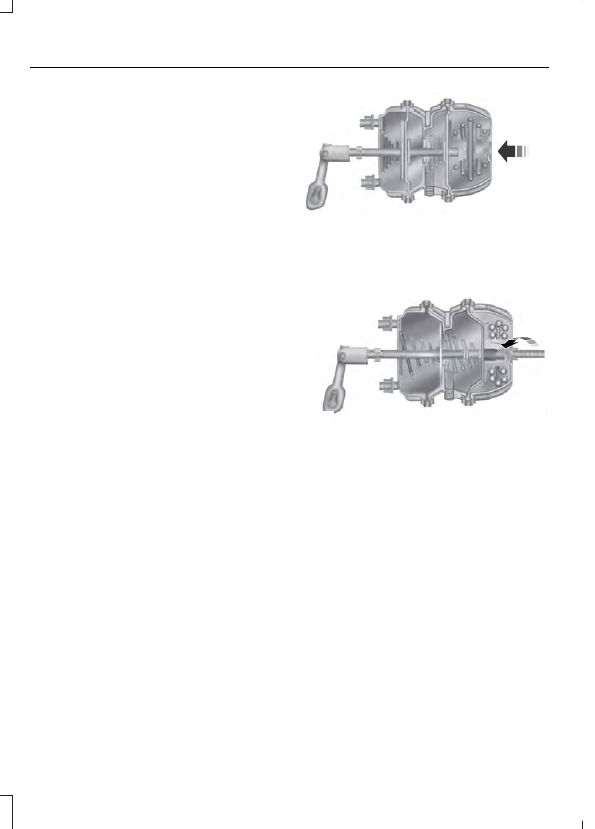
Releasing Spring Manually

Do not use impact wrenches as they may
damage the piston and prevent proper
caging of the spring. Do not apply more
than 50 lb.ft (68 Nm) to the release bolt
nut.

1.

Remove the stud tool and nut from the
carrying pocket on the brake chamber
assembly.

E210365

2. Remove the access plug from the end

of the spring chamber.

3. Insert the release stud through the

opening in the chamber and into the
spring pressure plate.

E210366

4. Turn the release stud ¼ turn to engage

the stud tangs with the slot in the
pressure plate. Keep the stud engaged
and install the nut on the release stud.

5. Tighten the nut until the spring is fully

caged and brakes released. Do not
loosen or remove the release stud and
nut unless you completely assemble
and securely clamp the brake chamber.

6. After restoring the air pressure,

unscrew and remove the release stud
and install in the carrying pocket. Install
the access plug.

AIR BRAKES

 (If Equipped)

WARNINGS

Do not drive or continue to drive if the
low air pressure buzzer is sounding
or the brake warning light is lit. These

warnings indicate that air pressure is not
to normal operating level. Continued use
of the vehicle could result in loss of braking
ability.

Avoid repeated light application of
the brake pedal. This depletes air
pressure faster and could result in

loss of braking capability.

Do not move the vehicle when the
air pressure is insufficient because
the brake system may be inoperative.

After starting the engine, give the air
compressor time to build up the air
pressure to 60 psi (414 kPa) before moving
your vehicle.

E210336

Periodically check the air pressure gauge
while driving. Pressure should range
between approximately 100 psi (690 kPa)
to 130 psi (896 kPa). The air compressor
governor cut-in and cutout pressure
settings are set at the factory and are not
adjustable.

E206772

When air pressure is insufficient
(below 60 psi (414 kPa)), a
warning light illuminates and a

buzzer sounds when the ignition is in the
on position. This may happen because
excessive brake applications are depleting
the system air pressure. If this condition
occurs, stop driving your vehicle until the
compressor has fully recharged the air
system.

Select a gear ratio to help slow your vehicle
before descending grades. Supplementing
with brakes, as required, help to safely slow
the vehicle and avoids overspeeding the
engine.

Air Chamber Stroke Indication

Air chamber push rods have orange stroke
indicator markers that warn when the
braking system requires adjustment or
repair. The painted orange indicator is on
the air chamber push rod at the slack
adjuster stroke dimension that requires
service when visible during brake
application.

A qualified service technician should
perform air brake inspection and
adjustment or repairs keeping to the
instructions in the service manual.

Cam Brakes - Automatic Slack
Adjusters

WARNING

Do not manually adjust the
automatic slack adjusters to correct
excessive push rod stroke as it may

result in reduced brake effectiveness and
a vehicle crash. Excessive push rod stroke
indicates that a problem exists with the
automatic adjuster, with the installation
of the adjuster, or with foundation brake
components that manual adjustment does
not remedy. Seek service from a qualified
facility for excessive push rod stroke.

E210337

Standard air brakes (cam) are equipped
with automatic brake adjusters. Automatic
adjustment occurs during brake
applications. Inspect brakes for proper
adjustment at the specified intervals.  See
Scheduled Maintenance (page 320).

Emergency Air Brake

WARNING

Do not continue to operate the
vehicle with a failure of one of the
brake systems. Take the vehicle to

your dealer for service immediately.

All vehicles are equipped with a dual brake
system. In the unlikely event of a failure of
one system, the second system functions
for emergency stopping. The brake pedal
controls all these systems in the same
manner as for normal stops.

EXHAUST BRAKE

 (If Equipped)

WARNINGS

Do not use tow/haul when the road
surface is slippery. Failure to follow
this instruction could result in the

loss of control of your vehicle.

WARNINGS

Do not use diesel engine exhaust
braking when the road surface is
slippery. Failure to follow this

instruction could result in the loss of
control of your vehicle.

Note: Installing an exhaust or auxiliary
brake does not necessarily protect the
engine from exceeding the maximum
governed speed. Use the primary brakes to
make sure the engine never exceeds the
maximum governed speed under any
circumstance.

Note: Before starting the engine, make sure
that the exhaust brake is off. Do not switch
the exhaust brake on until the engine has
reached normal operating temperature.

Note: Maximum exhaust brake
performance relates to the type of
transmission your vehicle has.

Note: Engine speed has a major influence
on limiting performance. When engine
speed stays at the maximum allowable
level, the exhaust brake operates at peak
performance.

Note: Exhaust brakes operate effectively
with automatic transmissions. However,
performance varies with engine speed and
the gear selected by the transmission.

An exhaust brake is an auxiliary braking
system that assists, but does not replace,
the primary brake system. It helps control
vehicle speed. It is not a vehicle-stopping
device.

Use the button on the instrument panel, in
combination with the accelerator and
clutch pedals, to maximize the use of the
exhaust brake in the following conditions:

Off-highway driving.

Mountain driving.

Heavy traffic.

High-speed highway driving.

E215226

To switch the exhaust brake on, press the
button. A light on the instrument cluster
indicates the system is on. Press the button
again to switch it off.

While approaching a steep grade, make
sure that the exhaust brake switch is on.
The exhaust brake begins working as soon
as you remove your foot from the
accelerator pedal.

Before descending a hill or steep grade,
always select the proper gear. If you take
the transmission out of gear while
descending, you may not be able to select
another gear because of maximum
governed RPM.

Make sure the engine speed does not
exceed the maximum allowable engine
RPM. Exceeding the maximum allowable
engine RPM can result in damage to the
engine. Apply the service brakes to reduce
the engine RPM or make a slower descent
by using a lower gear.

While driving down a grade, use a low
enough gear to descend safely with a
minimum application of the service brakes.
As a general guideline, use the same gear
as you use to ascend the hill.

Exhaust Brake Operating
Characteristics

The exhaust brake switches on when you
remove your feet from both the accelerator
and clutch pedals and the exhaust brake
is on.

If the brake is working properly, there will
be:

A slight change in engine sound when
the exhaust brake turns on.

A smooth braking effect. Do not expect
a retarding effect similar to sudden,
hard application of the service brakes.

A retarding force possibly felt acting
against your body during brake
application (depending on the grade
and vehicle load). This force prevents
the vehicle from going much faster.

Engine temperatures remaining in the
normal operating range.

A drop in engine RPM (depending on
grade and vehicle load) during a
descent.

A decrease in road speed when
applying the exhaust brake during a
descent, except when your vehicle is
carrying a heavy load or the grade is
extremely steep. In these instances,
you may need to apply the service
brakes occasionally.


Content   ..  28  29  30  31   ..