Ford F-53 Motorhome Chassis (2017 year). Manual - part 7
 

  Index      Ford     Ford F-53 Motorhome Chassis - service manual 2017 year in english


Search            


Content   ..  5  6  7  8   ..


Ford F-53 Motorhome Chassis (2017 year). Manual - part 7


FUEL QUALITY

Choosing the Right Fuel

E161513

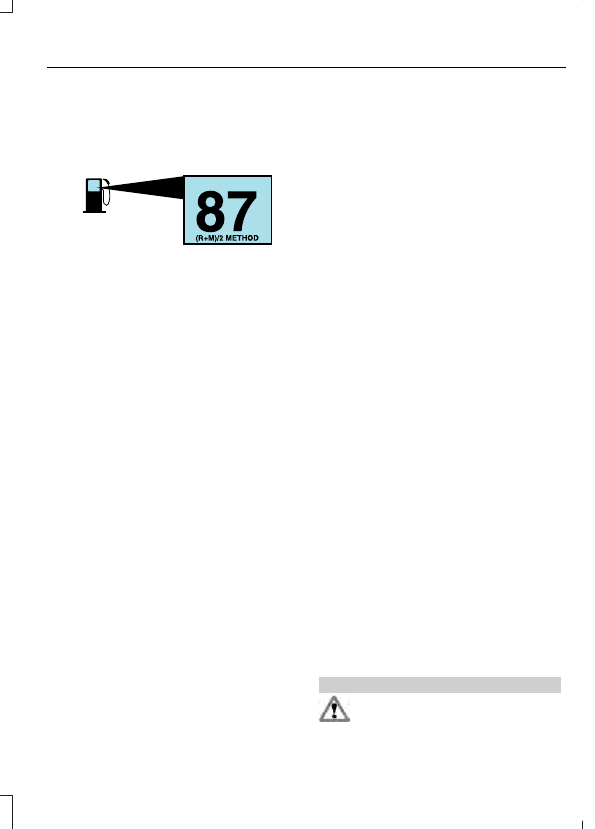
We recommend regular unleaded gasoline
with a minimum pump (R+M)/2 octane
rating of 87. Some fuel stations offer fuels
posted as regular unleaded gasoline with
an octane rating below 87, particularly in
high altitude areas. We do not recommend
fuels with an octane rating below 87.

Do not use any fuel other than those
recommended because they could lead to
engine damage that may not be covered
by the vehicle Warranty.

Note: Use of any fuel other than those
recommended can impair the emission
control system and cause a loss of vehicle
performance.

Do not use:

Diesel fuel.

Fuels containing kerosene or paraffin.

Fuel containing more than 15% ethanol
or E85 fuel.

Fuels containing methanol.

Fuels containing metallic-based
additives, including manganese-based
compounds.

Fuels containing the octane booster
additive, methylcyclopentadienyl
manganese tricarbonyl (MMT).

Leaded fuel (using leaded fuel is
prohibited by law).

The use of fuels with metallic compounds
such as methylcyclopentadienyl
manganese tricarbonyl (commonly known
as MMT), which is a manganese-based
fuel additive, will impair engine
performance and affect the emission
control system.

Do not be concerned if the engine
sometimes knocks lightly.  However, if the
engine knocks heavily while using fuel with
the recommended octane rating, contact
an authorized dealer to prevent any engine
damage.

RUNNING OUT OF FUEL

Avoid running out of fuel because this
situation may have an adverse effect on
powertrain components.

If you have run out of fuel:

You may need to cycle the ignition from
off to on several times after refueling
to allow the fuel system to pump the
fuel from the tank to the engine. On
restarting, cranking time will take a few
seconds longer than normal. With
keyless ignition, just start the engine.
Crank time will be longer than usual.

Normally, adding 1 gallon (3.8 liters) of
fuel is enough to restart the engine. If
the vehicle is out of fuel and on a steep
grade, more than 1 gallon (3.8 liters)
may be required.

The service engine soon indicator may
come on. For more information on the
service engine soon indicator,  See
Warning Lamps and Indicators
(page 16).

REFUELING

WARNINGS

Fuel vapor burns violently and a fuel
fire can cause severe injuries.

WARNINGS

Read and follow all the instructions
on the pump island.

Turn off your engine when you are
refueling.

Do not smoke if you are near fuel or
refueling your vehicle.

Keep sparks, flames and smoking
materials away from fuel.

Stay outside your vehicle and do not
leave the fuel pump unattended
when refueling your vehicle. This is

against the law in some places.

Keep children away from the fuel
pump; never let children pump fuel.

Do not use personal electronic
devices while refueling.

Wait at least 10 seconds before
removing the fuel pump nozzle to
allow any residual fuel to drain into

the fuel tank.

Stop refueling after the fuel pump
nozzle automatically shuts off for the
second time. Failure to follow this

will fill the expansion space in the fuel tank
and could lead to fuel overflowing.

Do not remove the fuel pump nozzle
from its fully inserted position when
refueling.

Use the following guidelines to avoid
electrostatic charge build-up when filling
an ungrounded fuel container:

Place approved fuel container on the
ground.

Do not fill a fuel container while it is in
the vehicle (including the cargo area).

Keep the fuel pump nozzle in contact
with the fuel container while filling.

Do not use a device that would hold
the fuel pump handle in the fill position.

Fuel Filler Cap

WARNINGS

The fuel system may be under
pressure. If you hear a hissing sound
near the fuel filler door, do not refuel

until the sound stops. Otherwise, fuel may
spray out, which could cause serious
personal injury.

If you do not use the proper fuel filler
cap, excessive pressure or vacuum
in the fuel tank may damage the fuel

system or cause the fuel cap to disengage
in a collision, which may result in possible
personal injury.

Note: If you must replace the fuel filler cap,
replace it with a fuel filler cap that is
designed for your vehicle. The customer
warranty may be void for any damage to the
fuel tank or fuel system if the correct
genuine Ford, Motorcraft or other certified
fuel filler cap is not used.

Your fuel tank filler cap has an indexed
design with a 1/4th turn on and off feature.
When fueling your vehicle:

1.

Put your vehicle in park (P).

2. Switch the engine off.

3. Carefully turn the filler cap

counterclockwise until it spins off.

4. Pull to remove the cap from the fuel

filler pipe.

5. To install the cap, align the tabs on the

cap with the notches on the filler pipe.

6. Turn the filler cap clockwise 1/4 of a

turn clockwise until it clicks at least
once.

If the Check Fuel Cap light or a Check Fuel
Cap message appears in the instrument
cluster and stays on after you start the
engine, you may not have installed the fuel
filler properly.

If the fuel cap light remains on, at the next
opportunity, safely pull off of the road,
remove the fuel filler cap, align the cap
properly and reinstall it. The check fuel cap
light or Check fuel cap message may not
reset immediately. It may take several
driving cycles for the indicators to turn off.
A driving cycle consists of an engine
start-up (after four or more hours with the
engine off) followed by normal city and
highway driving.

FUEL CONSUMPTION

Empty reserve is the amount of fuel
remaining in the tank after the fuel gauge
indicates empty. The amount of usable
fuel in the empty reserve varies and should
not be relied upon to increase driving range.

The usable capacity of the fuel tank is
the amount of fuel that you can add to
the fuel tank when the fuel gauge
indicates empty, before the first fuel
filler nozzle automatic shutoff event.

The advertised capacity is equal to the
volumetric difference between actual
fuel fill before the first fuel filler nozzle
automatic shutoff event and the fuel
quantity when the fuel gauge indicates
empty.  See Capacities and
Specifications (page 125).  It is the
usable capacity minus the empty
reserve.

Due to the empty reserve, you may be
able to add more fuel than the
advertised capacity of the fuel tank
when the fuel gauge indicates empty.

Filling the Fuel Tank

For consistent results when refueling:

Turn the ignition off before fueling; an
inaccurate reading results if the engine
is left running.

Use the same fill rate
(low-medium-high) each time the tank
is filled.

Allow no more than one automatic
shut-off when refueling.

Results are most accurate when the filling
method is consistent.

Calculating Fuel Economy

Do not measure fuel economy during the
first 1,000 mi (1,600 km) of driving (this is
your engine’s break-in period). A more
accurate measurement is obtained after
2,000 mi (3,200 km) to 3,000 mi
(4,800 km). Also, fuel expense, frequency
of fill ups or fuel gauge readings are not
accurate ways to measure fuel economy.

1.

Fill the fuel tank completely and record
the initial odometer reading.

2. Each time you fill the fuel tank, record

the amount of fuel added.

3. After at least three fill ups, fill the fuel

tank and record the current odometer
reading.

4. Subtract your initial odometer reading

from the current odometer reading.

To calculate L/100 km (liters per 100
kilometers) fuel consumption, multiply the
liters used by 100, then divide by kilometers
traveled.  To calculate MPG (miles per
gallon) fuel consumption, divide miles
traveled by gallons used.

Keep a record for at least one month and
record the type of driving (city or highway).
This provides an accurate estimate of your
vehicle’s fuel economy under current
driving conditions.  Keeping records during
summer and winter will show how
temperature impacts fuel economy.

Conditions

Heavily loading your vehicle reduces
fuel economy.

Carrying unnecessary weight in your
vehicle may reduce fuel economy.

Adding certain accessories to your
vehicle such as bug deflectors, rollbars
or light bars, running boards and ski
racks may reduce fuel economy.

Using fuel blended with alcohol may
lower fuel economy.

Fuel economy may decrease with lower
temperatures.

Fuel economy may decrease when
driving short distances.

You will get better fuel economy when
driving on flat terrain than when driving
on hilly terrain.

EMISSION CONTROL SYSTEM

WARNINGS

Do not park, idle or drive your vehicle
on dry grass or other dry ground
cover. The emission system heats up

the engine compartment and exhaust
system, creating the risk of fire.

Exhaust leaks may result in entry of
harmful and potentially lethal fumes
into the passenger compartment. If

you smell exhaust fumes inside your
vehicle, have your vehicle inspected
immediately. Do not drive if you smell
exhaust fumes.

Your vehicle has various emission control
components and a catalytic converter that
enables it to comply with applicable
exhaust emission standards.

To make sure that the catalytic converter
and other emission control components
continue to work properly:

Use only the specified fuel listed.

Avoid running out of fuel.

Do not turn off the ignition while your
vehicle is moving, especially at high
speeds.

Have the items listed in scheduled
maintenance information performed
according to the specified schedule.

The scheduled maintenance items listed
in scheduled maintenance information are
essential to the life and performance of
your vehicle and to its emissions system.

If you use anything other than Ford,
Motorcraft or Ford-authorized parts for
maintenance replacements or for service
of components affecting emission control,
such non-Ford parts should be equivalent
to genuine Ford Motor Company parts in
performance and durability.

Illumination of the service engine soon
indicator, charging system warning light or
the temperature warning light, fluid leaks,
strange odors, smoke or loss of engine
power could indicate that the emission
control system is not working properly.

An improperly operating or damaged
exhaust system may allow exhaust to
enter the vehicle. Have a damaged or
improperly operating exhaust system
inspected and repaired immediately.

Do not make any unauthorized changes to
your vehicle or engine. By law, vehicle
owners and anyone who manufactures,
repairs, services, sells, leases, trades
vehicles, or supervises a fleet of vehicles
are not permitted to intentionally remove


Content   ..  5  6  7  8   ..