Ford F-150 (2018 year). Manual - part 79
 

  Index      Ford     Ford F-150 - service manual 2018 year in english


Search            


Content   ..  77  78  79  80   ..


Ford F-150 (2018 year). Manual - part 79


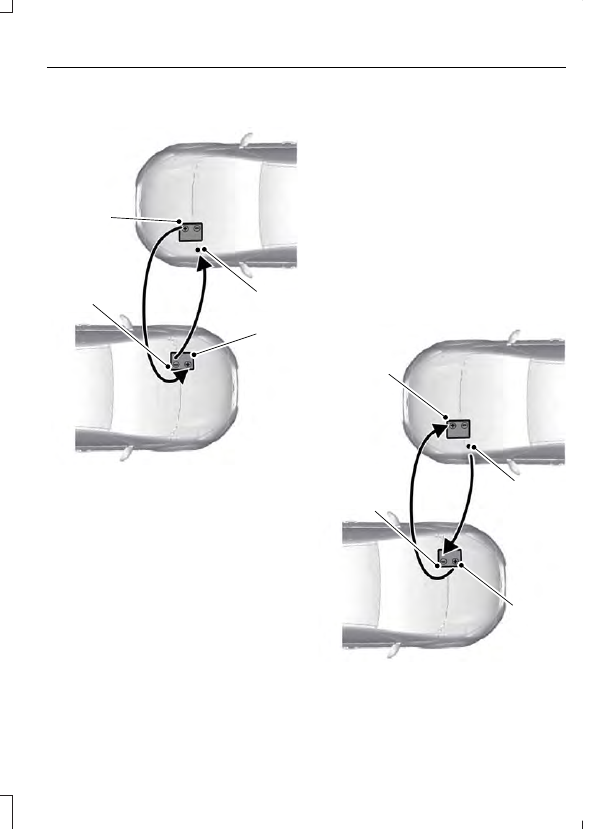
Note: In the illustration, the bottom vehicle
represents the booster vehicle.

4

2

1

3

E142664

1.

Connect the positive (+) jumper cable
to the positive (+) terminal of the
discharged battery.

2. Connect the other end of the positive

(+) cable to the positive (+) terminal
of the booster vehicle battery.

3. Connect the negative (-) cable to the

negative (-) terminal of the booster
vehicle battery.

4. Make the final connection of the

negative (-) cable to an exposed metal
part of the stalled vehicle's engine,
away from the battery and the fuel
injection system, or connect the
negative (-) cable to a ground
connection point if available.

Jump Starting

1.

Start the engine of the booster vehicle
and rev the engine moderately, or press
the accelerator gently to keep your
engine speed between 2000 and 3000
RPM, as shown in your tachometer.

2. Start the engine of the disabled vehicle.

3. Once the disabled vehicle has been

started, run both vehicle engines for an
additional three minutes before
disconnecting the jumper cables.

Removing the Jumper Cables

Remove the jumper cables in the reverse
order that they were connected.

4

1

3

2

E142665

1.

Remove the negative (-) jumper cable
from the disabled vehicle.

2. Remove the jumper cable on the

negative (-) terminal of the booster
vehicle battery.

3. Remove the jumper cable from the

positive (+) terminal of the booster
vehicle battery.

4. Remove the jumper cable from the

positive (+) terminal of the disabled
vehicle battery.

5. Allow the engine to idle for at least one

minute.

POST-CRASH ALERT SYSTEM

The system flashes the direction indicators
and sounds the horn (intermittently) in the
event of a serious impact that deploys an
airbag (front, side, side curtain or Safety
Canopy) or the seatbelt pretensioners.

The horn and indicators turn off when:

You press the hazard control button.

You press the panic button on the
remote entry transmitter (if equipped).

Your vehicle runs out of power.

TRANSPORTING THE VEHICLE

WARNINGS

Block the wheels to help prevent the
vehicle from moving.

Unexpected and possibly sudden
vehicle movement may occur if you
do not take these precautions.

E143886

If you need to tow your vehicle, contact a
professional towing service or, if you are a
member of a roadside assistance program,
your roadside assistance service provider.

We recommend the use of a wheel lift and
dollies or flatbed equipment to tow your
vehicle. Do not tow with a slingbelt. We do
not approve a slingbelt towing procedure.
If you tow your vehicle incorrectly, or by
any other means, vehicle damage may
occur.

We produce a towing manual for all
authorized tow truck operators. Have your
tow truck operator refer to this manual for
proper hook-up and towing procedures for
your vehicle.

It is acceptable to have your two-wheel
drive vehicle towed with the front wheels
on the ground (without dollies) and the
rear wheels off the ground.

We recommend towing a four-wheel drive
vehicle with all wheels off the ground, such
as using a wheel lift and dollies or flatbed
equipment. However, it is acceptable to
use a wheel lift to raise the rear of your
vehicle so long as, depending on vehicle
configuration, you perform the following
before towing:

If your vehicle has an electronic
shift-on-the-fly transfer case, make
sure you switch the four-wheel drive
control to the 2H position before
towing.

Note: Towing an electronic shift-on-the-fly
four-wheel drive vehicle with the front
wheels on the ground without disengaging
the front hubs may cause damage to the
automatic transmission.

Note: Towing a two-wheel drive vehicle or
an electronic shift-on-the-fly four-wheel
drive vehicle with the rear wheels on the
ground for more than 50 mi (80 km) or
faster than 35 mph (56 km/h) may cause
damage to the automatic transmission.

TOWING POINTS

WARNINGS

Using recovery hooks is dangerous
and should only be done by a person
familiar with proper vehicle recovery

safety practices. Improper use of recovery
hooks may cause hook failure or separation
from the vehicle and could result in serious
injury or death.

Always slowly remove the slack from
the recovery strap prior to pulling.
Failure to do so can introduce

significantly higher loads which can cause
the recovery hooks to break off, or the
recovery strap to fail which can cause
serious injury or death.

WARNINGS

Never link two straps together with
a clevis pin. These heavy metal
objects could become projectiles if

the strap breaks and can cause serious
injury or death.

Your vehicle comes equipped with
frame-mounted front recovery hooks.
These hooks should never have a load
applied to them greater than the gross
vehicle weight rating of your vehicle.

Before using recovery hooks:

Make sure all attaching points are
secure and capable of withstanding
the applied load.

Never use chains, cables or tow straps
with metal hook ends.

Only use recovery straps that have a
minimum breaking strength two to
three times the gross vehicle weight of
the stuck vehicle.

Make sure the recovery strap is in good
condition and free of visible cuts, tears
or damage.

Use a damper device such as a tarp,
heavy blanket or piece of carpet
draped over the recovery strap to help
absorb the energy in the event the
strap breaks.

Make sure the stuck vehicle is not
loaded heavier than its gross vehicle
weight rating specified on the
certification label.

Always align the tow vehicle and stuck
vehicle in a straight line (within 10
degrees).

Keep bystanders to the sides of the
vehicle, at a distance of at least twice
the length of the recovery strap. This
helps avoid injury from the hazard of a
recovery hook or strap breaking, or a
vehicle lurching into their path.

GETTING THE SERVICES YOU
NEED

Warranty repairs to your vehicle must be
performed by an authorized dealer. While
any authorized dealer handling your vehicle
line will provide warranty service, we
recommend you return to your selling
authorized dealer who wants to ensure
your continued satisfaction.

Please note that certain warranty repairs
require special training and equipment, so
not all authorized dealers are authorized
to perform all warranty repairs. This means
that, depending on the warranty repair
needed, you may have to take your vehicle
to another authorized dealer.

A reasonable time must be allowed to
perform a repair after taking your vehicle
to the authorized dealer. Repairs will be
made using Ford or Motorcraft® parts, or
remanufactured or other parts that are
authorized by Ford.

Away From Home

If you are away from home when your
vehicle needs service, contact the Ford
Customer Relationship Center or use the
online resources listed below to find the
nearest authorized dealer.

In the United States:

Mailing address

Ford Motor Company
Customer Relationship Center
P.O. Box 6248
Dearborn, MI 48126

Telephone

1-800-392-3673 (FORD)
(TDD for the hearing impaired:
1-800-232-5952)

Additional information and resources are
available online:

Website

www.owner.ford.com

These are some of the items that can be
found online:

U.S. dealer locator by Dealer Name,
City/State or Zip Code.

Owner Manuals.

Maintenance Schedules.

Recalls.

Ford Extended Service Plans.

Ford Genuine Accessories.

Service specials and promotions.

In Canada:

Mailing address

Customer Relationship Centre
Ford Motor Company of Canada, Limited
P.O. Box 2000
Oakville, Ontario L6K 0C8

Telephone

1-800-565-3673 (FORD)

Website

www.ford.ca

Twitter

@FordServiceCA (English Canada)
@FordServiceQC (Quebec)

Additional Assistance

If you have questions or concerns, or are
unsatisfied with the service you are
receiving, follow these steps:

1.

Contact your Sales Representative or
Service Advisor at your selling or
servicing authorized dealer.


Content   ..  77  78  79  80   ..