Ford Explorer Sport (2003 year). Manual - part 26
 

  Index      Ford     Ford Explorer Sport - service manual 2003 year in english


Search            


Content   ..  24  25  26  27   ..


Ford Explorer Sport (2003 year). Manual - part 26


FOUR-WHEEL DRIVE (4WD) OPERATION (IF EQUIPPED)

For important information regarding safe operation of this type
of vehicle, see Preparing to drive your vehicle in this chapter.

Four–wheel drive (4WD) supplies power to all four wheels. 4WD should
not be operated on dry pavement; driveline damage may occur.

Utility and four-wheel drive vehicles are not designed for
cornering at speeds as high as passenger cars any more than

low-slung sports cars are designed to perform satisfactorily under
off-road conditions. Avoid sharp turns, excessive speeds and abrupt
maneuvers in these vehicles. Failure to drive cautiously could result in
an increased risk of loss of vehicle control, vehicle rollover, personal
injury and death.

4WD system indicator lights
• 4WD HIGH- illuminates when

4x4 HIGH is selected.

• 4WD LOW– illuminates when 4x4

LOW is selected.

If these lights illuminate when driving in 2WD, contact your Ford dealer
as soon as possible.

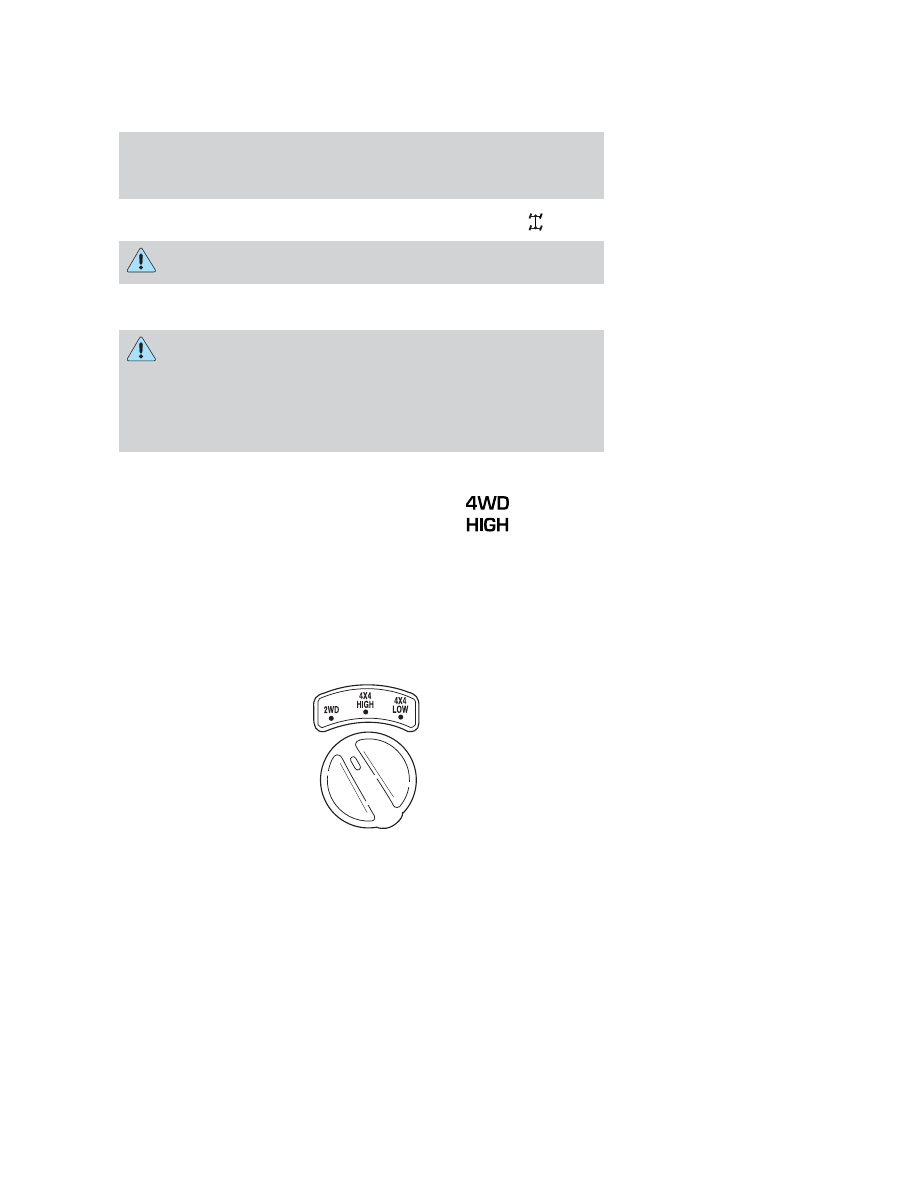
Electronic shift on the fly 4WD system

2WD - Power to the rear wheels only; used for street and highway
driving.

4WD

LOW

Driving

106

4X4 HIGH - Used for extra traction such as in snow or icy roads or in
off-road situations. Not intended for use on dry pavement.

4X4 LOW - Uses extra gearing to provide maximum power to all four
wheels. Intended only for off-road applications such as deep sand, steep
grades or pulling heavy objects. 4X4 LOW will not engage while the
vehicle is moving; this is normal and should be no reason for concern.
Refer to Shifting to/from 4X4 LOW for proper operation.

Shifting between 2WD and 4X4 HIGH
• Move the 4WD control between 2WD and 4X4 HIGH at any forward

speed.

Note: Do not perform this operation if the rear wheels are slipping.

Shifting to/from 4X4 LOW

1. Bring the vehicle to a complete stop

2. Depress the brake

3. On vehicles equipped with an automatic transmission, place the
transmission in N (Neutral); on vehicles equipped with a manual
transmission, depress the clutch.

4. Move the 4WD control to the desired position.
• If shifting into 4WD LOW, wait for the 4X4 LOW light in the

instrument cluster to turn on indicating the shift is complete.

• If shifting out of 4WD LOW, wait for the 4X4 LOW light in the

instrument cluster turn off indicating the shift is complete.

Driving off-road with truck and utility vehicles

How your vehicle differs from other vehicles

Truck and utility vehicles can differ from some other vehicles. Your
vehicle may be higher to allow it to travel over rough terrain without
getting hung up or damaging underbody components.

The differences that make your vehicle so versatile also make it handle
differently than an ordinary passenger car.

Maintain steering wheel control at all times, especially in rough terrain.
Since sudden changes in terrain can result in abrupt steering wheel
motion, make sure you grip the steering wheel from the outside. Do not
grip the spokes.

Drive cautiously to avoid vehicle damage from concealed objects such as
rocks and stumps.

Driving

107

You should either know the terrain or examine maps of the area before
driving. Map out your route before driving in the area. To maintain
steering and braking control of your vehicle, you must have all four
wheels on the ground and they must be rolling, not sliding or spinning.

Basic operating principles

Maintain steering wheel control at all times, especially in rough terrain;
sudden changes in terrain can result in abrupt steering wheel motion. Do
not use 4WD on dry, hard surfaced roads (except models equipped with
Auto 4WD).

If your vehicle goes off the edge of the pavement
• If your vehicle goes off the edge of the pavement, slow down, but

avoid severe brake application, ease the vehicle back onto the
pavement only after reducing your speed. Do not turn the steering
wheel too sharply while returning to the road surface.

• It may be safer to stay on the apron or shoulder of the road and slow

down gradually before returning to the pavement. You may lose
control if you do not slow down or if you turn the steering wheel too
sharply or abruptly.

• It often may be less risky to strike small objects, such as highway

reflectors, with minor damage to your vehicle rather than attempt a
sudden return to the pavement which could cause the vehicle to slide
sideways out of control or rollover. Remember, your safety and the
safety of others should be your primary concern.

Vehicles with a higher center of gravity such as utility and
four-wheel drive vehicles handle differently than vehicles with a

lower center of gravity. Utility and four-wheel drive vehicles are not
designed for cornering at speeds as high as passenger cars any more
than low-slung sports cars are designed to perform satisfactorily under
off-road conditions. Avoid sharp turns, excessive speed and abrupt
maneuvers in these vehicles. Failure to drive cautiously could result in
an increased risk of loss of vehicle control, vehicle rollover, personal
injury and death.

If your vehicle gets stuck

The vehicle may be rocked out by shifting from forward and reverse
gears, stopping between shifts, in a steady pattern. Press lightly on the
accelerator in each gear. Do not rock the vehicle for more than a
few minutes or damage to the transmission and tires may occur
or the engine may overheat.

Driving

108

Do not spin the wheels at over 56 km/h (35 mph). The tires may
fail and injure a passenger or bystander.

Emergency maneuvers
• In an unavoidable emergency situation where a sudden sharp turn

must be made, remember to avoid “over-driving” your vehicle (i.e.,
turn the steering wheel only as rapidly and as far as required to avoid
the emergency). Excessive steering will result in less vehicle control,
not more. Additionally, smooth variations of the accelerator and/or
brake pedal pressure should be utilized if changes in vehicle speed are
called for. Avoid abrupt steering, acceleration or braking which could
result in an increased risk of loss of vehicle control, vehicle rollover
and/or personal injury. Use all available road surface to return the
vehicle to a safe direction of travel.

• In the event of an emergency stop, avoid skidding the tires and do not

attempt any sharp steering wheel movements.

Vehicles with a higher center of gravity such as utility and
four-wheel drive vehicles handle differently than vehicles with a

lower center of gravity. Utility and four-wheel drive vehicles are not
designed for cornering at speeds as high as passenger cars any more
than low-slung sports cars are designed to perform satisfactorily under
off-road conditions. Avoid sharp turns, excessive speed and abrupt
maneuvers in these vehicles. Failure to drive cautiously could result in
an increased risk of loss of vehicle control, vehicle rollover, personal
injury and death.

Loaded vehicles, with a higher center of gravity, may handle
differently than unloaded vehicles. Extra precautions, such as

slower speeds and increased stopping distances, should be taken when
driving a heavily loaded vehicle.

• If the vehicle goes from one type of surface to another (i.e., from

concrete to gravel) there will be a change in the way the vehicle
responds to a maneuver (steering, acceleration or braking). Again,
avoid these abrupt inputs.

Driving

109


Content   ..  24  25  26  27   ..