Ford Explorer (2018 year). Manual - part 47
 

  Index      Ford     Ford Explorer - service manual 2018 year in english


Search            


Content   ..  45  46  47  48   ..


Ford Explorer (2018 year). Manual - part 47


Once through water, always try the brakes.
Wet brakes do not stop the vehicle as
effectively as dry brakes. Drying can be
improved by moving your vehicle slowly
while applying light pressure on the brake
pedal.

Be cautious of sudden changes in vehicle
speed or direction when you are driving in
mud. Even 4WD vehicles can lose traction
in slick mud. As when you are driving over
sand, apply the accelerator slowly and
avoid spinning your wheels. If the vehicle
does slide, steer in the direction of the slide
until you regain control of the vehicle.

After driving through mud, clean off residue
stuck to rotating driveshafts and tires.
Excess mud stuck on tires and rotating
driveshafts causes an imbalance that
could damage drive components.

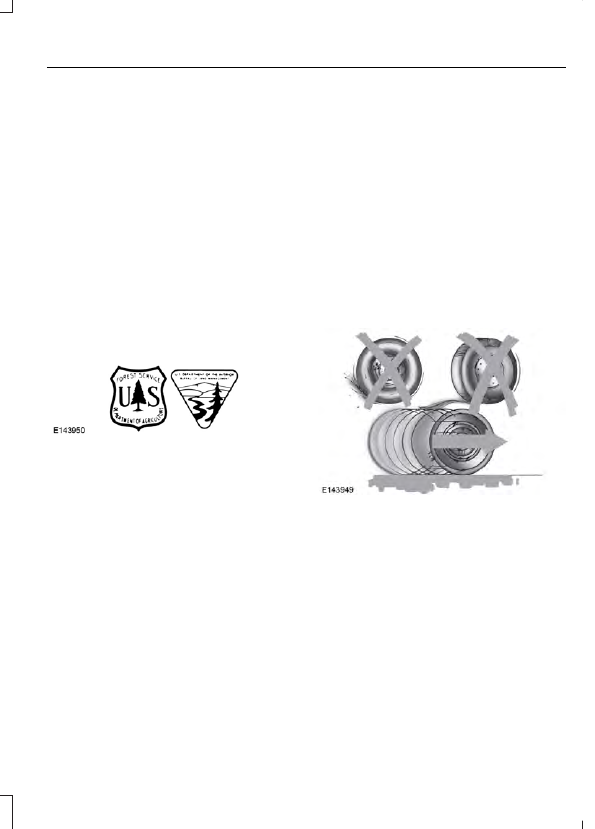
“Tread Lightly” is an educational program
designed to increase public awareness of
land-use regulations and responsibilities
in our nations wilderness areas. Ford Motor
Company joins the U.S. Forest Service and
the Bureau of Land Management in
encouraging you to help preserve our
national forest and other public and private
lands by “treading lightly.”

Driving on Hilly or Sloping Terrain

Note: Avoid driving crosswise or turning on
steep slopes or hills. A danger lies in losing
traction, slipping sideways and possibly
rolling over. Whenever driving on a hill,
determine beforehand the route you will
use. Do not drive over the crest of a hill
without seeing what conditions are on the
other side. Do not drive in reverse over a hill
without the aid of an observer.

Although natural obstacles may make it
necessary to travel diagonally up or down
a hill or steep incline, you should always
try to drive straight up or straight down.

When climbing a steep slope or hill, start
in a lower gear rather than downshifting to
a lower gear from a higher gear once the
ascent has started. This reduces strain on
the engine and the possibility of stalling.

If you do stall out, do not try to turn around
because you might roll over. It is better to
back down to a safe location.

Apply just enough power to the wheels to
climb the hill. Too much power will cause
the tires to slip, spin or lose traction,
resulting in loss of vehicle control.

Descend a hill in the same gear you would
use to climb up the hill to avoid excessive
brake application and brake overheating.
Do not descend in neutral; instead,
disengage overdrive or manually shift to a
lower gear. When descending a steep hill,
avoid sudden hard braking as you could
lose control. The front wheels have to be
turning in order to steer the vehicle.

Your vehicle has anti-lock brakes, therefore
apply the brakes steadily. Do not “pump”
the brakes.

 (If Equipped)

Driving on Snow and Ice

WARNING

If you are driving in slippery
conditions that require tire chains or
cables, then it is critical that you drive

cautiously. Keep speeds down, allow for
longer stopping distances and avoid
aggressive steering to reduce the chances
of a loss of vehicle control which can lead
to serious injury or death. If the rear end of
the vehicle slides while cornering, steer in
the direction of the slide until you regain
control of the vehicle.

Note: Excessive tire slippage can cause
driveline damage.

4WD vehicles have advantages over 2WD
vehicles in snow and ice but can skid like
any other vehicle.

Should you start to slide while driving on
snowy or icy roads, turn the steering wheel
in the direction of the slide until you regain
control.

Avoid sudden applications of power and
quick changes of direction on snow and
ice. Apply the accelerator slowly and
steadily when starting from a full stop.

Avoid sudden braking as well. Although an
4WD vehicle may accelerate better than
a two-wheel drive vehicle in snow and ice,
it won’t stop any faster, because as in other
vehicles, braking occurs at all four wheels.
Do not become overconfident as to road
conditions.

Make sure you allow sufficient distance
between you and other vehicles for
stopping. Drive slower than usual and
consider using one of the lower gears. In
emergency stopping situations, apply the
brake steadily. Since your vehicle is
equipped with a four wheel (ABS), do not
“pump” the brakes.  See Hints on Driving
With Anti-Lock Brakes (page 193).

Maintenance and Modifications

The suspension and steering systems on
your vehicle have been designed and
tested to provide predictable performance
whether loaded or empty and durable load
carrying capability. For this reason, Ford
Motor Company strongly recommends that
you do not make modifications such as
adding or removing parts (such as lowering
kits or stabilizer bars) or by using
replacement parts not equivalent to the
original factory equipment.

Any modifications to a vehicle that raise
the center of gravity can make it more likely
the vehicle will rollover as a result of a loss
of control. Ford Motor Company
recommends that caution be used with
any vehicle equipped with a high load or
device (such as ladder or luggage racks).

Failure to maintain your vehicle properly
may void the warranty, increase your repair
cost, reduce vehicle performance and
operational capabilities and adversely
affect driver and passenger safety.
Frequent inspection of vehicle chassis
components is recommended if the vehicle
is subjected to off-highway usage.

 (If Equipped)

GENERAL INFORMATION

Note: Occasional brake noise is normal. If
a metal-to-metal, continuous grinding or
continuous squeal sound is present, the
brake linings may be worn-out. Have the
system checked by an authorized dealer. If
your vehicle has continuous vibration or
shudder in the steering wheel while braking,
have it checked by an authorized dealer.

Note: Brake dust may accumulate on the
wheels, even under normal driving
conditions. Some dust is inevitable as the
brakes wear and does not contribute to
brake noise.  See Cleaning the Wheels
(page 306).

Note: Depending on applicable laws and
regulations in the country for which your
vehicle was originally built, your brake lamps
may flash during heavy braking. Following
this, your hazard lights may also flash when
your vehicle comes to a stop.

See Warning Lamps and
Indicators (page 99).

Wet brakes result in reduced braking
efficiency. Gently press the brake pedal a
few times when driving from a car wash or
standing water to dry the brakes.

Brake Over Accelerator

In the event the accelerator pedal
becomes stuck or entrapped, apply steady
and firm pressure to the brake pedal to
slow the vehicle and reduce engine power.
If you experience this condition, apply the
brakes and bring your vehicle to a safe
stop. Move the transmission to park (P),
switch the engine off and apply the parking
brake. Inspect the accelerator pedal for
any interference. If none are found and the
condition persists, have your vehicle towed
to the nearest authorized dealer.

Brake Assist

Brake assist detects when you brake
rapidly by measuring the rate at which you
press the brake pedal. It provides
maximum braking efficiency as long as you
press the pedal, and can reduce stopping
distances in critical situations.

Anti-lock Brake System

This system helps you maintain steering
control during emergency stops by keeping
the brakes from locking.

This lamp momentarily
illuminates when you turn the
ignition on. If the light does not

illuminate during start up, remains on or
flashes, the system may be disabled. Have
the system checked by an authorized
dealer. If the anti-lock brake system is
disabled, normal braking is still effective.

If the brake warning lamp
illuminates when you release the
parking brake, have the system

checked by an authorized dealer.

HINTS ON DRIVING WITH
ANTI-LOCK BRAKES

The anti-lock braking system does not
eliminate the risks when:

You drive too closely to the vehicle in
front of you.

Your vehicle is hydroplaning.

You take corners too fast.

The road surface is poor.

Note:  If the system activates, the brake
pedal may pulse and may travel further.
Maintain pressure on the brake pedal.  You
may also hear a noise from the system.  This
is normal.

PARKING BRAKE

WARNING

Always set the parking brake fully
and make sure the transmission is
locked in park (P). Failure to set the

parking brake and engage park could result
in vehicle roll-away, property damage or
bodily injury.

To set the parking brake, press the parking
brake pedal down to its fullest extent. The
brake warning lamp in the instrument
cluster will illuminate and remains
illuminated until the parking brake is
released.

To release the parking brake, press the
parking brake pedal down again.

If you are parking your vehicle on a grade
or with a trailer, press and hold the brake
pedal down, then set the parking brake.
There may be a little vehicle movement as
the parking brake sets to hold the vehicle's
weight. This is normal and should be no
reason for concern. If needed, press and
hold the service brake pedal down, then
try reapplying the parking brake. Chock the
wheels if required. If the parking brake
cannot hold the weight of the vehicle, the
parking brake may need to be serviced or
the vehicle may be overloaded.

HILL START ASSIST

WARNINGS

The system does not replace the
parking brake. When you leave your
vehicle, always apply the parking

brake. Failure to leave your vehicle securely
parked may lead to a crash or injury.  See
Parking Brake (page 194).

WARNINGS

You must remain in your vehicle
when the system turns on. At all
times, you are responsible for

controlling your vehicle, supervising the
system and intervening, if required. Failure
to take care may result in the loss of
control of your vehicle, serious personal
injury or death.

The system will turn off if a
malfunction is apparent or if you rev
the engine excessively. Failure to

take care may result in the loss of control
of your vehicle, serious personal injury or
death.

The system makes it easier to pull away
when your vehicle is on a slope without the
need to use the parking brake.

When the system is active, your vehicle
remains stationary on the slope for two to
three seconds after you release the brake
pedal. This allows time to move your foot
from the brake to the accelerator pedal.
The system releases the brakes
automatically once the engine has
developed sufficient torque to prevent your
vehicle from rolling down the slope. This
is an advantage when pulling away on a
slope, for example from a car park ramp,
traffic lights or when reversing uphill into
a parking space.

Note: The system only functions when you
bring your vehicle to a complete standstill
in an uphill gear (for example, drive (D)
when facing uphill or reverse (R) when
facing downhill).

Note: There is no warning light to indicate
the system is either on or off.

Using Hill Start Assist

1.

Press the brake pedal to bring your
vehicle to a complete standstill. Keep
the brake pedal pressed.


Content   ..  45  46  47  48   ..