Ford Escort (2003 year). Manual - part 22
 

  Index      Ford     Ford Escort - service manual 2003 year in english


Search            


Content   ..  20  21  22  23   ..


Ford Escort (2003 year). Manual - part 22


• The anti-lock systemdoes not reduce stopping distance. Always leave

enough roombetween your vehicle and the vehicle in front of you to
stop.

• We recommend that you familiarize yourself with this braking

technique. However, avoid taking any unnecessary risks.

ABS warning lamp

ABS

The

ABS

warning lamp in the instrument cluster momentarily illuminates

when the ignition is turned to the ON position. If the light does not
illuminate momentarily at start up, remains on or continues to flash, the
ABS needs to be serviced.

With the ABS light on, the anti-lock
brake systemis disabled and normal
braking is still effective unless the
brake warning light also remains
illuminated with parking brake
released. (If your brake warning lamp illuminates, have your vehicle
serviced immediately.)

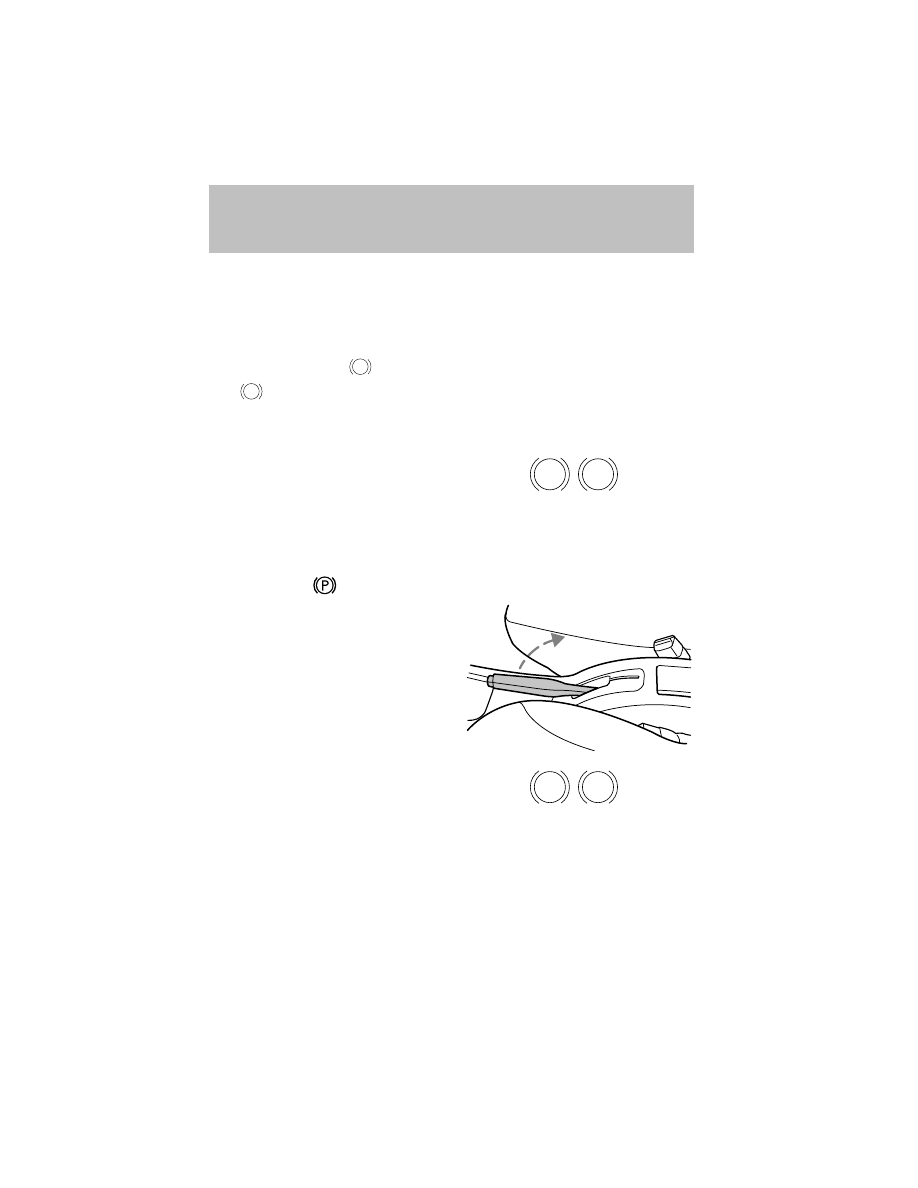
Parking brake

Apply the parking brake whenever
the vehicle is parked. To set the
parking brake, pull the handle up as
far as possible.

The BRAKE warning lamp in the
instrument cluster illuminates and
remains illuminated (when the
ignition is turned ON) until the
parking brake is released.

The parking brake is not recommended to stop a moving vehicle.
However, if the normal brakes fail, the parking brake can be used to stop
your vehicle in an emergency. Since the parking brake applies only the
rear brakes, the vehicle’s stopping distance will increase greatly and the
handling of your vehicle will be adversely affected.

P

!

BRAKE

P

!

BRAKE

Driving

90

Always set the parking brake fully and make sure that the
gearshift is securely latched in P (Park) (automatic transaxle) or

in 1 (First) (manual transaxle).

Push the button on the end of the
parking brake and push the handle
down as far as possible to release
the brake. Driving with the parking
brake on will cause the brakes to
wear out quickly and reduce fuel
economy.

STEERING

Your vehicle is equipped with power steering. Power steering uses energy
fromthe engine to decrease the driver’s effort in steering the vehicle.

To prevent damage to the power steering pump:
• Never hold the steering wheel to the extreme right or the extreme left

for more than a few seconds when the engine is running.

• Do not operate the vehicle with the power steering pump fluid level

below the MIN mark on the reservoir.

If the power steering systembreaks down (or if the engine is turned
off), you can steer the vehicle manually, but it takes more effort.

If the steering wanders or pulls, check for:
• Underinflated tire(s) on any wheel(s)
• Uneven vehicle loading
• High crown in center of road
• High crosswinds
• Wheels out of alignment
• Loose or worn suspension components

AUTOMATIC TRANSMISSION OPERATION (IF EQUIPPED)

Brake-shift interlock

This vehicle is equipped with a brake-shift interlock feature that prevents
the gearshift lever frombeing moved fromP (Park) unless the brake

Driving

91

pedal is depressed. If you cannot move the gearshift lever out of P
(Park) with the brake pedal depressed:

1. Continue depressing the brake
pedal, and remove the shift-lock
override cap with a 2.5 cm(1 inch)
or longer screwdriver.

2. Insert the screwdriver into the
shift-lock override opening and push
down.

3. Push and hold the thumb button.

4. Move the gearshift lever.

If it is necessary to use the above
procedure to move the gearshift
lever, it is possible that a fuse has
blown and the vehicle’s brakelamps
may not be operating properly.
Refer to Fuses and relays in the
Roadside emergencies chapter.

Do not drive your vehicle until you verify that the brakelamps
are working.

If your vehicle gets stuck in mud or snow it may be rocked out by
shifting fromforward and reverse gears, stopping between shifts, in a
steady pattern. Press lightly on the accelerator in each gear.
Do not rock the vehicle for more than a few minutes. The
transaxle and tires may be damaged or the engine may overheat.

P

R

N

D

D

L

P

R

N

D

D

L

Driving

92

Always set the parking brake fully and make sure the gearshift
lever is latched in P (Park). Turn off the ignition whenever you

leave your vehicle.

If the parking brake is fully released, but the brake warning lamp
remains illuminated, the brakes may not be working properly.

See your dealer or a qualified service technician.

Understanding gearshift positions

Hold the brake pedal down while you move the gearshift lever
fromP (Park) to another position. If you do not hold the brake

pedal down, your vehicle may move unexpectedly and injure someone.

P (Park)

Always come to a complete stop
before shifting into P (Park). Make
sure that the gearshift lever is
securely latched in P (Park). This
locks the transaxle and prevents the
front wheels fromrotating.

Always set the parking
brake fully and make sure

the gearshift lever is latched in P
(Park). Turn off the ignition
whenever you leave your vehicle.

P

R

N

D

D

L

Driving

93


Content   ..  20  21  22  23   ..