Ford Contour (2000 year). Manual - part 29
 

  Index      Ford     Ford Contour - service manual 2000 year in english


Search            


Content   ..  27  28  29  30   ..


Ford Contour (2000 year). Manual - part 29


Starting

114

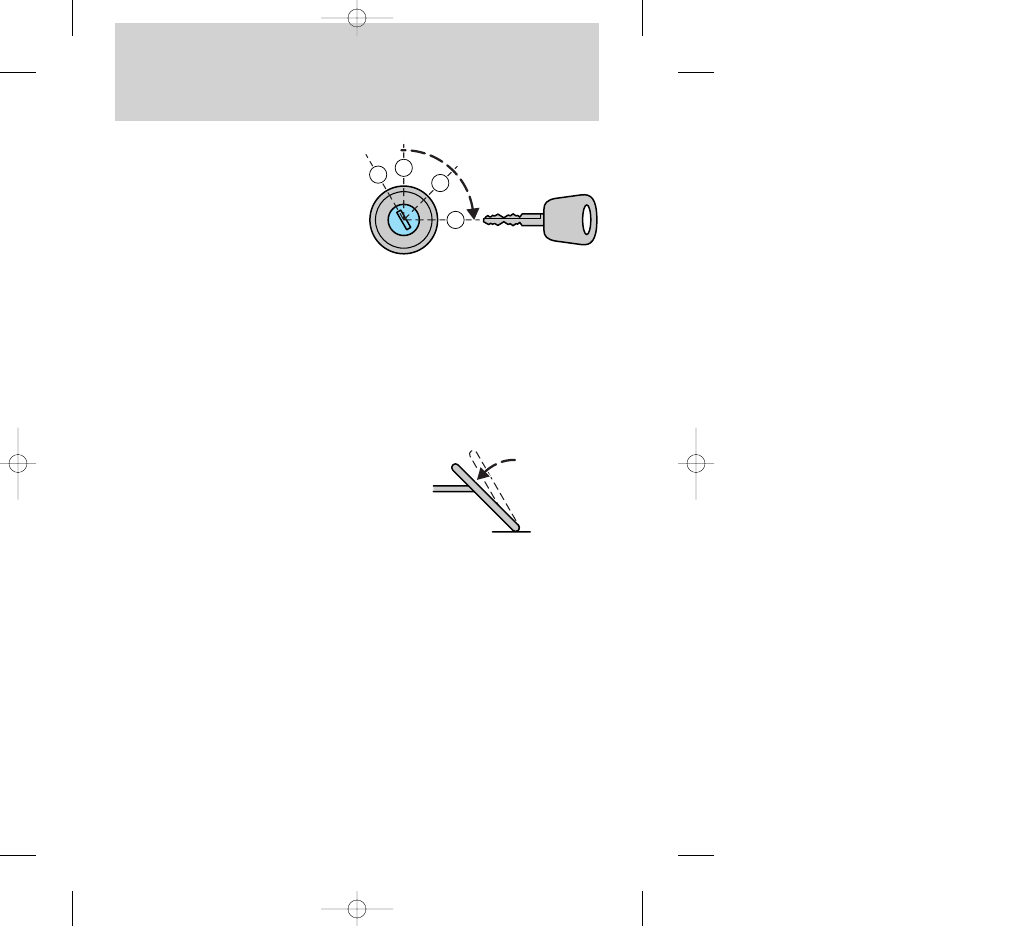
STARTING THE ENGINE

1. Turn the key to the  start
position (4) without pressing the
accelerator pedal and release as
soon as the engine starts. The key
will return to the on (3) position.

3

4

2

1

2. If the engine does not start
within five seconds, wait ten
seconds and try again.

3. If the engine does not start in
two attempts OR the temperature
is below -12°C (10°F), depress the
accelerator pedal and start the
engine while holding the
accelerator pedal down. Release
accelerator pedal when the engine
starts.

Vehicles equipped with the 2.0 l
engine: If the engine fails to start,
continue to crank with the
accelerator depressed about 1/4 of
the way down and hold that
position until the engine starts.
DO NOT crank for more than
30 seconds 
or you could damage
the starter.

4. After idling the engine for a few
seconds, apply the brake pedal and
release the parking brake.

21CSten  17.6.99 11:06 Uhr  Seite 114

Starting

115

USING THE ENGINE BLOCK
HEATER (if equipped)

An engine block heater warms the
engine coolant, which improves
starting, warms up the engine
faster and allows the heater-
defroster system to respond
quickly. It is strongly recommended
if you live in a region where
temperatures reach –23°C (–10°F)
or below.

For best results, plug the heater in
at least three hours before starting
the vehicle. Using the heater for
more than three hours will not
harm the engine, so the heater can
be plugged in the night before
starting the vehicle.

To prevent electrical shock,
do not use your heater with

ungrounded electrical systems or
two-pronged (cheater) adapters.

21CSten  17.6.99 11:06 Uhr  Seite 115

116

Driving

BRAKES

Your brakes are self-adjusting.
Refer to the “Scheduled
Maintenance Guide” for
maintenance intervals.

Anti-lock braking system (ABS)
(if equipped)

The ABS operates by detecting the
onset of wheel lock-up during
brake applications and
compensating for this tendency.
The wheels are prevented from
locking even when the brakes are
firmly applied, helping to ensure
that the vehicle can be steered and
the driver can avoid obstacles.

Operation of the anti-lock
braking system

The anti-lock braking system is not
employed during normal braking. It
becomes operational only when it
senses differences in the rotational
speed of the road wheels,
indicating that they are about to
lock-up. Its operation is indicated
by a pulsing of the brake pedal. Do
not release the pedal while braking.

22CDren  17.6.99 11:08 Uhr  Seite 116

Driving

117

Two important
rules when
braking in
emergencies with
ABS:

1.

Apply full force
on both brake
and clutch pedal
(if equipped).

Braking with ABS

• In an emergency, apply full force
on the brake pedal. In vehicles
with manual transaxles, you must
also depress the clutch pedal. The
anti-lock braking system will be
activated immediately, allowing
you to retain full steering control
of your vehicle and, providing
there is sufficient space, will
enable you to avoid obstacles. 

• We recommend that you
familiarize yourself with this
braking technique. However,
avoid taking any unnecessary
risks.

• Although the ABS ensures
optimum braking efficiency,
stopping distances can vary
greatly, depending on the road
surface and conditions. Use of 
the ABS cannot eliminate the
dangers inherent in driving too
close to the vehicle in front of you,
hydroplaning, excessive cornering
speed, or poor road surfaces.

2

Steer around the
obstacle. No matter
how hard you brake,
steering control is
maintained.

22CDren  17.6.99 11:08 Uhr  Seite 117


Content   ..  27  28  29  30   ..