Ford Contour (2000 year). Manual - part 22
 

  Index      Ford     Ford Contour - service manual 2000 year in english


Search            


Content   ..  20  21  22  23   ..


Ford Contour (2000 year). Manual - part 22


Seating and safety restraints

86

Care of safety belts

Periodically check the belts for
damage or fraying. Check the
security of the anchorage points
and the locking action of the inertia
reels by giving each belt a sharp
tug.

Belts subjected to strain, as in the
result of an accident, should be
replaced and the anchorages
checked by your dealer or a
qualified technician.

Failure to follow these
instructions will affect the

performance of the safety belts
and increase the risk of personal
injury.

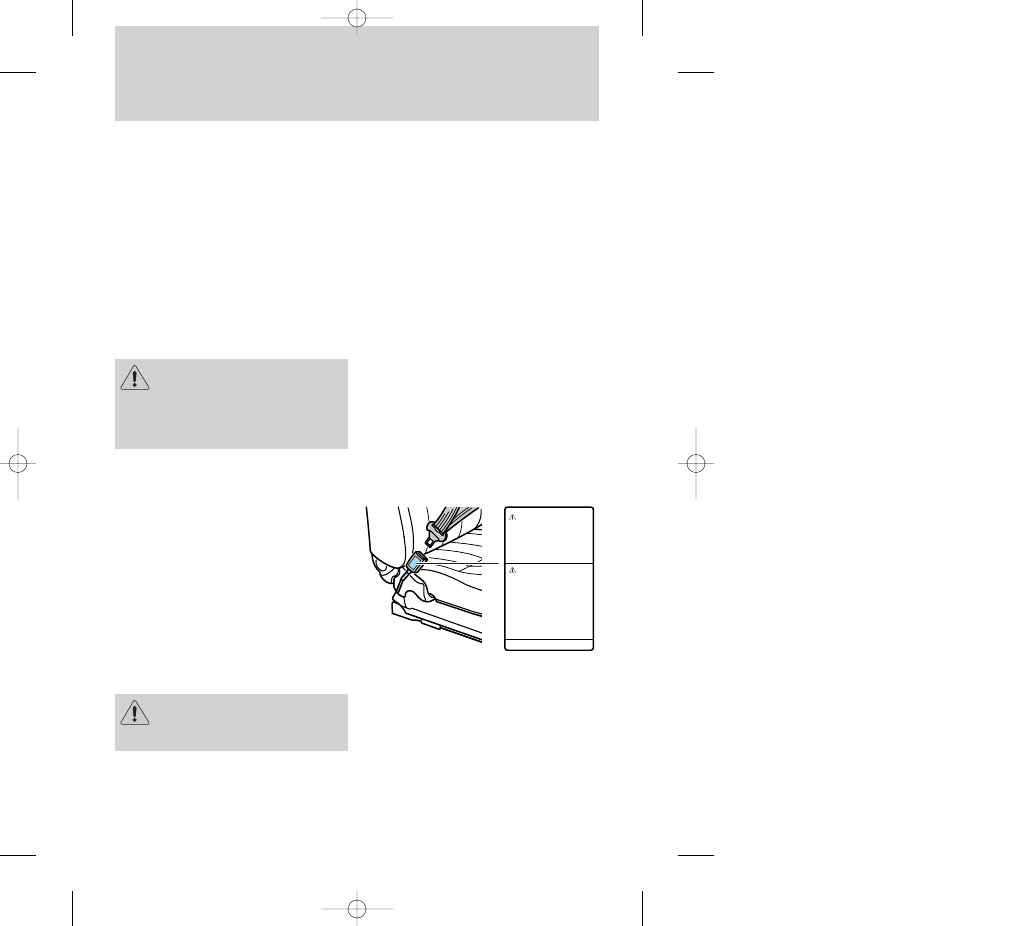
Safety belt warning label

A warning label has been placed on
the buckle of each of your vehicle’s
front seat safety belts.

In a collision of sufficient severity
while the safety belt is in use, the
safety belt buckle will pull out of
the sleeve so that all or part of the
orange portion of the label is
visible.

Whenever the orange
portion of the label is visible,

the safety belt must be replaced.

      WARNING Replace buckle 
assembly if this vehicle is in a collision 
or if any orange portion of this label 
is visible. (See Owner Guide). Failure 
to replace this buckle assembly under 
the above conditions could result in 
severe personal injuries in the event 
of collision.

      AVERTISSEMENT Remplacer 
l'ensemble de boucle de ceinture en 
cas de collision avec ce véhicule, ou si 
la partie orange de cette étiquette 
est visible (Voir le Guide du 
proprietaire). Faute de remplacer cet 
ensemble de boucle, des blessures 
graves pourraient être encourues en 
cas de collision.

REPLACE BUCKLE/REMPLACER LA BOUCLE

14CSSen  17.6.99 11:00 Uhr  Seite 86

Seating and safety restraints

87

Important supplemental
restraint system (SRS)
precautions

The supplemental restraint system
(SRS) is designed to work with the
safety belt to help protect the
driver and right front passenger
from certain upper body injuries.

AIR BAG SUPPLEMENTAL
RESTRAINT SYSTEM (SRS)

M

IRRORS

OFF

LO

PNL/FLR

PANEL

A/C

FLOOR

DEF

FLR 

       DEF

MAX

A/C

HI

/

POWER

AUDIO

AM/FM

SCAN

SEEK

3

1

2

4

5

ANS

SIDE

1-2

EJECT

VOLUME

0 0 0 1 2 3

0 0 0 0

10

20

30

40

50

60 70 80

90

100

110

120

130

MPH

20

40

60

55

80

120

100

140

160

180

200

E

F

1

2

0

3

x 1000

4

5

6

7

8

BRAKE

CHECK
ENGINE

O/D
OFF

CLOCK

TRACTION
       TROL

C

H

Always transport children
12 years old and under in

the back seat and always use
appropriate child restraints.

All occupants of the vehicle
including the driver should

always properly wear their safety
belts even when air bag SRS is
provided.

NHTSA recommends a
minimum distance of at least

25 cm (ten [10] inches) between
an occupant’s chest and the air
bag module.

14CSSen  17.6.99 11:00 Uhr  Seite 87

Seating and safety restraints

88

Do not attempt to service,
repair, or modify the air bag

Supplemental Restraint System
(SRS) or its fuses. See your Ford
or Lincoln-Mercury dealer.

Air bags can kill or injure a
child in a child seat. NEVER

place a rear-facing child seat in
front of an active air bag. If you
must use a forward facing child
seat in the front seat, move the
seat all the way back.

Children and air bags

For additional important safety
information, read all information on
safety restraints in this guide.

Children should always wear safety
belts. Failure to follow these
instructions may increase the risk
of injury in a collision.

Do not put anything on or
over the air bag module.

Placing objects on or over the air
bag inflation area may cause those
objects to be propelled by the air
bag into your face and torso
causing serious injury.

Never place your arm over
the air bag module as a

deploying air bag can result in
serious arm fractures or other
injuries.

14CSSen  17.6.99 11:00 Uhr  Seite 88

Seating and safety restraints

89

How does the air bag
supplemental restraint system
(SRS) work?

The SRS is designed to activate
when the vehicle is in a collision,
similar to hitting a fixed barrier
head-on at 12-24 km/h (8-14 mph).

The fact that the air bags did not
inflate in a collision does not mean
that something is wrong with the
system. Rather, it means the forces
were not of the type sufficient to
cause activation.

The air bags inflate and deflate
rapidly upon activation.

After air bag deployment, it is
normal to notice a smoke-like,
powdery residue or smell the
burned propellant. This may
consist of cornstarch, talcum
powder (to lubricate the bag), or
sodium compounds (e.g., baking
soda) that result from the
combustion process that inflates
the air bag. Small amounts of
sodium hydroxide may be present,
which may irritate the skin and
eyes, but none of the residue is
toxic.

14CSSen  17.6.99 11:00 Uhr  Seite 89


Content   ..  20  21  22  23   ..