Ford C-MAX Hybrid / Energi (2017 year). Manual - part 64
 

  Index      Ford     Ford C-MAX Hybrid / Energi - service manual 2017 year in english


Search            


Content   ..  62  63  64  65   ..


Ford C-MAX Hybrid / Energi (2017 year). Manual - part 64


11.

After 4 miles (6 kilometers), stop and
check the tire pressure. See Second
Stage: Checking Tire Pressure.

Note: If you experience any unusual
vibration, ride disturbance or noise while
driving, reduce your speed until you can
safely pull off to the side of the road to call
for roadside assistance.

Note: Do not proceed to the second stage
of this operation.

Second Stage: Checking Tire
Pressure

WARNINGS

If you are proceeding from the First
stage: Re–inflating the tire with
sealing compound and air section

and have injected sealant in the tire and
the pressure is below 20 psi (1.4 bar), stop
and call roadside assistance. If tire
pressure is above 20 psi (1.4 bar), continue
to the next step.

The power plug may get hot after use
and should be handled carefully
while unplugging.

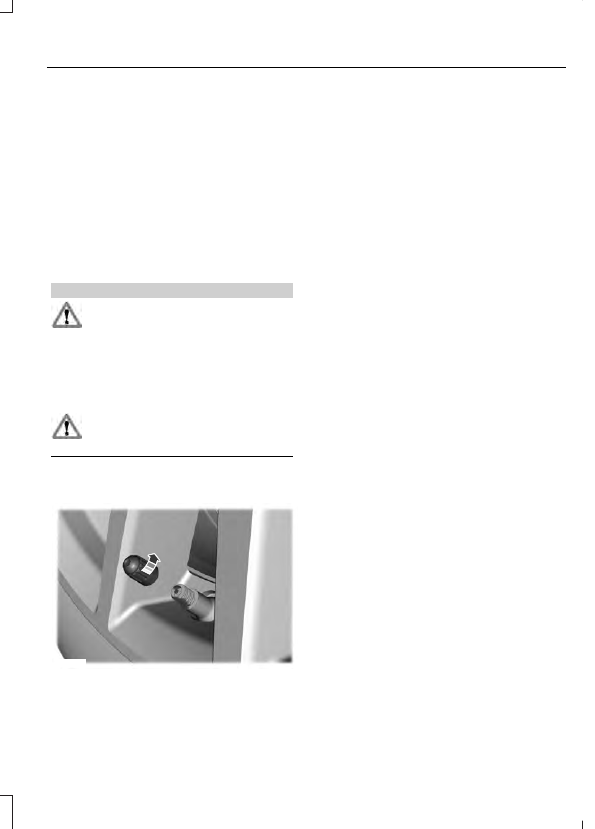
Check the air pressure of your tires as
follows:

E175983

1.

Remove the valve cap from the tire
valve.

2. Firmly screw the air compressor hose

onto the valve stem by turning
clockwise.

3. Push and turn the dial clockwise to the

air position.

4. If required, switch on the compressor

and adjust the tire to the
recommended inflation pressure
shown on the tire label located on the
driver's door or door jamb area. You
should check the tire pressure with the
compressor turned OFF in order to get
an accurate pressure reading.

5. Unplug the hoses, re-install the valve

cap on the tire and return the kit to the
stowage area.

What to Do After the Tire has Been
Sealed

After using the kit to seal your tire, replace
the sealant canister and clear tube (hose).
Obtain and replace the sealing compound
and spare parts at an authorized Ford
Motor Company dealership or tire dealer.
You can dispose empty sealant bottles at
home. However, return the liquid residue
from the sealing compound to an
authorized dealer or tire dealer for disposal,
or in accordance with local waste disposal
regulations.

Note: After you use the sealing compound,
the maximum vehicle speed is 50 mph
(80 km/h) and the maximum driving
distance is 120 mi (200 km). Inspect the
sealed tire immediately.

Check the tire pressure any time within the
120 mi (200 km) by performing the steps
listed previously in the Second Stage:
Checking Tire Pressure procedure.

Removal of the Sealant Canister from
the Kit

E175984

1.

Unwrap the dual purpose hose (black
tube) from the compressor housing.

E175985

2. Unwrap the power cord.

E175986

3. Remove the back cover.

E175987

4. Rotate the sealant canister up 90

degrees and pull away from
casing/housing to remove.

Installation of the Sealant Canister to
the Kit

1.

With the canister held perpendicular
to the housing, insert the canister
nozzle into the connector and push
until seated.

2. Rotate the canister 90 degrees down

into the housing/casing.

E175988

3. Snap the back cover back into place.

E175989

4. Wrap the dual purpose hose (black

tube) around the channel on the
bottom of the housing/casing.

E175990

5. Wrap the power cord around the

housing and stow the accessory power
plug into its storage area.

Note: If you experience any difficulties
when you remove or install the sealant
canister, contact your authorized Ford dealer
for assistance.

Make sure you check the sealant
compound’s use-by date regularly. The
use-by date is on a label located on the
sealant canister, which you can see
through the rectangular viewing window
on the bottom of the kit. Replace the
sealant canister after four years of
non-use.

TIRE CARE

Information About Uniform
Tire Quality Grading

E142542

Tire Quality Grades apply to new
pneumatic passenger car tires.
The Tire Quality Grades can be
found where applicable on the tire
sidewall between tread shoulder
and maximum section width. For
example: Treadwear 200
Traction AA Temperature A.

These Tire Quality Grades are
determined by standards that the
United States Department of
Transportation has set.

Tire Quality Grades apply to new
pneumatic passenger car tires.
They do not apply to deep tread,
winter-type snow tires,
space-saver or temporary use
spare tires, light truck or LT type
tires, tires with nominal rim
diameters of 10 to 12 inches or
limited production tires as defined
in Title 49 Code of Federal
Regulations Part 575.104 (c)(2).

U.S. Department of
Transportation Tire quality
grades:  The U.S. Department of
Transportation requires Ford
Motor Company to give you the
following information about tire
grades exactly as the government
has written it.

Treadwear

The treadwear grade is a
comparative rating based on the
wear rate of the tire when tested
under controlled conditions on a
specified government test course.
For example, a tire graded 150
would wear 1 ½ times as well on
the government course as a tire
graded 100. The relative
performance of tires depends
upon the actual conditions of their
use, however, and may depart
significantly from the norm due to
variations in driving habits, service
practices, and differences in road
characteristics and climate.

Traction AA A B C

WARNING

The traction grade assigned
to this tire is based on

straight-ahead braking traction
tests, and does not include
acceleration, cornering,
hydroplaning or peak traction
characteristics.

The traction grades, from highest
to lowest are AA, A, B, and C. The
grades represent the tire’s ability
to stop on wet pavement as
measured under controlled
conditions on specified
government test surfaces of
asphalt and concrete. A tire
marked C may have poor traction
performance.

Temperature A B C

WARNING

The temperature grade for
this tire is established for a

tire that is properly inflated and
not overloaded. Excessive speed,
underinflation, or excessive
loading, either separately or in
combination, can cause heat
buildup and possible tire failure.

The temperature grades are A
(the highest), B and C,
representing the tire’s resistance
to the generation of heat and its
ability to dissipate heat when
tested under controlled conditions
on a specified indoor laboratory
test wheel. Sustained high
temperature can cause the
material of the tire to degenerate
and reduce tire life, and excessive
temperature can lead to sudden
tire failure. The grade C
corresponds to a level of
performance which all passenger
car tires must meet under the


Content   ..  62  63  64  65   ..