Ford C-MAX Hybrid / Energi (2017 year). Manual - part 49
 

  Index      Ford     Ford C-MAX Hybrid / Energi - service manual 2017 year in english


Search            


Content   ..  47  48  49  50   ..


Ford C-MAX Hybrid / Energi (2017 year). Manual - part 49


Note: When you try to restart your vehicle
after a fuel shutoff, the vehicle makes sure
that the electrical system is safe to restart.
Once your vehicle determines that the
electrical system is safe, then the vehicle
will allow you to restart.

Note: In the event that your vehicle does
not restart after your third attempt, contact
an authorized dealer.

JUMP STARTING THE VEHICLE

WARNINGS

The gases around the battery can
explode if exposed to flames, sparks
or lit cigarettes. An explosion could

result in injury or vehicle damage.

Batteries contain sulfuric acid which
can burn skin, eyes and clothing, if
contacted.

Do not attempt to push-start your
automatic transmission vehicle. Automatic
transmissions do not have push-start
capability. Attempting to push-start a
vehicle with an automatic transmission
may cause transmission damage.

Preparing Your Vehicle

Note: Use only a 12-volt supply to start your
vehicle.

Note: Do not disconnect the battery of the
disabled vehicle as this could damage the
vehicle's electrical system.

1.

Park the booster vehicle close to the
hood of the disabled vehicle making
sure the two vehicles do not touch. Set
the parking brake on both vehicles and
stay clear of the engine cooling fan and
other moving parts.

2. Check all battery terminals and remove

any excessive corrosion before you
attach the battery cables. Ensure that
vent caps are tight and level.

3. Turn the heater fan on in both vehicles

to protect from any electrical surges.
Turn all other accessories off.

Connecting the Jumper Cables

Your vehicle has a 12-volt battery that has
two prongs accessible from under the
hood. Your vehicle can be jumped the
same way conventional vehicles can by
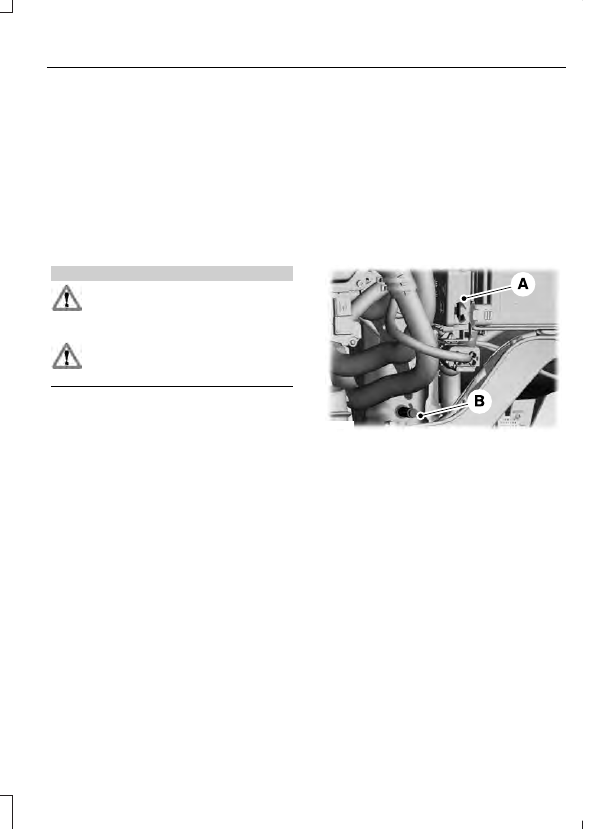
using these prongs. The illustration below
shows the two connector prongs used for
jump-starting your vehicle.

E192363

A. Positive prong (+)

B. Negative prong (-)

Note: In the illustration, the vehicle on the
bottom is used to designate the assisting
(boosting) battery.

Note: Remove the red cap from the positive
prong (A) on your vehicle before connecting
the cables.

E148861

1.

Connect the positive (+) jumper cable
to the positive (+) prong (A) of the
discharged battery.

2. Connect the other end of the positive

(+) cable to the positive (+) terminal
of the assisting battery.

3. Connect the negative (-) cable to the

negative (-) terminal of the assisting
battery.

4. Make the final connection of the

negative (-) cable to the negative (-)
prong (B) of your vehicle.

Note: Do not attach the negative (-) cable
to fuel lines, engine rocker covers, the intake
manifold or electrical components. These
items should not be considered grounding
points.

WARNING

Never connect the negative end of
the cable to the negative (-) terminal
of the discharged battery. A spark

may cause an explosion of the gases that
surround the battery. Always use the
negative prong as a grounding point.

Make sure that the cables are clear of fan
blades, belts, the moving parts of both
engines, or any fuel delivery system parts.

Jump Starting

1.

Start the booster vehicle and press the
accelerator pedal moderately.

2. Start the disabled vehicle. Check the

instrument cluster for the Ready to
Drive light as the gasoline engine may
not start, but the electric motor may
be running.

3. Once you start the disabled vehicle, run

both vehicles for an additional three
minutes before disconnecting the
jumper cables.

Removing the Jumper Cables

Remove the jumper cables in the reverse
order that they were connected.

Note: In the illustration, the vehicle on the
bottom is used to designate the assisting
(boosting) battery.

E148862

1.

Remove the jumper cable from the
negative prong.

2. Remove the jumper cable on the

negative (-) terminal of the booster
vehicle's battery.

3. Remove the jumper cable from the

positive (+) terminal of the booster
vehicle's battery.

4. Remove the jumper cable from the

positive (+) prong of the disabled
vehicle's battery.

After disconnecting the jumper cables, let
the disabled vehicle sit in Ready to Drive
mode for several minutes to charge the
12V battery. The disabled vehicle can
charge the 12V battery even if the gasoline
engine may be off. The 12V battery will
receive power from the high-voltage
battery instead.

COLLISION, DAMAGE OR FIRE
EVENT

Guidance for Ford Motor Company
Electric and Hybrid-Electric
Vehicles Equipped With High
Voltage Batteries

(Vehicle Owner/Operator/General
Public)
Electric and Hybrid-Electric Vehicle
Considerations

In the event of damage or fire involving
an electric vehicle (EV) or
hybrid-electric vehicle (HEV):

Always assume the high-voltage
battery and associated components
are energized and fully charged.

Exposed electrical components, wires
and high-voltage batteries present
potential high-voltage shock hazards.

Venting/off-gassing high-voltage
battery vapors are potentially toxic and
flammable.

Physical damage to the vehicle or
high-voltage battery may result in
immediate or delayed release of toxic,
flammable gases and fire.

Vehicle Information and General
Safety Practices

Know the make and model of your
vehicle.

Review the owner’s manual and
become familiar with your vehicle’s
safety information and recommended
safety practices.

Do not attempt to repair damaged
electric and hybrid-electric vehicles
yourself. Contact an authorized Ford
Dealer or vehicle manufacturer
representative for service.

Crashes

A crash or impact significant enough to
require an emergency response for
conventional vehicles would also require
the same response for an electric or
hybrid-electric vehicle.

If possible

Move your car to a safe, nearby
location and remain on the scene.

Roll down the windows before shutting
your vehicle off.

Place your vehicle in Park, set the
parking brake, turn off the vehicle,
activate the hazard lights, and move
your key(s) at least 16 feet (5 meters)
away from the vehicle.

Always

Call 911 if assistance is needed and
advise that an electric or hybrid-electric
vehicle is involved.

Do not touch exposed electrical
components or the engine
compartment, as a shock hazard may
exist.

Avoid contact with leaking fluids and
gases, and remain out of the way of
oncoming traffic until emergency
responders arrive.

When emergency responders arrive,
tell them that the vehicle involved is an
electric vehicle or hybrid vehicle.

Fires

As with any vehicle, call 911 immediately if
you see sparks, smoke or flames coming
from the vehicle.

Exit the vehicle immediately.

Advise 911 that an electric or
hybrid-electric vehicle is involved.

As with any vehicle fire, do not inhale
smoke, vapors or gas from the vehicle,
as they may be hazardous.

Remain a safe distance from the
vehicle and try to stay clear of the
smoke.

Stay out of the roadway and stay out
of the way of any oncoming traffic
while awaiting the arrival of emergency
responders.

Post-Incident

Do not store a severely damaged
vehicle with a lithium-ion battery inside
a structure or within 50 feet (15
meters) of any structure or vehicle.

Make sure that passenger and cargo
compartments remain ventilated (i.e.
open window, door or trunk).

For vehicles in the United States, notify
Ford Motor Company 1-800-392-3673
(then follow the prompts on the voice
response menu), an authorized Ford
dealer or service center as soon as
possible as there may be other steps
to secure and discharge the
high-voltage battery.

For vehicles in Canada, notify Ford
Motor Company 1-800-565-3673
(then follow the prompts on the voice
response menu), an authorized Ford
dealer or service center as soon as
possible as there may be other steps
to secure and discharge the
high-voltage battery.

Call 911 if you observe leaking fluids,
sparks, smoke or flames, or hear
gurgling or bubbling from the
high-voltage battery.


Content   ..  47  48  49  50   ..