Dodge Ram Truck 1500-2500-3500. Manual - part 559
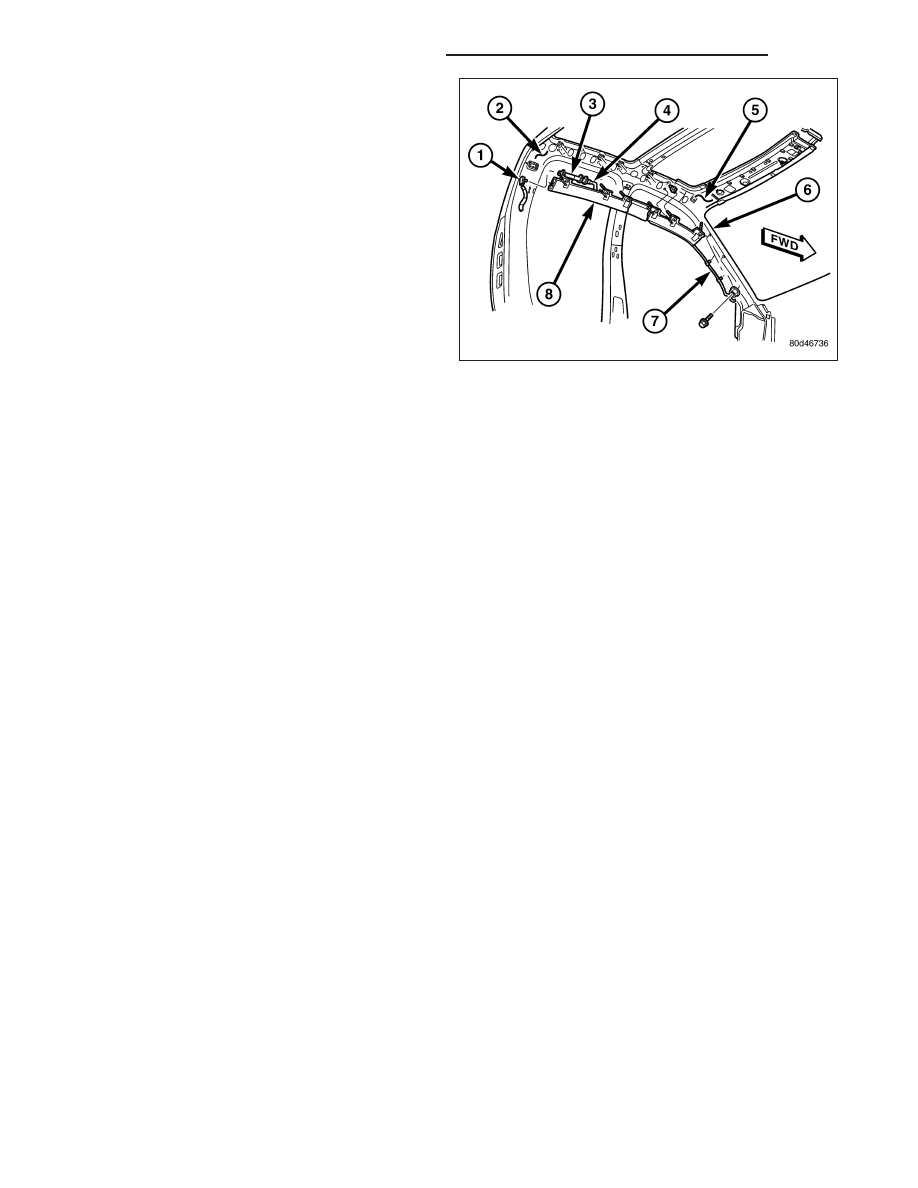
Vehicles equipped with side curtain airbags have two
individually controlled curtain airbag units. These air-
bag units are concealed and mounted above the
headliner where they are each secured to one of the
roof side rails (5). Each folded airbag cushion is con-
tained within a long extruded plastic channel (8) that
extends along the roof rail from the A-pillar (6) at the
front of the vehicle to just behind the B-pillar (2) on
standard cab models, and to just behind the C-pillar
(2) on quad cab models.
A long tether (7) extends down the A-pillar from the
front of the airbag cushion, where it is retained to the
pillar with plastic push-in routing clips and it is secured
to the base of the A-pillar near the belt line with a
screw.
The hybrid-type inflator (3) for each airbag is secured to the roof rail at the rear of the airbag unit behind the B-pillar
(standard cab) or C-pillar (quad cab), and is connected to the airbag cushion by a long tubular manifold (4). The
inflator bracket and the extruded airbag cushion channel are located with plastic push-in fasteners to the roof rail,
then secured with screws to spring nuts located in the roof rail.
A two-wire take out of the body wire harness with a keyed and latched connector insulator (1) on the B-pillar (stan-
dard cab) or C-pillar (quad cab) connects directly to an integral receptacle on the inflator initiator. The body wire
harness connects the airbag unit to the Airbag Control Module (ACM).
The side curtain airbag unit cannot be adjusted or repaired and must be replaced if deployed, faulty, or in any way
damaged. Once a side curtain airbag has been deployed, the complete airbag unit, the headliner, the upper A, B,
and C-pillar trim, and all other visibly damaged components must be replaced.
OPERATION
Each side curtain airbag is deployed individually by an electrical signal generated by the Airbag Control Module
(ACM) to which it is connected through left or right curtain airbag line 1 and line 2 (or squib) circuits. The hybrid-
type inflator assembly for each airbag contains a small canister of highly compressed inert gas. When the ACM
sends the proper electrical signal to the airbag inflator, the electrical energy creates enough heat to ignite chemical
pellets within the inflator.
Once ignited, these chemicals burn rapidly and produce the pressure necessary to rupture a containment disk in the
inert gas canister. The inflator and inert gas canister are sealed and connected to a tubular manifold so that all of
the released gas is directed into the folded curtain airbag cushion, causing the cushion to inflate. As the airbag
cushion inflates it will drop down from the roof rail between the edge of the headliner and the side glass/body pillars
to form a curtain-like cushion to protect the vehicle occupants during a side impact collision.
The front tether keeps the front portion of the side curtain bag taut, thus ensuring that the bag will deploy in the
proper position. Following the airbag deployment, the airbag cushion quickly deflates by venting the inert gas
through the loose weave of the cushion fabric, and the deflated cushion hangs down loosely from the roof rail.
REMOVAL
WARNING: To avoid personal injury or death, on vehicles equipped with airbags, disable the supplemental
restraint system before attempting any steering wheel, steering column, airbag, seat belt tensioner, impact
sensor, or instrument panel component diagnosis or service. Disconnect and isolate the battery negative
(ground) cable, then wait two minutes for the system capacitor to discharge before performing further diag-
nosis or service. This is the only sure way to disable the supplemental restraint system. Failure to take the
proper precautions could result in accidental airbag deployment.
WARNING: To avoid personal injury or death, when removing a deployed airbag, rubber gloves, eye protec-
tion, and a long-sleeved shirt should be worn. There may be deposits on the airbag unit and other interior
surfaces. In large doses, these deposits may cause irritation to the skin and eyes.
8O - 270
RESTRAINTS - SERVICE INFORMATION
DR/DH