Dodge Dakota (ND). Manual - part 236
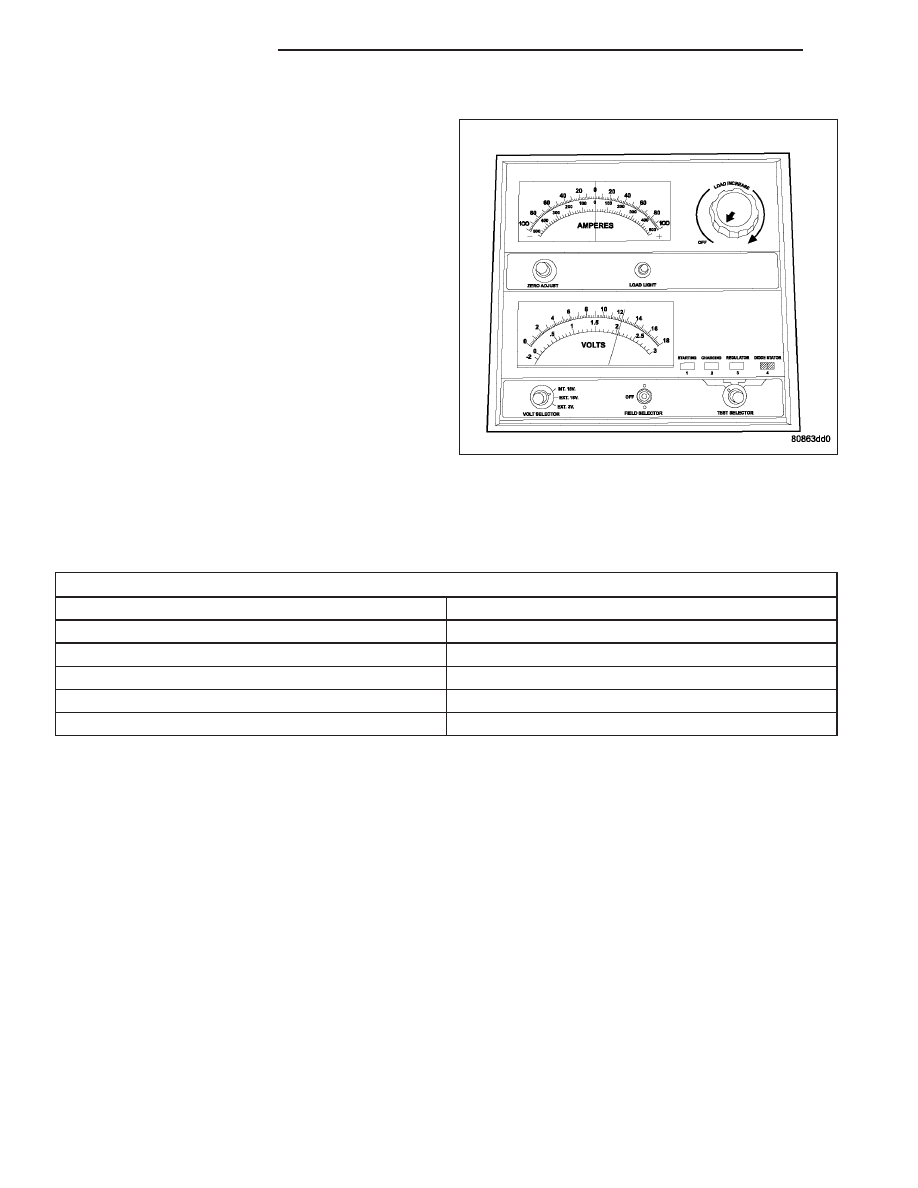
OPEN-CIRCUIT VOLTAGE TEST
A battery open-circuit voltage (no load) test will show
the approximate state-of-charge of a battery. This test
can be used in place of the hydrometer test when a
hydrometer is not available, or for maintenance-free
batteries with non-removable cell caps.
Before proceeding with this test, completely charge
the battery (Refer to 8 - ELECTRICAL/BATTERY SYS-
TEM/BATTERY - STANDARD PROCEDURE - BAT-
TERY CHARGING).
1. Before measuring the open-circuit voltage, the sur-
face charge must be removed from the battery.
Turn on the headlamps for fifteen seconds, then
allow up to five minutes for the battery voltage to
stabilize.
2. Disconnect and isolate both battery cables, nega-
tive cable first.
3. Using a voltmeter connected to the battery posts
(see the instructions provided by the manufacturer
of the voltmeter), measure the open-circuit voltage.
See the Open-Circuit Voltage Table. This voltage reading will indicate the battery state-of-charge, but will not reveal
its cranking capacity. If a battery has an open-circuit voltage reading of 12.4 volts or greater, it may be load tested
to reveal its cranking capacity (Refer to 8 - ELECTRICAL/BATTERY SYSTEM/BATTERY - STANDARD PROCE-
DURE - USING MICRO 420 BATTERY TESTER).
OPEN CIRCUIT VOLTAGE TABLE
Open Circuit Voltage
Charge Percentage
11.7 volts or less
0%
12.0 volts
25%
12.3 volts
50%
12.6 volts
75%
12.8 volts or more
100%
8F - 14
BATTERY SYSTEM
ND