DAF CF65, CF75, CF85 Series . Manual - part 935
©
200423
2-7
Inspection and adjustment
BRAKING PERFORMANCE AND BRAKE EQUALISATION
ΧΦ65/75/85 series
6
6
Inspecting brake equalisation of non-EBS
truck with EBS trailer vehicle
1.
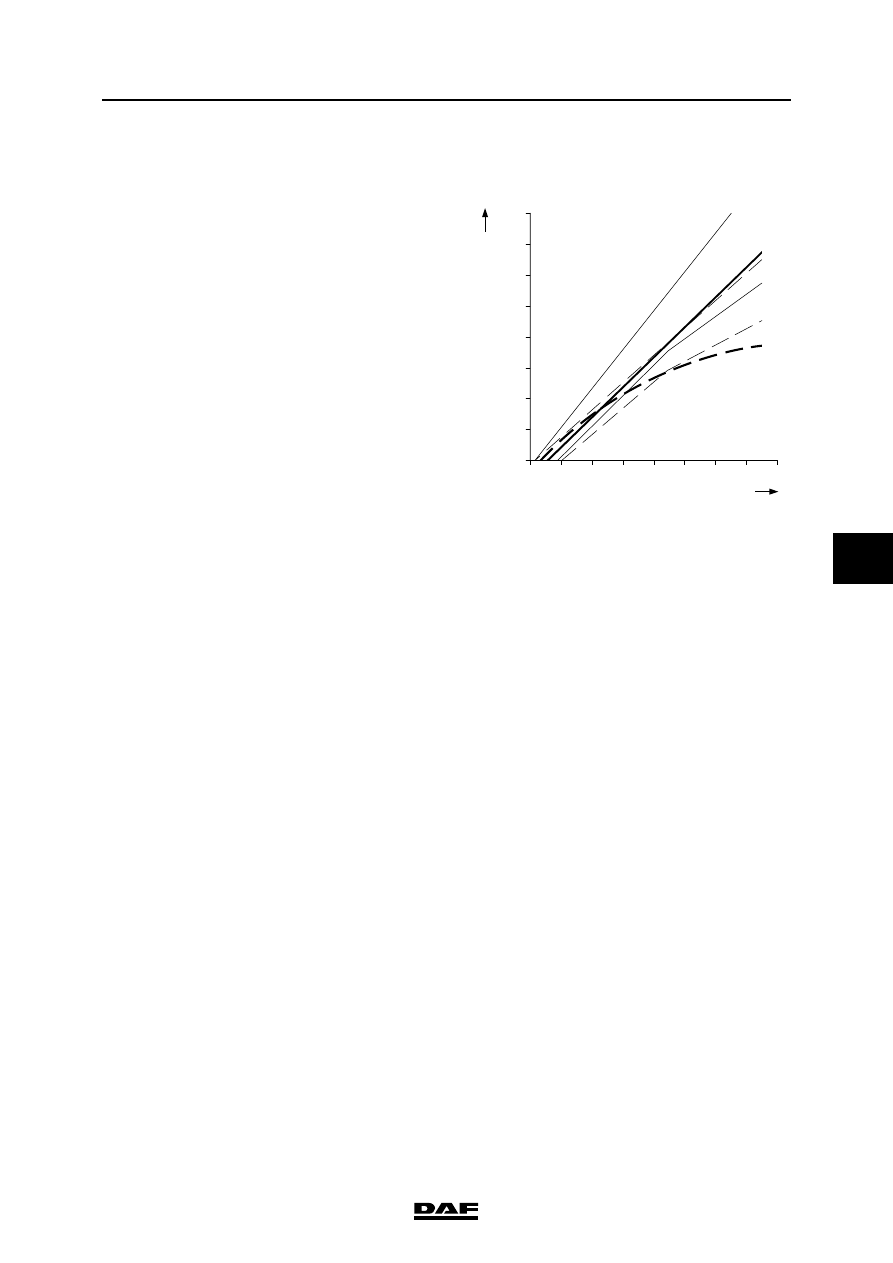
When the brake pressure advance in the
trailer vehicle control valve on the truck is
increased or decreased, the position of the
curve for the trailer vehicle (B) in the graph
will not be affected. This is because the
reference pressures are measured at the
yellow coupling head (= service line).
For the same reason, however, the curve for
the truck (A) will shift to the right or the left
(will appear to be lower or higher
respectively).
So the horizontal axis indicates how much
the brake pressure advance has to be
changed. Reducing the brake pressure
advance results in increased deceleration
of the truck. Increasing the brake pressure
advance results in decreased deceleration
of the truck.
Note:
Due to the operation of EBS on the trailer
vehicle it is not possible to set the brake
pressure advance on the trailer vehicle.
The brake pressure advance is automatically
adjusted electronically by the EBS.
Bear in mind that an increase in the
brake pressure advance does not
necessarily improve the braking
performance of the trailer vehicle.
It only means that the brake
pressure balance between prime
mover and trailer vehicle is changed.
Moreover, in the event of an
emergency stop the poorer braking
performance of the trailer vehicle
will again be noticeable, as the brake
pressure advance is eliminated
when the maximum brake pressure
is used.
2.
So the horizontal axis indicates how much
the brake pressure advance has to be
changed.
3.
Take a test run, perform a brake equalisation
test using a brake dynamometer and fill in
the "Brake equalisation form for brake
dynamometer". See "General". If desired or
required, the setting of the trailer vehicle
control valve can be adjusted again.
4.
If the desired brake equalisation cannot be
achieved, the cause must be sought and
remedied by means of the diagnostics table.
See "Diagnostics".
R600774
0
10
20
30
40
50
60
70
80
a
(%)
A
B
1
2
3
4
5
6
7
8
p(bar)
}