Citroen C5 (2017 year). Instruction - part 4
 

  Index      Citroen     Citroen C5 - instruction 2017 year in english


Search            


Content   ..  2  3  4  5   ..


Citroen C5 (2017 year). Instruction - part 4


2

Access

47

C5_en_Chap02_ouverture_ed01-2016

Operating problem

Following disconnection of the vehicle battery, 
replacement of the remote control battery or in 
the event of a remote control fault, you can no 
longer unlock, lock or locate your vehicle.
F

  First of all, use the key in the lock to unlock 

or lock your vehicle.

F

  Then, reinitialise the remote control.

If the problem persists, contact a CITROËN 
dealer or a qualified workshop as soon as 
possible.

Reinitialisation

F

  Switch off the ignition.

F

  Turn the key to position 2 (Igntion on).


(For more information on Starting-
switching off the engine
, refer to the 
corresponding section).

F

  Press the closed padlock immediately for a 

few seconds, until the operation requested 
is triggered.

F

  Switch off the ignition and remove the key 

from the ignition switch.

The remote control is fully operational again.

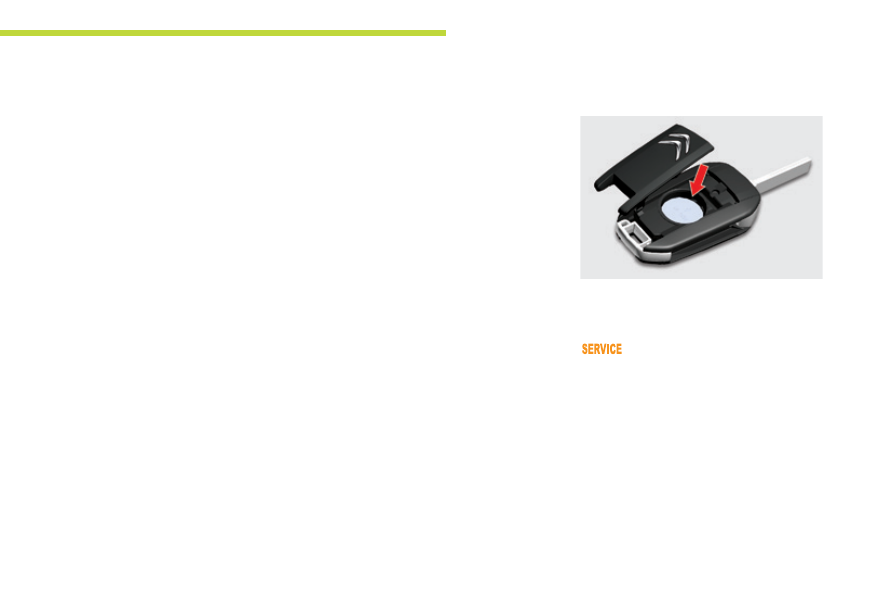
Changing the battery

Battery ref.: CR2032 / 3 volts.

F

  Unclip the casing using a small screwdriver 

at the notch.

F

  Remove the cover.

F

  Remove the flat battery from its housing.

F

  Place the new battery into its housing 

observing the original direction of fitment.

F

  Clip the cover into place.

Locating your vehicle

F

  Press the closed padlock to locate your 

locked vehicle in a car park.

This is indicated by switching on of the interior 
lighting and flashing of the direction indicators 
for a few seconds.
The vehicle remains locked.

If the battery is flat, you are informed 
by illumination of this warning lamp, 
an audible signal and a message in 
the multifunction screen.

Access

48

C5_en_Chap02_ouverture_ed01-2016

Lost keys

Go to a CITROËN dealer with the vehicle's registration document, your personal 
identification documents and if possible the key code label.
The CITROËN dealer will be able to look up the key code and the transponder code 
required to order a new key.

Remote control

The high frequency remote control is a sensitive system; do not operate it while it is in your 
pocket as there is a possibility that it may unlock the vehicle, without you being aware of it.
Do not repeatedly press the buttons of your remote control out of range and out of sight of 
your vehicle. You run the risk of stopping it from working and the remote control would have 
to be reinitialised.
No remote control can operate when the key is in the ignition switch, even when the ignition 
is switched off, except for reinitialisation.

Locking the vehicle

Driving with the doors locked may make access to the passenger compartment by the 
emergency services more difficult in an emergency.
As a safety precaution, never leave children alone in the vehicle, except for a very short 
period.
In all cases, it is essential to remove the key from the ignition switch when leaving the vehicle.

Anti-theft protection

Do not make any modifications to the electronic engine immobiliser system; this could 
cause malfunctions.

When purchasing a second-hand vehicle

Have the pairing of all of the keys in your possession checked by a CITROËN dealer, to 
ensure that only your keys can be used to open and start the vehicle.

Do not throw the remote control 
batteries away, they contain metals 
which are harmful to the environment.
Take them to an approved collection 
point.

2

Access

49

C5_en_Chap02_ouverture_ed01-2016

Alarm*

-  exterior perimeter

The system checks for opening of the vehicle.
The alarm is triggered if anyone tries to open a 
door, the boot, the bonnet...

-  interior volumetric

The system checks for any variation in the 
volume in the passenger compartment.
The alarm is triggered if anyone breaks a 
window, enters the passenger compartment or 
moves inside the vehicle.

- tilt

The system checks for any change in the 
attitude of the vehicle.
The alarm is triggered if the vehicle is lifted, 
moved or knocked.

Locking the vehicle with full 
alarm system

Activation

* Depending on the country of sale.

Self-protection function

The system checks for the putting out of 
service of its components.
The alarm is triggered if the battery, the 
central control or the siren wiring are 
put out of service or damaged.

For all work on the alarm system, 
contact a CITROËN dealer or a 
qualified workshop.

System which protects and provides a deterrent 
against theft and break-ins. It provides the 
following types of monitoring:

Switch off the ignition and get out of the 
vehicle.

F

  Press the locking button on the remote control.

The monitoring system is active: the indicator lamp 
in the button flashes once per second.
After the locking button on the remote control 
is pressed, the exterior perimeter monitoring is 
activated after a delay of 5 seconds and the interior 
volumetric and anti-tilt monitoring after a delay of 
45 seconds.
If an opening (door, boot...) is not closed fully, the 
vehicle is not locked but the exterior perimeter 
monitoring will be activated after a delay of 
45 seconds at the same time as the interior 
volumetric and anti-tilt monitoring.

Access

50

C5_en_Chap02_ouverture_ed01-2016

Deactivation

F

  Press the unlocking button on the remote 

control.

The alarm system is deactivated: the indicator 
lamp in the button goes off.

Locking the vehicle 
with exterior perimeter 
monitoring only

Deactivate the interior volumetric and anti-tilt 
monitoring to avoid unwanted triggering of the 
alarm in certain cases such as:
-  leaving a pet in the vehicle,
-  leaving a window partially open,
-  washing your vehicle,
-  changing a wheel,
-  having your vehicle towed,
-  transport by sea.

Deactivation of the interior 
volumetric and anti-tilt monitoring

F

  Switch off the ignition.

F  Within ten seconds, press the button until 

the indicator lamp is on continuously.

F

  Get out of the vehicle.

F

  Press the locking button on the remote 

control immediately.

The exterior perimeter monitoring alone is 
activated: the indicator lamp in the button 
flashes once per second.

Reactivation of the interior 
volumetric and anti-tilt monitoring

F

  Press the unlocking button on the remote 

control to deactivate the exterior perimeter 
monitoring.

F

  Press the locking button on the remote 

control to activate all the monitoring 
functions.

The indicator lamp in the button again flashes 
once per second.

To be effective, this deactivation must 
be carried out each time the ignition is 
switched off.

2

Access

51

C5_en_Chap02_ouverture_ed01-2016

Triggering of the alarm

This is indicated by sounding of the siren and 
flashing of the direction indicators for thirty 
seconds.
The monitoring functions remain active until 
the alarm has been triggered eleven times in 
succession.
When the vehicle is unlocked using the remote 
control, rapid flashing of the indicator lamp 
in the button informs you that the alarm was 
triggered during your absence. When the 
ignition is switched on, this flashing stops 
immediately.

Failure of the remote control

F

  unlock the vehicle using the key in the 

driver's door lock,

F

  open the door; the alarm is triggered,

F

  switch on the ignition; the alarm stops; 

the indicator lamp in the button goes off.

Locking the vehicle without 
activating the alarm

F

  Lock or deadlock the vehicle using the key 

in the driver's door lock.

Operating fault

When the ignition is switched on, fixed 
illumination of the indicator lamp in the button 
indicates a fault with the system.
Have it checked by a CITROËN dealer or a 
qualified workshop.

Automatic activation*

2 minutes after closing the last door or the 
boot, the system is activated automatically.
F

  To avoid triggering the alarm when entering 

the vehicle, first press the remote control 
unlocking button.

* Depending on the country of sale.

To deactivate the monitoring functions:

Access

52

C5_en_Chap02_ouverture_ed01-2016

Electric windows

1.  Driver's electric window control.
2.
  Passenger's electric window control.
3.
  Rear right electric window control.
4.
  Rear left electric window control.
5.
  Deactivation of the rear electric window 

and door controls.

One-touch electric windows

automatic mode
F

 Press or pull the control firmly, beyond 

the point of resistance. The window 
opens or closes fully when the control is 
released.

F

 Pressing the control again stops the 

movement of the window.

Safety anti-pinch

When the window rises and meets an obstacle, 
it stops and partially lowers again.

The electric window controls remain 
operational for approximately 
45 seconds after the ignition is switched 
off or until the vehicle is locked after a 
door is opened.
If one of the passenger windows cannot 
be operated from the driver's door 
control panel, carry out the operation 
from the control panel of the passenger 
door concerned, and vice versa.

If the window cannot be closed (for 
example, in the presence of ice), 
immediately after the movement is 
reversed:
F  press and hold the control until the 

window opens fully,

F

  then pull the control immediately 

and hold it until the window closes,

F  continue to hold the control for 

approximately one second after the 
window has closed.

The safety anti-pinch function is not 
operational during these operations.

There are two options:

manual mode
F

 Press or pull the control gently, without 

passing the point of resistance. The 
window stops when the control is 
released.

2

Access

53

C5_en_Chap02_ouverture_ed01-2016

Reinitialisation

If a window does not rise automatically, its 
operation must be reinitialised:
F  pull the control until the window stops,
F

  release the control and pull it again until 

the window closes fully,

F  continue to hold the control for 

approximately one second after the window 
has closed,

F  press the control to lower the window 

automatically to the low position,

F  when the window has reached the low 

position, press the control again for 
approximately one second.

The safety anti-pinch function is not 
operational during these operations.

Deactivation of the rear 
electric window and door 
controls

F  For the safety of your children, press 

control 5 to deactivate the rear electric 
window controls regardless of their 
position.

Indicator lamp on, the rear controls are 
deactivated.
Indicator lamp off, the rear controls are 
activated.
A message in the instrument panel screen 
informs you of the activation / deactivation of 
the control.

Always remove the key from the ignition 
when leaving the vehicle, even for a 
short time.
If an obstacle is encountered during 
operation of the electric windows, you 
must reverse the movement of the 
window. To do this, press the control 
concerned.
When the driver operates the controls 
for the passengers' electric windows, 
they must ensure that no-one is 
preventing correct closing of the 
windows.
The driver must ensure that the 
passengers use the electric windows 
correctly.
Be particularly aware of children when 
operating the windows.

This control also deactivates the interior 
controls for the rear doors.
For more information on the Child lock, refer 
to the corresponding section.

Any other status of the indicator lamp 
indicates a fault with the electric child 
lock.
Have it checked by a CITROËN dealer 
or a qualified workshop.

Access

54

C5_en_Chap02_ouverture_ed01-2016

Doors

Opening

From inside

Manual central locking

Locking

F  Press button A

 to lock the vehicle.

The red indicator lamp on the button comes 
on. It flashes when the doors are locked while 
stationary with the engine off.

From outside

When the selective unlocking is 
activated, the first press of the remote 
control unlocking button permits 
unlocking of the driver's door only.

With the selective unlocking activated:
-  the driver's door control unlocks the 

driver's door only,

-  the other door controls unlock the 

other doors and the boot.

The interior door controls do not 
operate when the vehicle is deadlocked.

If one of the doors is open, the central 
locking from the inside does not take 
place.

System which provides full manual locking or 
unlocking of the doors and boot from the inside.

F

  After unlocking the vehicle completely 

using the remote control or the key, pull the 
door handle.

F

  Pull the interior control lever of a front door; 

this unlocks the vehicle completely.

2

Access

55

C5_en_Chap02_ouverture_ed01-2016

Unlocking

F  Press button A

 again to unlock the vehicle.

The red indicator lamp on the button 
switches off.

Automatic central locking

Locking

When the speed exceeds 6 mph (10 km/h), the 
doors and the boot lock automatically.
If one of the doors is open, the automatic 
central locking does not take place.
If the boot is open, the automatic central 
locking of the doors is active.

Unlocking

F

  Above 6 mph (10 km/h), press button A to 

unlock the doors and the boot temporarily.

Activation

F  Press button A

 for more than two seconds.

A confirmation message appears on the 
instrument panel screen, accompanied by an 
audible signal.

Deactivation

F  Press button A

 again for more than 

two seconds.

A confirmation message appears on the 
instrument panel screen, accompanied by an 
audible signal.

If the vehicle is locked or deadlocked 
from the outside, the red indicator lamp 
flashes and button A

 is inactive.

F

  In this case, use the remote control 

or the key to unlock the vehicle.

System which provides full automatic locking 
or unlocking of the doors and the boot while 
driving.
You can activate or deactivate this function.

Access

56

C5_en_Chap02_ouverture_ed01-2016

System allowing the doors to be locked and 
unlocked manually in the event of a malfunction 
of the central locking system or battery failure.

Locking the driver's door

F

  Insert the key in the door lock, then turn it 

to the rear.

You can also apply the procedure described for 
the passenger doors.

Unlocking the driver's door

F

  Insert the key in the door lock, then turn it 

to the front.

Locking the passenger doors

F

  Open the doors.

F

  On the rear doors, check that the child lock 

is not on.

For more information on the Child lock, refer 
to the corresponding section.
F

  Remove the black cap, located on the edge 

of the door, using the key.

F

  Insert the key in the socket without forcing 

it, then without turning it, move the latch 
sideways towards the inside of the door.

F

  Remove the key and refit the cap.

F

  Close the doors and check that the vehicle 

has locked correctly from the outside.

Unlocking the passenger doors

F

  Pull the interior door opening control.

Back-up control

2

Access

57

C5_en_Chap02_ouverture_ed01-2016

Boot (Saloon)

F  Press upwards on lever 1 and lift up the 

boot lid.

With the vehicle stationary, this is carried out 
using:
-  The remote control.
-  The key in a door lock.
-  The interior central locking/ unlocking control.

The boot automatically locks when the vehicle 
is moving at a speed of over 6 mph (10 km/h), 
even if automatic central locking is deactivated. 
It is unlocked when a door is opened or when 
the central locking button is pressed (speed 
lower than 6 mph (10 km/h)).

Opening

Locking/unlocking

Emergency boot release

Unlocking

F

  Fold back the rear seats to gain access to 

the lock from inside the boot.

F

  Insert a small screwdriver into hole A of the 

lock to unlock the tailgate.

F  Push the white part, located inside the 

lock, to the left to unlock the boot.

System for mechanical unlocking of the boot 
in the event of a battery or central locking 
malfunction.

Access

58

C5_en_Chap02_ouverture_ed01-2016

Motorised opening

Boot (Tourer)

Manual opening

F  Press upwards on lever A and lift up the 

tailgate.

F  Press upwards on lever A

, or press of more 

than one second on button B

 of the remote 

control.

Manual closing

F

  Lower the tailgate using the interior 

handle C

.

Motorised closing

F  Press the push-button D to close the 

tailgate.

Do not interrupt the closing of the tailgate; 
if any obstacle prevents it closing, the 
operation will stop and the tailgate will 
automatically rise by a few centimetres.

Do not attempt to help the opening of 
the tailgate manually after pressing the 
control A

.

2

Access

59

C5_en_Chap02_ouverture_ed01-2016

Cancelling the 
memorisation

With the tailgate in the intermediate position, 
you can cancel the stored position:
F

  Make a long press on push-button D.  

The system emits a long audible beep.

F  Release the push-button D

. The tailgate 

will return to the fully open position at the 
next use.

Electrical protection of the 
motor

If the tailgate is repeatedly opened and closed 
in quick succession, the motor can start to 
overheat and then cut out, preventing opening 
and closing of the tailgate.
Allow the motor to cool down for ten minutes 
without opening or closing the tailgate.
Closing in manual back-up mode remains 
possible.

To avoid risk of injury, make sure that 
no one is in the vicinity of the boot while 
opening and closing.
If the tailgate is carrying extra weight 
(snow, bicycle carrier, etc.) there is a 
risk of it closing under this load. Support 
the tailgate or first unload the bicycle 
carrier or clear the snow.
When using an automatic car wash, 
don’t forget to lock the vehicle so as to 
avoid any risk of motorised opening of 
the tailgate.

Memorisation of an 
intermediate position

You can store an opening angle for the tailgate:
F

  Manually or automatically move the tailgate 

to the required position.

F

  Make a long press on push-button D.  

The system emits a short audible beep.

F  Release the push-button D

.

Interrupting the opening / 
closing of the tailgate

When the tailgate is being opened or closed 
electrically, you can interrupt its movement 
at any point by pressing push-button D, the 
control A or button B

.

You can then open or close the tailgate 
electrically or manually, if necessary moving it 
in the opposite direction to release it.

Locking/unlocking

With the vehicle stationary, this is carried out 
using:
-  The remote control.
-  The key in a door lock.
-  The interior central locking/ unlocking 

control.

The boot automatically locks when the vehicle 
is moving at a speed of over 6 mph (10 km/h), 
even if automatic central locking is deactivated. 
It is unlocked when a door is opened or when 
the central locking button is pressed (at a 
speed of less than 6 mph (10 km/h)).

Ease of use and comfort

60

C5_en_Chap03_ergonomie-et-confort_ed01-2016

Front seats

Manual adjustments

1.  Adjustments to the height and angle of 

the head restraint 


To raise it, pull upwards. 


To lower it, press on the release button A 
and simultaneously on the head restraint 
itself. The adjustment is correct when the 
top edge of the head restraint is at the 
same height as the top of the head. It is 
also tilt adjustable. 


To remove it, press the release button A
then pull it upwards. It may be necessary to 
adjust the backrest angle.

2.  Adjustment of the backrest angle 
 

Operate the control and adjust the position 
of the backrest to the front or to the rear.

3.  Adjustment of the seat height 
 

Raise or lower the control the number 
of times required to obtain the desired 
position.

4.  Longitudinal adjustment of seat 
 

Lift the control bar and adjust to the desired 
position.

5.  Adjustment of lumbar support 
 

Turn the control and adjust to the desired 
position.

Seat consisting of a seat cushion, seat back and head restraint which can all be adjusted for optimum driving comfort.

For your safety, do not drive with the 
head restraints removed; they must be 
in place and correctly adjusted.

Before moving the seat backwards, 
ensure that there is nothing that might 
prevent the full travel of the seat.
There is a risk of trapping or pinching 
passengers if present in the rear seats 
or jamming the seat if large objects are 
placed on the floor behind the seat.

6.  Heated seat controls 
 

The heated seats only operate when the 
engine is running.

3

Ease of use and comfort

61

C5_en_Chap03_ergonomie-et-confort_ed01-2016

Electric adjustments

To adjust the electric seats, switch on the 
ignition or start the engine if the vehicle has 
gone into economy mode.
Seat adjustments are also possible for a short 
period after opening one of the front doors or 
switching off the ignition.

1.  Adjustment of the seat height and 

angle, and longitudinal position 


Raise or lower the front of the control to 
adjust the seat cushion angle.


Raise or lower the rear of the control to 
raise or lower the seat.


Slide the control forwards or backwards to 
move the seat forward or back.

2.  Adjustment of the backrest angle 
 

Move the control forwards or backwards to 
adjust the backrest angle.

3.  Adjustment of the angle of the top of 

the backrest 


Move the control forwards or backwards to 
adjust the angle of the top of the backrest.

Before moving the seat backwards, 
ensure that there is nothing that might 
prevent the full travel of the seat.
There is a risk of trapping or pinching 
passengers if present in the rear seats 
or jamming the seat if large objects are 
placed on the floor behind the seat.

Move the control:
-  Forwards or backwards to increase or 

reduce the lumbar support.

Upwards or downwards to raise or lower 
the lumbar support zone.

4.  Adjustment of lumbar support 
 

This function allows you to independently 
adjust the height and level of lumbar 
support.

Ease of use and comfort

62

C5_en_Chap03_ergonomie-et-confort_ed01-2016

Head restraint height and angle 
adjustments
(electric seats)

F

  To adjust the angle of the head restraint, 

push back or pull forward section B of the 
head restraint until you reach the desired 
position.

F

  To raise it, pull upwards.

F  To lower it, press on the control C to 

release it, and simultaneously on the head 
restraint itself.

F

  To remove it, press on the control C to 

release it, then pull it upwards.

Heated seats control

With the engine running, the front seats can 
operate separately.
F

  Use the corresponding adjustment dial, 

placed on the outer side of each front seat, 
to switch on and select the level of heating 
required:

0

: Off.

1

: Low.

2

: Medium.

3

: High.

Do not use the function if the seat is not 
occupied.
Reduce the level of heating as soon as 
possible.
Once the seat and passenger 
compartment are at a comfortable 
temperature, you can switch off the 
function; reducing electric current 
consumption also reduces fuel 
consumption.

Prolonged use at the highest setting 
is not recommended for those with 
sensitive skin.
There is a risk of burns for those that 
do not have normal perception of heat 
(illness, taking medicines, ...).
There is a risk of overheating the 
system if material with insulating 
properties is used, such as cushions or 
seat covers.
Do not use the system:
-  if wearing damp clothing,
-  if child seats are fitted.
To avoid breaking the heating element 
in the seat:
-  do not place heavy objects on the 

seat,

-  do not kneel or stand on the seat,
-  do not place sharp objects on the 

seat,

-  do not spill liquids onto the seat.
To avoid the risk of short-circuit:
-  do not use liquid products for 

cleaning the seat,

-  never use the heating function 

when the seat is damp.


Content   ..  2  3  4  5   ..