Chrysler Pacifica. Manual - part 906
PCV VALVE
DESCRIPTION
The PCV valve contains a spring loaded plunger.
The plunger meters the amount of crankcase vapors
routed into the combustion chamber based on intake
manifold vacuum.
DIAGNOSIS AND TESTING - PCV SYSTEM
WARNING:
APPLY
PARKING
BRAKE
AND/OR
BLOCK WHEELS BEFORE PERFORMING ANY TEST
OR ADJUSTMENT WITH THE ENGINE OPERATING.
(1) With engine idling, remove the hose from the
PCV valve. If the valve is not plugged, a hissing
noise will be heard as air passes through the valve. A
strong vacuum should also be felt when a finger is
placed over the valve inlet.
(2) Install
hose
on
PCV
valve.
Remove
the
make-up air hose from the air plenum at the rear of
the engine. Hold a piece of stiff paper (parts tag)
loosely over the end of the make-up air hose.
(3) After allowing approximately one minute for
crankcase pressure to reduce, the paper should draw
up against the hose with noticeable force. If the
engine does not draw the paper against the grommet
after installing a new valve, replace the PCV valve
hose.
(4) Turn the engine off. Remove the PCV valve
from intake manifold. The valve should rattle when
shaken.
(5) Replace the PCV valve and retest the system if
it does not operate as described in the preceding
tests. Do not attempt to clean the old PCV valve.
REMOVAL
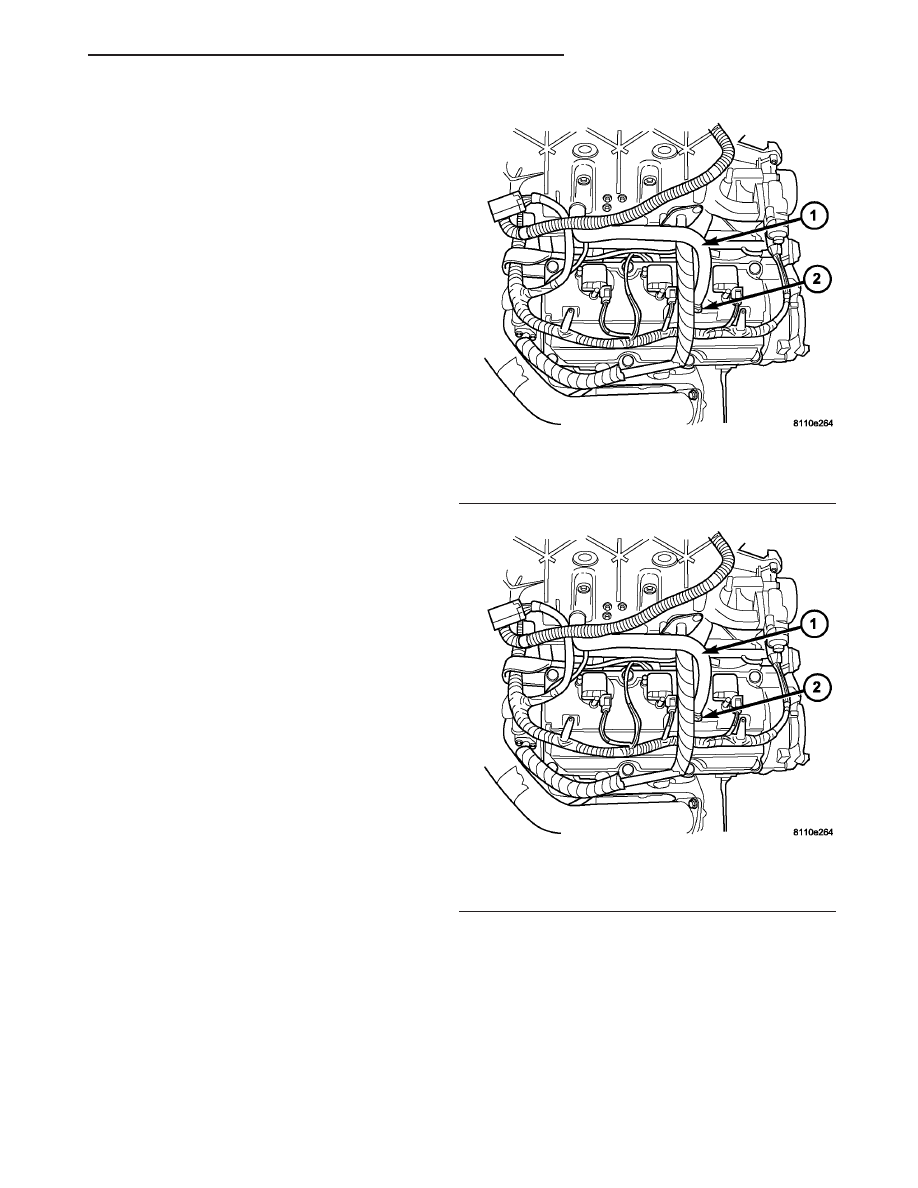
(1) Remove hose from PCV valve. The valve is on
the rear valve cover (Fig. 13).
(2) Unscrew the PCV valve.
(3) Remove PCV valve.
INSTALLATION
(1) Install PCV valve and tighten (Fig. 14).
(2) Install PCV hose.
VAPOR CANISTER
OPERATION
All vehicles use a maintenance free, evaporative
(EVAP) canister. Fuel tank vapors vent into the can-
ister. The canister temporarily holds the fuel vapors
until intake manifold vacuum draws them into the
combustion chamber. The Powertrain Control Module
(PCM) purges the canister through the proportional
purge solenoid. The PCM purges the canister at pre-
determined intervals and engine conditions.
Purge Free Cells
Purge-free memory cells are used to identify the
fuel vapor content of the evaporative canister. Since
the evaporative canister is not purged 100% of the
time, the PCM stores information about the evapora-
tive canister’s vapor content in a memory cell.
The purge-free cells are constructed similar to cer-
tain purge-normal cells. The purge-free cells can be
Fig. 13 PCV VALVE AND HOSE
1 - PCV Hose
2 - PCV valve
Fig. 14 PCV VALVE AND HOSE
1 - PCV Hose
2 - PCV valve
CS
EVAPORATIVE EMISSIONS
25 - 15