Chrysler Stratus Convertible. Manual - part 276
(2) The relay normally open terminal (87) is con-
nected to the common feed (movable contact) termi-
nal (30) in the energized position. This terminal
when energized supplies battery voltage to the deck
lid release solenoid. If OK, go to Step 3. If not OK,
repair the open circuit to the deck lid release sole-
noid as required.
(3) The coil battery (+) terminal (86) is connected
to the electromagnet in the relay. It has battery (+)
at all times. Check for battery voltage at cavity (86)
of the relay connector. If OK, go to Step 4. If not OK,
check for an open circuit to the deck lid release relay
and repair as necessary.
(4) The relay coil ground (-) terminal (85) is con-
nected to the Body Control Module Q33 circuit and
deck lid release switch. This terminal will receive a
ground (-) through the BCM, or the deck lid release
switch, when the key fob transmitter button, or the
deck lid release switch is depressed. If not OK, check
for an open circuit to the BCM and repair as neces-
sary.
(5) When the Vehicle Theft Security System is
armed the BCM opens the ground circuit to the deck
lid release switch.
DIAGNOSTIC CONDITIONS
When trouble shooting problems with the Remote
Keyless Entry System, always verify that the power
door lock/unlock switches are functional. If the doors
do not lock/unlock with the power switches, the fol-
lowing modules should be analyzed: Lock/Unlock
Switches, Body Control Module, and the door lock/
unlock latches. Refer to Group 8W, Wiring Diagrams.
FUSE TEST
If the following modules do not work:
• Remote Keyless Entry System
• Body Control Module
• Door lock switches
A blown fuse is the probable cause. The Body Con-
trol Module (BCM) battery feed fuse are located in
the Power Distribution Center (PDC). Check fuses 4,
15 and 18 in the PDC and fuses 4, 5 and 9 in the
Junction Block.
Key fob transmitter will not lock or unlock doors.
(1) Check that the BCM has power and ground.
(2) Re-synchronize the key fob rolling code with
the receiver by pressing and holding the lock button
then the deck lid button simultaneously for at least
five seconds. Then wait until the doors unlock indi-
cating that the code has been synchronized. This may
take as long as six minutes. This procedure is to be
used for a key fob transmitter that has been previ-
ously programmed to this vehicle only.
(3) If the RKE system still doesn’t function,
replace the key fob transmitter. Refer to Program-
ming Remote Keyless Entry Key Fob Transmitter.
All doors will not unlock with the key fob
transmitter.
(1) Using a voltmeter, check Pin 4 of the BCM 20
Pin connector for a voltage pulse (Fig. 3). Press the
unlock button once.
(2) If no voltage pulse, replace RKE module. If
voltage is measured, repair the harness between the
BCM and the driver door latch.
(3) Check Pin 1 of the BCM 20 Pin connector for a
quick voltage pulse when the unlock button is
pressed.
(4) If no voltage pulse is measured at Pin 1,
replace the BCM. Repair the harness between termi-
nal and lock latch.
Driver door will NOT unlock with the key fob
transmitter, but passenger door will unlock.
(1) Using a voltmeter, check Pin 4 of the BCM 20
Pin connector for a voltage pulse (Fig. 3). Depress the
unlock button. The voltmeter should read battery
voltage for approximately 1 second.
(2) If no voltage pulse is measured, replace the
BCM. If voltage is measured repair harness from
BCM to the driver door latch.
Driver door will unlock with the key fob
transmitter, but passenger door will not lock.
(1) Using a voltmeter, check Pin 1 of the BCM 20
Pin connector for a voltage pulse (Fig. 3). Press the
unlock button.
(2) If no voltage pulse is measured, replace the
BCM. If voltage is measured, repair the harness to
the door latch.
Doors do not lock with the key fob transmitter.
(1) Using a voltmeter, check Pins 10 and 11 of the
BCM 20 Pin connector for a voltage pulse (Fig. 3).
Press the lock button on the transmitter. Wait for
quick voltage pulse. It may be necessary to press the
key fob transmitter several times. The voltage pulse
only appears for milliseconds.
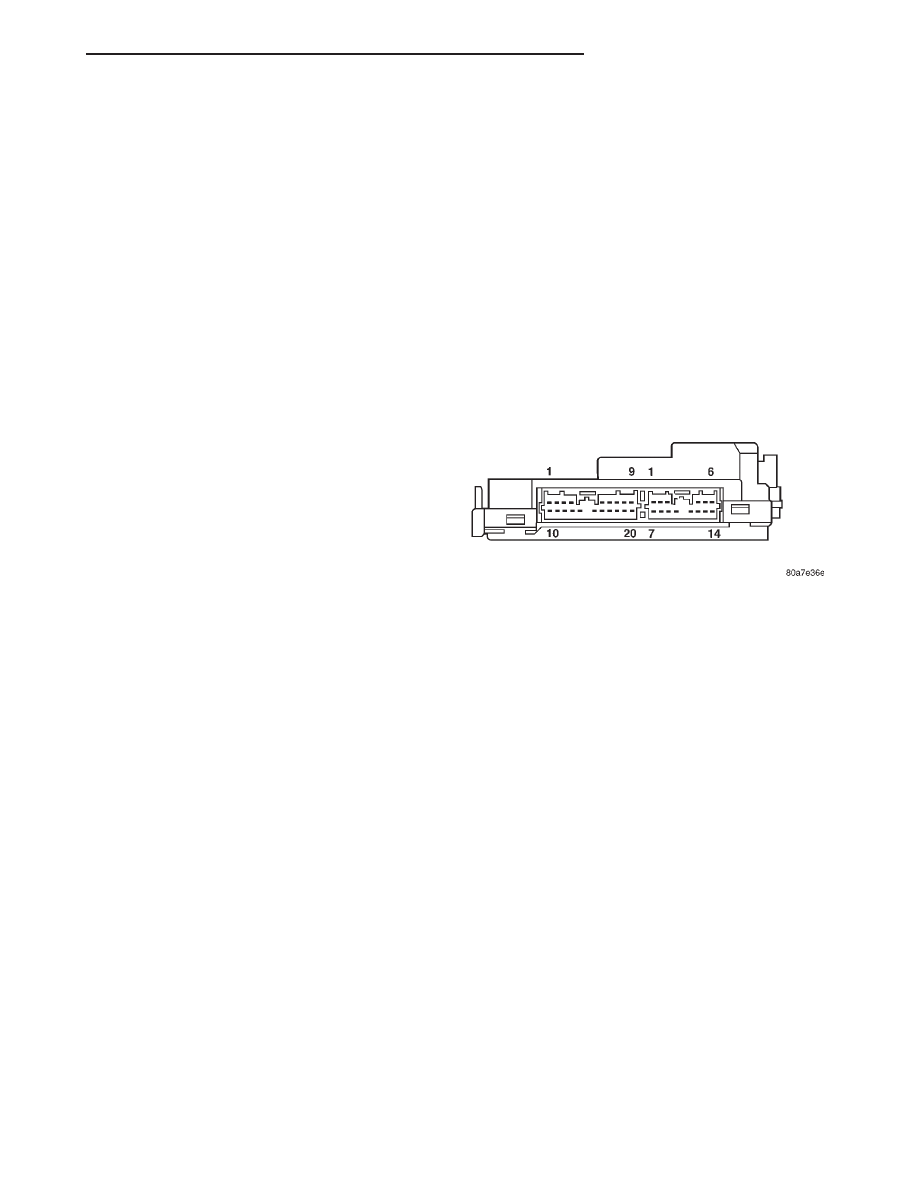
Fig. 3 BCM 20-Way Connector
JX
POWER LOCK SYSTEMS
8P - 3
DIAGNOSIS AND TESTING (Continued)