Chrysler New Yorker. Manual - part 26
If brake fluid is contaminated, drain and thor-
oughly flush system. Replace master cylinder, propor-
tioning valve, caliper seals, wheel cylinder seals,
Antilock Brakes hydraulic unit and all hydraulic
fluid hoses.
RED BRAKE WARNING LAMP TEST
For diagnosis of specific problems with the red
brake warning lamp system, refer to Brake System
Diagnostics Chart 2, located in the Diagnosis And
Testing section in this group of the service manual.
STOP LAMP SWITCH
The required procedure for testing the stop lamp
switch is covered in Group 8H Vehicle Speed Control
System in this service manual. The electrical circuit
for stop lamps is covered in Group 8W Rear Lighting
in this service manual.
REAR WHEEL HUB AND BEARING
The rear hub and bearing assembly is designed for
the life of the vehicle and should require no mainte-
nance. The following procedure may be used for eval-
uation of bearing condition.
With wheel and brake drum removed, rotate
flanged outer ring of hub. Excessive roughness, lat-
eral play or resistance to rotation may indicate dirt
intrusion or bearing failure. If the rear wheel bear-
ings exhibit these conditions during inspection, the
hub and bearing assembly should be replaced.
Damaged bearing seals and resulting excessive
grease loss may also require bearing replacement.
Moderate grease loss from bearing is considered nor-
mal and should not require replacement of the hub
and bearing assembly.
SERVICE PROCEDURES
MASTER CYLINDER FLUID LEVEL
Check master cylinder reservoir brake fluid level a
minimum of twice a year.
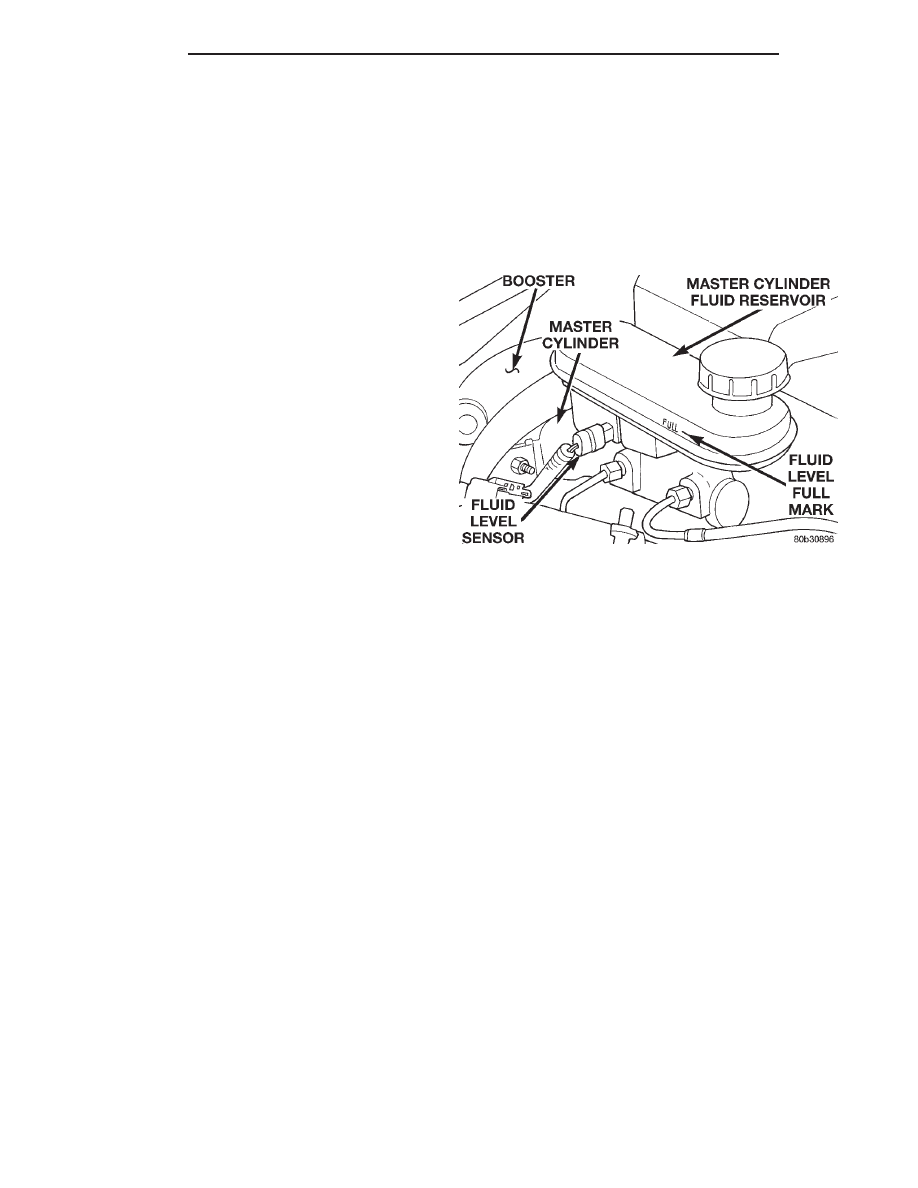
The master cylinder brake fluid reservoir used on
this vehicle includes a brake fluid level sensor. The
brake fluid level sensor location is in the body of the
brake fluid reservoir (Fig. 18). In the event of low
brake fluid level in the brake fluid reservoir, the
RED brake warning light in the instrument panel
will turn on.
Master cylinder fluid reservoirs on both standard
and antilock brake systems, are marked with a
FULL fill line indicating the fluid reservoirs proper
fluid level (Fig. 18).
NOTE:
When filling brake fluid reservoir, use only
Mopar
T
brake fluid or an equivalent stored in a
tightly sealed container. Brake fluid must conform
to DOT 3, specifications. Do not use brake fluid
with a lower boiling point then DOT 3, as brake fail-
ure could result during prolonged hard braking. Do
not use petroleum-based fluid because seal damage
in the brake system will result.
If necessary, add brake fluid to reservoir, bringing
brake fluid level to the FULL fill line shown on fluid
reservoir (Fig. 18).
BRAKE BLEEDING
NOTE: To
bleed
this
vehicles
antilock
brakes
hydraulic system, see the antilock brake system
service procedures in this group of the service
manual. It describes in detail the required proce-
dure which needs to be followed when bleeding the
antilock brake system.
CAUTION: Before removing the master cylinder
cover, wipe it clean to prevent dirt and other foreign
matter from dropping into the master cylinder.
PRESSURE BLEEDING
CAUTION: Use bleeder tank Special Tool C-3496-B
or equivalent, with Adapter, Special Tool 8224 (Fig.
19), to pressurize the brake hydraulic system for
bleeding.
Follow pressure bleeder manufacturer’s instruc-
tions, for use of pressure bleeding equipment.
When bleeding the brake system. Some air may be
trapped in the brake lines or valves far upstream. As
much as ten feet from the bleeder screw (Fig. 20).
Therefore, it is essential to have a fast flow of a large
volume of brake fluid when bleeding the brakes. This
will ensure all the air is bled from the brakes
hydraulic system.
Fig. 18 Master Cylinder Fluid Level
5 - 18
BRAKES
300M
DIAGNOSIS AND TESTING (Continued)