Audi TT (2007 year). Manual - part 260


  Главная      Audi     Audi TT (2007 year) (4-cylinder TDI engine (2.0 ltr. 4-valve common rail), mechanics Engine ID CBB) - Workshop Manual


поиск по сайту            


содержание   ..  258  259  260  261   ..


Audi TT (2007 year). Manual - part 260


Protected by copyright. Copying for private or commercial purposes, in part or in whole, is not 
 permitted unless authorised by AUDI AG. AUDI AG does not guarantee or accept any liability 
     with respect to the correctness of information in this document. Copyright by AUDI AG.

17

383_062

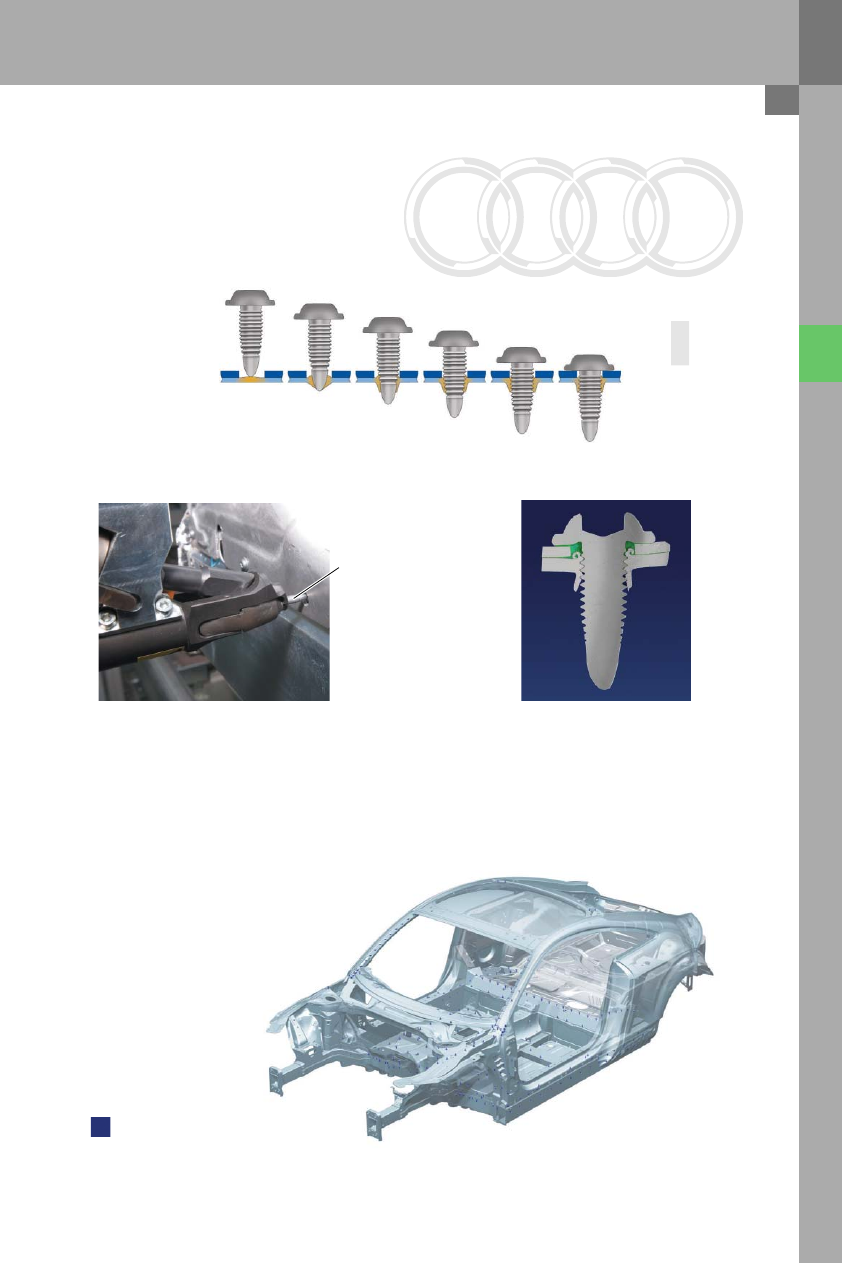
Flow Drill screwing process

New joining technique: Flow Drill screwing

Automatic direct screwing enables joints to be made between any materials, even if these materials can be 
accessed from one side only. A special coated screw is driven under high surface pressure through a hole in 
the outer part to be joined. The lower part is not predrilled. The pressure and rotational speed soften the 
material and allow the screw to be inserted.

383_063

Screwing process in production

Flow Drill 
Screw

383_074

Micrograph of a Flow Drill screw connection

383_064

Applications of Flow Drill screwing

Information on the repair concept

Flow Drill screws can be removed in the service workshop and replaced with new screws. In case of thread 
damage, screws are also available in oversize (M6 instead of M5) . For use in new parts, it may be necessary to 
predrill the material.

Protected by copyright. Copying for private or commercial purposes, in part or in whole, is not 
 permitted unless authorised by AUDI AG. AUDI AG does not guarantee or accept any liability 
     with respect to the correctness of information in this document. Copyright by AUDI AG.

18

Joining techniques and production processes

New joining technique: aluminium laser welding 
(invisible roof seam)

Laser welding has been used for joining aluminium body parts since the launch of the Audi A2. In most cases, 
sheet-metal parts are welded onto castings or extruded parts. The invisible joint in the roof area is joined 
using a new joining technique: laser welding.

383_066

Laser welding process in production

383_025

Micrograph of the roof frame and roof panel joint

383_067

Applications of laser beam welding 
Invisible roof seam

Applications of laser beam welding

Laser beam

Evaporating metal vapour

Welding wire

Vapour / plasma / channel

Direction of welding

Laser-induced plasma

Liquid melt zone

Solid melt zone

383_065

Protected by copyright. Copying for private or commercial purposes, in part or in whole, is not 
 permitted unless authorised by AUDI AG. AUDI AG does not guarantee or accept any liability 
     with respect to the correctness of information in this document. Copyright by AUDI AG.

19

To ensure consistent laser welding of aluminium parts, the parts to be welded must have a perfectly clean sur-
face. This is achieved either by washing the component parts followed by chemical pickling or by using the 
new Laser Clean process. 
A controlled laser beam removes all residues from the surface by heating it for a short time. Parts cleaned 
using this method can be directly laser-welded.

383_075

Micrograph of a laser-welded seam with
Laser Clean (above) and without cleaning (below)

383_069

383_068

Laser Clean process in production

The joint between the roof frame and roof panel is reworked and surface finished automatically in the produc-
tion line by means of a brushing process.

383_070

Brushing process in production

383_071

383_072

Laser weld seam before (above) and 
after the brushing process (below)

Protected by copyright. Copying for private or commercial purposes, in part or in whole, is not 
 permitted unless authorised by AUDI AG. AUDI AG does not guarantee or accept any liability 
     with respect to the correctness of information in this document. Copyright by AUDI AG.

20

Repair concept

383_023

Crash box

Bumper beam 1

Bumper beam

Screw connections

Bumper beam 2

Aluminium repair

The repair concept for the all-aluminium body parts 
is similar to that for the repair of previous Audi alu-
minium-bodied vehicles. 

The front end of the vehicle is designed in such a 
way that the bumper beams and bolted crash boxes 
can be replaced after minor collisions up to approx. 
15 kph. 

If the vehicle structure is damaged, beam 1 can also 
be replaced by undoing the screw connection. All fur-
ther damage to the vehicle front end can only be 
repaired by welding suitable genuine parts into place.

383_024

Joint between beam 1 and beam 2


содержание   ..  258  259  260  261   ..