Audi TT (2007 year). Manual - part 221


  Главная      Audi     Audi TT (2007 year) (4-cylinder TDI engine (2.0 ltr. 4-valve common rail), mechanics Engine ID CBB) - Workshop Manual


поиск по сайту            


содержание   ..  219  220  221  222   ..


Audi TT (2007 year). Manual - part 221


17

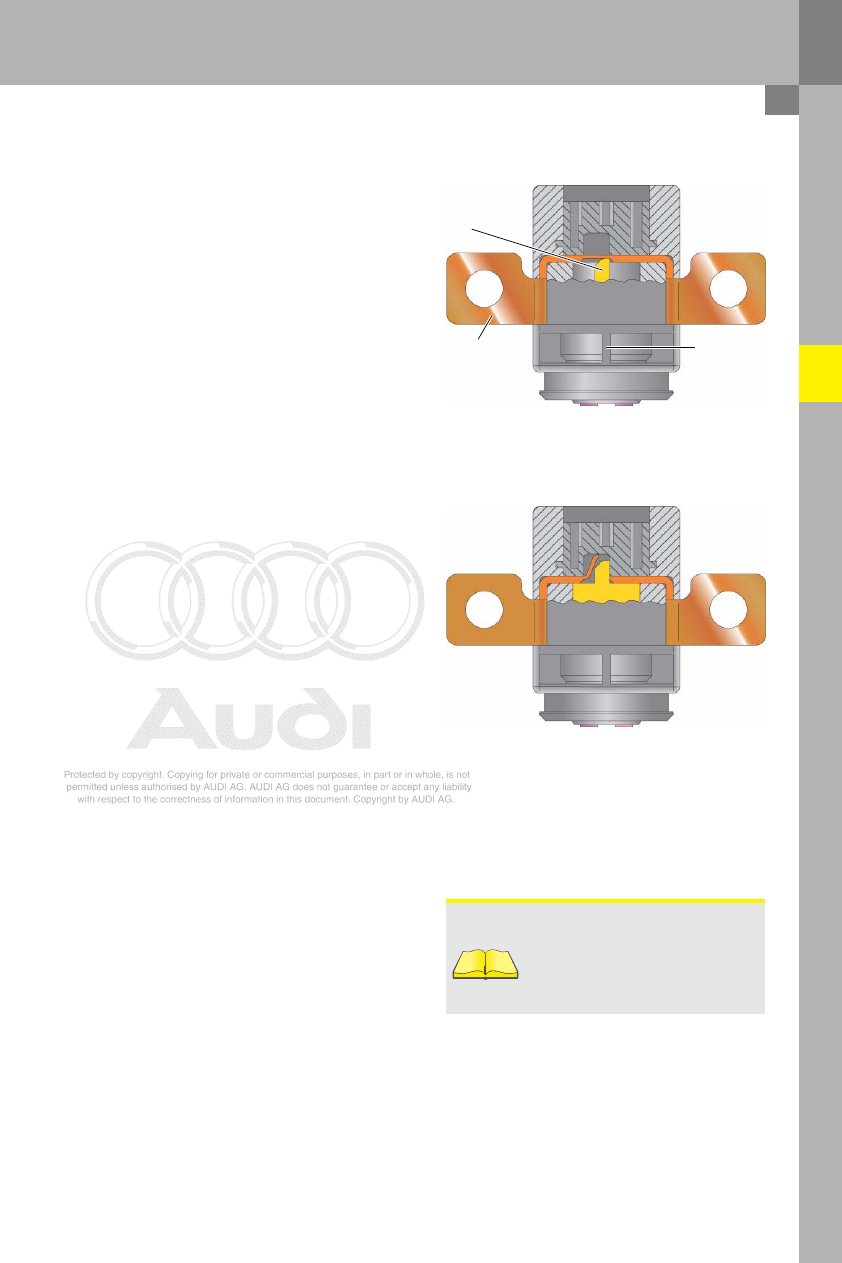
Battery isolation igniter N253

The battery isolation igniter has the task of 
disconnecting the starter and alternator leads from 
the vehicle battery in the event of a crash.
Use is made of a pyrotechnic component which is 
activated by the airbag control unit J234 whenever 
the airbag is deployed.
During a rear collision, only the belt tensioner and 
the battery isolation igniter are activated.

If the pyrotechnic propellant charge is ignited, the 
resultant gas pressure displaces the pin on a piston 
and disconnects the two terminals.

After deployment of the airbag, the battery isolation 
igniter must be replaced.

Battery isolation igniter

332_030

Pin

Connecting 
element with 
terminals

Detonator

361_024

Reference

Further information on the function 
of the battery isolation igniter, refer 
to Self-Study Programme 361 
Audi Q7.

18

Occupant protection

Additional functions and components of the occupant 
protection system for the North American market

The additional functions and components of the occupant protection system for the North American market 
are described on the following pages.

The occupant protection system is equipped with additional functions and components, 
e.g. second crash sensor for front airbag, so that the Audi TT Coupé ‘07 meets the statutory and market-
specific requirements for the US market.

Seat occupied detection, front passenger side

The front passenger side seat occupied recognition system was largely adopted from the Audi Q7.

The system basically comprises the following components:

Seat squab

Sensor mat for seat occupied recognition

Pressure sensor for seat occupied recognition G452

Seat occupied recognition control unit J706

Front passenger side belt switch E25

Seat belt force sensor for seat occupied recognition G453

Front passenger side airbag deactivated warning lamp
K145 (PASSENGER AIRBAG OFF)

Airbag  control  unit  J234

These components form a single 
unit and must not be separated 
from each other.

Driver side belt switch E24
Front passenger side belt switch E25

The Audi TT Coupé ‘07 for the North American 
market is equipped with seat belt switches for belt-
fastened recognition on the driver and front 
passenger sides. 
Seat belt switches E24 and E25 are integrated in the 
belt buckles on the front seats So-called "reed 
switches" are used. The reed switch remains open 
until the occupants have fastened their seat belts.

The airbag control unit J234 performs a resistance 
measurement from which it can determine whether 
the occupants have fastened their seat belts or not.
Depending on the position of the reed switch, the 
measurement is made using one or both resistors.

361_029

Reference

For further information about the 
seat occupied recognition system 
and the seat belt switch, refer to Self-
Study Programme 361 Audi Q7.

19

Knee airbag igniter, driver side N295
Knee airbag igniter, front passenger side N296

The Audi TT Coupé ‘07 for the North American market is equipped with knee airbags for the driver and front 
passenger sides.
Ignited knee airbags allow the occupants to participate earlier in the vehicle deceleration process. The airbag 
system of driver and front passenger front airbags in combination with knee airbags reduces the injury risk 
for the occupants.
On the driver side, the knee airbag is located in the footwell trim panel below the dash panel.On the front 
passenger side, the knee airbag is located behind the glove box lid.

Hybrid gas generators have the task of inflating the airbags with gas.
The airbag control unit J234 activates the igniter in the gas generator. The resultant pulsation wave is directed 
to the rupture disc. The rupture disc breaks and the helium from the pressurised gas bottle flows into the 
airbag.

After the airbags are activated, the airbag unfolds 
between the dash panel and the occupants' legs.

View inside the dash panel

Gas generator

Airbag

380_006

380_009

Detonator

Filter

Air outlet

Filter

Air outlet

Rupture disc

Pressurised gas bottle
Gas: Helium
Pressure:  approx. 600 bar

20

Occupant protection

The front inertia-reel seatbelts have a two-stage belt 
force limiter. In the event of a collision, the belt 
tensioners (band tensioners) are ignited first. The 
inertia-reel seatbelt blocks the seat belt retractor 
shaft and prevents the seat belt from unreeling, 
which would occur due to the forwards movement 
of the occupants. The seat belt retractor shaft is 
designed as a torsion shaft. To limit the load which 
the seat belt places on the occupants, two torsion 
shafts allow controlled unreeling of the seat belt; 
belt force limiter. 
After a defined interval, the airbag control unit 
activates the belt force limiter igniter.
The second torsion shaft is decoupled. The seat belt 
retractor shaft now counteracts the force which the 
seat belt exerts. 
To ensure that the occupants are afforded a good 
level of protection, the belt tensioning function, the 
belt force limiting function and the front airbags are 
coordinated with each other.

Gears I and II are permanently connected to the seat 
belt retractor shaft and the second torsion shaft 
respectively. 
In the initial state, both gears are in mesh with one 
another.

Belt force limiter, driver side G551
Belt force limiter, front passenger side G552

380_013

Detonator

Spline end

Gear II

Gear I

Torsion shaft II

Seat belt

retractor shaft

380_012

Seat belt retractor shaft

Gear I

Torsion shaft II

Spline end

Gear II


содержание   ..  219  220  221  222   ..