Alfa Romeo Giulia GTA (2022 year). Manual in english - page 6
 

  Index      Manuals     Alfa Romeo Giulia GTA (2022 year). Manual in english


Search            copyright infringement  


Content      ..     4      5      6      7     ..


Alfa Romeo Giulia GTA (2022 year). Manual in english - page 6


91

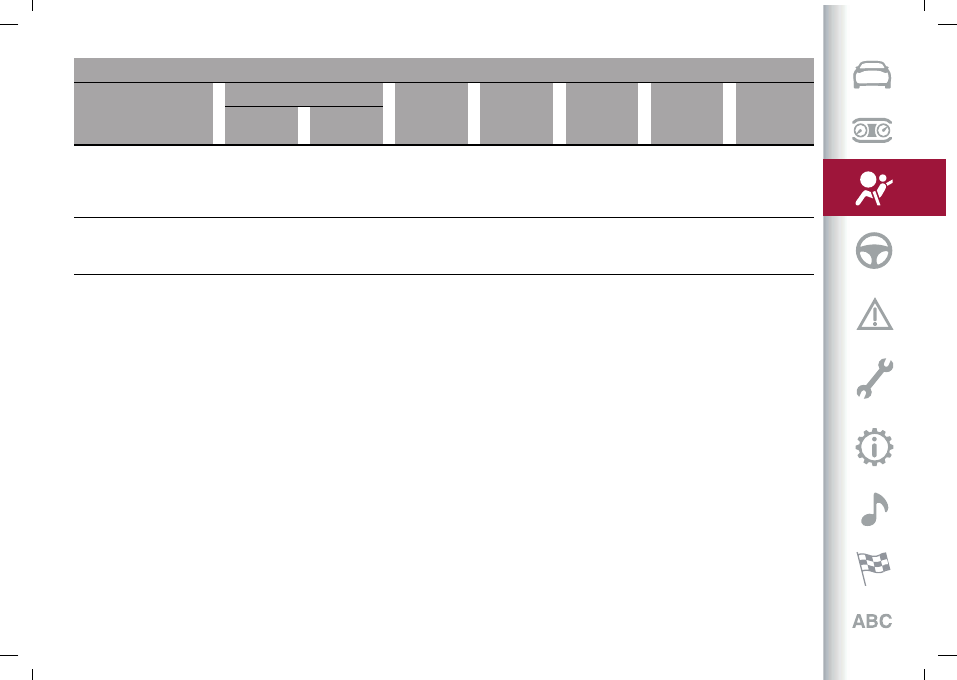
Number of seats

Seat number

1

2

3

4

5*

6

Airbag

ENABLED

Airbag

DISABLED

Seat suitable for ISOFIX

forward facing child

restraint systems (F2 / F2X

/ F3)

X

X

X

X

YES (IUF)1

X

YES (IUF)1

Seat suitable for auxiliary

child restraint systems (B2

/ B3)

X

X

X

X

YES (Only B2)

(IUF)1

X

YES (Only B2)

(IUF)1

U = Position suitable for a "universal" child restraint system approved for this weight category.
UF = Position suitable for a "universal" forward facing child restraint system approved for this weight category.
IUF = Position suitable for an "ISOFIX" universal forward facing child restraint system approved for this weight category.
i-U = Position suitable for an i-Size "universal" forward facing or rearward facing child restraint system.
i-UF = Position suitable for an i-Size "universal" forward facing child restraint system.
IL = Position suitable for specific listed ISOFIX child restraint systems (CRS). These ISOFIX CRS are classified as "vehicle-specific", "restricted use"

and "semi-universal".
X = Not applicable. The seat is not approved for installation of child restraint systems.
* = Child restraint systems with support leg cannot be installed on this seat.
1 =

Children cannot be transported in GTAm version cars without rear seats

.

2 = The ISOFIX child restraint system can be installed by adjusting the front seat.
Remove/adjust the head restraint (if adjustable) if it interferes with installation of the child restraint system.

-------------------------------------------------------------------------------------------------------------------------------------------------------------

 SAFETY

92

 Main recommendations to carry

children safely

Install the child restraint systems

on the rear seat, which is the most

protected position in the event of a

collision.

Keep children in rearward facing child

restraint systems for as long as possible,

until 3–4 years old if possible.

The rear head restraint can be raised

if needed to install a child restraint

system. The head restraint must always

be present in the vehicle and fitted if

the seat is used by an adult passenger

or a child sitting in a restraint system

without backrest (refer to the procedure

described in ‘’Head restraint’’ paragraph,

‘’Knowing your vehicle’’ chapter).

If the front passenger airbag has

been deactivated, always check that the

warning light on the courtesy light is on

continuously to make sure that it is

effectively deactivated.

Carefully follow the instructions

supplied with the child restraint system.
Keep the instructions in the car along

with the other documents and this

handbook. Do not use second-hand child

seats without instructions.

Only one child is to be strapped into

each restraint system; never carry two

children using one child restraint system.

Always check that the seat belts do

not rest on the child’s neck.

Always check that the seat belt is well

fastened by pulling on it.

While travelling, do not let the child sit

incorrectly or unfasten the belts.

Never allow a child to put the belt's

diagonal section under an arm or behind

their back.

Never carry children on your lap, even

newborns. No-one can hold a child in the

case of a collision.

In the event of an accident, replace the

child restraint system with a new one.

SUPPLEMENTARY RESTRAINT

SYSTEM (SRS) - AIRBAG

The car is equipped with:

front driver airbag;
front passenger airbag;
front side bags for pelvis, chest

and shoulder protection of driver and

passenger (GTA versions only);

window bags to protect the heads of

the front seat occupants (GTA versions

only);

window bags to protect the heads

of the side rear seat occupants (GTA

versions only);
The location of the airbags on the vehicle

is marked by the word "AIRBAG" under

the Alfa Romeo emblem on the steering

wheel, on the dashboard, on the side trim

or on a label placed next to the airbag

deployment area.

FRONT AIRBAGS

The front (driver and passenger) airbags

protect the front seat occupants in the

event of head-on crashes of medium-

high severity, by placing the cushion

between the occupant and the steering

wheel or dashboard.
Therefore non-activation of airbags in

other types of collisions (side impacts,

rear shunts, roll-overs, etc.) does not

indicate a system malfunction.
Driver and passenger front airbags are

not a replacement of but complementary

to the seat belts, which should always be

worn, as specified by law in Europe and

most non-European countries.
In a crash, those not wearing a seat

belt are projected forwards and may

come into contact with the bag which

is still inflating. The protection offered

by the bag is compromised in these

circumstances.
Front airbags may not activate in the

following situations:

frontal impacts against highly

deformable objects not involving the

front surface of the car (e.g. wing

collision against safety barrier, etc.);

car wedging under other vehicles or

safety barriers (e.g. trucks or guard rails).

-------------------------------------------------------------------------------------------------------------------------------------------------------------

93

Failure to activate in the conditions

described above is due to the fact that

they may not provide any additional

protection compared with seat belts, so

their activation would be inappropriate.
In these cases, non-deployment does not

indicate a system malfunction.

Driver's side front airbag

This consists of an instantly inflating

bag contained in a special recess in the
centre of the steering wheel fig. 84.

84

06106S0022EM

Passenger's front airbag

(GTA and GTAm versions)
This consists of an instantly inflating

bag contained in a special recess in the
dashboard fig. 85: this bag has a larger

volume than that on the driver side.

85

06106S0322EM

Passenger's front airbag and child

restraint systems

(GTAm versions excluded)
Rearward facing child restraint systems

must

NEVER

be fitted on the front seat

with an active passenger side airbag

since in the event of an impact the airbag

activation may cause fatal injuries to the

transported child.

ALWAYS

comply with the instructions

on the label stuck on the passenger side
sun visor fig. 86 and shown in table on the

following page.
WARNING Finally, ALWAYS refer to the

child restraint system installation table

provided in the “Child restraint systems”

paragraph for the list of seats on which a

child restraint system may be installed,

for the specific model of car.

86

06106S0003EM

Deactivating/activating the passenger

side air bags: front air bag and side bag

(where provided)
To deactivate the front and side

passenger side airbag, use the Connect

system. Select the following functions

in succession from the main Menu, and

activate them by pressing the

fig. 87

button: "Settings", "Safety", "Passenger

Airbag". The system will check airbag

activation/deactivation status and

request confirmation of change of

status.

87

05036S0099EM

-------------------------------------------------------------------------------------------------------------------------------------------------------------

 SAFETY

94

The ON and OFF status LEDs fig. 88

are on the front ceiling light. Moving

the ignition device to MAR, the two

LEDs switch on for a few seconds. If

not, contact a Dedicated Alfa Romeo

Dealership.

88

06106S0008EM

During the first seconds, the activation

of the LEDs does not actually show the

passenger protection status, but only

checks its correct operation.
After a test of a few seconds, the LEDs

will indicate the status of the passenger

airbag protection.

Passenger protection activated

: the ON

LED fig. 88 switches on fixed.

Passenger protection deactivated

: the

OFF LED turns on fixed.

-------------------------------------------------------------------------------------------------------------------------------------------------------------

 SAFETY

96

 SIDE BAGS

(GTA versions only)
To help increase occupants protection

in the event of side impact collisions, the

vehicle is equipped with front side bags

and window bags.

Side bag

These comprise two bags located in
the front seat backrests fig. 90 which

protect the pelvis, chest and shoulder

area of the occupants in the event of a

side collision of medium-high severity.
They are marked by the "AIRBAG" label

sewn on the outer side of the front seats.

90

06106S0017EM

Window bag

This consists of a "curtain" bag housed

behind the roof side linings and covered
by special trims fig. 91.
They are designed to protect the head

of front and side rear occupants in the

event of a side collision, thanks to the

wide cushion inflation surface.

91

06106S0015EM

The deployment of side bags in the event

of side impacts of low severity is not

required.
In the event of a side impact, the

system provides best protection if the

passenger sits on the seat in a correct

position, allowing the window bag to

inflate correctly.

78) 79) 80) 81) 82) 83) 84) 85) 86) 87) 88) 89) 90) 91)

Warnings

Do not wash the seats with water or

pressurised steam (wash by hand or at

automatic seat washing stations).
The front airbags and/or side bags

may be deployed in the event of sharp

impacts to the underbody of the car (e.g.

impact with steps, pavements, potholes

or road bumps etc.).
When the airbag deploys it emits a small

amount of dust: the dust is harmless and

does not indicate the beginning of a fire.

The dust may irritate the skin and eyes

however: in this case, wash with neutral

soap and water.
Airbag checking, repair and replacement

must be carried out at a Dedicated Alfa

Romeo Dealership.
If the car is scrapped, have the airbag

system deactivated at a Dedicated Alfa

Romeo Dealership.
Pretensioners and airbags are deployed

in different ways on the basis of the type

of collision. Failure to activate one or

more of the devices does not indicate a

system malfunction.

WARNING

78)

Do not apply stickers or other objects

on the steering wheel, on the dashboard

in the passenger side airbag area, on side

upholstery on the roof or on the seats.

Never put objects (e.g. mobile phones) on

the passenger's side dashboard since they

could interfere with correct inflation of the

airbag and also cause serious injury to the

passengers.

79)

The airbag must be able to inflate

without obstruction in the event of

deployment. It is therefore recommended

not to drive with the body bent forward, but

to sit up resting your back and shoulders

on the backrest of the seat. Adjusting

the position of the seat so that you can

reach and manoeuvre the steering wheel

-------------------------------------------------------------------------------------------------------------------------------------------------------------

97

comfortably with your arms slightly bent

being as far away as possible from the

steering wheel. Being too close to the

steering wheel when the airbag is deployed

may cause serious injury.

80)

The passenger side front and side

airbags can be deactivated on the

Connect system by selecting the following

functions in sequence on the main Menu:

“Settings”; “Safety”; “Passenger air bag” and

“Deactivation”.

81)

Do not affix rigid objects to the garment

hooks or support handles.

82)

Do not rest your head, arms or elbows

on the door, on the windows or in the

window bag area to prevent injury during

deployment.

83)

Never lean your head, arms or elbows

out of the window.

84)

If when setting the ignition device to

ON the warning light

does not turn on

or stays on whilst driving, a failure may

have occurred in the restraint systems. In

this case the air bags or pretensioners

may not be deployed in an impact or, in

a lower number of cases, they may be

deployed accidentally. Before continuing,

contact a Dedicated Alfa Romeo Dealership

immediately to have the system checked.

85)

In the event of a LED

OFF

failure

(located on the front courtesy light), the
warning light on the instrument panel turns

on.

86)

On cars with side bags, do not cover the

front seat backrests with extra covers.

87)

Do not travel with objects in your lap,

in front of your chest or held in your mouth

(e.g., pipe, pencil etc.). They could cause

severe injury if the airbag is deployed in a

crash.

88)

If the car has been subject to theft,

attempted theft, vandalism, or flooding,

have the air bag system inspected at a

Dedicated Alfa Romeo Dealership.

89)

Malfunction of the airbag failure

warning light is indicated by the activation

of an airbag failure icon and a dedicated

message on the instrument panel display.

The pyrotechnic charges are not disabled.

Before continuing, contact a Dedicated Alfa

Romeo Dealership immediately to have the

system checked.

90)

The front airbag deployment threshold

is higher than that of the pretensioners. For

impacts whose intensity falls between the

two levels, normally, only the pretensioners

will be activated.

91)

The airbag does not replace seat belts

but increases their efficiency. Because front

airbags are not deployed for low-speed

crashes, side collisions, rear-end shunts

or rollovers, occupants are protected, in

addition to any side bags, only by their seat

belts, which must therefore always be

fastened.

-------------------------------------------------------------------------------------------------------------------------------------------------------------

We have now reached the "heart" of the vehicle: let's see how

to use the vehicle to its full potential. We’ll look at how to

drive safely in any situation, making it a welcome companion

with our comfort and wallets in mind.

STARTING AND DRIVING

STARTING THE ENGINE . . . . . . . . . . . . . . . . . . . . . . . . . . . . . . . . . . . . . . . . . . . . . . . . . 100
ENGINE RUN-IN . . . . . . . . . . . . . . . . . . . . . . . . . . . . . . . . . . . . . . . . . . . . . . . . . . . . . . . . . . .101
WHEN PARKED . . . . . . . . . . . . . . . . . . . . . . . . . . . . . . . . . . . . . . . . . . . . . . . . . . . . . . . . . . . .101
AUTOMATIC TRANSMISSION . . . . . . . . . . . . . . . . . . . . . . . . . . . . . . . . . . . . . . . . . 104
“Alfa DNA™ Pro” SYSTEM . . . . . . . . . . . . . . . . . . . . . . . . . . . . . . . . . . . . . . . . . . . . . . . 107
START&STOP EVO . . . . . . . . . . . . . . . . . . . . . . . . . . . . . . . . . . . . . . . . . . . . . . . . . . . . . . 107
SPEED LIMITER . . . . . . . . . . . . . . . . . . . . . . . . . . . . . . . . . . . . . . . . . . . . . . . . . . . . . . . . . . 109
CRUISE CONTROL . . . . . . . . . . . . . . . . . . . . . . . . . . . . . . . . . . . . . . . . . . . . . . . . . . . . . . . 109
PARK SENSORS SYSTEM . . . . . . . . . . . . . . . . . . . . . . . . . . . . . . . . . . . . . . . . . . . . . . . 111
REAR BACK-UP CAMERA / DYNAMIC GRIDLINES . . . . . . . . . . . . . . . . . . .112
REFUELLING THE VEHICLE . . . . . . . . . . . . . . . . . . . . . . . . . . . . . . . . . . . . . . . . . . . . .113
DRIVING TIPS . . . . . . . . . . . . . . . . . . . . . . . . . . . . . . . . . . . . . . . . . . . . . . . . . . . . . . . . . . . . .115
TOWING TRAILERS . . . . . . . . . . . . . . . . . . . . . . . . . . . . . . . . . . . . . . . . . . . . . . . . . . . . . . . 117

-------------------------------------------------------------------------------------------------------------------------------------------------------------

 STARTING AND DRIVING

100

STARTING THE ENGINE

STARTING THE ENGINE

Before starting the car, adjust the

seat, the interior rear view mirrors, the

door mirrors and fasten the seat belt

correctly.
Never press the accelerator pedal for

starting the engine.
If necessary, messages on the

instrument panel indicating the starting

procedure can be shown on the display.

STARTING PROCEDURE

92) 93) 94)

19) 20) 21)

Proceed as follows:

engage the electric parking brake

and set the gear lever to P (Park) or N

(Neutral);

fully depress the brake pedal without

touching the accelerator;

briefly press the ignition button;
if the engine doesn't start within a

few seconds, you need to repeat the

procedure.
If the problem persists, contact a

Dedicated Alfa Romeo Dealership.

ENGINE STARTING FAILURE

Starting the engine with electronic key

battery (Keyless Start) run down or flat

If the ignition device does not respond

when the relevant button is pressed the

electronic key battery might be run down

or flat. Therefore, the system does not

detect the presence of the electronic key

on board the car and displays a dedicated

message on the instrument panel.
In this case, follow the instructions

in paragraph "Starting with flat key

battery" in the "Knowing your car"

chapter and start the engine normally.

STOPPING THE ENGINE

21)

To stop the engine, proceed as follows:

park the car in a position that is not

dangerous for oncoming traffic;

engage P (Park) mode;
with engine idling, press the start

button.
WARNING Do not leave the ignition

device in the ON position when the

engine is off.

Cars with electronic key (Keyless Start)

If the vehicle speed is above 8km/h, it is

still possible to stop the engine, selecting

a gear operation mode other than P

(Park).
To switch off the engine in this situation,

hold down the ignition device button for

a while or press it 3 times in a row within

a few seconds.

WARNING

92)

It is dangerous to run the engine in

enclosed areas. The engine consumes

oxygen and engine exhaust contains carbon

dioxide, carbon monoxide and other toxic

gasses.

93)

The electro-hydraulic braking system

is not active until the engine starts running.

So, the brake pedal travel will be longer than

normal. This does not indicate a fault.

94)

Do not start the engine by pushing,

towing or driving downhill. These

manoeuvres may damage the catalytic

converter.

IMPORTANT

19)

We recommend that during the

initial period, or during the first 1600 km

(1000 miles), you do not drive to full car

performance (e.g. excessive acceleration,

long journeys at top speed, sharp braking,

etc.).

20)

With the engine stopped never leave

the ignition device in the ON position to

prevent useless current draw from draining

the battery.

21)

A quick burst on the accelerator before

turning off the engine serves absolutely

no practical purpose; it wastes fuel and is

damaging for the engine.

-------------------------------------------------------------------------------------------------------------------------------------------------------------

101

ENGINE RUN-IN

RECOMMENDATIONS FOR RUNNING IN

THE ENGINE

Despite modern construction

technology, the mechanical parts of the

engine must be run in during the first 800

kilometres of travel up to the first engine

oil change.
NOTE The consumption of engine oil and

fuel in a new engine, during the first

thousand kilometres of operation,

before the first engine oil change, could

be higher than usual. This is normal

behaviour during the run-in period and

should not be understood as an anomaly.

Periodically check the engine oil level

during the run-in period and top up, if

necessary, as shown in the "Maintenance

and care" chapter.
Observe following driving behaviour

during the run-in period of the car.

From 0 to 100 miles (from 0 to

160 kilometres)

Do not leave the engine idling for a

long time.

Gradually press the throttle pedal

never more than halfway to avoid

excessive acceleration.

Avoid braking too hard.
Drive keeping the engine under

3500 rpm.

Keep your speed below 55 mph

(90 km/h) and respect the speed limits

in force in the country in which you are

driving.

From 100 to 300 miles (from 160 to

500 kilometres)

Gradually press the throttle pedal

never more than halfway to avoid rapid
acceleration in low gears (from 1st to
3rd).

Avoid braking too hard.
Drive keeping the engine under

5,000 rpm.

Keep your speed below 70 mph

(120 km/h) and respect the speed limits

in force in the country in which you are

driving.

From 300 to 500 miles (from 500 to

800 kilometres)

Make full use of the full rpm range by

manually shifting at higher revs where

possible, in sequential mode using the

gear lever or steering wheel paddles

(where fitted).

Do not hold the throttle pedal pressed,

requiring maximum engine performance,

for too long.

Keep your speed below 85 mph

(144 km/h) and respect the speed limits

in force in the country in which you are

driving.

During the first 2500 kilometres

:

Avoid taking part in races on the track.
Avoid sporty driving or similar

activities.

WHEN PARKED

95) 96) 97)

WARNING In addition to parking the

vehicle with the electric parking brake

always engaged, the wheels turned,

chocks or stones positioned in front of

the wheels (when on a steep slope), you

must always:

engage P (Park) mode;
always take the key with you when

leaving the vehicle.
WARNING Always engage the electric

parking brake before leaving the car.

ELECTRIC PARKING BRAKE

The car is equipped with electric parking

brake to guarantee better use and

optimal performance compared to a

manually operated parking brake.
The electric parking brake features a

switch, located on the central tunnel

fig. 92, a motor with calliper for each rear

wheel and an electronic control module.

-------------------------------------------------------------------------------------------------------------------------------------------------------------

 STARTING AND DRIVING

102

92

07076S0993EM

The electric parking brake can be

engaged in two ways:

manually

, by pulling the switch on the

central tunnel;

automatically

in "Safe Hold" or "Auto

Park Brake" conditions.
WARNING Normally, the electric parking

brake is engaged automatically when the

engine is stopped.This function can be

deactivated/activated on the Connect

system by selecting the following

items in sequence on the main menu:

"Settings", "Driver Assistance" and

"Automatic Parking Brake".
WARNING Should the car battery be

faulty, to unlock the electric parking

brake the battery must be replaced.

Electric parking brake manual

engagement

Briefly pull the switch located on the

central tunnel to manually engage the

electric parking brake when the car is

stationary.
Noise may be heard from the rear of the

car when engaging the electric parking

brake.
A slight movement of the brake pedal

may be detected when engaging the

electric parking brake with the brake

pedal pressed.
With the electric parking brake engaged,
the

warning light on the instrument

panel and the LED on the switch fig. 92

turn on.
WARNING With the

warning light on,

some functions of the electric parking

brake are deactivated. In this case the

driver is responsible for brake activation

and car parking in complete safety

conditions.
If, under exceptional circumstances,

the use of the electric parking brake is

required with the car in motion, keep the

switch on the central tunnel pulled as

long as the electric parking brake action

is necessary.
The warning light

may switch on

with the hydraulic system temporarily

unavailable; in this case braking is

controlled by the motors.
The brake lights (stop) will also

automatically switch on in the same way

as for normal braking with the use of the

brake pedal.

Release the switch on the central tunnel

to stop the braking action with the car in

motion.
If, through this procedure, the car is

braked until a speed below 2 mph

(3 km/h) is reached and the switch is kept

pulled, the electric parking brake will

definitively engage.
WARNING Driving the car with the

electric parking brake engaged, or using

it several times to slow down the car,

may cause severe damage to the braking

system.

Disengaging the electric parking brake

manually

In order to manually release the parking

brake, the ignition device should be in the

ON position.
Moreover, you need to press the brake

pedal, then press the switch on the

central tunnel briefly.
Noise may be heard from the rear of

the vehicle and a slight movement of

the brake pedal may be detected during

disengagement.
After disengaging the electric parking
brake, the

warning light on the

instrument panel and the LED on the
switch fig. 92 turn off.
If the

warning light on the instrument

panel remains on with the electric

parking brake disengaged, this indicates

-------------------------------------------------------------------------------------------------------------------------------------------------------------

103

a fault: in this case contact a Dedicated

Alfa Romeo Dealership.
WARNING Never use gear position

P (Park) instead of the electric parking

brake. Always engage the electric

parking brake when parking the car to

prevent injury or damage caused by the

unexpected movement of the car.

ELECTRIC PARKING BRAKE

OPERATING MODES

The electric parking brake may operate

as follows:

"Dynamic operating mode"

: this

mode is activated by pulling the switch

repeatedly whilst driving;

"Static engagement and release

mode"

: with the car stationary, the

electric parking brake can be activated

by pulling the switch on the central

tunnel once. On the other hand, press the

switch and the brake pedal at the same

time to disengage the brake;

"Drive Away Release"

: (where

provided) the electric parking brake will

automatically disengage with the driver

side seat belt fastened and the detection

of an action performed by the driver to

move the car (forward gear or reverse

gear);
NOTE Before using "Drive Away

Release" mode and moving the vehicle,

it is necessary to buckle the seat

belts or manually release the electric

handbrake to prevent damage to the

carbon-ceramic discs.

"Safe Hold"

: if the vehicle speed is

lower than 2 mph (3 km/h), the gear

lever is not in P (Park) position and the

driver's intention of leaving the vehicle is

detected, the electric parking brake will

automatically engage to hold the vehicle

in safety conditions;

"Auto Park Brake"

: if the vehicle

speed is below 2 mph (3 km/h), the

electric parking break will automatically

engage when the gear lever is in P (Park)

position. The LED on the switch located
on the central tunnel fig. 92 switches

on together with the warning light

on the instrument panel when the

electric parking brake is engaged and

applied to the wheels. Each automatic

engagement of the electric parking

brake can be cancelled by pressing the

switch on the central tunnel and at the

same time moving the gear lever for the

transmission to position P (Park).

SAFE HOLD

It is a safety function that automatically

engages the electric parking brake in the

event of a dangerous condition for the

car.
If:

the car speed is below 2 mph (3 km/h);

a transmission operating mode

different from P (Park) is activated;

the driver's seat belt is not fastened;
the driver side door is open;
no attempts to apply pressure on the

brake pedal have been detected;

the car is parked on roads which

gradient higher than 4%;
the electric parking brake engages

automatically to prevent car movement.
The Safe Hold function can be

temporarily disabled by pressing the

switch located on the central tunnel and

the brake pedal at the same time, with

the car stationary and the driver side

door open.
Once disabled, the function will activate

again when the vehicle speed reaches

18 mph (20 km/h) or the ignition device is

moved to STOP and then to ON.

WARNING

95)

In the case of parking manoeuvres

on roads on a gradient, the front wheels

must be steered towards the pavement

(when parking downhill), or in the opposite

direction if the car is parked uphill. Block the

wheels with a wedge or a stone if the car is

parked on a steep slope.

96)

Never leave children alone in an

unattended car; make sure that when you

-------------------------------------------------------------------------------------------------------------------------------------------------------------

 STARTING AND DRIVING

104

move away from the car, you have the key

with you.

97)

The electric parking brake must always

be engaged when leaving the car.

AUTOMATIC TRANSMISSION

The car is equipped with an electronically

controlled 8-speed automatic

transmission where gear shifting

automatically takes place, depending

on the vehicle usage instantaneous

parameters (vehicle speed, gradient, and

accelerator pedal position).
It is still possible to change gear

manually thanks to the "sequential

mode" position for the gear lever.

GEAR LEVER

The transmission is operated by means
of the control lever (1) fig. 93 which can

be used to select the following operating

modes:

P

= Park

R

= Reverse

N

= Neutral

D

= Drive, (automatic forward speed)

AutoStick

:

+

shifting to a higher gear

in sequential driving mode /shifting to a

lower gear in sequential driving mode.
The operating mode positions diagram is

illustrated on the top of the lever.

93

07076S0686EM

The letter corresponding to the selected

mode lights up on the gear lever and also

appears on the instrument panel display.
To select one of the operating modes,

move the lever forwards or backwards

and press the brake pedal at the same

time.
To engage R (Reverse) mode, press the
brake pedal and the button (3)fig. 94 in

combination.
To pass from P (Park) mode directly to D

(Drive) mode, in addition to pressing the

brake pedal, it is also necessary to press

button (3).
To pass from R (Reverse) mode directly

to D (Drive) mode and vice versa, in

addition to pressing the brake pedal, it is

necessary to press button (3).

94

07076V0020EM

The gear lever functions like a joystick,

so releasing it after giving the command,

it automatically returns to the centre

position.
The P (Park) mode can be enabled

pressing the P (Park) (2) fig. 93 button.
If using the gear shift in "sequential"

mode. you can activate it by moving the

lever from D (Drive) to the left and then

forward towards the - symbol or back

towards the + symbol and the gear is

shifted.
To exit position P (Park), or to pass

from position N (Neutral) to position D

(Drive) or R (Reverse) when the vehicle is

stopped or is moving at a low speed, the

brake pedal must also be pressed.
WARNING DO NOT accelerate while

shifting from position P (or N) to another

position.
WARNING After selecting a gear, wait

a few seconds before accelerating. This

-------------------------------------------------------------------------------------------------------------------------------------------------------------

105

precaution is particularly important with

engine cold.

TRANSMISSION OPERATING MODES

AutoStick - Manual (sequential)

shifting mode

In the case of frequent shifting (e.g.

during sporty driving, when the car is

driven with a heavy load, on gradients, or

with strong headwind), it is advisable to

use the AutoStick (sequential shifting)

mode to select and keep in a lower gear.
In these conditions, the use of a lower

gear improves vehicle performance,

preventing overheating.
It is possible to shift from D mode (Drive)

to sequential mode regardless of vehicle

speed.

Activation

Starting from D (Drive) mode, to activate

the sequential drive mode, move the

lever to the left (– and + indication of the

trim). The gear engaged will be shown on

the instrument panel display.
Gearshifting is made by moving the gear

lever forwards, towards symbol – or

backwards, towards symbol +.

Steering wheel stalks

Manual shifting is possible using the

paddles positioned behind the steering

wheel.
Pull the right shift paddle (+) towards

the steering wheel and release it to shift

up. Do the same operation with the left
paddle (-) to shift down fig. 95.
To engage N (Neutral), pull both levers

simultaneously.
To activate D (Drive) mode, from N

(Neutral), P (Parking) and R (Reverse)

position: push the brake pedal and the

right lever (+).

95

07076S0021EM

WARNING If only one manual shift is

necessary, the letter D will remain on the

display of the instrument panel with the

engaged gear shown next to it.

Deactivation

To deactivate the sequential driving

mode, bring the gear lever back in

position D (Drive) ("automatic" drive

mode).

“LAUNCH MODE” FUNCTION

98)

The “Launch Mode” function is used for

racing starts.

Activating this function optimises

gear shifts during acceleration from a

standstill.
The instrument panel display shows the
icon

illustrated in fig. 96, which may

be one of two colours:

icon green

: function active;

icon grey

: function not active/not

available.
The following conditions must be met in

order to perform a “Launch Mode” start:

engine oil temperature within correct

parameters;

no failures in engine or car’s electronic

systems;

car at a standstill on a flat road

surfaces with the wheels straight;

electric parking brake not engaged.

There is a pause time of 45 seconds

between activations.

96

07076S0080EM

-------------------------------------------------------------------------------------------------------------------------------------------------------------

 STARTING AND DRIVING

106

With the car stationary, proceed as

follows to activate this function:

check that the gear lever is in the D

position;

in the Alfa DNA™ Pro” system, activate

the “Race" driving mode;

depress the brake pedal with your left

foot and, simultaneously, fully depress

the accelerator pedal with your right

foot;

release the brake pedal: in this way a

more "lively" start is achieved.
When the brake pedal is released the

car will start in its fastest mode (with

shorter shifting times): the car will

automatically shift gears to achieve the

greatest possible acceleration once the

correct engine speed for the gear shift is

reached.

Deactivation

To deactivate the function, simply

interrupt the above sequence of

operations or release the accelerator

pedal.

TRANSMISSION EMERGENCY

FUNCTION

(where provided)
Transmission function is monitored

electronically for abnormal conditions.

If a condition that might damage

the transmission is detected, the

"transmission emergency" function is

activated.
In this condition, the transmission stays
in 4th gear, regardless of the selected

gear. The P (Park), R (Reverse) and N

(Neutral) modes continue to work.
The symbol

might be shown on the

instrument panel display.
In the event of a "transmission

emergency" immediately contact

the nearest Dedicated Alfa Romeo

Dealership.

Temporary failure

If the warning light turns on, the failure

may be temporary, in which case,

proceed as follows to restore correct

transmission operation:

stop the car;
engage P (Park) mode;
turn the ignition device to the STOP

position;

please wait for about 10 seconds, then

restart the engine;

shift into the desired gear range.

If the problem is no longer detected,

the transmission will return to normal

operation.
WARNING In the event of a temporary

failure it is in any case recommended

to contact a Dedicated Alfa Romeo

Dealership as soon as possible.

GEAR ENGAGEMENT DISABLING

SYSTEM WITHOUT BRAKE PEDAL

PRESSED

This system prevents you from

deactivating P (Park) mode if the brake

pedal has not been previously depressed.
To bring the gear lever to a position other

than P (Park), the ignition device must be

in position AVV (engine on or off) and the

brake pedal must be pressed.
You also need to press the brake pedal

to shift from position N (Neutral) to

position D (Drive) or R (Reverse) if the

car is stationary.

WARNING

98)

While the Launch Mode function is

being used, the ESC and ASR systems are

deactivated. This means that car dynamic

control is the sole responsibility of the

driver. Therefore pay the utmost attention

when using the Launch Mode. Take into

account traffic and road surface conditions

and during manoeuvres make sure there is

enough room in the area concerned.

Activation

-------------------------------------------------------------------------------------------------------------------------------------------------------------

107

“Alfa DNA™ Pro” SYSTEM

DESCRIPTION

This device allows different car response

modes to be selected according to

driving style and road conditions using
the selector fig. 97 (on the central

tunnel).

97

04306S0086EM

d

= Dynamic (sports driving mode)

n

= Normal (mode for driving in normal

conditions)

a

= Advanced Efficiency (ECO driving

mode for maximum fuel savings)

RACE

= track race driving mode

= adjusts the calibration of the

suspensions
On some versions when the engine is

stopped, the selector always returns to

n

(Normal) mode.
When RACE mode is active, the selector

is illuminated in red.

DRIVING MODES

"Dynamic" Mode
Engagement / disengagement

It is activated by rotating the selector to

the letter "d", the displays light up in red.
To deactivate the Dynamic mode, move

the selector to "n", Normal mode.

"Normal" Mode
Engagement / disengagement

It is activated by rotating the selector to

the letter "n", the displays light up in blue.
To deactivate the Normal mode, move

the selector to another mode ("d" or "a").

"Advanced Efficiency" Mode
Engagement / disengagement

It is activated by rotating the selector

to the letter “a”, the displays light up in

green.
ESC and ASR systems: intervention

thresholds aimed at ensuring maximum

safety in low-grip driving conditions.

It is advisable to select "Advanced

Efficiency" mode in the presence of

low-grip road surfaces.
To deactivate the Advanced Efficiency

mode, move the selector to "n", Normal

mode.
WARNING The selector will always be

positioned in Normal "n" mode when the

engine is started.

“Race” mode
Engagement / disengagement

It is activated by rotating the selector to

position "Race", the displays light up in

yellow.
To turn off the Race mode, move the

selector to the “Race” position again and

the system will be set to “d” mode.

START&STOP EVO

99)

22)

The Start&Stop Evo system

automatically stops the engine each time

the car is stationary and starts it again

when the driver wants to start off again.
In this way, the car efficiency is

increased, by reducing consumption,

emission of harmful gases and noise

pollution.

OPERATING MODE

Stopping the engine

With car at a standstill and brake pedal

pressed, the engine switches off if the

gear lever is in a position other than R.
The system does not operate when the

gear lever is in R, for making parking

manoeuvres easier.
In the event of stops uphill, engine

switching off is disabled to make the "Hill

Start Assist" function available (works

only with running engine).

-------------------------------------------------------------------------------------------------------------------------------------------------------------

 STARTING AND DRIVING

108

NOTE Automatic stopping of the engine

is not enabled until the car has exceeded

a speed of about 6 mph (10 km/h). After

an automatic restart, to stop the engine

you only need to move the vehicle

(exceed a speed of 0.3 mph / 0.5 km/h).
Engine stopping is signalled by the

symbol lighting up on the instrument

panel display.

Restarting the engine

To restart the engine, release the brake

pedal or, for versions/markets where

provided, turn the steering wheel slightly.
With brake pedal pressed, if the gear

lever is in automatic D (Drive) mode, the

engine can be restarted by moving the

lever to R (Reverse) or "AutoStick".
If the gear lever is in "AutoStick" mode,

the engine can be restarted by moving

the lever to + or -.

SYSTEM MANUAL ACTIVATION /

DEACTIVATION

To manually activate/deactivate the

system, press the button inserted in the

control panel on the left of the steering
wheel, fig. 98.

98

07126S0005EM

System activation

The system activation is signalled by the
symbol

lighting up on the instrument

panel. In this condition, the LED on the
fig. 98 button is off.

System deactivation

A message will appear on the instrument

panel display when the system is

deactivated. In this condition, the LED on

the button fig. 98 is off.
WARNING Each time the engine is

started, the system is activated

regardless of where was when it was

previously switched off.

SAFETY FUNCTIONS

When the engine is stopped through the

Start&Stop Evo system, if the driver

releases their seat belt, opens the

driver's or passenger's door or releases

the engine bonnet from inside the car,

the engine can be restarted only by using

the ignition device.

This condition is indicated to the driver

both through a buzzer and a message on

the instrument panel display.

WARNING

99)

When replacing the battery, always

contact a Dedicated Alfa Romeo Dealership.

Replace the battery with a new one of the

same EFB (Enhanced Flooded Battery) type

and specifications.

IMPORTANT

22)

If climate comfort is to be favoured, the

Start&Stop system can be deactivated,

for a continuous operation of the climate

control system.

-------------------------------------------------------------------------------------------------------------------------------------------------------------


Content      ..     4      5      6      7     ..