Acura RL. Manual - part 837
 

  Index      Acura     Acura RL - service repair manual 2005-2008 year


Search            


Content   ..  835  836  837  838   ..


Acura RL. Manual - part 837


2005-08 SUSPENSION

TPMS (Tire Pressure Monitoring System) - RL 

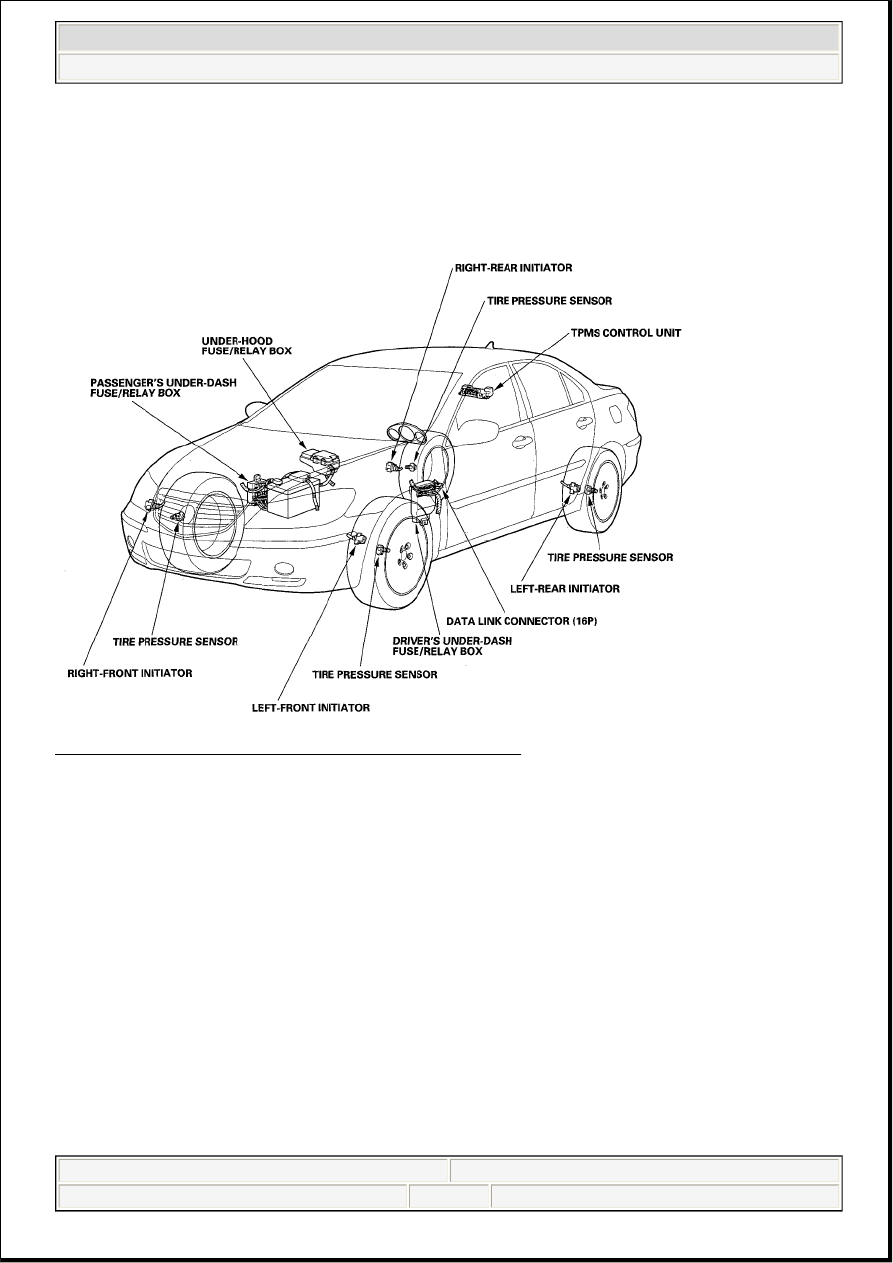
COMPONENT LOCATION INDEX 

Fig. 1: Identifying TPMS (Tire Pressure Monitoring System) 
Courtesy of AMERICAN HONDA MOTOR CO., INC. 

GENERAL TROUBLESHOOTING INFORMATION 

SYSTEM INDICATOR LOCATION 


2007 Acura RL 

2005-08 SUSPENSION TPMS (Tire Pressure Monitoring System) - RL


2007 Acura RL 

2005-08 SUSPENSION TPMS (Tire Pressure Monitoring System) - RL


me 


Friday, June 05, 2009 3:22:24 PM

Page 1 

© 2005 Mitchell Repair Information Company, LLC. 

me 


Friday, June 05, 2009 3:22:36 PM

Page 1 

© 2005 Mitchell Repair Information Company, LLC. 

Fig. 2: Identifying Multi-Information Display 
Courtesy of AMERICAN HONDA MOTOR CO., INC. 

HOW TPMS WORKS ('05-07 MODELS) 

The TPMS (Tire Pressure Monitoring System) has many indicators: a low tire pressure indicator (LED 
indicator), a system indicator, and the tire(s) indicator (shown on the multi-information display). When the 
TPMS control unit detects low pressure in a tire or a problem in the system, it turns on the appropriate 
indicator(s). 

If low tire pressure is detected, the low tire pressure indicator and the appropriate tire indicator come 
on.  

If a problem in the system is detected, the TPMS indicator comes on.  

If low tire pressure and a problem in the system are detected, only the TPMS indicator comes on.  

If the system is OK, the low tire pressure indicator should come on when you turn the ignition switch ON 
(II), and then go off 2 seconds later. If it doesn't, there is a problem with the system. 

If the system detects low pressure in any of the four tires, the low tire pressure indicator comes on and the 
appropriate tire(s) indicator will show on the multi-information display, and the control unit will set one or 
more of these codes: DTC 11,13,15,17. When the tire pressure returns to normal, the control unit will turn 
off the indicators and store the DTC(s). However, if the control unit detects a problem in the system during 
an indication of low tire pressure, it will turn off the low pressure and tire(s) indicators, store the DTC(s), 
and turn on the TPMS indicator. 


2007 Acura RL 

2005-08 SUSPENSION TPMS (Tire Pressure Monitoring System) - RL


me 


Friday, June 05, 2009 3:22:24 PM

Page 2 

© 2005 Mitchell Repair Information Company, LLC. 

If a problem is detected in the system, the TPMS indicator will come on and stay on until the system returns 
to normal with most DTCs. If DTC 45,51,53,55, 57, 81,83, or 85 is set, the TPMS indicator will go off only 
when the ignition switch is turned off. 

If a flat tire is replaced with the spare tire, and the flat tire is stored in the cargo area, the low tire pressure 
indicator will stay on but the appropriate tire indicator will go off. This prevents the client from thinking 
there is a problem with the spare tire. When the flat tire is taken out of the vehicle for repair, the TPMS 
indicator will come on showing a (DTC 32,34, 36, or 38) because the system is no longer receiving the 
signal from the tire's transmitter. 

HOW TPMS WORKS ('08 MODEL) 

The TPMS (Tire Pressure Monitoring System) has many indicators: a low tire pressure indicator (LED 
indicator), a system indicator, and the tire(s) indicator (shown on the multi-information display). When the 
TPMS control unit detects low pressure in a tire or a problem in the system, it turns on, or blinks the 
appropriate indicator(s). 

If low tire pressure is detected, the low tire pressure indicator and the appropriate tire indicator come 
on.  

If a problem in the system is detected, the TPMS indicator comes on, and the low tire pressure 
indicator comes on after blinking for about 75 seconds.  

If low tire pressure and a problem in the system are detected the TPMS indicator comes on, and the 
low tire pressure indicator comes on after blinking for 75 seconds. In this case the low tire pressure 
indicator will be warming of the system failure.  

If the system is OK, the low tire pressure indicator should come on when you turn the ignition switch ON 
(II), and then go off 2 seconds later. If it doesn't, there is a problem with the system. 

If the system detects low pressure in any of the four tires, the low tire pressure indicator comes on and the 
appropriate tire indicator(s) will show on the multi-information display, and the control unit will set one or 
more of these codes: DTC 11,13,15,17. When the tire pressure returns to normal, the control unit will turn 
off the indicators and store the DTC(s). However, if the control unit detects a problem in the system during 
an indication of low tire pressure, it will turn off the tire indicators, store the DTC(s), and turn on the TPMS 
indicator and the low tire pressure indicator after blinking. 

NOTE:

Tire pressures will increase slightly as the temperature in the tires rises 
during driving at highway speeds. Pressures will also increase or decrease 
slightly with changes in outside air temperature. A temperature change of 
about 50°F (10°C) will change tire pressure by about 10 kPa (0.1 kgf/cm

2

 , 1.5 

psi). If the temperature drops and then rises, tire pressure could decrease 
just enough to turn on the low pressure and tire(s) indicators, but later 
increase enough to turn them off. To resolve a complaint of such intermittent 
indications, confirm and clear the stored DTC(s) and check the tire 
pressures. Then explain to the client how temperature changes can affect 
the system, especially when tire pressures are near the low end of the TPMS 
normal range - 168 to 220 kPa (1.7 to 2.2 kgf/cm

2

 , 24 to 32 psi).

NOTE:

Tire pressures will increase slightly as the temperature in the tires rises 
during driving at highway speeds. Pressures will also increase or decrease 


2007 Acura RL 

2005-08 SUSPENSION TPMS (Tire Pressure Monitoring System) - RL


me 


Friday, June 05, 2009 3:22:24 PM

Page 3 

© 2005 Mitchell Repair Information Company, LLC. 

If a problem is detected in the system, the TPMS indicator and the low tire pressure indicator (start blinking) 
will come on and stay on until the system returns to normal with most DTCs. If DTC 45, 51,53, 55, 57, 
81,83, or 85 is set, the TPMS indicator will go off only when the ignition switch is turned off. 

If a flat tire is replaced with the spare tire, and the flat tire is stored in the cargo area, the low tire pressure 
indicator will stay on but the appropriate tire indicator will go off. This prevents the client from thinking 
there is a problem with the spare tire. When the flat tire is taken out of the vehicle for repair, the TPMS 
indicator and the low tire pressure indicator (start blinking) will come on showing a (DTC 32,34,36, or 38) 
because the system is no longer receiving the signal from the tire's transmitter. 

PROBLEMS THAT ARE NOT SYSTEM FAULTS 

Tire Sealant 

Fluid sealant used to repair a punctured tire can damage the tire pressure sensor mounted on each 
wheel. It can prevent the system from detecting the correct tire pressure, which sets a DTC 11,13,15, 
or 17 even though the system is normal. 

Cold Weather 

When the weather is extremely cold - about -40°F (-40°C) or colder - the output of the lithium battery 
in each tire pressure sensor may drop far enough that the control unit sets a DTC for low battery 
voltage (31, 33,35, or 37) even though the system is normal. 

Non-TPMS Wheels 

Vehicles equipped with TPMS (including PAX system) must use wheels made for the system. Every 
TPMS wheel is marked with the letters TPMS or PAX System; do not use any other type of wheel. 

HOW A DIAGNOSTIC TROUBLE CODE (DTC) IS SET ('05-07 MODELS) 

When the system detects a problem, the TPMS control unit sets a code, but shifts to fail-safe mode, 
and will not alert the driver to low tire pressures.  

If the TPMS control unit loses power, or fails, the TPMS indicator will come on, but no DTC will be 
set.  

The memory can hold all the DTCs that could possibly be set. However, when the same DTC is 
detected more than once, the most recent one overwrites the previous one, so only the latest DTC of 
each type is stored.  

DTCs are indicated in ascending order, not in the order they occurred. 

slightly with changes in outside air temperature. A temperature change of 
about 50°F (10°C) will change tire pressure by about 10 kPa (0.1 kgf/cm

2

 ,1.5 

psi). If the temperature drops and then rises, tire pressure could decrease 
just enough to turn on the low pressure and tire(s) indicators, but later 
increase enough to turn them off. To resolve a complaint of such intermittent 
indications, confirm and clear the stored DTC(s) and check the tire 
pressures. Then explain to the client how temperature changes can affect 
the system, especially when tire pressures are near the low end of the TPMS 
normal range - 168 to 220 kPa (1.7 to 2.2 kgf/cm

2

 , 24 to 32 psi).


2007 Acura RL 

2005-08 SUSPENSION TPMS (Tire Pressure Monitoring System) - RL


me 


Friday, June 05, 2009 3:22:24 PM

Page 4 

© 2005 Mitchell Repair Information Company, LLC. 


Content   ..  835  836  837  838   ..