Acura RL. Manual - part 372
 

  Index      Acura     Acura RL - service repair manual 2005-2008 year


Search            


Content   ..  370  371  372  373   ..


Acura RL. Manual - part 372


2005-08 BRAKES

Conventional Brake Components - RL 

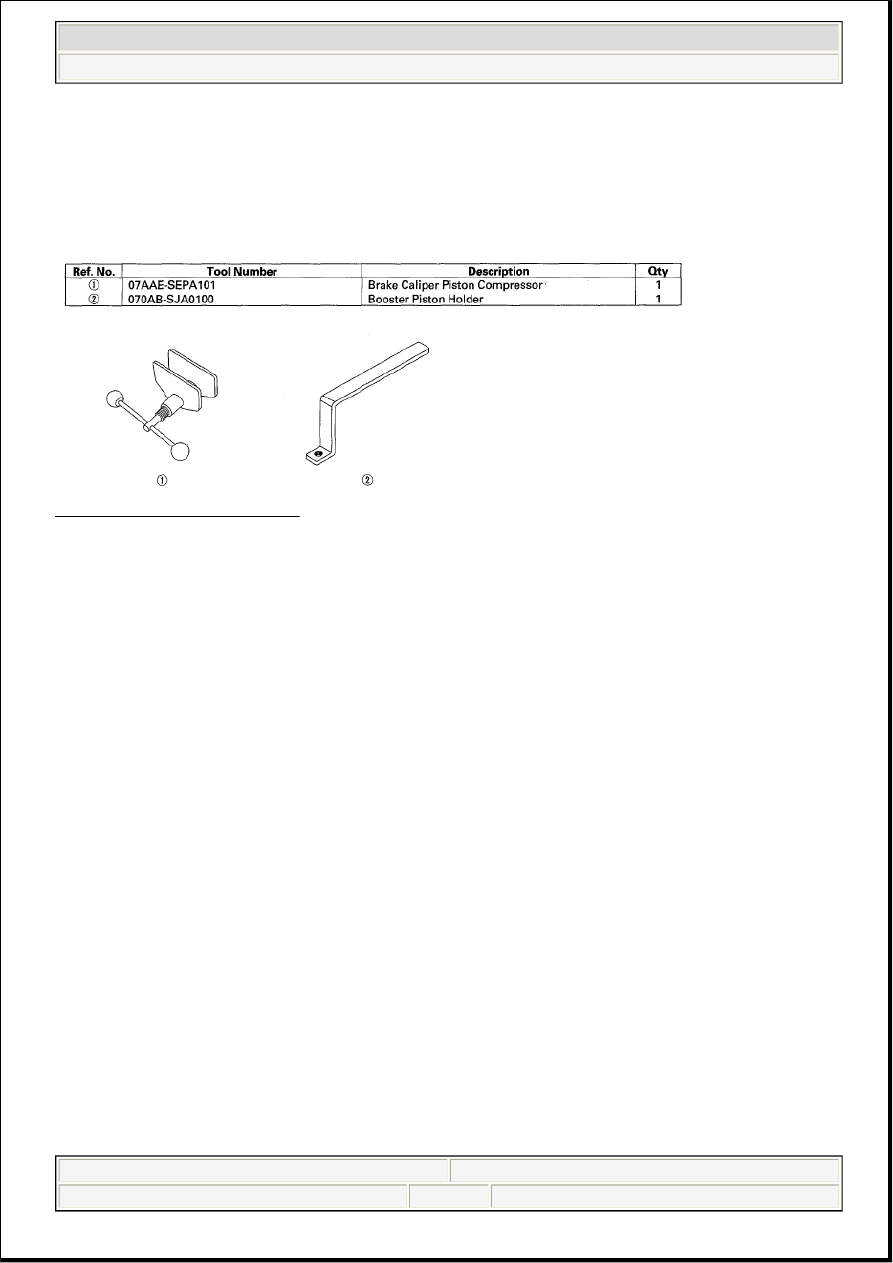
SPECIAL TOOLS 

Fig. 1: Identifying Special Tools 
Courtesy of AMERICAN HONDA MOTOR CO., INC. 

COMPONENT LOCATION INDEX


2007 Acura RL 

2005-08 BRAKES Conventional Brake Components - RL


2007 Acura RL 

2005-08 BRAKES Conventional Brake Components - RL


me 


Friday, June 05, 2009 3:00:06 PM

Page 1 

© 2005 Mitchell Repair Information Company, LLC. 

me 


Friday, June 05, 2009 3:00:11 PM

Page 1 

© 2005 Mitchell Repair Information Company, LLC. 

Fig. 2: Identifying Conventional Brakes Components Location 
Courtesy of AMERICAN HONDA MOTOR CO., INC. 

BRAKE SYSTEM INSPECTION AND TEST 

Inspect the brake system components listed. Repair or replace any parts that are leaking or damaged. 

Component Inspections:  

COMPONENT INSPECTIONS CHART 

Component

Procedure

Also check for:

Master Cylinder

Look for damage or signs of fluid 
leakage at: 

Reservoir or master cylinder 
body.  

Line joints.  

Between master cylinder and 

Bulging seal at reservoir cap. This is a 
sign of fluid contamination.


2007 Acura RL 

2005-08 BRAKES Conventional Brake Components - RL


me 


Friday, June 05, 2009 3:00:06 PM

Page 2 

© 2005 Mitchell Repair Information Company, LLC. 

BRAKE SYSTEM TEST 

Brake pedal sinks/fades when braking 

1. Set the parking brake, and start the engine, then turn off the A/C switch. Allow the engine to warm up 

to normal operating temperature (radiator fan comes on twice).  

2. Attach a 50 mm (2 in.) piece of masking tape along the bottom of the steering wheel, and draw a 

horizontal reference mark across it.  

3. With the transmission in the P or N position, press and hold the brake pedal lightly (about the same 

pressure needed to keep an A/T-equipped car from creeping), then release the parking brake.  

4. While still holding the brake pedal, hook the end of the tape measure behind the brake pedal, then pull 

the tape up to the steering wheel, noting where the tape measure lines up with the reference mark you 
made on the masking tape.  

5. Apply steady pressure to the brake pedal for 3 minutes.  

6. Watch the tape measure. 

If it moves less than 10 mm (3/8 in.), the master cylinder is OK.  

If it moves more than 10 mm (3/8 in.), replace the master cylinder.  

SYMPTOM TROUBLESHOOTING 

RAPID BRAKE PAD WEAR, VEHICLE VIBRATION (AFTER A LONG DRIVE), OR HIGH, 
HARD BRAKE PEDAL 

1. Drive the vehicle until the brakes drag or until the pedal is high and hard. This can take 20 or more 

brake pedal applications during an extended test-drive.  

2. With the engine running, raise the vehicle on a lift, and spin all four wheels by hand. 

booster.  

Brake Hoses

Look for damage or signs of fluid 
leakage at: 

Line joints and line joints 
connections.  

Hoses and lines, also inspect for 
twisting or damage.  

Bulging, twisted, or bent lines.

Caliper

Look for damage or signs of fluid 
leakage at: 

Piston seal.  

Line joints connections.  

Bleeder screw.  

Seized or sticking caliper pins.

VSA Modulator-
Control Unit

Look for damage or signs of fluid 
leakage at: 

Line joints.  

Modulator-control unit.  


2007 Acura RL 

2005-08 BRAKES Conventional Brake Components - RL


me 


Friday, June 05, 2009 3:00:06 PM

Page 3 

© 2005 Mitchell Repair Information Company, LLC. 

Is there brake drag at any of the wheels?

YES -Go to step 3. 

NO -Look for other causes of the pad wear, high pedal, or vehicle vibration. 

3. Turn the engine off, pump the brake pedal to deplete the vacuum in the brake booster, and then spin 

the wheels again to check for brake drag. 

Is there brake drag at any of the wheels?  

YES -Go to step 4. 

NO -Replace the brake booster. 

4. Without removing the brake lines, unbolt and separate the master cylinder from the booster, then spin 

the wheels to check for brake drag. 

Is there brake drag at any of the wheels?  

YES -Go to step 5. 

NO -Check the brake pedal position switch adjustment and pedal free play (see BRAKE PEDAL 
AND BRAKE PEDAL POSITION SWITCH ADJUSTMENT
 ). 

5. Loosen the hydraulic lines at the master cylinder, then spin the wheels to check for brake drag. 

Is there brake drag at any of the wheels?  

YES -Go to step 6. 

NO -Replace the master cylinder (see MASTER CYLINDER REPLACEMENT ). 

6. Loosen the breeder screws at each caliper, then spin the wheels to check for brake drag. 

Is there brake drag at any of the wheels?  

YES -Disassemble and repair the caliper on the wheel(s) with brake drag. 

NO -Look for a bulging master cylinder cap seal, discolored or contaminated brake fluid in the master 
cylinder, or damaged brake lines. If any of these items are damaged, replace them. If all of these items 
are OK, replace the VSA modulator-control unit (see VSA MODULATOR-CONTROL UNIT 
REMOVAL AND INSTALLATION
 ). 

BRAKE PEDAL AND BRAKE PEDAL POSITION SWITCH ADJUSTMENT 

PEDAL HEIGHT 

1. Turn the brake pedal position switch (A) counterclockwise, and pull it back until it is no longer 

touching the brake pedal. 


2007 Acura RL 

2005-08 BRAKES Conventional Brake Components - RL


me 


Friday, June 05, 2009 3:00:06 PM

Page 4 

© 2005 Mitchell Repair Information Company, LLC. 


Content   ..  370  371  372  373   ..