Moroccan Arabic Textbook (2011) - page 1
Table of Contents
Introduction
Learning Moroccan Arabic
1
Transcription of Moroccan Arabic
1
Getting Started with Moroccan Arabic
Greetings
5
Independent Pronouns
7
Possessive Pronouns
8
Masculine and Feminine Nouns
9
Describing Yourself
Nationalities, Cities, and Marital Status
10
The Possessive Word ―dyal‖
13
Demonstrative Adjectives & Demonstrative Pronouns
14
Asking about Possession
17
Useful Expressions
19
Numerals
Cardinal Numbers
22
Ordinal Numbers / Fractions
29
Time
30
Getting Started Shopping
Money
33
At the Hanoot
34
Verb ―to want‖
36
Kayn for ―There is‖
37
Family
Family Members
38
Verb ―to have‖
40
Directions
Prepositions
42
Directions
43
Past Events
Time Vocabulary
45
Past Tense - Regular Verbs
46
Past Tense - Irregular Verbs
48
Negation
52
Have you ever... / I‘ve never
54
Object Pronouns
55
Question Words
56
Daily Routines
Present Tense - Regular Verbs
58
Present Tense - Irregular Verbs with Middle ―a‖
60
Present Tense - Irregular Verbs with Final ―a‖
64
Using One Verb after Another
68
The Imperative
69
Bargaining
Bargaining
71
Clothing
73
Adjectives
78
Comparative and Superlative Adjectives
81
Shopping For Food
Fruits and Vegetables
84
Buying Produce
86
Spices and Meat
88
Food and Drink
Food and Drink
89
The Reflexive verb ―to please / to like‖
92
The Verb ―to need, to have to, must, should‖
95
The Verb ―to want, to like‖
96
Medical & Body
Body Parts
97
Health Problems
98
Site Visit Expressions
100
Travel
Future Tense
102
Travel
106
At the Hotel
Hotel Accommodation
110
The Conditional
111
At the Post Office
The Post Office
113
Using Prepositions with Pronoun Endings & Verbs
115
Describing the Peace Corps Mission
Peace Corps
120
Youth Development
121
Environment
122
Health
123
Small Business Development
124
Renting a House
Finding a House
125
Furnishing a House
127
Safety and Security
Sexual Harassment
129
At the Taxi Stand
131
At Work
132
Forgetting a Wallet in a Taxi / Filing a Report
133
Butagas
135
Hash
136
Theft
137
House Security / Doors and Windows
139
Political Harassment
141
Appendices
Pronunciation of Moroccan Arabic
Understanding How Sounds Are Made
144
Pronunciation of Non-English Consonants
144
Pronunciation of Shedda
146
The Definite Article
147
Supplementary Grammar Lessons
Making Intransitive Verbs into Transitive Verbs
148
Passive Verbs
149
The Past Progressive
150
The Verb ―to remain‖
151
Verb Participles
151
Conjunctions
154
More Useful Expressions
157
Moroccan Holidays
Religious Holidays
159
National Holidays
162
Glossary of Verbs
163
Grammar Index
193
Vocabulary Index
194
Introduction
Learning Moroccan Arabic
Even under the best conditions, learning a new language can be challenging. Add to this challenge the
rigors of Peace Corps training, and you‘re faced with what will be one of the most demanding-and
rewarding-aspects of your Peace Corps experience: learning to communicate to Moroccans in their
own language. But it can be done. And rest assured that you can do it. Here are a few reasons why:
You are immersed in the language: Some people may need to hear a word three times to
remember it; others may need thirty. Learning Moroccan Arabic while living and training with
Moroccans gives you the chance to hear the language used again and again.
You have daily language classes with Moroccan teachers: You‘re not only immersed in
the language; you also have the opportunity to receive feedback from native speakers on the
many questions that predictably crop up when one learns a new language.
Peace Corps has over forty years of experience in Morocco: Your training, including
this manual, benefits from the collective experience gained by training thousands of Americans
to live and work in Morocco. You will benefit from and contribute to that legacy.
Despite these advantages, at times you may still feel like the task of learning Moroccan Arabic is too
much to handle. Remember that volunteers like you having been doing it for decades, however. One of
the most rewarding aspects of your time will be communicating with Moroccans in Arabic, surprising
them and yourself with how well you know the language. When that time arrives, your hard work will
have been worth it.
Transcription of Moroccan Arabic
In order for trainees to move quickly into Moroccan Arabic (also called ―Darija‖), Peace Corps uses a
system of transcription that substitutes characters of the Latin alphabet (a, b, c, d, . . . ) for characters
from Arabic script (
). With this system, it isn‘t necessary for a trainee to learn all of
Arabic script before he or she begins to learn the language. On the contrary, once you become familiar
with the system of transcription, you will be able to ―read‖ and ―write‖ Moroccan Arabic fairly quickly-
using characters you are familiar with. You will also learn Arabic script during training, but with
transcription it isn‘t necessary to know it right away. Throughout the book, therefore, you will always
see both the original Arabic script and the transcription. Becoming familiar with the Peace
Corps’ system of transcription is one of the best things you can do, early on, to help
yourself learn Moroccan Arabic. Practicing the different sounds of Moroccan Arabic
until you can reproduce them is another. This introduction is intended mainly to help you get
started with the system of transcription, and as a result it will mention only briefly the different sounds
of Arabic. However, a fuller explanation can be found on page 144.
Sounds You Already Know
The large majority of consonants in Moroccan Arabic are similar to sounds that we have in English.
The vowels in Arabic are also similar to English vowels. In the following table, each transcription
character that represents a sound you already know will be explained. The sounds are not
necessarily what you may expect, but each character was matched with a sound for good reasons.
Transcription
Arabic
Description
Character
Character
a
sometimes the /ä/ in “father,” sometimes the /a/ in “mad”
b
the normal English sound /b/
d
the normal English sound /d/
the short “e” sound /e/ as in “met” (this transcription character is not used
e
often, only when confusion would be caused by using the transcription character “a”)
2 • Moroccan Arabic
f
the normal English sound /f/
g
the normal English sound /g/ as in “go”
h
the normal English sound /h/ as in “hi.”
i
the long “ee” sound /ē/ as in “meet”
j
the /zh/ sound represented by the „s‟ in “pleasure”
k
the normal English sound /k/
l
the normal English sound /l/
m
the normal English sound /m/
n
the normal English sound /n/
the long “o” sound /ō/ as in “bone” (this transcription character is not used
o
often, mainly for French words that have entered Moroccan Arabic)
p
the normal English sound /p/
this is not the normal English “r,” but a “flap” similar to the Spanish
r
“r” or to the sound Americans make when they quickly say “gotta”
as in “I gotta go.”
s
the normal English sound /s/
t
the normal English sound /t/
u
the long “oo” sound /ü/ as in “food”
v
the normal English sound /v/
w
the normal English sound /w/
y
the normal English sound /y/
z
the normal English sound /z/
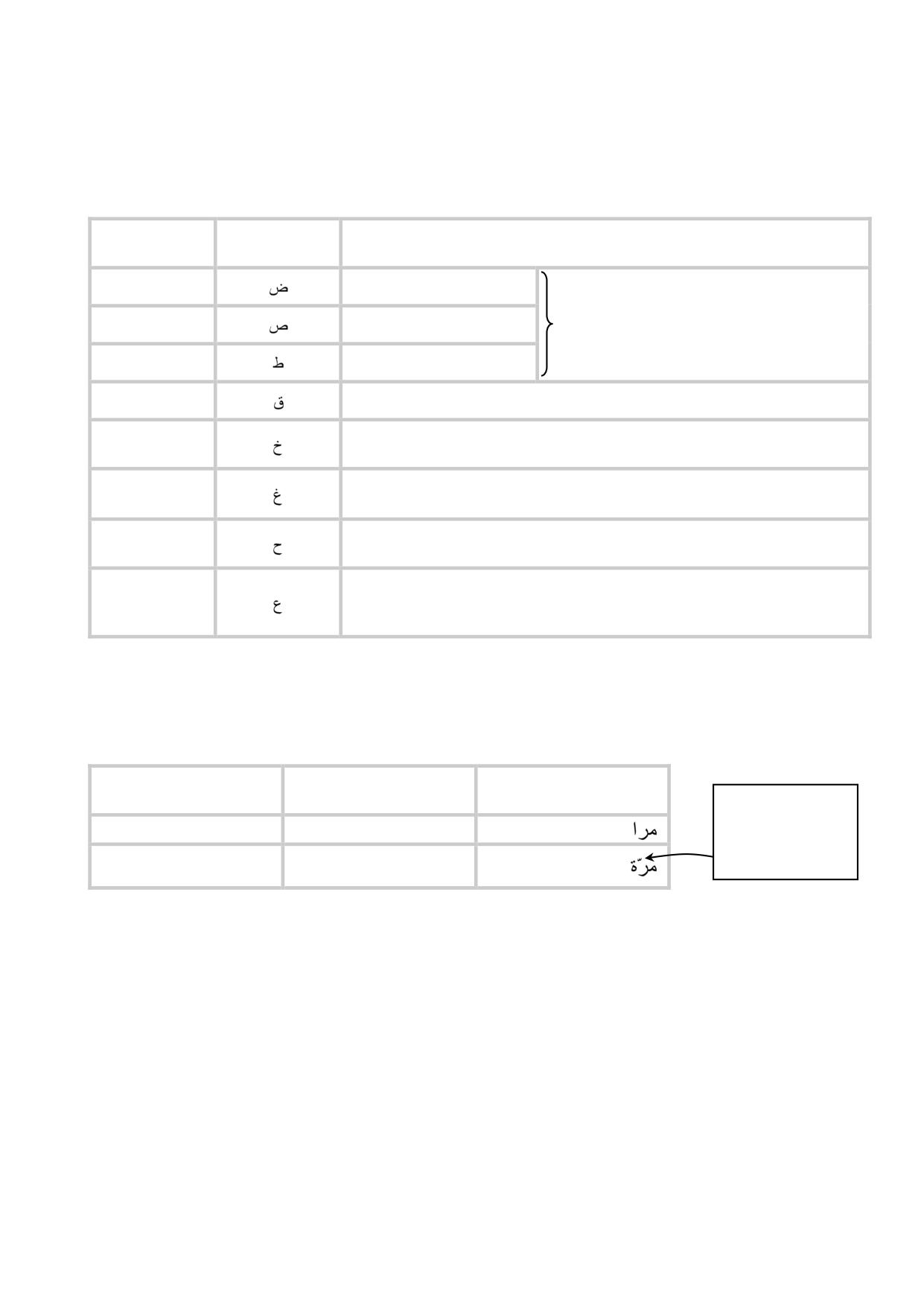
š
the normal English sound /sh/ as in “she”
Some vowel combinations
ay
the “ay” as in “say”
au
the “ow” as in “cow”
iu
the “ee you” as in “see you later”
3
New Sounds
There are eight consonants in Moroccan Arabic that we do not have in English. It may take you some
time to be able to pronounce these correctly. At this point, what‘s important is that you learn the
transcription character for each of these sounds. See page 144 for more information on how to
pronounce the sounds in Moroccan Arabic.
Transcription
Arabic
Sound
Character
Character
d
the Arabic emphatic “d”
These sounds are pronounced like their
non-emphatic counterparts, but with a
s
the Arabic emphatic “s”
lower pitch and a greater tension in the
tongue and throat.
t
the Arabic emphatic “t”
q
like the English /k/ but pronounced further back in the throat
like the „ch‟ in the German “Bach;” some people use this sound to
x
say yech!
like the x sound above, but pronounced using your voice box;
ġ
similar to the French “r”
like the English “h,” except pronounce deep in the throat as a loud
н
raspy whisper.
This sound will be difficult at first. It can be approximated by
ع
pronouncing the „a‟ in “fat” with the tongue against the bottom of the
mouth and from as deep in the throat as possible
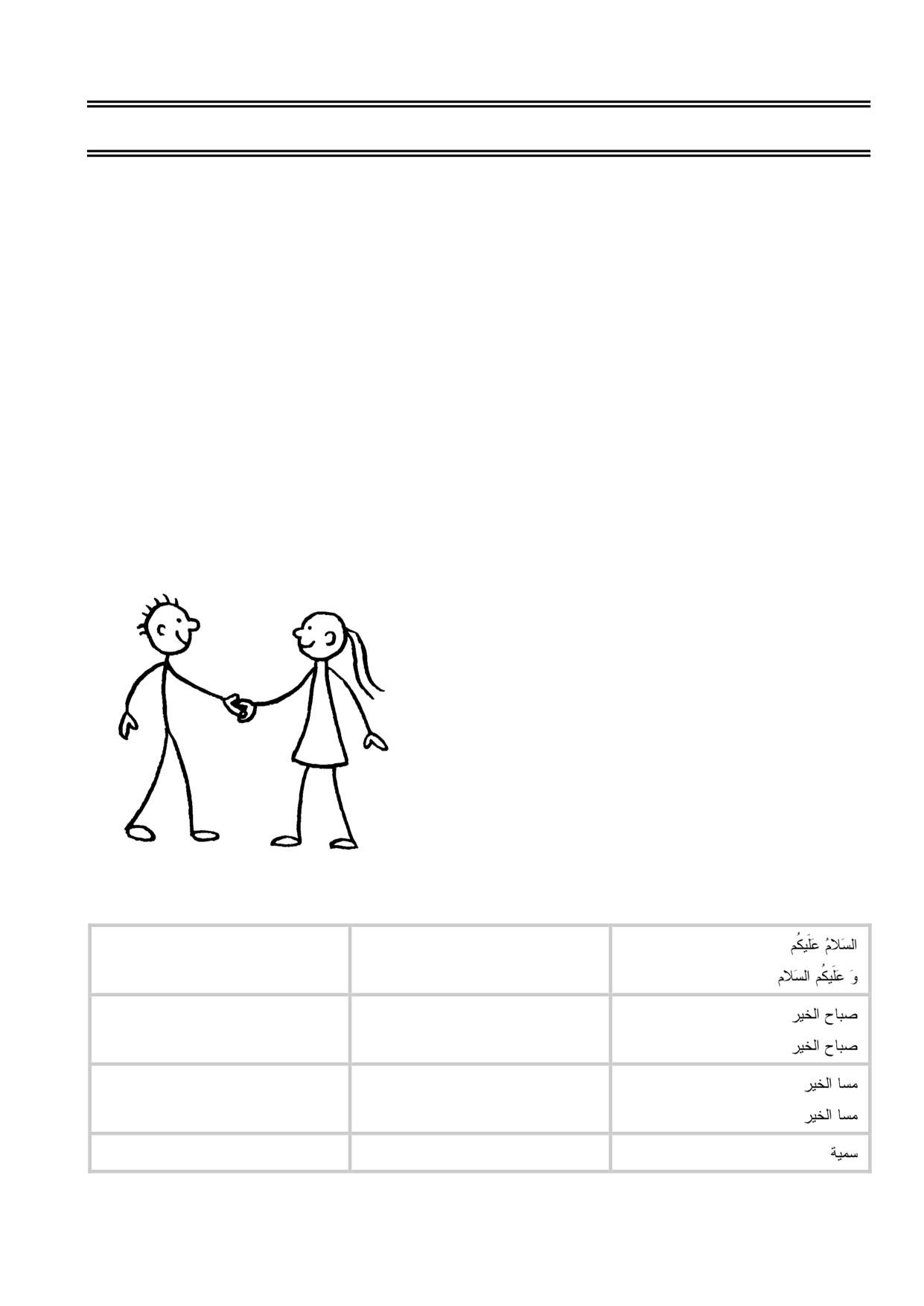
Shedda
If you see a transcription character doubled, that means that a ―shedda‖ is over that character in
the Arabic script. For example, in the following table, you will see how the transcription changes for
―shedda,‖ and thus the pronunciation.
English
Arabic
Transcription
Translation
Script
This small character,
which looks like a “w,”
woman
mra
is the shedda. That is
why the transcription
time (as in: “I‟ve seen
has a doubled “r.”
mrra
him one time”)
Notice that these two words are spelled differently in the transcription. The word ―woman‖ does not
have a shedda on the ―r‖ in Arabic script, and that is why there is only one ―r‖ in the transcription. The
word ―time‖ does have a shedda in the Arabic script, and that is why the transcription doubles the
letter ―r.‖ These two words are pronounced differently, so you must pay attention to
doubled letters in transcription. To learn more about how we pronounce the shedda in Arabic,
see page 146. For now, what‘s important is that you understand the transcription.
4 • Moroccan Arabic
Other Symbols
Sometimes, you will see a hyphen used in the transcription. This has three purposes:
1. It indicates the definite article: For some letters, the definite article (the word ―the‖) is
made by adding the letter ―l.‖ For others, it is made by doubling the first letter. In both cases, a
hyphen will be used to indicate to you that the word has the definite article in front of it. See
page 147 for more info on the definite article.
2. It connects the present tense prefix: The present tense prefix (―kan,‖ ―kat,‖ or ―kay‖) will
be connected to the verb with a hyphen. This will make it easier for you to understand what
verb you are looking at.
3. It connects the negative prefix (“ma”) and the negative suffix (“š”) to a verb.
In these instances, the hyphen does not necessarily indicate a change in pronunciation. The
hyphen is there to make it easy for you to see when a definite article is being used, for example, or
which verb is being used. It is a visual indicator, not an indicator of pronunciation. Sometimes the
rhythm of speech may seem to break with the hyphen; other times the letters before and after the
hyphen will be pronounced together.
Another symbol you will sometimes see is the apostrophe ( ' ). When you see an apostrophe, it
indicates a ―glottal stop,‖ which is the break between vowels as heard in the English exclamation ―uh
oh.‖ That is to say, if you see an apostrophe you should not connect the sounds before the apostrophe
with the sounds after the apostrophe. Pronounce them with a break in the middle.
Words & Syllables Without Vowels
Sometimes you will see syllables or even whole words without any vowels written in them. This is
normal in Moroccan Arabic. To the English speaker, however, this seems impossible, since we have
always been taught that all words must contain a vowel sound. Which side is correct? Well, in a sense
they both are. In reality, it is indeed possible to pronounce consonants together without articulating a
vowel sound; we do it a lot in English at the beginning of words. Think about the word street. We
pronounce three consonants-s, t, and r-without any vowels between them. So it is possible. The only
challenge with Arabic is that the consonant combinations are new for English speakers (we don‘t put
the /sh/ sound next to the /m/ sound, for example, but in Arabic they do).
However, try for a moment to pronounce only the letters ―str,‖ not the whole word ―street.‖ In this
case, most English speakers will hear something that sounds like the word ―stir.‖ With certain
consonant combinations, that is to say, it sounds to the English speaker like there is a vowel in the
middle, even if there isn‘t. The ―vowel‖ is in reality just the normal sound made as one consonant
sound transitions to another.
Part of learning Moroccan Arabic is becoming comfortable with new consonant combinations and
practicing those combinations without necessarily placing a vowel in the middle. The transcription
words, you will notice, only include characters for vowels when there really is a vowel in the word. It
may seem difficult at first, but it is better to accustom yourself to this as early as you can.
Why Not Just Write “sh”?
A final point about the transcription. At times it may seem overly complicated to someone beginning
Moroccan Arabic. For example, why doesn‘t it just use ―sh‖ for the /sh/ sound? The answer is this:
every sound must have just a single character to represent it. Why? Well, in Arabic it is normal for the
/h/ sound to follow the /s/ sound. If we used ―sh‖ to represent the /sh/ sound, there would not be any
way to represent an /s/ plus /h/ sound, because it too would look like ―sh.‖ Using the symbol š to
represent /sh/ makes it possible to represent /s/ plus /h/ and /sh/ plus /h/ (yes, in Arabic both these
combinations are used).
All of this concerns a larger point: the transcription system used in this book may appear
complex at first, but it has been carefully thought out and in the end it is the easiest system
possible. That said, the sooner you can make the transition to reading Arabic script, the easier it will be
to pronounce Arabic correctly.
5
Getting Started with Moroccan Arabic
Objective: By the end of the chapter, you will be able to:
• greet people and introduce yourself
• use independent pronouns to make simple sentences
• use possessive pronouns to indicate possession
• distinguish between masculine and feminine nouns
Greetings
Cultural Points
Greetings and farewells (good byes) are two important aspects of Moroccan life. Greetings are
not to be compared with the quick American ―hi.‖ It takes time for two people to exchange different
questions and answers which interest them about each other, their families, and life in general.
Greetings change from one region to another, both in the questions posed and in the fashion of the
greeting (i.e. shaking hands, kissing cheeks head or hands, or putting one‘s hand over one‘s heart after
shaking hands).
If you greet a group of people, then the way you greet the first person is the way you should greet
everyone in the group. Don‘t be surprised if you are greeted by a friend but he does not introduce you
to other people with whom he may be talking. Do not be surprised if you are in a group and you are not
greeted as others are in the group (people may be shy to greet a stranger.) It is also not necessary to
give an overly detailed response to a greeting-only the usual response is expected. For example, ―How
are you?‖ requires only a simple ―Fine, thanks be to God.‖
How do people greet each
other in different cultures?
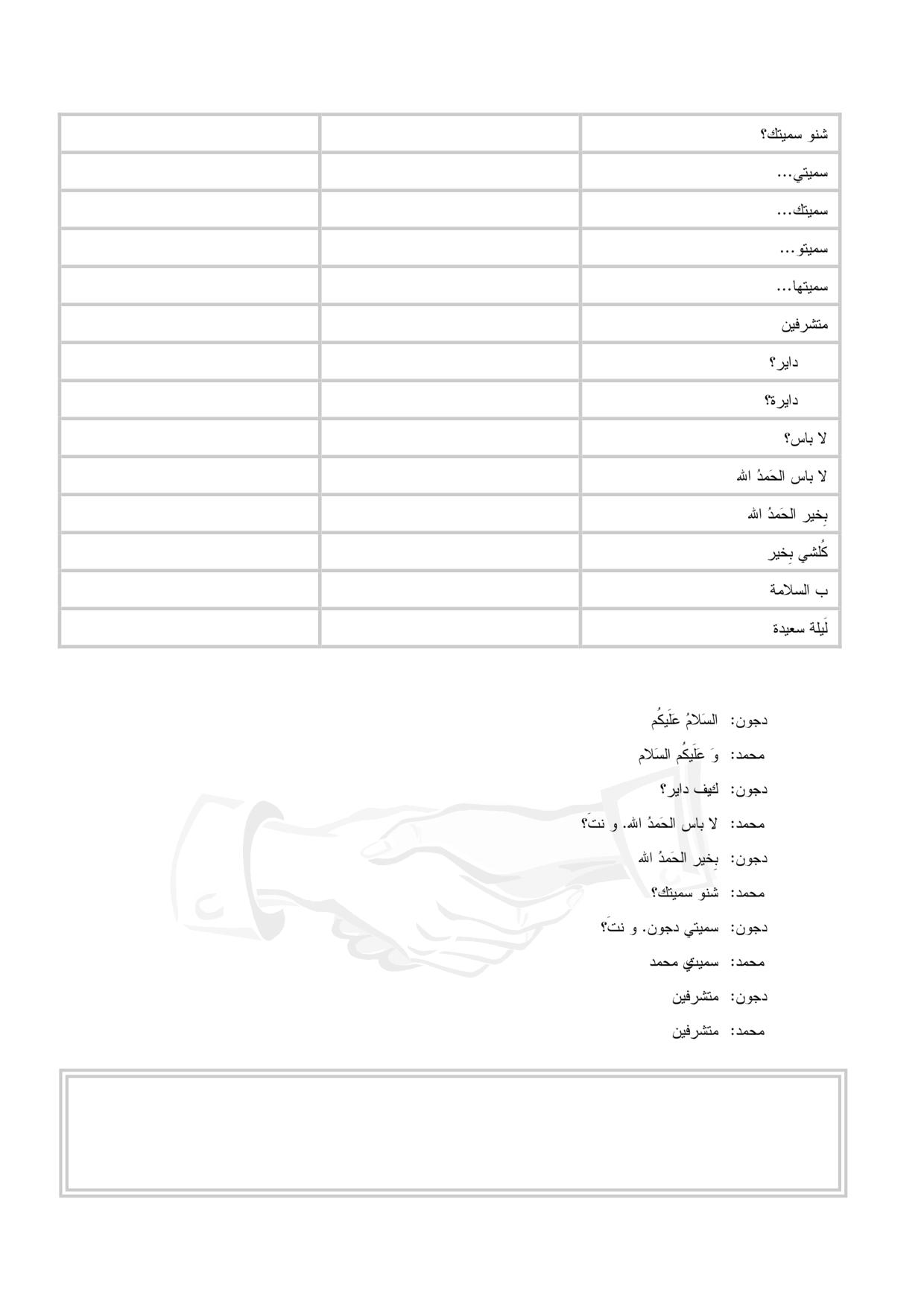
Greeting expressions and appropriate responses
A: Peace be upon you
s-salamu عalaykum
B: And peace be upon you (too)
wa عalaykum s-salam
A: Good morning
sbaн l-xir
B: Good morning
sbaн l-xir
A: Good afternoon / evening
msa l-xir
B: Good afternoon / evening
msa l-xir
name
smiya
6 • Moroccan Arabic
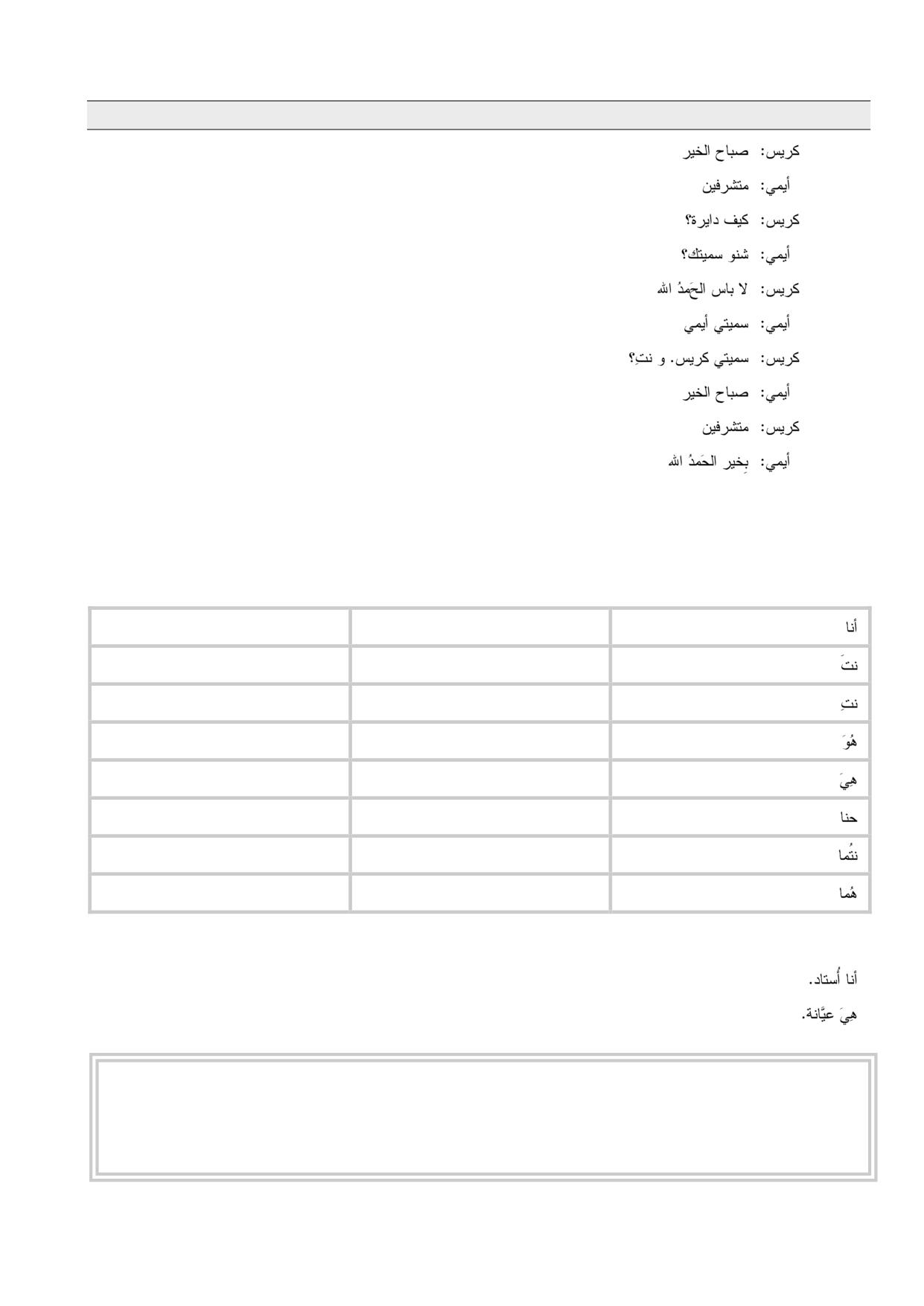
What‟s your name?
šnu smitk?
my name...
smiti...
your name...
smitk...
his name...
smitu...
her name...
smitha...
Nice to meet you.
mtšrfin
How are you (masc.)?
kif dayr?
يـك
How are you (fem.)?
kif dayra?
يـك
Are you fine?
labas?
Good, thanks be to God.
labas, l-нamdullah
Good, thanks be to God.
bixir, l-нamdullah
Everything is fine.
kulši bixir
Good-bye
bslama
Good night
layla saعida
Greetings Dialogue
John: s-salamu عalaykum.
Mohamed: wa عalaykum s-salam.
John: kif dayr?
Mohamed: labas, l-нamdullah. u nta?
John: bixir, l-нamdullah.
Mohamed: šnu smitk?
John: smiti John. u nta?
Mohamed: smiti Mohamed.
John: mtšrfin.
Mohamed: mtšrfin.
Transcription Reminder - see page 1 for the full table with all transcription characters.
š: the /sh/ sound as in “she”
a: the „a‟ in “father” or the „a‟ in “mad”
x: the „ch‟ in the German “Bach” or the
i: the „ee‟ in “meet”
Scottish “loch” See page144.
u: the „oo‟ in “food”
7
Exercise: Put this dialogue in the correct order.
Chris: sbaн l-xir.
Amy: mtšrfin.
Chris: kif dayra?
Amy: šnu smitk?
Chris: labas, l-нamdullah.
Amy: smiti Amy.
Chris: smiti Chris. u nti?
Amy: sbaн l-xir.
Chris: mtšrfin.
Amy: bixir, l-нamdullah. u nta?
Independent Pronouns
We call the following pronouns ―independent‖ because they are not attached to other words, such as
nouns, verbs, or prepositions (see ―Possessive Pronouns,‖ next page, and ―Object Pronouns,‖ page 55).
The pronouns are often used in a number of different ways.
I
ana
you (masc. singular)
nta
you (fem. singular)
nti
he
huwa
she
hiya
we
нna
you (plural)
ntuma
they
huma
When they are followed by a noun or an adjective, the verb ―to be‖ is not necessary. It is implied
already, and simple sentences can be made by using independent pronouns with a nouns or adjectives.
I am a teacher.
ana ustad.
She is tired.
hiya عiyana.
Transcription Reminder - see page 1 for the full table with all transcription characters.
h: the normal English /h/ sound as in
н: like the English “h,” except pronounce it
“hello.”
deep in the throat as a loud raspy
whisper. See page 145.
8 • Moroccan Arabic
Possessive Pronouns
In Darija, a suffix (ending) may be added to the end of words in order to express possession.
my
i / ya*
your (singular)
k
his
u / h*
her
ha
our
na
your (plural)
kum
their
hum
* For the ―my‖ and ―his‖ forms, the first ending is used for words ending in consonants, while the
second is used with words ending in vowels. For example, smiti (my name), but xuya (my brother).
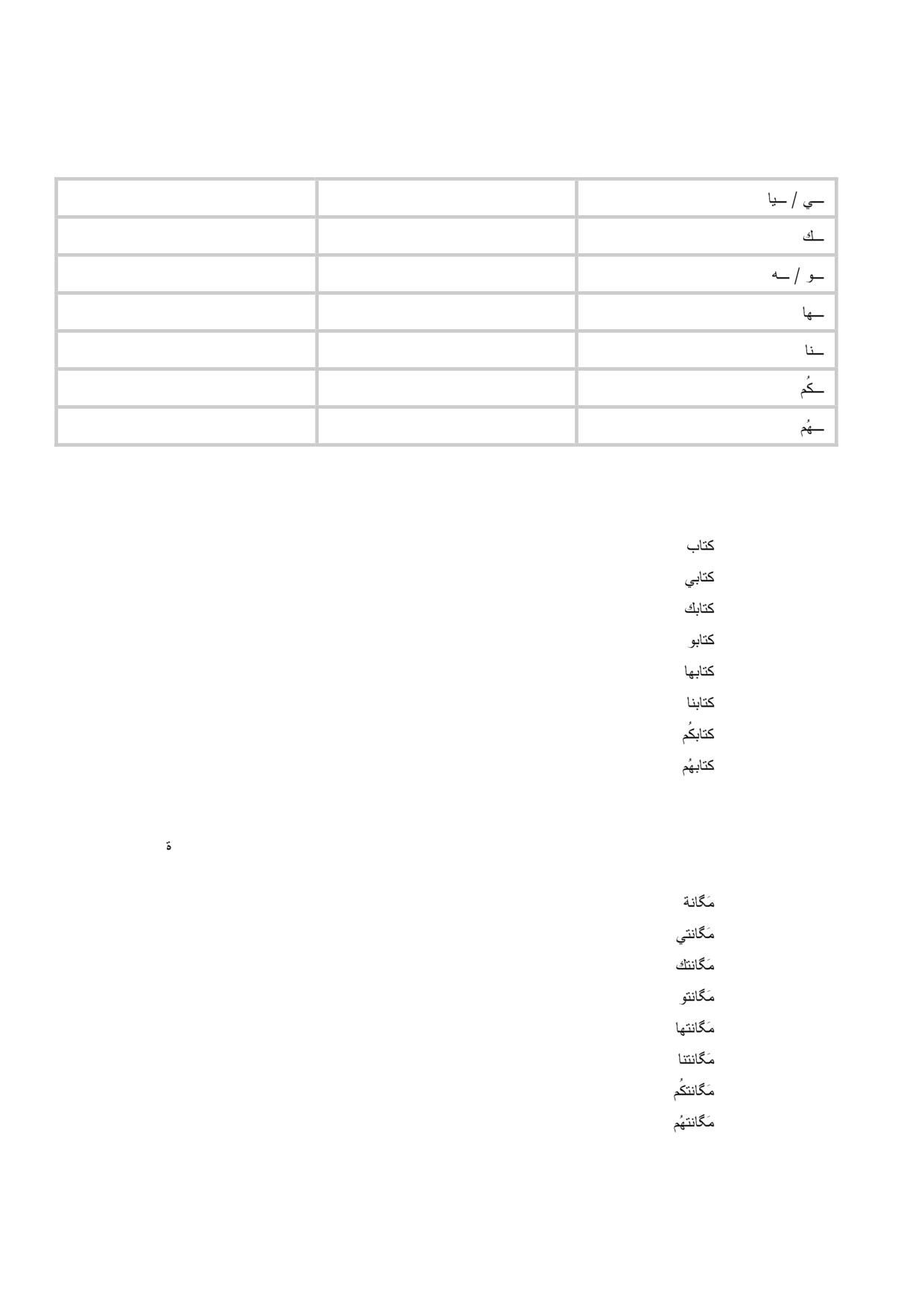
Example of possessive pronouns with the noun ―book.‖
book
ktab
my book
ktabi
your (sing.) book
ktabk
his book
ktabu
her book
ktabha
our book
ktabna
your (plur.) book
ktabkum
their book
ktabhum
Most feminine nouns in Arabic have an ―a‖ sound at the end of the word. In Arabic script, this ―a‖ is
actually a silent “t” that is only pronounced on certain occasions. For all feminine words ending in
this silent ―t‖ ( ), we drop the sound ―a‖ and substitute it with ―t‖ before adding a possessive pronoun.
For example, the feminine noun magana (a watch).
watch
magana
my watch
maganti
your (sing.) watch
magantk
his watch
magantu
her watch
magantha
our watch
magantna
your (plur.) watch
magantkum
their watch
maganthum
9
Exercise: Use the following words with the appropriate possessive pronoun.
• dar (house)
• blasa (place)
• ktab (book)
• wrqa (sheet of paper, ticket)
1. your (plur.) house
6. their place
2. my place
7. her house
3. his book
8. his ticket
4. our place
9. your (sing.) book
5. your (sing.) ticket
10. their house
Masculine and Feminine Nouns
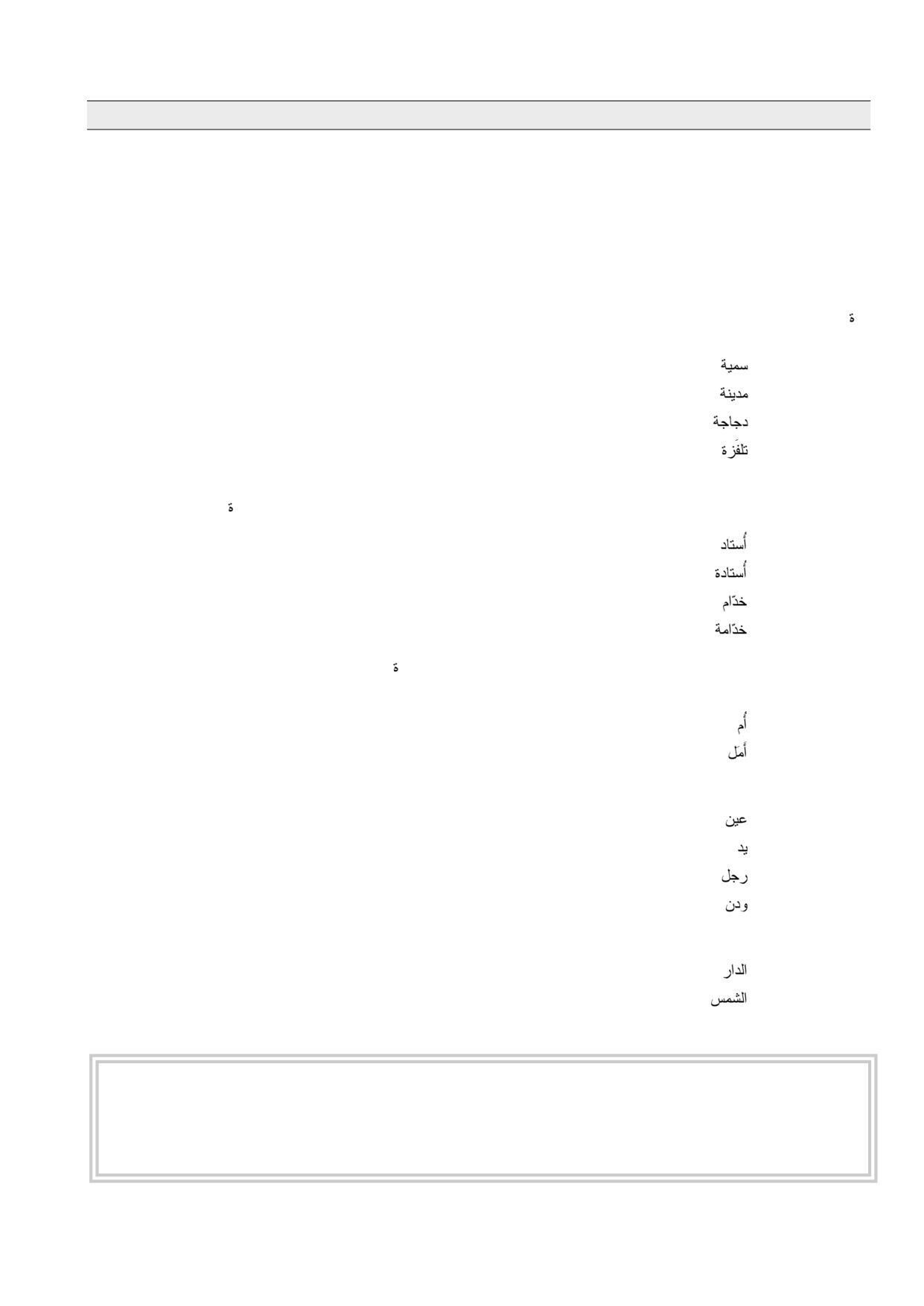
In Arabic, all nouns are either masculine or feminine. In general, nouns ending in ―a‖ (the silent ―t‖ ( )
in Arabic script) are feminine. For example:
name
smiya
city
mdina
chicken (a single one)
djaja
television
tlfaza
The feminine is formed from the masculine (for nouns indicating professions or participles) by adding
―a‖ (the silent ―t‖ ( ) in Arabic script) to the end of the word. For example:
male teacher
ustad
female teacher
ustada
working (masc. participle)
xddam
working (fem. participle)
xddama
Some words without ―a‖ (the silent ―t‖ ( ) in Arabic script) are nonetheless feminine. First, words and
proper names which are by their nature feminine:
mother
om
Amal (girl‟s name)
amal
Second, most (though not all) parts of the body that come in pairs are feminine:
an eye
عin
a hand
yd
a foot
rjl
an ear
udn
Third, a small number of nouns which do not fall into any category and yet are feminine:
the house
d-dar
the sun
š-šms
Transcription Reminder - see page 1 for the full table with all transcription characters.
j: the /zh/ sound, like the „s‟ in the
Remember that if two characters in a row are
word “pleasure.”
the same, a “shedda” is used, and we pronounce
ع: See page 146.
that sound longer. See pages 3 and 146.
10 • Moroccan Arabic
Describing Yourself
Objective: By the end of the chapter, you will be able to:
• ask and answer questions about nationalities, cities, age, and marital status
• use the possessive word “dyal” to indicate possession
• use demonstrative pronouns and adjectives in simple sentences
• ask questions about possession
Cultural Points
Avoid asking about the salary and age (sometimes) of people, especially women. Men should not
enquire about the wives or other female relations of someone-this could be seen as expressing an
inappropriate interest. People won‘t always tell you about their jobs and other personal concerns if not
asked. Religion can be a sensitive issue and sometimes people are not willing to express their views.
Nationalities, Cities, and Marital Status
Vocabulary and Expressions
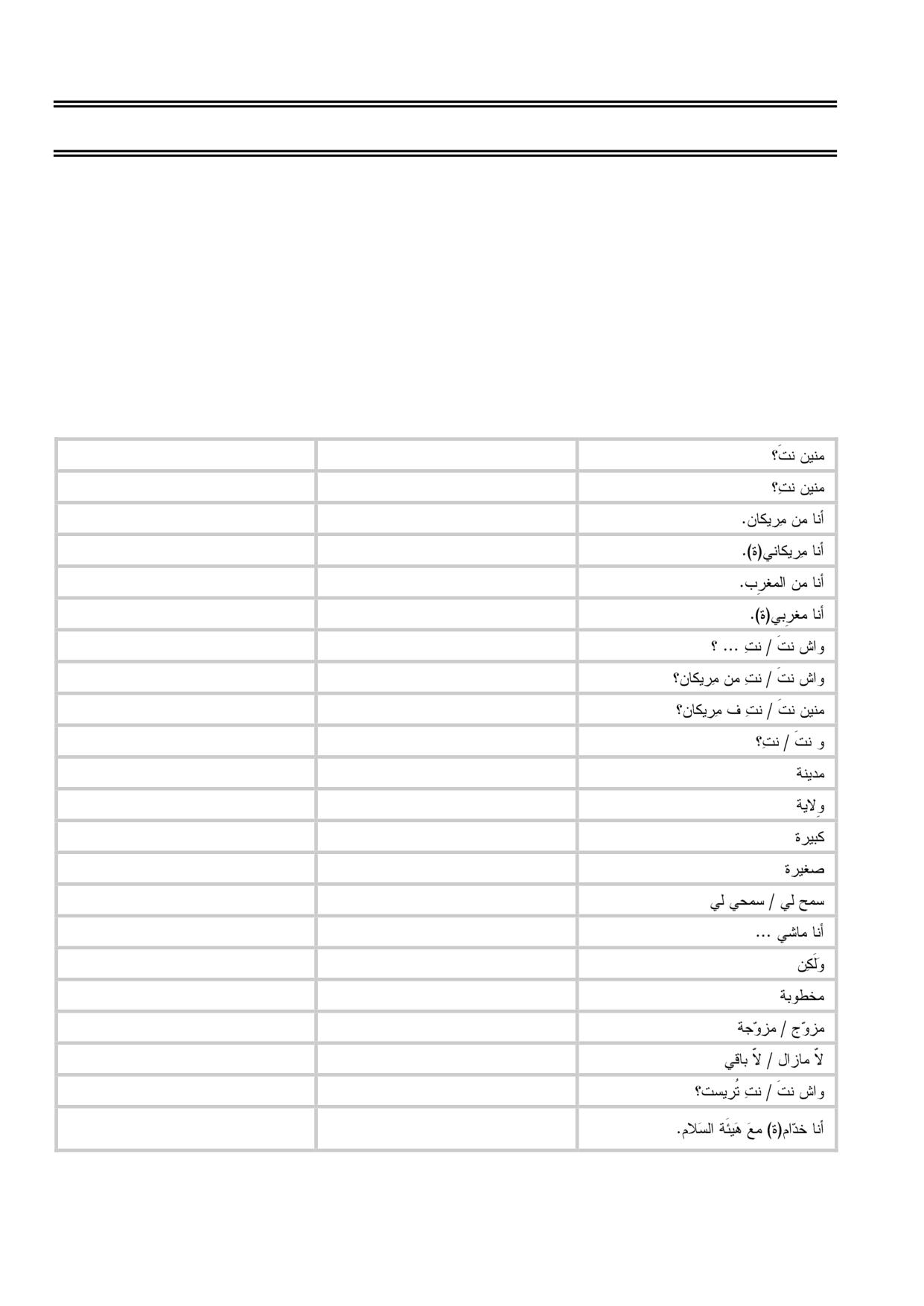
Where are you (masc.) from?
mnin nta?
Where are you (fem.) from?
mnin nti?
I am from the U.S.
ana mn mirikan.
I am American.
ana mirikani(ya).
I am from Morocco.
ana mn l-mġrib.
I am Moroccan.
ana mġribi(ya).
Are you ... ?
weš nta/nti ... ?
Are you from the U.S.?
weš nta/nti mn mirikan?
Where are you from in the U.S.?
mnin nta/nti f mirikan?
And you?
u nta/nti?
city
mdina
state
wilaya
big (fem.)
kbira
small (fem.)
sġira
Excuse me. (to man / woman)
smн li / smнi li
I am not ...
ana maši ...
but
welakin
engaged (fem.)
mxtuba
married (masc. / fem.)
mzuwj / mzuwja
No, not yet.
lla mazal / lla baqi
Are you a tourist?
weš nta/nti turist?
ana xddam(a) mعa hay'at
I work with the Peace Corps.
s-salam.
11
Dialogue
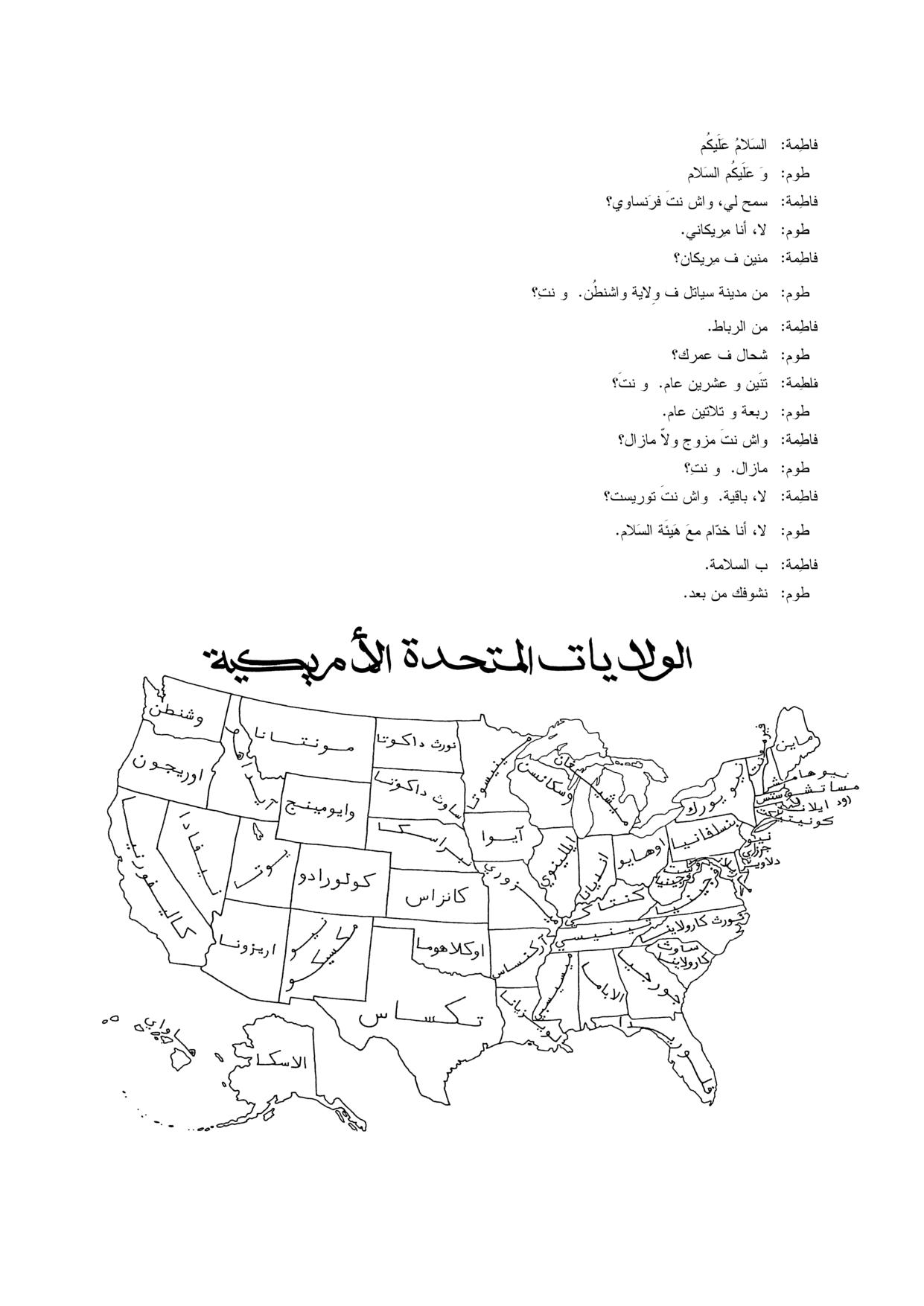
Fatima: s-salamu عalaykum.
Tom: wa عalaykum s-salam.
Fatima: smн li, weš nta fransawi?
Tom: lla, ana mirikani.
Fatima: mnin f mirikan?
Tom: mn mdint Seattle f wilayat
Washington. u nti?
Fatima: mn Rabat.
Tom: šнal f عmrk?
Fatima: tnayn u عšrin عam. u nta?
Tom: rbعa u tlatin عam.
Fatima: weš nta mzuwj wlla mazal?
Tom: mazal. u nti?
Fatima: lla, baqiya. weš nta turist?
Tom: lla, ana xddam mعa
hay'at s-salam.
Fatima: bslama.
Tom: n-šufk mn bعd.
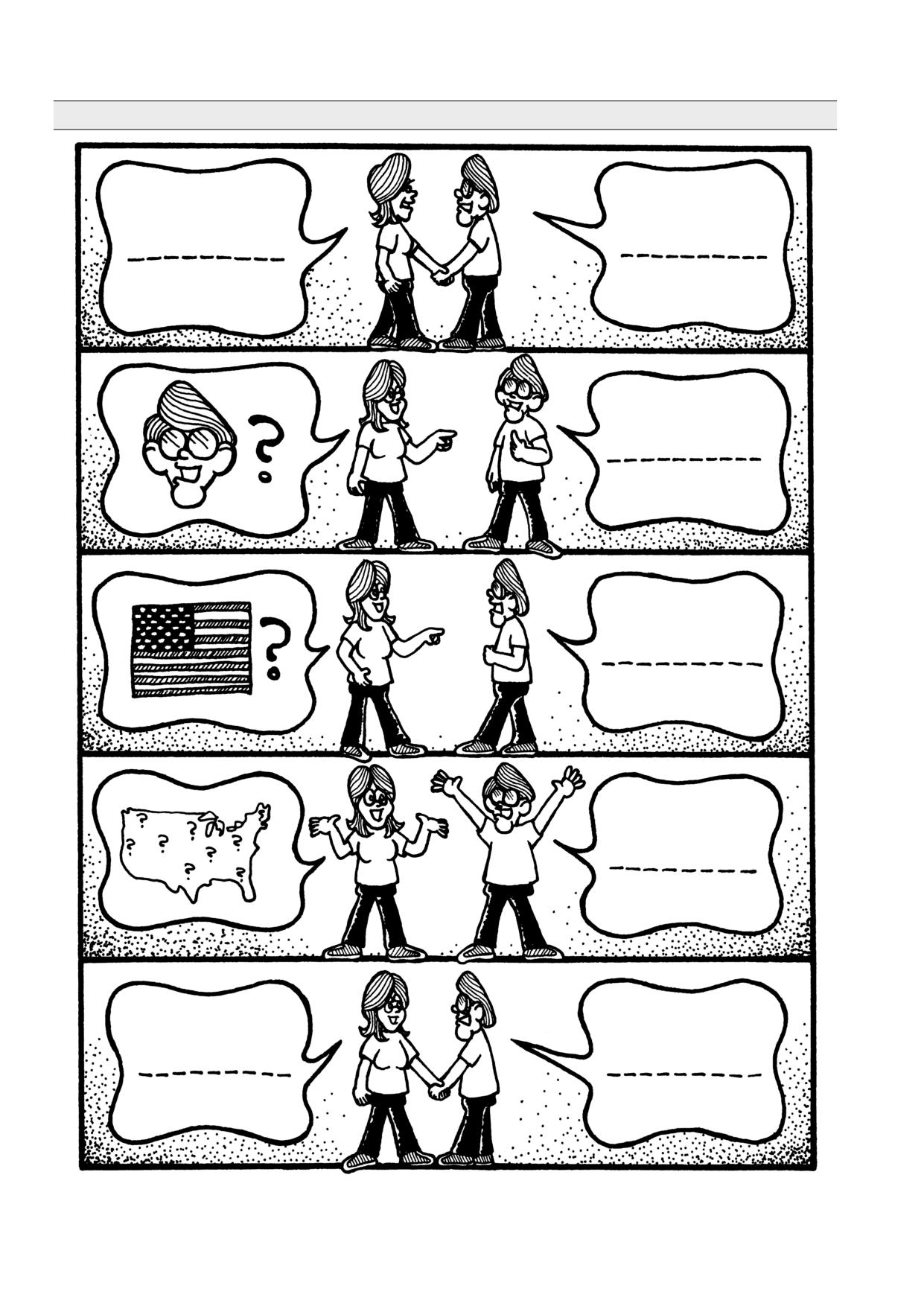
12 • Moroccan Arabic
Exercise: Complete each section of this dialogue.
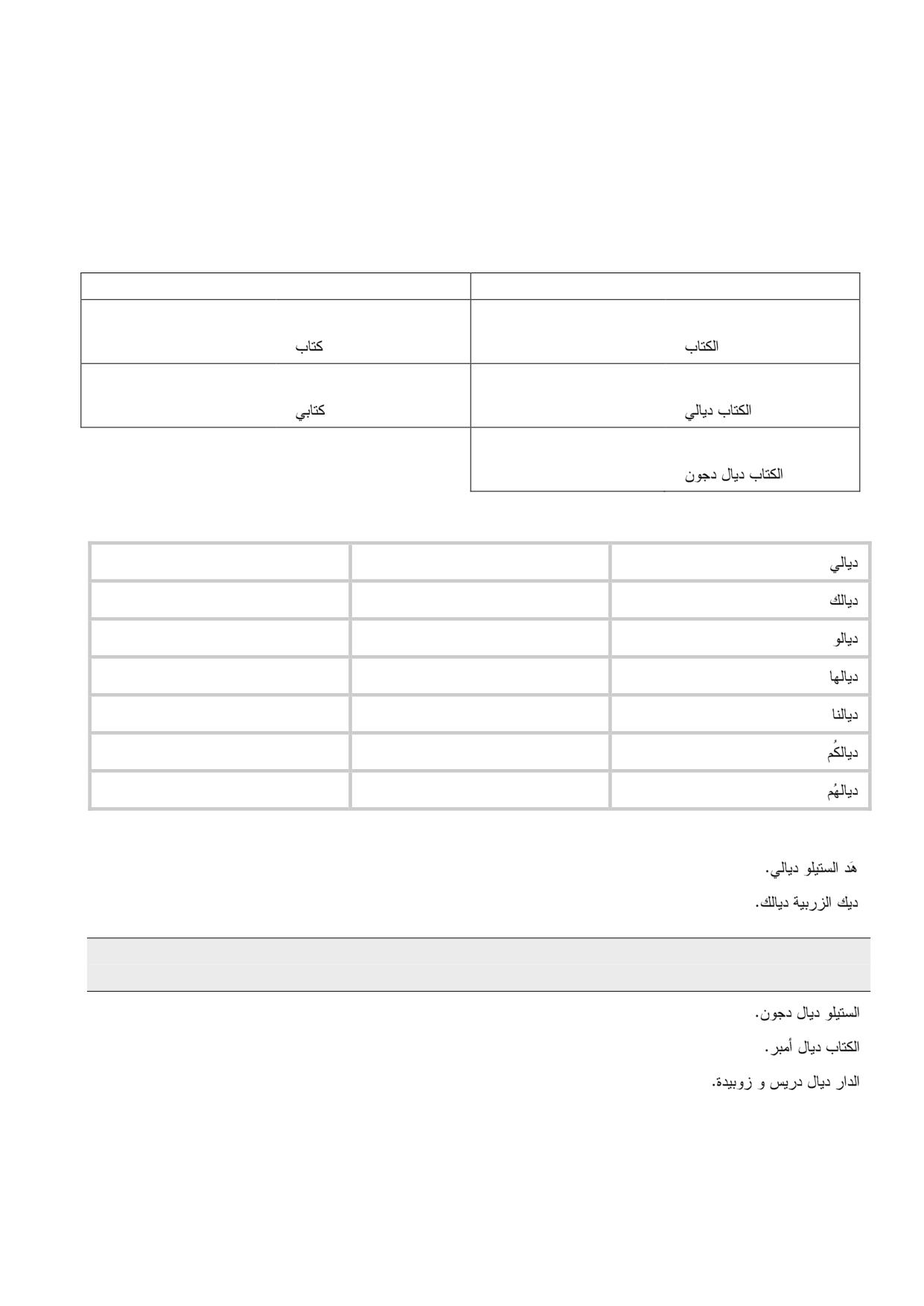
13
The Possessive Word “dyal”
In Moroccan Arabic, you have already learned that possession can be expressed by adding the
possessive pronouns to the end of a word (see page 8). Another way to express possession is through
the word dyal. It is placed after a noun with the definite article ―the,‖ which in Arabic may be either
the letter ―l‖ or a doubling of the first consonant of a word (see page 147 for more information on the
Arabic definite article). The same possessive pronouns you learned before are attached to the end of
dyal. You can also use a name with dyal. Some examples:
Using Possessive Pronoun
Using “dyal”
book
the book
ktab
l-ktab
my book
my book
ktabi
l-ktab dyali
John‟s book
l-ktab dyal John
Here is a list of dyal with all of the possessive pronoun endings:
my / mine
dyali
your / yours (sing.)
dyalk
his / his
dyalu
her / hers
dyalha
our / ours
dyalna
your / yours
dyalkum
their / theirs
dyalhum
As the list above shows, the forms dyali, dyalk, etc. also mean ―mine,‖ ―yours,‖ etc.
This pen is mine.
had s-stilo dyali.
That rug is yours.
dik z-zrbiya dyalk.
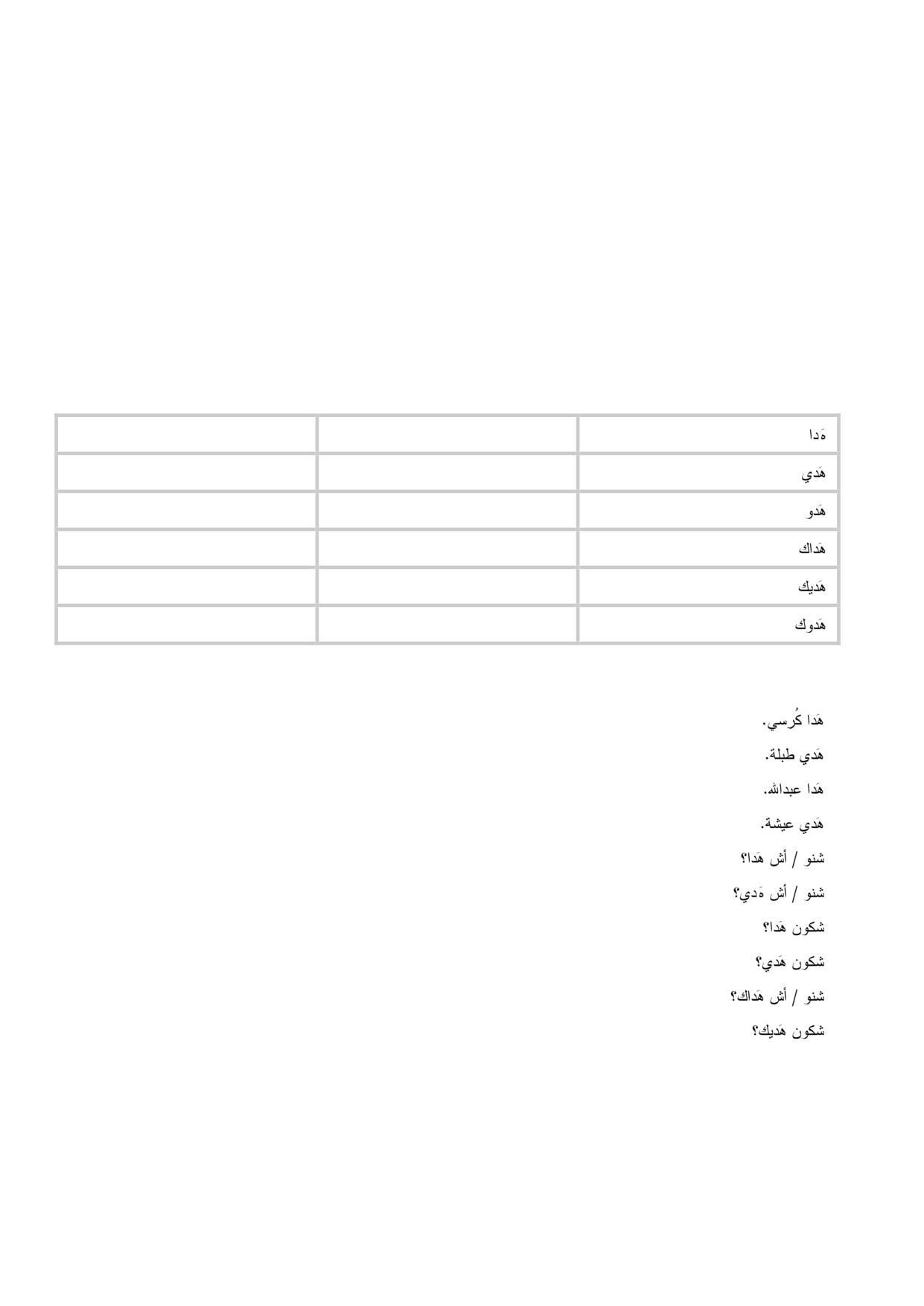
Exercise: Substitute the underlined words by the corresponding possessive pronoun
endings.
1. s-stilu dyal John.
2. l-ktab dyal Amber.
3. d-dar dyal Driss u Zubida.
14 • Moroccan Arabic
Demonstrative Adjectives & Demonstrative Pronouns
This, that, these, and those are used often in Arabic, like in English. But, unlike in English, in
Arabic we must be aware of whether they act as adjectives or pronouns. Think about how we use these
words in English. Sometimes, we use them before a noun. When we use them before a noun, they are
called demonstrative adjectives.
This car is John’s.
I like these towels.
I want that book.
Those flowers smell lovely.
Sometimes, we use them by themselves. In this case, they are called demonstrative pronouns.
This is John’s.
I like these.
I want that.
Those smell lovely.
It isn‘t necessary to know their names, but it is necessary to pay attention to whether they are before a
noun or not. Let‘s first look at the pronoun forms in Arabic, which you will use often even as a
beginner.
Demonstrative Pronouns
this (masc.)
hada
this (fem.)
hadi
these (plur.)
hadu
that (masc.)
hadak
that (fem.)
hadik
those (plur.)
haduk
These forms may be used at the beginning of a sentence, in the middle or at the end of a sentence, or in
questions. In Arabic, these pronouns can represent people.
This is a chair.
hada kursi.
This is a table.
hadi tbla.
This is Abdallah.
hada Abdallah.
This is Aicha.
hadi Aicha.
What‟s this? (masc. object)
šnu / aš hada?
What‟s this? (fem. object)
šnu / aš hadi?
Who is this? (masc.)
škun hada?
Who is this? (fem.)
škun hadi?
What is that? (masc. object)
šnu / aš hadak?
Who is that? (fem.)
škun hadik?
At first, you may have difficulty knowing whether to use the masculine or feminine form of this or
that. Moroccans should understand you even if you make an error with gender, however.
15
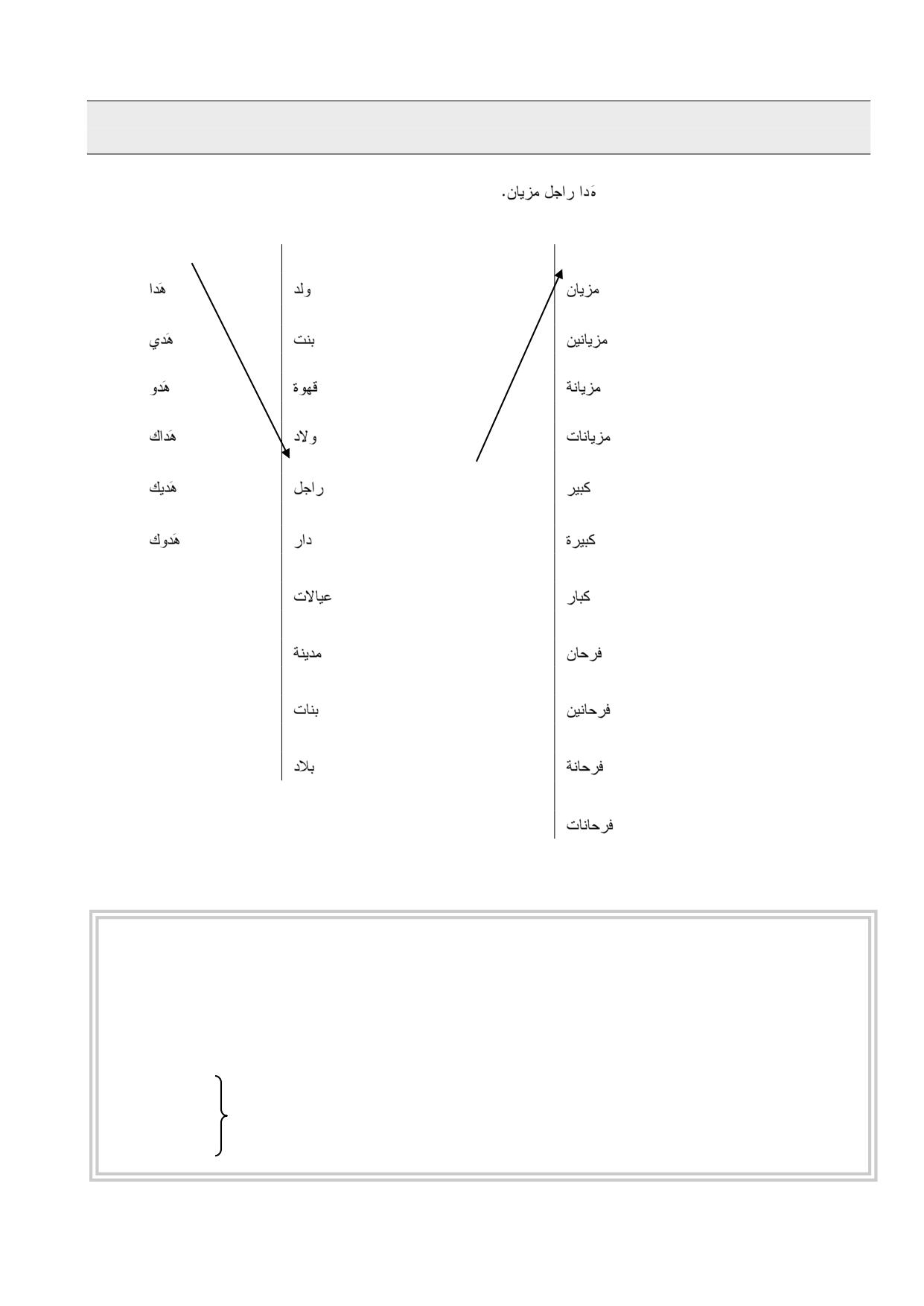
Exercise: Write as many correct sentences as you can using the words from the
following table.
e.g. hada rajl mzyan.
(This is a good man.)
hada
wld (masc. sing.)
mzyan (masc. sing.)
hadi
bnt (fem. sing.)
mzyanin (masc. plur.)
hadu
qhwa (fem. sing.)
mzyana (fem. sing.)
hadak
wlad (masc. plur.)
mzyanat (fem. plur.)
hadik
rajl (masc. sing.)
kbir (masc. sing.)
haduk
dar (fem. sing.)
kbira (fem. sing.)
عyalat (fem. plur.)
kbar (masc./fem. plur.)
mdina (fem. sing.)
frнan (masc. sing.)
bnat (fem. plur.)
frнanin (masc. plur.)
blad (masc. sing.)
frнana (fem. sing.)
frнanat (fem. plur.)
Transcription Reminder - see page 1 for the full table with all transcription characters.
š: the /sh/ sound as in “she”
a: the „a‟ in “father” or the „a‟ in “mad”
x: the „ch‟ in the German “Bach” or the
i: the „ee‟ in “meet”
Scottish “loch” See page144.
u: the „oo‟ in “food”
ġ: the French “r,” like a light gargle
k: the normal /k/ sound
See page 145.
q: like the English /k/ but pronounced
t:
pronounced like t, d, and s, but
further back in the throat. See page 144.
with a lower pitch and a greater
d:
tension in the tongue and throat.
s:
See page 145.
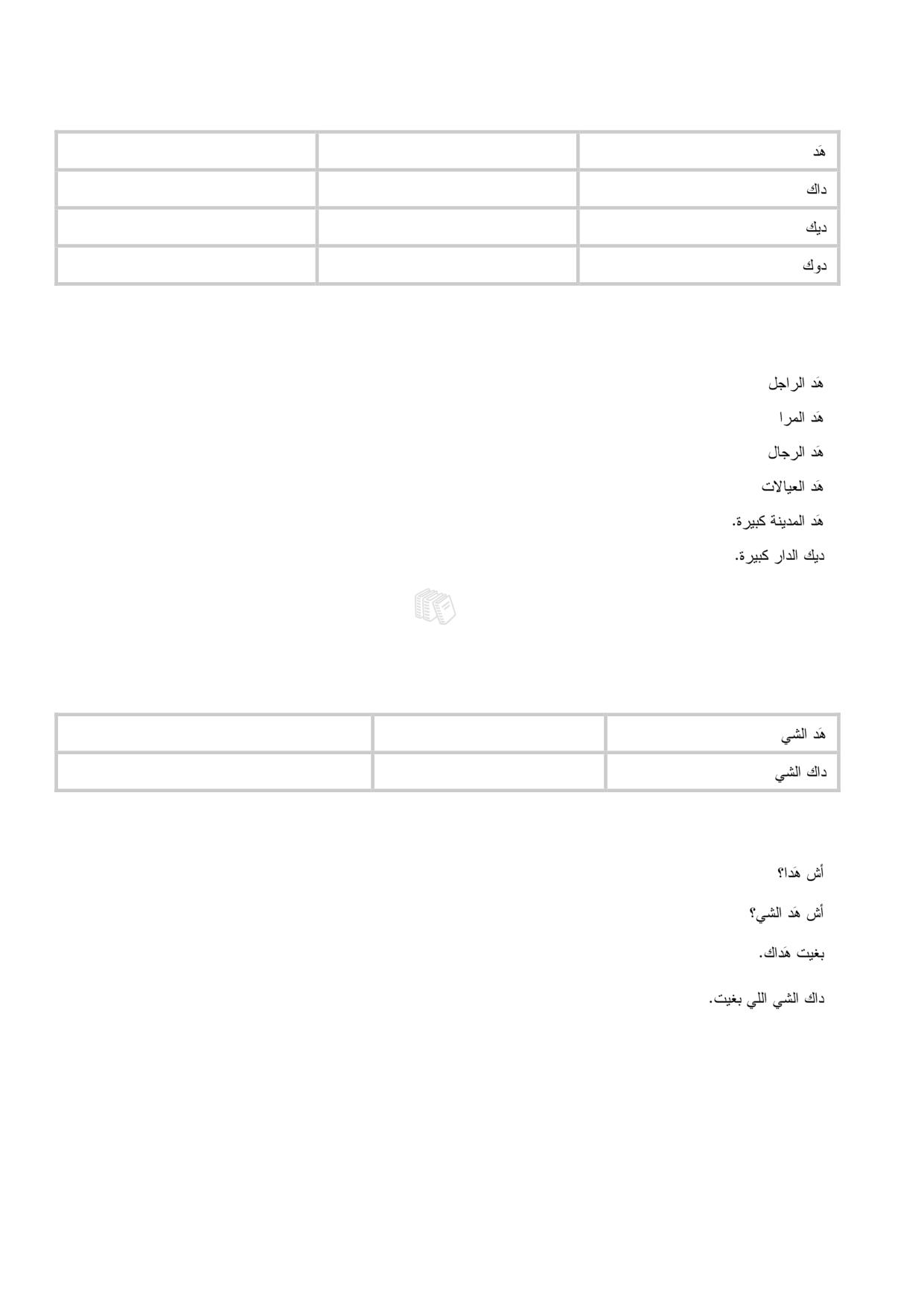
16 • Moroccan Arabic
Demonstrative Adjectives
this/these (masc. / fem. / plur.)
had
that (masc.)
dak
that (fem.)
dik
those (plur.)
duk
As you can see, the this/these form (had) is the same for masculine, feminine, and plural. For all the
demonstrative adjectives, you must use the definite article in front of the nouns that follow them. This
means using an ―l‖ in front of ―moon letters‖ or doubling the first letter of ―sun letters‖ (see page 147).
this man
had r-rajl
this woman
had l-mra
these men
had r-rjal
these women
had l-عyalat
This city is big.
had l-mdina kbira.
That house is big.
dik d-dar kbira.
INTERMEDIATE
Talking about a General Situation
TOPIC
Sometimes in English, we use the words this and that to talk about general situations, not about
specific things.
Some of the students are always late for class. I don’t like that.
In Arabic, different expressions are used for these meanings.
this (general situation)
had š-ši
that (general situation)
dak š-ši
After some experience hearing native speakers, you should be able to know when to use the normal
demonstrative pronouns and when to use these expressions. Some examples:
What is this? (this thing, this
aš hada?
object)
What is this? (situation, affair)
aš had š-ši?
I want that. (that thing, that
bġit hadak.
object)
That‟s what I want. (a situation
dak š-ši l-li bġit.
or outcome)
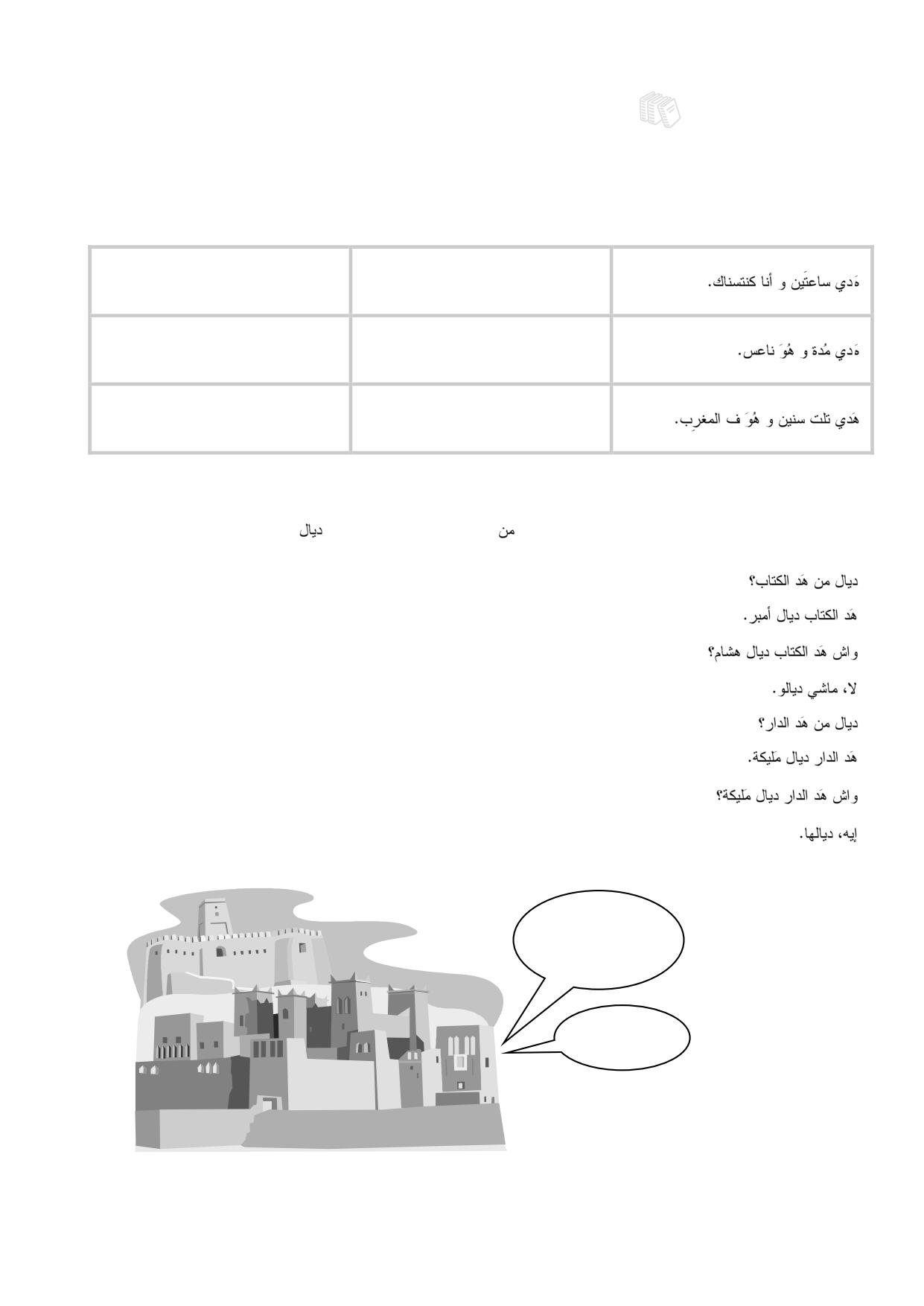
17
INTERMEDIATE
Using a Demonstrative Pronoun to Express Duration
TOPIC
With a present tense verb form, an active participle expressing current activity, or an equational
sentence, the demonstrative pronoun hadi is used to express duration, like the English present perfect
tense or present perfect progressive tense. It is used with a time expression and u (and) followed by the
rest of the sentence:
hadi + time expression + u + rest of sentence
I‟ve been waiting for you for two
hadi saعtayn u ana
hours. (Literally: This is two
kan-tsnak.
hours and I am waiting for you.)
He‟s been asleep for a long
time. (Literally: This is a long
hadi muda u huwa naعs.
time and he is sleeping.)
He‟s been in Morocco for three
hadi tlt snin u huwa
years. (Literally: This is three
f l-maġrib.
years and he is in Morocco.)
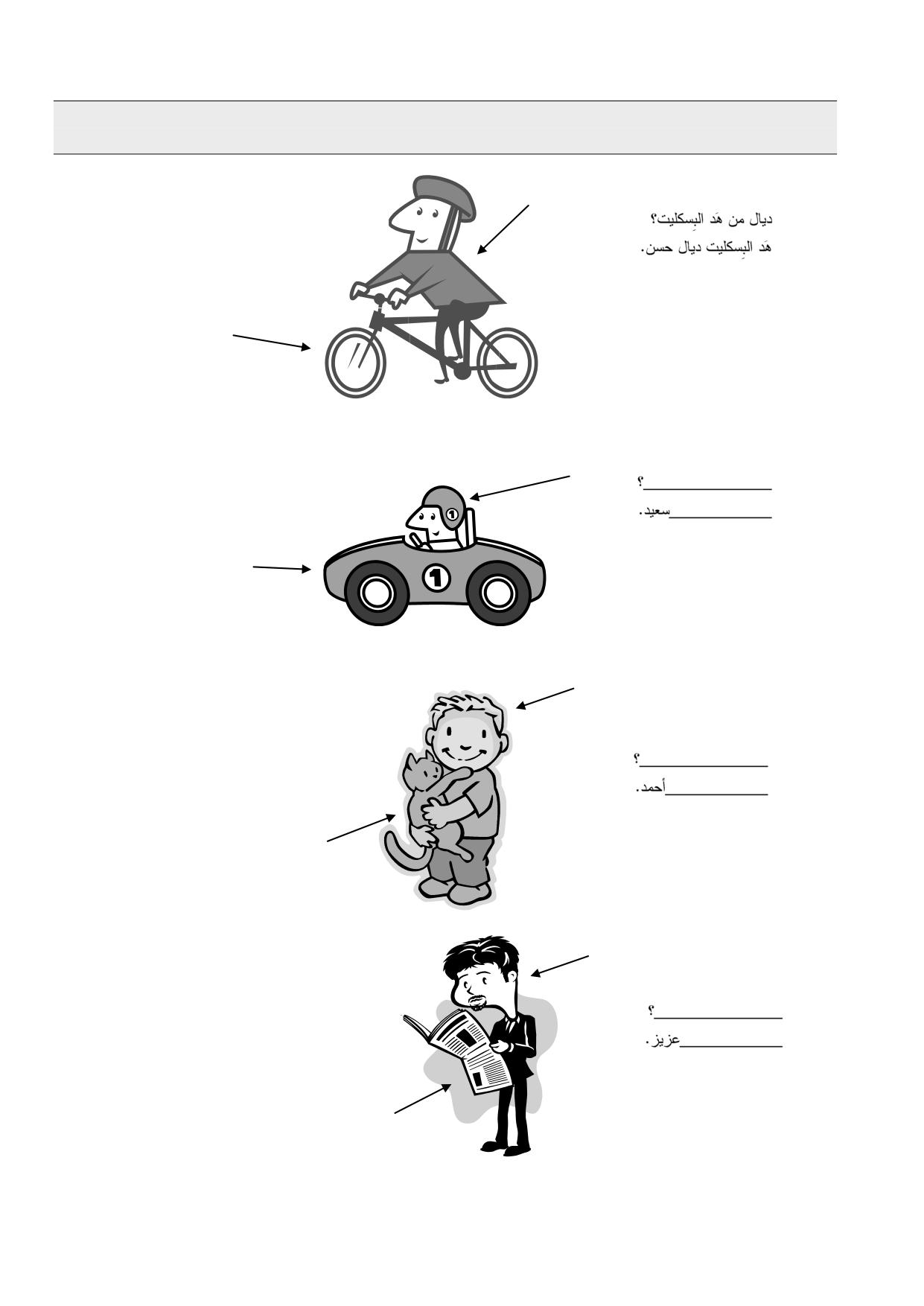
Asking about Possession
The possessive word dyal (
) may be used with mn (
) to mean ―whose.‖
Whose book is this?
dyal mn had l-ktab?
This is Amber‟s book.
had l-ktab dyal Amber.
weš had l-ktab dyal
Is this Hicham‟s book?
Hicham?
No, it‟s not his.
lla, maši dyalu.
Whose house is this?
dyal mn had d-dar?
This house is Malika‟s.
had d-dar dyal Malika.
weš had d-dar dyal
Is this house Malika‟s?
Malika?
Yes, it‟s hers.
iyeh, dyalha.
weš had
d-dar dyal
Malika?
iyeh,
dyalha.
18 • Moroccan Arabic
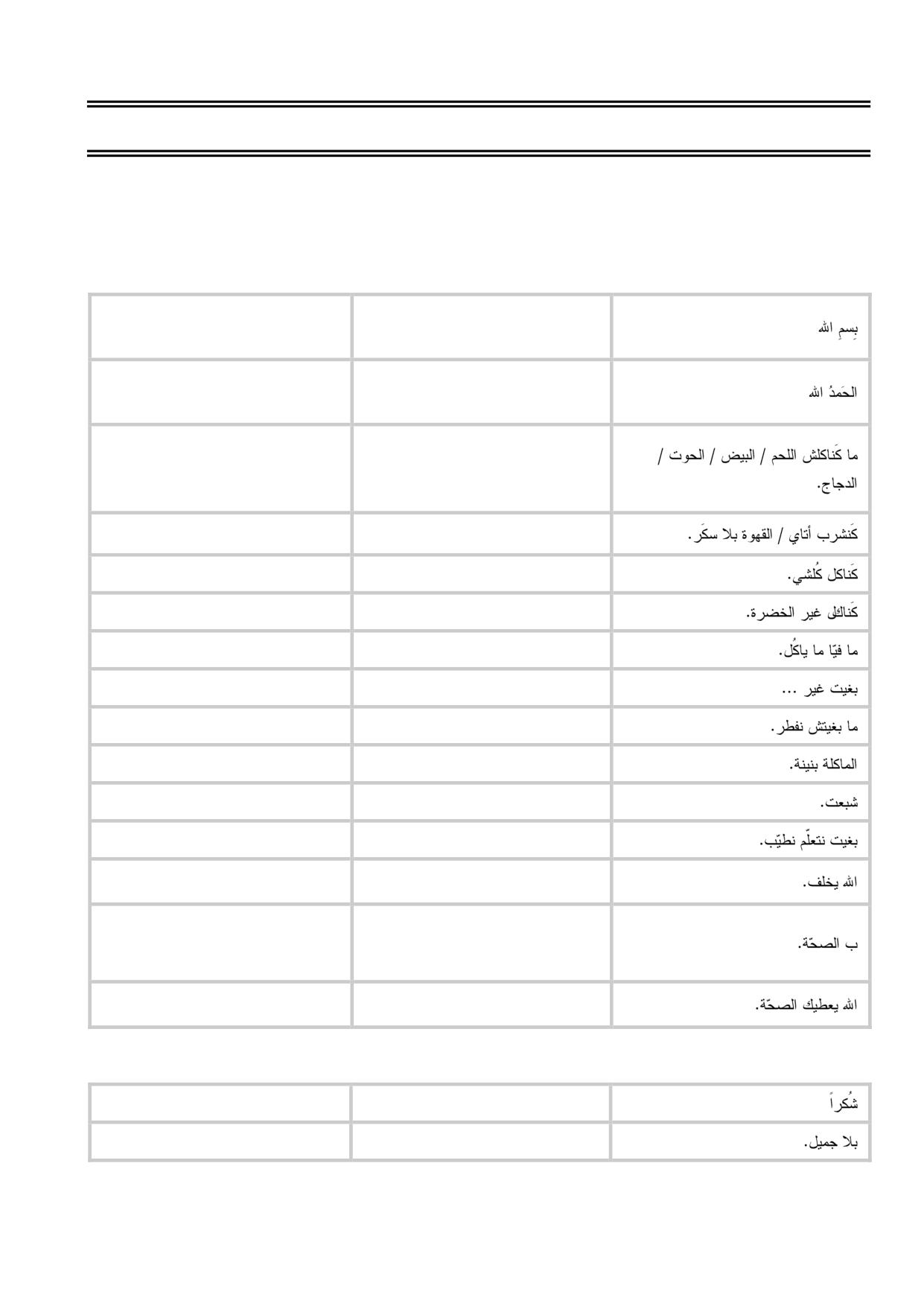
Exercise: Ask a question about possession for each picture. Then, give the correct
answer. The first one is done for you.
Hassan
Q: dyal mn had l-bisklit?
A: had l-bisklit dyal Hassan.
?
Q:
_______________________?
Said
A:
___________________Said.
?
Ahmed
Q:
_______________________?
A:
__________________Ahmed.
?
Aziz
Q:
_______________________?
A:
___________________Aziz.
?
19
Useful Expressions
Here are some expressions to help you with homestay, travel, and other situations where your language
may not yet be at a point where you are able to communicate well in Moroccan Arabic. If you follow the
pronunciation of the transcriptions, Moroccans should understand you. More expressions can be
found in the appendix. See page 157.
Mealtime Expressions
In the name of God (said when you
begin an activity: eating, drinking,
bismillah
working, studying, traveling, etc.).
Thanks to God (said after finishing a
meal, or after expressing that all is well
l-нamdullah
in life).
I don‟t eat ... meat
ma-kan-akul-š...l-lнm
eggs
l-bid
fish
l-нut
chicken
d-djaj
kan-šrb atay / l-qhwa
I drink tea / coffee without sugar.
bla skkar.
I eat everything.
kan-akul kulši.
I eat vegetables only.
kan-akul ġir l-xodra.
I don‟t feel like eating.
ma-fiya ma-y-akul.
I want just/only ...
bġit ġir ...
I don‟t want to have breakfast.
ma-bġit-š n-ftr.
The food is delicious.
l-makla bnina.
I‟m full.
šbعt.
I want to learn how to cook.
bġit n-tعllm n-tiyb.
May God replenish / reward you.
lla y-xlf.
(said after a meal to thank host)
To your health (said to someone
after eating, drinking, coming out of the
bssннa.
hammam, wearing new clothes, having
a hair cut, etc.)
May God grant you health too.
lla y-عtik ssннa
(response to the above)
Thanking Expressions
Thank you.
šukran.
You‟re welcome.
bla jmil.
20 • Moroccan Arabic
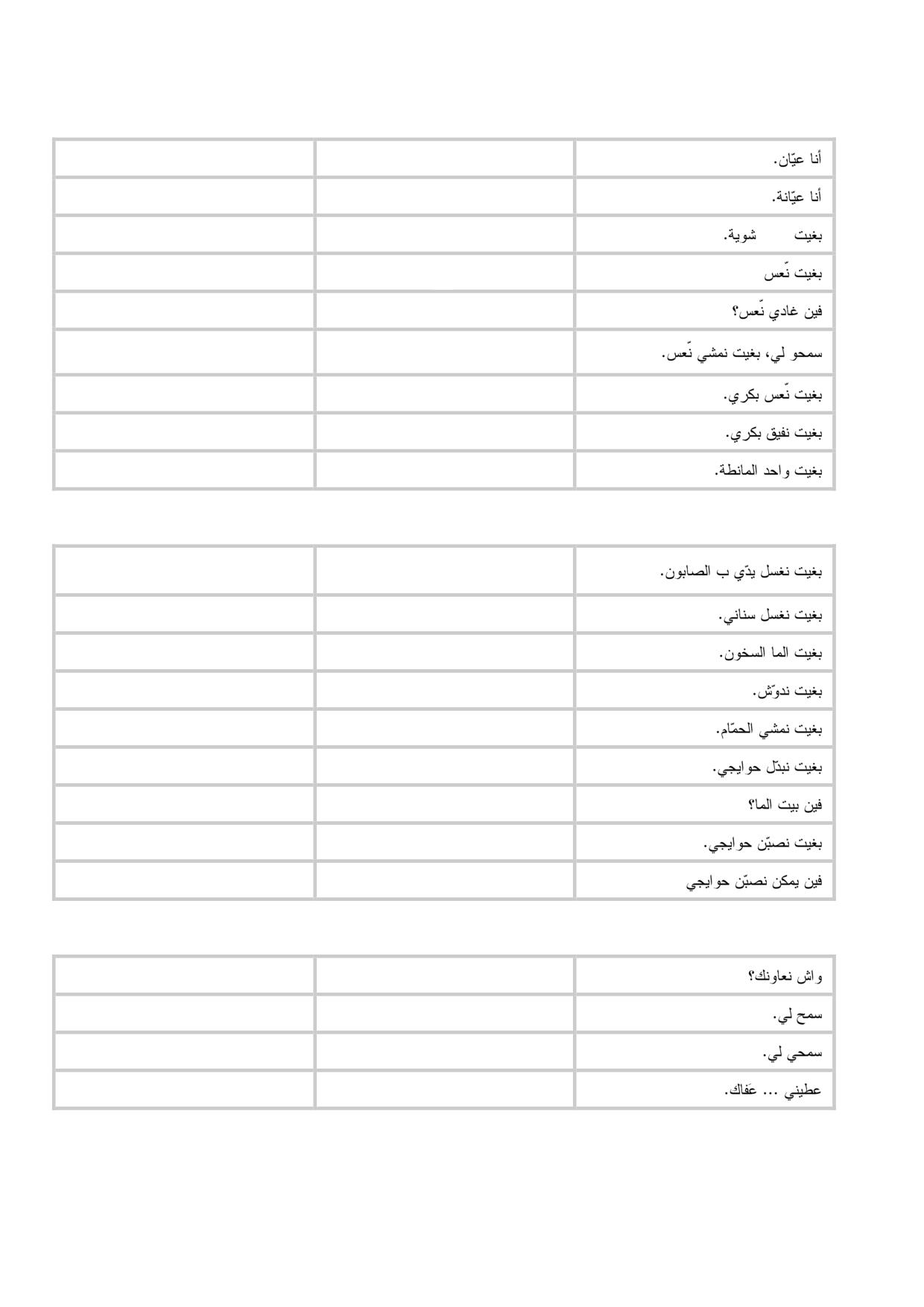
Expressions for Nighttime / Sleeping
I‟m tired. (male speaker)
ana عiyan.
I‟m tired. (female speaker)
ana عiyana.
I want to read a little bit.
bġit n-qra šwiya.
ىرقن
I want to go to bed.
bġit n-nعs?
؟
Where I am going to sleep?
fin ġadi n-nعs
?
Excuse me, I want to go to bed.
smнu li, bġit n-mši
(addressing a group of people)
n-nعs.
I want to go to bed early.
bġit n-nعs bkri.
I want to get up early.
bġit n-fiq bkri.
I want a blanket.
bġit waнd l-manta.
Hygiene/Cleanliness Expressions
I want to wash my hands with
bġit n-ġsl yddi b
soap.
s-sabun.
I want to brush my teeth.
bġit n-ġsl snani.
I want hot water, please.
bġit l-ma s-sxun عafak.
I want to take a shower.
bġit n-duwš.
I want to go to the hammam.
bġit n-mši l-нmmam.
I want to change my clothes.
bġit n-bddl нwayji.
Where is the toilet?
fin bit l-ma?
I want to do laundry.
bġit n-sbbn нwayji.
Where can I do laundry?
fin ymkn n-sbbn нwayji.
?
؟
Offering Help / Asking for Favors
Can I help you?
weš n-عawnk?
Excuse me. (to a man)
smн li.
Excuse me. (to a woman)
smнi li.
Give me ... please.
عtini ... عafak.
21
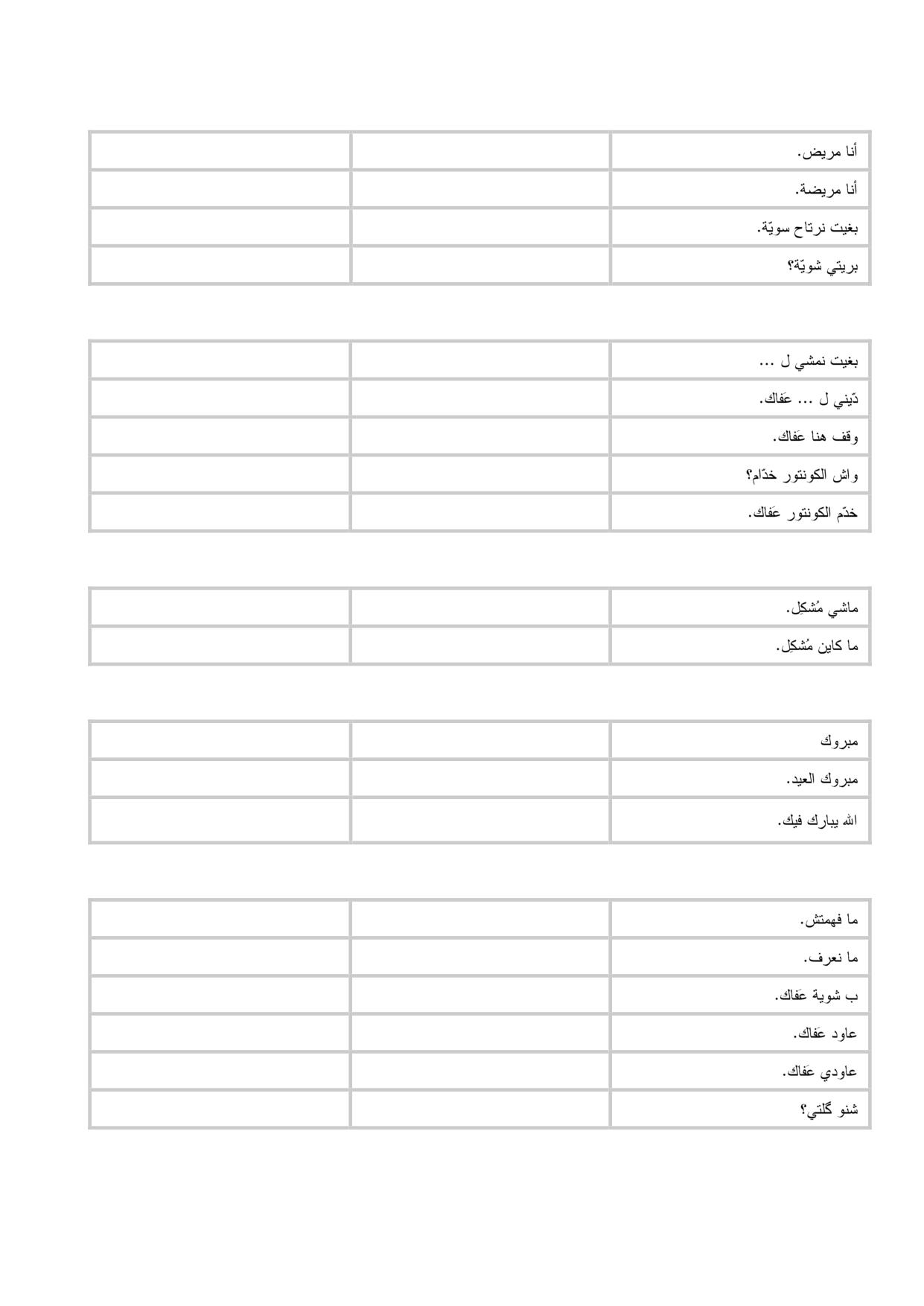
Being Sick
I‟m sick. (male speaker)
ana mrid.
I‟m sick. (female speaker)
ana mrida.
I want to rest a bit.
bġit n-rtaн swiya.
Do you feel better?
briti šwiya?
Transportation Expressions
I want to go to ...
bġit n-mši l ...
Take me to ... please.
ddini l ... عafak.
Stop here, please.
wqf hna عafak.
Is the meter on?
weš l-kuntur xddam?
Turn on the meter, please.
xddm l-kuntur عafak.
Responses to Problems/Difficulties/Apologies
It‟s not a problem.
maši muškil.
There is no problem.
ma-kayn muškil.
Congratulations
Congratulations.
mbruk
Happy holiday.
mbruk l-عid.
May God grant you grace.
lla y-bark fik.
(response to the above)
Communication
I don‟t understand.
ma-fhmt-š.
I don‟t know.
ma-n-عrf.
Slowly please.
b šwiya عafak.
Repeat please. (to a man)
عawd عafak.
Repeat please. (to a woman)
عawdi عafak.
What did you say?
šnu glti?
22 • Moroccan Arabic
Numerals
Objective: By the end of the chapter, you will be able to :
• count in Moroccan Arabic
• combine numbers with nouns to indicate amounts
• ask and answer questions about time
When we talk about numerals, we want to be able to do two things. First, we have to be able to count.
That is, we have to learn our numbers. Second, we have to be able to use the numbers with objects. In
other words, we have to be able to say things like ―five apples‖ or ―twenty-seven students‖ or ―one
hundred forty-three volunteers.‖
In English, we never think of these two tasks separately. We simply use a number in combination with
the plural form of some object. In Arabic, however, we have to learn how to combine different numbers
with objects, sometimes using a plural form, sometimes a singular, sometimes with a letter in between
the two, sometimes not. As in all things Arabic, what seems difficult now becomes natural with time.
Cardinal Numbers
Cardinal numbers refer to the normal numbers we use (one, two, three...). They are different than
ordinal numbers (first, second, third...) and fractions (one-half, one-third, one-fourth...). For now, we
start with the cardinal numbers. We will work with ordinal numbers and fractions later.
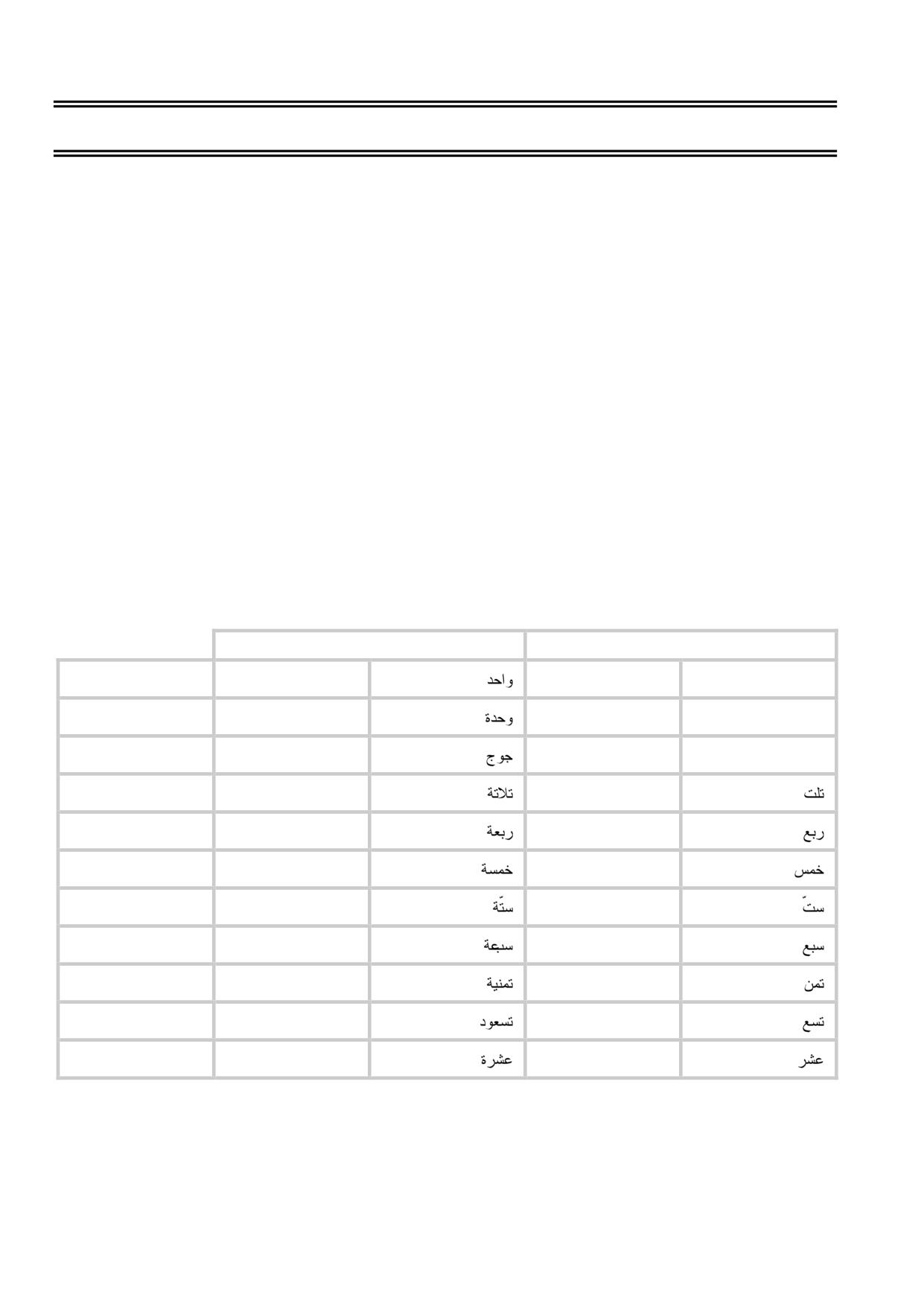
Numbers 1 thru 10
In Moroccan Arabic, there are two ways to combine the numbers 3 thru 10 with an object. We some-
times use the ―full‖ or normal form of the number, and sometimes we use a ―short‖ form of the number.
Here is a table listing the full form of numbers 1 thru 10 and the short form of numbers 3 thru 10.
Full Forms
Short Forms
one (masc.)
waнd
Ø
Ø
one (fem.)
wнda
Ø
Ø
two
juj
Ø
Ø
three
tlata
tlt
four
rbعa
rbع
five
xmsa
xms
six
stta
stt
seven
sbعa
sbع
eight
tmnya
tmn
nine
tsعud
tsع
ten
عšra
عšr
23
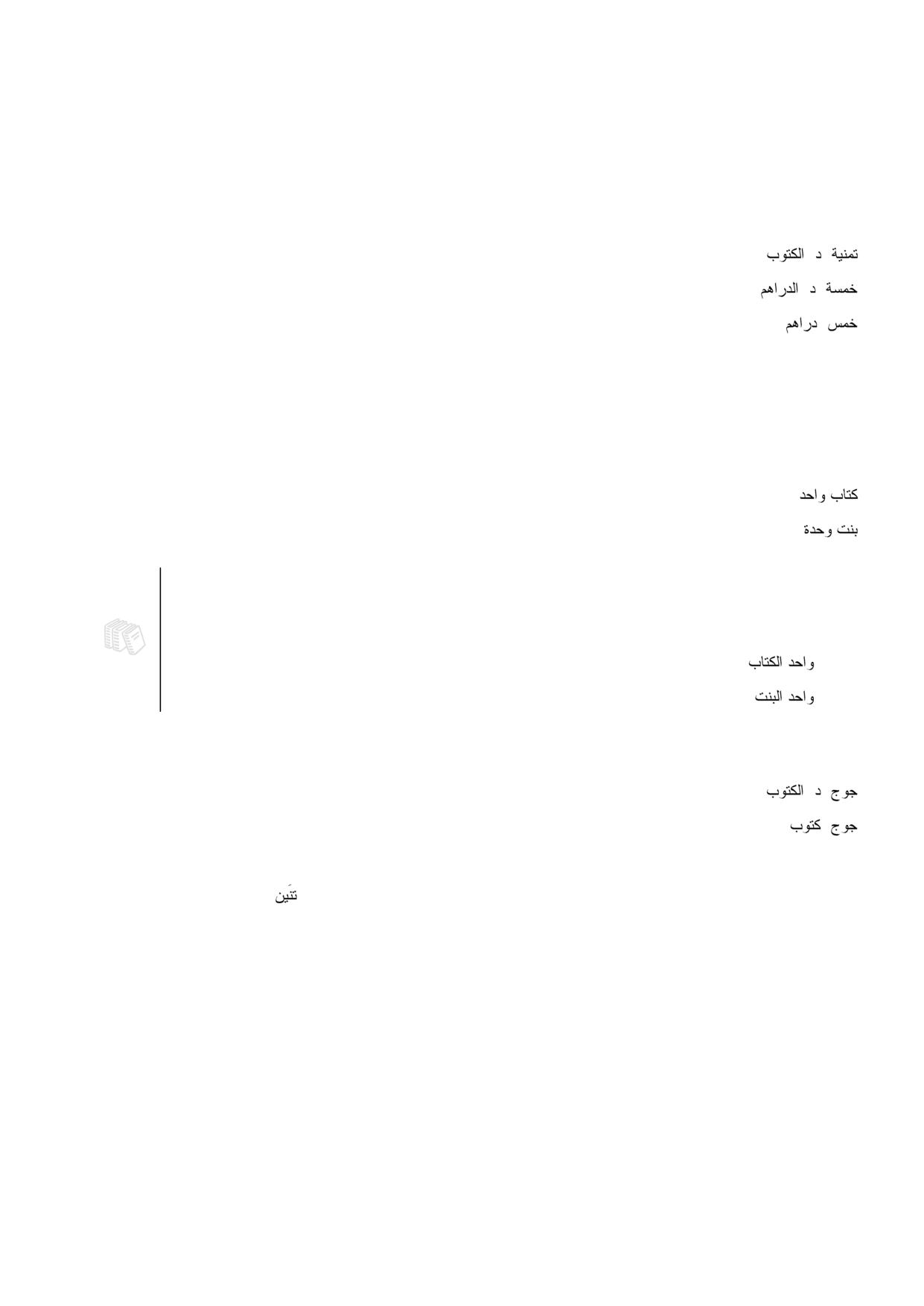
For the numbers 3 thru 10, we combine the full form of a number and a noun like this:
number (full form) + d (د) + plural noun with definite article
For the numbers 3 thru 10, we combine the short form of a number and a noun like this:
number (short form) + plural noun (no definite article)
Eight books (using full form)
tmnya d l-ktub
Five dirhams (using full form)
xmsa d d-drahm
Five dirhams (using short form) xms drahm
The numbers one and two have some special qualities.
The number one (waнd/wнda) differs from all other numbers because in Arabic, it acts like an
adjective. This means that it comes after a noun, like other adjectives, and that it must agree in gender
with the noun, like other adjectives.
one book (book is masc.)
ktab waнd
one girl (girl is fem.)
bnt wнda
Sometimes, you may hear waнd (not wнda) used before a noun. In this case, it is not acting
as a number, but rather as an indefinite article (like the English ―a‖ or ―an‖). Don‘t worry
about it now, just be aware of it.
INTERMEDIATE
TOPIC
a book
waнd l-ktab
a girl
waнd l-bnt
The number two (juj) can be used as a full or short form with plural nouns.
two books
juj d l-ktub
two books
juj ktub
However, when two is part of a compound number (as in twenty-two), a different form is used. Here,
we use the form tnayn (
). This will be shown in the section on numbers from 20 thru 99.
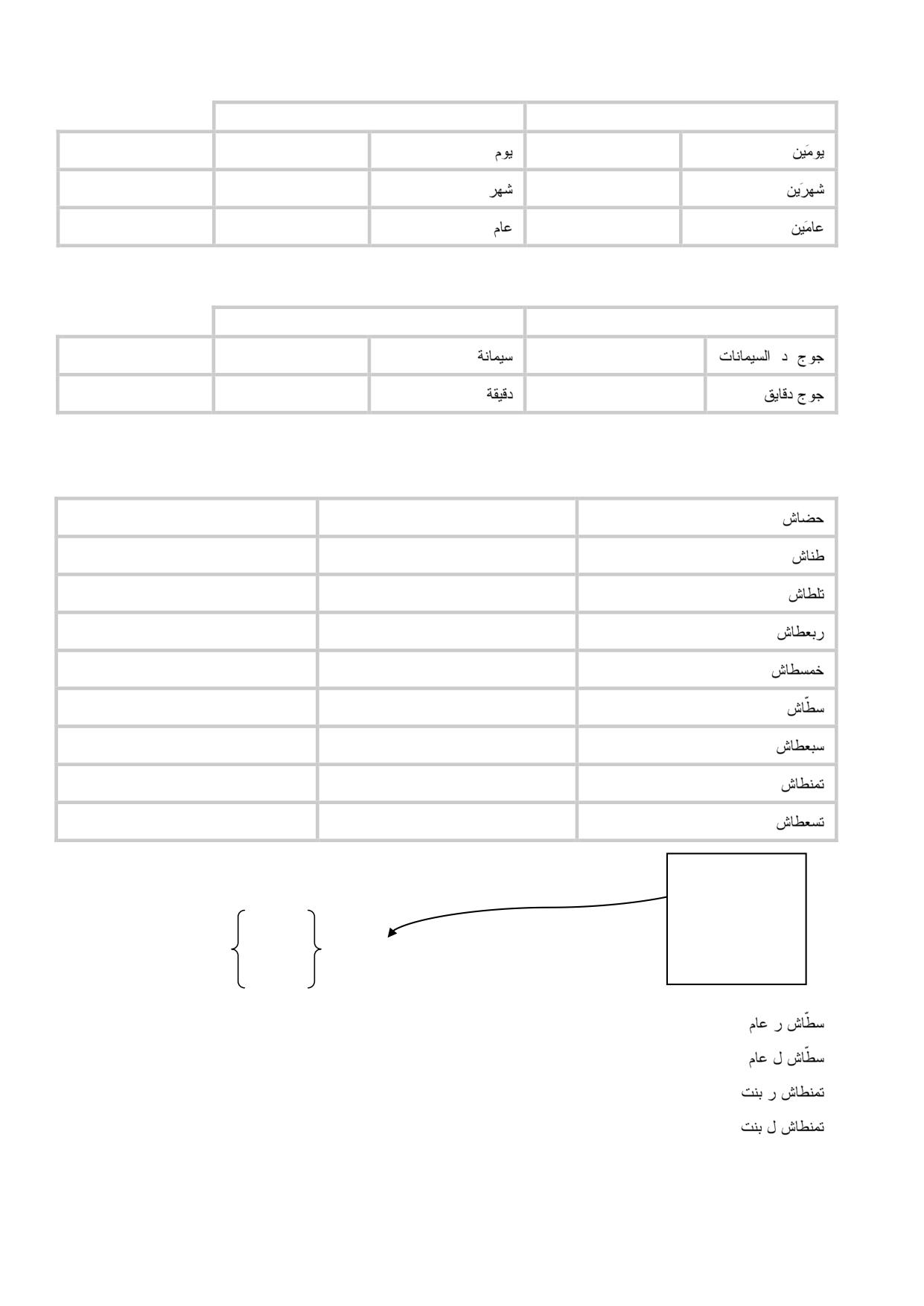
Dual noun forms
In English, nouns have a singular and a plural form. In Arabic, nouns also have a singular and plural
form, but a small number of nouns also have a dual form. The dual form is used for these nouns
when we refer to two of something. For nouns that have a dual form, therefore, we don‘t use juj. The
dual form includes the idea of ―two.‖ The dual form is usually made by adding ―ayn‖ to the end of the
singular form. In the following tables, the first three examples have dual forms, but the last two are
normal and therefore use their plural form.
24 • Moroccan Arabic
Singular Form
Dual Form
day
yum
yumayn
month
šhr
šhrayn
year
عam
عamayn
But...
Singular Form
Plural Form
week
simana
juj d s-simanat
minute
dqiqa
juj dqayq
Numbers 11 thru 19
The numbers 11 thru 19 do not have a short form. Only numbers 3 thru 10 have a short form.
eleven
нdaš
twelve
tnaš
thirteen
tltaš
fourteen
rbعtaš
fifteen
xmstaš
sixteen
sttaš
seventeen
sbعtaš
eighteen
tmntaš
nineteen
tsعtaš
Yes - the singular!
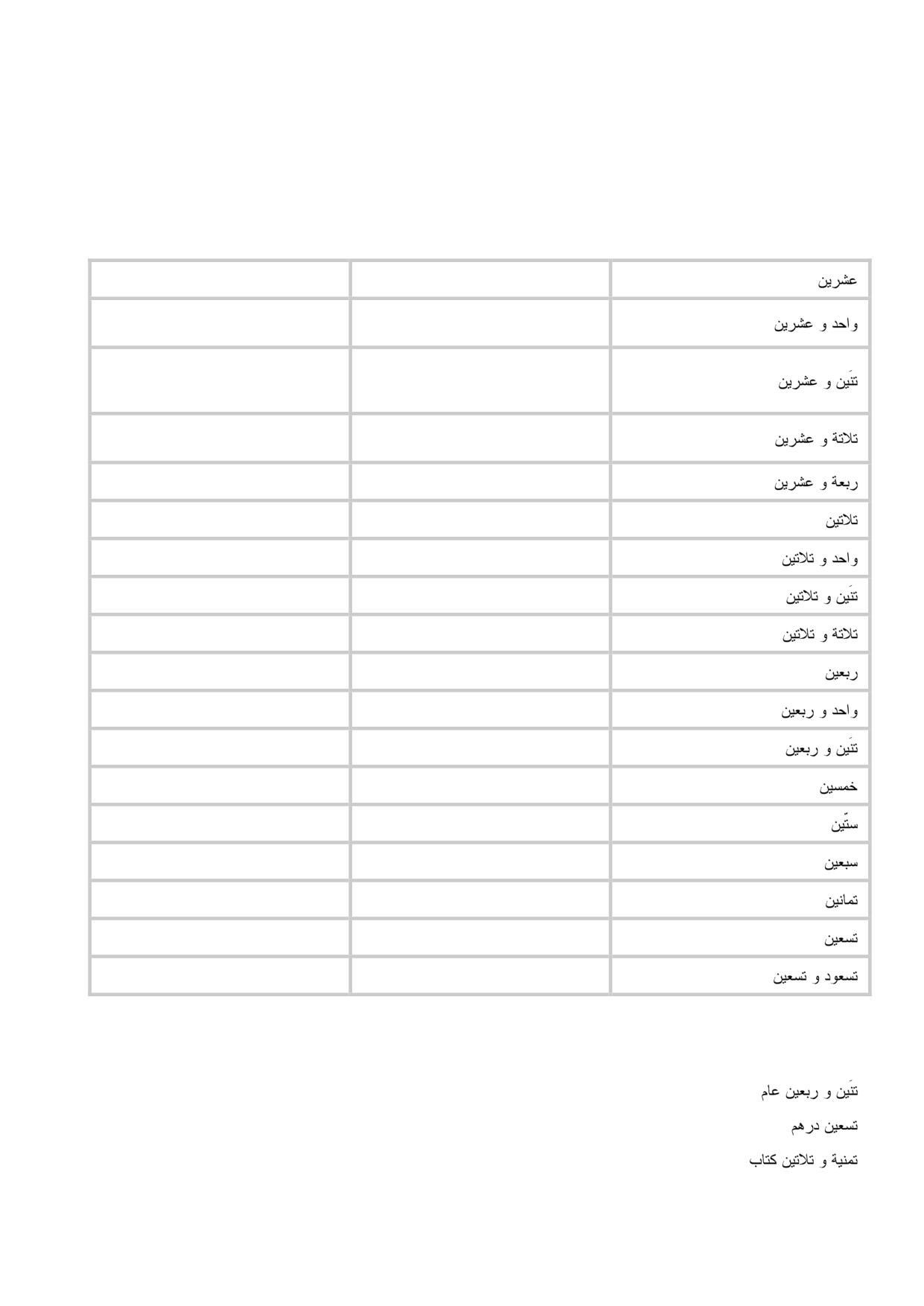
For numbers 11 thru 19, we can combine a number and a noun like this:
In Arabic, the plural
form is only used for
r (ر)
numbers 2 thru 10.
number +
or
+ singular noun (no definite article)
The singular is used
l (ل)
for everything else!
sixteen years
sttaš r عam
sixteen years
sttaš l عam
eighteen girls
tmntaš r bnt
eighteen girls
tmntaš l bnt
25
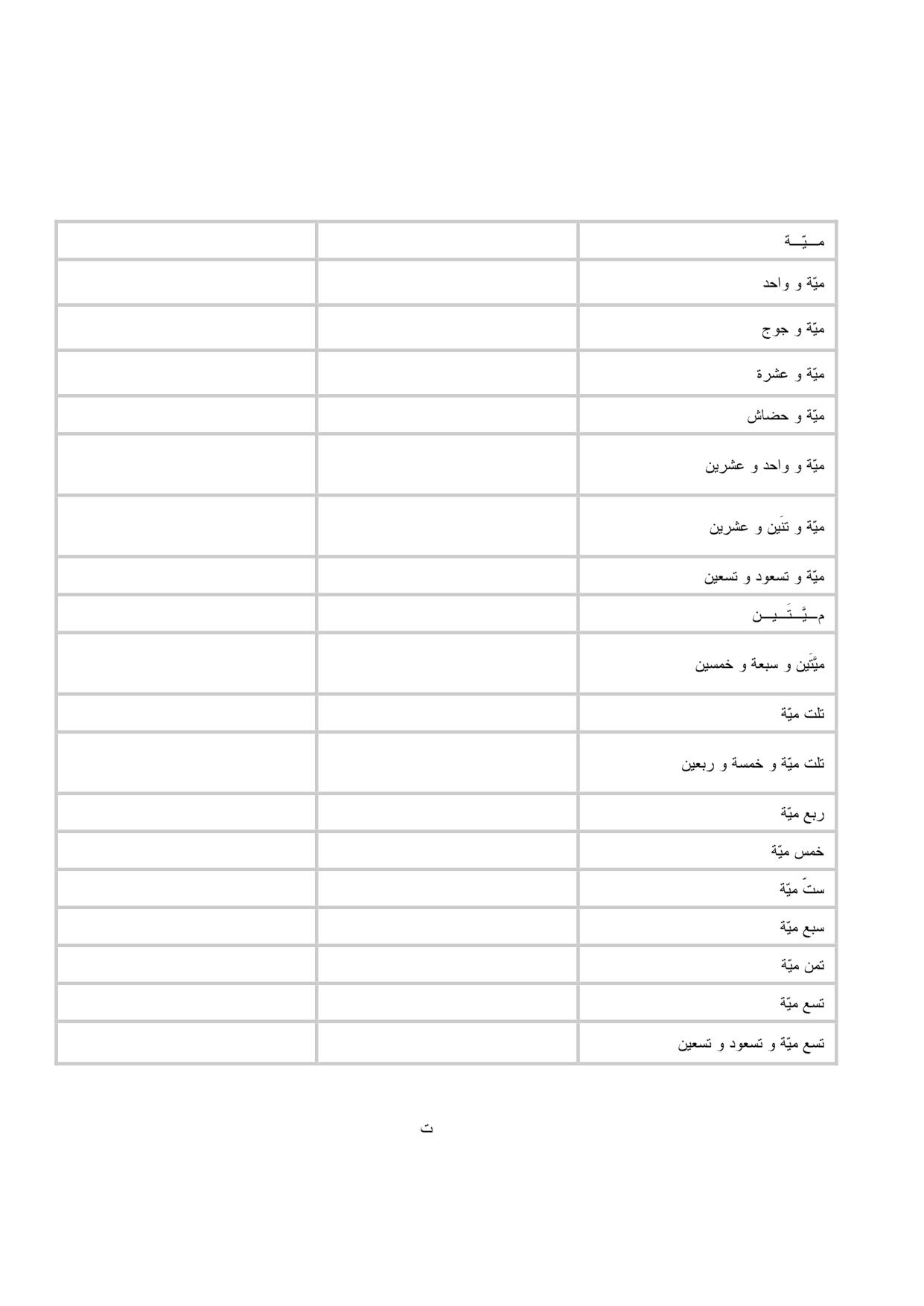
Numbers 20, 30, 40 ... 99
For a multiple of ten (20, 30, 40 etc.) in Arabic, we simply use the name for that number, like in
English. For numbers such as 21, 22, or 23, however, it is not like English. In Arabic, the ―ones‖ digit is
pronounced first, followed by the word ―and,‖ then followed by the ―tens‖ digit. For example, in Arabic
the number 21 is literally ―one and twenty‖ while the number 47 is literally ―seven and forty.‖ Also,
remember that for the numbers 22, 32, 42, 52, 62, 72, 82, and 92, we do not use juj. Rather, we use
tnayn. Here is a list of the multiples of ten, with examples of numbers between each multiple:
twenty
عšrin
twenty-one
waнd u عšrin
literally: one and twenty
twenty-two
literally: two and twenty
tnayn u عšrin
Remember: “tnayn,” not “juj”
twenty-three
tlata u عšrin
literally: three and twenty
twenty-four
rbعa u عšrin
thirty
tlatin
thirty-one
waнd u tlatin
thirty-two
tnayn u tlatin
thirty-three
tlata u tlatin
forty
rbعin
forty-one
waнd u rbعin
forty-two
tnayn u rbعin
fifty
xmsin
sixty
sttin
seventy
sbعin
eighty
tmanin
ninety
tsعin
ninety-nine
tsعud u tsعin
For numbers 20 thru 99, we can combine a number and a noun like this:
number + singular noun (no definite article)
forty-two years
tnayn u rbعin عam
ninety dirhams
tsعin drhm
thirty-eight books
tmnya u tlatin ktab
26 • Moroccan Arabic
Numbers 100, 200, 300 ... 999
The Arabic word for 100 is miya. For 200, there is a dual form of miyatayn. For 300 thru 900, we
use the short form of the numbers 3 thru 9 plus miya. For numbers such as 107 or 257, we will use the
appropriate multiple of 100 followed by the word ―and‖ and then the rest of the number. Some
examples:
one hundred
miya
one hundred one
miya u waнd
literally: one hundred and one
one hundred two
miya u juj
literally: one hundred and two
one hundred ten
miya u عšra
literally: one hundred and ten
one hundred eleven
miya u нdaš
one hundred twenty-one
literally: one hundred and one and
miya u waнd u عšrin
twenty
one hundred twenty-two
literally: one hundred and two and
miya u tnayn u عšrin
twenty
one hundred ninety-nine
miya u tsعud u tsعin
two hundred
miyatayn
two hundred fifty-seven
miyatayn u sbعa u
literally: two hundred and seven
xmsin
and fifty
three hundred
tlt miya
three hundred forty-five
tlt miya u xmsa u
literally: three hundred and five and
rbعin
forty
four hundred
rbع miya
five hundred
xms miya
six hundred
stt miya
seven hundred
sbع miya
eight hundred
tmn miya
nine hundred
tsع miya
tsع miya u tsعud u
nine hundred ninety-nine
tsعin
Exact multiples of 100 (100, 300, 400, etc. - not 137 or 278) are combined with a noun like this:
number + t ( ) + singular noun
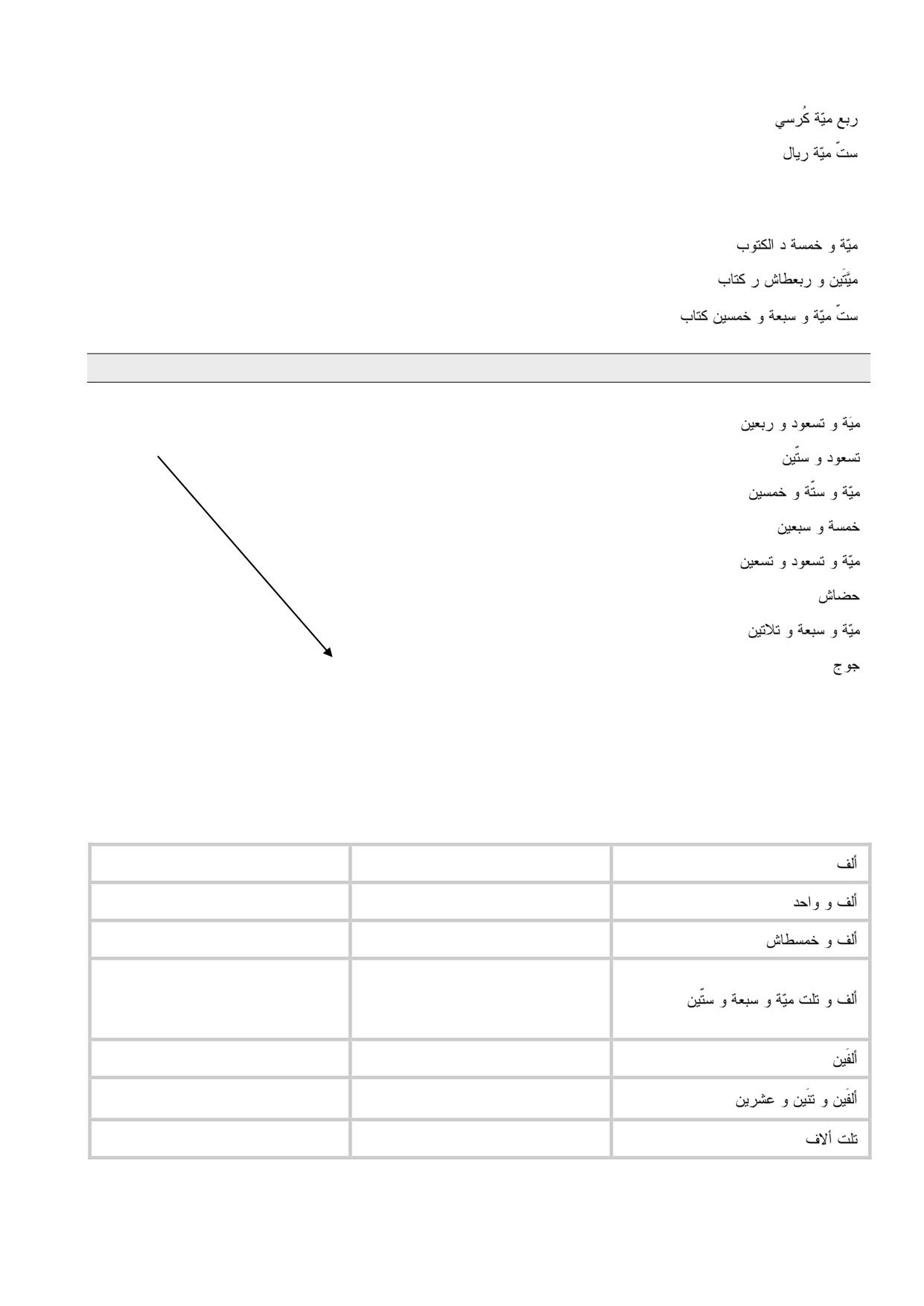
27
four hundred chairs
rbع miyat kursi
six hundred ryal
stt miyat ryal
But when a number between 100 and 999 is not an exact multiple of 100 (e.g. 167, 492, 504), we
combine the number with a noun according to the rule for the final digits of the number.
105 books (use the rule for “5”)
miya u xmsa d l-ktub
214 books (use the rule for “14”)
miyatayn u rbعtaš r ktab
stt miya u sbعa u xmsin
657 books (use the rule for “57”)
ktab
Exercise: Match the number with the correct Arabic translation.
199
miya u tsعud u rbعin
2
tsعud u sttin
11
miya u stta u xmsin
149
xmsa u sbعin
137
miya u tsعud u tsعin
75
нdaš
69
miya u sbعa u tlatin
156
juj
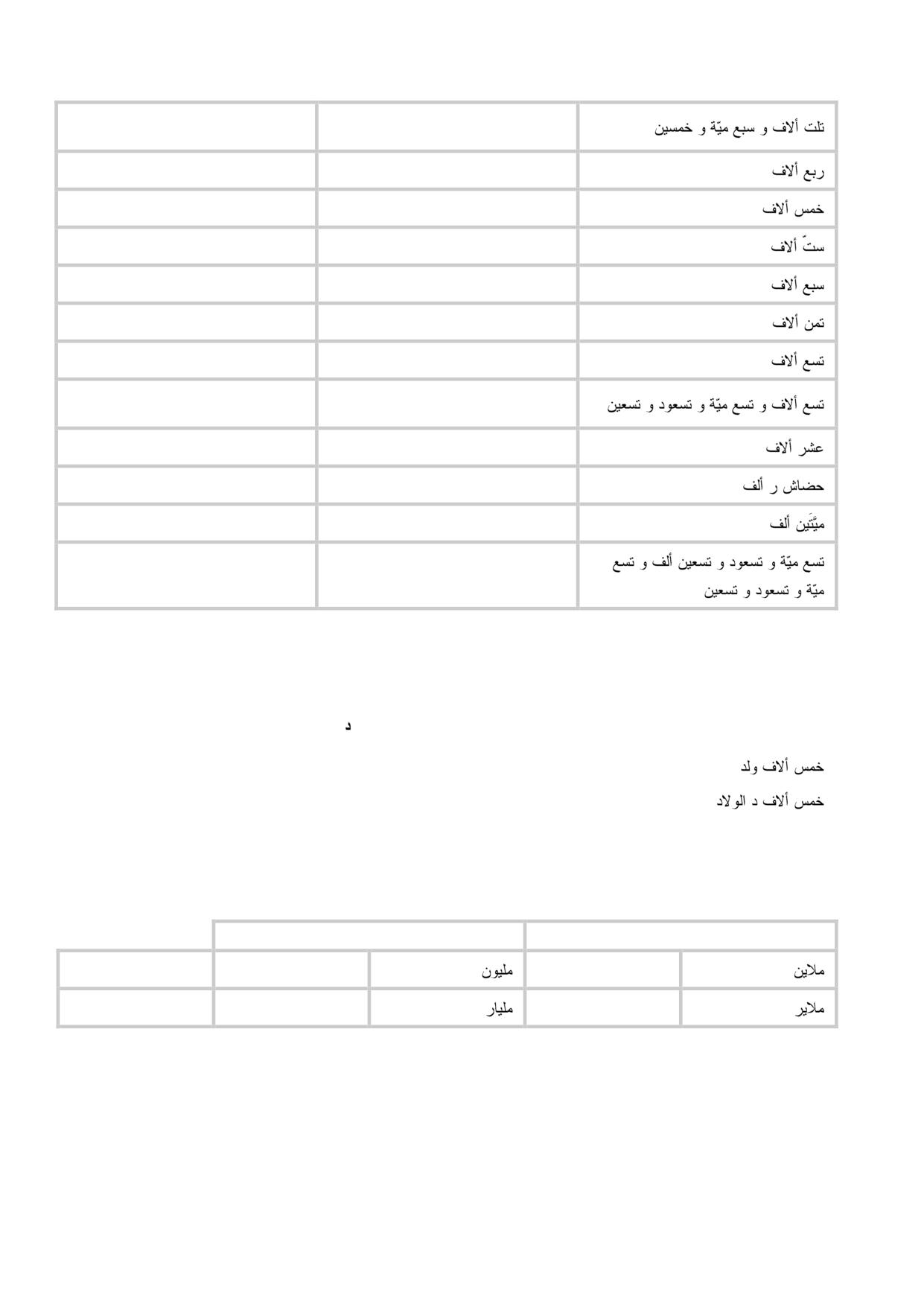
Numbers 1000, 2000, 3000 ...
The word for ―thousand‖ has the singular form alf, the dual form alfayn, and the plural form alaf.
The plural form is used with the short form of the numbers 3 thru 10 from ―3‖ thousand to ―10‖
thousand. Then we return to the singular form (like we do for all Arabic nouns). Like the word for
―hundred,‖ it is followed by ―and‖ when the number is not an exact multiple of 1000 (e.g. 1027 or
4738). From 1000 onward:
one thousand
alf
one thousand one
alf u waнd
one thousand fifteen
alf u xmstaš
one thousand three hundred
alf u tlt miya u sbعa
sixty-seven (literally: one
thousand and three hundred and
u sttin
seven and sixty)
two thousand
alfayn
alfayn u tnayn u
two thousand twenty-two
عšrin
three thousand
tlt alaf
28 • Moroccan Arabic
three thousand seven
tlt alaf u sb عmiya u
hundred and fifty
xmsin
four thousand
rbع alaf
five thousand
xms alaf
six thousand
stt alaf
seven thousand
sbع alaf
eight thousand
tmn alaf
nine thousand
tsع alaf
nine thousand nine hundred
tsع alaf u tsع miya u
ninety-nine
tsعud u tsعin
ten thousand
عšr alaf
eleven thousand
нdaš r alf
two hundred thousand
miyatayn alf
tsع miya u tsعud u
999,999
tsعin alf u tsع miya
u tsعud u tsعin
Exact multiples of 1000 can be combined with nouns in two ways:
number + singular noun
Or...
number + d ( ) + plural noun with definite article
five thousand boys
xms alaf wld
five thousand boys
xms alaf d l-wlad
Numbers larger than 1000 that are not exact multiples of 1000 are combined with nouns according to
the rules for the final digits, as you saw with numbers that were not exact multiples of 100.
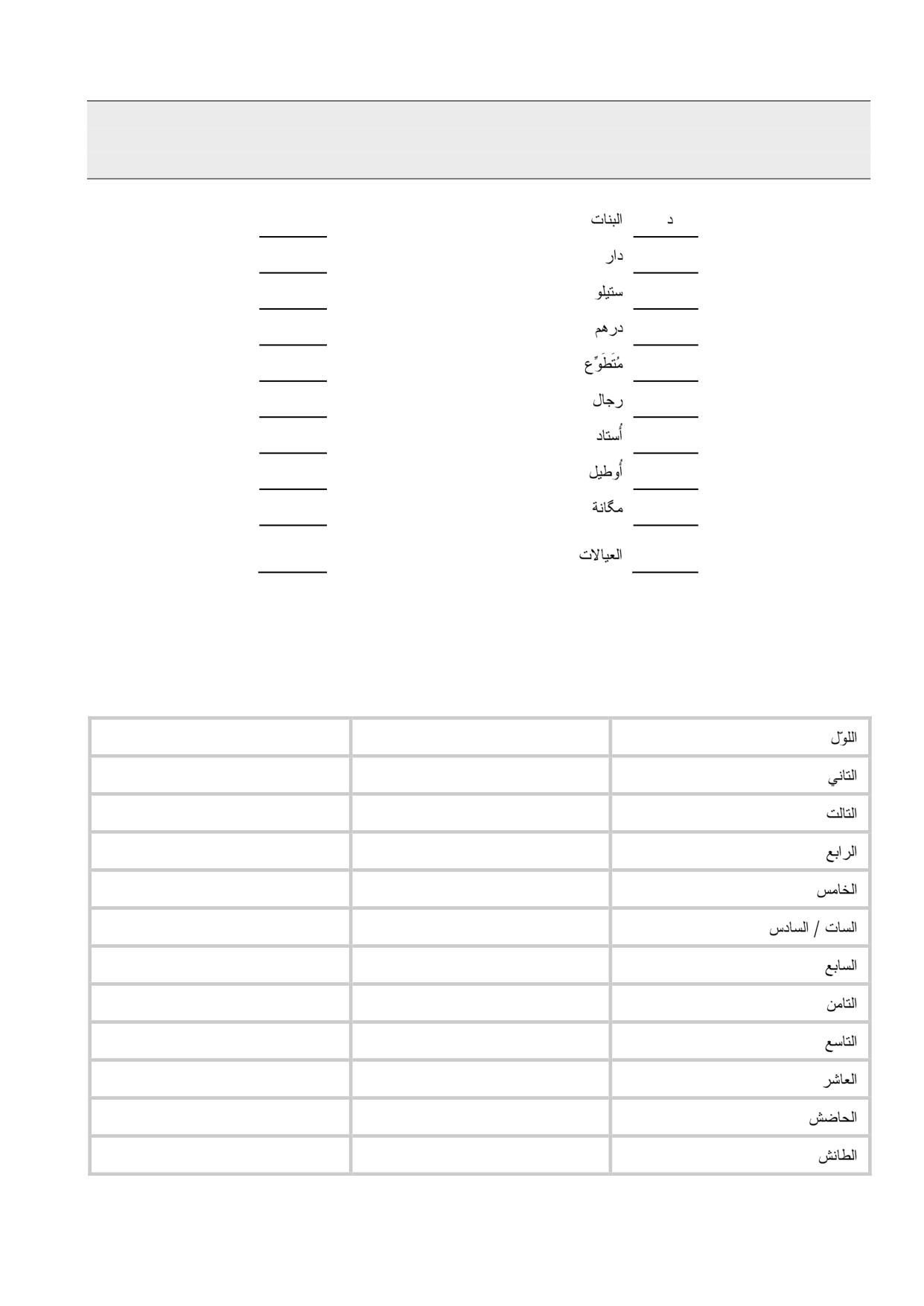
Larger Numbers
Singular
Plural
million(s)
mlyun
mlayn
billion(s)
mlyar
mlayr
29
Exercise: Correctly combine numbers with nouns by filling in the blanks using the
following numbers and any necessary letters: 1, 3, 8, 13, 20, 400, or 1000.
There may be more than one correct answer for each.
3
3 d l-bnat
(the girls)
dar
(house)
stilu
(pen)
drhm
(dirham)
mutatawwiع (volunteer)
rjal
(men)
ustad
(teacher)
otil
(hotel)
magana
(watch)
(the
l-عyalat
women)
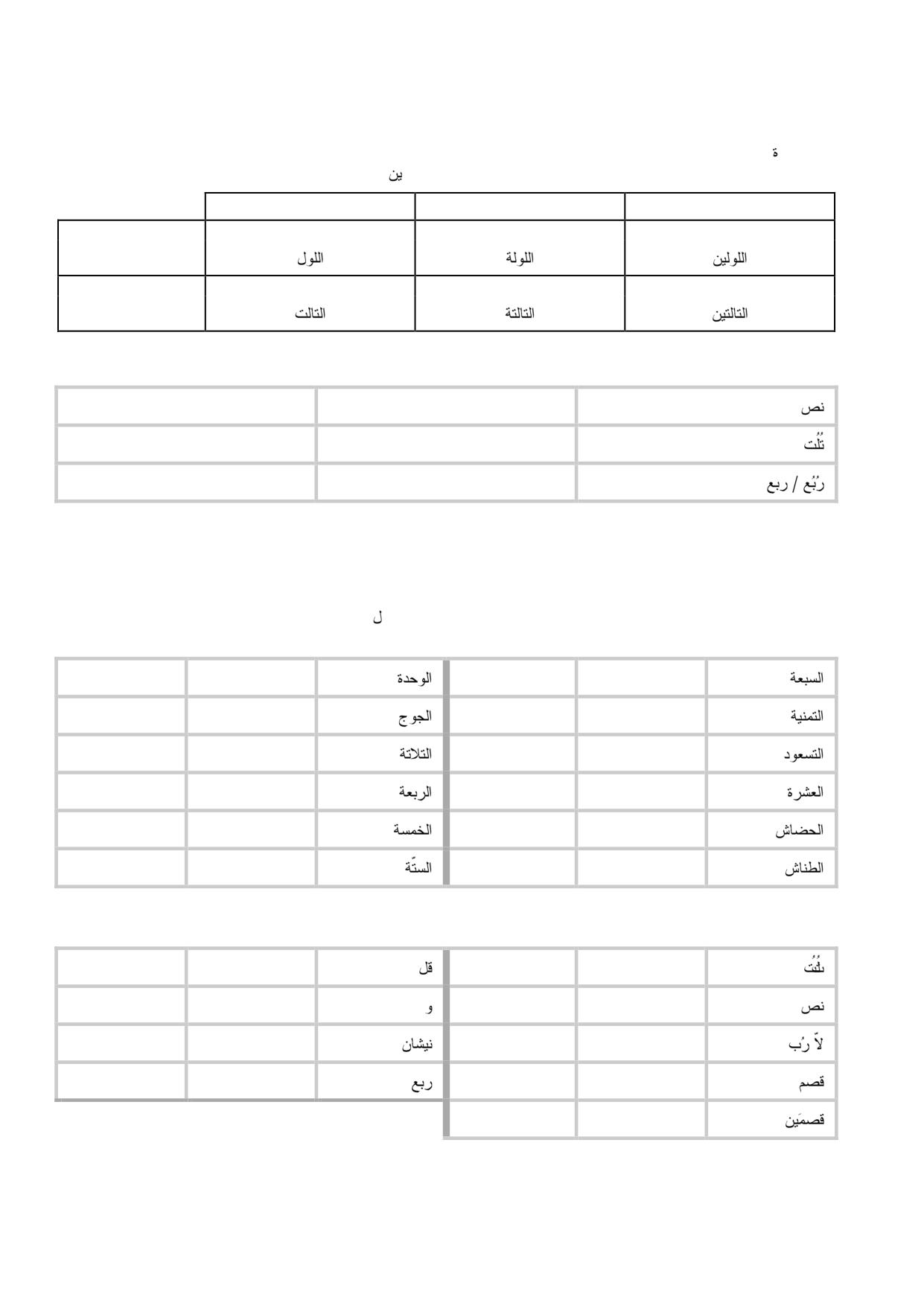
Ordinal Numbers / Fractions
Ordinal Numbers
For numbers 1 thru 12, there is a separate form for cardinal and ordinal numbers. From 13 on there is
no difference between the cardinal and ordinal number.
first
l-luwl
second
t-teni
third
t-talt
fourth
r-rabع
fifth
l-xams
sixth
s-sat / s-sads
seventh
s-sabع
eighth
t-tamn
ninth
t-tasع
tenth
l-عašr
eleventh
l-нadš
twelfth
t-tanš
30 • Moroccan Arabic
Ordinal numbers act like adjectives, and therefore must agree in gender and number with the noun
they describe. Listed are the masculine singular forms. To make the feminine form, add a ( ) to the
ordinal number. To make it plural, add in (
).
Masculine
Feminine
Plural
l-luwl
l-luwla
l-luwlin
first
t-talt
t-talta
t-taltin
third
Fractions
half
ns
third
tulut
fourth
rubuع / rbع
Time
To express time, we use the demonstrative pronoun hadi and the appropriate number with the
definite article (see page 147 for more info on the definite article). This means that for 1:00, 5:00,
10:00, and 11:00, we will use the letter l ( ) before the number, while for the others, we will double the
first consonant.
one
l-wнda
seven
s-sbعa
two
j-juj
eight
t-tmnya
three
t-tlata
nine
t-tsعud
four
r-rbعa
ten
l-عšra
five
l-xmsa
eleven
l-нdaš
six
s-stta
twelve
t-tnaš
Like in English, Arabic uses certain words to express things like ―quarter to five,‖ ―half past seven,‖ etc.
before
ql
twenty minutes
tulut
and
u
half
ns
exactly
nišan
quarter to
lla rob
quarter
rbع
five minutes
qsm
ten minutes
qsmayn
31
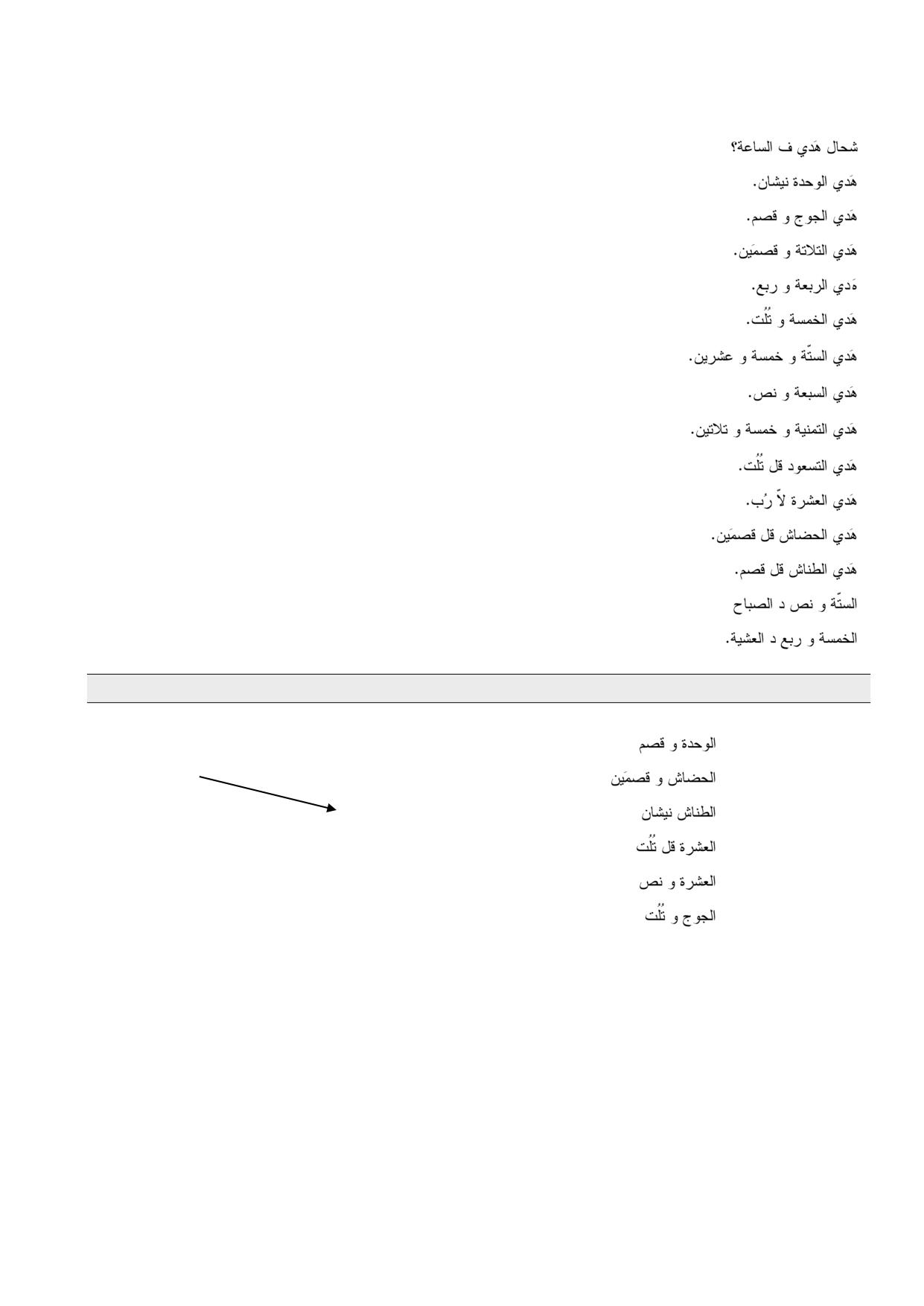
Some examples of asking and answering about time:
What time is it?
šнal hadi f s-saعa?
It is exactly one o‟clock.
hadi l-wнda nišan.
It is five minutes past two.
hadi j-juj u qsm.
It is ten minutes past three.
hadi t-tlata u qsmayn.
It is a quarter past four.
hadi r-rbعa u rbع.
It is twenty minutes past five.
hadi l-xmsa u tulut.
hadi s-stta u xmsa u
It is twenty-five minutes past six.
عšrin.
It is seven thirty.
hadi s-sbعa u ns.
hadi tmnya u xmsa u
It is eight thirty-five.
tlatin.
It is twenty minutes to nine.
hadi t-tsعud ql tulut.
It is a quarter to ten.
hadi l-عšra lla rob.
It is ten minutes to eleven
hadi l-нdaš ql qsmayn.
It is five minutes to twelve.
hadi t-tnaš ql qsm.
6:30 A.M.
s-stta u ns d s-sbaн
5:15 P.M.
l-xmsa u rbع d l-عšiya
Exercise: Match the times with the correct Arabic translation.
10:30
l-wнda u qsm
12:00
l-нdaš u qsmayn
1:05
t-tnaš nišhan
2:20
l-عšra ql tulut
11:10
l-عšra u ns
9:40
j-juj u tulut
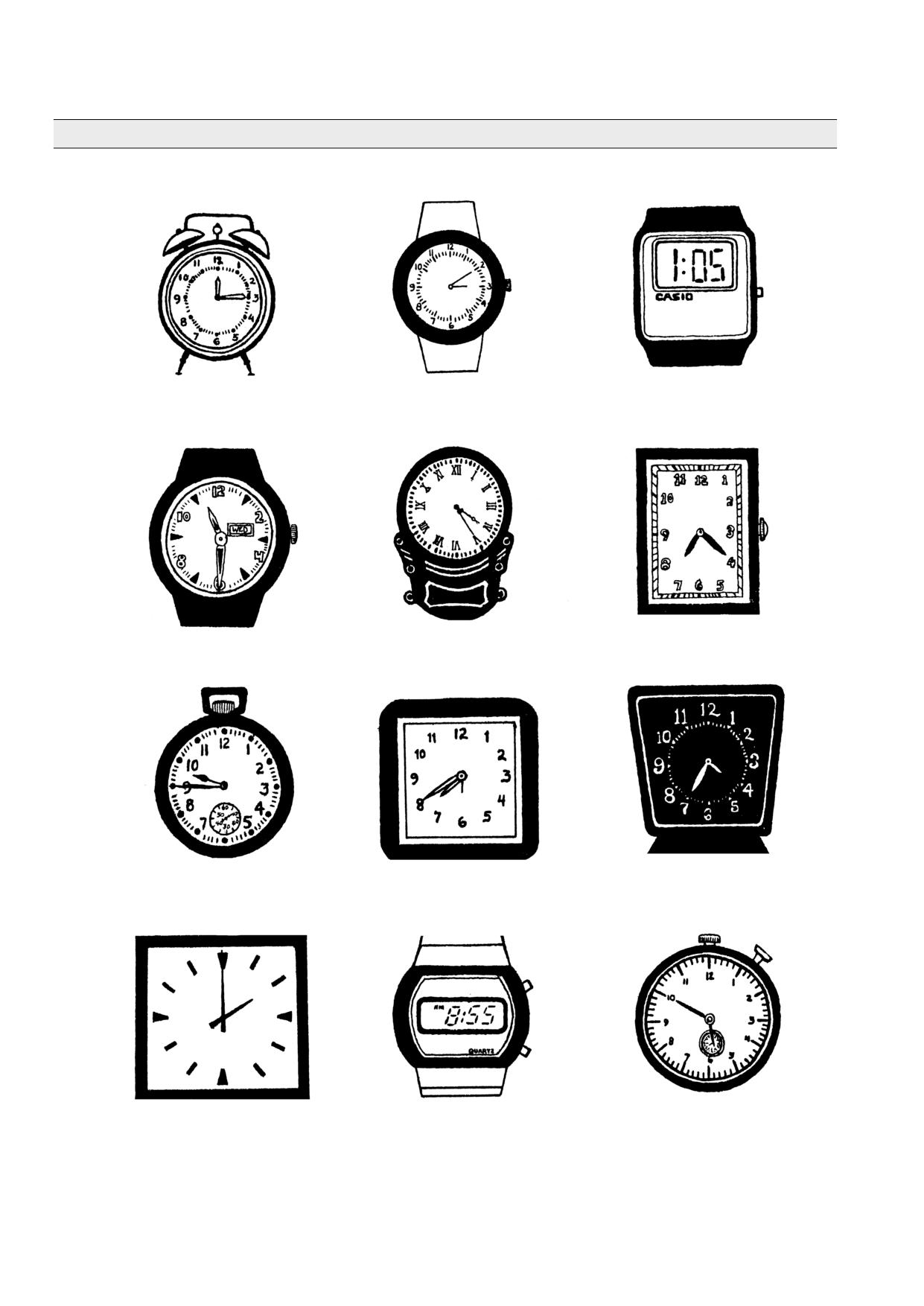
32 • Moroccan Arabic
Exercise: Give the time in Arabic for each clock or watch.
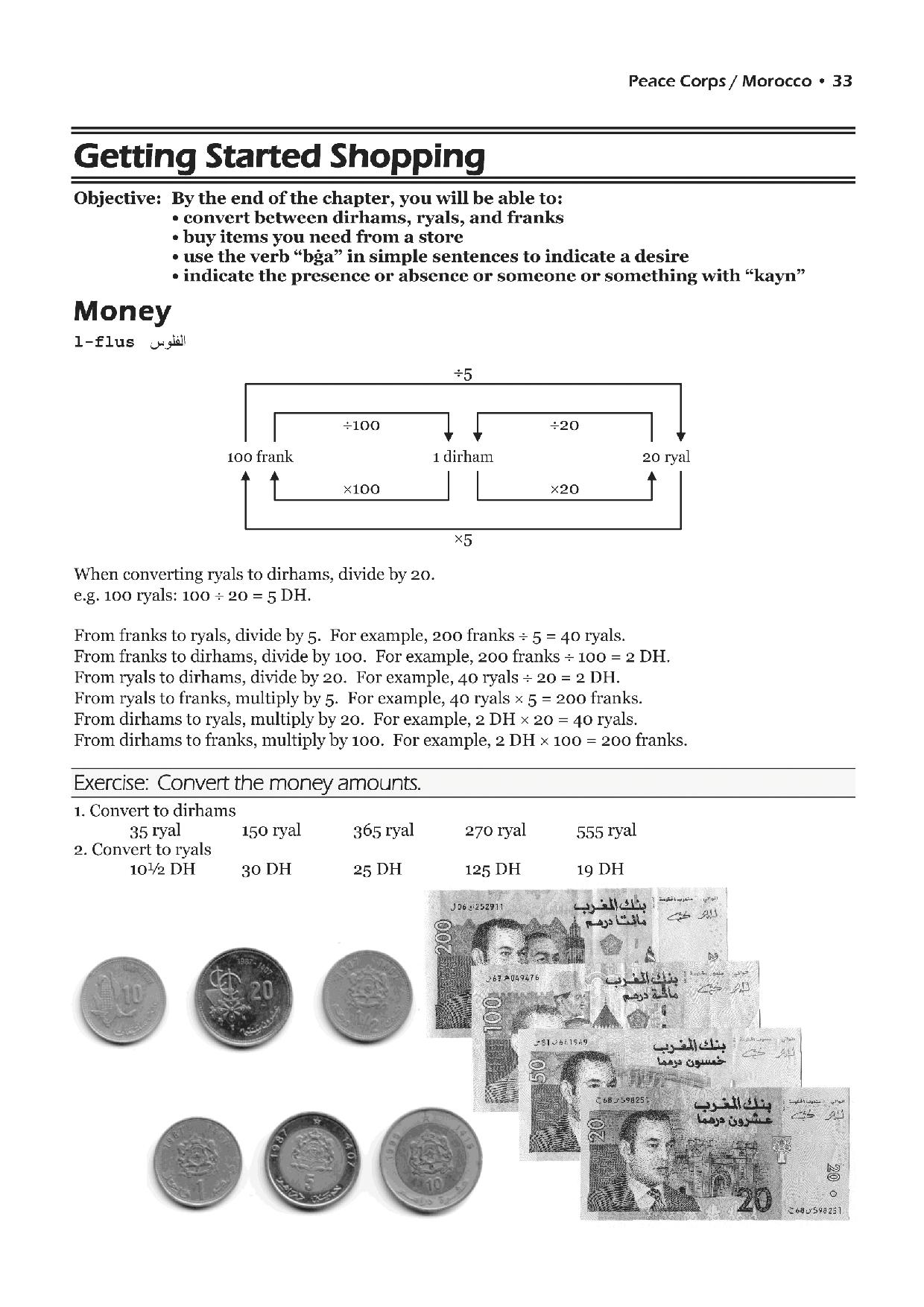
34 • Moroccan Arabic
At the Hanoot
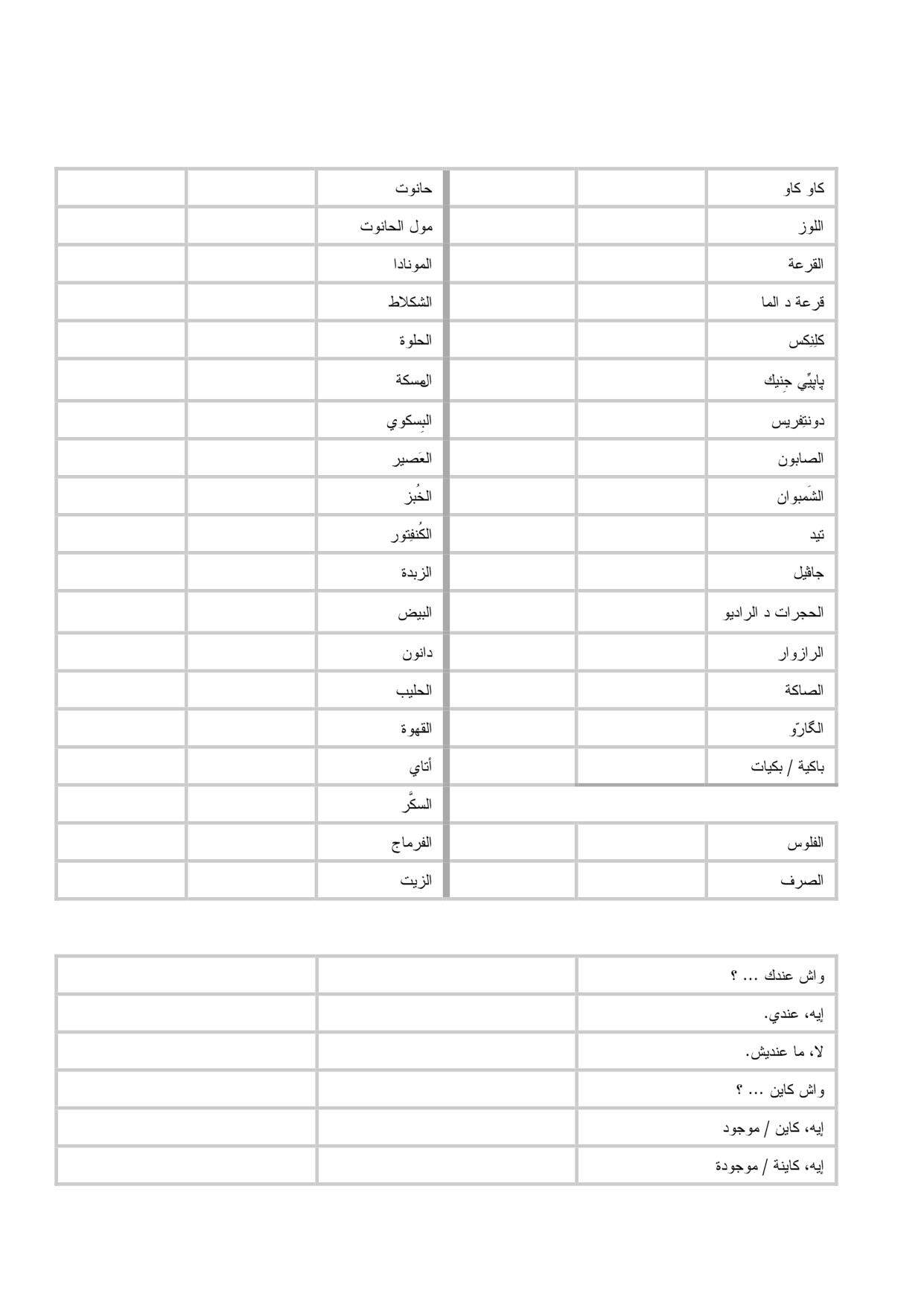
Vocabulary
store
нanut
peanuts
kaw kaw
store keeper
mul l-нanut
almonds
l-luz
soda
l-monada
bottle
l-qrعa
chocolate
š-šklat
bottle of water
qrعa d l-ma
candies
l-нlwa
Kleenex
kliniks
ppapiyi
gum
l-mska
toilet paper
jinik
cookies
l-biskwi
tooth paste
dontifris
juice
l-عasir
soap
s-sabun
bread
l-xubz
shampoo
š-šampwan
jam
l-konfitur
detergent
tid
butter
z-zbda
bleach
javel
l-нjrat d
eggs
l-bid
batteries
r-radyu
yogurt
danon
razor
r-razwar
milk
l-нlib
tobacco store
s-saka
coffee
l-qhwa
cigarettes
l-garru
tea
atay
package(s)
bakiya(t)
sugar
s-skkar
cheese
l-frmaj
money
l-flus
oil
z-zit
change
s-srf
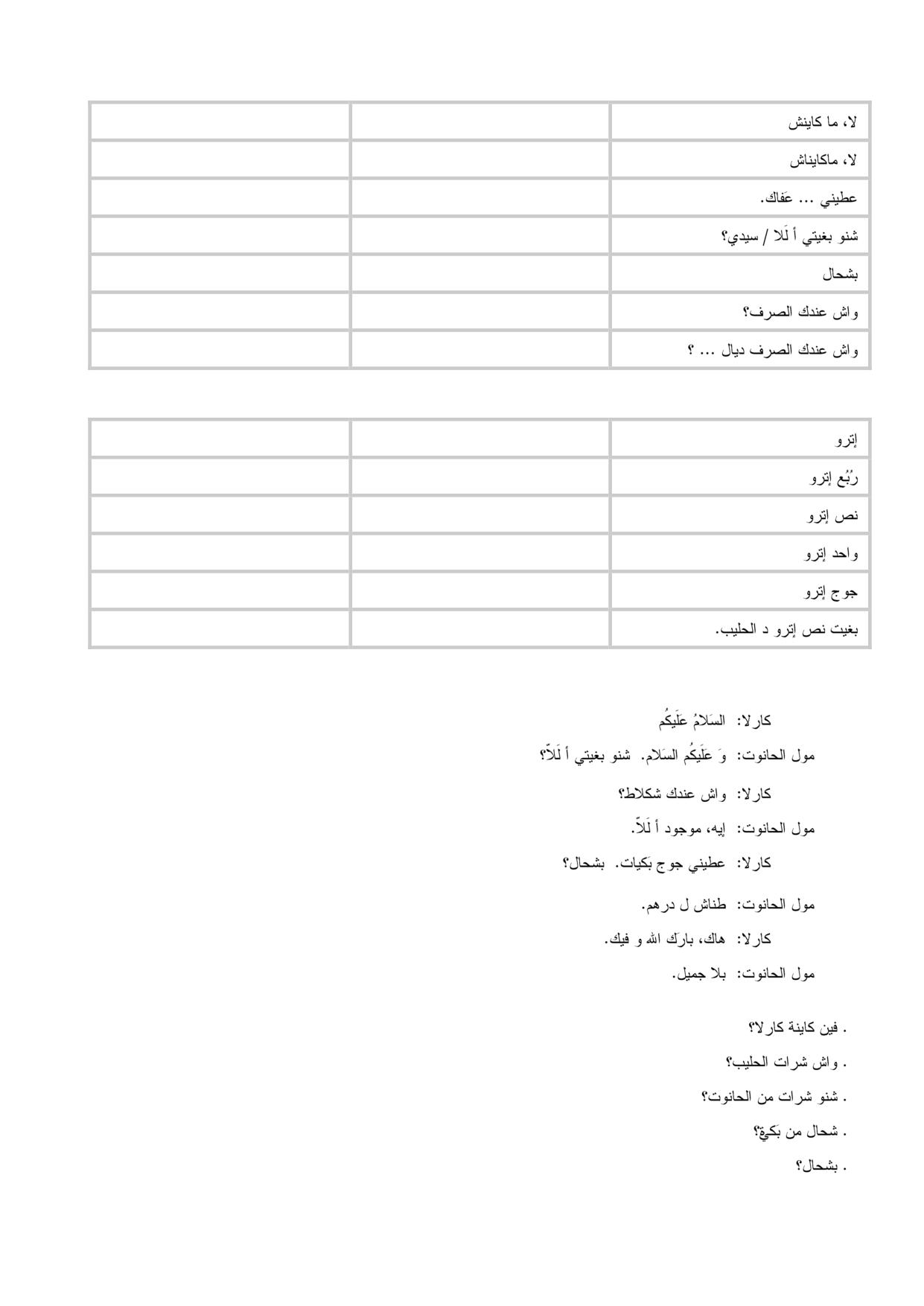
Expressions
Do you have ... ?
weš عndk ... ?
Yes, I do (have).
iyeh, عndi.
No, I don‟t (have).
lla, ma-عndi-š.
Is there ... ?
weš kayn ... ?
Yes, there is. (masc.)
iyeh, kayn / mujud
Yes, there is. (fem.)
iyeh, kayna / mujuda
35
No, there isn‟t. (masc.)
lla, ma-kayn-š.
No, there isn‟t. (fem.)
lla, ma-kayna-š.
Give me ... please.
عtini ... عafak.
What do you want ma‟am / sir?
šnu bġiti a lalla/sidi?
How much?
bšнal?
Do you have change?
weš عndk s-srf?
Do you have change for ... ?
weš عndk s-srf dyal..?
Liter
liter
itru
¼ liter
rubuع itru
½ liter
ns itru
1 liter
waнd itru
2 liters
juj itru
I want ½ a liter of milk.
bġit ns itru d l-нlib.
Dialogue
Karla: s-salamu عalaykum.
mul l-нanut: wa عalaykum s-salam.
šnu bġiti a lalla?
Karla: weš عndk šklat?
mul l-нanut: iyeh, mujud a lalla.
Karla: عtini juj bakiyat.
bšнal?
mul l-нanut: tnaš l drhm.
Karla: hak, barak llah u fik.
mul l-нanut: bla jmil
1. feen kayna Karla?
1
2. weš šrat l-нlib?
2
3. šnu šrat mn l-нanut?
3
4. šнal mn bakiya?
4
5. bšнal?
5
36 • Moroccan Arabic
Verb “to want”
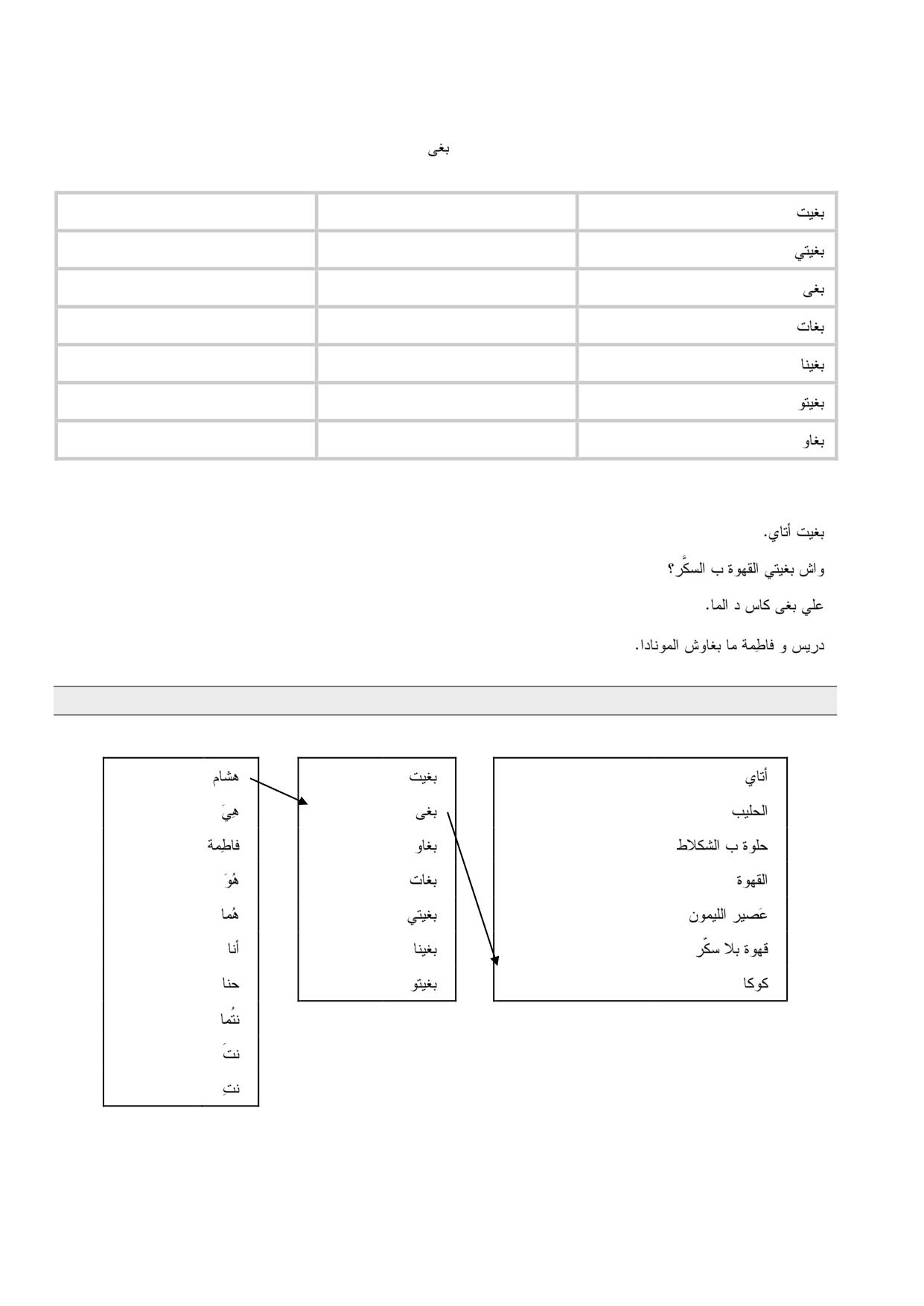
In Moroccan Arabic, the verb ―to want‖ is bġa (
). This verb uses the past tense but has a present
tense meaning. When conjugated in the present tense, bġa means ―to like‖ (see page 96).
I want
bġit
you want (sing.)
bġiti
he wants
bġa
she wants
bġat
we want
bġina
you want (plur.)
bġitu
they want
bġau
Verb + Noun Examples
I want tea.
bġit atay.
weš bġiti l-qhwa b
Do you want coffee with sugar?
skkar?
Ali wants a glass of water.
Ali bġa kas d l-ma.
Driss and Fatima don‟t want
Driss u Fatima ma-bġau-š
soda.
l-monada.
Exercise: Make as many sentences as you can.
e.g. Hicham bġa kuka.
Hicham
bgit
atay
hiya
bġa
l-нlib
Fatima
bġau
нlwa b šklat
huwa
bġat
l-qhwa
huma
bġiti
عasir l-limun
ana
bġina
qhwa bla skkar
нna
bġitu
kuka
ntuma
nta
nti
37
Listening Exercise
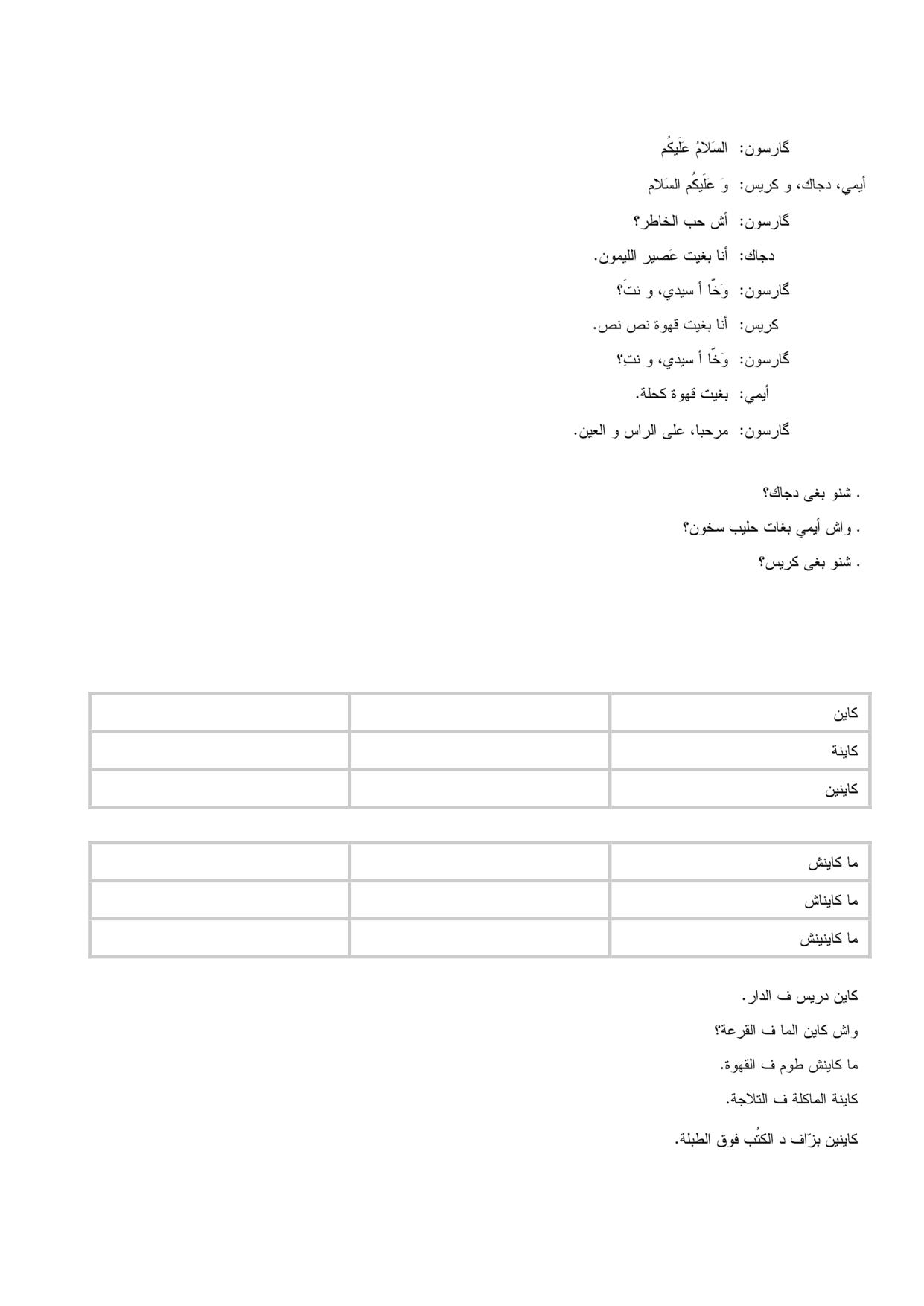
garsun: s-salamu عalaykum.
Amy, Jack,
& Chris: wa عalaykum s-salam.
garsun: aš нb l-xatr?
Jack: ana bġit عasir l-limun.
garsun: waxxa a sidi, u nta?
Chris: ana bġit qhwa ns ns.
garsun: waxxa a sidi, u nti?
Amy: bġit qhwa kнla.
garsun: mrнba, عla r-ras u
l-عin.
1. šnu bġa Jack?
1
2. weš Amy bġat нlib sxun?
2
3. šnu bġa Chris?
3
Kayn for “There is”
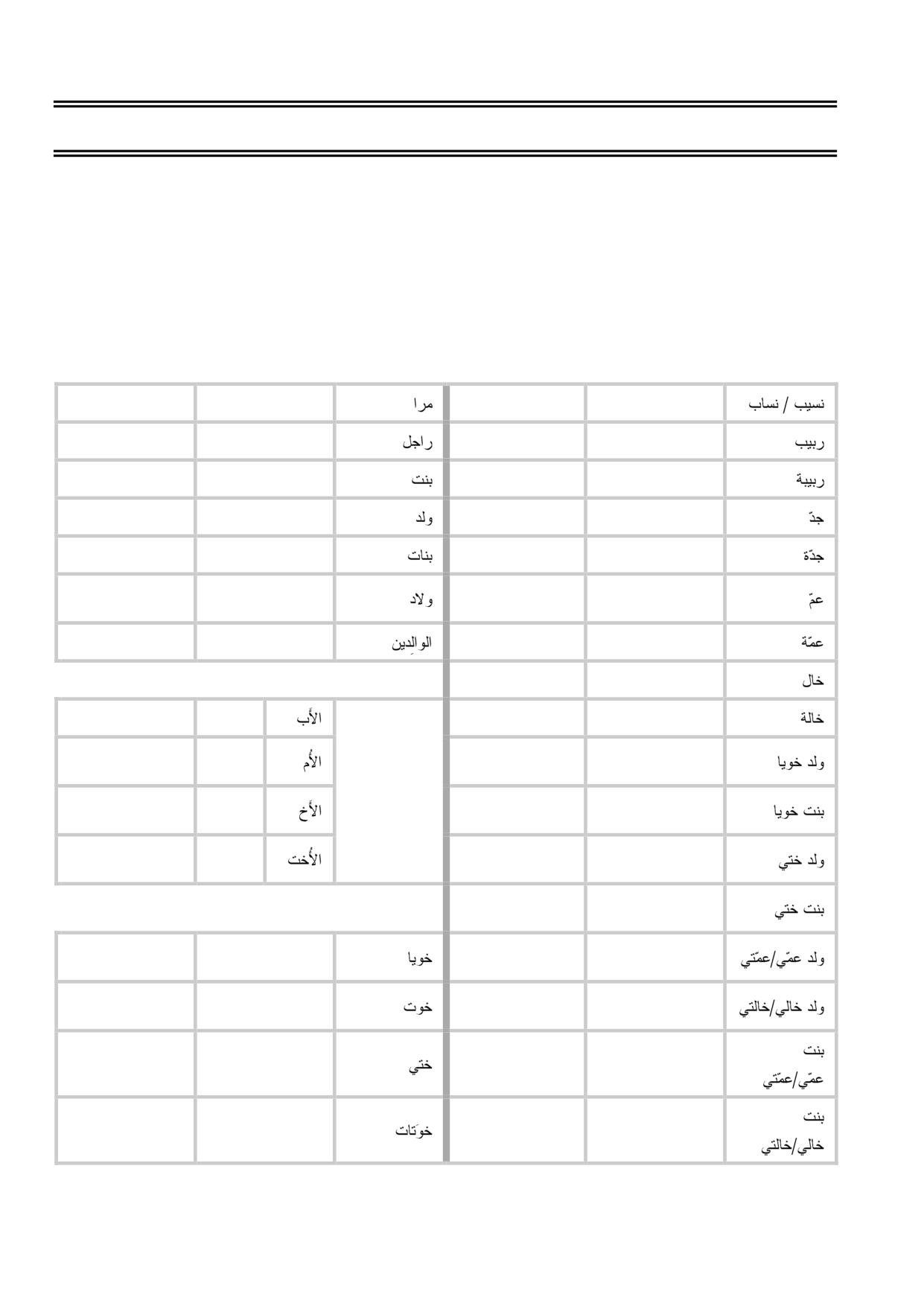
The words kayn, kayna, and kaynin are actually the participles for the verb ―to be.‖ In Darija,
however, we use them most often in the sense of ―there is‖ or ―there are.‖
Affirmative
there is (masc. sing.)
kayn
there is (fem. sing.)
kayna
there are (plur.)
kaynin
Negative
there is not (masc. sing.)
ma-kayn-š
there is not (fem. sing.)
ma-kayna-š
there are not (plur.)
ma-kaynin-š
Driss is at home.
kayn Driss f d-dar.
Is there water in the bottle?
weš kayn l-ma f l-qrعa?
Tom is not at the café.
ma-kayn-š Tom f l-qhwa.
There is food in the fridge.
kayna l-makla f t-tlaja.
There are many books on the
kaynin bzzaf d l-ktub
table.
fuq tbla.
38 • Moroccan Arabic
Family
Objective: By the end of the chapter, you will be able to:
• describe family members
• use the verb “to have” in simple sentences
Cultural Points
Family ties are very strong in Morocco. Children remain in touch or live with the family even if
they get married (taking into consideration space available within the house). Men are not expected to
help in the kitchen. Roles of men and women may differ in the city and in the country.
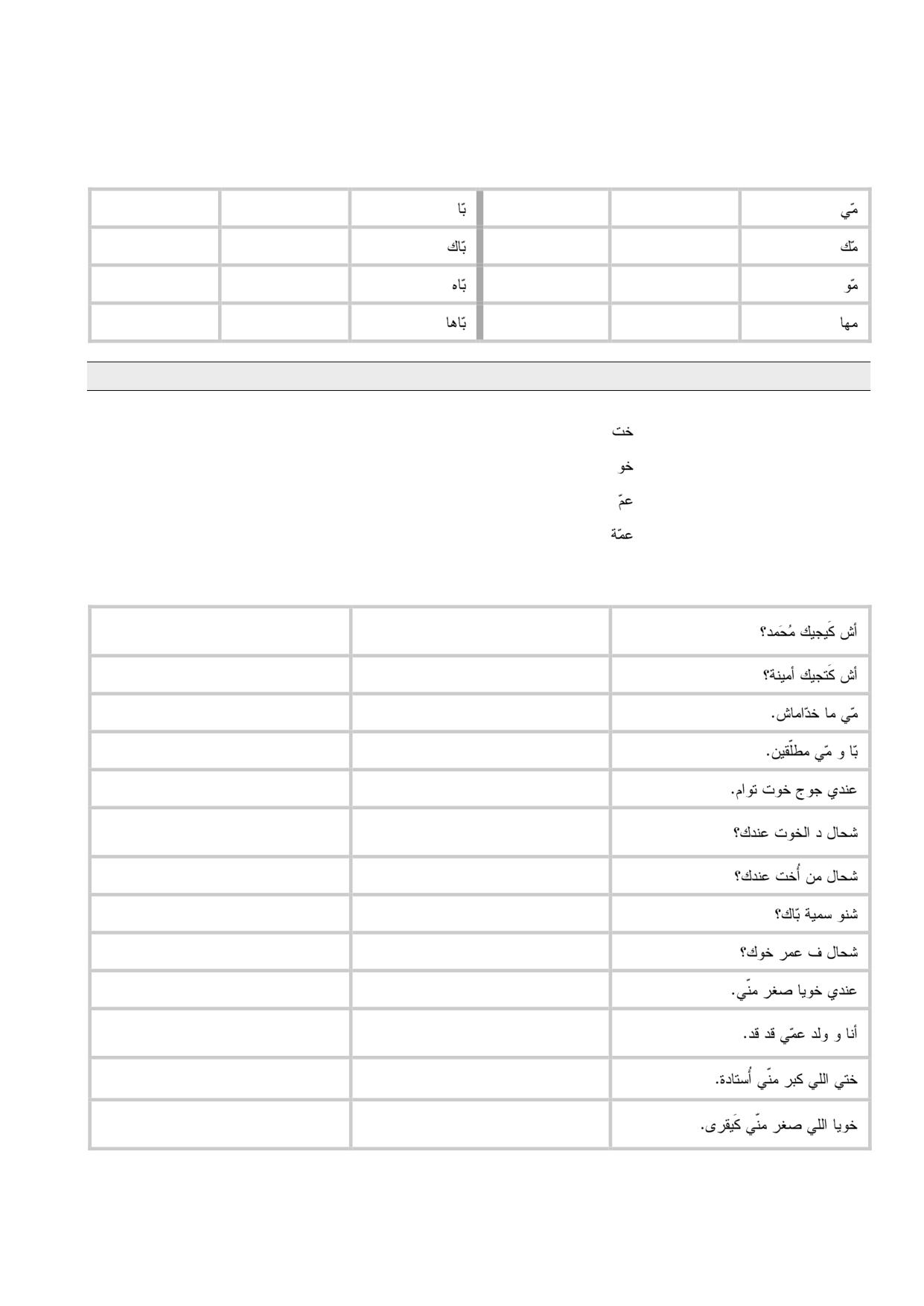
Family Members
Vocabulary
woman/wife
mra
in-law(s)
nsib / nsab
man/husband
rajl
step-son
rbib
girl/daughter
bnt
step-daughter
rbiba
boy/son
wld
grandfather
jdd
girls/daughters
bnat
grandmother
jdda
boys/sons/
wlad
uncle (paternal)
عmm
children
the parents
l-walidin
aunt (paternal)
عmma
uncle (maternal)
xal
the father
l'ab
These forms are
aunt (maternal)
xala
rarely used in
Moroccan Arabic.
my nephew
the mother
l'om
wld xuya
Sometimes they
(brother‟s side)
are used with
my niece
the brother
l'ax
“dyal.” More
bnt xuya
(brother‟s side)
often, we use the
forms “my father,
my nephew
the sister
l'oxt
wld xti
“my sister,” etc.
(sister‟s side)
my niece
bnt xti
(sister‟s side)
my cousin
(my) brother
xu(ya)
wld عmm(t)i
(mas., paternal)
my cousin
brothers/ siblings
xut
wld xal(t)i
(mas., maternal)
my cousin
(my) sister
xt(i)
bnt عmm(t)i
(fem, paternal)
my cousin
sisters
xwatat
bnt xal(t)i
(fem, maternal)
39
For ―father, mother, brother, sister, aunt, and uncle,‖ the word is almost always used with a possessive
pronoun. Thus, we say ―my father‖ or ―his mother‖ or ―your brother,‖ but rarely ever use them alone.
The words ―brother, sister, aunt, and uncle‖ take the possessive pronoun endings you already learned
(see page 8), but ―father‖ and ―mother‖ have a couple irregularities.
my father
bba
my mother
mmi
your father
bbak
your mother
mmk
his father
bbah
his mother
mmu
her father
bbaha
her mother
mha
Exercise: Add the possessive endings to the following:
sister
xt
brother
xu
uncle
عmm
aunt
عmma
Expressions
How is Mohamed related to
aš kay-jeek Mohamed?
you?
How is Amina related to you?
aš kat-jeek Amina?
My mom doesn‟t work.
mmi ma-xddama-š.
My mom and dad are divorced.
bba u mmi mtllqin.
I have two twin siblings.
عndi juj xut twam.
How many siblings do you
šнal d l-xut عndk?
have?
How many sisters do you have?
šнal mn oxt عndk?
What‟s your father‟s name?
šnu smit bbak?
How old is your brother?
šнal f عmr xuk?
I have a younger brother.
عndi xuya sġr mnni.
My (male) cousin and I are the
ana u wld عmmi qd qd.
same age.
xti lli kbr mnni
My older sister is a teacher.
ustada.
My younger brother goes to
xuya lli sġr mnni
school.
kay-qra.
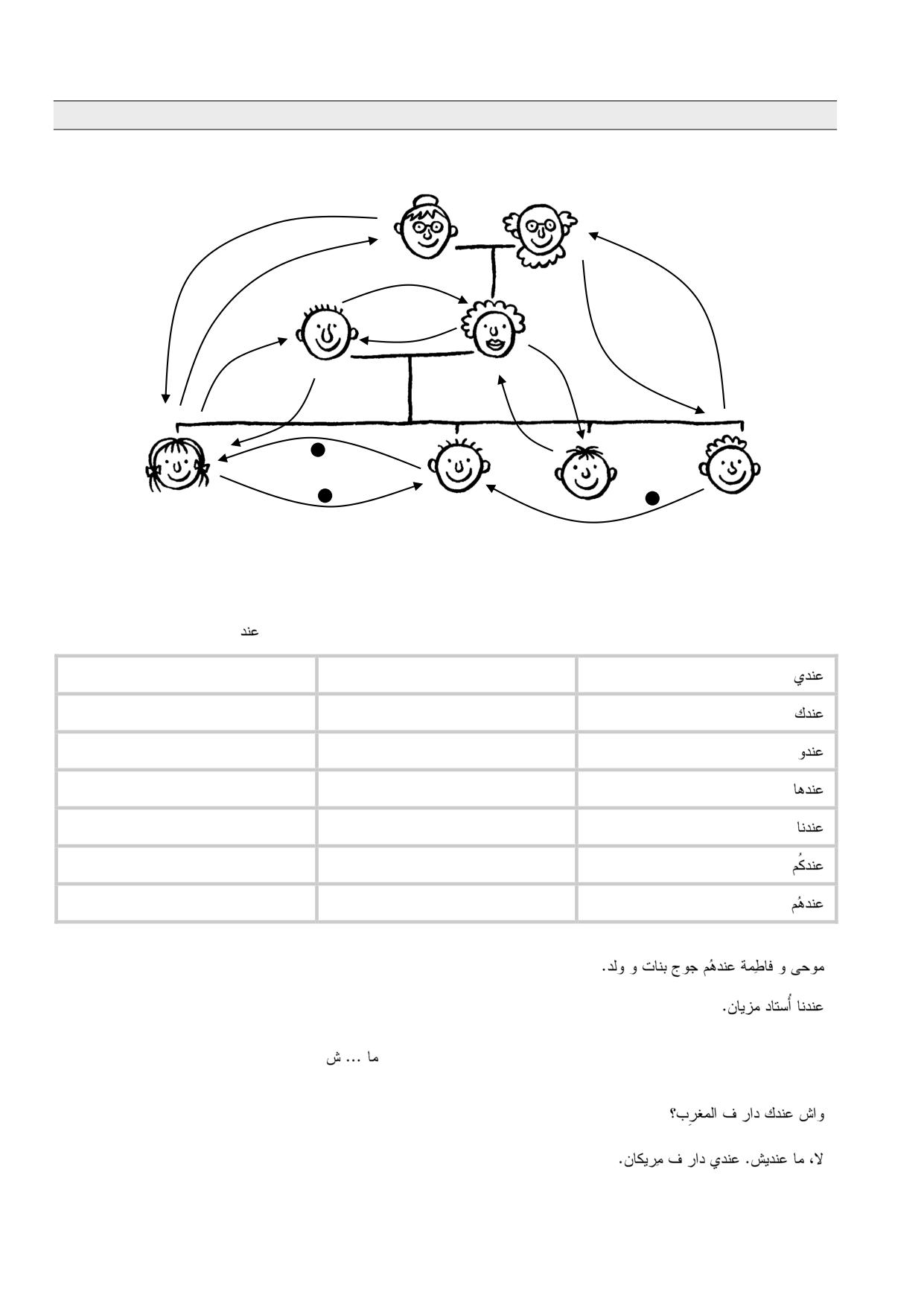
40 • Moroccan Arabic
Exercise: Describe the relationships between family members for each arrow.
ex: 1. Fatima
______
Samira.
Fatima
Aziz
Ahmed
Karima
11
Samira
12
13
Mohamed
Youness
Rachid
Verb “to have”
The verb ―to have‖ عnd (
) in the present tense:
I have
عndi
you have (sing.)
عndk
he has
عndu
she has
عndha
we have
عndna
you have (plur.)
عndkum
they have
عndhum
Moha and Fatima have two
Moha u Fatima عndhum juj
daughters and a son.
bnat u wld.
We have a good teacher.
عndna ustad mzyan.
To negate the verb, use ma ... š (
).
Do you have a house in
weš عndk dar f l-mġrib?
Morocco?
No, I don‟t. I have a house in
lla, ma-عndi-š. عndi dar
the U.S.
f mirikan.
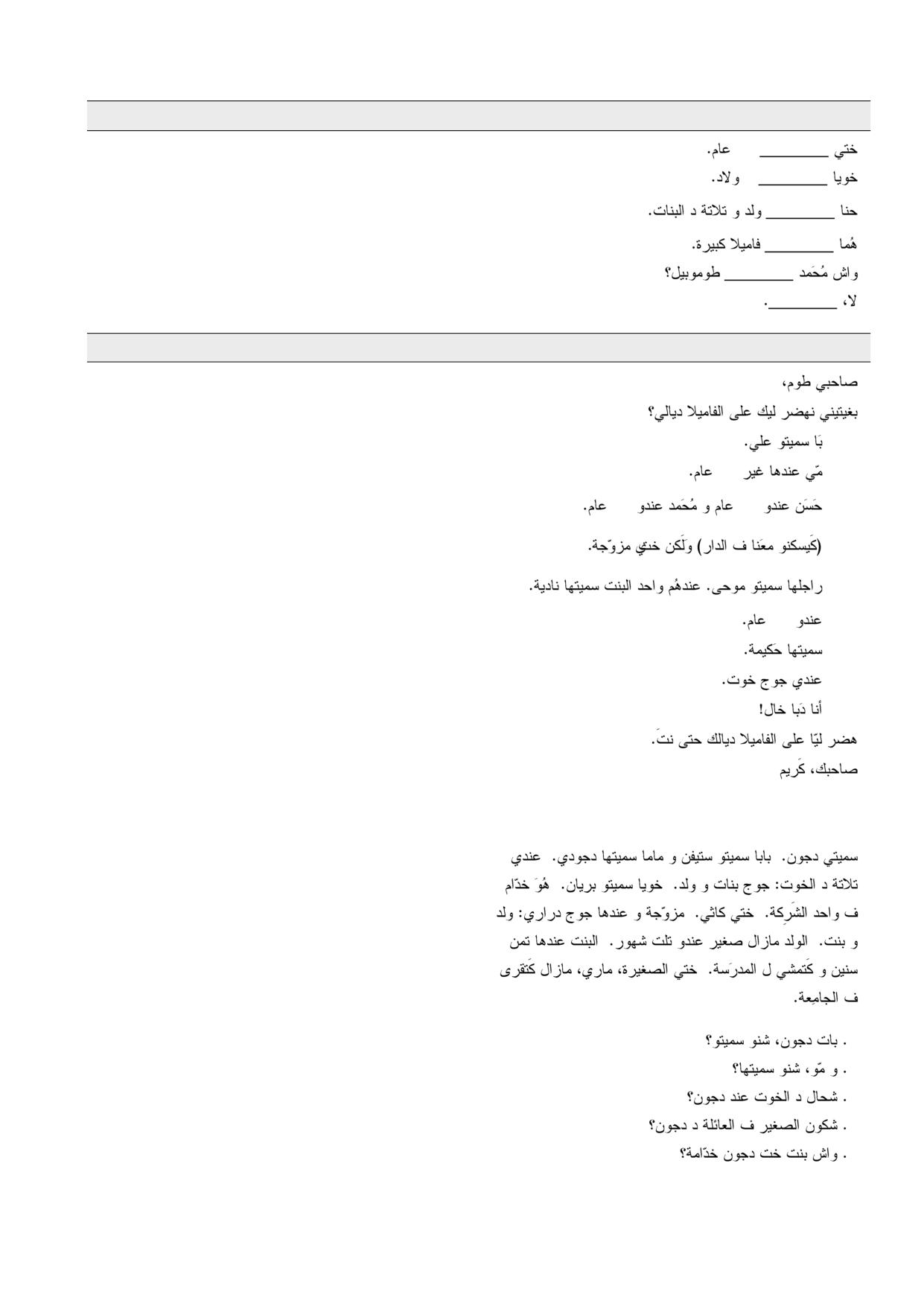
41
Exercise: Put the verb “عnd” in the correct form.
1. xti
_________
24 عam.
24
2. xuya
_________
2 wlad.
2
3. нna
_________
wld u tlata d
l-bnat.
4. huma
_________
famila kbira.
5. weš Mohamed
_________
tomobil?
6. lla,
_________
Exercise: Put sentences A thru I in the correct order for this letter from Karim to Tom.
saнbi Tom,
bġitini n-hdr lik عla l-famila dyali?
A. bba smitu Ali.
.A
B. mmi عndha ġir 52 عam.
52
.B
C. Hassan عndu 15 عam u Mohamed عndu
20
15
.C
20 عam.
D. (kay-sknu mعana f d-dar) welakin
.D
xti mzuwja.
E. rajlha smitu Moha. عndhum waнd
.E
l-bnt smitha Nadia.
F. عndoo 26 عam.
26
.F
G. smitha Hakima
.G
H. عndi juj xut.
.H
I. ana deba xal!
.I
hdr liya عla l-famila dyalk нta nta.
saнbk, Karim
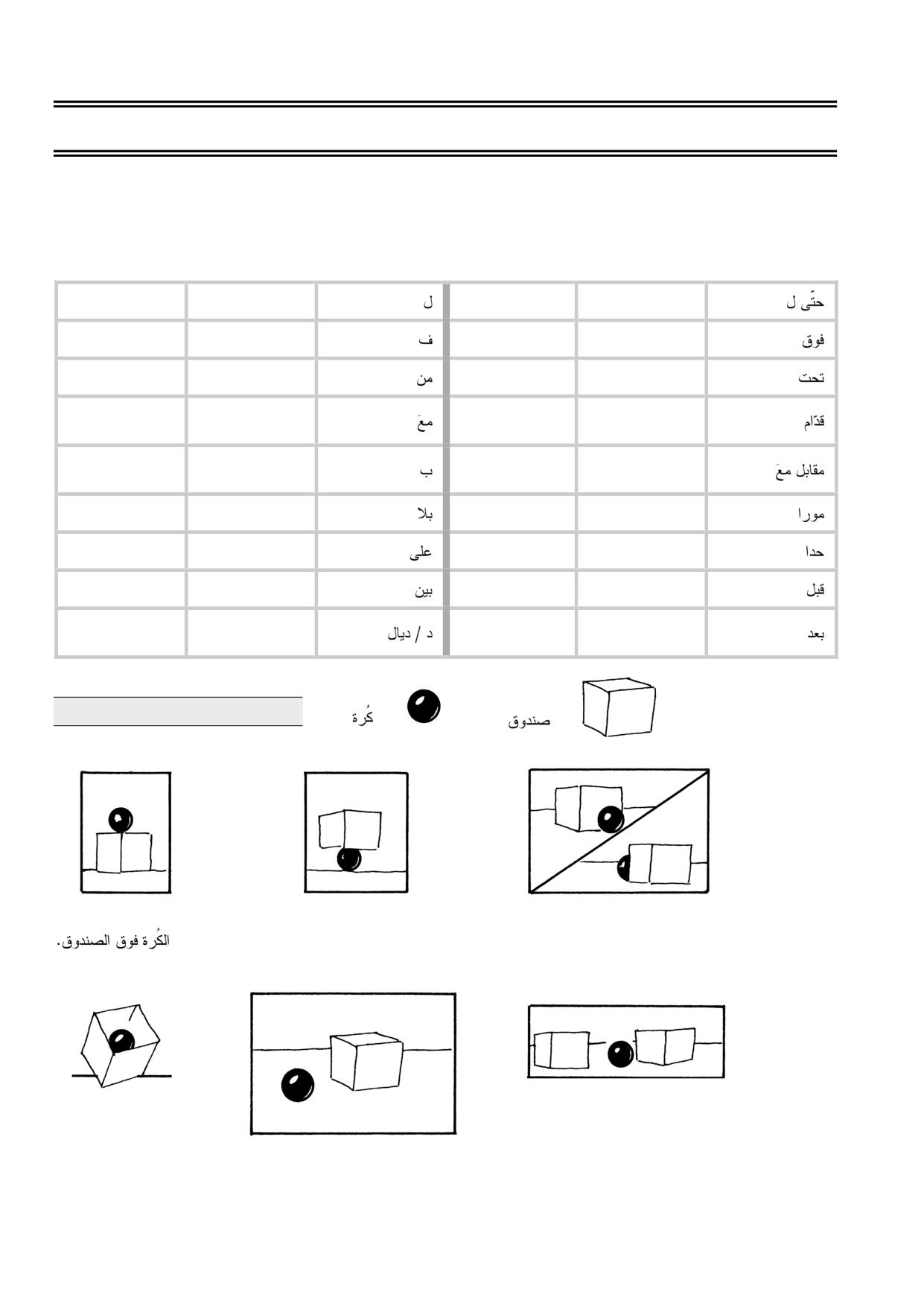
Practice Text
smiti John. baba smitu Stephen u
mama smitha Judy. عndi tlata d
l-xut: juj bnat u wld. xuya smitu
Brian. huwa xddam f waнd š-šarika.
xti Kathy. mzuwja u عndha jooj
drari: wld u bnt. l-wld mazal sġir
عndu tlt šhur. l-bnt عndha tmn snin
u kat-mši l l-mdrasa. xti s-sġira,
Mary, mazal kat-qra f l-jamiعa.
1. bat John, šnu smitu?
1
2. u mmu, šnu smitha?
2
3. šнal d l-xut عnd John?
3
4. škun s-sġir f l-عa'ila d John?
4
5. weš bnt xt John xddama?
5
42 • Moroccan Arabic
Directions
Objective: By the end of the chapter, you will be able to:
• use prepositions to describe the locations of objects
• give and receive directions to places around town
Prepositions
to / for
l
until
нtta l
in / at
f
above / on
fuq
from
mn
below / under
tнt
with
mعa
in front of
qddam
(someone)
with / by / by
b
facing
mqabl mعa
means of
without
bla
behind
mura
on / about
عla
next to
нda
between
bin
before
qbl
of, belonging
d / dyal
after
bعd
to
kora
snduq
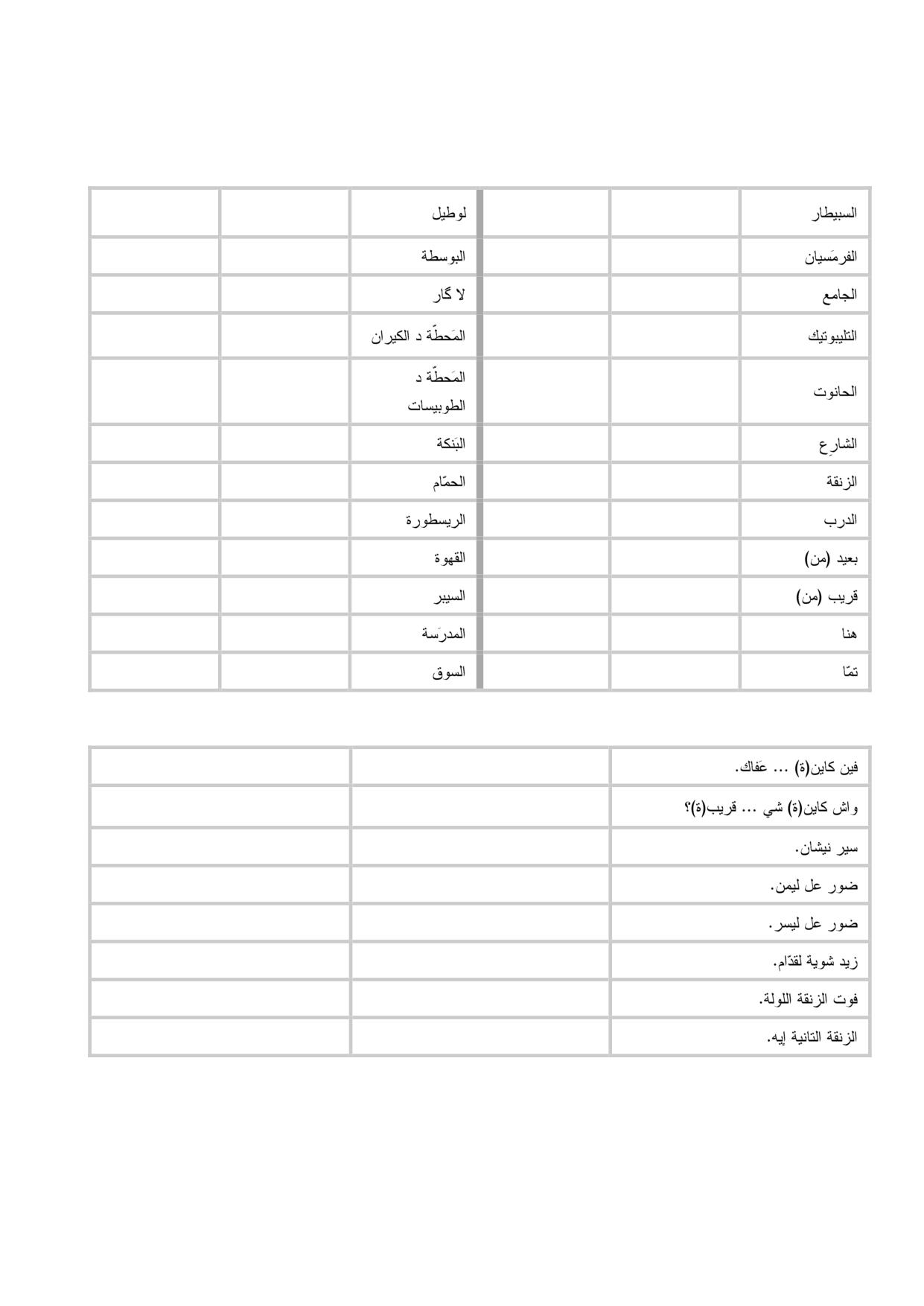
Exercise: fin l-kora?
1
2
3
4
l-kora fuq s-snduq.
5
6
7
43
Directions
Vocabulary
hospital /
hotel
l-otil
s-sbitar
health center
post office
l-bosta
pharmacy
l-frmasyan
train station
la-gar
mosque
j-jamع
l-maнtta d
bus station
public phone
t-telebutik
l-kiran
l-maнtta d
city bus stop
store
l-нanut
t-tubisat
bank
l-banka
avenue
š-šariع
public bath
l-нmmam
street
z-znqa
restaurant
r-ristora
alley
d-drb
café
l-qhwa
far (from)
bعid (mn)
cyber café
s-siber
close (to)
qrib (mn)
school
l-mdrasa
here
hna
weekly market
s-suq
there
tmma
Expressions
Where is ... please?
fin kayn(a) ... عafak.
weš kayn(a) ši ...
Is there a ... close?
qrib(a)?
Go straight.
sir nišan.
Turn right.
dur عl limn.
Turn left.
dur عl lisr.
Go ahead a bit.
zid šwiya l qddam.
Pass the first street.
fut z-znqa l-luwla.
The 2nd street, yes.
z-znqa tenya iyeh.
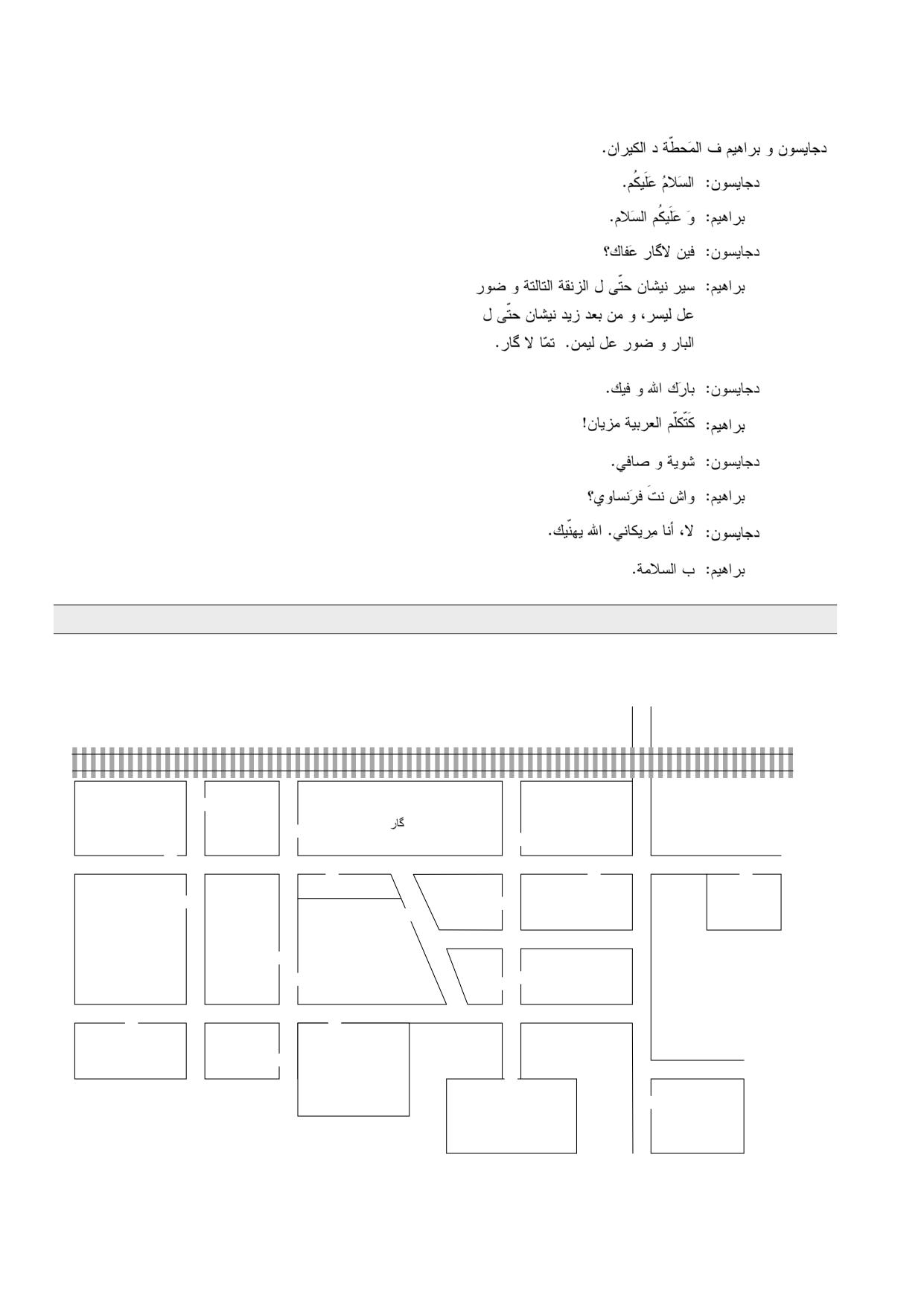
44 • Moroccan Arabic
Dialogue
Jason u Brahim f l-maнtta d l-kiran.
Jason: s-salamu عalaykum.
Brahim: wa عalaykum s-salam.
Jason: fin la-gar عafak?
Brahim: sir nišan нtta l z-znqa
t-talta u dur عl lisr, u
mn bعd zid nišan нtta l
l-bar u dur عl limn.
tmma la-gar.
Jason: barak llah u fik.
Brahim: kat-tkllm l-عrbiya
mzyan!
Jason: šwiya u safi.
Brahim: weš nta fransawi?
Jason: lla, ana mirikani. lla
y-hnnik.
Brahim: bslama.
Exercise: Using the same map, give each person directions.
1. Dave is in the sbitar and wants to go to l-bosta.
2. Anna is in the maнtta and wants to go to l-otil.
3. Stephen is in the marši and wants to go to s-siber.
4. Hakim is in the нanut and wants to go to l-нmmam.
l-нm m a m
r-ristora
la gar
s-siber
مامحلا
ةروطسيرلا
لا
ربيسلا
l-bar
رابلا
l-qhwa
l-frmasyan
l-banka
ةوهقلا
نايسمرفلا
تكنبلا
l-mdrasa
l-marši
j-jrda
تسردملا
يشراملا
ةدرجلا
t-telebutik
كيتوبيلتلا
нa n u t
ثوناح
l-ọi l
l-boṣa
j-jamع
ليطول
تطسوبلا
عماجلا
maн̣̣a t l
k
a
n
s-sbị a r
ناريكلا تطحم
راطيبس
45
Past Events
Objective: By the end of the chapter, you will be able to:
• talk about past activities with regular and irregular verbs
• talk about what you did not do using negative sentences
• ask about past experiences (Have you ever...) and respond (I’ve never...)
• use object pronouns with verbs
• ask varied questions with different question words
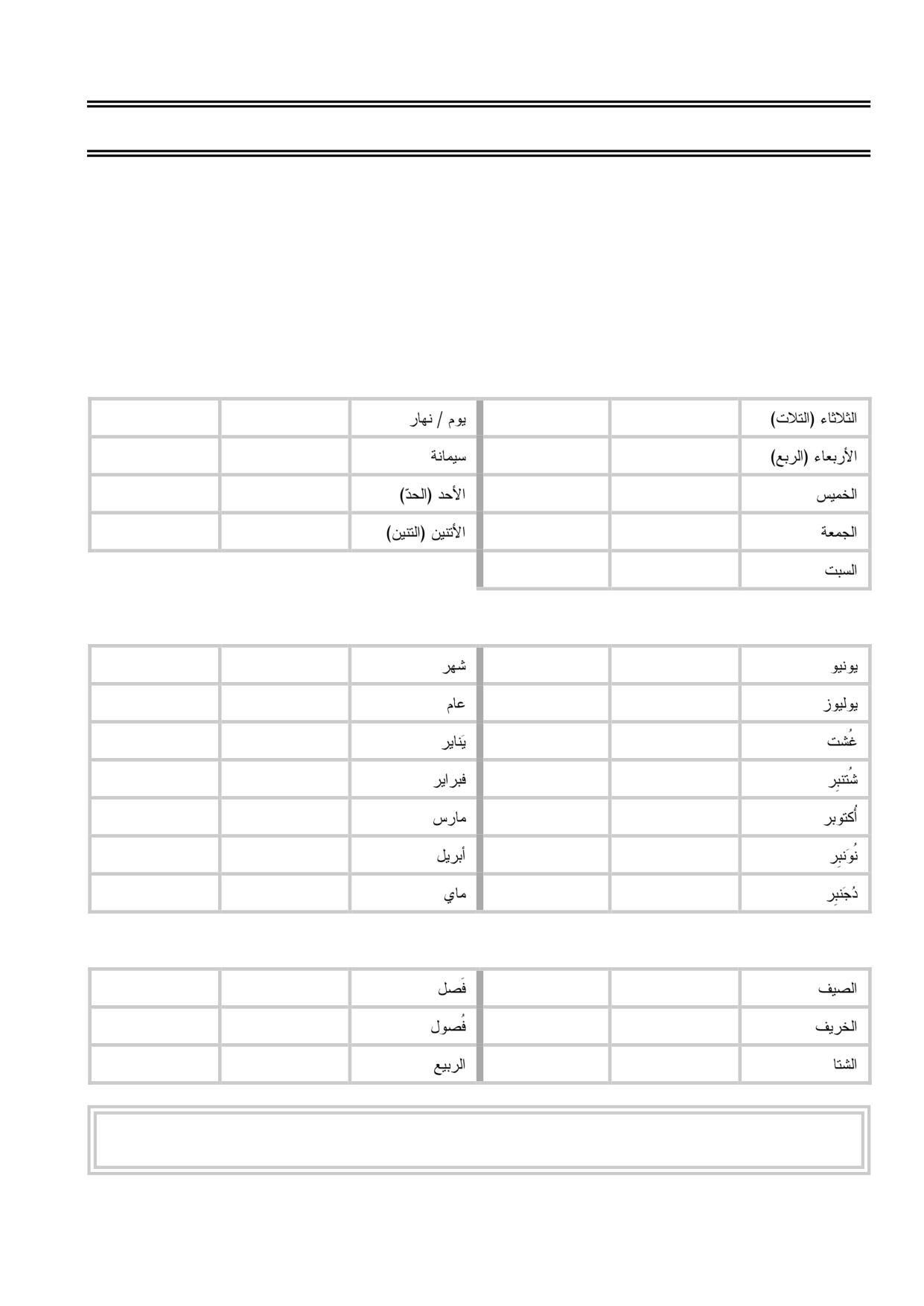
Time Vocabulary
Before we begin the past tense, let‘s learn some words that will help us describe when past events took
place. Then we will be ready to talk about some of our past activities.
Days of the Week
day
yum / nhar
Tuesday
t-tlat
week
simana
Wednesday
l-arbع
Sunday
l-нdd
Thursday
l-xmis
Monday
l-tnin
Friday
j-jmعa
Saturday
s-sbt
Months of the Year
month
šhr
June
yunyu
year
عam
July
yulyuz
January
yanayr
August
ġušt
February
fbrayr
September
šutnbir
March
mars
October
oktobr
April
abril
November
nuwanbir
May
may
December
dujanbir
The Seasons
season
fasl
summer
s-sif
seasons
fosul
fall
l-xrif
spring
r-rbiع
winter
š-šta
For information about the months of the Islamic calendar and some of the major religious events
of the year, see ―Moroccan Holidays‖ on page 159.
46 • Moroccan Arabic
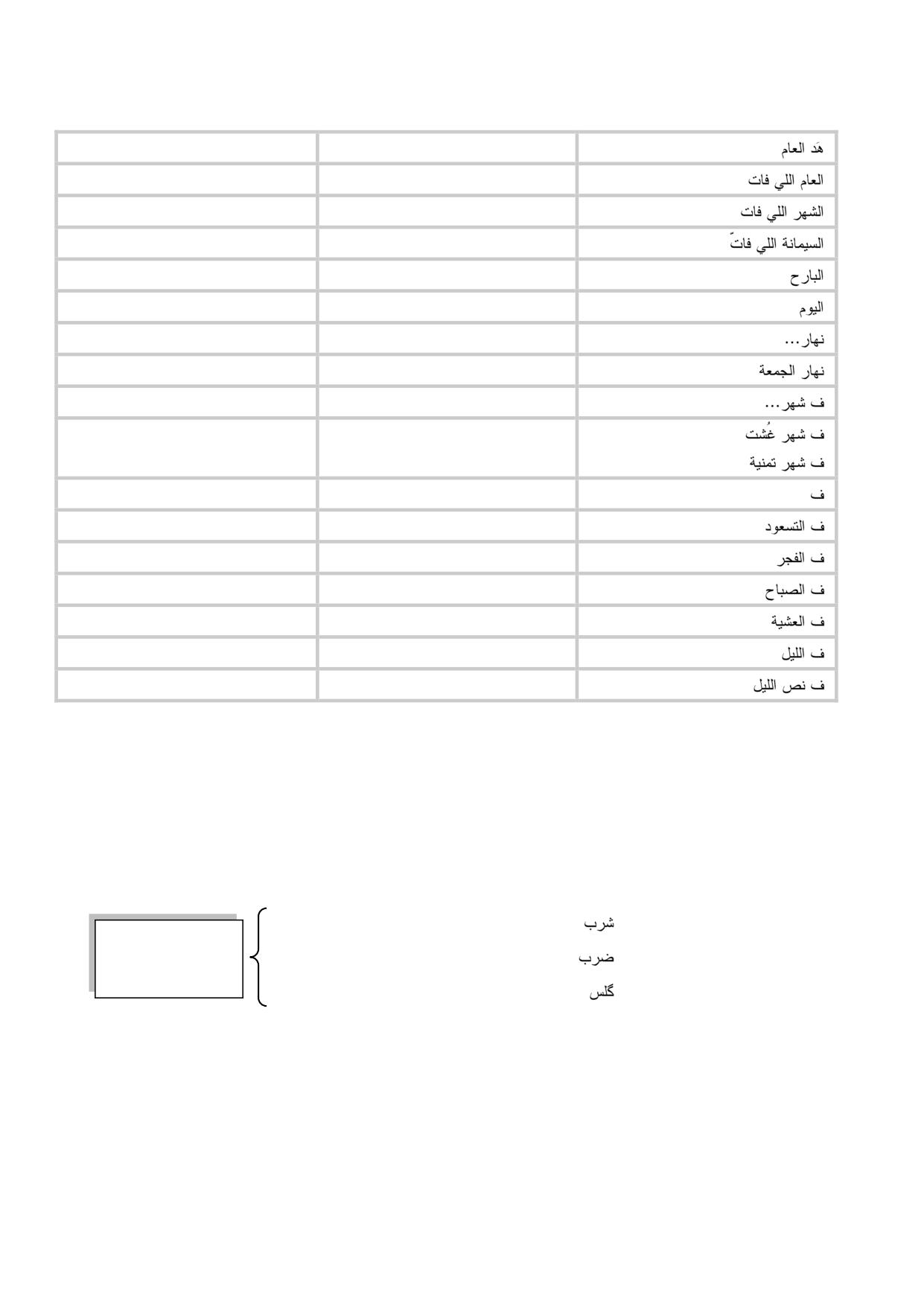
Time Expressions
this year
had l-عam
last year
l-عam lli fat
last month
š-šhr lli fat
last week
s-simana lli fatt
yesterday
l-barн
today
l-yum
on (+ day of the week)
nhar
on Friday
nhar j-jmعa
in (+ month)
f šhr
f šhr ġušt
in August
f šhr tmnya
at (+ time)
f
at 9:00
f t-tsعud
at dawn
f l-fjr
in the morning
f s-sbaн
in the afternoon / evening
f l-عšiya
at night
f l-lil
at midnight
f ns l-lil
Past Tense - Regular Verbs
Verbs in General
When learning verbs in a foreign language, we usually learn the ―infinitive‖ form of the verb (e.g. to
eat), and then learn how to ―conjugate‖ from that infinitive (I eat, he eats, they eat). In Arabic, there
are not infinitives for verbs in this way. Rather, we learn the “he” form of the verb (i.e. third person
masculine singular) in the past tense, and then learn how to conjugate the other forms (I, you, she,
etc.) from the ―he‖ form. Because we use this past tense ―he‖ form like an infinitive for the purposes of
learning verbs, if you see something referred to as an ―infinitive,‖ it is this form. Some examples:
he drank
šrb
past tense
―he‖ form:
he hit
drb
like an infinitive
he sat
gls
Whenever you are given a new verb in this book or by your teacher, it will be given to you in this form.
You will be able to conjugate verbs in the past or present tense based upon this ―infinitive‖ form.
The vast majority of Darija (Moroccan Arabic) verbs are made up of three letters (see the verbs
above). To these ―stems‖ we can add prefixes (letters that we attach to the beginning of a word) and
suffixes (letters we attach to the end of a word) in order to conjugate the verb. Stems with a vowel in
the middle and stems with a vowel at the end will differ from verbs with three consonants.
47
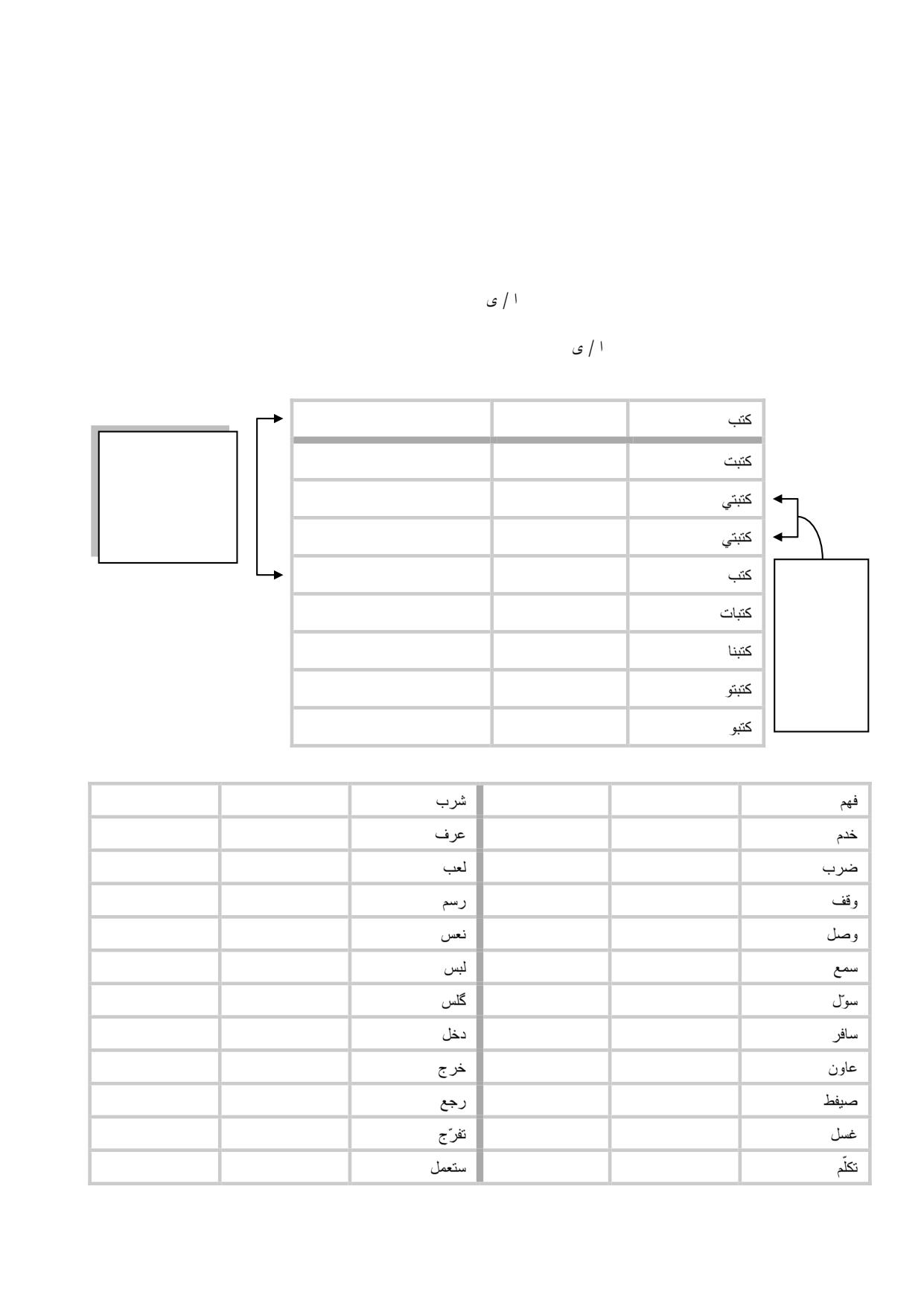
Regular Verbs in the Past Tense
When we say ―regular verb,‖ we mean a verb that is conjugated according to rules that the large
majority of verbs in the language use. An ―irregular verb‖ is conjugated according to different rules.
There are regular and irregular verbs for both the past and present tense in Darija. However, irregular
verbs that are similar in the past may be different in the present. So, you need to realize that the groups
of verbs categorized together for the past tense may not always correspond to the groups in the present
tense.
In general, ―regular verb‖ refers to:
All 3-letter verbs without the long vowel ―a‖ (
) in the middle or end position
(i.e. 3-letter verbs made up only of consonants)
All verbs with more than 3 letters and not ending in ―a‖ (
)
To conjugate a regular verb in the past tense, we add the following suffixes (endings):
“to write”
ktb
Remember
I wrote
ktbt
that the
―infinitive‖ is
you wrote (masc. sing.)
ktbti
the same as
the past tense
you wrote (fem. sing.)
ktbti
―he‖ form.
he wrote
ktb
In the past
tense, you
she wrote
ktbat
(masc.) and
you (fem.)
are the same.
we wrote
ktbna
In the present
tense, they
you wrote (plur.)
ktbtu
will be
different.
they wrote
ktbu
Some Regular Verbs
to drink
šrb
to understand
fhm
to know
عrf
to work
xdm
to play
lعb
to hit
drb
to draw
rsm
to stop / stand up
wqf
to sleep
nعs
to arrive
wsl
to wear
lbs
to hear / listen
smع
to stay / sit
gls
to ask
suwl
to enter
dxl
to travel
safr
to go out
xrj
to help
عawn
to return
rjع
to send
sift
to watch
tfrrj
to wash
ġsl
to use
stعml
to speak
tkllm
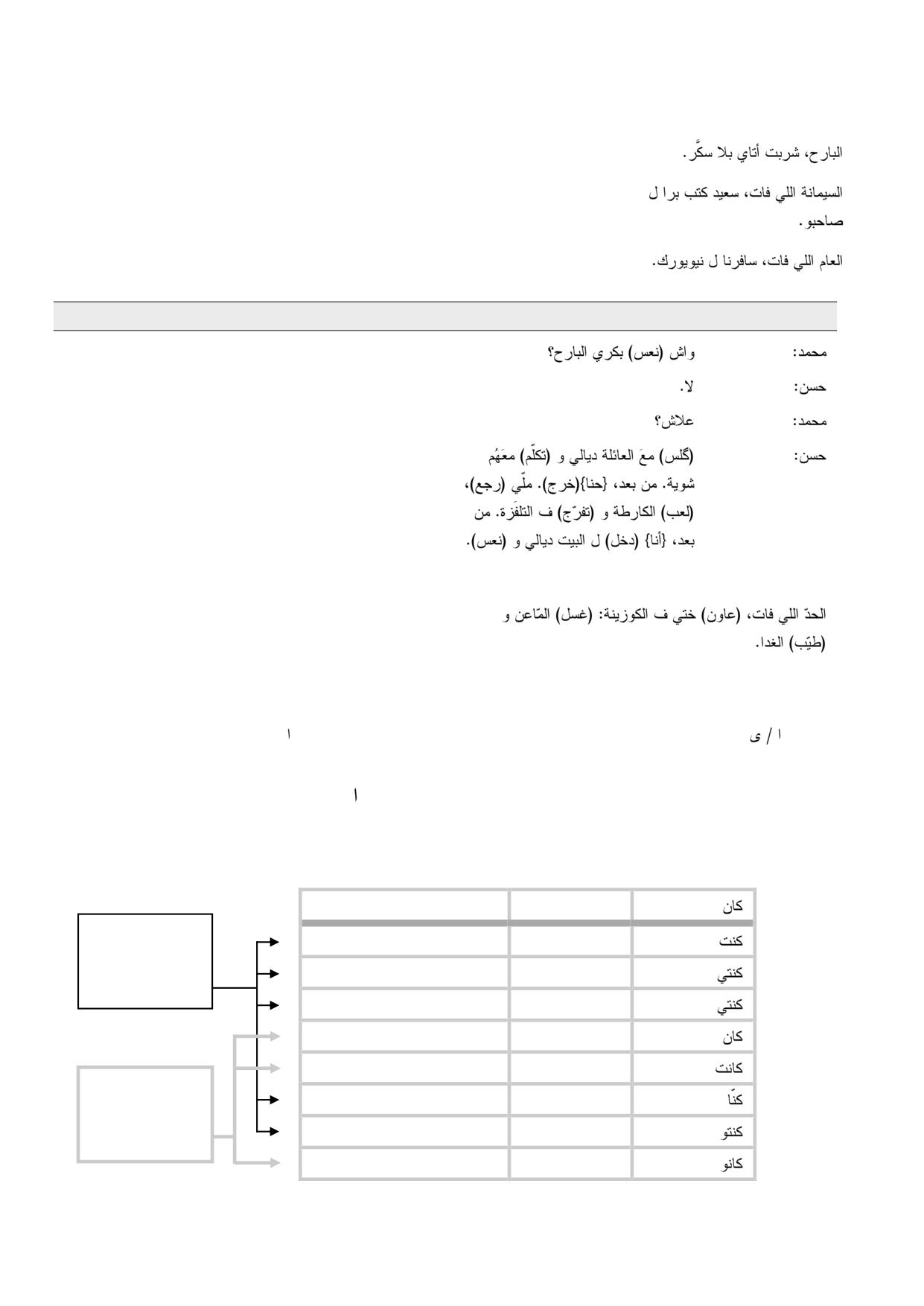
48 • Moroccan Arabic
Some examples:
Yesterday, I drank tea without
l-barн, šrbt atay bla
sugar.
skkar.
Last week, Said wrote a letter to s-simana lli fatt, Said
his friend.
ktb bra l saнbu.
Last year, we traveled to New
l-عam lli fat, safrna l
York.
New York.
Exercise: Put the verbs in parentheses in the correct form.
Mohamed: weš (nعs) bkri l-barн?
Hassan: lla
Mohamed: عlaš?
Hassan: (gls) mعa l-عa'ila dyali
u (tkllm) mعahum šwiya.
mn bعd, {нna}(xrj). mlli
(rjع), (lعb) l-karta u
(tfrrj) f t-tlfaza. mn
bعd {ana}(dxl) l l-bit
dyali u (nعs).
l-нdd lli fat, (عawn) xti f l-kuzina:
(ġsl) l-mmaعn u (tiyb) l-ġda.
Past Tense - Irregular Verbs
When we speak about irregular verbs for the past tense, we refer to three categories: 1. three-letter
verbs with the long vowel ―a‖ ( ) in the middle position, 2. any verb with the long vowel ―a‖ (
) at the
end, and 3. two-letter verbs.
1st Category: long vowel “a” ( ) in the middle position
To conjugate a three-letter verb in the past tense with the long vowel ―a‖ in the middle position, remove
the long vowel ―a‖ for the I, you (sing.), we, and you (plur.) forms before adding the past tense
endings. For the she form, only add a ―t.‖ The he and they forms are like regular verbs.
“to be”
kan
In these forms,
we remove the
I was
knt
middle ―a‖ and
then add the
you were (masc. sing.)
knti
endings.
you were (fem. sing.)
knti
he was
kan
she was
kant
In these forms,
we keep the
we were
knna
middle ―a‖ and
then add the
you were (plur.)
kntu
endings.
they were
kanu
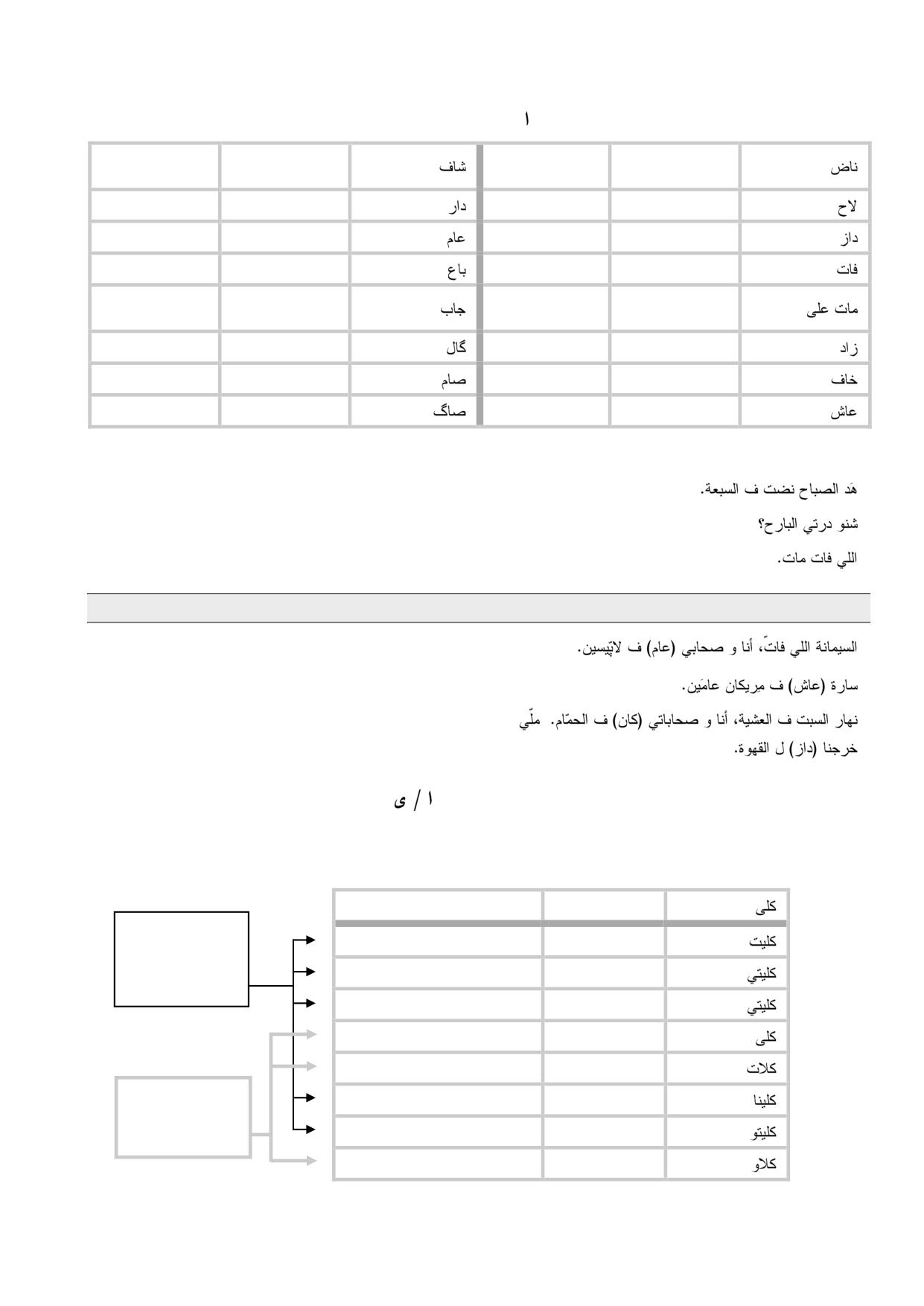
49
Some Irregular Verbs with long vowel “a” ( ) in the middle position
to get up /
to see
šaf
nad
stand up
to do / make
dar
to throw
laн
to swim
عam
to pass / pass by
daz
to sell
baع
to pass
fat
to love / be
to bring
jab
mat عla
dying for
to say
gal
to increase
zad
to fast
sam
to be scared
xaf
to drive
sag
to live
عaš
Some examples:
This morning I got up at 7:00.
had s-sbaн ndt f s-sbعa.
What did you do yesterday?
šnu drti l-barн?
What‟s done is done. (proverb) lli fat mat.
Exercise: Put the verbs in parentheses in the correct form.
s-simana lli fatt, ana u sнabi (عam)
f la-ppisin.
Sara (عaš) f mirikan عamayn.
nhar s-sbt f l-عšiya, ana u sнabati
(kan) f l-нmmam. mlli xrjna (daz) l
l-qhwa.
2nd Category: long vowel “a” (
) at the end
To conjugate a verb with the long vowel ―a‖ at the end, change the vowel to ―i‖ for the I, you (sing.),
we, and you (plur.) forms, then add the normal endings. For the she form, only add a ―t.‖ The he
and they forms are like regular verbs.
“to eat”
kla
In these forms,
we change the
I ate
klit
final ―a‖ to ―i‖
then add the
you ate (masc. sing.)
kliti
endings.
you ate (fem. sing.)
kliti
he ate
kla
she ate
klat
In these forms,
we ate
klina
we keep the final
―a‖ and then add
you ate (plur.)
klitu
the endings.
they ate
klau
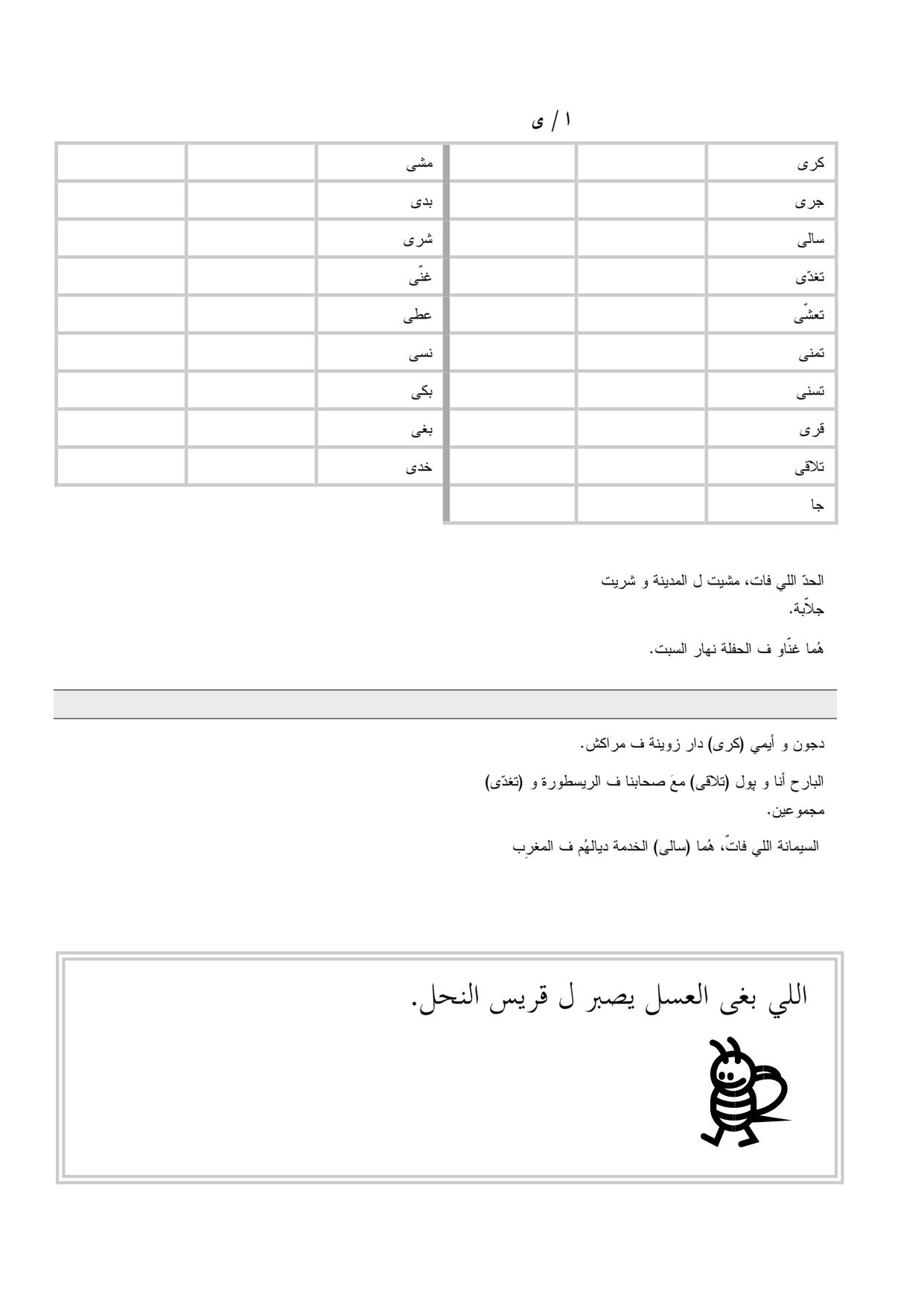
50 • Moroccan Arabic
Some Irregular Verbs with the long vowel “a” (
) at the end
to go
mša
to rent
kra
to start
bda
to run
jra
to buy
šra
to finish
sala
to sing
ġnna
to have lunch
tġdda
to give
عta
to have dinner
tعšša
to forget
nsa
to hope
tmna
to cry
bka
to wait
tsna
to want
bġa
to read / study
qra
to take
xda
to meet
tlaqa
to come
ja
Some examples:
Last Sunday, I went to the
l-нdd lli fat, mšit l
medina and bought a jellaba.
l-mdina u šrit jllaba.
They sang at the party on
huma ġnnau f l-нfla nhar
Saturday.
s-sbt.
Exercise: Put the verbs in parentheses in the correct form.
John u Amy (kra) dar zwina f
Marrakech.
l-barн ana u Paul (tlaqa) mعa sнabna
f r-ristora u (tġdda) mjmuعin.
s-simana lli fatt, huma (sala)
l-xdma dyalhum f l-mġrib.
Moroccan Wisdom:
l-li bġa l-عsl y-sbr l qris n-nнl.
The one who wants honey must tolerate bee stings.
English equivalent: Every rose has its thorn.
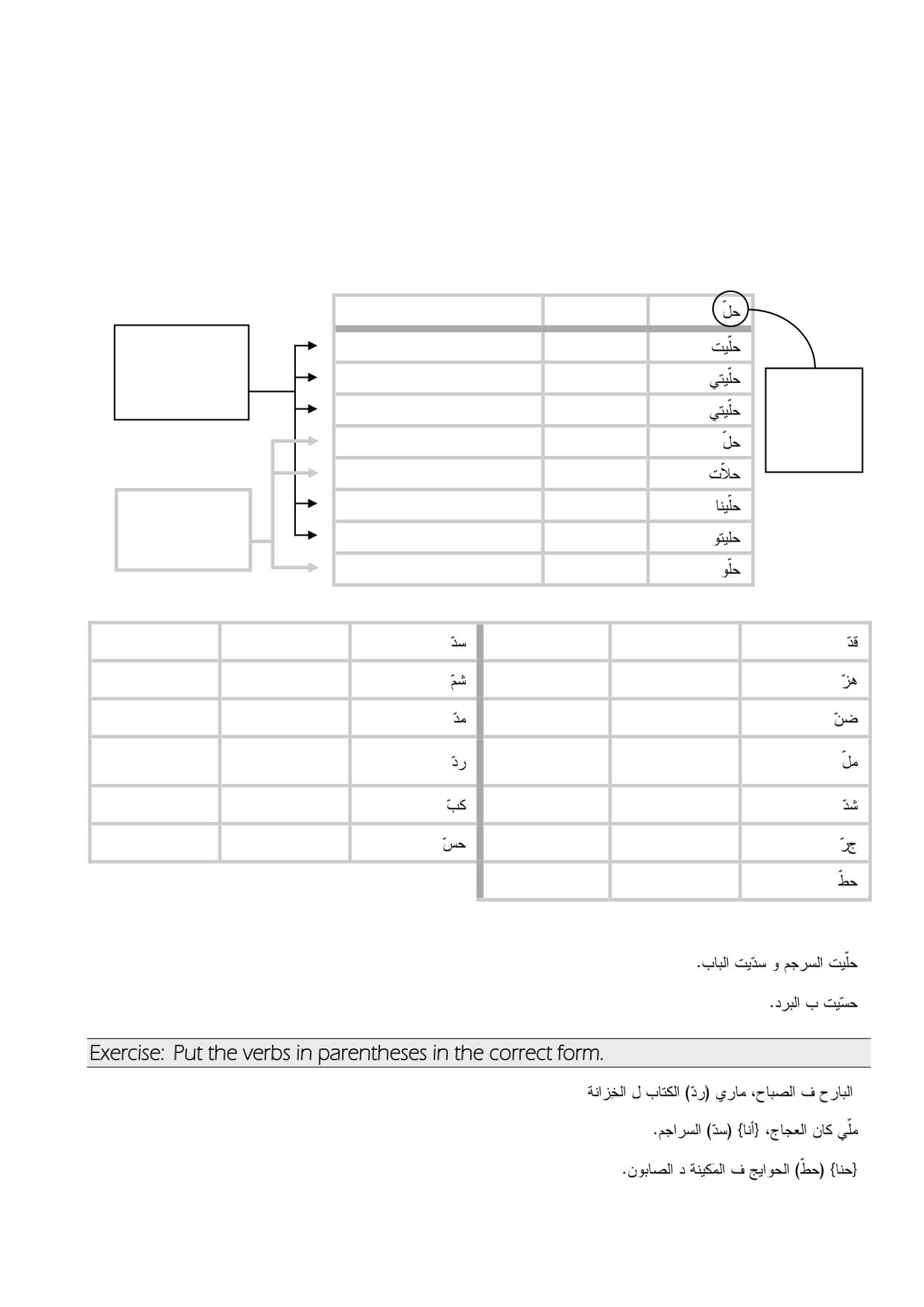
51
3rd Category: two-letter verbs
When we say ―two-letter verbs,‖ some confusion can arise. When we write them in Arabic, they have
only two letters. However, there is a ―shedda‖ on the second letter (see pages 3 and 146), so in the
transcription we double the second letter, making them look like three-letter verbs. In this case, you
can still recognize them because the second and third letters are the same. Or, look at the Arabic script
and you can be sure of the fact that they are, indeed, two-letter verbs.
To conjugate this type of verb, we add the long vowel ―i‖ to the I, you (sing.), we, and you (plur.)
forms, then add the normal endings. The he, she, and they forms are like regular verbs.
“to open”
нll
In these forms,
I opened
нllit
we add ―i‖ to the
verb, then add
you opened (masc. sing.)
нlliti
the normal
A two-letter
endings.
verb with
you opened (fem. sing.)
нlliti
“shedda” on
he opened
нll
the second
letter.
she opened
нllat
In these forms,
we opened
нllina
we simply add
the normal
you opened (plur.)
нllitu
endings.
they opened
нllu
Some two-letter verbs
to close
sdd
to be able
qdd
to smell
šmm
to pick up
hzz
to hand
mdd
to think
dnn
to answer /
rdd
to be bored
mll
return back
to pour
kbb
to take / catch
šdd
to feel
нss
to pull / drag
jrr
to put
нtt
Some examples:
I opened the window and I
нllit
shrjm
u sddit
closed the door
l-bab.
I felt cold
нssit b l-brd.
Exercise: Put the verbs in parentheses in the correct form.
l-barн f s-sbaн, Mary (rdd) l-ktab l
l-xizana.
mlli kan l-عjaj, {ana} (sdd)
shrjm.
{нna} (нtt) l-нwayj f l-makina d
s-sabun.
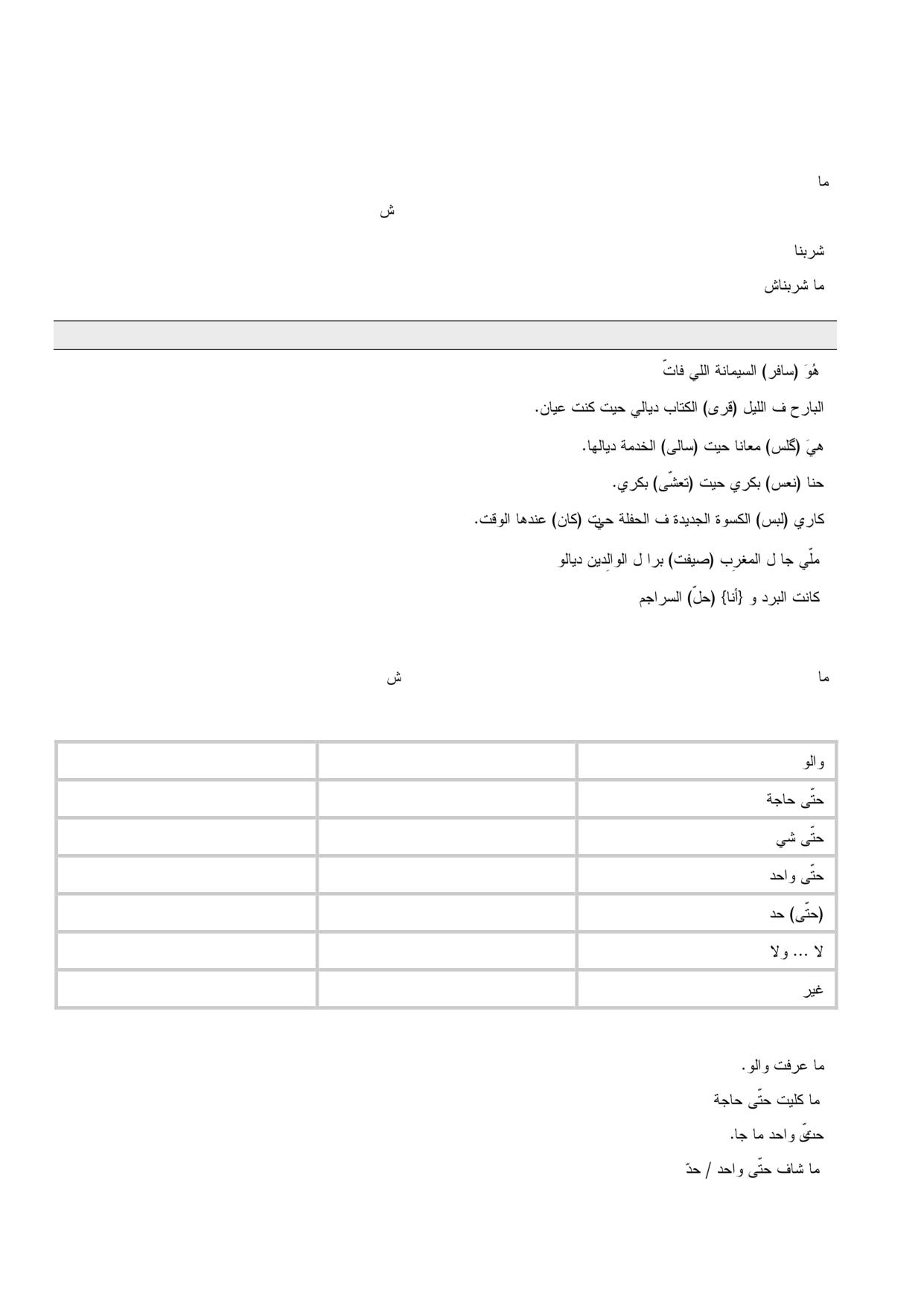
52 • Moroccan Arabic
Negation
Normal Negative Form
In order to express the negative of a verb (i.e. ―didn‘t,‖ or ―don‘t,‖ or ―doesn‘t‖), we add the prefix ma ( )
to the beginning of a verb and the suffix š (
) to the end of a verb.
We drank.
šrbna
We didn‟t drink.
ma-šrbna-š
Exercise: Conjugate the verbs in parentheses in the negative form.
huwa (safr) s-simana lli fatt.
l-barн f l-lil (qra) l-ktab dyali
нit knt عiyan.
нiya (gls) mعana нit (sala) l-xdma
dyalha.
нna (nعs) bkri нit (tعšša) bkri.
Kari (lbs) l-kswa j-jdida f l-нfla
нit (kan) عndha l-wqt.
mlli ja l l-mġrib (sift) bra l
l-walidin dyalu.
kant l-brd u {ana} (нll) s-srajm.
Additional Negative Forms
The following negative forms replace the š (
) we use for the normal negative form. We still use ma ( )
before the verb, but we use these forms after the verb or, sometimes, before the verb (and thus before
ma).
nothing
walu
nothing
нtta нaja
nothing
нtta ši
no one
нtta waнd
no one
(нtta) нdd
neither ... nor
la ... wala
only / just
ġir
Some examples:
I knew nothing.
ma-عrft walu.
I ate nothing.
ma-kleet нtta нaja.
No one came.
нtta waнd ma-ja.
He saw no one.
ma-šaf нtta waнd / нdd.
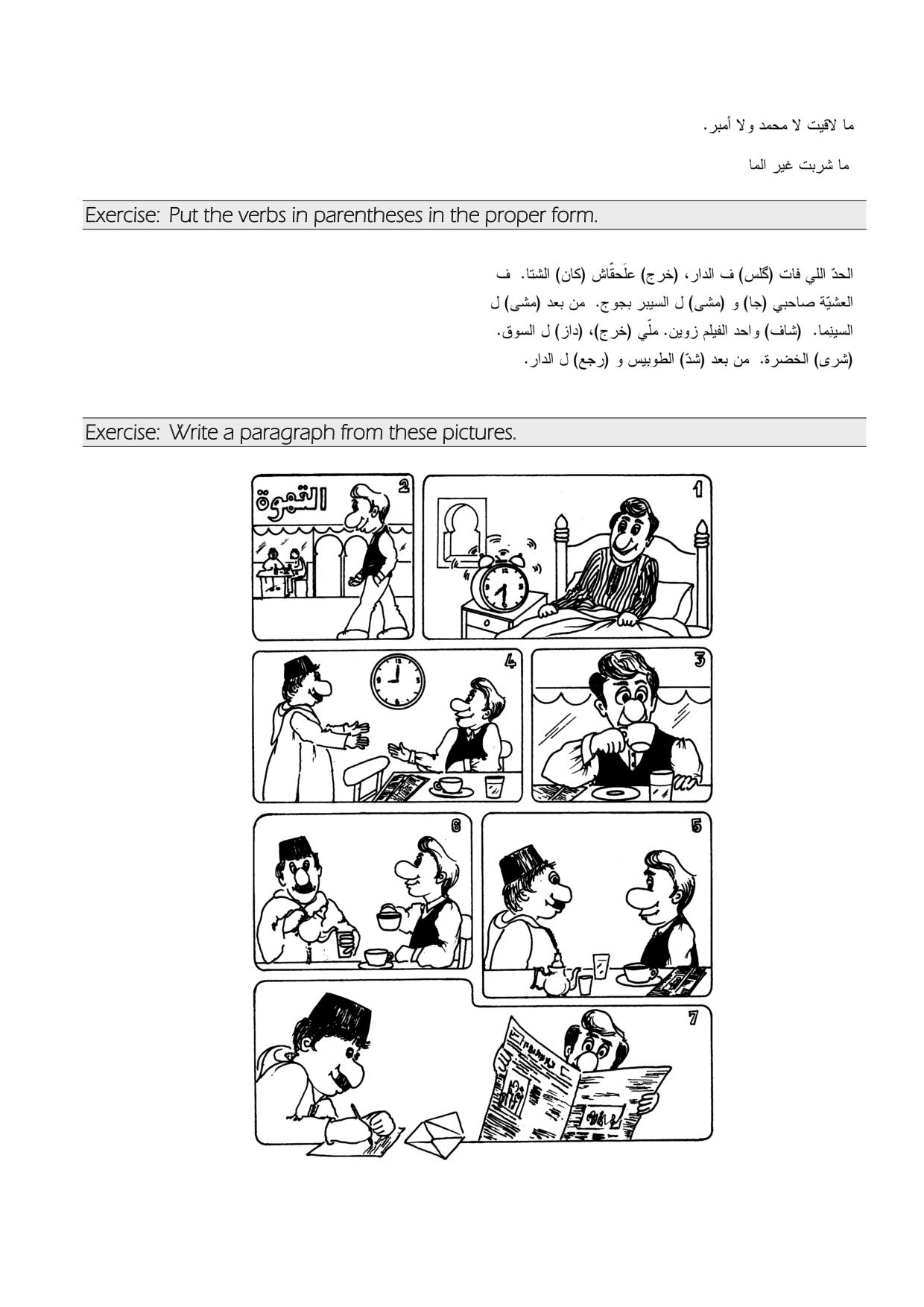
53
I met neither Mohamed nor
ma-tlaqit
la Mohamed wala
Amber.
Amber.
I drank only water.
ma-šrbt ġir l-ma.
Exercise: Put the verbs in parentheses in the proper form.
l-нdd lli fat (gls) f d-dar,
(xrj negative) عlaнqqaš (kan) š-šta.
f l-عšiya saнbi (ja) u (mša) l
s-siber bjooj. mn bعd (mša) l
s-sinima. (šaf) waнd l-film zwin.
mlli (xrj), (daz) l s-suq. (šra)
l-xodra. mn bعd (šdd) tobis u (rjع)
l d-dar.
Exercise: W
rite a paragraph from these pictures.
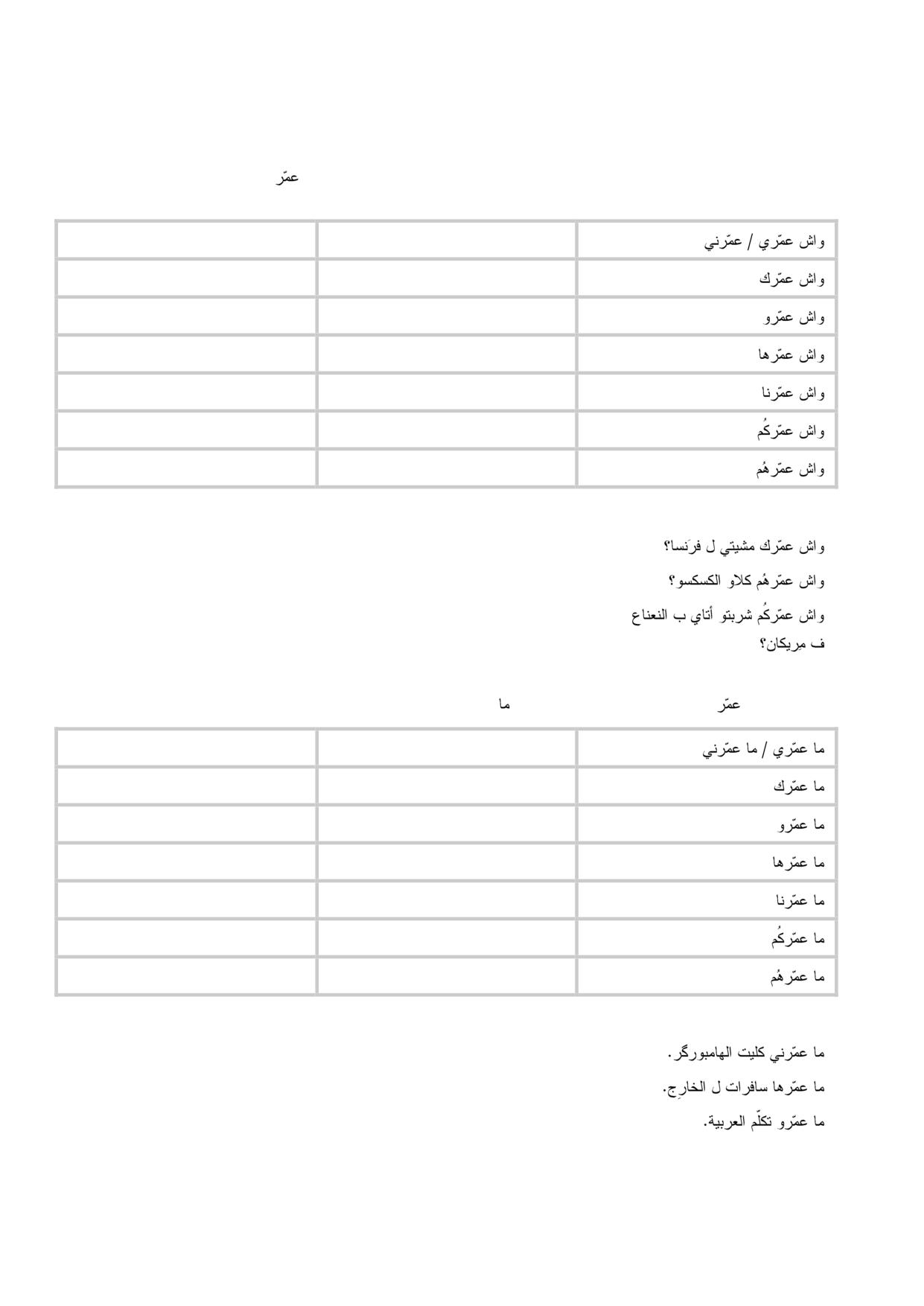
54 • Moroccan Arabic
Have you ever... / I’ve never...
Have you ever...?
We can use the word عmmr (
) to express the English equivalent of the present perfect tense: ―Have
you ever...?‖ and ―I have never...‖ We ―conjugate‖ it as follows:
Have I ever...
weš عmmri / عmmrni
Have you (sing.) ever...
weš عmmrk
Has he ever...
weš عmmru
Has she ever...
weš عmmrha
Have we ever...
weš عmmrna
Have you (plur.) ever...
weš عmmrkum
Have they ever...
weš عmmrhum
The verb that follows عmmr is often in the past tense. Some examples:
Have you ever gone to France? weš عmmrk mšiti l Fransa?
Have they ever eaten couscous? weš عmmrhum klau l-ksksu?
Have you ever drunk mint tea in weš عmmrkum šrbtu atay b
America?
n-nعnaع f mirikan?
I’ve never...
This is like the conjugation above, with the addition of ma ( ) at the beginning of عmmr (
).
I have never...
ma-عmmri / ma-عmmrni
you (sing.) have never...
ma-عmmrk
he has never...
ma-عmmru
she has never...
ma-عmmrha
we have never...
ma-عmmrna
you (plur.) have never...
ma-عmmrkum
they have never...
ma-عmmrhum
Some examples:
I‟ve never eaten hamburger.
ma-عmmrni kleet l-hamborgr.
She has never been abroad.
ma-عmmrha safrat l l-xarij.
He has never spoken Arabic.
ma-عmmru tkllm l-عrbiya.
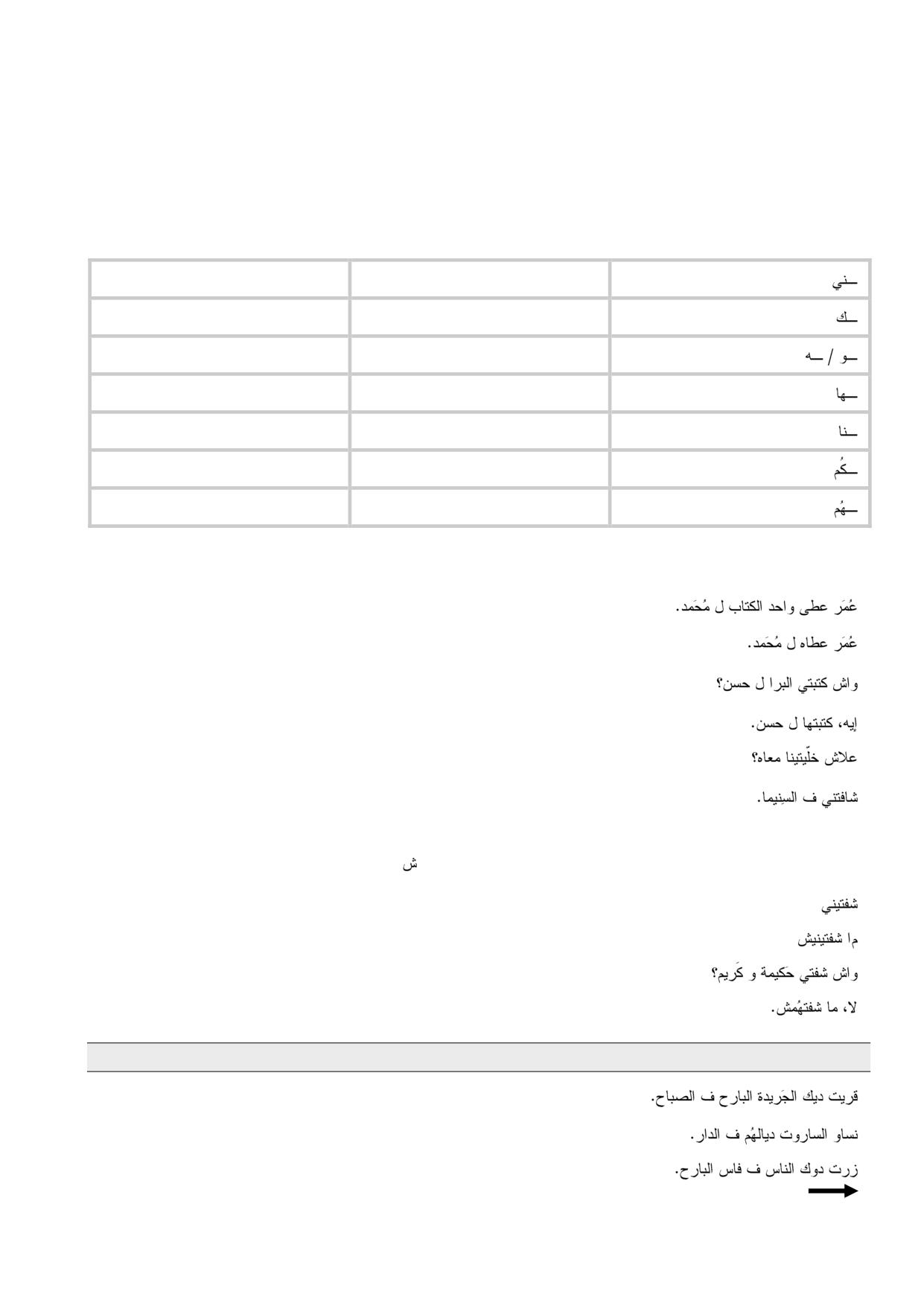
55
Object Pronouns
In English, we have pronouns for the subject of a sentence: I, you, he, she, we, and they. But we also
have object pronouns that we use after verbs:
He hit me.
I saw her.
Ask him a question.
We gave them some cake.
So far, you have learned the independent pronouns (see page 7) and the possessive pronouns (see
page 8). Here are the object pronouns that we use in Moroccan Arabic after verbs:
me
ni
you (sing.)
k
him / it
u / h
her / it
ha
us
na
you (plur.)
kum
them
hum
These pronouns are the same as the possessive pronouns, with the exception of ―me.‖ The ―him‖ form
uses u after consonants and h after vowels, exactly like the possessive pronoun form. Some examples:
عomar عta waнd l-ktab l
Omar gave a book to Mohamed.
Mohamed.
Omar gave it to Mohamed.
عomar عtah l Mohamed.
Did you write the letter to
weš ktbti l-bra l
Hassan?
Hassan?
Yes, I wrote it to Hassan.
iyeh, ktbtha l Hassan.
Why did you leave us with him? عlaš xllitina mعah?
She saw me at the movie
šaftni f s-sinima.
theater.
As you can see, these pronouns are attached directly to the verb. As a result, when a verb with an
object pronoun is made negative, the š (
) is used after the pronoun. Some examples:
You saw me.
šftini
You didn‟t see me.
ma-šftini-š
Did you see Hakima and Karim? weš šfti Hakima u Karim?
No, I didn‟t see them.
lla, ma-šfthum-š.
Exercise: Replace the underlined nouns by the corresponding pronouns.
1. qrit dik l-jarida l-barн f
s-sbaн.
2. nsau s-sarut dyalhum f d-dar.
3. zrt duk n-nas f Fes l-barн.
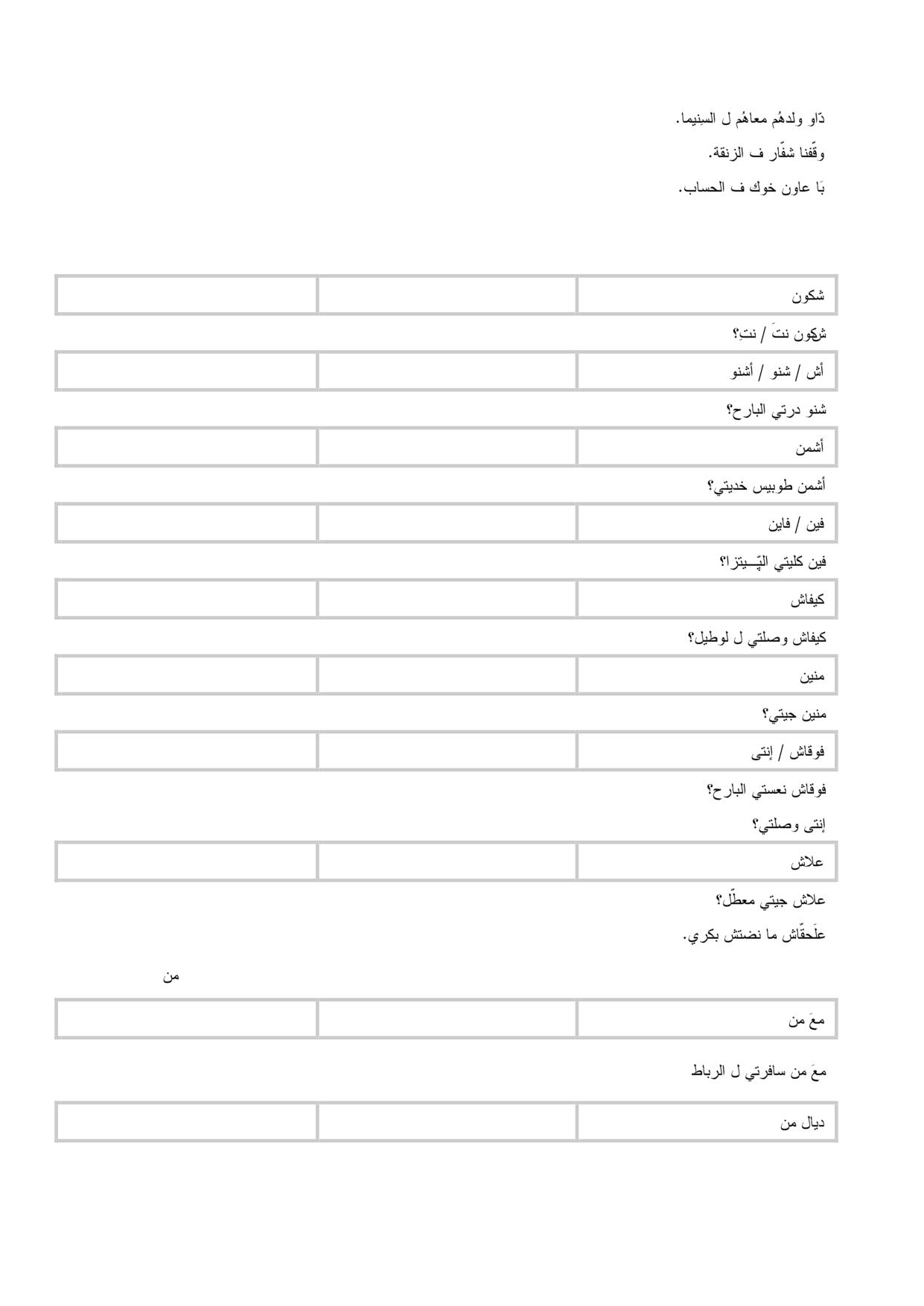
56 • Moroccan Arabic
4. ddau wldhum mعahum l s-sinima.
5. wqqfna šffar f z-znqa.
6. bba عawn xuk f l-нsab.
Question Words
Some of these you already know. Some will be new for you.
who
škun
Who are you?
škun nta / nti?
what
aš / šnu / ašnu
What did you do yesterday?
šnu drti l-barн?
which
ašmn
Which bus did you take?
ašmn tobis xditi?
where
fin / fayn
Where did you eat pizza?
fin kliti l-ppitza?
how
kifaš
How did you get to the hotel?
kifaš wslti l l-otil?
from where
mnin
Where did you come from?
mnin jiti?
when
fuqaš / imta
When did you sleep yesterday?
fuqaš nعsti l-barн?
When did you arrive?
imta wslti?
why
عlaš
Why did you come late?
عlaš jiti mعttl?
Because I didn‟t get up early.
عlaнqqaš ma-ndt-š bkri.
The word mn (
) is used after some prepositions to create question words.
with whom
mعa mn
With whom did you travel to
Rabat? (In the US: Who did you travel mعa mn safrti l Rabat?
to Rabat with?)
whose
dyal mn
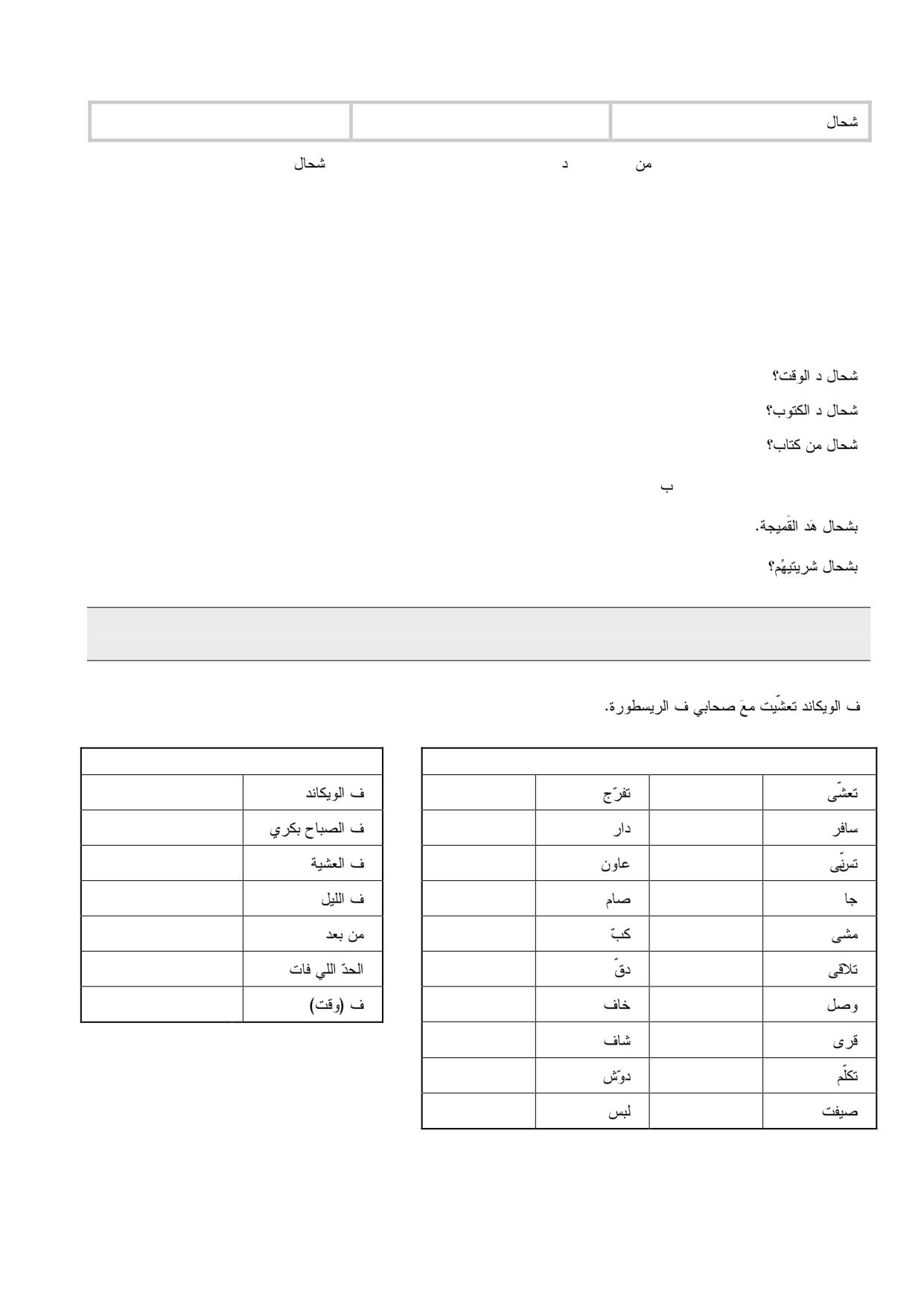
57
how many / how much
šнal
The question word šнal (
) may is followed by either d ( ) or mn (
), depending upon the noun
following it. Uncountable nouns are nouns that do not have a plural because they speak about
something that can be ―measured,‖ but not ―counted‖ (e.g. tea, air). Countable nouns are nouns that
have plural forms and, therefore, nouns with which we use numbers (e.g. 5 cats, 3 books). With šнal:
šнal + d + singular uncountable noun
or
šнal + d + plural countable noun
or
šнal + mn + singular countable noun
How much time?
šнal d l-wqt?
How many books?
šнal d l-ktub?
How many books?
šнal mn ktab?
In referring to prices, šнal is almost always preceded by the preposition b (
).
How much is this shirt?
bšнal had l-qamija?
How much did you pay for
bšнal šritihum?
them?
Exercise: Write your time line of activities for last Sunday. Use the following time
expressions and verbs to write as many sentences as you can.
e.g. f l-weekend tعššit mعa sнabi f
r-ristora.
Time Expressions
Verbs
f l-weekend
tfrrj
tعšša
f s-sbaн bkri
dar
safr
f l-عšiya
عawn
tsnna
f l-lil
sam
ja
mn bعd
kbb
mša
l-нdd lli fat
dqq
tlaqa
f (time)
xaf
wsl
šaf
qra
duwš
tkllm
lbs
sift
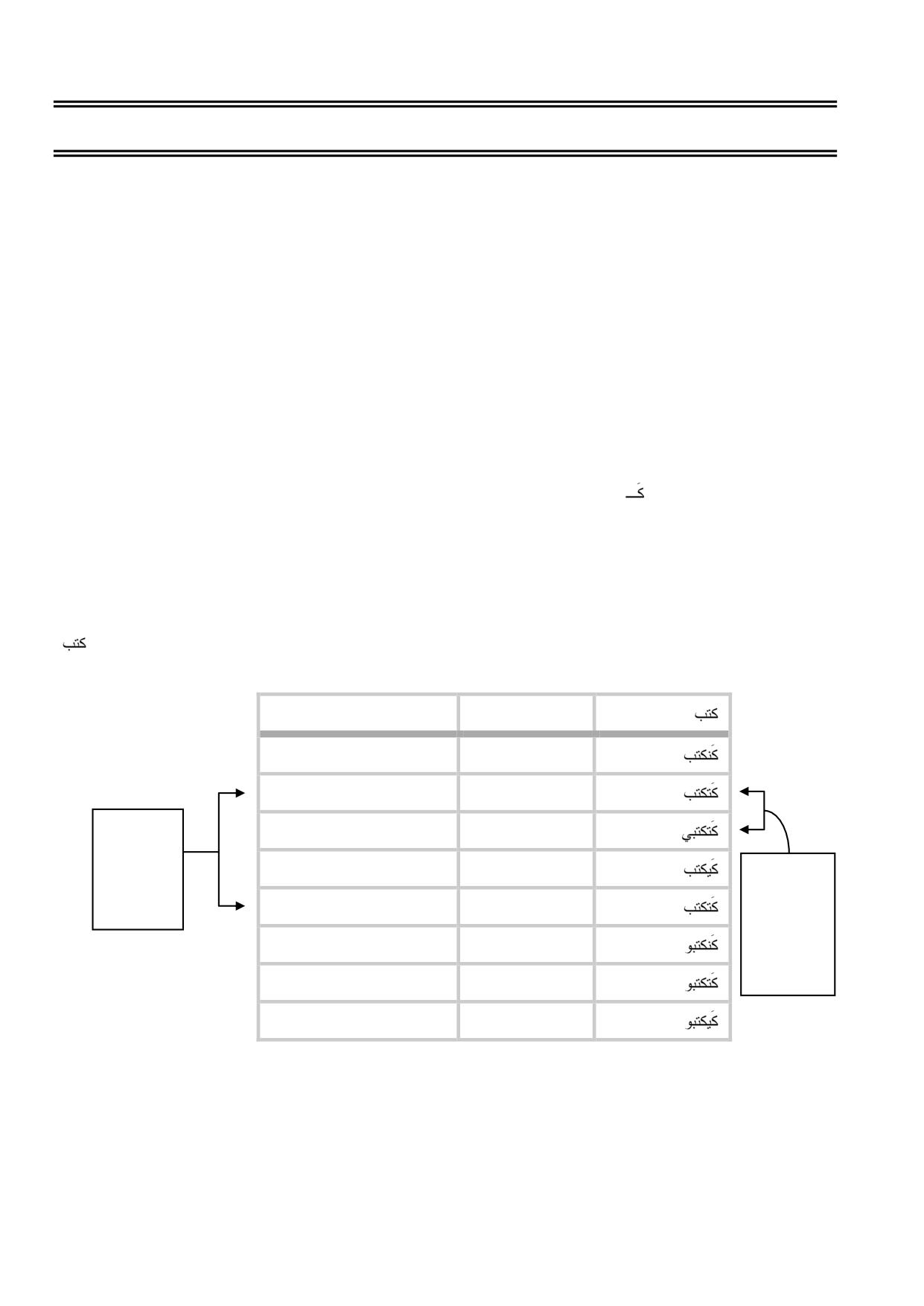
58 • Moroccan Arabic
Daily Routines
Objective: By the end of the chapter, you will be able to:
• talk about your daily activities using the present tense
• use one verb after another to express complex thoughts
• give commands with the imperative
Present Tense - Regular Verbs
Present Tense in General
In Arabic, the present tense normally expresses both habitual and progressive actions.
habitual action:
I eat couscous every Friday.
progressive action: I am eating couscous now.
For a small number of verbs, the present tense expresses only habitual actions (see page 151 for more
information on these verbs).
Unlike the past tense, which uses only suffixes (endings) to conjugate a verb, the present tense uses
both suffixes and prefixes. The present tense prefix is written with ka (
) and another letter (n, t,
or y). Present tense suffixes (i or u) may be added as well.
Regular Verbs in the Present Tense
Verbs that were regular in the past tense are still regular in the present tense. In addition to these,
two-letter verbs are also regular in the present tense. Therefore, they will be conjugated like ktb
(
) in the present tense. See page 51 for more information on two-letter verbs.
Here is the conjugation of the verb ktb in the present tense, with prefixes and suffixes underlined:
“to write”
ktb
I write
kan-ktb
you write (masc. sing.)
kat-ktb
Yes, these
you write (fem. sing.)
kat-ktbi
are the
same. You
he writes
kay-ktb
These have
understand
different
the speaker
she writes
kat-ktb
conjugations.
by context.
In the past
tense, they
we write
kan-ktbu
had the same
conjugation.
you write (plur.)
kat-ktbu
they write
kay-ktbu
Q: What changes are brought to the verb when conjugated in the present tense?
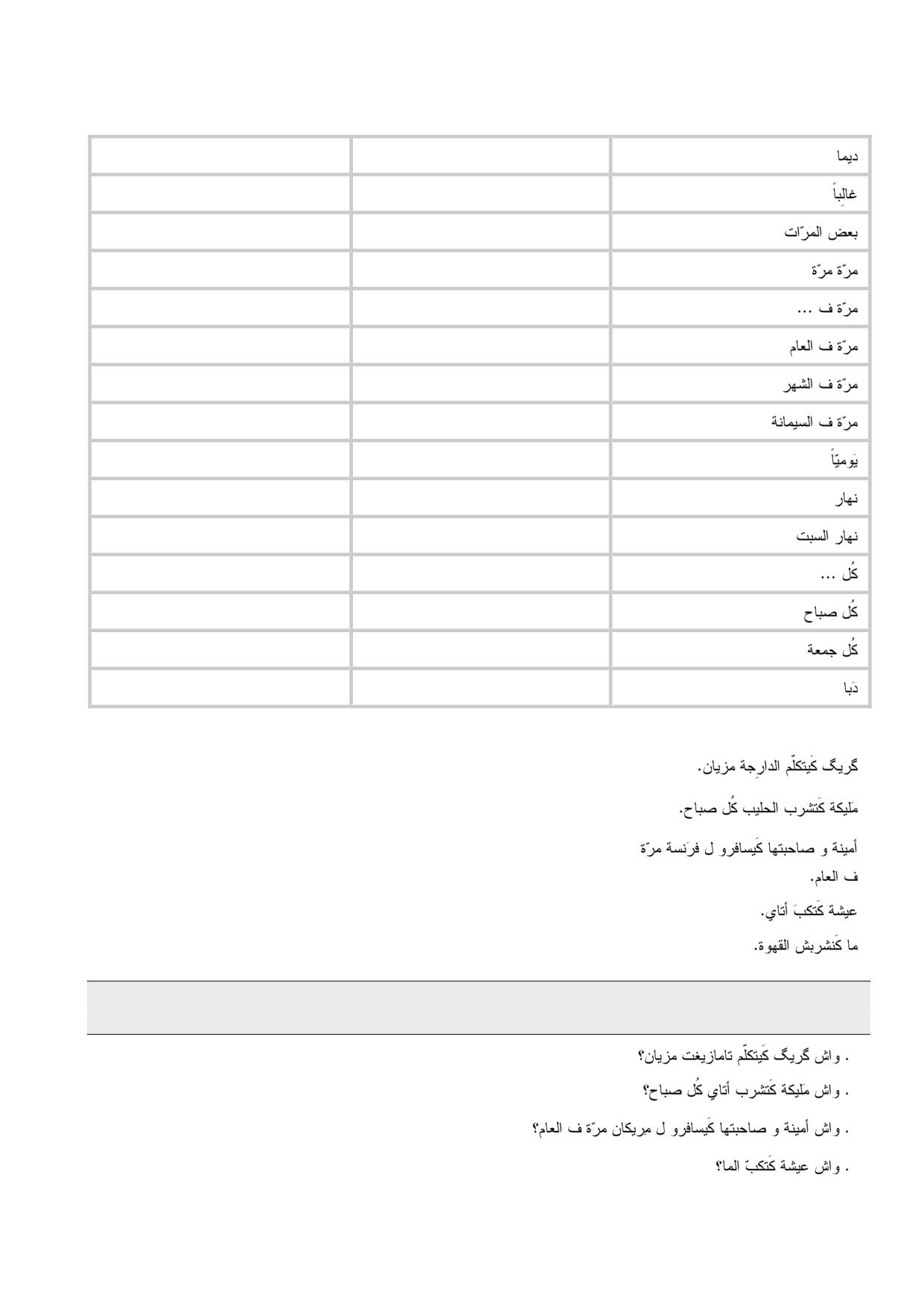
59
Time Expressions
always
dima
usually
ġaliban
sometimes
bعd l-mrrat
from time to time
mrra mrra
once a ...
mrra f ...
once a year
mrra f l-عam
once a month
mrra f l-šhr
once a week
mrra f s-simana
everyday
yawmiyan
on (day of the week)
nhar ...
on Saturday
nhar s-sbt
every ...
kul ...
every morning
kul sbaн
every Friday
kul jmعa
now
deba
Some examples:
Greg kay-tkllm d-darija
Greg speaks Darija well.
mzyan.
Malika drinks milk every
Malika kat-šrb l-нlib kul
morning.
sbaн.
Amina and her friend travel to
Amina u saнbtha kay-safru
France once a year.
l fransa mrra f l-عam.
Aicha is pouring tea.
Aicha kat-kbb atay.
I don‟t drink coffee.
ma-kan-šrb-š l-qhwa.
Exercise: Answer the following sentences (based on the examples above) in the
negative.
1. weš Greg kay-tkllm tamaziġt mzyan?
1
2. weš Malika kat-šrb atay kul sbaн?
2
3. weš Amina u saнbtha kay-safru l
3
mirikan mrra f l-عam?
4. weš Aicha kat-kbb l-ma?
4
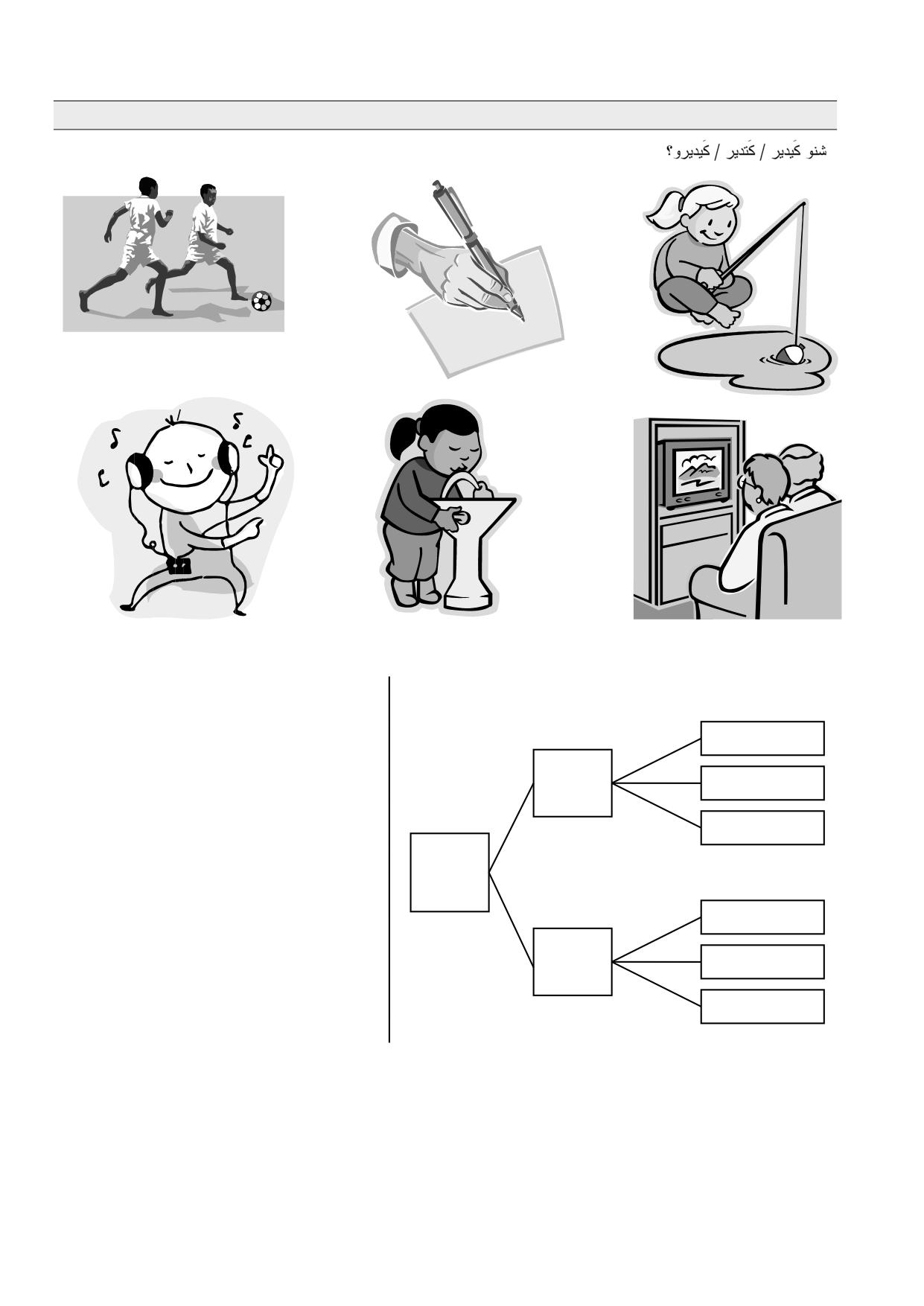
60 • Moroccan Arabic
Exercise: Describe in the present tense the following activities.
šnu kay-dir / kat-dir / kay-diru?
Present Tense - Irregular Verbs with Middle “a”
Irregular Verbs in General
Categories of Present Tense Irregular Verbs
Irregular verbs in the present tense are
more complicated than in the past tense.
“a” becomes “u”
In the past tense, verbs with the same
long vowel
structure (―a‖ in the middle, ―a‖ at the
“a” in
“a” becomes “i”
end) were conjugated the same way. In
the middle
the present tense, verbs that look the
“a” remains “a”
same in their ―infinitive‖ form may be
Present
conjugated differently.
Tense
As a result of this difference, in the
Irregular
Verbs
present tense you will have to remember
“a” becomes “i”
which category of conjugation each
irregular verb belongs to. These catego-
long
ries are listed in the diagram to the right,
vowel “a”
“a” remains “a”
at the end
and each will be shown individually. The
glossary of verbs in the appendix (see
internal changes
page 163) also shows, by example, how
an irregular verb is conjugated.
We will deal with two large groups of irregular verbs: 3-letter verbs with a long vowel ―a‖ in the middle
and all verbs with a long vowel ―a‖ at the end. Within each of these general groups, there will be three
categories of different conjugations. At times, it may seem like too much information to handle. But
Peace Corps trainees have been learning the irregular present tense for years; you‘ll do great.
Practicing irregular verbs with your homestay family is one way to remember how each verb is
conjugated. The more you use the verbs, the quicker they will ―stick‖ in your memory.
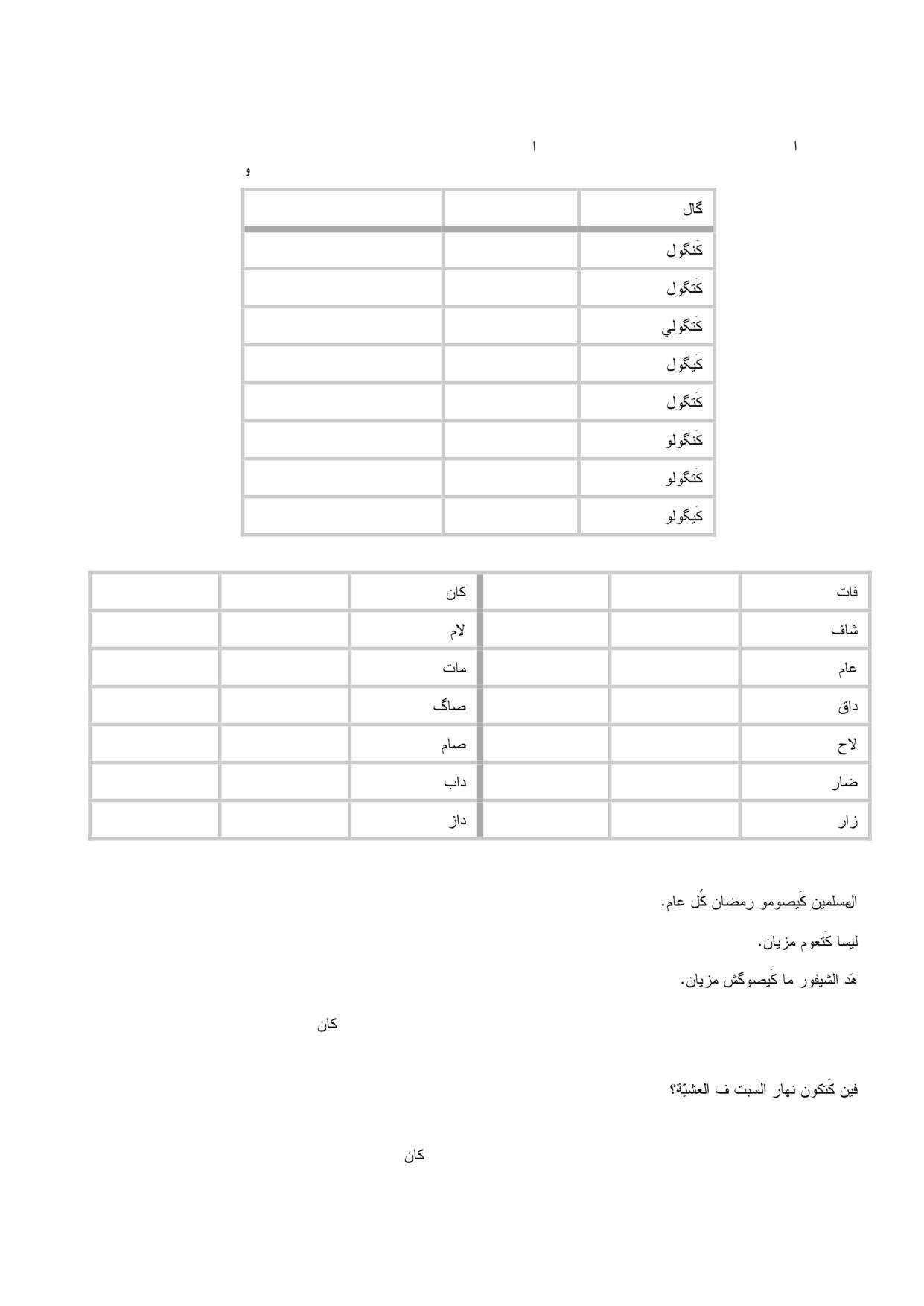
61
1st Category: Long “a” Becomes Long “u”
Remember, here we are dealing with 3-letter verbs with a ( ) in the middle. The long vowel a ( ) changes
to the long vowel u ( ), with the same prefixes and suffixes as regular verbs in the present tense.
“to say”
gal
I say
kan-gul
you say (masc. sing.)
kat-gul
you say (fem. sing.)
kat-guli
he says
kay-gul
she says
kat-gul
we say
kan-gulu
you say (plur.)
kat-gulu
they say
kay-gulu
Verbs like “gal”
to be
kan
to pass
fat
to blame
lam
to see
šaf
to die
mat
to swim
عam
to drive / ride
sag
to taste
daq
to fast
sam
to throw
laн
to melt
dab
to turn
dar
to pass
daz
to visit
zar
Some examples:
Muslims fast Ramadan every
l-mslmin kay-sumu rmdan
year.
kul عam.
Lisa swims well.
Lisa kat-عum mzyan.
had š-šifur ma-kay-sug-š
This driver doesn‟t drive well.
mzyan.
When the verb ―to be,‖ kan (
) is conjugated in the present tense, it expresses a habitual action or
activity, not a current state or condition.
Where are you (every) Saturday fin kat-kun nhar s-sbt f
afternoon?
l-عšiya?
In order to express current states or conditions, use independent pronouns with adjectives or nouns
(see page 7) or use the participles of kan (
) (see page 37). You have already learned both!
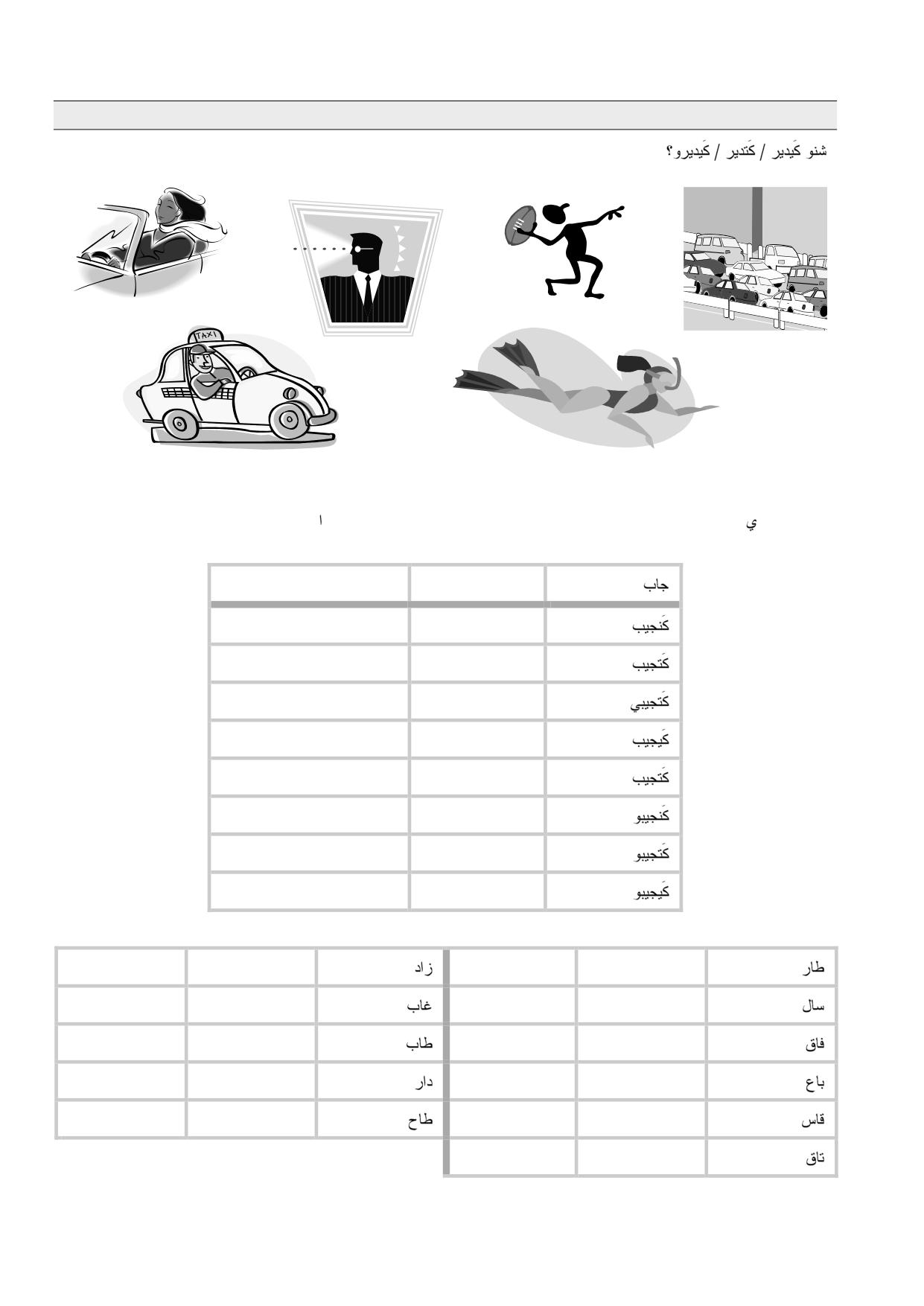
62 • Moroccan Arabic
Exercise: Describe in the present tense the following activities.
šnu kay-dir / kat-dir / kay-diru?
2nd Category: Long “a” Becomes Long “i”
In this category, the long vowel a ( ) in the middle of the verb changes to the long vowel i ( ), with the
same prefixes and suffixes as regular verbs in the present tense.
“to bring”
jab
I bring
kan-jib
you bring (masc. sing.)
kat-jib
you bring (fem. sing.)
kat-jibi
he brings
kay-jib
she brings
kat-jib
we bring
kan-jibu
you bring (plur.)
kat-jibu
they bring
kay-jibu
Verbs like “jab”
to add
zad
to fly
tar
to be absent
ġab
to leak
sal
to be cooked
tab
to wake up
faq
to do / make
dar
sell
baع
to fall
taн
to touch
qas
to trust
taq
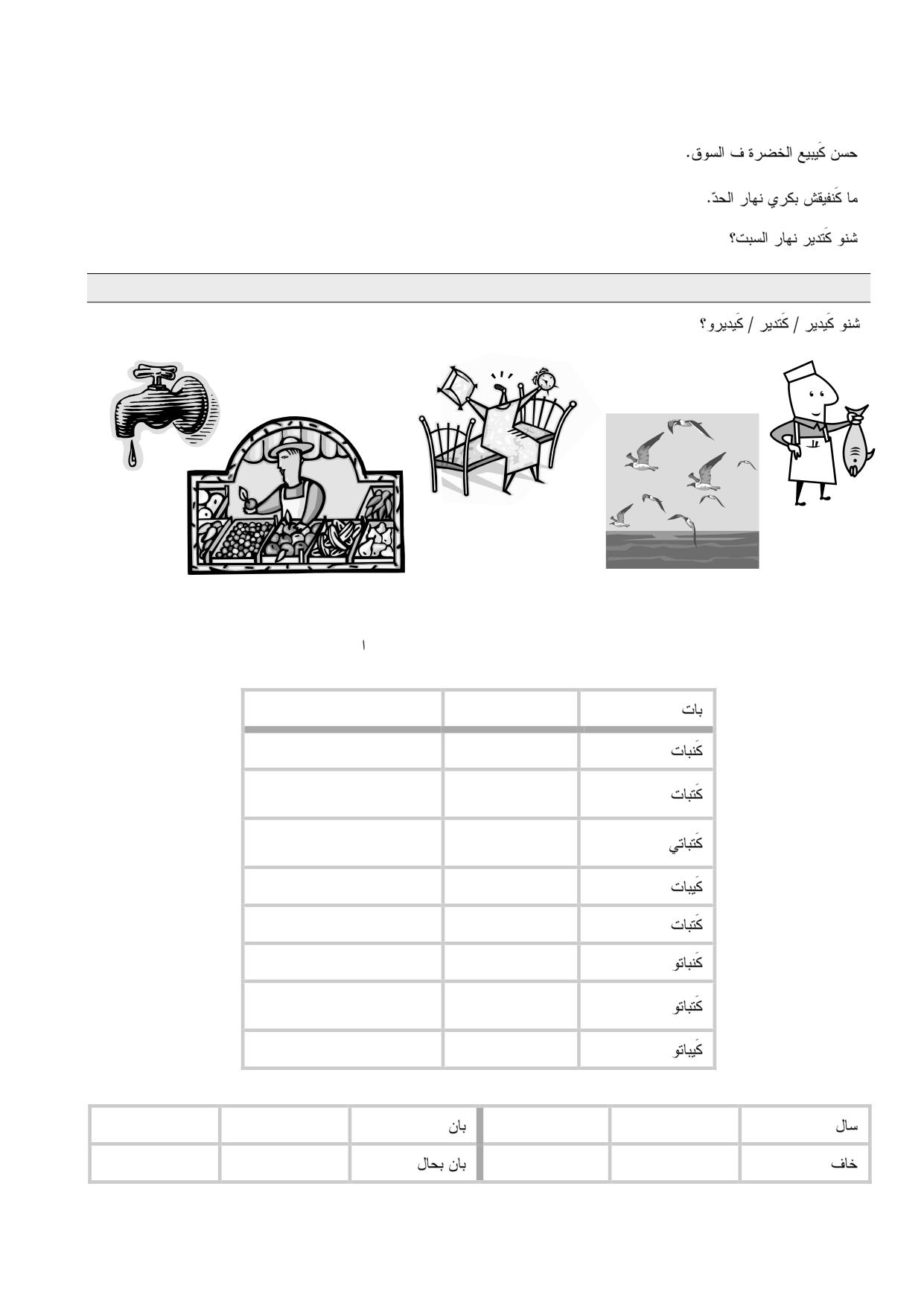
63
Some examples:
Hassan sells (is selling)
Hassan kay-biع l-xodra f
vegetables in the souq.
s-suq.
I don‟t wake up early on
ma-kan-fiq-š bkri nhar
Sundays.
l-нdd.
What do you do on Saturdays? šnu kat-dir nhar s-sbt?
Exercise: Describe in the present tense the following activities.
šnu kay-dir / kat-dir / kay-diru?
3rd Category: Long “a” Remains Long “a”
In this category, the long vowel a ( ) remains the same, without any changes, with the same prefixes
and suffixes as regular verbs in the present tense.
“to spend the night”
bat
I spend the night
kan-bat
you spend the night
kat-bat
(masc. sing.)
you spend the night
kat-bati
(fem. sing.)
he spends the night
kay-bat
she spends the night
kat-bat
we spend the night
kan-batu
you spend the night
kat-batu
(plur.)
they spend the night
kay-batu
Verbs like “bat”
to appear
ban
to owe
sal
to look like
ban bнal
to be scared
xaf
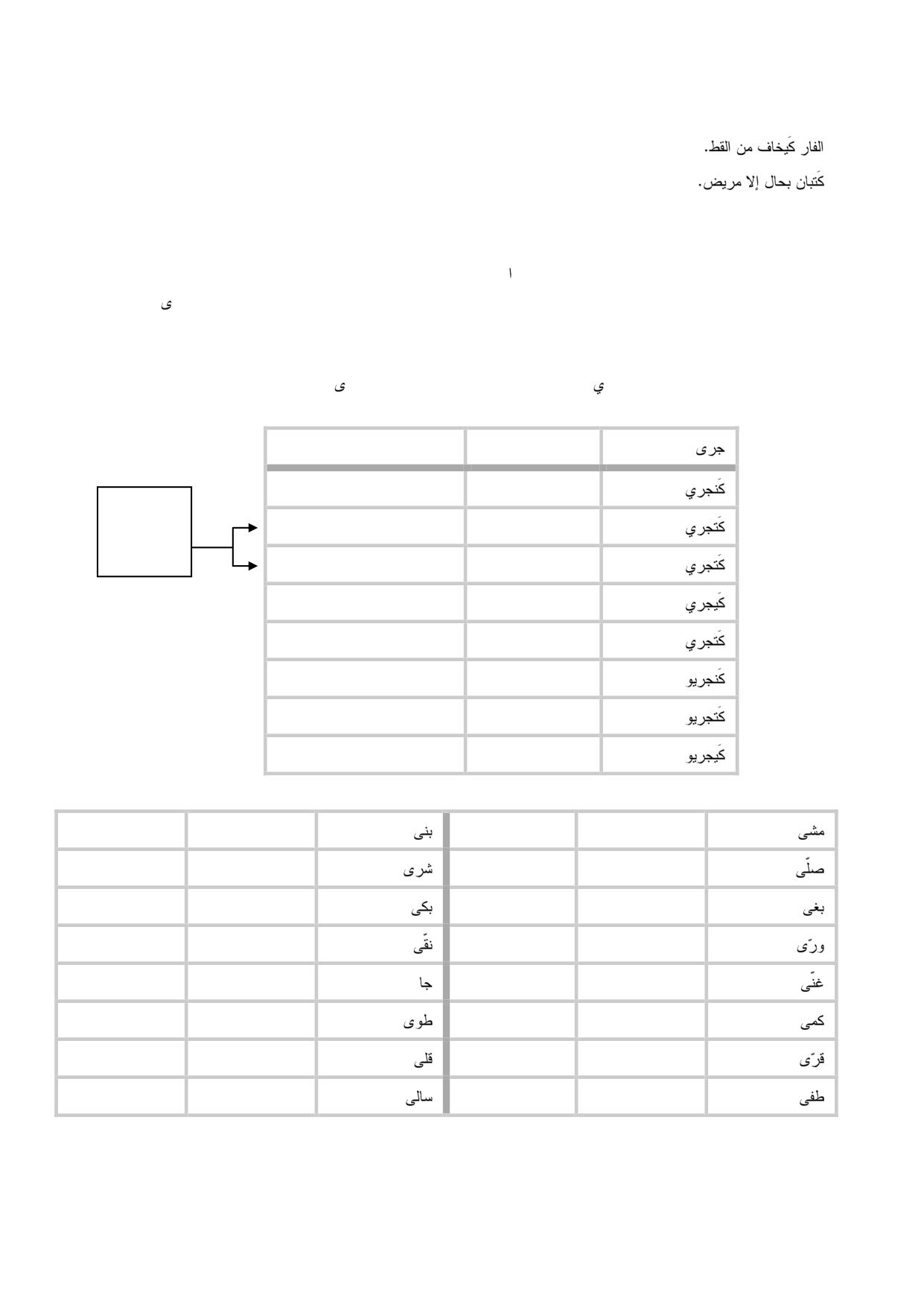
64 • Moroccan Arabic
Some examples:
The mouse is scared of the cat. l-far kay-xaf mn l-qt.
You look like you are sick.
kat-ban bнal ila mrid.
Present Tense - Irregular Verbs with Final “a”
Now we change our focus from verbs with a long vowel a ( ) in the middle of the verb to those with a
long vowel a ( ) at the end of the verb.
1st Category: Long “a” Becomes Long “i”
In this category, the long vowel a ( ) changes to the long vowel i ( ), with the same prefixes and
suffixes as regular verbs in the present tense.
“to run”
jra
I run
kan-jri
These have
the same
you run (masc. sing.)
kat-jri
conjugation in
this category.
you run (fem. sing.)
kat-jri
he runs
kay-jri
she runs
kat-jri
we run
kan-jriu
you run (plur.)
kat-jriu
they run
kay-jriu
Verbs like “jra”
to build
bna
to go
mša
to buy
šra
to pray
slla
to cry
bka
to like / love
bġa
to clean
nqqa
to show
wrra
to come
ja
to sing
ġnna
to fold
twa
to smoke
kma
to fry
qla
to teach
qrra
to finish
sala
to turn off
tfa
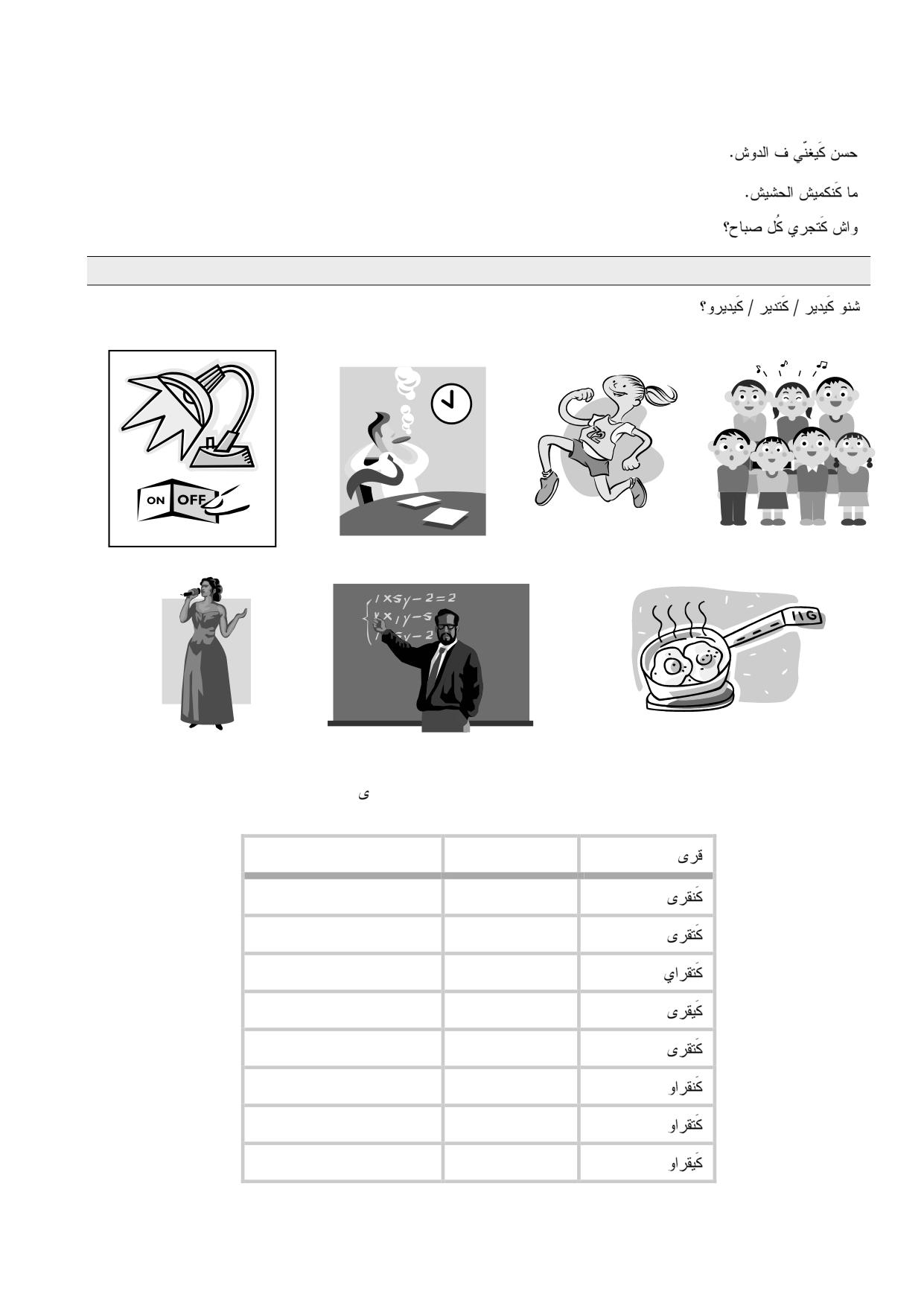
65
Some examples:
Hassan sings (is singing) in the
Hassan kay-ġnni f d-duš.
shower.
I don‟t smoke hash.
ma-kan-kmi-š l-нšiš.
Do you run every morning?
weš kat-jri kul sbaн?
Exercise: Describe in the present tense the following activities.
šnu kay-dir / kat-dir / kay-diru?
2nd Category: Long “a” Remains Long “a”
In this category, the long vowel a ( ) remains the same, without any changes, with the same prefixes
and suffixes as regular verbs in the present tense.
“to read / study”
qra
I read
kan-qra
you read (masc. sing.)
kat-qra
you read (fem. sing.)
kat-qray
he reads
kay-qra
she reads
kat-qra
we read
kan-qrau
you read (plur.)
kat-qrau
they read
kay-qrau
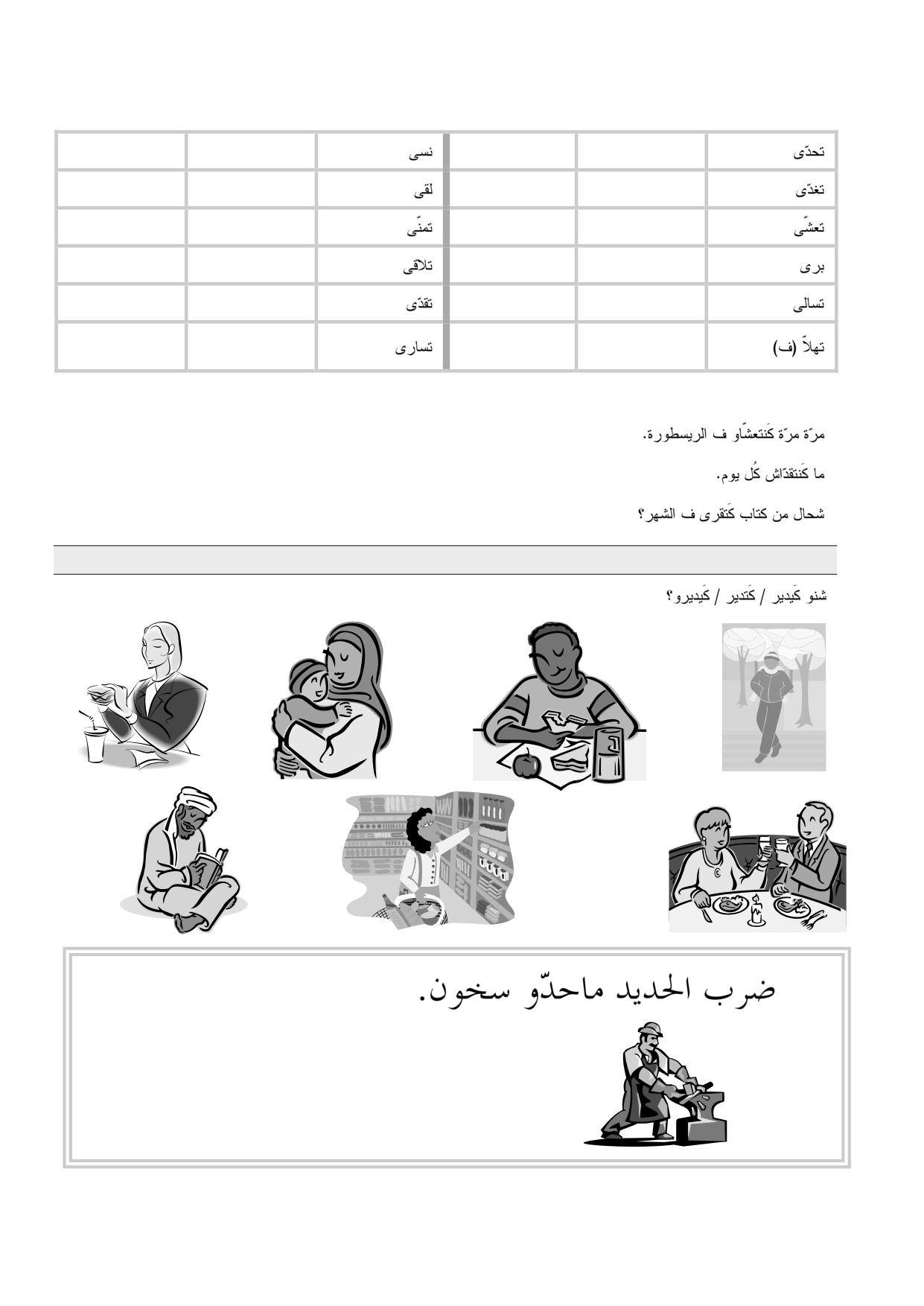
66 • Moroccan Arabic
Verbs like “qra”
to forget
nsa
to defy
tнdda
to find
lqa
to eat lunch
tġdda
to hope
tmnna
to eat dinner
tعšša
to meet
tlaqa
to be cured
bra
to go shopping
tqdda
to be finished
tsala
to take care
to walk around
tsara
thlla (f)
(of)
Some examples:
From time to time we eat dinner mrra mrra kan-tعššau f
at the restaurant.
r-ristora.
I don‟t go shopping every day.
ma-kan-tqdda-š kul yum.
How many books do you read in šнal mn ktab kat-qra f
a month?
š-šhr?
Exercise: Describe in the present tense the following activities.
šnu kay-dir / kat-dir / kay-diru?
Moroccan Wisdom:
drb l-нdid maнddu sxun.
Strike while the iron is hot.
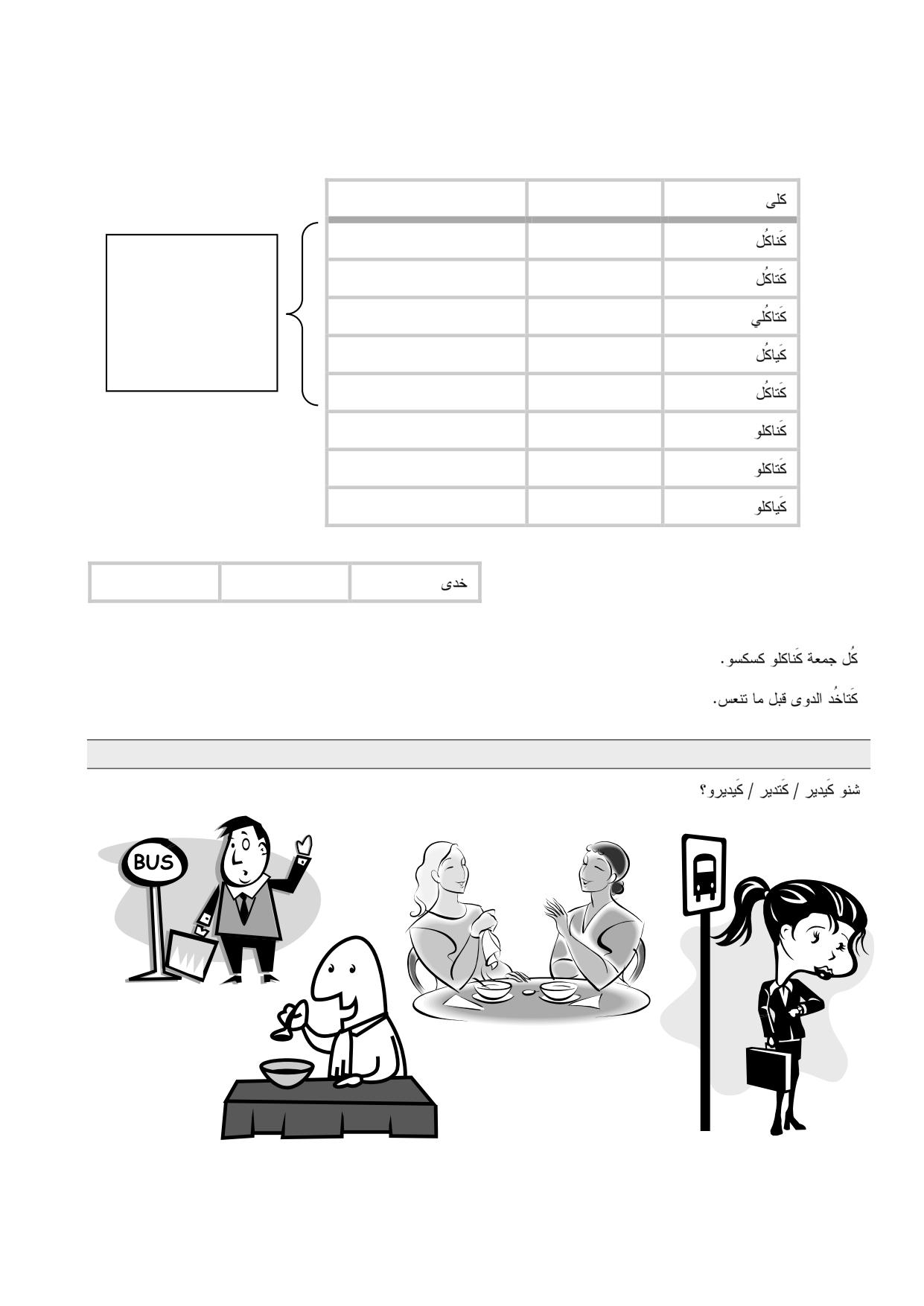
67
3rd Category: Verb Has Internal Changes
Two verbs in Moroccan Arabic are conjugated in the present tense by changing their internal structure
in addition to adding the normal prefixes and suffixes.
“to eat”
kla
I eat
kan-akul
In these forms, the
―u‖ is pronounced
you eat (masc. sing.)
kat-akul
very quickly. Thus,
one shouldn‘t say
you eat (fem. sing.)
kat-akuli
―kan-akuuuuul,‖
but rather
he eats
kay-akul
―kan-akul‖
she eats
kat-akul
we eat
kan-aklu
you eat (plur.)
kat-aklu
they eat
kay-aklu
Another Verb like “kla”
to take
xda
Some examples:
Every Friday we eat couscous. kul jmعa kan-aklu ksksu.
She takes medicine before she kat-axud d-dwa qbl
goes to bed.
ma t-nعs.
Exercise: Describe in the present tense the following activities.
šnu kay-dir / kat-dir / kay-diru?
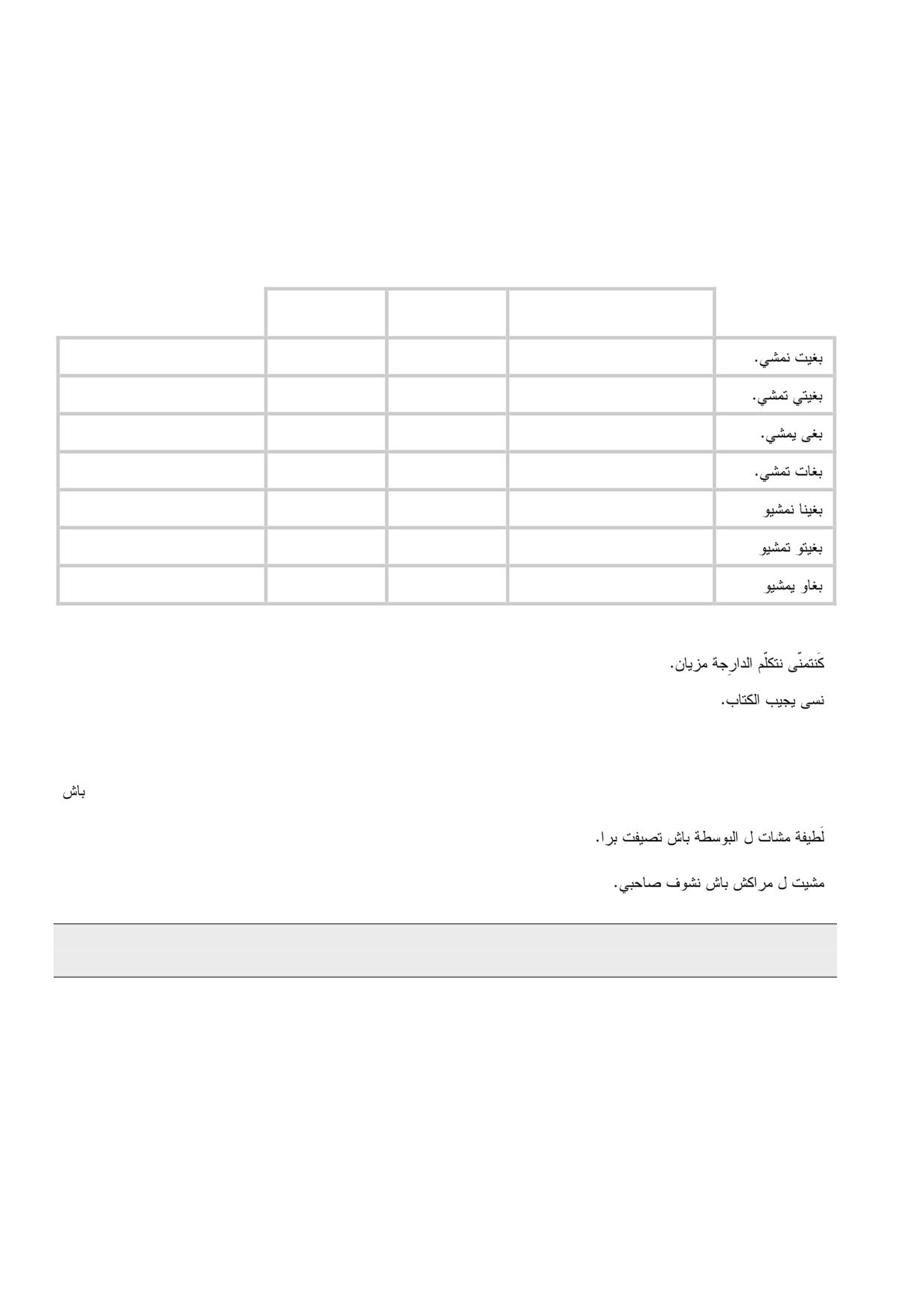
68 • Moroccan Arabic
Using One Verb after Another
Sometimes, we will want to use one verb directly after another. This is true in English:
I want to read.
He likes to cook.
We forgot to call you.
She began to study yesterday.
As the examples show, in English we use the infinitive after a verb (to read, to cook, to call, to study).
But in Arabic, as you recall, there isn‘t actually an infinitive for verbs (see page 46). Instead, we use the
present tense of a verb without the opening “ka.” This will serve as the equivalent of the
English infinitive when we use one verb after another.
Present
Without
Used after “bġa”
Tense
“ka”
I want to go.
kan-mši
n-mši
bġit n-mši
You want to go.
kat-mši
t-mši
bġiti t-mši
He wants to go.
kay-mši
y-mši
bġa y-mši
She wants to go.
kat-mši
t-mši
bġat t-mši
We want to go.
kan-mšiu
n-mšiu
bġina n-mšiu
You want to go.
kat-mšiu
t-mšiu
bġitu t-mšiu
They want to go.
kay-mšiu
y-mšiu
bġau y-mšiu
Some more examples:
kan-tmnna n-tkllm
I hope to speak Darija well.
d-darija mzyan.
He forgot to bring the book.
nsa y-jib l-ktab.
Using with Other Expressions
This same construction is used after other words and expressions. The most important of these is bash
(
). This word is the equivalent of the English ―in order to.‖ Some examples:
Latifa went to the post office
Latifa mšat l l-bosta
in order to send a letter.
baš t-sift bra.
I went to Marrakech in order
mšit l Marrakech
to see my friend.
baš n-šuf saнbi.
Exercise: Combine the following words into sentences, using the proper conjugations
of verbs and pronouns.
1. Amina / mša / l l-bosta / baš / šra / kart d t-tilifun.
2. huwa / bġa / mša / l mirikan / baš / qra.
3. нna / ja / l l-mġrib / baš / عawn / nas dyalu / u / tعrrf / عlihum / u /
{huma} عrf {нna} / mzyan.
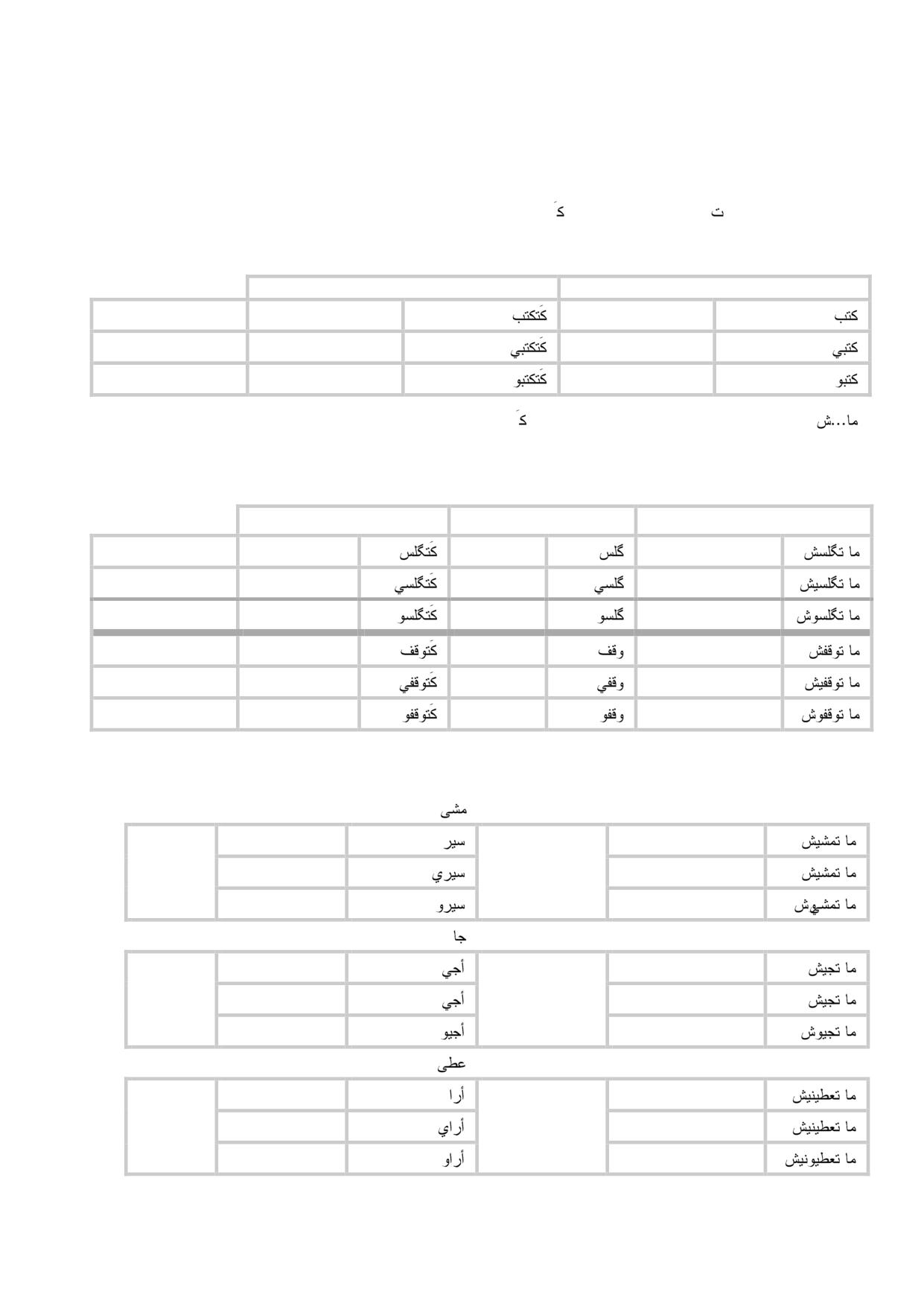
69
The Imperative
The imperative is used to give commands: Go to the store! Open the window! Study Arabic! The
positive imperative tells someone to do something, the negative imperative tells someone not to do
something.
The positive imperative is formed by dropping both the ka ( ) and the prefix t (
) from the singular
and plural ―you‖ forms of the present tense. In the following table, all the examples are equal to the
English command, ―Write!‖
Present Tense
Imperative
you (masc. sing.)
kat-ktb
ktb
you (fem. sing.)
kat-ktbi
ktbi
you (plur. sing.)
kat-ktbu
ktbu
The negative imperative is formed by dropping the ka ( ) and using the negative form ma...š (
).
In the following table, the first verb is gls, ―to sit,‖ and the negative imperatives are equivalent to the
English ―Don‘t sit!‖ The second verb is wqf, ―to stand / stop‖
and the negative imperatives are
equivalent to the English ―Don‘t stand up!‖
Present Tense
Imperative
Negative Imperative
you (masc. sing.)
kat-gls
gls
ma-t-gls-š
you (fem. sing.)
kat-glsi
glsi
ma-t-glsi-š
you (plur. sing.)
kat-glsu
glsu
ma-t-glsu-š
you (masc. sing.)
kat-wqf
wqf
ma-t-wqf-š
you (fem. sing.)
kat-wqfi
wqfi
ma-t-wqfi-š
you (plur. sing.)
kat-wqfu
wqfu
ma-t-wqfu-š
Some Irregular Imperatives
For the following three verbs, the positive imperative is not regular.
1.
to go
mša
sir
ma-t-mši-š
Go.
siri
Don‟t go.
ma-t-mši-š
siru
ma-t-mšiu-š
2.
to come ja
aji
ma-t-ji-š
Come.
aji
Don‟t come.
ma-t-ji-š
ajiu
ma-t-jiu-š
3.
to give
عta / ara
ara
ma-t-عtini-š
Give me.
aray
Don‟t give me.
ma-t-عtini-š
arau
ma-t-عtiuni-š
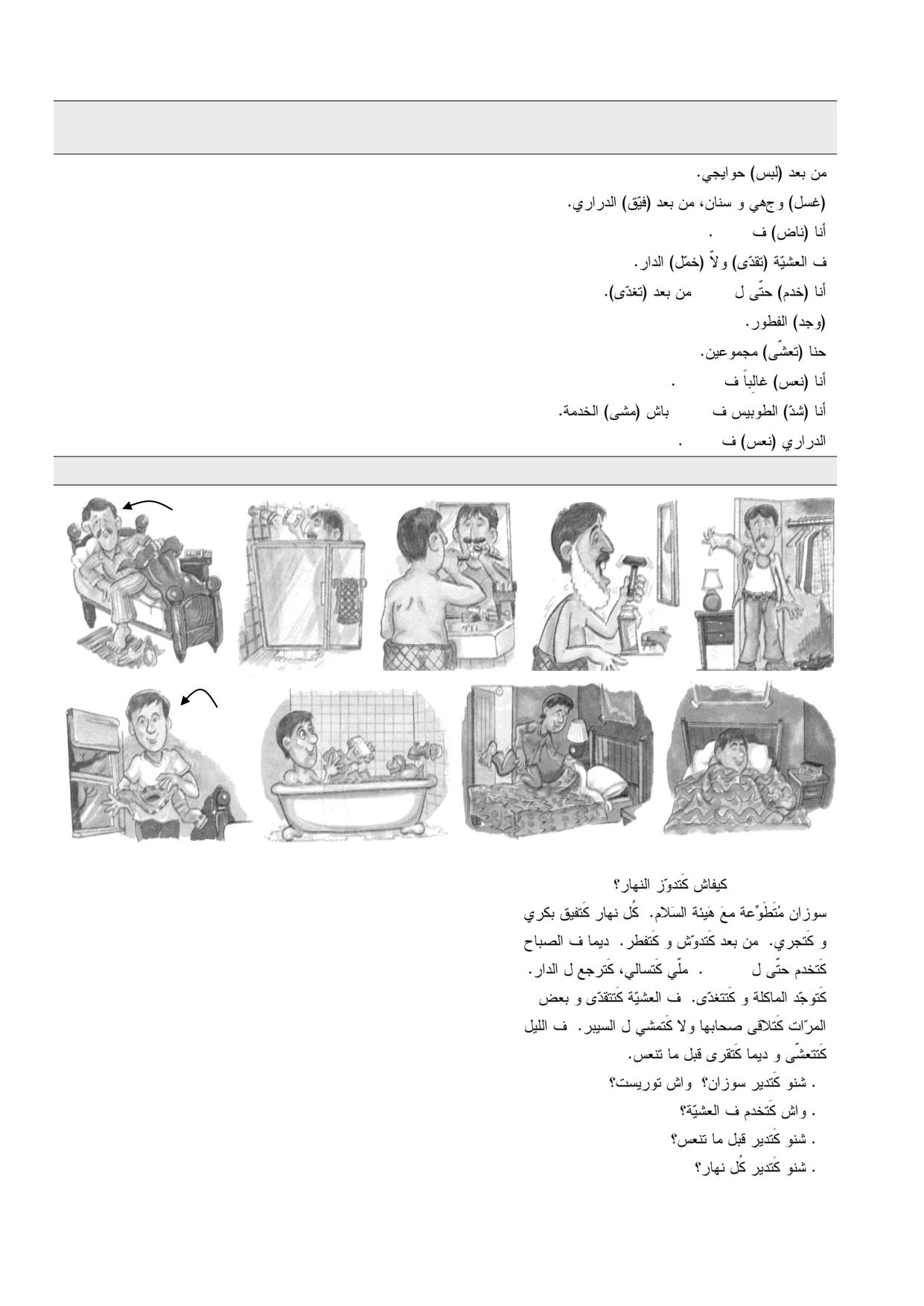
70 • Moroccan Arabic
Exercise: Put the verbs between parentheses in correct form, then arrange the
sentences in the correct order.
A. mn bعd (lbs) нwayji.
B. (ġsl) wjhi u snan, mn bعd (fiyq) d-drari.
C. ana (nad) f 7:30.
7:30
D. f l-عšiya (tqdda) wlla (xmml) d-dar.
E. ana (xdm) нtta l 1:00 mn bعd (tġdda).
1:00
F. (wjd) l-ftur.
G. нna (tعšša) mjmuعin.
H. ana (nعs) ġaliban f 11:00.
11:00
I. ana (šdd) t-tubis f 8:00 baš (mša) l-xdma.
8:00
J. d-drari (nعs) f 8:00.
8:00
Exercise: Write a paragraph out of each set of pictures.
John
Bobby
Text
kifaš kat-duwz n-nhar?
Susan mutatawiعa mعa hay'at s-salam. kul
nhar kat-fiq bkri u kat-jri. mn bعd
kat-duwš u kat-ftr. dima f s-sbaн kat-xdm
нtta l 11:30. mlli kat-sali, kat-rjع l
11:30
d-dar. kat-wjjd l-makla u kat-tġdda. f
l-عšiya kat-tqdda u bعd l-mrrat kat-laqa
sнabha wlla kat-mši l s-siber. f l-lil
kat-tعšša u dima kat-qra qbl ma t-nعs.
1. šnu kat-dir Susan? weš turist?
1
2. weš kat-xdm f l-عšiya?
2
3. šnu kat-dir qbl ma t-nعs?
3
4. šnu kat-dir kul nhar?
4
71
Bargaining
Objective: By the end of the chapter, you will be able to:
• bargain for basic items, such as clothing
• describe the colors of items
• use masculine, feminine, and plural adjectives correctly
• describe differences between objects using the comparative and superlative
Bargaining
General Bargaining Information
In Morocco, bargaining is a part of life. It can sometimes be tiring for people not used to it, but with
some cultural and language skills, it can become much easier. Some information about bargaining can
also make the process simpler.
First of all, you need to know what items should be bargained for, and what items normally have fixed
prices, even for Moroccans. This is not always easy to determine, since the place where you buy some
things may determine whether the price is fixed or not. For example, some items that are sold at fixed
prices in a нanut (e.g. laundry soap, vegetables, eggs) may be bargained for in the souk or from a street
vendor. Ask your host family or watch other Moroccans in order to find out. Here are some general
guidelines for whether prices are fixed or not:
Usually Bargained For
Seldom Bargained For
any article of clothing
things which are literally bought every day:
mint, parsley, bread, coriander
any household or kitchen utensil, appliance,
or furniture
refill on a butagas
rent for a house or apartment
cigarettes and alcohol
taxi fares on unscheduled runs
meals or beverages in restaurants
anything bought in a souk (e.g. grains in
bus fares between scheduled stops
bulk, animals, rugs, etc.)
taxi fares on regular runs
anything bought from a street vendor who
price-controlled staple foods: sugar, oil, tea,
has no regular shop
flour, milk, butter, etc.
petit taxi fares if the meter does not work
anything bought in a pharmacy
anything used or second-hand
meat and vegetables, if the price per kilo is
domestic help and services (maid, plumber,
posted
electrician, etc. Determine the price before
school supplies
the work is done.)
It is also good to be aware of some of the standard tactics that are used between the buyer and the seller
in Morocco. If you watch Moroccans, you will see many of these.
The Buyer’s Tactics
The Seller’s Tactics
not showing too much enthusiasm for buying
not showing too much enthusiasm for selling
walking away when the seller has named the
turning away when the buyer has named the
―lowest‖ price
―highest‖ price
pointing out defects in the merchandise
noting the superior quality in the merchandise
quoting a lower price for an identical item in
insisting that goods in other shops are not of
another shop
the same quality
claiming not to have enough money to meet
claiming that in selling at the buyer‘s ―highest‖
the seller's ―lowest‖ price
price he would be taking a loss
complimenting or flattering the seller (on his
complimenting or flattering the buyer (on his
shop, merchandise, children, friendliness)
or her language ability, friendliness, expertise
in bargaining)
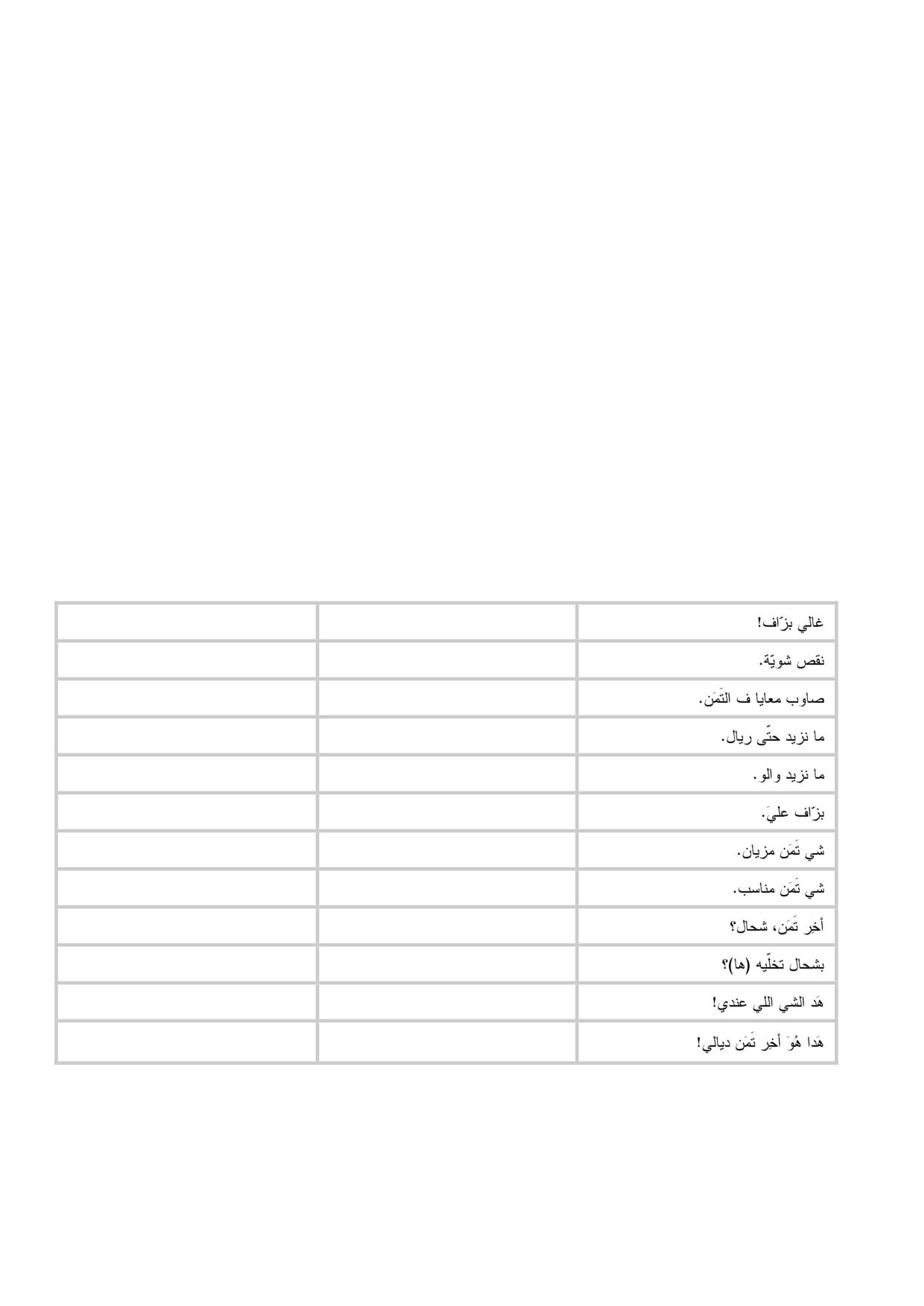
72 • Moroccan Arabic
The Buyer’s Tactics
The Seller’s Tactics
acting insulted by the seller‘s price
acting insulted by the buyer‘s offer
arguing that the difference between the
arguing that the difference between the
seller‘s price and the price offered is
buyer‘s price and his price is insignificant and
insignificant; i.e. the seller should come
the buyer should come up
down to the offered price
pulling out one's money as if the offered price
wrapping up the purchase as if the asking
has been agreed upon
price has been agreed upon
When you are looking to buy an item that you know you will have to bargain for, there are a few things
that you should probably try to avoid. These include:
showing too much interest in, or too great a need for, a particular item
carrying large sums of money, carrying expensive, previously-bought items, looking like a tourist
having no idea what an item is really worth, or what is a fair price for that type of item
being in a hurry
buying with a guide (he gets a percentage of what you pay)
Always be prepared to pay a price you have named. Do not get too far into bargaining for something if
you do not intend to buy it. If you are not clear on the currency in which you are bargaining (i.e. ryals),
proceed slowly. In the end, don‘t let a bargaining scenario ruin your day. Most of us go unbothered by
the sometimes huge markups on big-ticket items in America, yet we can be easily frustrated by a
Moroccan merchant who makes an extra dollar or two off of us. Remember that one‘s peace of mind is
worth something, too.
Bargaining Expressions
It‟s too expensive!
ġali bzzaf!
Lower the price.
nqs šwiya.
Give a good price.
sawb mعaya f t-taman.
I won‟t add even a ryal.
ma-n-zid нtta ryal.
I‟ll add nothing.
ma-n-zid walu.
It‟s too much for me.
bzzaf عliya.
A good price.
ši taman mzyan.
A reasonable price.
ši taman mnasb.
What‟s the last price?
axir taman, šнal?
How much will I get it for?
bšнal t-xllih (ha)?
That‟s what I have (money)!
had š-ši l-li عndi!
hada huwa axir taman
That‟s my last price!
dyali!
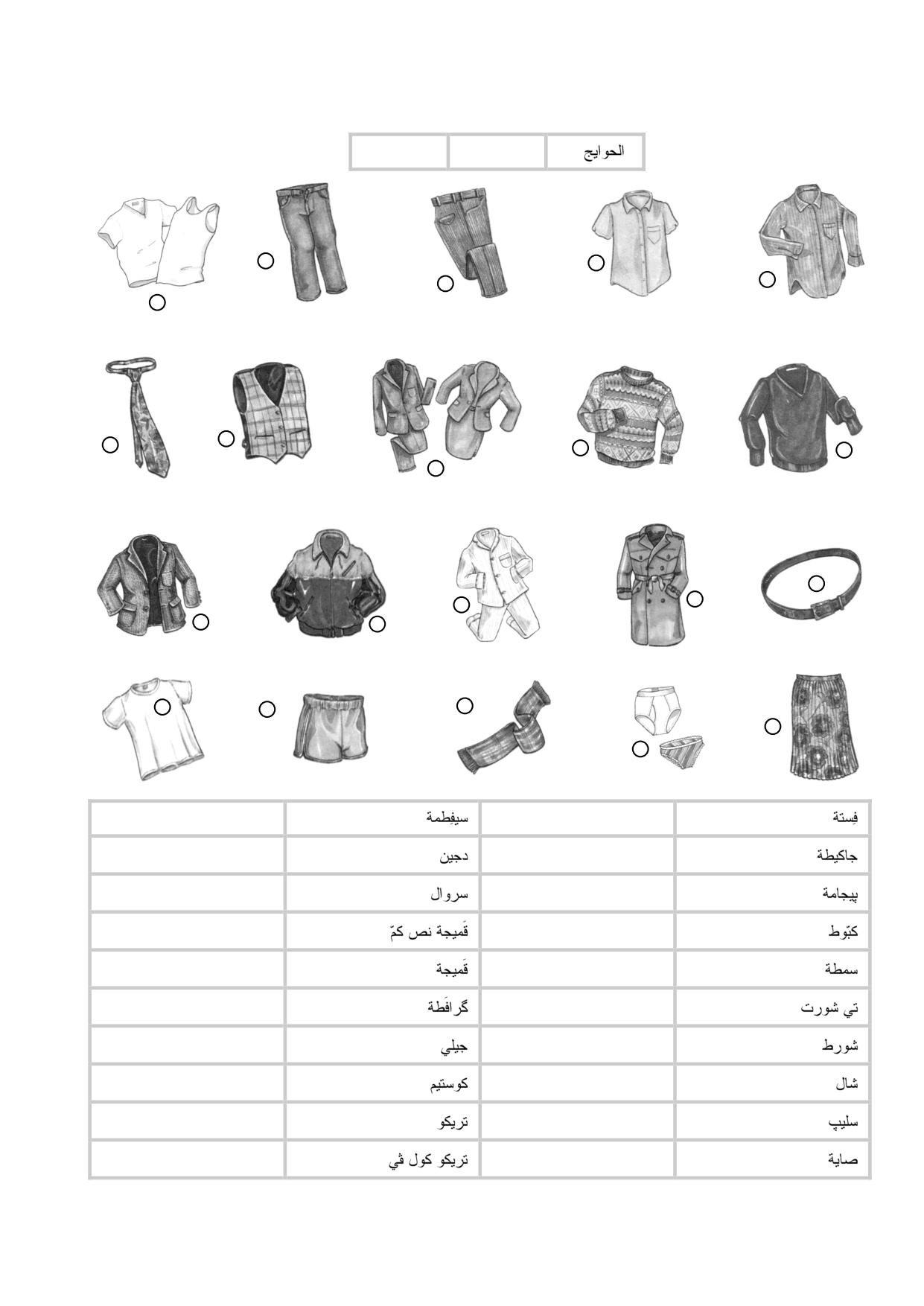
73
Clothing
Clothing Vocabulary
clothes
l-нwayj
2
4
5
3
1
7
6
9
10
8
15
14
13
11
12
16
17
18
20
19
1. sifitma
11. fista
2. jean
12. jakita
3. srwal
13. pijama
4. qamija ns kmm
14. kbbut
5. qamija
15. smta
6. grafata
16. T-shirt
7. jili
17. šort
8. kustim
18. šal
9. triko
19. slip
10. triko col v
20. saya
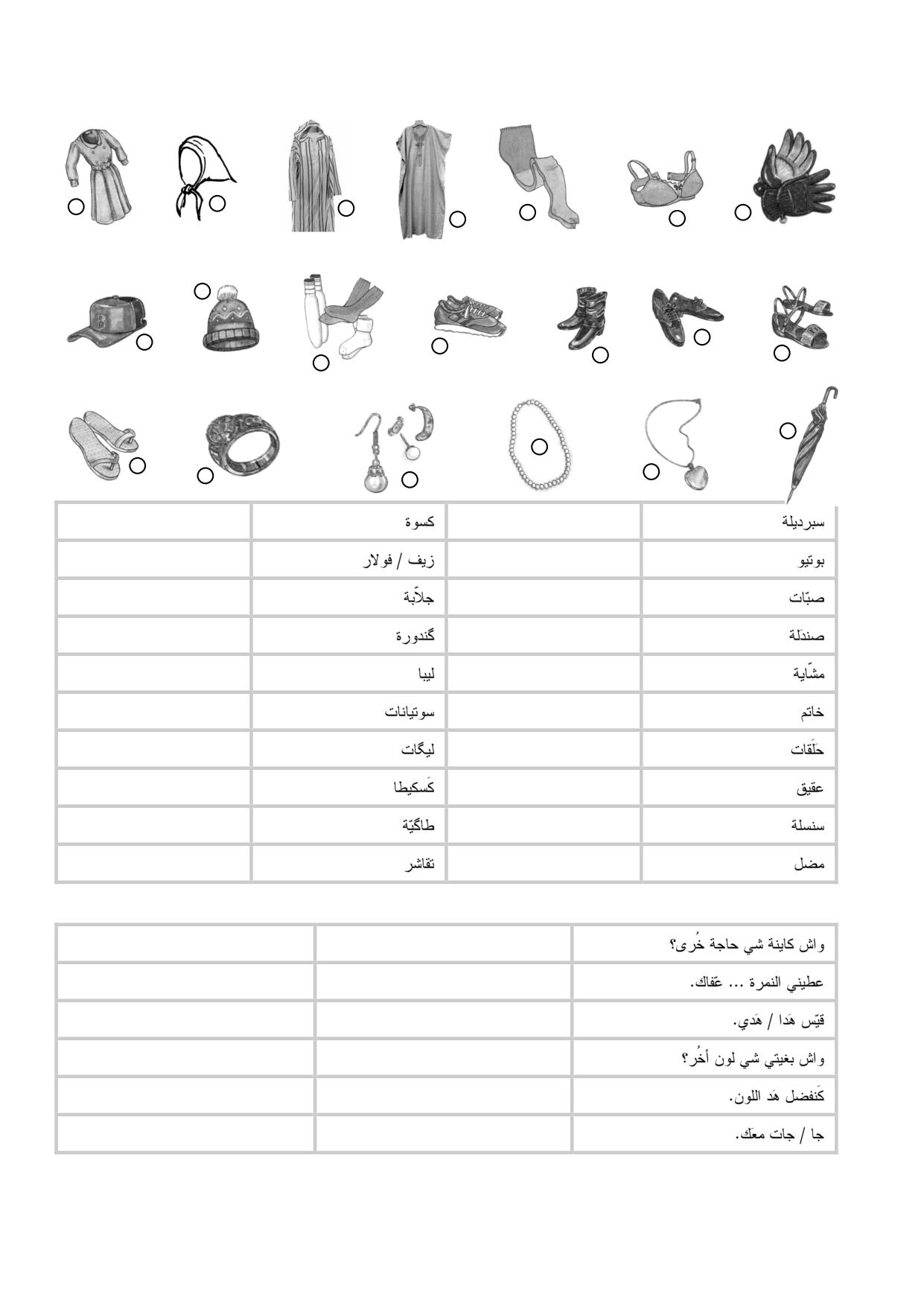
74 • Moroccan Arabic
1
2
3
5
7
4
6
9
13
8
11
12
14
10
20
18
15
16
19
17
1. kswa
11. sbrdila
2. zif / fular
12. butyu
3. jllaba
13. sbbat
4. gndura
14. sndala
5. liba
15. mššaya
6. sutyanat
16. xatm
7. ligat
17. нalaqat
8. kaskita
18. عqiq
9. tagiya
19. snsla
10. tqašr
20. mdl
Clothing Expressions
Is there anything else?
weš kayna ši нaja xora?
Give me size ... please.
عtini n-nmra ... عafak.
Try this one on.
qiys hada / hadi.
Do you want another color?
weš bġiti ši lun axor?
I prefer this color.
kan-fdl had l-lun.
It goes well with you.
ja / jat mعak.
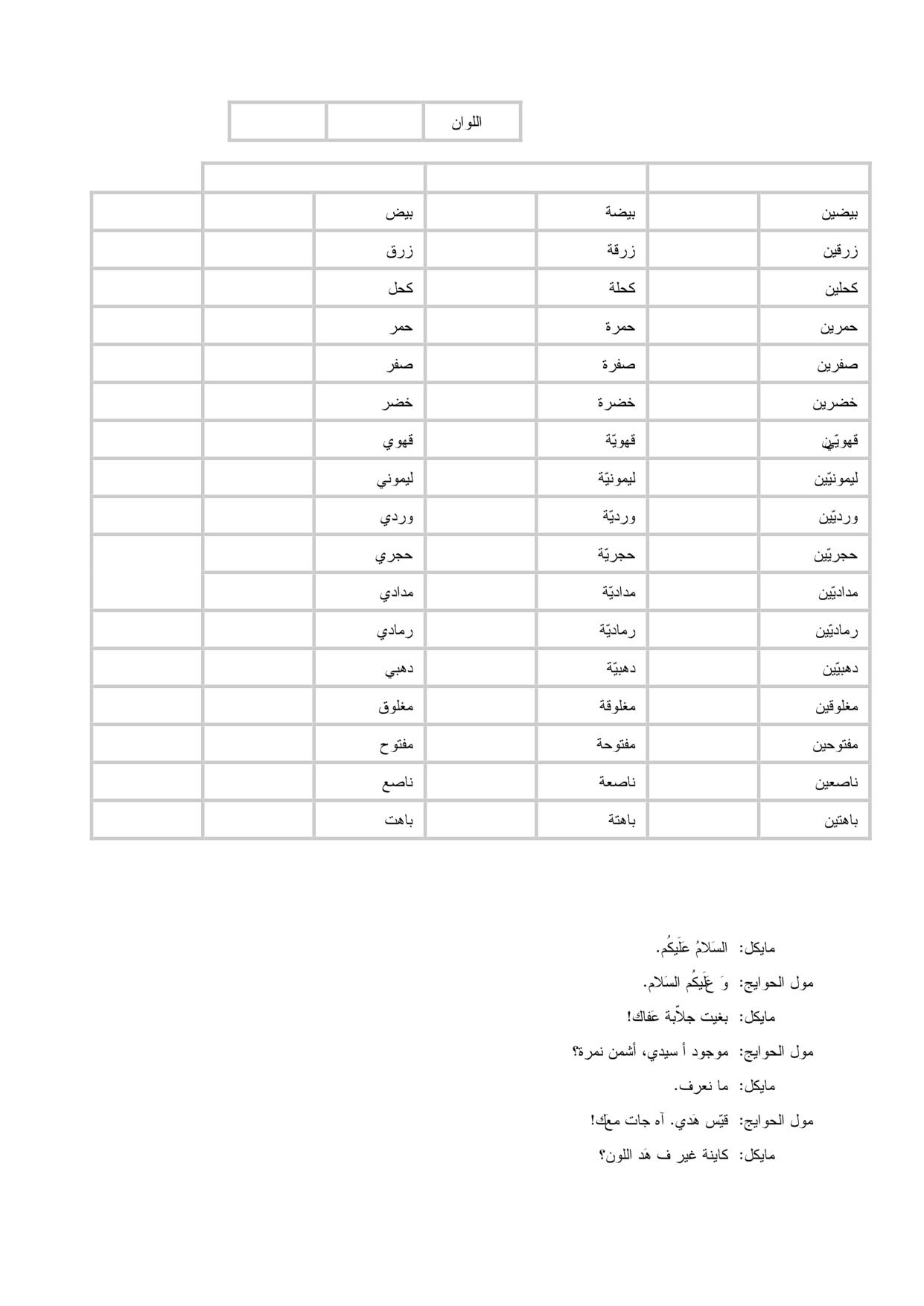
75
Colors
colors
l-lwan
Masculine Singular
Feminine Singular
Plural
white
byd
bida
bidin
blue
zrq
zrqa
zrqin
black
kнl
kнla
kнlin
red
нmr
нmra
нmrin
yellow
sfr
sfra
sfrin
green
xdr
xdra
xdrin
brown
qhwi
qhwiya
qhwiyin
orange
limuni
limuniya
limuniyin
pink
wrdi
wrdiya
wrdiyin
нjri
нjriya
нjriyin
purple
mdadi
mdadiya
mdadiyin
grey
rmadi
rmadiya
rmadiyin
golden
dhbi
dhbiya
dhbiyin
dark
mġluq
mġluqa
mġluqin
light
mftuн
mftuнa
mftuнin
bright
nasع
nasعa
nasعin
faded
baht
bahta
bahtin
As you can see in the table above, feminine forms of colors are made by adding an ―a‖ sound to the
masculine form, and plurals are made by adding ―in‖ to the masculine form.
Dialogue
Michael: s-salamu عalaykum.
mul l-нwayj: wa عalaykum s-salam.
Michael: bġit jllaba عafak!
mul l-нwayj: mujud a sidi, ašmn nmra?
Michael: ma-n-عrf.
mul l-нwayj: qiys hadi. Ah jat mعak!
Michael: kayna ġir f had l-lun?
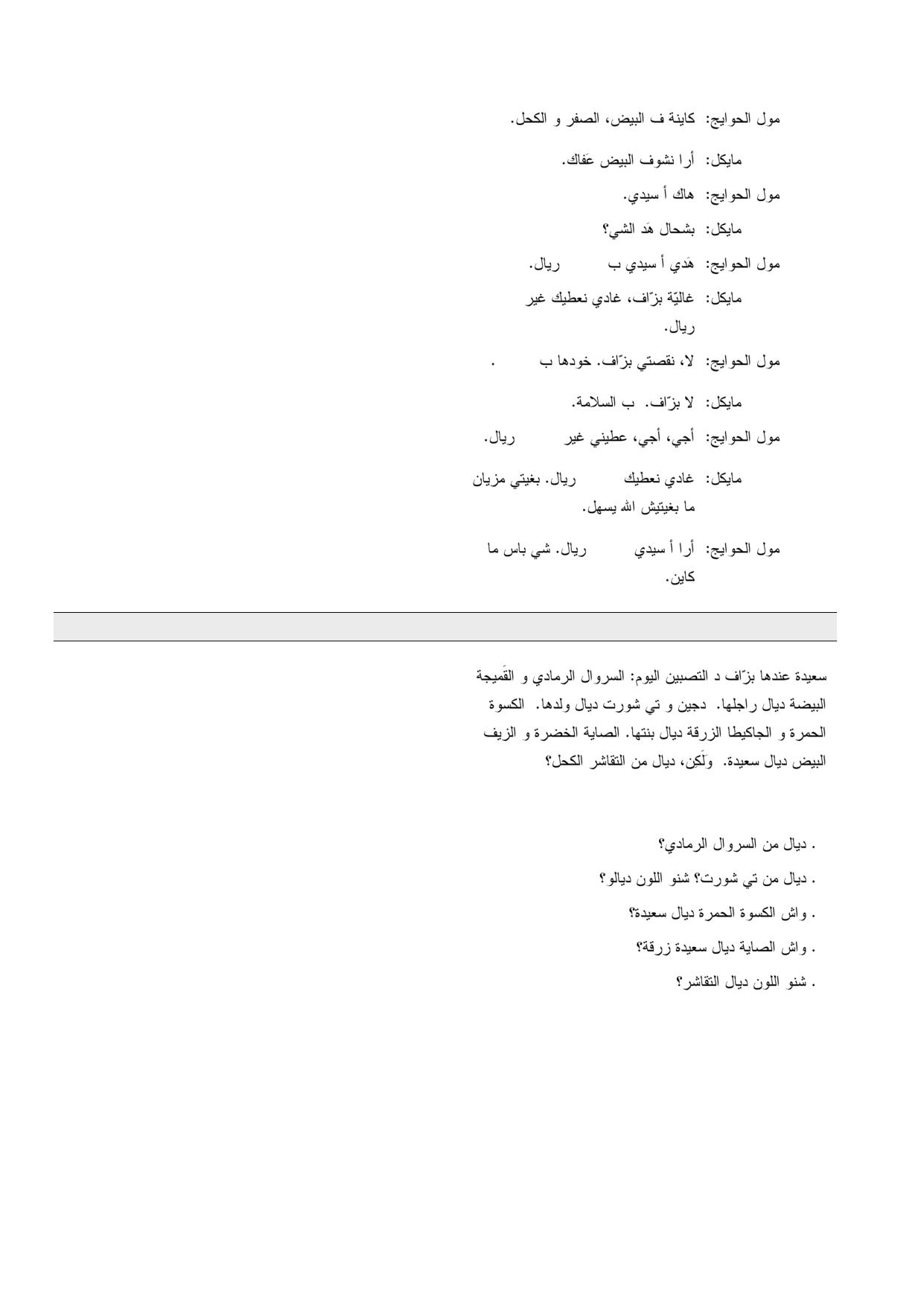
76 • Moroccan Arabic
mul l-нwayj: kayna f l-byd, s-sfr u
l-kнl.
Michael: ara n-šuf l-byd عafak.
mul l-нwayj: hak a sidi.
Michael: bšнal had š-ši?
mul l-нwayj: hadi a sidi b 8000 ryal.
8000
Michael: ġaliya bzzaf, ġadi
3000
n-عtik ġir 3000 ryal.
mul l-нwayj: lla, nqsti bzzaf. xudha
6000
b 6000.
Michael: lla bzzaf. bslama.
mul l-нwayj: aji, aji, عtini ġir 5000
5000
ryal.
3500
Michael: ġadi n-عtik 3500 ryal.
bġiti mzyan ma-bġiti-š
lla y-shl.
mul l-нwayj: ara a sidi 3500 ryal. ši
3500
bas ma-kayn.
Exercise: Read the text and answer the questions.
Saida عndha bzzaf d t-tsbin l-yum:
s-srwal r-rmadi u l-qamija l-bida
dyal rajlha. jean u T-shirt dyal
wldha. l-kswa l-нmra u j-jakita
z-zrqa dyal bntha. s-saya l-xdra u
z-zif l-byd dyal Saida. welakin,
dyal mn t-tqašr l-kнl?
1. dyal mn s-srwal r-rmadi?
1
2. dyal mn T-shirt? šnu l-lun dyalu?
2
3. weš l-kswa l-нmra dyal Saida?
3
4. weš s-saya dyal Saida zrqa?
4
5. šnu l-lun dyal t-tqašr?
5
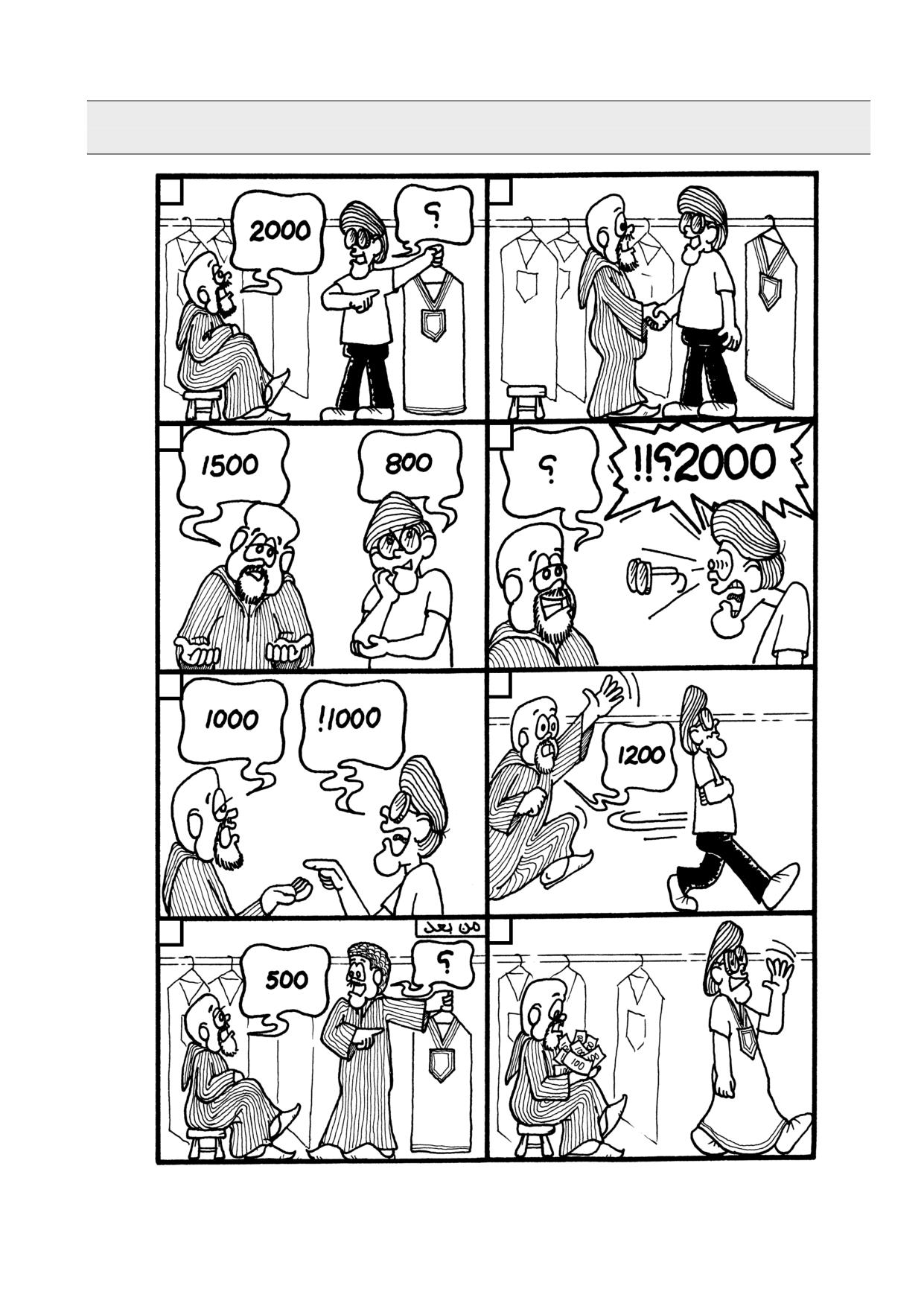
77
Exercise: Write a dialogue for the following pictures. Try to write it without looking at
the previous pages.
2
1
4
3
6
5
8
7
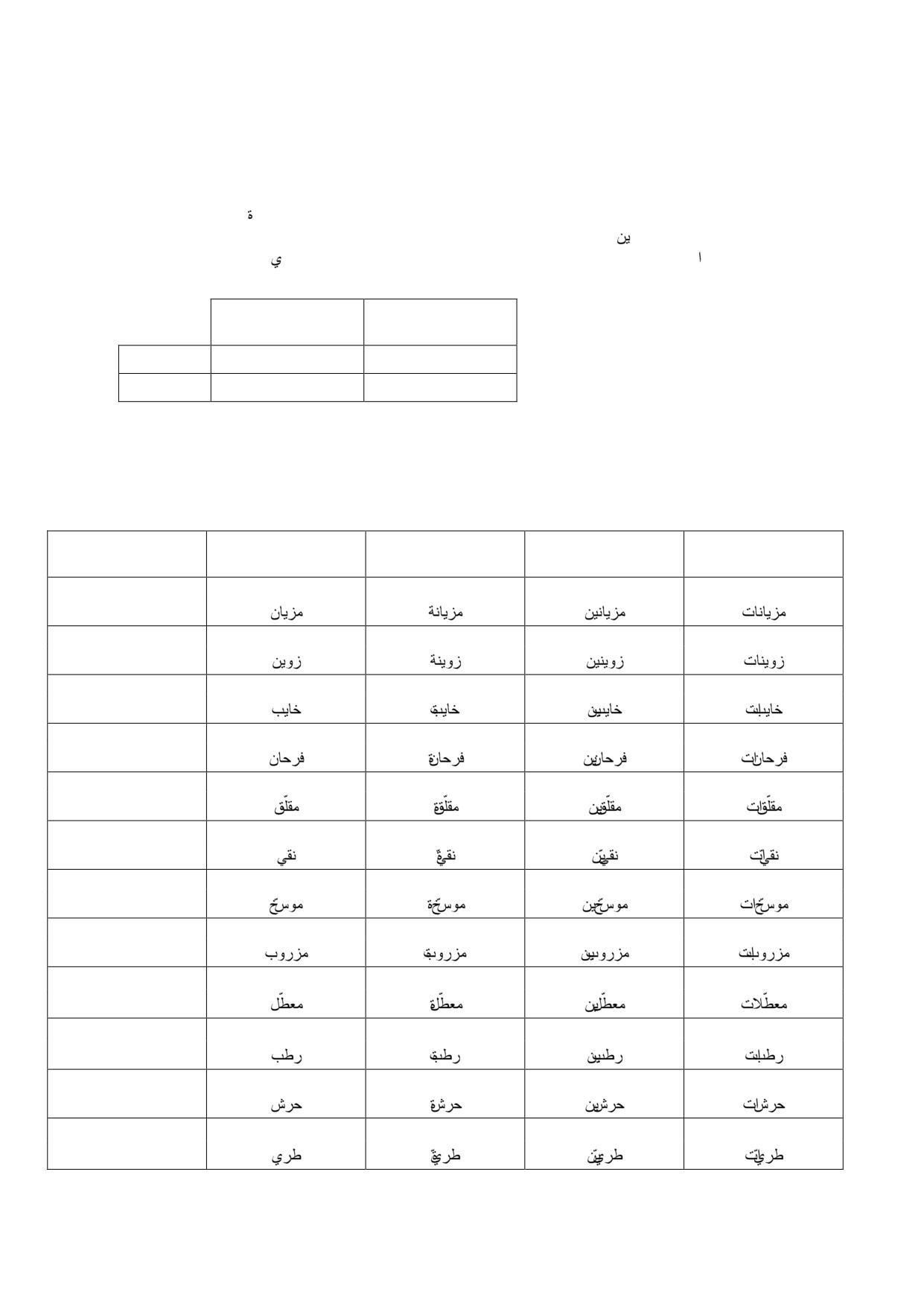
78 • Moroccan Arabic
Adjectives
Adjectives come after the nouns they modify and must agree in gender and number. For example, if a
noun is feminine and singular then the adjective that follows must be feminine and singular as well.
Feminine and plural forms of adjectives are derived from the masculine base form. The feminine form
is made by adding an a ( ) to the end of the masculine form. The plural form, like with nouns, is not
always predictable. The two most common patterns are: adding in (
) to the masculine form, or
replacing the long vowel i ( ) in the middle of an adjective with the long vowel a ( ). An example of
each plural form:
Masculine
Plural
Singular
happy
frнan
frнanin
we add in to form the plural
big
kbir
kbar
we change i to a to form the plural
Adjectives in this first group (forming the plural with in) also have a feminine plural form that is used
when all the members of a group are feminine. If their is a mixture of masculine and feminine people
or objects, the masculine plural (often just called ―plural‖) is used. The feminine plural is formed by
adding at to the masculine singular base form.
Common Adjectives
Masculine
Feminine
Masculine
Feminine
English
Singular
Singular
Plural
Plural
good
mzyan
mzyana
mzyanin
mzyanat
pretty / hand-
zwin
zwina
zwinin
zwinat
some / good
bad / ugly
xayb
xayba
xaybin
xaybat
happy
frнan
frнana
frнanin
frнanat
sad / angry
mqllq
mqllqa
mqllqin
mqllqat
clean
nqi
nqiya
nqiyin
nqiyat
dirty
mussx
mussxa
mussxin
mussxat
harried
mzrub
mzruba
mzrubin
mzrubat
late
mعttl
mعttla
mعttlin
mعttlat
soft
rtb
rtba
rtbin
rtbat
harsh
нrš
нrša
нršin
нršat
fresh
tri
triya
triyin
triyat
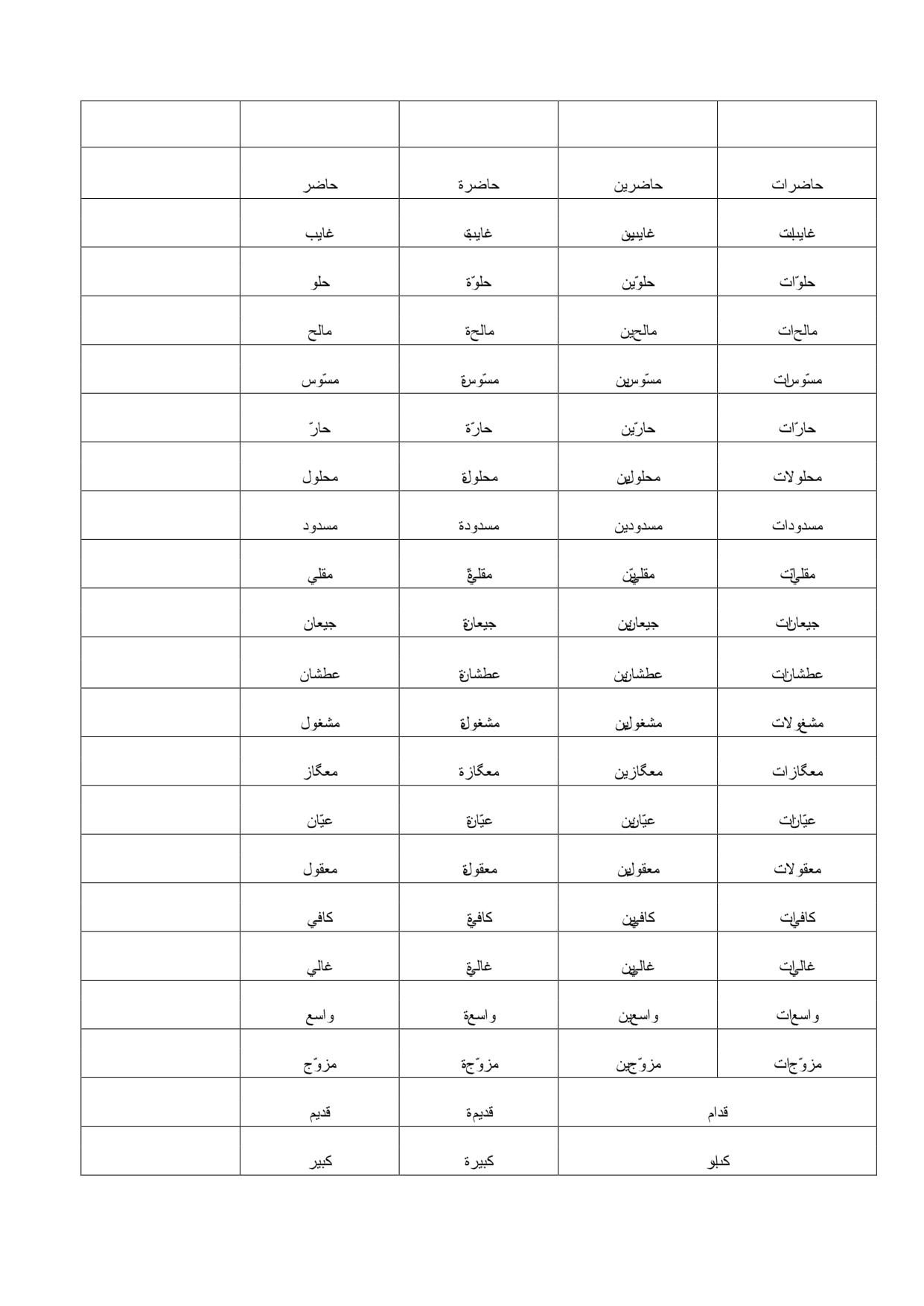
79
Masculine
Feminine
Masculine
Feminine
English
Singular
Singular
Plural
Plural
present
нadr
нadra
нadrin
нadrat
absent
ġayb
ġayba
ġaybin
ġaybat
sweet
нlu
нluwa
нluwin
нluwat
salty
malн
malнa
malнin
malнat
bland / tasteless
mssus
mssusa
mssusin
mssusat
spicy
нarr
нarra
нarrin
нarrat
open
mнlul
mнlula
mнlulin
mнlulat
closed
msdud
msduda
msdudin
msdudat
fried / grilled
mqli
mqliya
mqliyin
mqliyat
hungry
jiعan
jiعana
jiعanin
jiعanat
thirsty
عtšan
عtšana
عtšanin
عtšanat
busy
mšġul
mšġula
mšġulin
mšġulat
lazy
mعgaz
mعgaza
mعgazin
mعgazat
tired
عiyan
عiyana
عiyanin
عiyanat
reasonable / serious
mعqul
mعqula
mعqulin
mعqulat
enough
kafi
kafiya
kafiyin
kafiyat
expensive
ġali
ġaliya
ġaliyin
ġaliyat
wide / large
wasع
wasعa
wasعin
wasعat
married
mzuwj
mzuwja
mzuwjin
mzuwjat
old (something)
qdim
qdima
qdam
big (something)
kbir
kbira
kbar
old (someone)
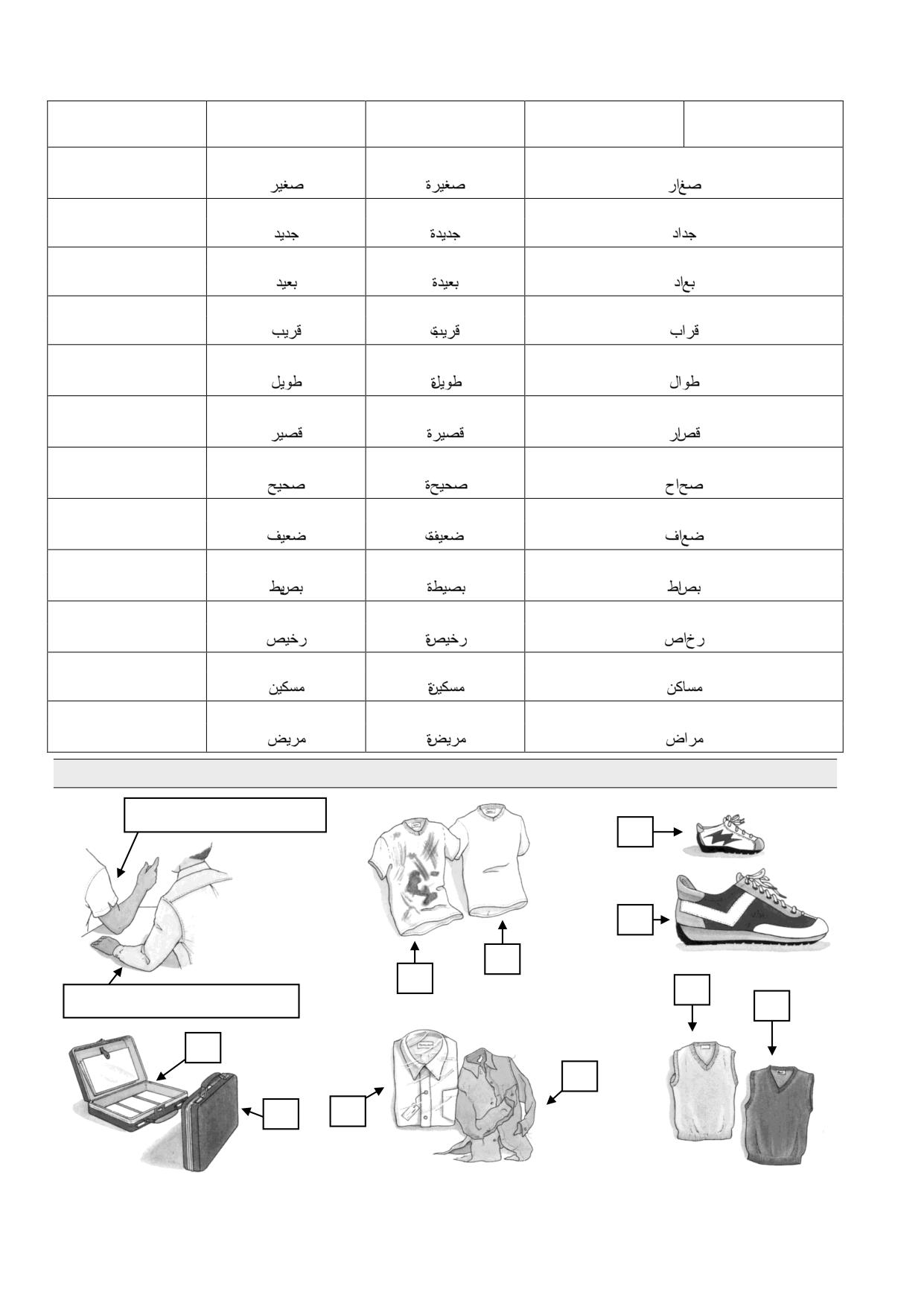
80 • Moroccan Arabic
Masculine
Feminine
Masculine
Feminine
English
Singular
Singular
Plural
Plural
small (something)
sġir
sġira
sġar
young (someone)
new
jdid
jdida
jdad
far
bعid
bعida
bعad
near
qrib
qriba
qrab
tall / long
twil
twila
twal
short
qsir
qsira
qsar
strong / correct
sнiн
sнiнa
sнaн
weak
dعif
dعifa
dعaf
simple / easy
bsit
bsita
bsat
cheap
rxis
rxisa
rxas
poor
mskin
mskina
msakn
sick
mrid
mrida
mrad
Exercise: Describe the following pictures using adjectives.
1. hada kmm qsir.
5
6
4
3
11
2. hada kmm
_______
12
7
10
8
9
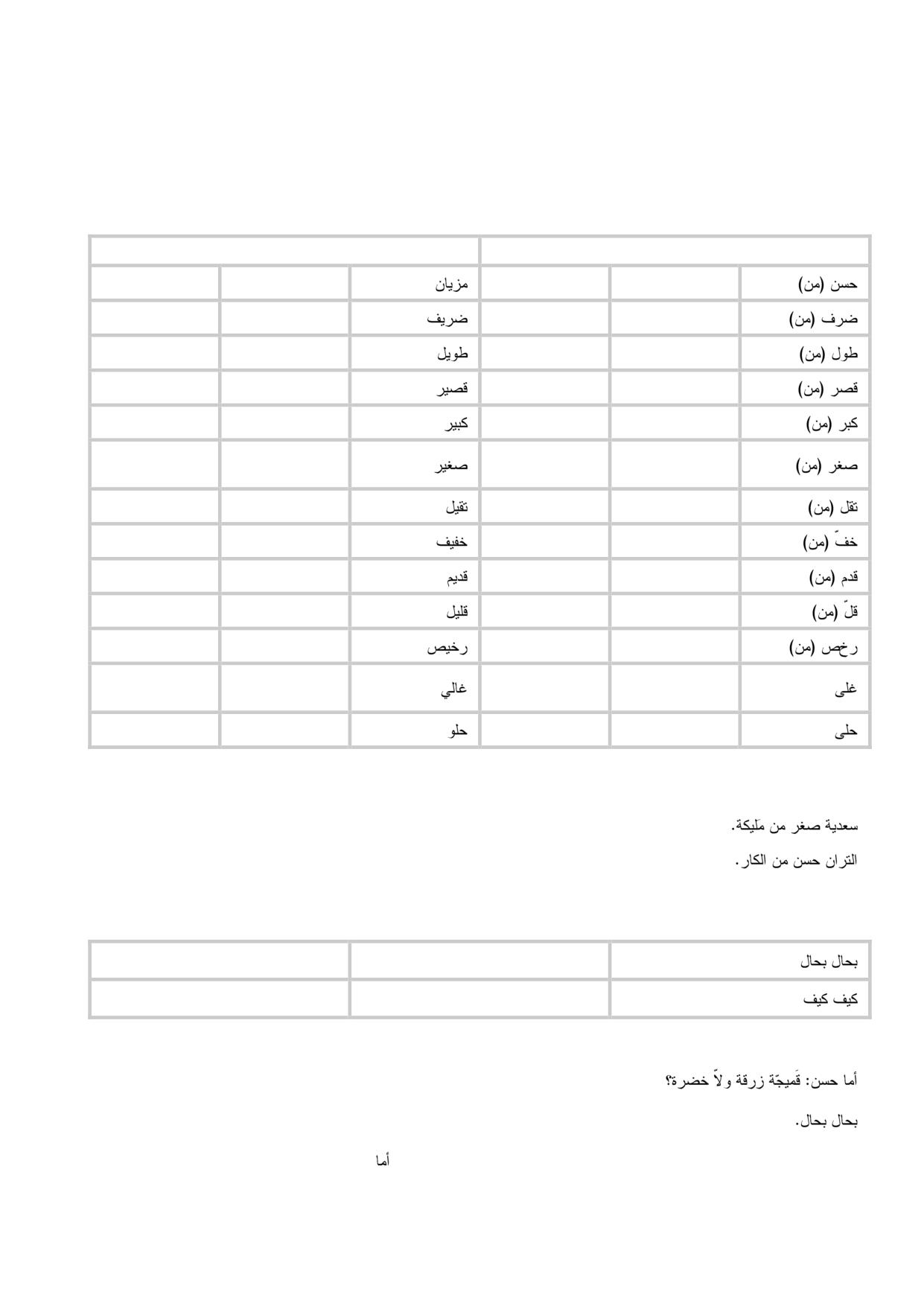
81
Comparative and Superlative Adjectives
Comparative Adjectives
We use comparative adjectives when we are comparing two objects based upon some quality or
characteristic. For example, in English we can say: I am taller than John. ―Taller than‖ is the
comparative form of the adjective ―tall.‖ Here are the comparative forms for some Arabic adjectives:
Adjectives
Comparatives
good
mzyan
better
нsn (mn)
nice
drif
nicer
drf (mn)
tall / long
twil
taller / longer
twl (mn)
short
qsir
shorter
qsr (mn)
big / old
kbir
bigger / older
kbr (mn)
smaller /
small / young
sġir
sġr (mn)
younger
heavy
tqil
heavier
tql (mn)
light
xfif
lighter
xff (mn)
old (thing)
qdim
older (thing)
qdm (mn)
few
qlil
fewer
qll (mn)
cheap
rxis
cheaper
rxs (mn)
more
expensive
ġali
ġla (mn)
expensive
sweet
нlu
sweeter
нla (mn)
As you can see above, for many adjectives (but not all) the comparative is formed by removing the long
vowel i from the word. Here are some examples:
Sadia is younger than Malika.
Sadia sġr mn Malika.
The train is better than the bus. t-tran нsn mn l-kar.
Comparing Like Objects
In order to express that two things/people/etc. are the same, we can use either of two expressions:
the same / alike
bнal bнal
the same / alike
kif kif
Some examples:
Which is better: a blue shirt or a ama нsn: qamijja zrqa
green one?
wlla xdra?
They are the same.
bнal bнal.
As the example shows, the word ama (
) is used for comparisons when we mean ―which.‖
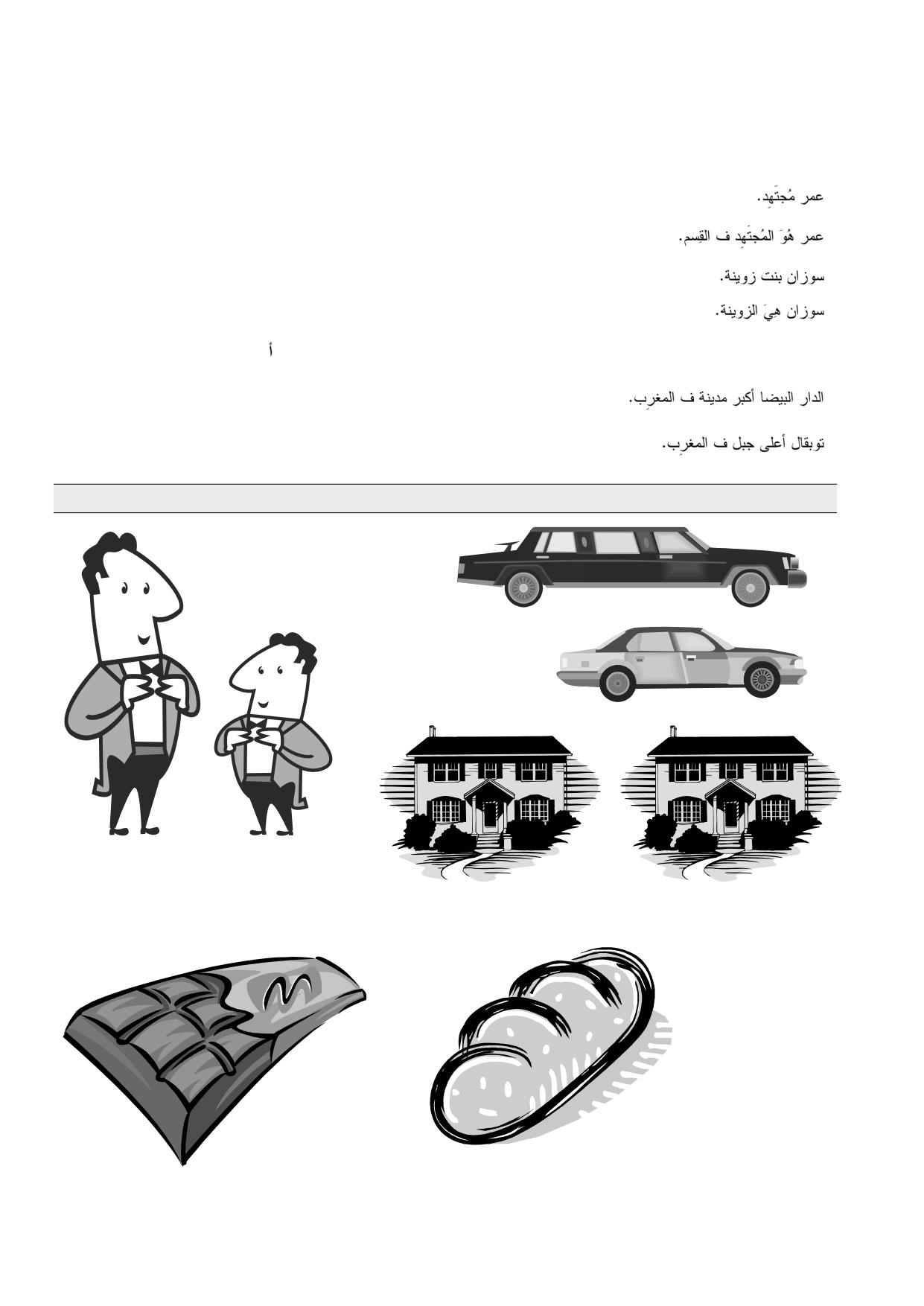
82 • Moroccan Arabic
Superlative Adjectives
The superlative adjective in Moroccan Arabic can be formed in two ways.
First, by using the definite article with the adjective and inserting the personal pronoun:
Omar is bright.
Omar mujtahid.
Omar is the brightest student in Omar huwa l-mujtahid f
the class.
l-qism.
Susan is a pretty girl.
Susan bnt zwina.
Susan is the prettiest.
Susan hiya z-zwina.
Second, by prefixing “a” ( ) to the comparative adjective:
Casablanca is the largest city in d-dar l-bida akbr mdina
Morocco.
f l-mġrib.
Toubkal is the highest mountain
tubqal aعla jbl f
in Morocco.
l-mġrib.
Exercise: Compare each pair using comparative adjectives.
t-tomobil dyal Mary
t-tomobil dyal Mike
Driss
Hassan
d-dar dyal Mohamed
d-dar dyal Judy
š-šklat
l-xubz
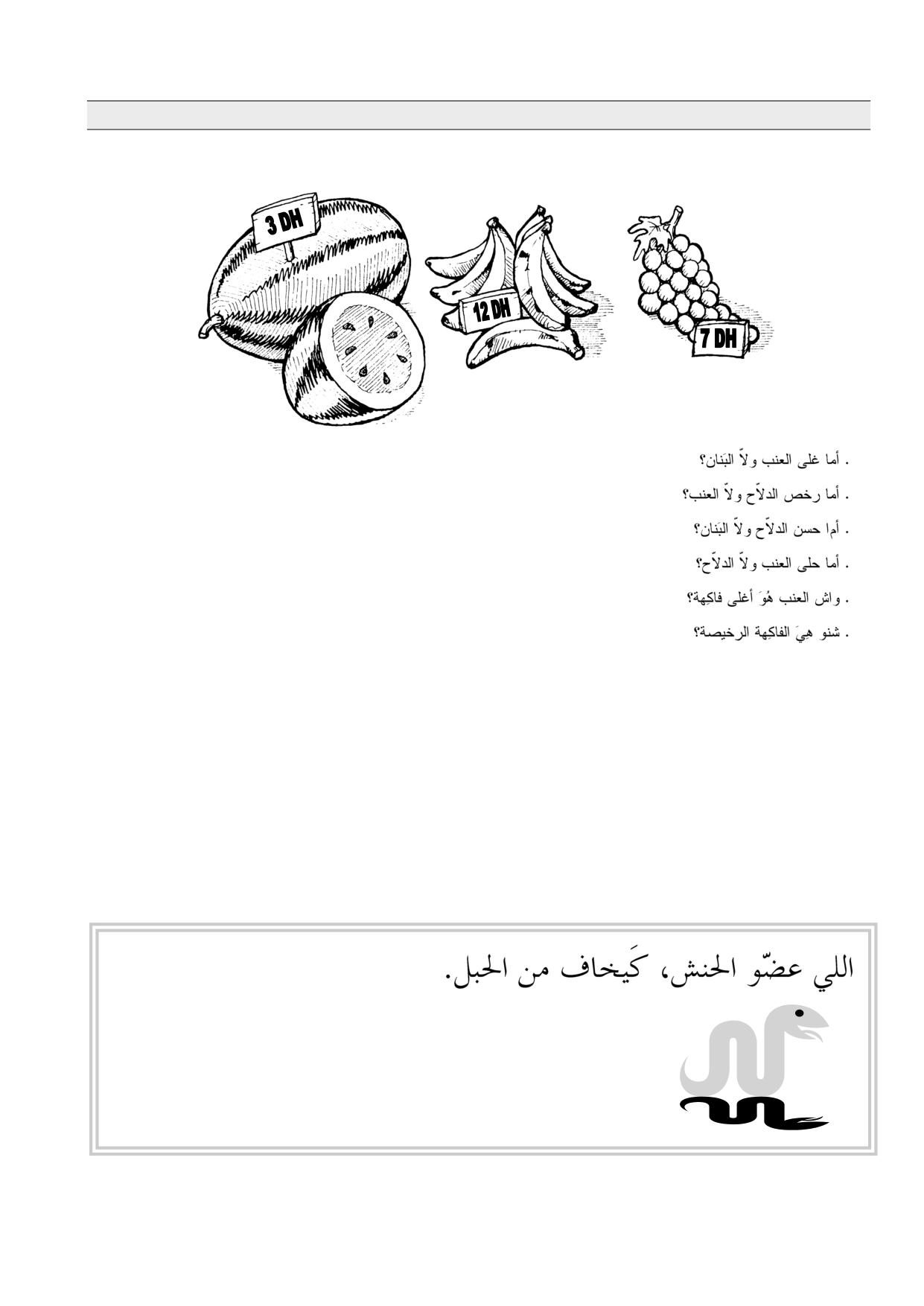
83
Exercise: Answer the following questions based upon the drawing.
d-dllaн
l-banan
l-عnb
1. ama ġla l-عnb wlla l-banan?
1
2. ama rxs d-dllaн wlla l-عnb?
2
3. ama нsn d-dllaн wlla l-banan?
3
4. ama нla l-عnb wlla d-dllaн?
4
5. weš l-عnb huwa aġla fakiha?
5
6. šnu hiya l-fakiha r-rxisa?
6
Moroccan Wisdom:
l-li عddu l-нnš, kay-xaf mn l-нbl.
The one bitten by a snake is afraid of ropes.
English equivalent: Once bitten, twice shy.
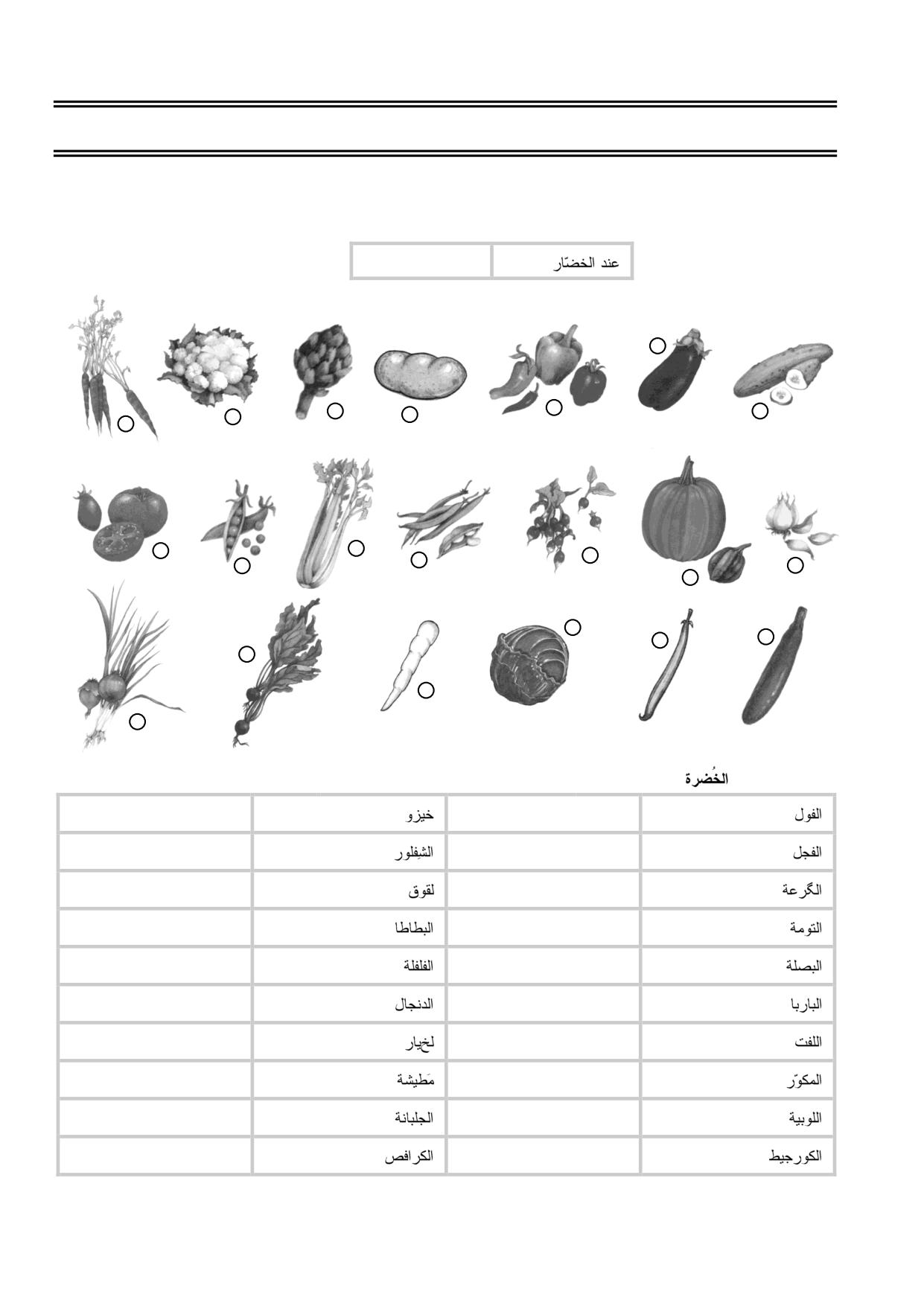
84 • Moroccan Arabic
Shopping For Food
Objective: By the end of the chapter, you will be able to:
• shop for produce, meats, and spices
Fruits and Vegetables
At the Green Grocer’s
عnd l-xddar
6
5
3
7
2
4
1
8
10
12
11
9
14
13
18
19
20
16
17
zucchini
15
vegetables
l-xodra
1. xizu
11. l-ful
2. š-šiflur
12. l-fjl
3. lquq
13. l-grعa
4. l-btata
14. t-tuma
5. l-flfla
15. l-bsla
6. d-dnjal
16. l-barba
7. lxyar
17. l-lft
8. matiša
18. l-mkuwr
9. j-jlbana
19. l-lubya
10. l-krafs
20. l-korjit
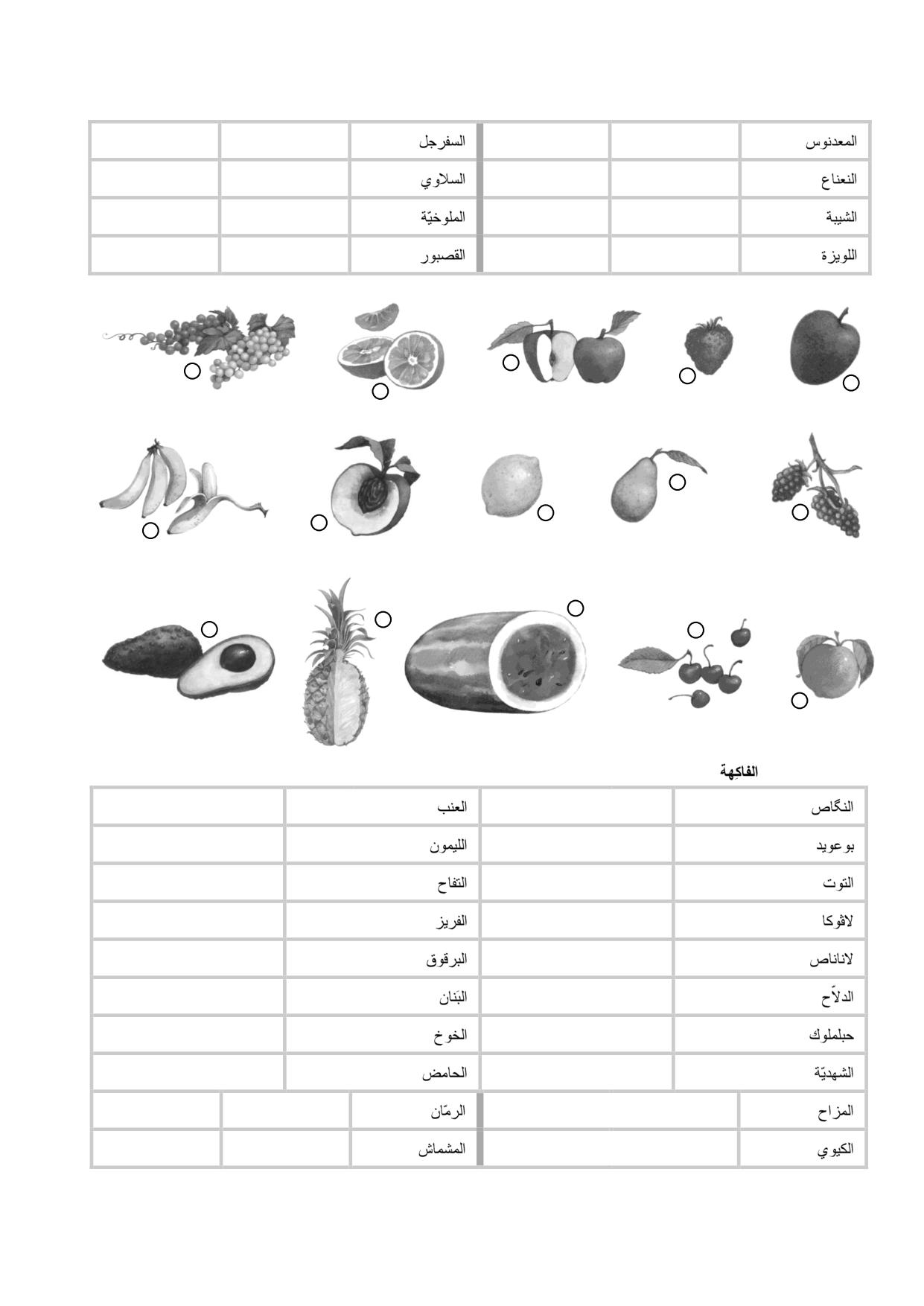
85
quince
s-sfrjl
parsley
l-mعdnus
gourd
s-slawi
mint
n-nعnaع
okra
l-mluxiya
absinth
š-šiba
coriander
l-qsbur
verbena
l-lwiza
plum
3
1
4
5
2
9
8
10
7
6
13
12
11
14
15 nectarine
fruit
l-fakiha
1. l-عnb
9. n-ngas
2. l-limun
boعwid
3. t-tfaн
10. t-tut
4. l-friz
11. lavoka
5. l-brquq
12. lananas
6. l-banan
13. d-dllaн
7. l-xux
14. нblmluk
8. l-нamd
15. š-šhdiya
pomegranate
r-rmman
Japanese plums l-mzaн
apricots
l-mšmaš
kiwi
l-kiwi
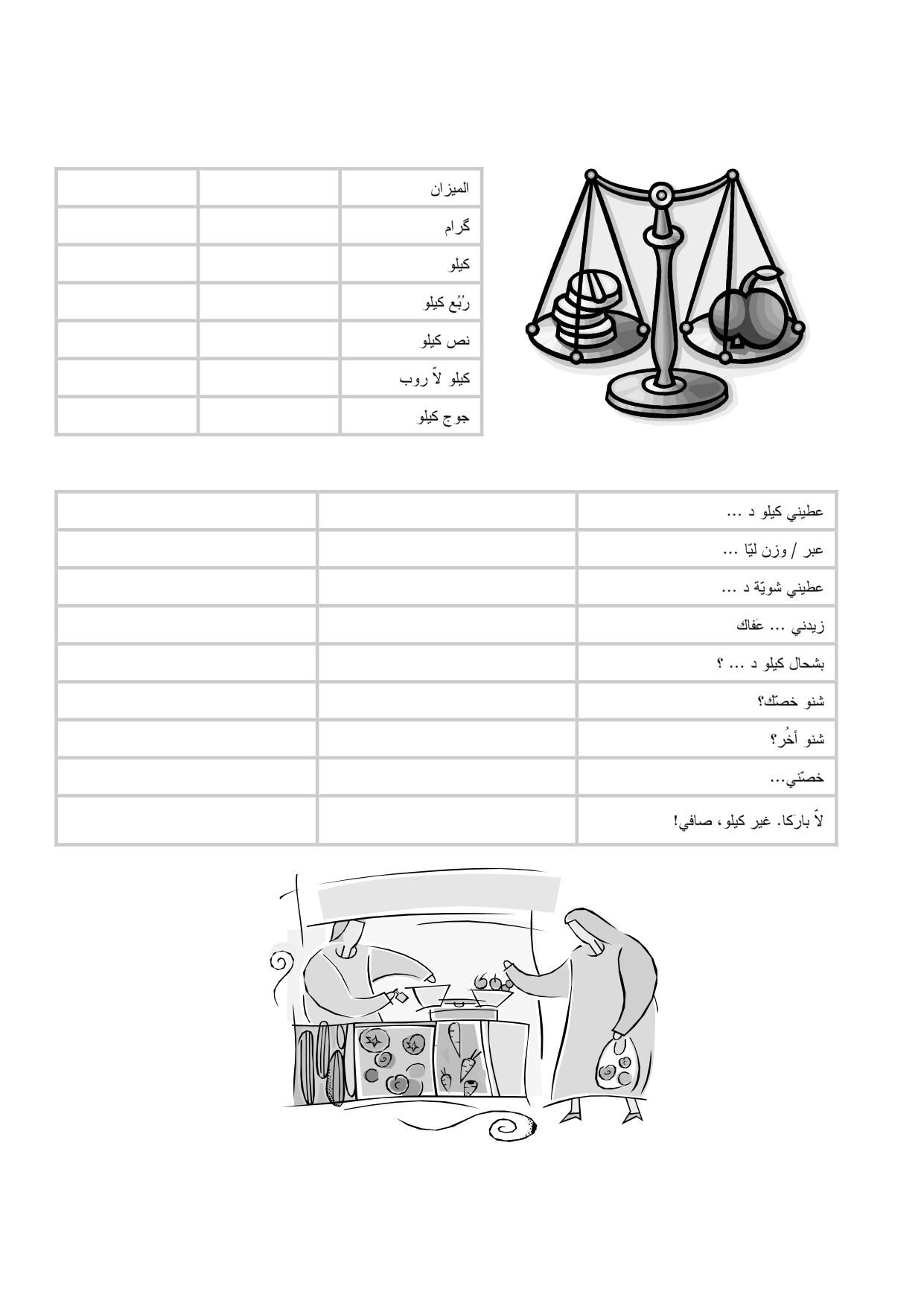
86 • Moroccan Arabic
Buying Produce
Units of Measurement
scale
l-mizan
gram
gram
kilogram
kilu
¼ kilogram
rubu عkilu
½ kilogram
ns kilu
¾ kilogram
kilu lla rob
2 kilograms
juj kilu
Expressions
Give me a kilo of ...
عtini kilu d ...
Weigh me ...
عbr / wzn liya ...
Give me some ...
عtini šwiya d ...
More ... please
zidni ... عafak
How much is a kilo of ... ?
bšнal kilu d ... ?
What do you need?
šnu xssk?
What else?
šnu axor?
I need ...
xssni ...
No, that‟s enough. Only 1 kilo,
lla baraka. ġir kilu,
that‟s all!
safi!
87
Dialogue
shopping
t-tqdya
Susan: sbaн l-xir.
sbaн l-xir. aš нb
l-xddar:
l-xatr a lalla?
Susan: bġit juj kilu d xizu, u
kilu d matiša u ns kilu
d l-barba u xtar liya ši
нaja mzyana. عbr liya
kilu u rubuع d l-bsla.
l-xddar: safi a lalla?
Susan: bšнal t-tfaн?
l-xddar: sttaš l drhm l l-kilu.
Susan: waxxa, عbr liya kilu
lla rob. aah! nsit
عtini šwiya d l-qsbur
u l-mعdnus.
l-xddar: hani a lalla.
Susan: bšнal kulši?
l-xddar: عndk a lalla tsع miya u
sttin ryal.
Susan: šнal mn drhm?
l-xddar: 48 drhm.
48
Susan: hak a sidi, lla y-عawn.
l-xddar: lla y-xlf a lalla.
1. fin Susan?
1
2. šnu šrat Susan?
2
3. šнal šrat mn kul нaja?
3
4. weš šrat ši нaja xora?
4
5. šнal xllsat?
5
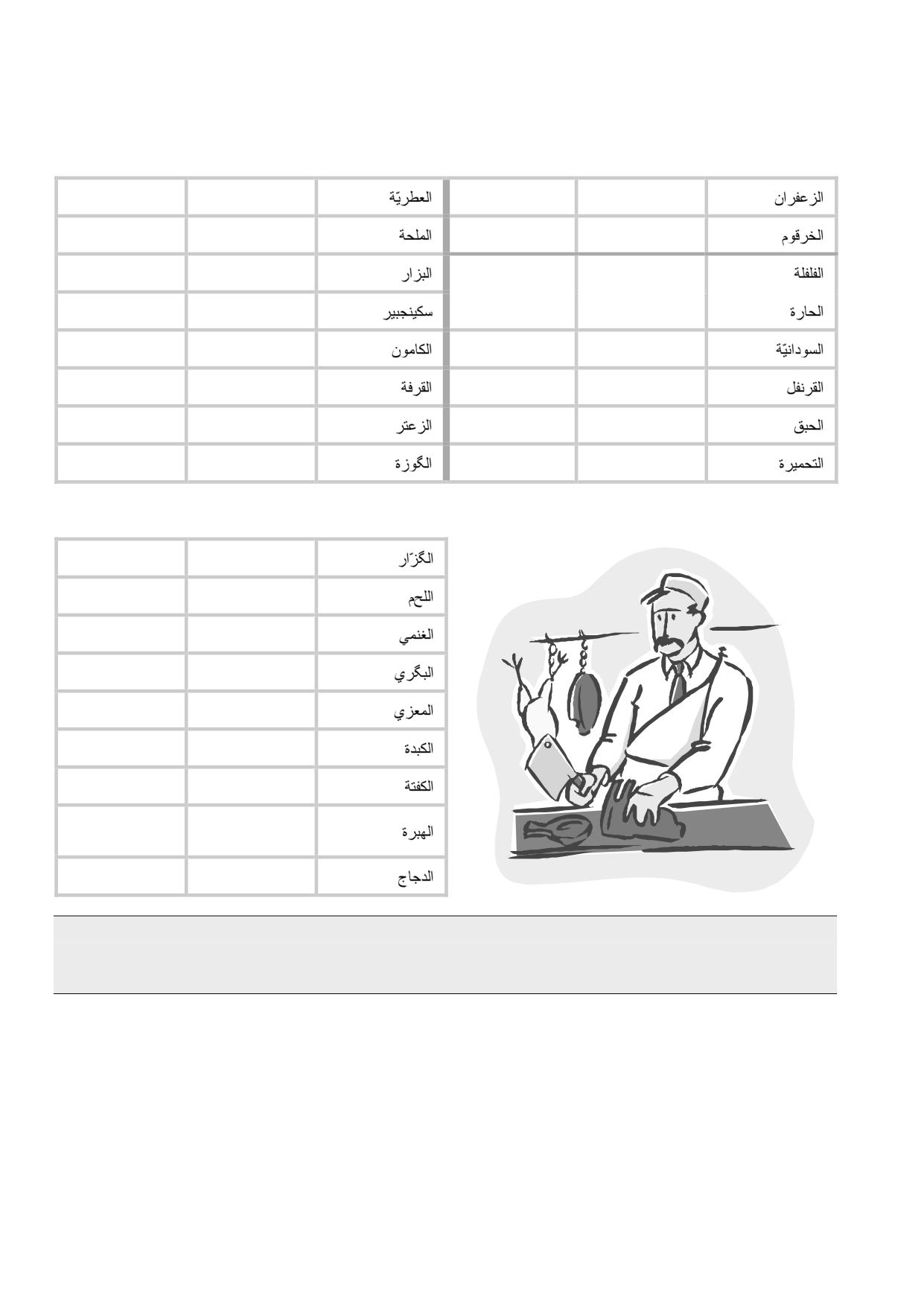
88 • Moroccan Arabic
Spices and Meat
Spices
spices
l-عtriya
saffron
z-zعfran
salt
l-mlнa
turmeric
l-xrqum
black pepper
l-bzar
hot pepper
l-flfla
ginger
skinjbir
l-нara
cumin
l-kamun
red hot pepper
s-sudaniya
cinnamon
l-qrfa
cloves
l-qrnfl
oregano
z-zعtr
basil
l-нbq
nutmeg
l-guza
paprika
t-tнmira
At the Butcher’s
butcher
l-gzzar
meat
l-lнm
lamb
l-ġnmi
beef
l-bgri
goat meat
l-mعzi
liver
l-kbda
ground meat
l-kfta
meat w/o
l-hbra
bones
chicken
d-djaj
Exercise: You have guests for dinner and you want to serve them tea with cakes, then
a tajine. List the items you need for preparing tea/cakes and a tajine and
write your shopping list. Then, write a shopping list for an American dish.
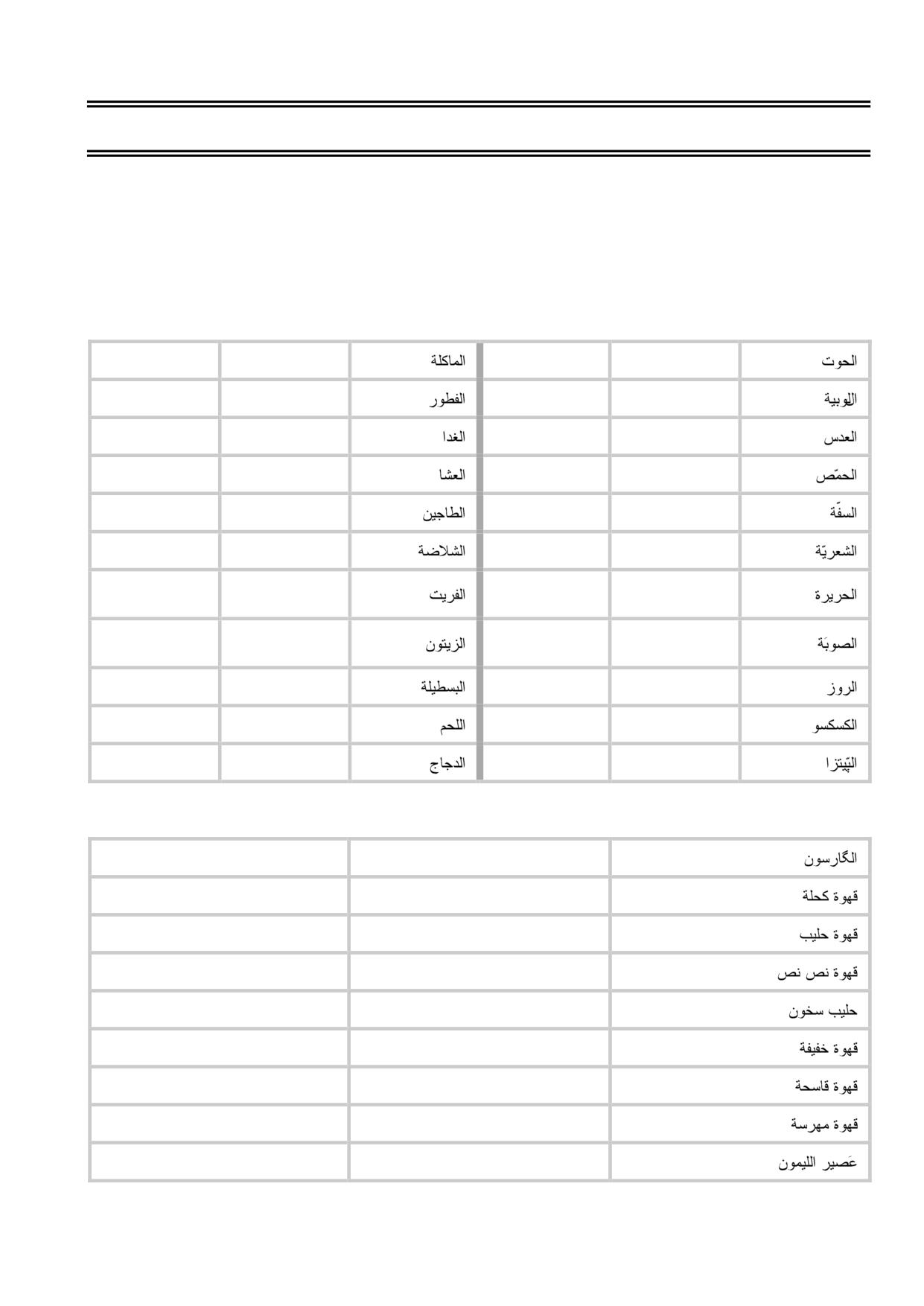
89
Food and Drink
Objective: By the end of the chapter, you will be able to:
• use the correct words and expressions concerning food and drink
• express likes and dislikes using عjb “to please”
• express necessity or obligation with xss “to need / to have to”
• use bġa “to want / to like” with the proper tense
Food and Drink
Food
food
l-makla
fish
l-нut
breakfast
l-ftur
beans
l-lubya
lunch
l-ġda
lentils
l-عds
dinner
l-عša
chick peas
l-нmms
steamed pasta with
tajine
t-tajin
s-sffa
cinnamon and sugar
salad
š-šlada
vermicelli
š-šعriya
Moroccan
French fries
l-frit
l-нrira
soup
vegetable
olives
z-zitun
s-suba
soup
bastila
l-bstila
rice
r-ruz
meat
l-lнm
couscous
l-ksksu
chicken
d-djaj
pizza
l-ppitza
At a Café
the waiter
l-garsun
black coffee
qhwa kнla
coffee with milk
qhwa нlib
half coffee, half milk
qhwa ns ns
hot milk
нlib sxun
weak coffee
qhwa xfifa
strong coffee
qhwa qasнa
coffee with a little milk
qhwa mhrsa
orange juice
عasir l-limun
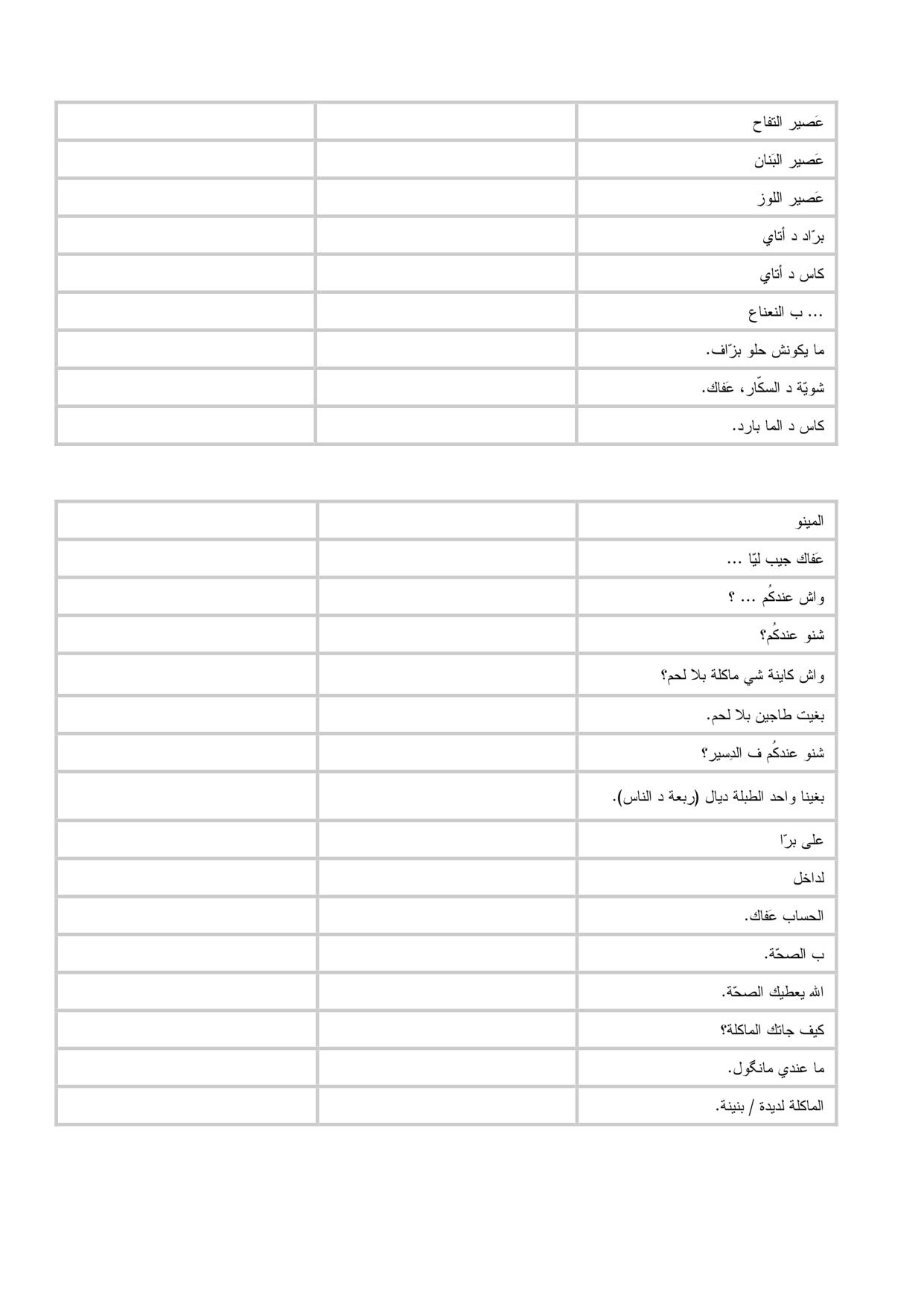
90 • Moroccan Arabic
apple & milk shake
عasir t-tfaн
banana & milk shake
عasir l-banan
almond & milk shake
عasir l-luz
pot of tea
brrad d atay
glass of tea
kas d atay
... with mint
... b n-nعnaع
Not very sweet.
ma-y-kun-š нlu bzzaf.
Some sugar, please.
šwiya d s-skkar, عafak.
a glass of cold water
kas d l-ma bard.
At a Restaurant
the menu
l-menu
Please bring me ...
عafak jib liya ...
Do you have ... ?
weš عndkum ... ?
What do you have?
šnu عndkum?
weš kayna ši makla bla
Is there any food without meat?
lнm?
I want a tajine without meat.
bġit tajin bla lнm.
What do you have for dessert?
šnu عndkum f d-disir?
We want a table for (four
bġina waнd t-tbla dyal
people).
(rbعa d n-nas).
outside
عla brra
inside
ldaxl
The bill, please.
l-нsab عafak.
To your health.
b s-sннa.
To your health (response).
lla y-عtik s-sннa.
How do you like the food?
kif jatk l-makla?
I have no complaints.
ma عndi mangul.
The food is delicious.
l-makla ldida / bnina.
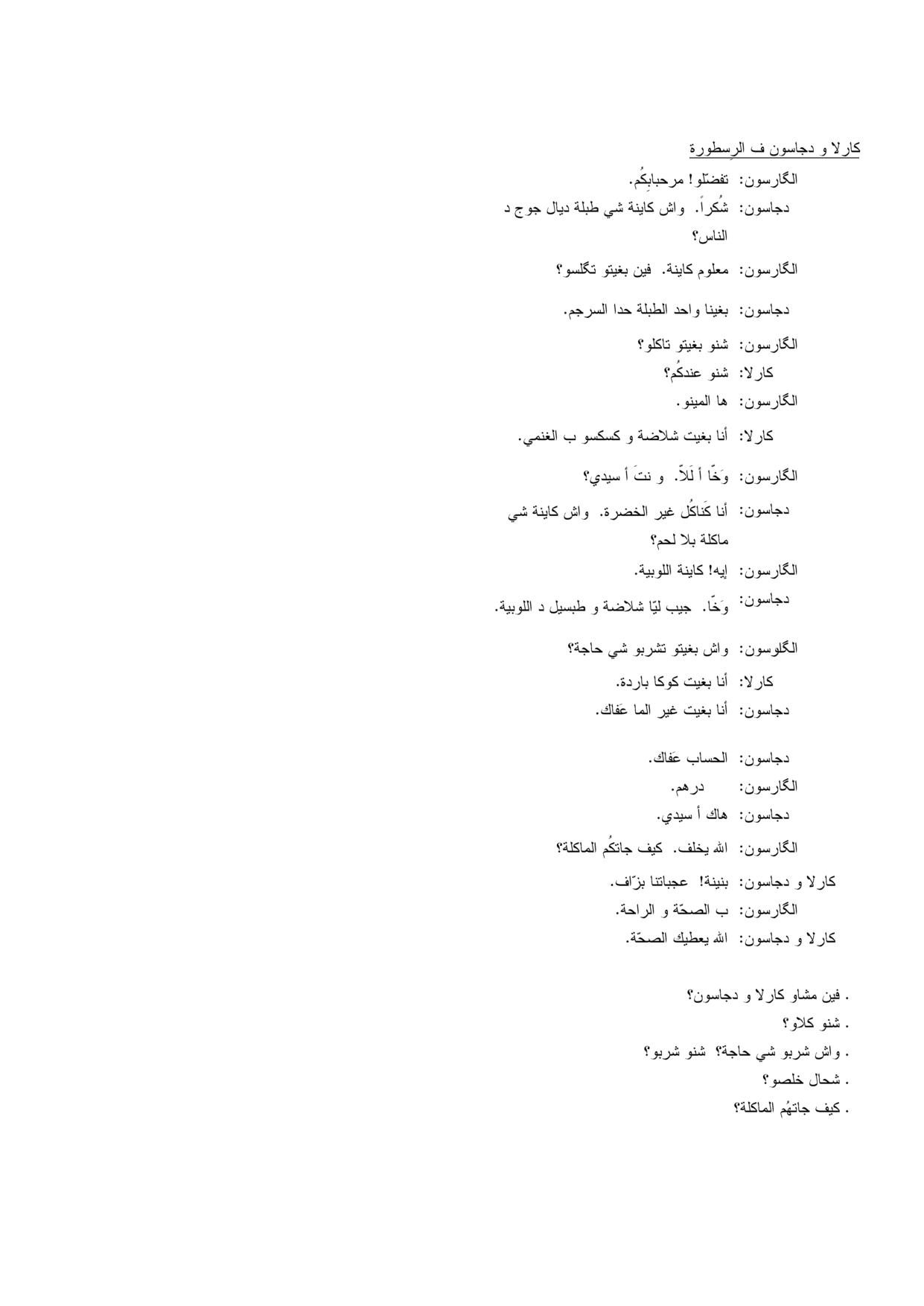
91
Dialogue
Karla u Jason f r-ristora
l-garsun: t-fddlu! mrнbabikum.
Jason: šukran. weš kayna ši
tbla dyal juj d n-nas?
l-garsun: mعlum kayna. fin bġitu
t-glsu?
Jason:
bġina waнd t-tbla нda
s-srjm.
l-garsun: šnu bġitu t-aklu?
Karla: šnu عndkum?
l-garsun: ha l-menu.
Karla:
ana bġit šlada u ksksu b
l-ġnmi.
l-garsun: waxxa a lalla. u nta a
sidi?
Jason:
ana kan-akul ġir l-xdra.
weš kayna ši makla bla
lнm?
l-garsun: iyeh! kayna l-lubya.
Jason:
waxxa. jib liya šlada u
tbsil d l-lubya.
l-garsun: weš bġitu t-šrbu ši
нaja?
Karla: ana bġit kuka barda.
Jason: ana bġit ġir l-ma عafak.
~~~~~~~~~~~~~~~~~~~~~~~~~~~~~~~~~~~
Jason: l-нsab عafak.
l-garsun:
60 drhm.
60
Jason: hak a sidi.
l-garsun: lla y-xlf. kif jatkum
l-makla?
Karla/Jason: bnina! عjbatna bzzaf.
l-garsun: b s-sннa u r-raнa.
Karla/Jason: lla y-عtik s-sннa.
1. fin mšau Karla u Jason?
1
2. šnu klau?
2
3. weš šrbu ši нaja? šnu šrbu?
3
4. šнal xlsu?
4
5. kif jathum l-makla?
5
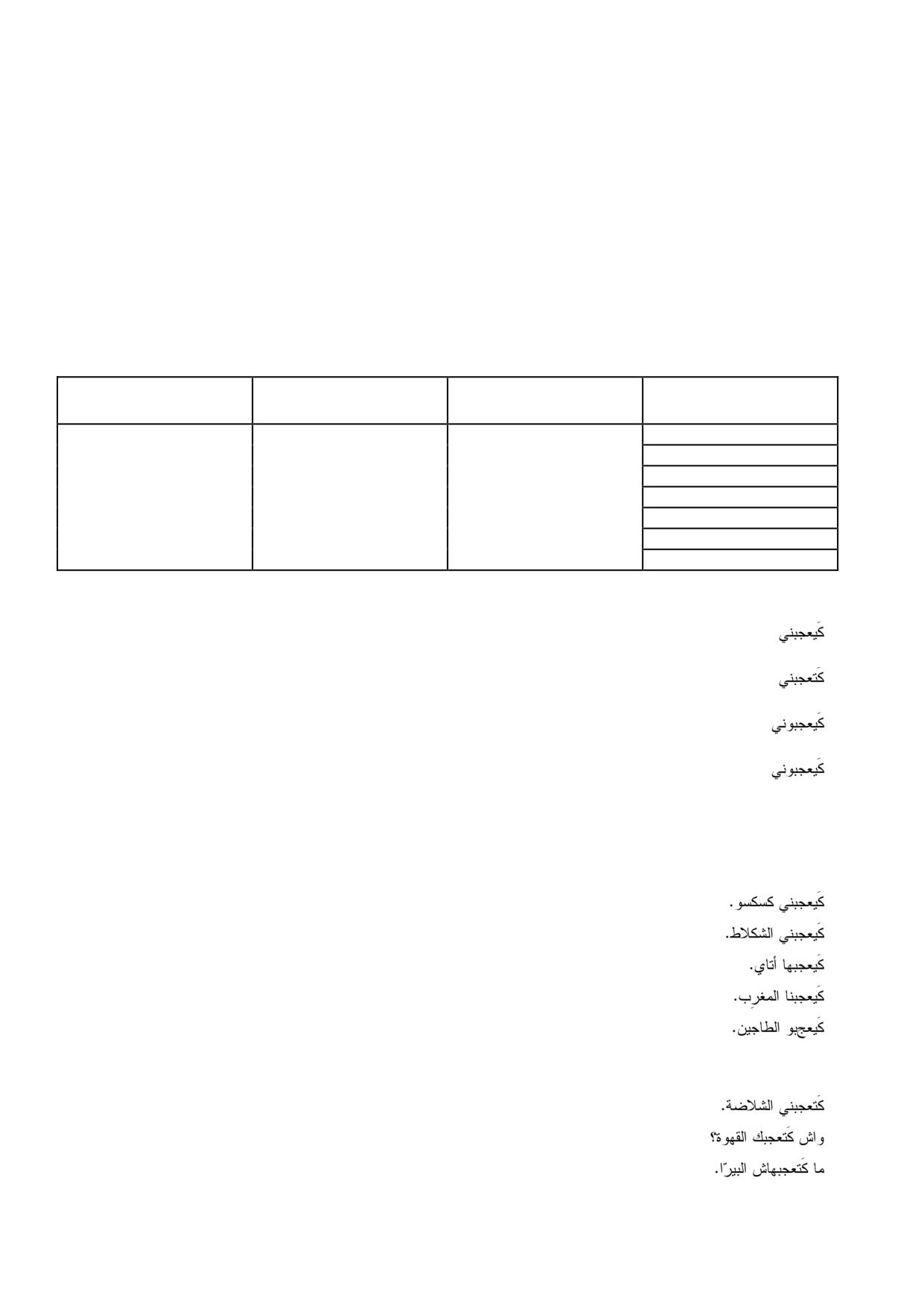
92 • Moroccan Arabic
The Reflexive verb “to please / to like”
In Darija, it is not common to say, literally, ―I like something.‖ Rather, we use the construction,
―Something pleases me.‖ In reality, this phrase would translate into the English ―I like something,‖ but
what is important is that you understand that the ―person who likes‖ is actually the object of the
sentence, and the ―thing liked‖ is the subject. At first, it will seem backward; in fact, it is (from an
English speaker‘s perspective). In time you will use this construction naturally.
How to Conjugate “to please”
The verb ―to please‖ is عjb. It can be tricky to conjugate because, as we said, the subject of the verb is
actually the object that is ―liked,‖ and the object is the person who ―likes.‖ Thus, if I want to say, ―He
likes them,‖ I literally need to say, ―They please him.‖ Also, as a result of this, the verb must always
agree in gender and number with the subject, that is, the thing “liked.” In the present
tense, therefore, the conjugation of the verb can be outlined in the following manner:
Introduce Present
Verb
For Plural
Object
Tense
Root
Form Only
Pronouns
ni
kay
k
(masc. sing.)
u / h
kat
عjb
u
ha
(fem. sing.)
na
kay
kum
(masc/fem plur.)
hum
Some examples:
It (masc. sing.) pleases me.
kay-عjbni
(i.e. I like it.)
It (fem. sing.) pleases me.
kat-عjbni
(i.e. I like it.)
They (masc. plur.) please me.
kay-عjbuni
(i.e. I like them.)
They (fem. plur.) please me.
kay-عjbuni
(i.e. I like them.)
Present Tense Examples
In the following examples, we use the translation ―to like.‖ The literal translation would be ―to please.‖
عjb with masculine singular subject
I like couscous.
kay-عjbni ksksu.
I like chocolate.
kay-عjbni š-šklat.
She likes tea.
kay-عjbha atay.
We like Morocco.
kay-عjbna l-mġrib.
He likes tajines.
kay-عjbu t-tajin.
عjb with feminine singular subject
I like salad.
kat-عjbni š-šlada.
Do you like coffee?
weš kat-عjbk l-qhwa?
She does not like beer.
ma-kat-عjbha-š l-birra.
93
عjb with masculine/feminine plural subject
kay-عjbuni n-nas d
I like the people of Morocco.
l-mġrib.
He likes books.
kay-عjbuh l-ktub.
Do you (plur.) like kids?
weš kay-عjbukum d-drari?
We don‟t like them.
ma-kay-عjbuna-š.
Past Tense Examples
The verb عjb can also be used in the past tense, as in ―I liked it‖ or ―It pleased me.‖ It is conjugated
like all regular verbs in the past tense.
عjb with masculine singular subject
I liked dinner.
عjbni l-عša.
He liked mint tea.
عjbu atay b n-nعnaع.
She didn‟t like “fat bread.”
ma-عjbha-š xubz š-šнma.
Did you like the chicken?
weš عjbk d-djaj?
عjb with feminine singular subject
I liked the soup.
عjbatni l-нrira.
He didn‟t like the salad.
ma-عjbatu-š š-šlada.
weš عjbatk l-mdina
Did you like the old medina?
l-qdima?
عjb with masculine/feminine plural subject
عjbuni n-nas dyal
I liked the people of my village.
d-duwar dyali.
Did you like these books?
weš عjbuk had l-ktub?
She didn‟t like the colors.
ma-عjbuha-š l-luwan.
Followed by Another Verb
عjb can be followed by another verb. The second verb is always conjugated in the present, according to
the same rule that you already learned regarding verbs following other verbs (see page 68). Remember
that for the second verb, therefore, we remove the ka (
) to place it after عjb.
kay-عjbni n-nعs mura
I like to sleep after lunch.
l-ġda.
He likes to play soccer.
kay-عjbu y-lعb l-kura.
She doesn‟t like to wake up
ma-kay-عjbha-š t-fiq
early.
bkri.
Do you like to run early in the
weš kay-عjbk t-jri
morning?
s-sbaн bkri?
What do you like to do on the
šnu kay-عjbk t-dir f
weekend?
l-weekend?
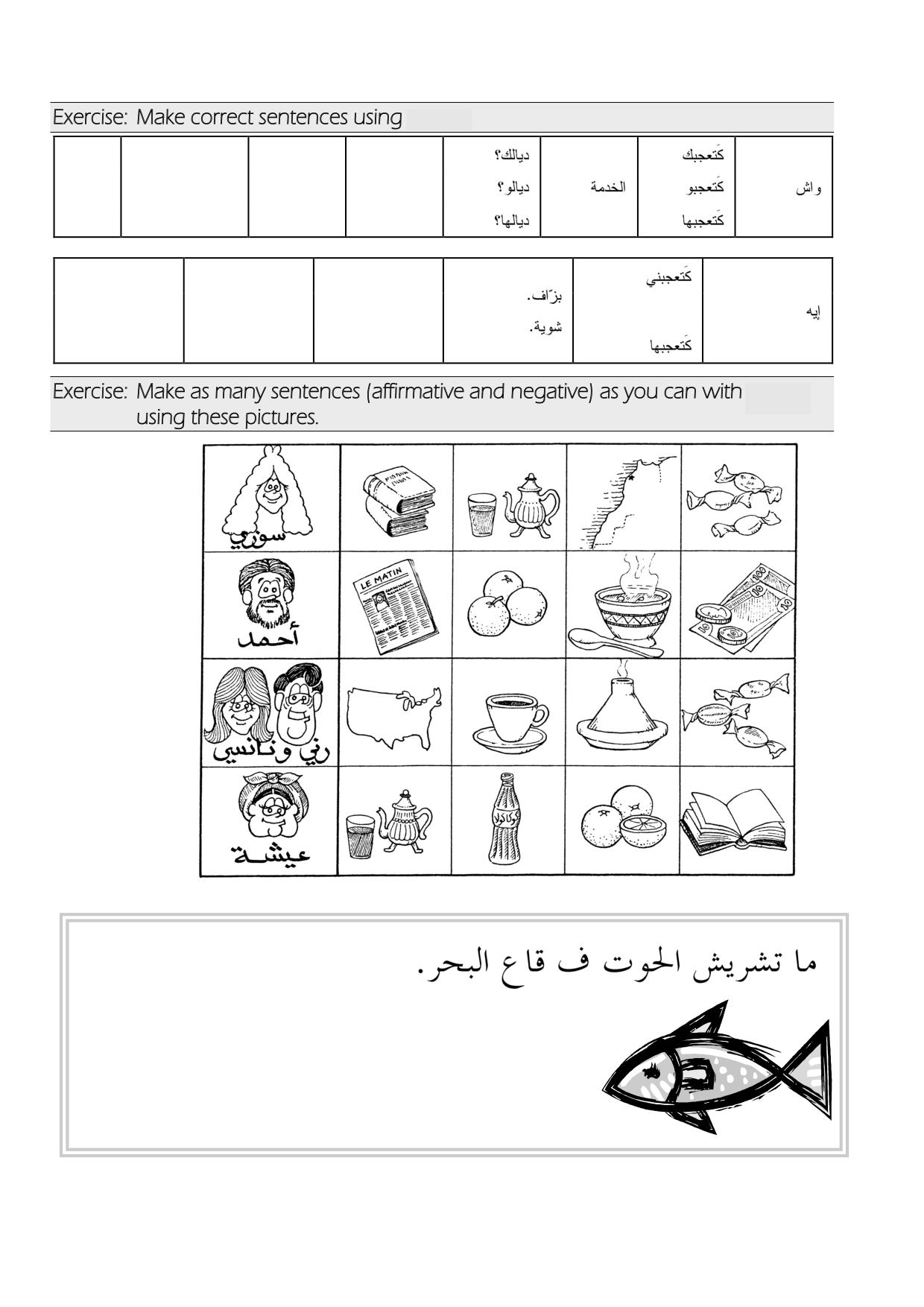
94 • Moroccan Arabic
Exercise: Make correct sentences using
3jb
kat-3jbk
dyalk?
weš
kat-3jbo
l-xdma
dyalu?
kat-3jbna
dyalha?
kat-3jbni
bzzaf.
iyeh
kat-3jbo
وبجعتـك
šwiya.
3jbna
kat-
Exercise: Make as many sentences (affirmative and negative) as you can with
3jb
using these pictures.
Suzy
Ahmed
Ronny
&
Nancy
Aicha
Moroccan Wisdom:
ma-šri-š l-нut f qlع l-bнr.
Don’t buy fish on the bottom of the sea.
English equivalent: Don‟t count your chickens before they hatch.
95
The Verb “to need, to have to, must, should”
The verb xss (
) translates into all of the following in English: ―to need‖ or ―to have to‖ or ―must‖ or
―should.‖ It is conjugated by adding the object pronouns (see page 55) to the end of the verb. You do
not normally conjugate it like a present tense verb; that is, you do not add kay or kat before the verb.
Like other verbs, however, xss may be followed by a second verb which is conjugated in the present
tense, but without the prefix ka (see page 68). Some examples:
xssni n-tعllm l-عrbiya
I have to learn Arabic well.
mzyan.
You should be on time.
xssk t-ji f l-wqt.
You shouldn‟t stay up late.
ma-xssk-š t-shr.
I have to go.
xssni n-mši.
The meaning in the above examples depends largely on the context. However, when xss is followed by
a noun, it only means ―to need.‖ Some examples:
I need cigarettes.
xssni l-garru.
She needs a notebook.
xssha dftar.
The past tense of xss is formed by adding the verb kan before it. You do not conjugate kan if xss is
followed by another verb. If xss is followed by a noun, however, kan must agree in gender and
number with that noun. Examples:
I had to study yesterday.
kan xssni n-qra l-barн.
I needed a book.
kan xssni ktab.
I needed a ticket.
kant xssni wrqa.
I needed books.
kanu xssni ktub.
Exercise: Write the expressions that go along with these signs using the verb xss.
Exercise: Answer the following question in Moroccan Arabic.
šnu xssk baš t-kun mutatawwiع najн?
96 • Moroccan Arabic
The Verb “to want, to like”
The verb bġa translates into the English ―to want‖ and ―to like.‖ When conjugated in the past tense,
the verb expresses ―to want,‖ but with a present tense meaning (see page 36). When conjugated in the
present tense, the verb expresses ―to like,‖ also with a present tense meaning. An example:
I like mint tea.
kan-bġi atay b n-nعnaع.
When the verb is used with object pronouns (see page 55) in the present tense, it means ―to love‖ or ―to
like‖ someone. Examples:
I love you / I like you.
kan-bġik.
I love him / I like him.
kan-bġih.
I love her / I like her.
kan-bġiha.
When this verb is followed by another verb, the second verb is always conjugated in the present tense
without the prefix ka (see page 68). Some examples:
I like to drink coffee in the
kan-bġi n-šrb l-qhwa f
morning.
s-sbaн.
He likes to read at night.
kay-bġi y-qra b l-lil.
Because the past tense of bġa expresses a present tense meaning of ―to want,‖ to express a past tense
meaning of ―to want,‖ you must first use a past tense conjugated form of the verb kan, followed by the
past tense form of bġa. Examples:
I wanted to leave early.
knt bġit n-xrj bkri.
She wanted to tell him
kant bġat t-gul lih ši
something.
нaja.
Exercise: For each meal, write at least three sentences in which you express Moroccan
food you like or dislike for breakfast, lunch, and dinner.
l-ftur
l-ġda
l-عša
1. kan-bġi l-bid f
1.
1.
l-ftur
2.
2.
2.
3.
3.
3.
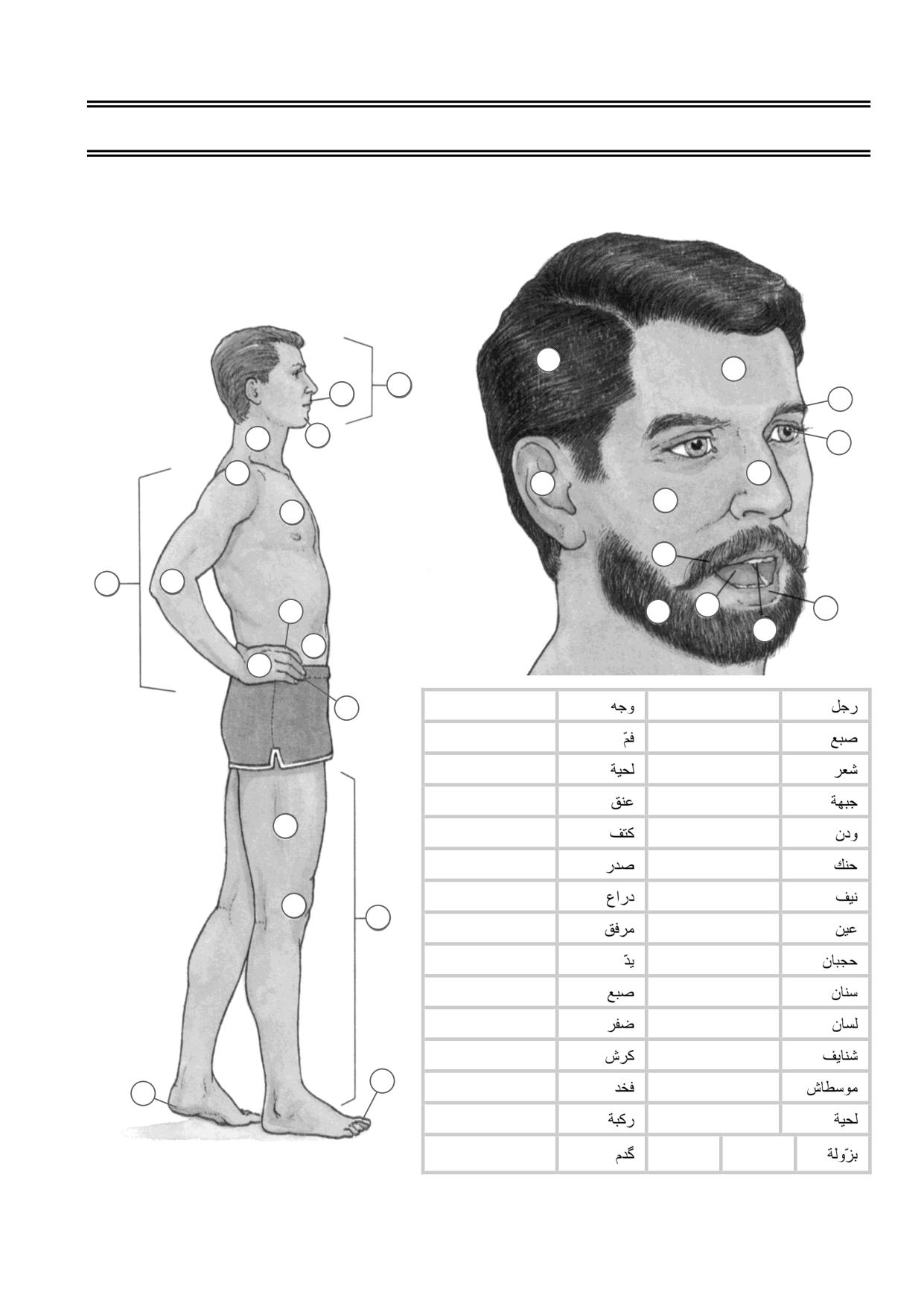
97
Medical & Body
Objective: By the end of the chapter, you will be able to:
• describe, in Darija, body parts and common illnesses
Body Parts
18
19
1
2
24
3
4
23
5
22
20
21
6
28
7
8
26
27
10
29
25
12
9
11
1. wjh
16. rjl
2. fmm
17. sbع
3. lнya
18. šعr
4. عnq
19. jbha
13
5. ktf
20. wdn
6. sdr
21. нnk
7. draع
22. nif
14
16
8. mrfq
23. عin
9. ydd
24. нjban
10. sbع
25. snan
11. dfr
26. lsan
12. krš
27. šnayf
17
13. fxd
28. mustaš
15
14. rkba
29. lнya
15. gdm
breast
bzzula
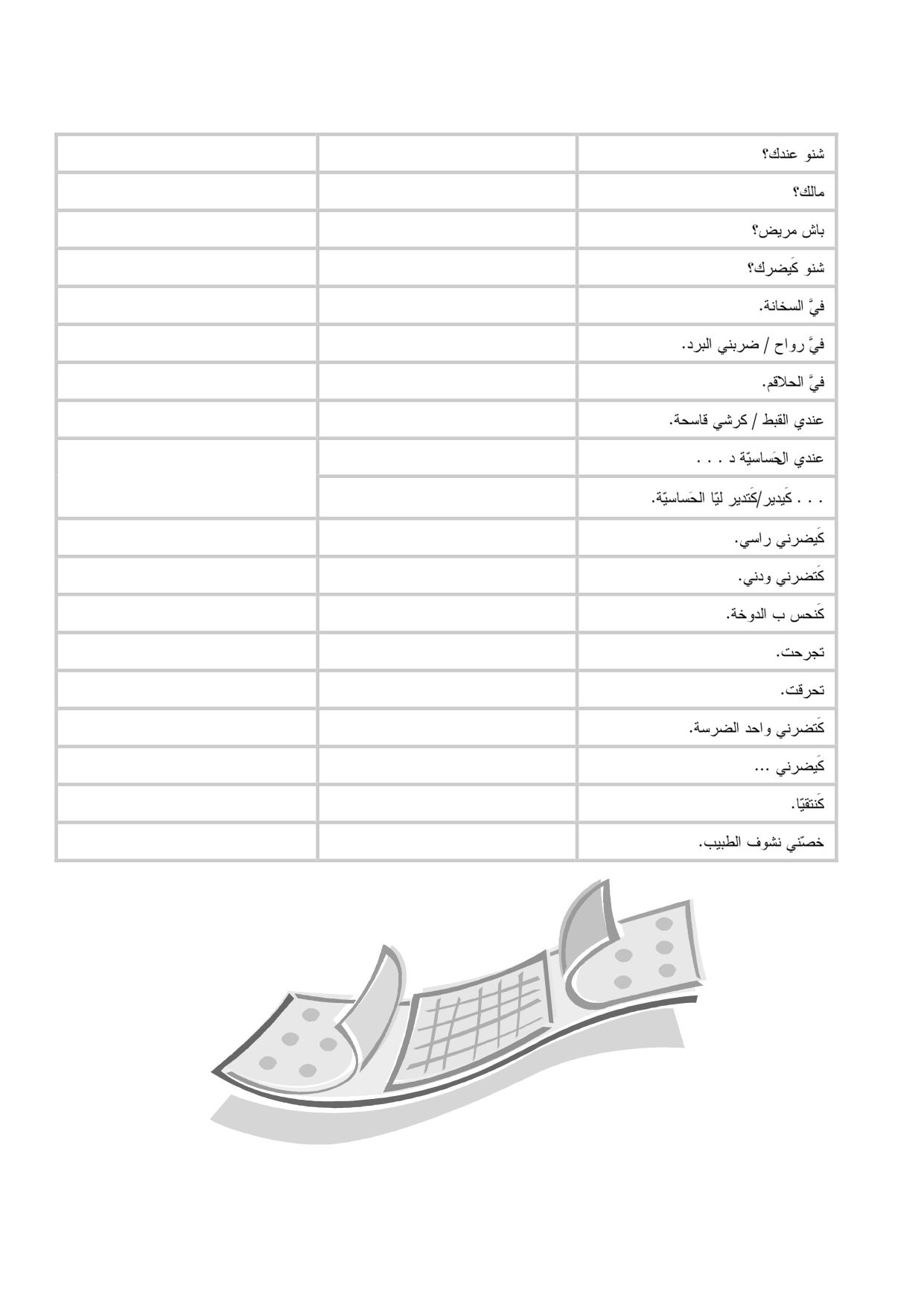
98 • Moroccan Arabic
Health Problems
What‟s wrong with you?
šnu عndk?
What‟s the matter?
malek?
What ails you?
baš mrid?
What aches?
šnu kay-drk?
I have a fever
fiya s-sxana.
I have a cold.
fiya rwaн / drbni l-brd.
I have a sore throat.
fiya l-нlaqm.
I‟m constipated.
عndi l-qbt / krši qasнa.
I‟m allergic to...
عndi l-нasasiya d . . .
. . . kay-dir/kat-dir
liya l-нasasiya.
I have a headache.
kay-drni rasi.
My ear aches.
kat-drni wdni.
I feel dizzy.
kan-нs b d-duxa.
I‟m injured.
tjrнt.
I‟m burnt.
tнrqt.
I have a toothache.
kat-drni waнd d-drsa.
My ... hurts.
kay-drni ...
I vomit / throw up.
kan-tqiya.
I need to see a doctor.
xssni n-šuf t-tbib.
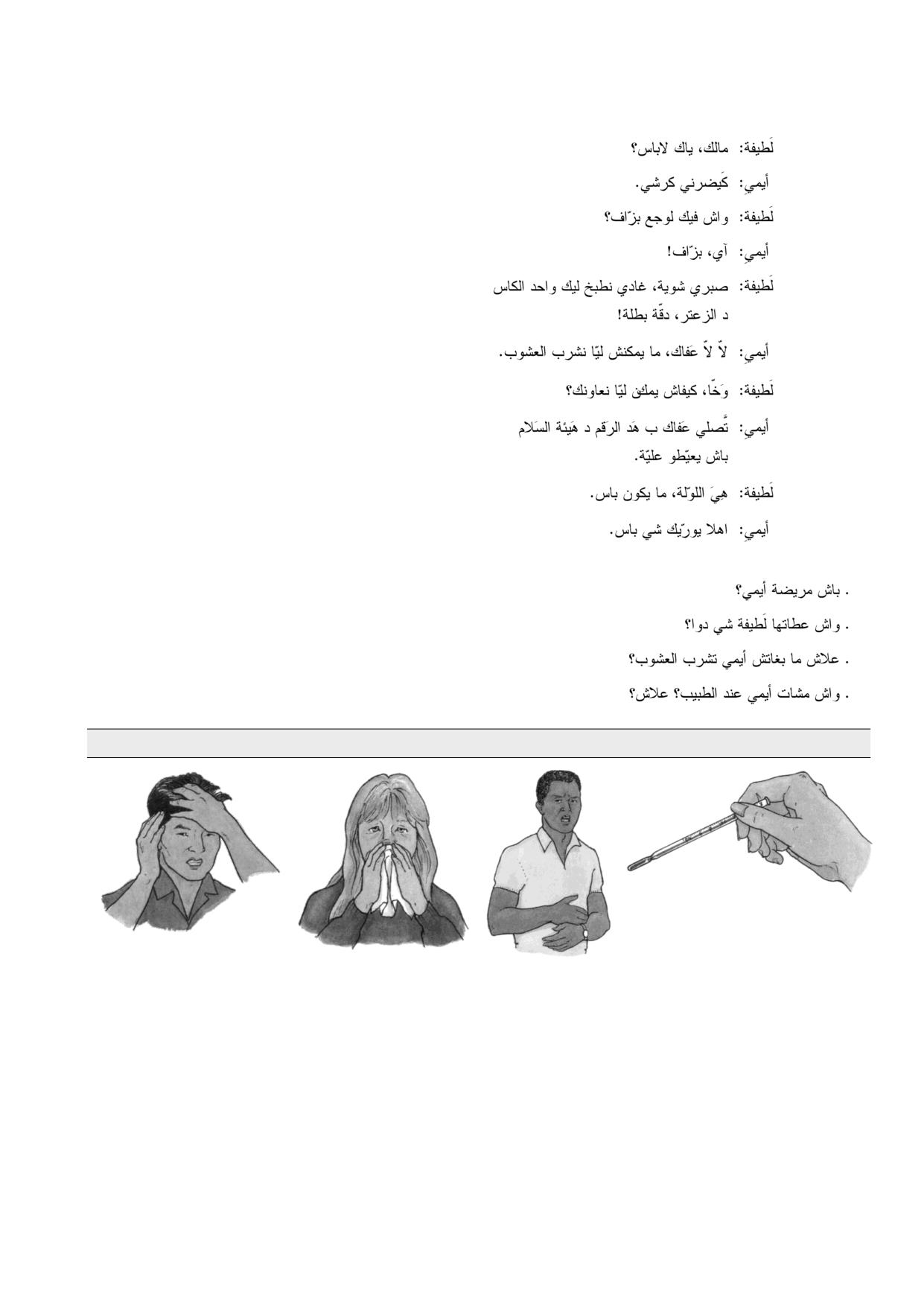
99
Dialogue
Latifa: malek, yak labas?
Amy: kay-drni krši.
Latifa: weš fik lujع bzzaf?
Amy: ay, bzzaf!
Latifa: sbri šwya, ġadi n-tbx
lik waнd l-kas d
z-zعtr, dqqa btla!
Amy: lla lla عafak, ma-ymkn-š
liya n-šrb l-عšub.
Latifa: waxxa, kifaš ymkn liya
n-عawnk?
Amy: ttasli عafak b had
r-raqm d hay'at s-salam
baš y-عiytu عliya.
Latifa: hiya l-luwla, ma-y-kun
bas.
Amy: ahla y-wrrik ši bas.
1. baš mrida Amy?
1
2. weš عtatha Latifa ši dwa?
2
3. عlaš ma-bġat-š Amy t-šrb l-عšub?
3
4. weš mšat Amy عnd t-tbib? عlaš?
4
Exercise: What might you say if you were the person in each picture?
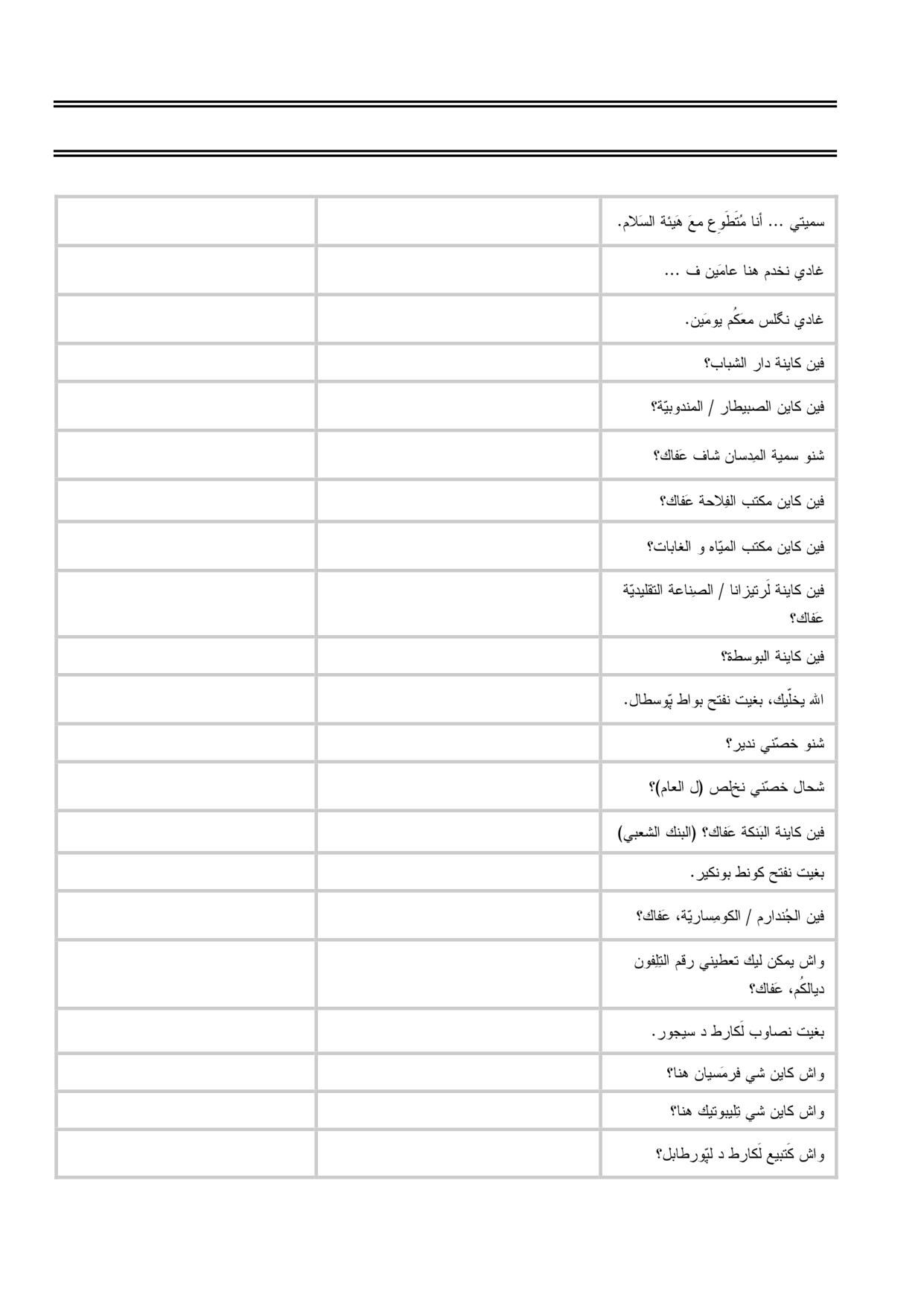
100 • Moroccan Arabic
Site Visit Expressions
Here are some useful expressions you may need during your site visit.
My name is ... I am a volunteer
smiti ... ana mutatawwiع
with Peace Corps.
mعa hay'at s-salam.
I will be working here for two
ġadi n-xdm hna عamayn f
years at
I‟m going to spend two days
ġadi n-gls mعakum yumayn.
with you (to host family).
Where is the youth center?
fin kayna dar š-šbab?
Where is the hospital /
fin kayn s-sbitar /
delegation?
l-mndubiya?
What is the name of the chief
šnu smit l-midsan šef
doctor?
عafak?
fin kayn mktb l-filaнa
Where is the agriculture office?
عafak?
Where is the water and forest
fin kayn mktb l-miyah u
office?
l-ġabat?
fin kayna lartizana /
Where is the “handicraft
s-sinaعa t-tqlidiya
center”?
عafak?
Where is the post office?
fin kayna l-bosta?
Please, I want to open a post
lla y-xllik, bġit n-ftн
box.
bwat ppostal.
What do I have to do?
šnu xssni n-dir?
How much do I have to pay (a
šнal xssni n-xls
year)?
(l l-عam)?
fin kayna l-banka عafak?
Where is the bank, please?
(l-bnk š-šعbi)
I want to open a bank account.
bġit n-ftн kont bonkir.
Where is the Gendarme / police
fin j-jondarm /
station, please?
l-kumisariya, عafak?
Can you please give me your
weš ymkn lik t-عtini rqm
phone number, please? (at
t-tilifun dyalkum,
Gendarme / police station)
عafak?
bġit n-sawb la-kart d
I want to get a “cart de sejour.”
sijur.
Is there a pharmacy here?
weš kayn ši frmasyan hna?
Is there a teleboutique here?
weš kayn ši tilibutik hna?
weš kat-biع la-kart d
Do you sell cell phone cards?
l-pportabl?
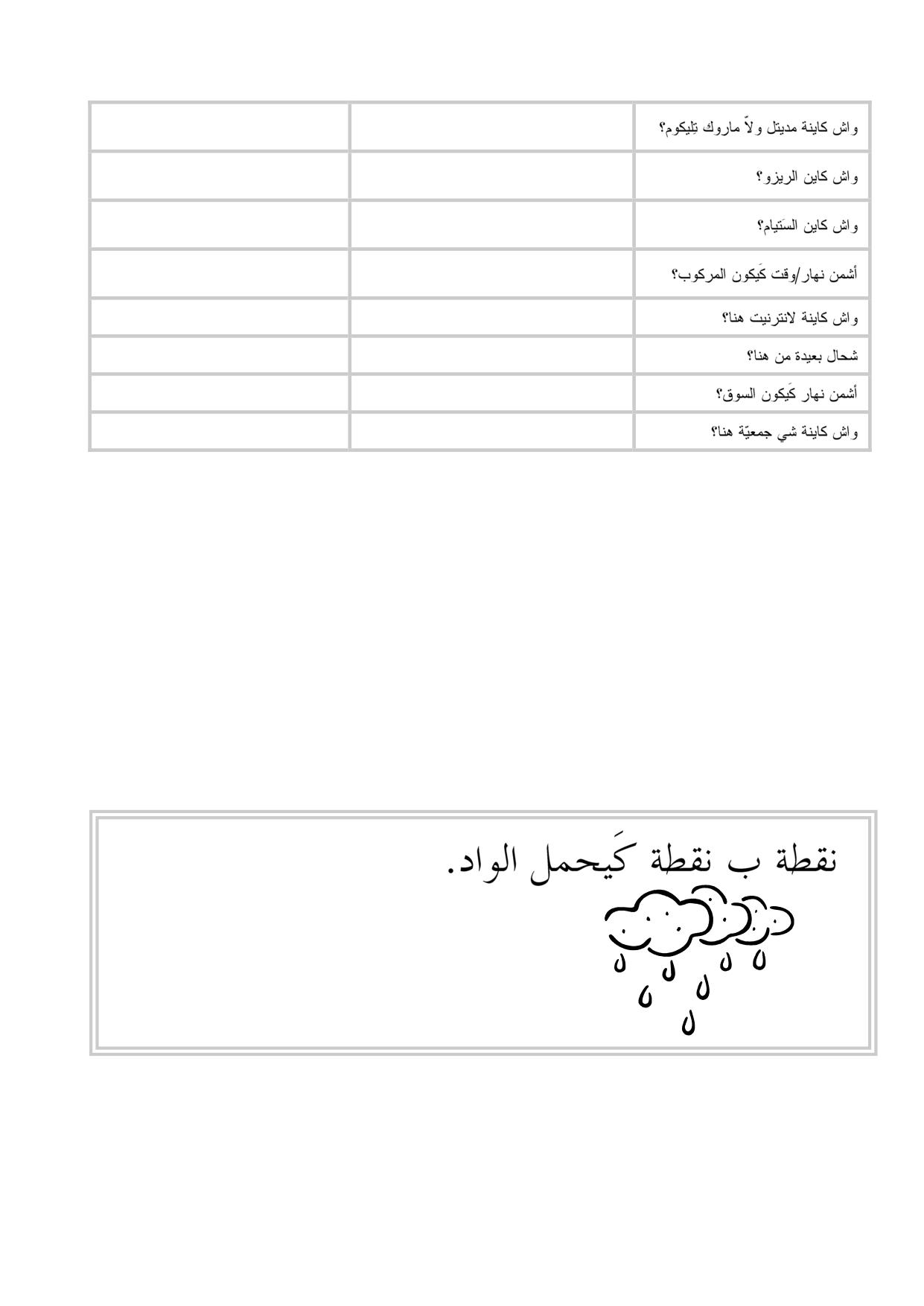
101
Which service is available here:
weš kayna Meditel wlla
Meditel or Maroc Telecom?
Maroc Telecom?
Is there cell phone reception /
weš kayn r-rizo?
coverage?
Is there CTM (the bus
weš kayn s-satyam?
company)?
What day/time is transportation
ašmn nhar/wqt kay-kun
available?
l-mrkub?
Is there a cyber café here?
weš kayna l-anternet hna?
How far is it from here?
šнal bعida mn hna?
Which day is the souk?
ašmn nhar kay-kun s-suq?
Is there any association here?
weš kayna ši jmعiya hna?
Ask your LCF for any other words or expressions you think you may need for site visit.
Moroccan Wisdom:
nqta b nqta kay-нml l-wad.
Drop by drop the river rises.
English equivalent: Rome wasn‟t built in a day.
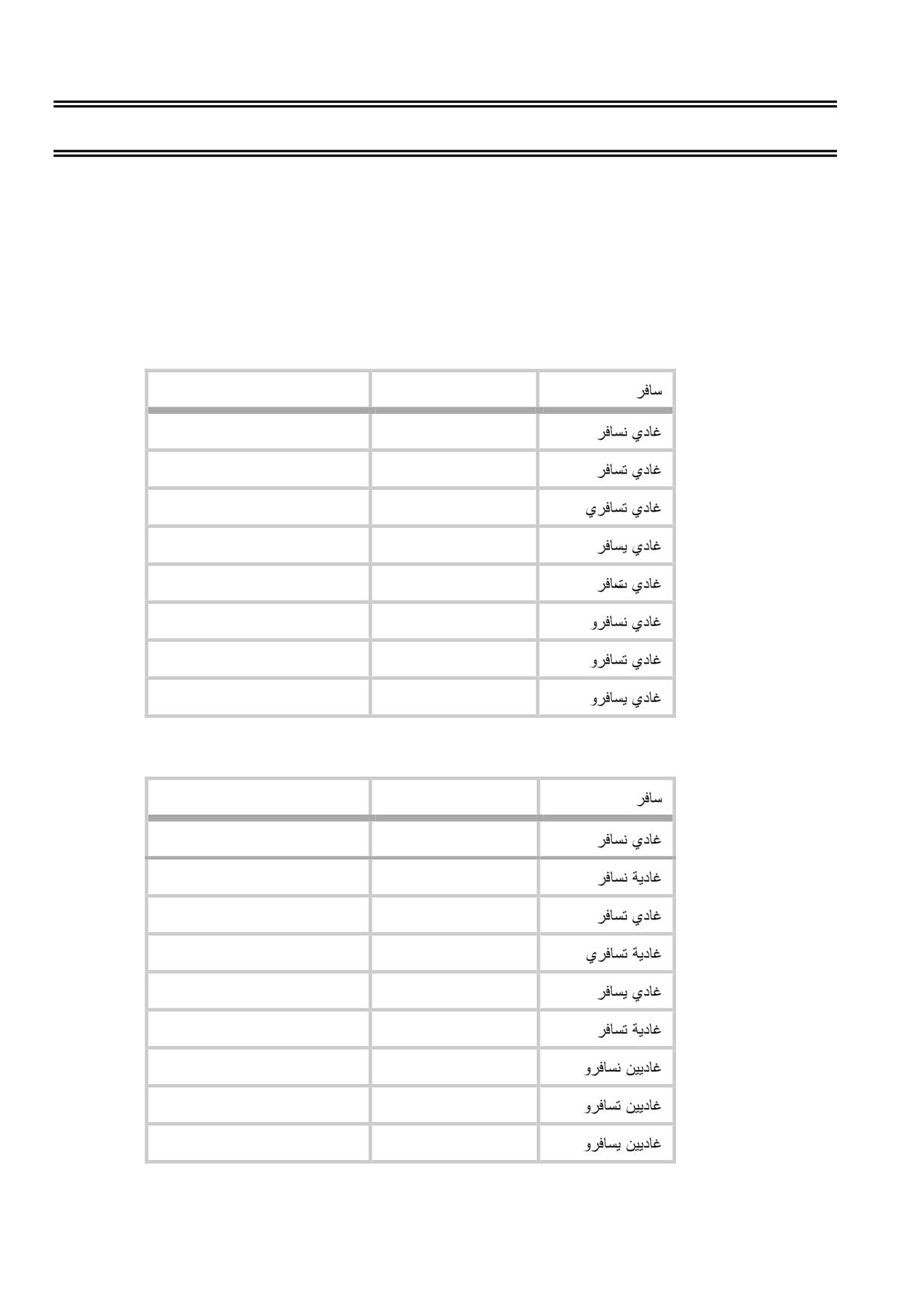
102 • Moroccan Arabic
Travel
Objective: By the end of the chapter, you will be able to:
• describe future activities
• identify means of transportation and use appropriate expressions for travel
Future Tense
Depending upon where you are in Morocco, people may form the future tense differently. Everyone in
Morocco, however, should understand you regardless of which way you form the future tense.
Forming the Future Tense
To form the future tense, take the present tense form, drop the prefix ka, and add ġadi. Thus:
“to travel”
safr
I will travel
ġadi n-safr
you will travel (masc. sing.)
ġadi t-safr
you will travel (fem. sing.)
ġadi t-safri
he will travel
ġadi y-safr
she will travel
ġadi t-safr
we will travel
ġadi n-safru
you will travel (plur.)
ġadi t-safru
they will travel
ġadi y-safru
In some places, ġadi is also used with a feminine form, ġadya, and a plural form, ġadyin. In this
case, the future tense would be as follows:
“to travel”
safr
I will travel (masc.)
ġadi n-safr
I will travel (fem.)
ġadya n-safr
you will travel (masc. sing.)
ġadi t-safr
you will travel (fem. sing.)
ġadya t-safri
he will travel
ġadi y-safr
she will travel
ġadya t-safr
we will travel
ġadyin n-safru
you will travel (plur.)
ġadyin t-safru
they will travel
ġadyin y-safru
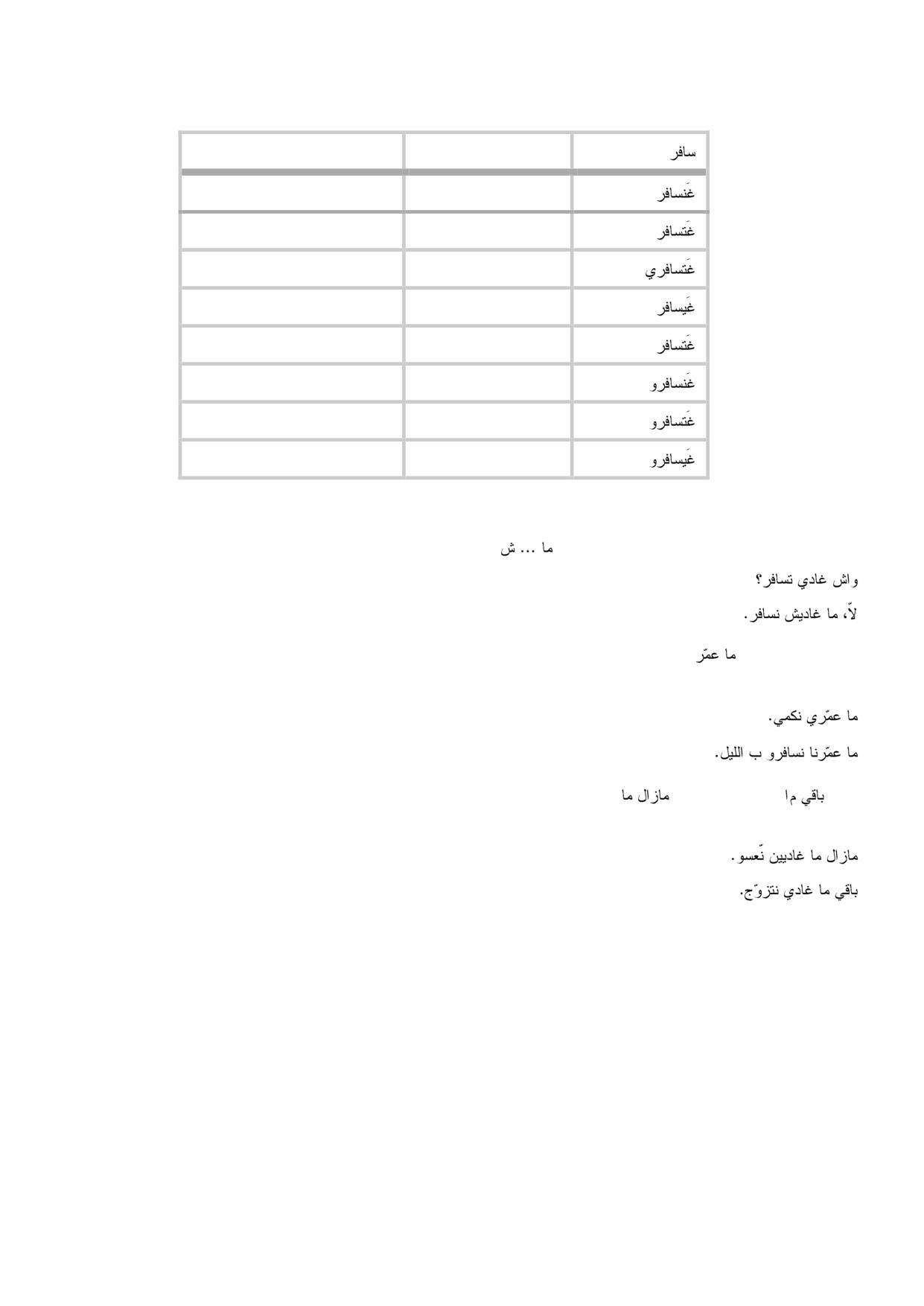
103
Sometimes, ġadi is contracted to ġa. The future tense in this case:
“to travel”
safr
I will travel
ġan-safr
you will travel (masc. sing.)
ġat-safr
you will travel (fem. sing.)
ġat-safri
he will travel
ġay-safr
she will travel
ġat-safr
we will travel
ġan-safru
you will travel (plur.)
ġat-safru
they will travel
ġay-safru
Negation of the Future Tense
To form the negative of the future tense, add ma...š (
) to ġadi, ġadya, or ġadyin.
Will you travel?
weš ġadi t-safr?
No, I will not travel.
lla, ma-ġadi-š n-safr.
To express ―will never,‖ we do not use the future tense, but rather ma عmmr (
) and the present
tense of a verb without the prefix ka.
I will never smoke.
ma عmmri n-kmi.
ma عmmrna n-safru b
We will never travel at night.
l-lil.
To express ―not yet‖ when speaking about the future, use mazal ma (
) or baqi ma (
) with
the future tense.
We will not go to bed yet.
mazal ma ġadyin n-nعsu.
I will not get married yet.
baqi ma ġadi n-tzuwj.
For the remainder of the book, all of the different forms of the future tense will be used
in order for you to become familiar with all of them.
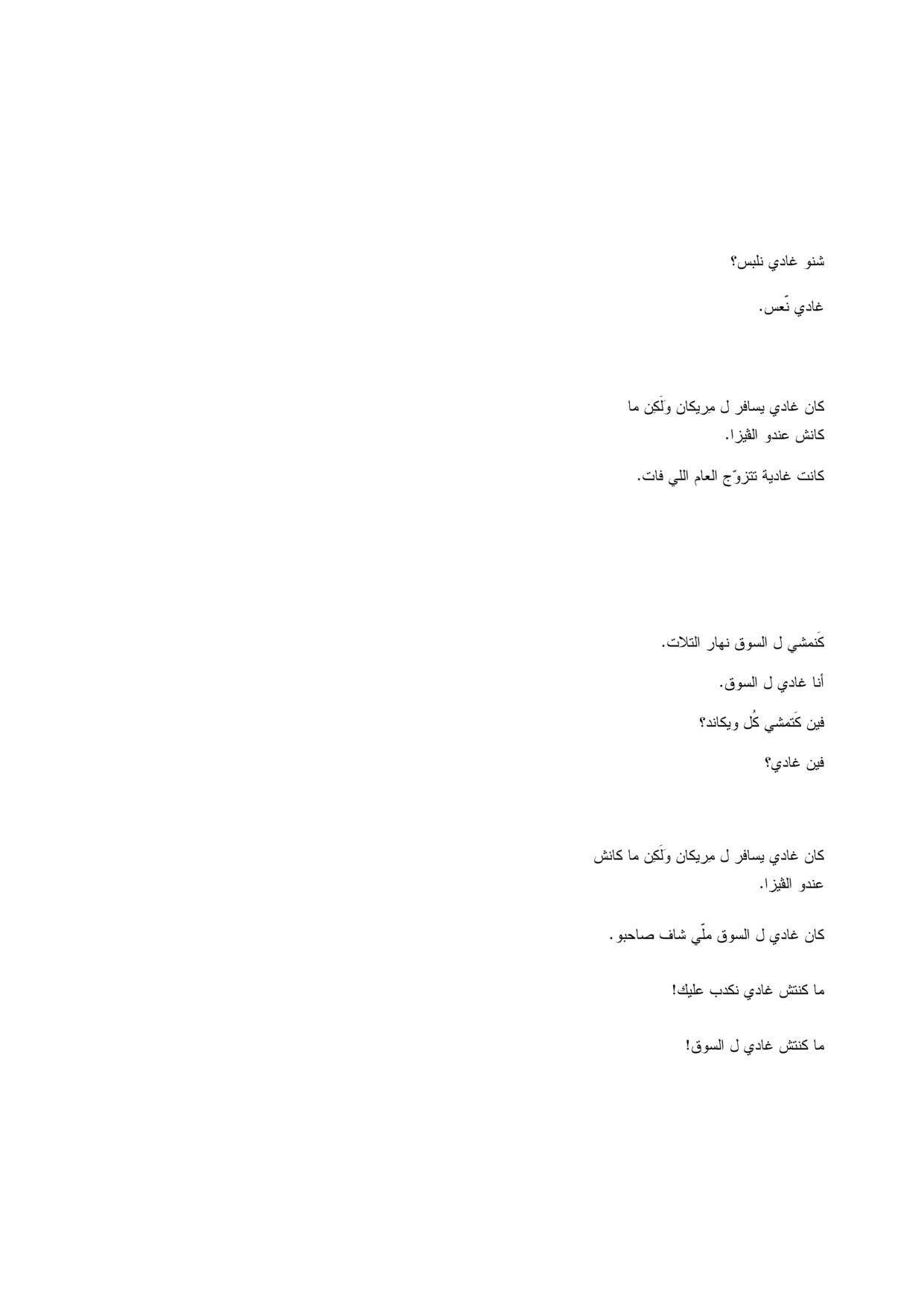
104 • Moroccan Arabic
Using the Participle ġadi to Mean “Going”
In English, we have two ways of expressing the future.
I will speak to him tomorrow.
I am going to speak to him tomorrow.
Both of these ways of expressing the future are expressed by the future tense in Moroccan Arabic. In
the following examples, therefore, both English translations can be given for the Arabic expressions.
What will I wear?
šnu ġadi n-lbs?
What am I going to wear?
I will sleep.
ġadi n-nعs.
I am going to sleep.
When the word ġadi is preceded by the conjugated past tense of the verb kan, ―to be,‖ it indicates a
past intention or a past future. Some examples:
He was going to travel to
kan ġadi y-safr l mirikan
America, but he didn‟t have a
welakin
visa. (i.e. he had intended...)
ma-kan-š عndu l-viza.
She was going to marry last
kant ġadya t-tzuwj l-عam
year. (i.e. she had planned...)
l-li fat.
The use of ġadi to indicate future or past future should be distinguished from its use as a participle to
indicating that someone is literally ―going‖ somewhere at the present moment (or ―was going‖ at a past
moment). In other words, besides its role as an ―auxiliary verb‖ to indicate future, ġadi also acts as the
active participle of the verb mša, ―to go.‖ Thus, mša is used only to express a habitual action when it
is conjugated in the present tense. To express a current action, the participle ġadi is used.
I go to souk on Tuesdays.
kan-mši l s-suq nhar
(habitual)
t-tlat.
I am going to souk. (now)
ana ġadi l s-suq.
Where do you go every
fin kat-mši kul weekend?
weekend? (habitual)
Where are you going? (now)
fin ġadi?
This idea of a current, progressive action may also be expressed in the past, and should be
distinguished, again, from the idea of past intention or past future that was discussed above.
He was going to travel to
kan ġadi y-safr l
America, but he didn‟t have a
mirikan welakin
visa. (past intention)
ma-kan-š عndu l-viza.
He was going to souk when he
kan ġadi l s-suq mlli
saw his friend. (past
šaf saнbu.
progressive action)
I was not going to lie to you!
ma-knt-š ġadi n-kdb
(negative past intention)
عlik!
I was not going to souk!
(negative past progressive
ma-knt-š ġadi l s-suq!
action)
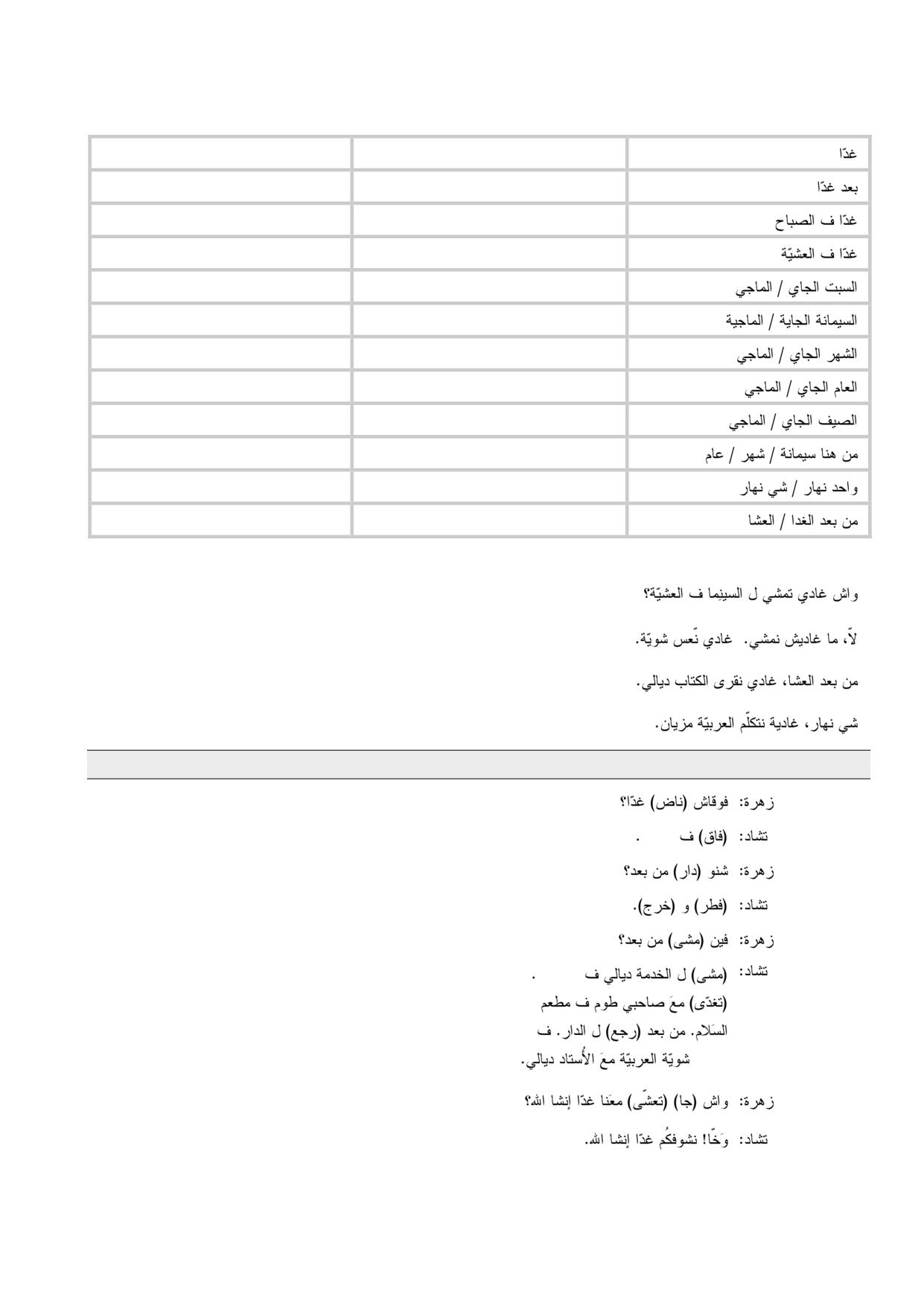
105
Time Expressions
tomorrow
ġdda
day after tomorrow
bعd ġdda
tomorrow morning
ġdda f s-sbaн
tomorrow afternoon/evening
ġdda f l-عšiya
next Saturday
s-sbt j-jay / l-maji
next week
s-simana j-jaya / l-majya
next month
š-šhr j-jay / l-maji
next year
l-عam j-jay / l-maji
next summer
s-sif j-jay / l-maji
in a week / month / year
mn hna simana / šhr / عam
one day / some day
waнd nhar / ši nhar
after lunch / dinner
mn bعd l-ġda / l-عša
Some examples of the future tense using time expressions:
Are you going to go to the
weš ġadi t-mši l
cinema in the evening?
s-sinima f l-عšiya?
No, I‟m not going to go. I‟m
lla, ma-ġadi-š n-mši.
going to sleep a little bit.
ġadi n-nعs šwiya.
mn bعd l-عša, ġadi
After dinner, I‟ll read my book.
n-qra l-ktab dyali.
Someday, I (fem.) will speak
ši nhar, ġadya n-tkllm
Arabic well.
l-عrbiya mzyan.
Exercise: Put the verbs in parentheses in the future tense.
Zahra: fuqaš (nad) ġdda?
Chad: (faq) f 7:00.
7:00
Zahra: šnu (dar) mn bعd?
Chad: (ftr) u (xrj).
Zahra: fin (mša) mn bعd?
Chad: (mša) l l-xdma dyali f
12:00
12:00. (tġdda) mعa saнbi
Tom f mtعm s-salam. mn
bعd (rjع) l d-dar. f 3:00
šwiya l-عrbiya mعa
3:00
l-ustad dyali.
Zahra: weš (ja) (tعšša) mعana
ġdda inšallah?
Chad: waxxa! n-šufkum ġdda
inšallah.
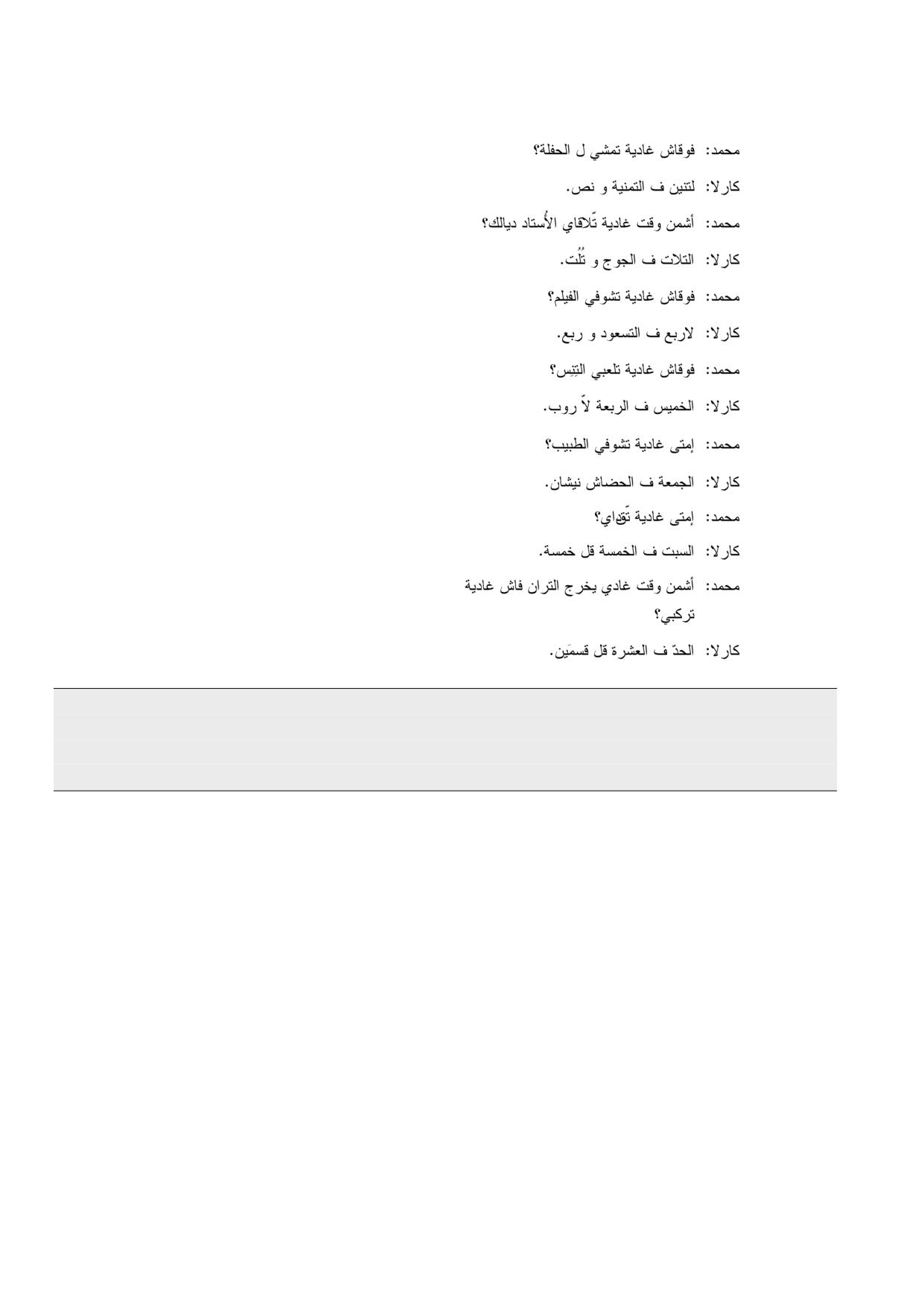
106 • Moroccan Arabic
Dialogue
Mohamed: fuqaš ġadya t-mši l
l-нfla?
Karla: ltnin f t-tmnya u ns.
Mohamed: ašmn wqt ġadya t-tlaqay
l-ustad dyalk?
Karla: t-tlat f j-juj u tulut.
Mohamed: fuqaš ġadia t-šufi
l-film?
Karla: larbع f t-tsعud u rbع.
Mohamed: fuqaš ġadya t-lعbi
t-tinis?
Karla: l-xmis f r-rbعa lla rub.
Mohamed: imta ġadya t-šufi
t-tbib?
Karla: j-jmعa f l-нdaš nišan.
Mohamed: imta ġadya t-tqday?
Karla: s-sbt f l-xmsa ql xmsa.
Mohamed: ašmn wqt ġadi y-xrj
t-tran faš ġadya
t-rkbi?
Karla: l-нdd f l-عšra ql
qsmayn.
Exercise: Read the dialogue again quickly and write down Karla’s plan for the week
(write down the times using numbers, not words). Then, write your own
schedule for the upcoming week. What will you be doing each day? At
what time?
Travel
General Travel Information
Public transport in Morocco is both inexpensive and easy to use. Between major cities, trains are the
quickest and most comfortable means of travel, although they can be crowded at certain times of year.
Buses are the cheapest choice and can vary in terms of speed and comfort.
Traveling Between Cities
CTM: This is the national bus line, very comfortable, on schedule, seats are reserved and can be
purchased in advance in most places. Unaccompanied baggage can be sent via CTM.
Souk buses: In each large town there is a bus station, such as Quamra in Rabat. One can buy a ticket
one day in advance and fares are set. Sometimes the ticket is for a reserved seat, other times it is for
whatever seat is open when the bus goes through town. A ticket does not necessarily mean there is a
real seat either. Sometimes there are additional places set-up in the aisle. You have to bargain for the
price you pay for your luggage if this gets stored on top of the bus. The price depends upon the size of
the piece. It is advisable to carry smaller pieces of luggage you can store in the bus itself. Souk buses
do not always leave or arrive on time. They may stop in the middle of nowhere. They may also stop in
towns along the way looking for additional passengers.
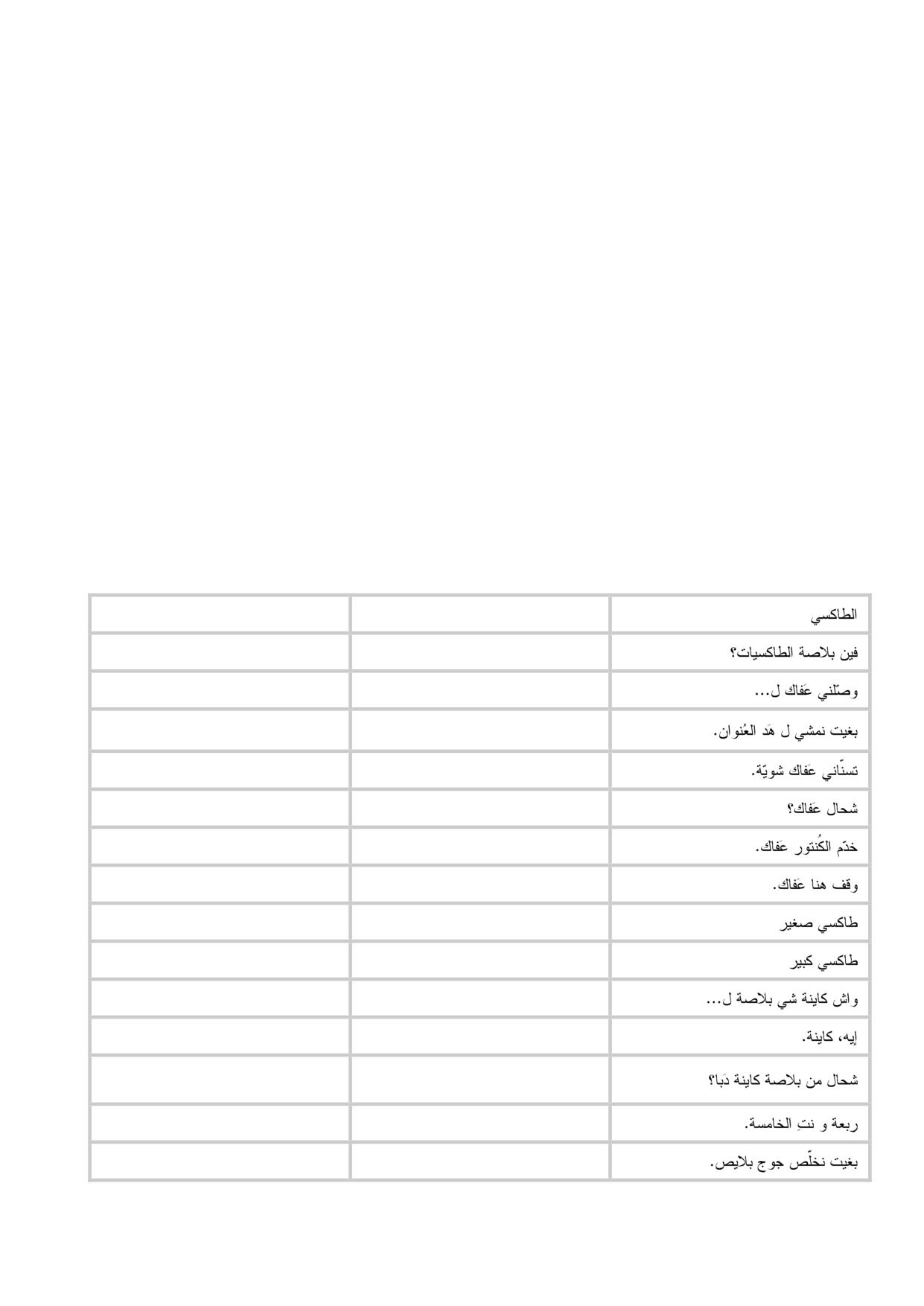
107
Train: There are two classes: first and second. The price of any train car with air conditioning will be
higher. Sometimes there are schedule changes, but no available printed timetables. Check to be sure
that the time you wish to travel is still accurate. Train tickets can be bought in advance, and this is the
only form of local transportation on which you can buy a round-trip ticket.
Grand taxis: This is for travel between large towns and cities. They carry 6 passengers and since the
fare is per seat, if you want you can pay for empty seats so that the taxi leaves earlier. Ask the other
passengers in the car what the regular fare should be, do not ask the driver first. If you want to take the
entire taxi for yourself, ask for a taxi ―coursa.‖ Baggage does not cost extra in a taxi.
Pick-up truck (camio): In some areas where no public transportation is available, people use their
personal trucks to carry supplies to their douars, they also take passengers at a rate that they determine
themselves.
Airport transportation: There are airport buses and trains which run from Rabat Ville to the
Casablanca airport. There are also airport buses which connect the airport to Casablanca but from
Rabat/Sale airport there are only taxis.
Travel Within Cities
Petit taxis: Every city has petit taxis which can carry up to three passengers. The fare is calculated by
meter. When you get in the taxi, ask that the meter be turned on. If there is no meter, or if it does not
work, ask the price before you begin. Since the taxi can take 3 passengers, if you are the only one
getting in, he can pick up other passengers. If you are the second or third person entering the taxi, ask
the price for your trip. At night (usually by 8 pm) until sunrise, the fare is 50% more than the daytime
fare.
Chariots: In very small villages, the chariots are used to get people to the weekly souk or to towns on
the main road, where larger transportation is available for farther distances.
Travel Expressions
taxi
t-taxi
Where is the taxi stand?
fin blasa t-taxiyat?
Please take me to...
wsslni عafak l...
bġit n-mši l had
I want to go to this address.
l-عunwan.
Please wait a minute for me.
tsnnani عafak šwiya.
How much, please?
šнal عafak?
Turn on the meter, please.
xddm l-kuntur عafak.
Stop here, please.
wqf hna عafak.
small taxi (petit taxi, inside city)
taxi sġir
large taxi (grand taxi, b/w cities)
taxi kbir
Is there a seat to ...
weš kayna ši blasa l...
Yes, there is.
iyeh, kayna.
How many seats are reserved
šнal mn blasa kayna
so far?
deba?
Four and you are the fifth.
rbعa u nti l-xamsa.
I want to pay for 2 seats.
bġit n-xlls juj blays.
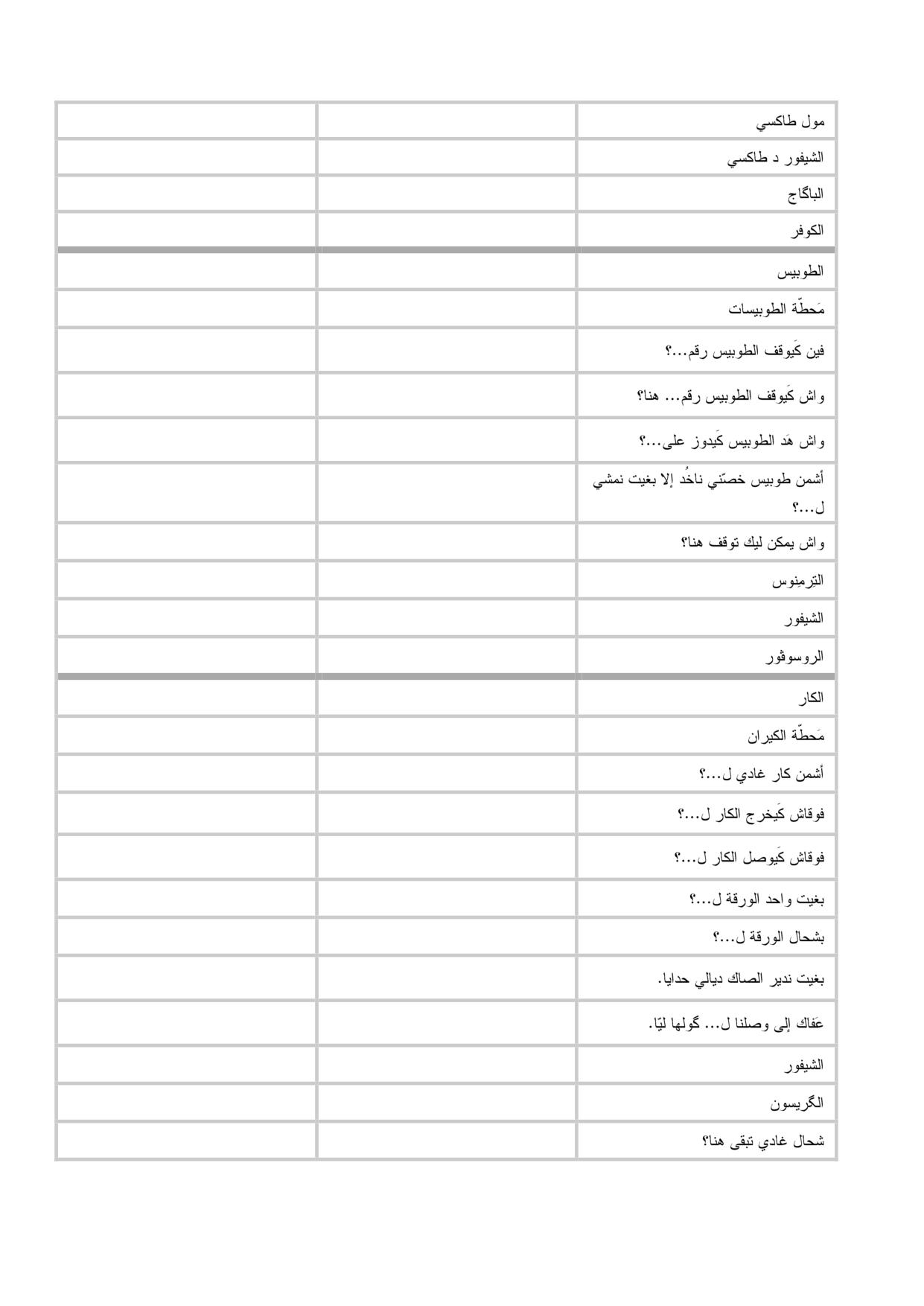
108 • Moroccan Arabic
taxi driver
mul taxi
taxi driver
š-šifur d taxi
baggage
l-bagaj
trunk
l-kufr
city bus
t-tobis
city bus depot / stop
maнttat t-tobisat
fin kay-wqf t-tobis
Where does bus #... stop?
rqm...?
weš kay-wqf t-tobis
Does bus #... stop here?
rqm... hna?
weš had t-tobis kay-duz
Does this bus go by ... ?
عla...?
Which bus do I need to take if I
ašmn tobis xssni n-axud
want to go to ... ?
ila bġit n-mši l...?
Can you stop here?
weš ymkn lik t-wqf hna?
last stop / terminus
t-tirminus
driver
š-šifur
ticket taker
r-rusuvur
bus (between cities)
l-kar
bus station
maнttat l-kiran
Which bus is going to ... ?
ašmn kar ġadi l...?
fuqaš kay-xrj l-kar
When does the bus leave to ... ?
l...?
fuqaš kay-wsl l-kar
When does the bus arrive to ...?
l...?
I want a ticket to ...
bġit waнd l-wrqa l...?
How much is the ticket to ... ?
bšнal l-wrqa l...?
bġit n-dir s-sak dyali
I want to keep my bag with me.
нdaya.
عafak ila wslna l...
Tell me when we arrive to ...
gulha liya.
driver
š-šifur
driver‟s assistant
l-grisun
How long will you stop here?
šнal ġadi t-bqa hna?
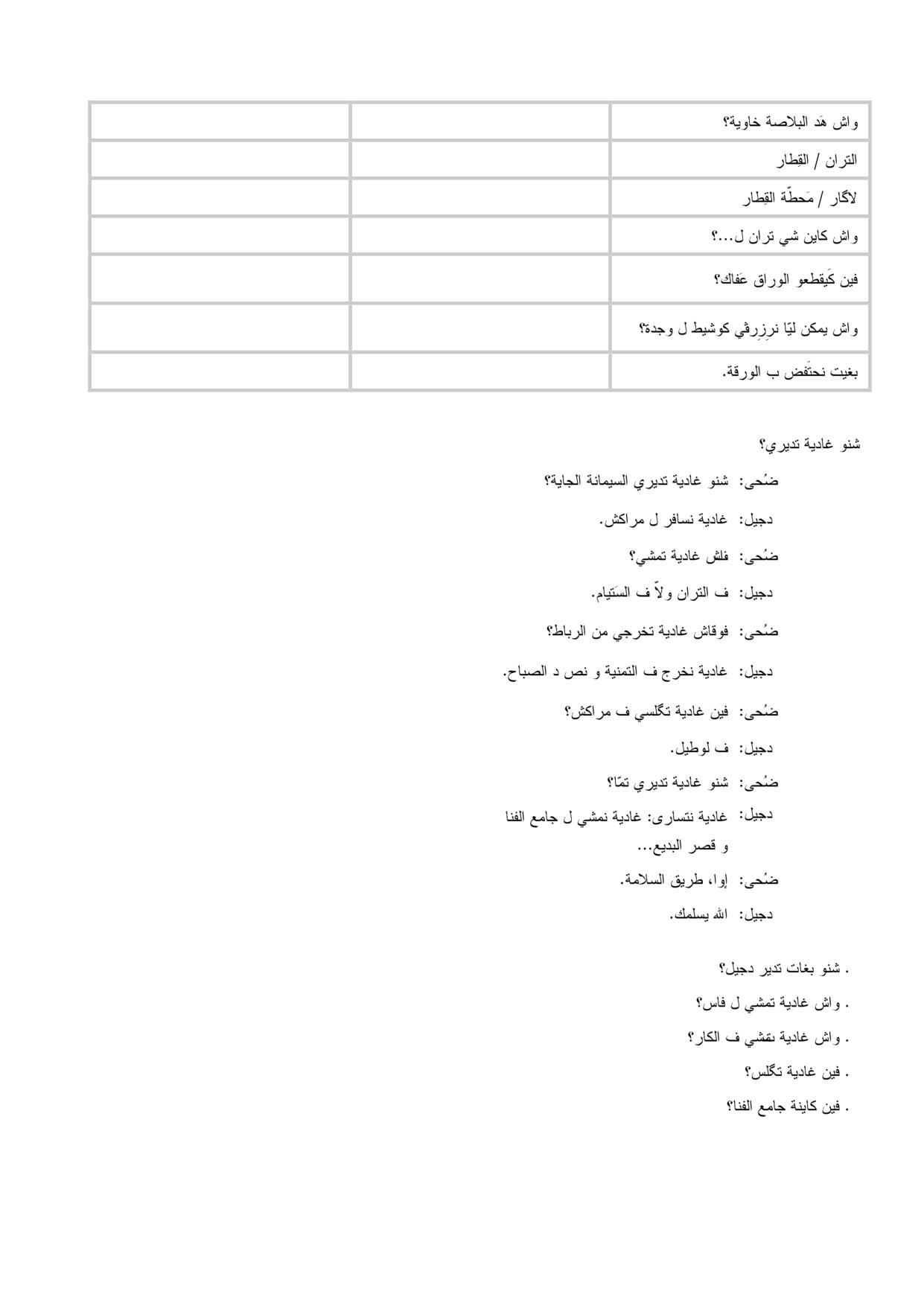
109
Is this seat empty?
weš had l-blasa xawya?
train
t-tran / l-qitar
train station
lagar / maнttat l-qitar
Is there a train to ...
weš kayn ši tran l...?
Where do they sell the tickets,
fin kay-qtعu l-wraq
please?
عafak?
Can I reserve a sleeper car to
weš ymkn liya n-rizirvi
Oujda?
kušit l wjda?
I want to keep the ticket.
bġit n-нtafd b l-wrqa.
Dialogue
šnu ġadya t-diri?
Doha: šnu ġadya t-diri
s-simana j-jaya?
Jill: ġadya n-safr l
Marrakech.
Doha: faš ġadya t-mši?
Jill: f t-tran wlla f s-satyam
(CTM).
Doha: fuqaš ġadya t-xrji mn
Rabat?
Jill: ġadya n-xrj f t-tmnya u
ns d s-sbaн.
Doha: fin ġadya t-glsi f
Marrakech?
Jill: f lotil.
Doha: šnu ġadya t-diri tmma?
Jill: ġadya n-tsara: ġadya
n-mši l jamع l-fna u qsr
l-bdiع...
Doha: iwa, triq s-slama.
Jill: lla y-slmk.
1. šnu bġat t-dir Jill?
1
2. weš ġadya t-mši l Fes?
2
3. weš ġadya t-mši f l-kar?
3
4. fin ġadya t-gls?
4
5. fin kayna jamع l-fna?
5
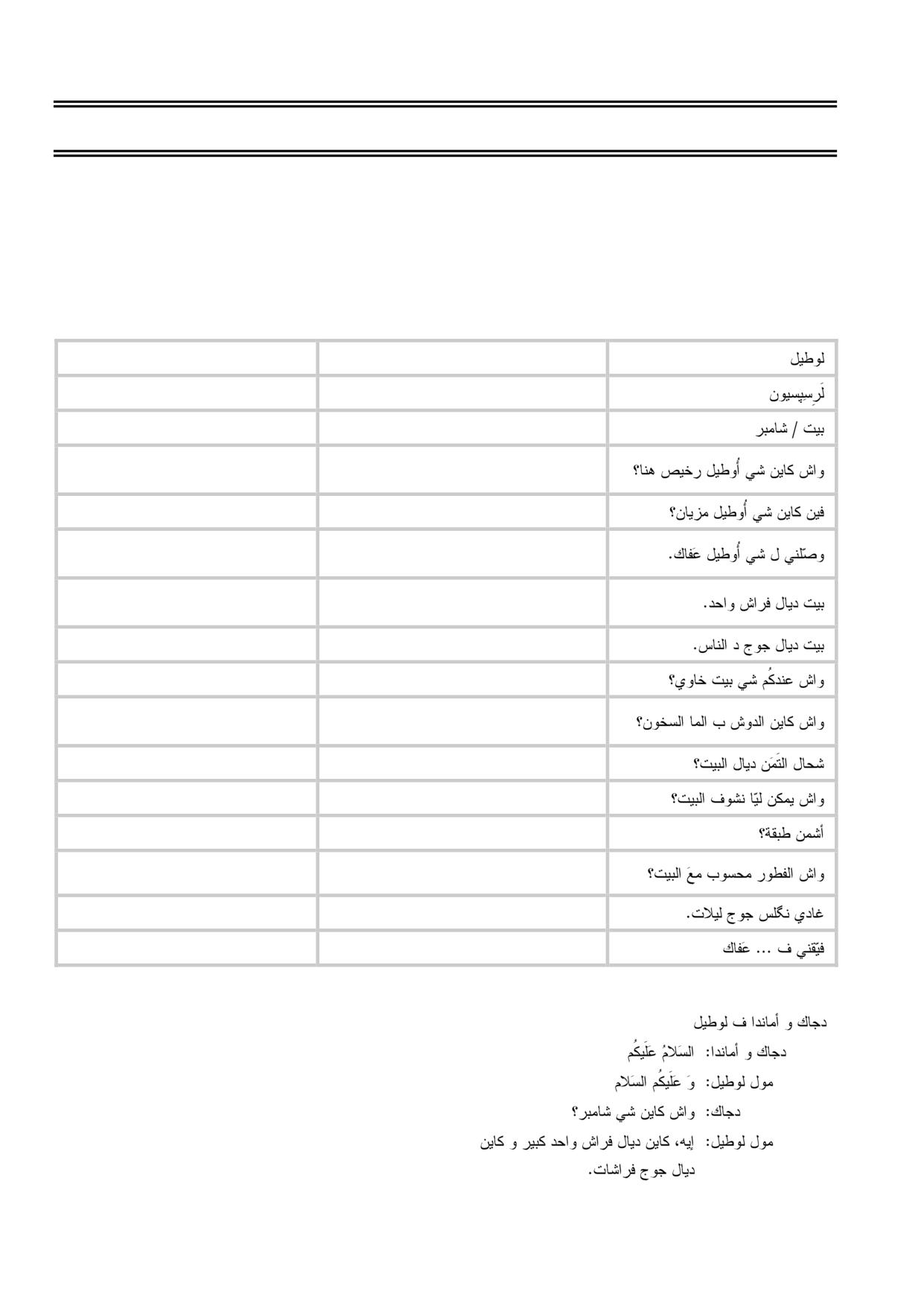
110 • Moroccan Arabic
At the Hotel
Objective: By the end of the chapter, you will be able to:
• look for and use hotel accommodation
• use conditional sentences to express possible and impossible conditions
Hotel Accommodation
Hotels are classified into categories from 0 (non-classified) to 5-star hotels. There is a reduction of
25% on the second day for Moroccans and foreign residents in Morocco, but only in classified hotels.
Vocabulary and Expressions
the hotel
lotil
the reception desk
larisipsyun
room
bit / šambr
Is there an inexpensive hotel
weš kayn ši otil rxis hna?
around here?
Where is a nice hotel?
fin kayn ši otil mzyan?
Please take me to a hotel (to a
wsslni l ši otil عafak.
taxi driver).
A room for one person (a
bit dyal fraš waнd.
single).
A room for two people.
bit dyal juj d n-nas.
Do you have a room available?
weš عndkum ši bit xawi?
Is there a shower with hot
weš kayn d-duš b l-ma
water?
s-sxun?
What‟s the price for the room?
šнal t-taman dyal l-bit?
Can I see the room?
weš ymkn liya n-šuf l-bit?
Which floor?
ašmn tbqa?
weš l-ftur mнsub mعa
Is breakfast included?
l-bit?
I‟ll stay for 2 nights.
ġadi n-gls juj lilat.
Wake me up at ... please.
fiyqni f ... عafak
Dialogue
Jack u Amanda f lotil
Jack u Amanda: s-salamu عalaykum
mul lotil: wa عalaykum s-salam
Jack: weš kayn ši šambr?
mul lotil: iyeh, kayn dyal fraš
waнd kbir u kayn dyal
juj frašat.
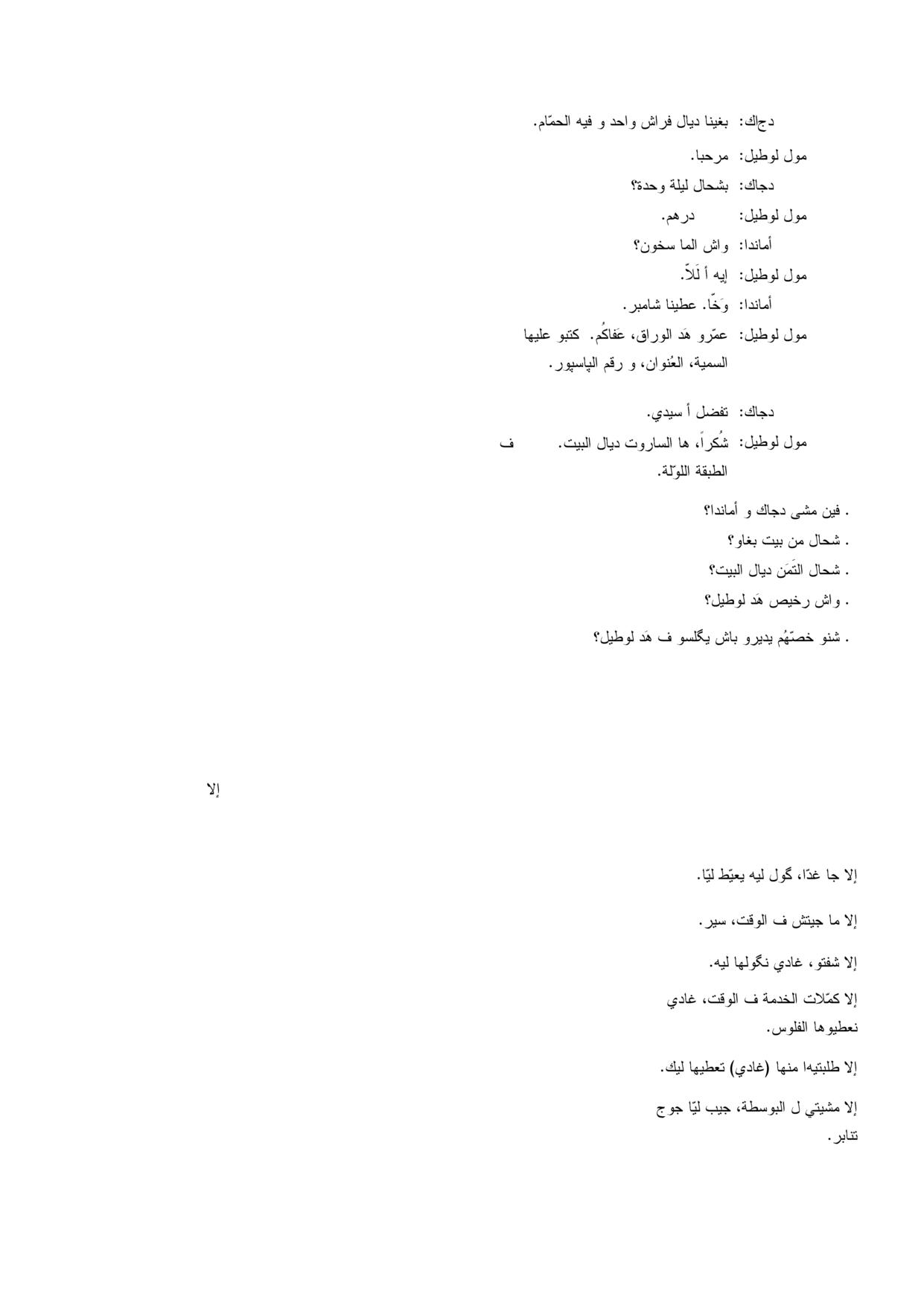
111
Jack: bġina dyal fraš waнd u
fih l-нmmam.
mul lotil: mrнba.
Jack: bšнal lila wнda?
mul lotil: 140 drhm.
140
Amanda: weš l-ma sxun?
mul lotil: iyeh a lalla.
Amanda: waxxa. عtina šambr.
mul lotil: عmmru had l-wraq,
عafakum. ktbu عliha
s-smya, l-عunwan, u rqm
l-paspor.
Jack: tfdl a sidi.
mul lotil: šukran, ha s-sarut dyal
156
l-bit.
156 f t-tbqa
l-luwla.
1. fin mša Jack u Amanda?
1
2. šнal mn bit bġau?
2
3. šнal t-taman dyal l-bit?
3
4. weš rxis had lotil?
4
5. šnu xsshum y-diru baš y-glsu
5
f had lotil?
The Conditional
There are two basic types of conditional sentences in Moroccan Arabic depending on whether the ―if
clause‖ represents a possible condition or a contrary-to-fact/impossible condition.
Type I Conditional: A Possible Condition in the Present/Future
The word ila (
) is equivalent to the English ―if.‖ It introduces a possible condition only. This type of
conditional sentence is composed of the simple past plus the future, or sometimes the simple past plus
the imperative. This is used in the same context as English to express a future probable condition.
If he comes tomorrow, tell him to ila ja ġdda, gul lih
call me.
y-عiyt liya.
If I don‟t come on time, go
ila ma-jit-š f l-wqt,
without me.
sir.
ila šftu, ġadi n-gulha
If I see him, I‟ll tell (it to) him.
lih.
ila kmmlat l-xdma f
If she finishes the work on time,
l-wqt, ġadi n-عtiuha
we‟ll give her some money.
l-flus.
If you ask her for it, she‟ll give it ila tlbtiha mnha (ġadi)
to you.
t-عtiha lik.
If you go to the post office bring ila mšiti l l-bosta, jib
me two stamps.
liya juj tnabr.
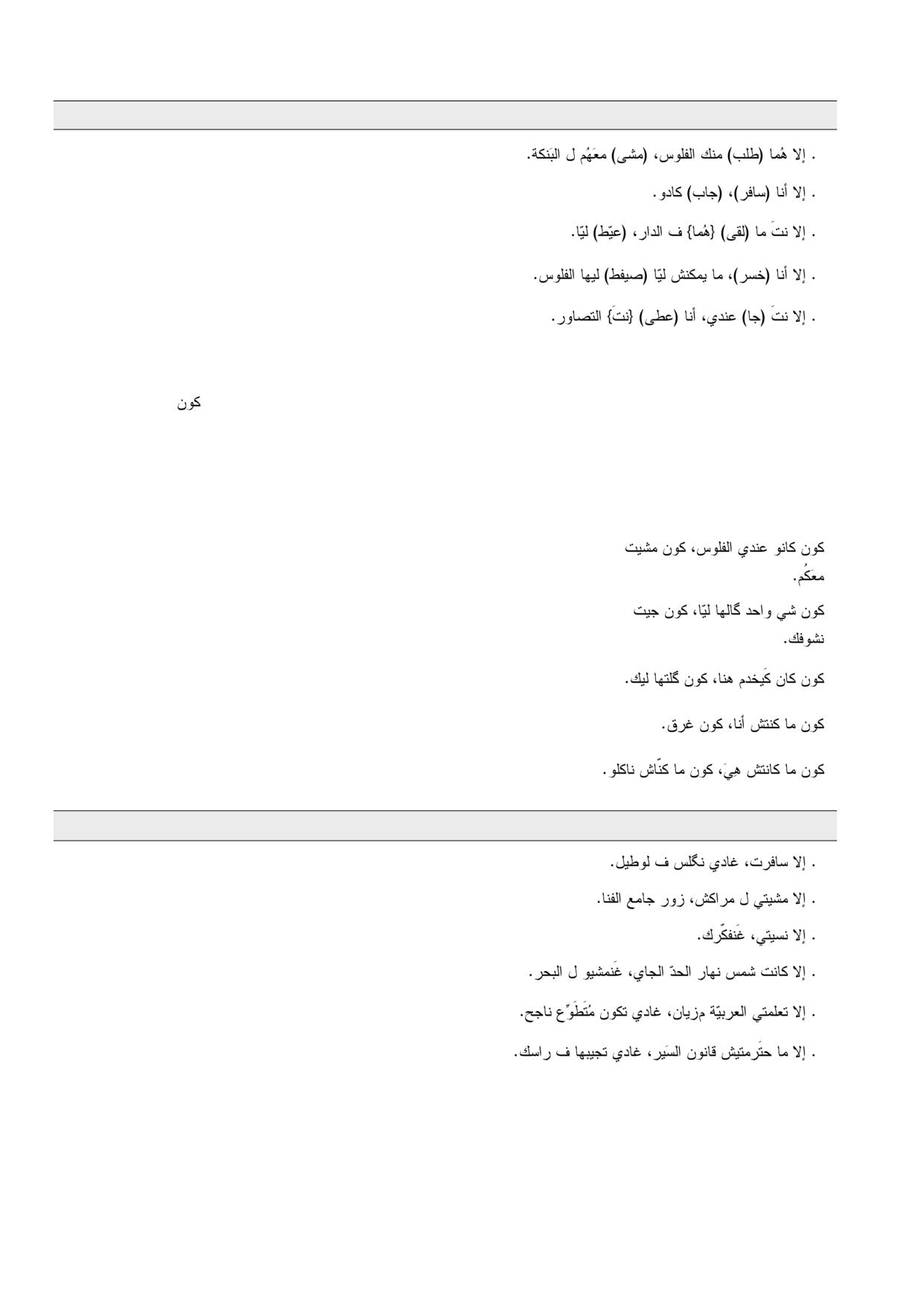
112 • Moroccan Arabic
Exercise: Put the verbs in parentheses in the correct form.
1. ila huma (tlb) mnk l-flus,
1
(mša) mعahum l l-banka.
2. ila ana (safr), (jab) kadu.
2
3. ila nta ma (lqa) {huma} f d-dar,
3
(عiyt) liya.
4. ila ana (xsr), ma-ymkn-š liya
4
(sift) liha l-flus.
5. ila nta (ja) عndi,
5
ana (عta) {nta} t-tsawr.
Type II Conditional: An Impossible Condition in the Past/Present
The word kun (
) is used in the second type of conditional. It also is equivalent to the English ―if.‖
This word introduces two different types of contrary-to-fact conditionals. The first kind refers to past
circumstances which did not occur. For example, ―if we had worked,‖ which implies that we did not
work. The second refers to present but unreal circumstances. For example, ―if I were rich,‖ which
implies that I am not rich. General context is the decisive factor in determining whether present or
past contrary-to-fact conditions are referred to.
If I had the money, I‟d go with
kun kanu عndi l-flus,
you.
kun mšit mعakum.
If someone had told me, I would kun ši waнd galha liya,
have come to see you.
kun jit n-šufk.
If he were working here, I would kun kan kay-xdm hna,
have told you.
kun gltha lik.
If it hadn‟t been for me, he would kun ma-knt-š ana,
have drowned.
kun ġrq.
If it were not for her, we wouldn‟t kun ma-kant-š hiya,
be eating.
kun ma-knna-š n-aklu.
Exercise: Substitute ila with kun and make the necessary changes.
1. ila safrt, ġadi n-gls f lotil.
1
2. ila mšiti l Marrakech,
2
zur jamع l-fna.
3. ila nsiti, ġan-fkkrk.
3
4. ila kant šms nhar l-нdd j-jay,
4
ġan-mšiu l l-bнr.
5. ila tعlmti l-عrbiya mzyan,
5
ġadi t-kun mutatawwiع najн.
6. ila ma-нtarmti-š qanun s-sayr,
6
ġadi t-jibha f rask.
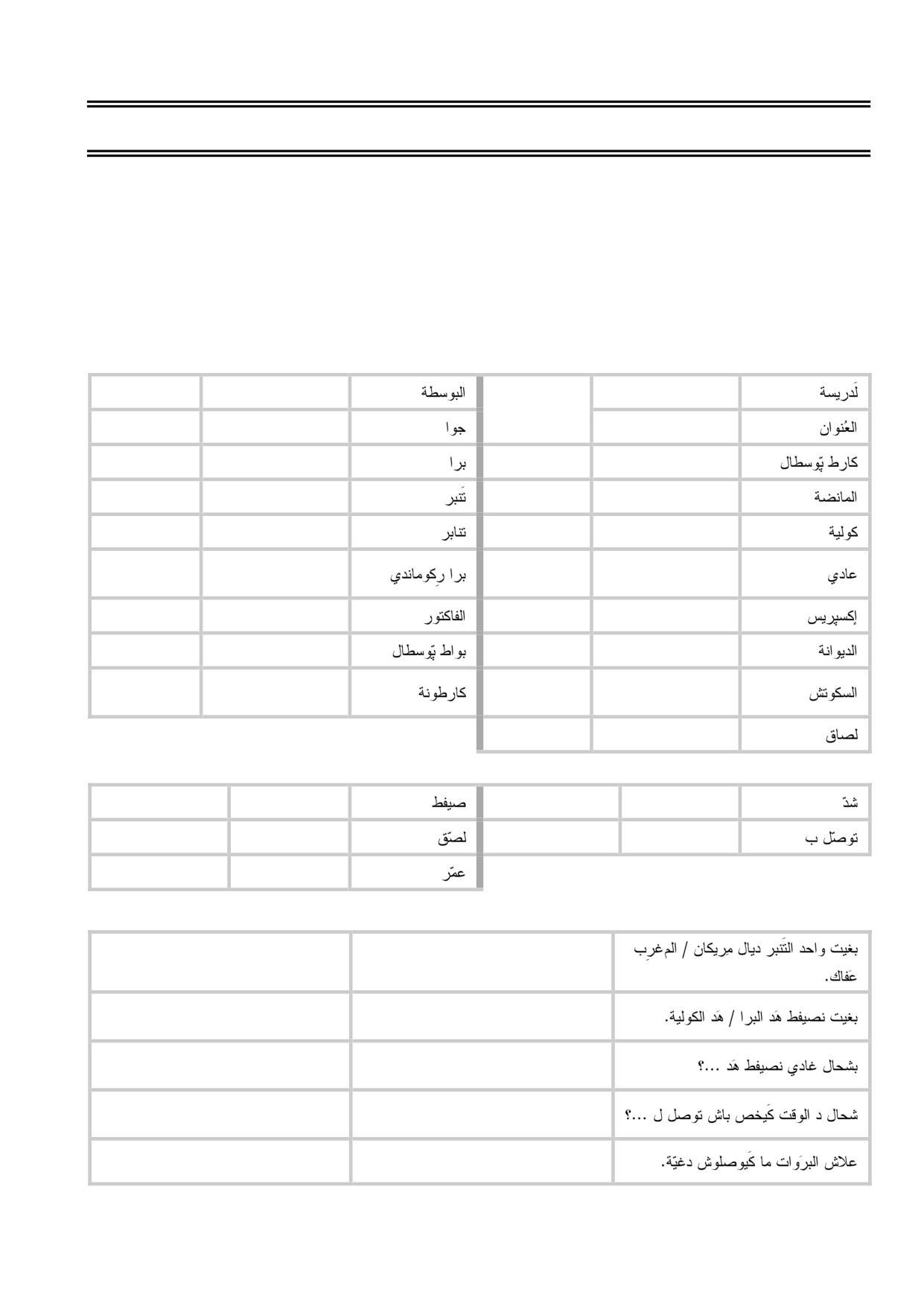
113
At the Post Office
Objective: By the end of the chapter, you will be able to:
• buy stamps and send letters and parcels
• use prepositions correctly with verbs
The Post Office
Stamps are available at tobacco stores in addition to the post office. It is best to mail your letters at the
mail slot outside the post office since pick-ups can be infrequent at other mail boxes. When sending
packages out of the country, you are required to fill out a customs declaration form. Be sure to leave
the package open because an official is required to see the contents before it is sealed.
Vocabulary
post office
l-bosta
ladrisa
address
envelope
jwa
l-عunwan
letter
bra
post card
kart ppostal
stamp
tanbr
money order
l-manda
stamps
tnabr
package
kulya
registered
bra rikomandi
normal
عadi
letter
postman
l-faktur
express
ixpres
post box
bwat ppostal
customs
d-diwana
box (for a
kartona
tape
s-skotš
package)
glue
lsaq
Verbs
to send
sift
to close / seal
šdd
to paste
lssq
to receive
twssl b
to fill in (a form)
عmmr
Expressions
I want a stamp for the US /
bġit waнd t-tanbr dyal
Morocco please.
mirikan / l-mġrib عafak.
I want to send this letter / this
bġit n-sift had l-bra /
package.
had l-kulya.
How much will I pay to send
bšнal ġadi n-sift had
this...?
... ?
How much time will it take for it
šнal d l-wqt kay-xs baš
to arrive to ... ?
t-wsl l ... ?
عlaš l-brawat
Why don‟t letters arrive quickly?
ma-kay-wslu-š dġiya.
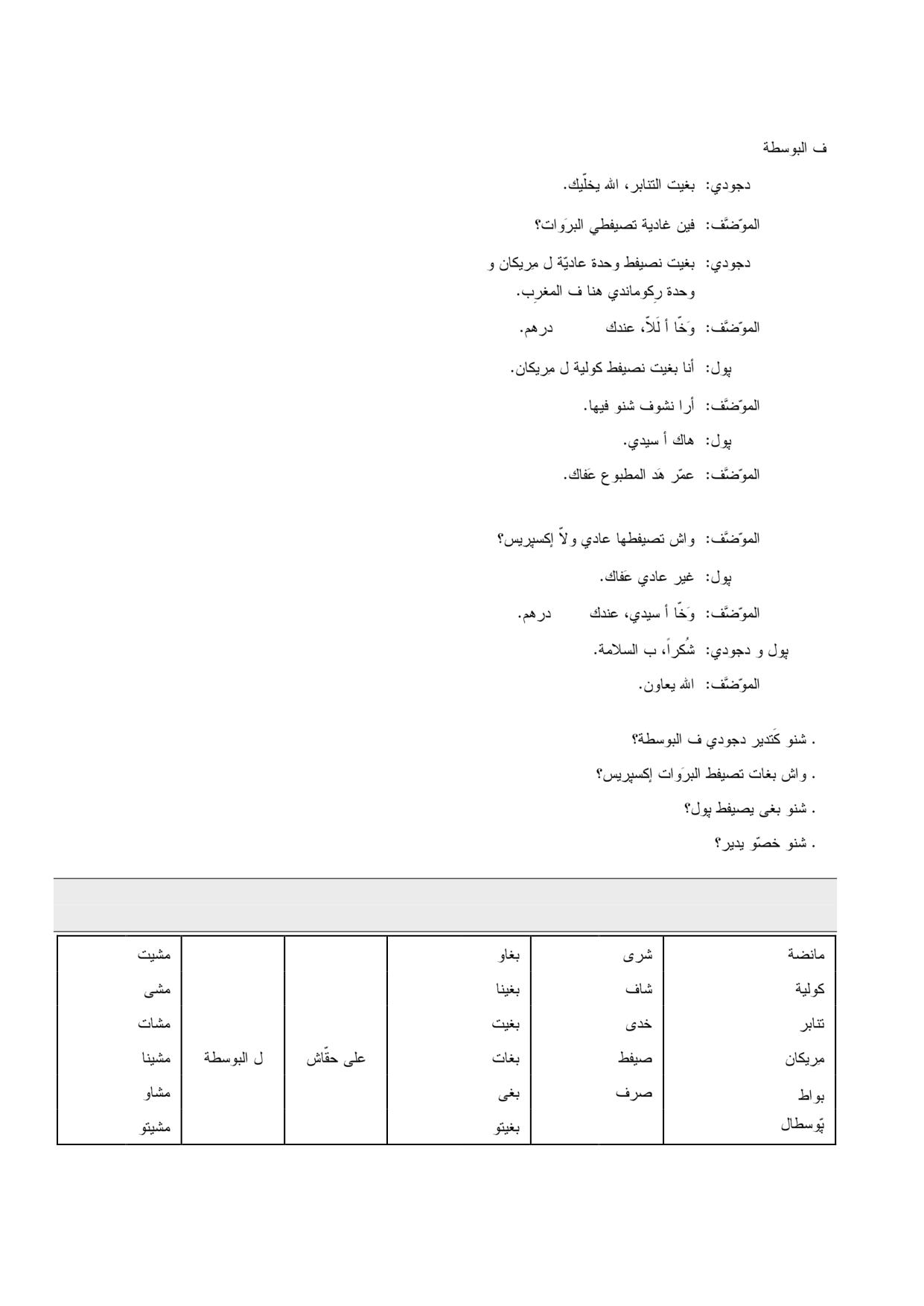
114 • Moroccan Arabic
Dialogue
f l-bosta
Judy: bġit t-tnabr, lla
y-xllik.
l-muwddaf: fin ġadya t-sifti
l-brawat?
Judy: bġit n-sift wнda عadiya
l mirikan u wнda
rikumandi hna f l-mġrib.
l-muwddaf: waxxa a lalla, عndk
22.50
22.50 drhm.
Paul: ana bġit n-sift kulya l
mirikan.
l-muwddaf: ara n-šuf šnu fiha.
Paul: hak a sidi.
l-muwddaf: عmmr had l-mtbuع عafak.
~~~~~~~~~~~~~~~~~~~~~~~~~~~~~~~~~~~~
l-muwddaf: weš t-siftha عadi wlla
ixpres?
Paul: ġir عadi عafak.
l-muwddaf: waxxa a sidi, عndk 250
250
drhm.
Paul & Judy: šukran, bslama.
l-muwddaf: lla y-عawn.
1. šnu kat-dir Judy f l-bosta?
1
2. weš bġat t-sift l-brawat ixpres?
2
3. šnu bġa y-sift Paul?
3
4. šnu xssu y-dir?
4
Exercise: Make as many sentences as you can using the following words. You may
need to add some of your own words.
mšit
bġau
šra
manda
mša
bġina
šaf
kulya
mšat
l l-bosta
عla нqqaš
bġit
xda
tnabr
mšina
bġat
sift
mirikan
mšau
bġa
srf
bwat
ppostal
mšitu
bġitu
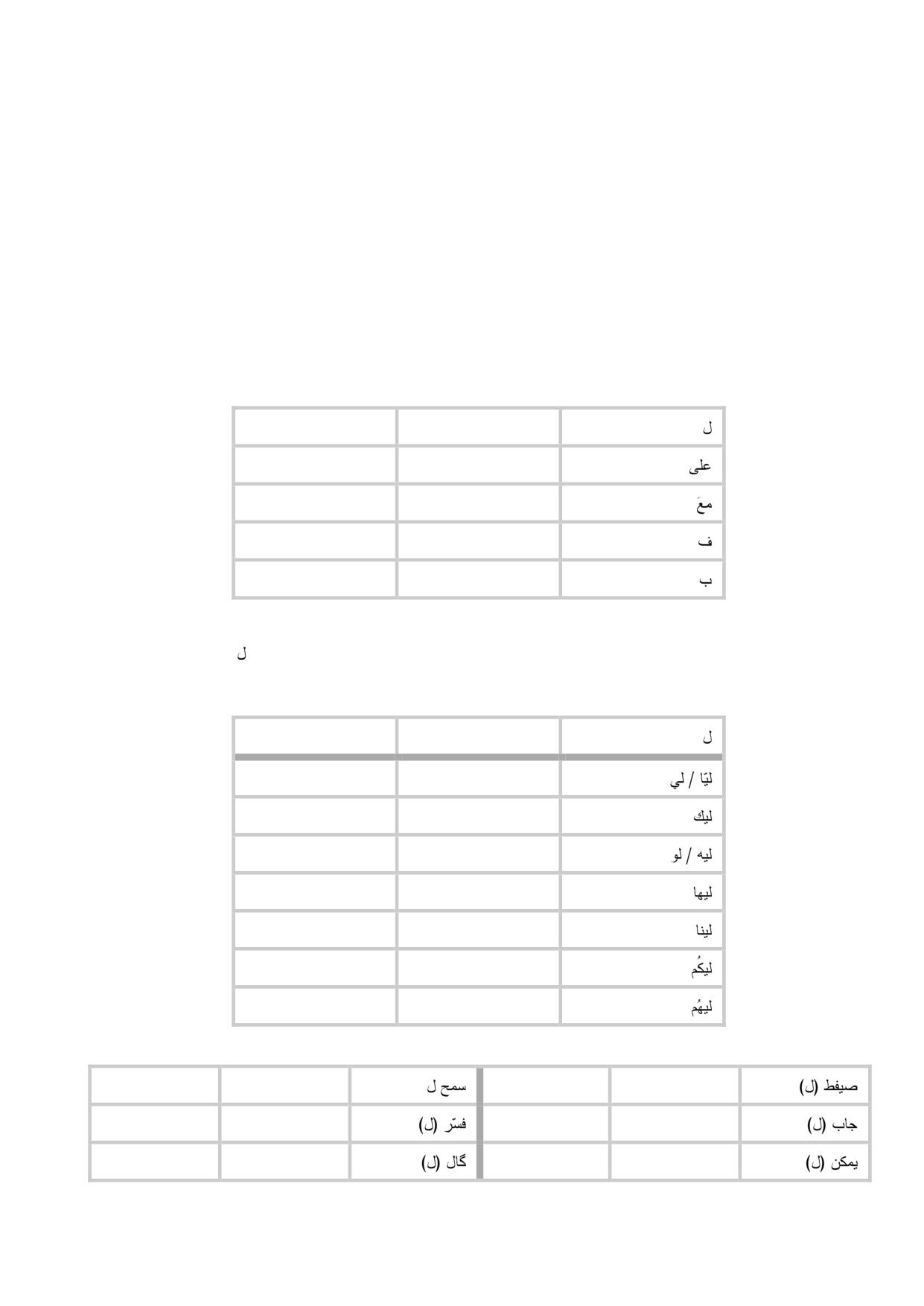
115
Using Prepositions with Pronoun Endings & Verbs
Learning how to use prepositions correctly can sometimes be tricky. First, the prepositions don‘t
always correspond directly to English prepositions . Thus, at different times in Moroccan Arabic we
will use different prepositions for what would be the same preposition in English. Second, prepositions
sometimes change in meaning depending upon the verb they are used with. This is true in English, too:
She spoke on the rights of homeless people. (on means “on the subject of”)
I put the book on the table. (on means “on top of”)
With these challenges, it may take awhile for you to be a master of Darija prepositions. But with
continued use and exposure, they will become natural for you, just as greetings are now natural for you.
In this section, we will look at two aspects of prepositions: 1. how to connect prepositions with pronoun
endings, and 2. which verbs use certain prepositions.
Some prepositions you have already learned (such as dyal) simply add the normal pronoun endings
(ex. dyali, dyalk, etc.). The following prepositions, however, change slightly when pronoun endings
are added:
to / for
l
on / about
عla
with
mعa
in / at / about
f
with / by
b
The Preposition “l”
The preposition l ( ) often means ―to‖ (ex. I gave something to you) or ―for‖ (ex. I did something for
you). It may also be used with certain verbs simply to express the meaning of the verb; in these cases, it
doesn‘t translate into anything in English. To add the pronoun endings:
to / for
l
to / for me
liya / li
to / for you (sing.)
lik
to / for him
lih / lu
to / for her
liha
to / for us
lina
to / for you (plur.)
likum
to / for them
lihum
Some verbs that go with this preposition:
excuse
smн l
send (to)
sift (l)
explain (to)
fssr (l)
bring (to)
jab (l)
say (to)
gal (l)
to be possible (for...)
ymkn (l)
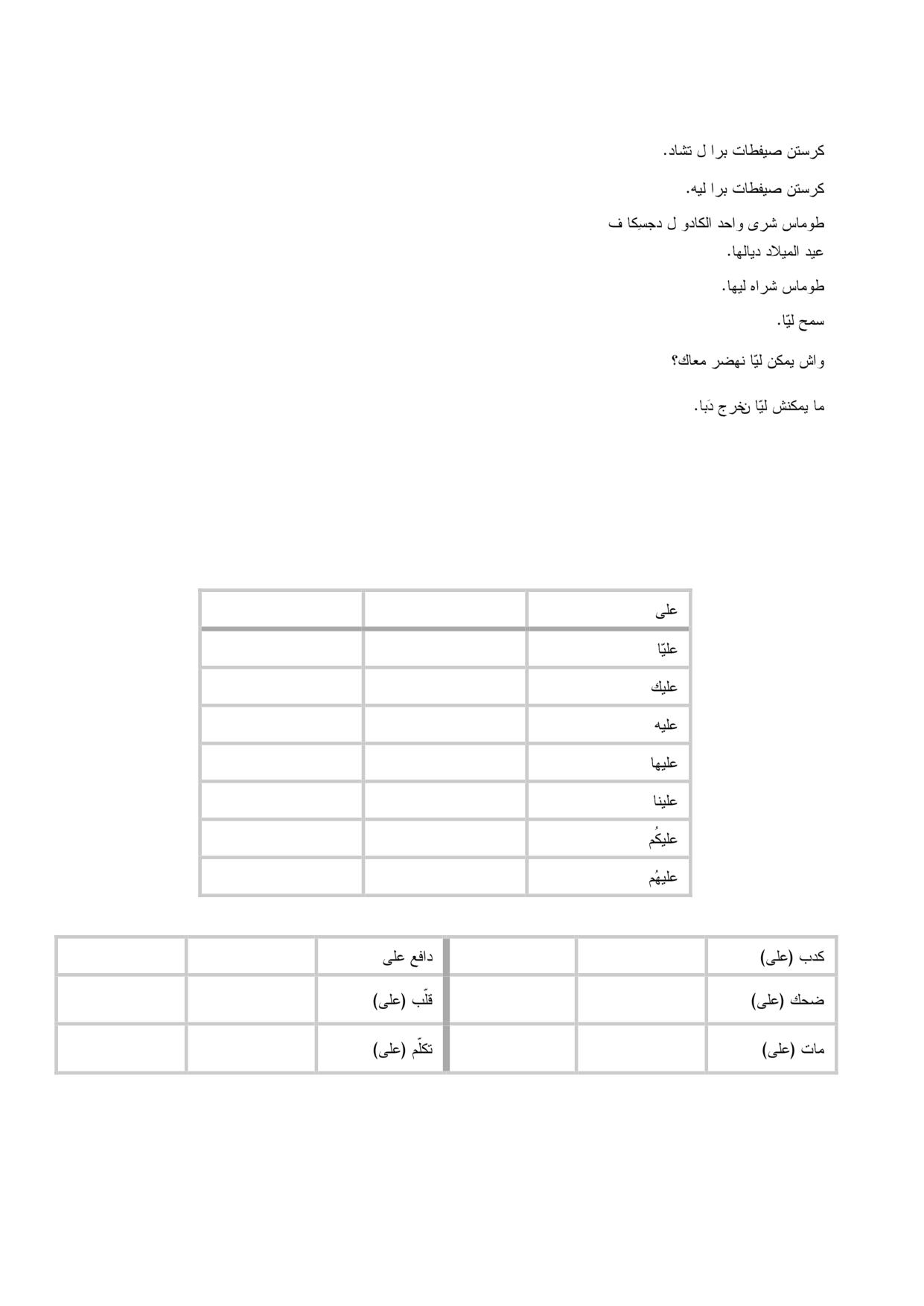
116 • Moroccan Arabic
Some examples:
Kristin siftat bra
Kristin sent a letter to Chad.
l Chad.
Kristin sent a letter to him.
Kristin siftat bra lih.
Thomas šra waнd l-kadu
Thomas bought a present for
l Jessica f عid l-milad
Jessica on her birthday.
dyalha.
Thomas bought it for her.
Thomas šrah liha.
Excuse me.
smн liya.
Can I (i.e. is it possible for me) talk with
weš ymkn liya n-hdr
you?
mعak?
I can‟t (i.e. it is not possible for me) go out ma-ymkn-š liya n-xrj
now.
deba.
As you can see in the example ―Excuse me‖ above, sometimes the Arabic verb requires the preposition
in order to be equivalent to the English verb. In these cases, the English translation doesn‘t have a
preposition, but the Arabic still requires it.
The Preposition “عla”
The preposition عla is used with many verbs and expressions, and as a result it translates into many
English prepositions, including: ―on,‖ ―about,‖ ―to,‖ ―at,‖ and others. With pronoun endings:
on (and others)
عla
on me
عliya
on you (sing.)
عlik
on him
عlih
on her
عliha
on us
عlina
on you (plur.)
عlikum
on them
عlihum
Some verbs that go with this preposition:
defend
dafع عla
lie (to)
kdb (عla)
look/search
qllb (عla)
laugh (at)
dнk (عla)
(for)
to love (i.e. to
speak (about)
tkllm (عla)
mat (عla)
be dying for)
In the first verb, ―defend,‖ the preposition عla does not have an English translation since it is required
in order to translate the Arabic verb into ―defend.‖ In the second verb, ―look/search,‖ however, the
preposition عla is basically equivalent to the English ―for.‖ Some examples:
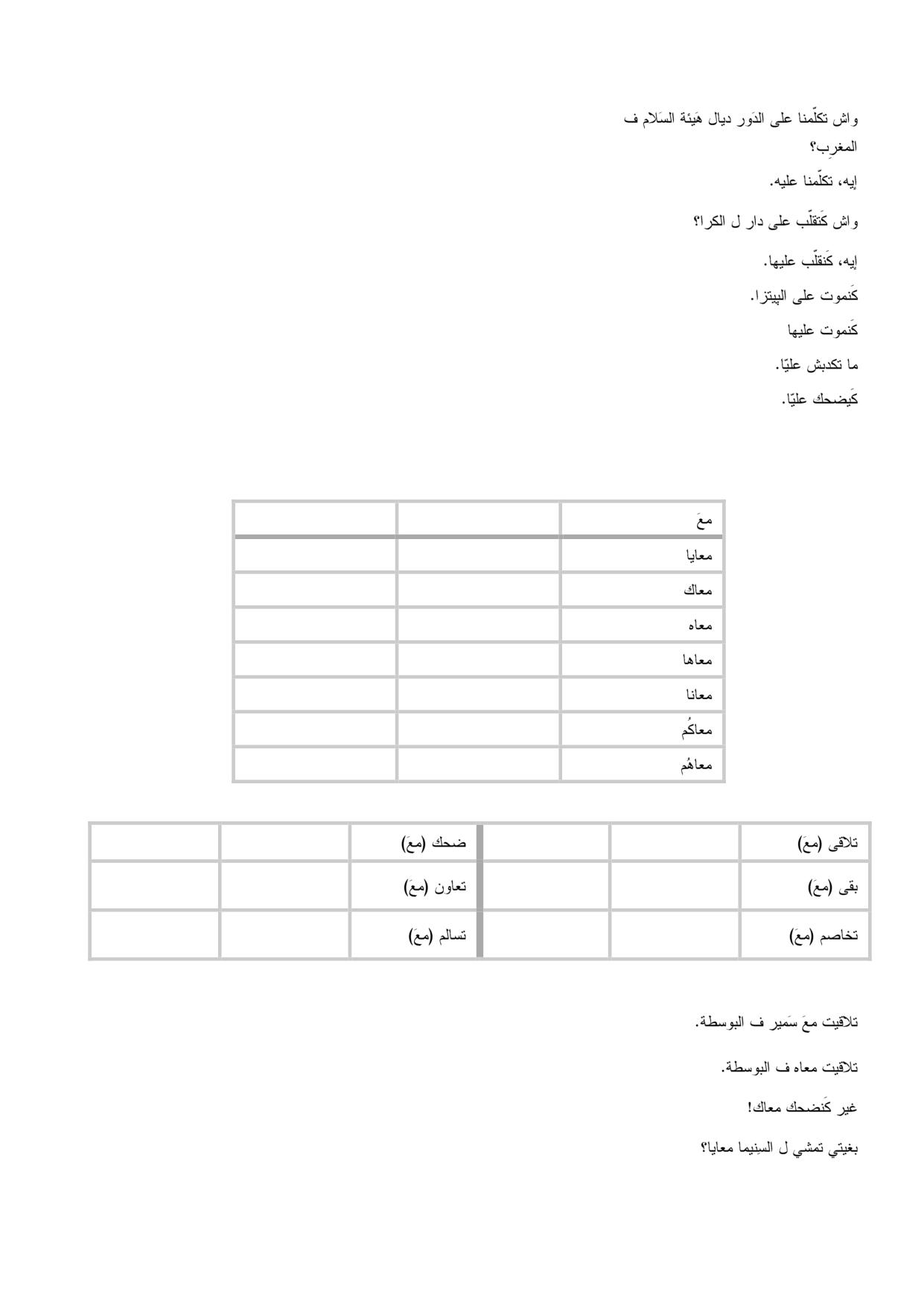
117
weš tkllmna عla d-dawr
Did we talk about the role of
dyal hay'at s-salam f
Peace Corps in Morocco?
l-mġrib?
Yes, we talked about it.
iyeh, tkllmna عlih.
Are you looking for a house to weš kat-qllb عla dar l
rent?
l-kra?
Yes, I‟m looking for one.
iyeh, kan-qllb عliha.
I love (am dying for) pizza.
kan-mut عla l-pitza.
I love it.
kan-mut عliha
Don‟t lie to me.
ma-tkdb-š عliya.
He‟s laughing at me.
kay-dнk عliya.
The Preposition “mعa”
The preposition mعa almost always translates into the English ―with.‖ With pronouns:
with
mعa
with me
mعaya
with you (sing.)
mعak
with him
mعah
with her
mعaha
with us
mعana
with you (plur.)
mعakum
with them
mعahum
Some verbs that go with this preposition:
laugh (with)
dнk (mعa)
meet (with)
tlaqa (mعa)
be helpful
tعawn (mعa)
stay (with)
bqa (mعa)
(with)
shake hands
tsalm (mعa)
argue (with)
txasm (mعa)
(with)
Some examples:
I met (with) Samir in the post
tlaqit mعa Samir f
office.
l-bosta.
I met (with) him in the post
tlaqit mعah f l-bosta.
office.
I‟m just kidding! (with you)
ġir kan-dнk mعak!
Would you like to come to the
bġiti t-mši l s-sinima
movies with me?
mعaya?
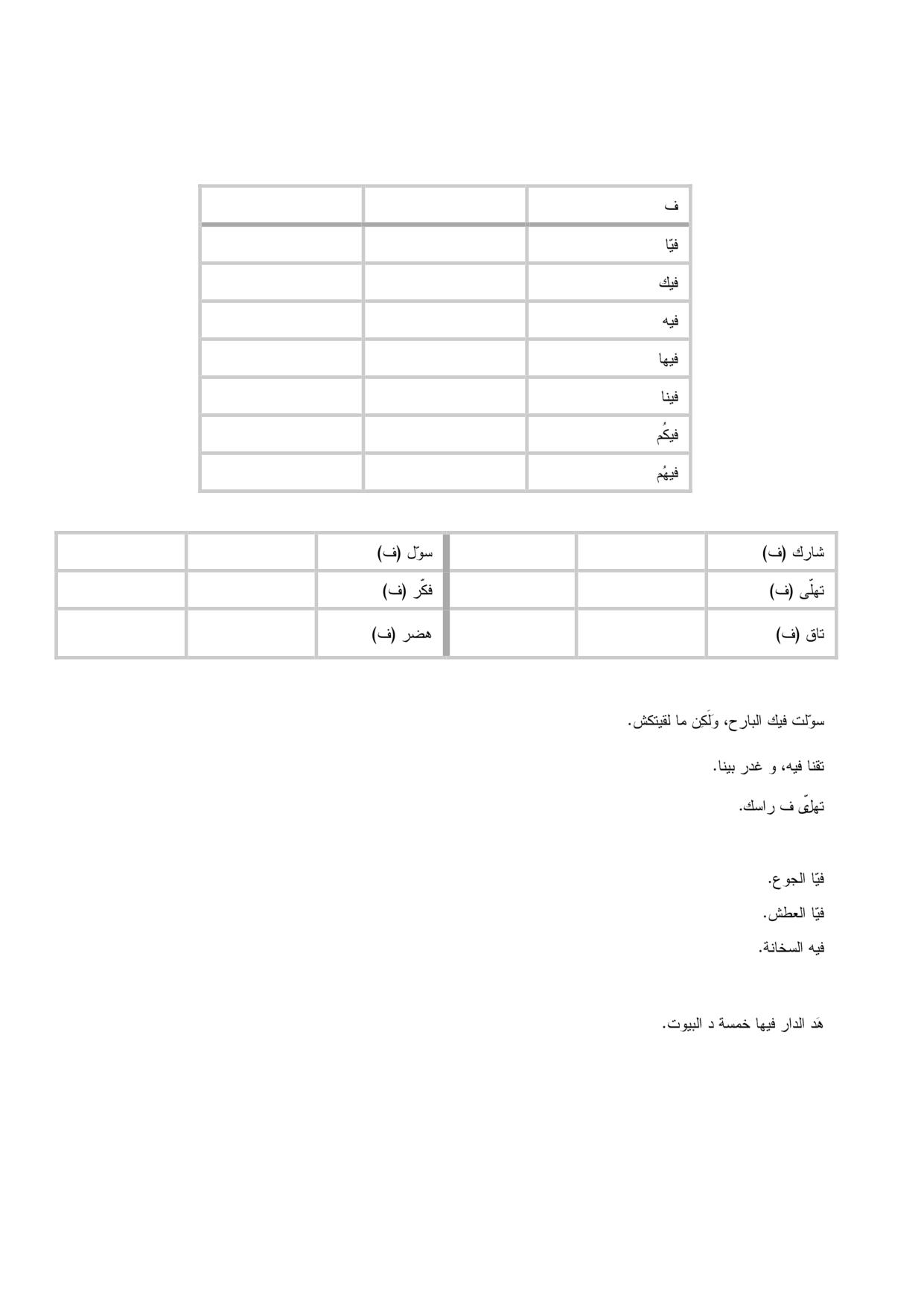
118 • Moroccan Arabic
The Preposition “f”
Like عla, the preposition f has many different English translations, including: ―in,‖ ―about,‖ ―at,‖ ―on,‖
and others. When used with pronouns:
in
f
in me
fiya
in you (sing.)
fik
in him
fih
in her
fiha
in us
fina
in you (plur.)
fikum
in them
fihum
Some verbs that go with this preposition:
ask (about)
suwl (f)
participate (in)
šark (f)
think (about)
fkkr (f)
take care (of)
thlla (f)
talk (about) a
hdr (f)
trust (in)
taq (f)
person
Some examples:
I came over (asked about you) suwlt fik l-barн,
yesterday, but I didn‟t find you.
welakin ma-lqitk-š.
We trusted (in) him, but he
tqna fih, u ġdr bina.
betrayed us.
Take care of yourself.
thlla f rask.
This preposition, with pronouns, can also have the meaning of the verb ―to be.‖
I am hungry.
fiya j-juع.
I am thirsty.
fiya l-عtš.
He has a fever.
fih s-sxana.
And sometimes it takes the meaning of ―to have‖ in the expression ―to have in it/them.‖
had d-dar fiha xmsa d
This house has five rooms.
l-byut.
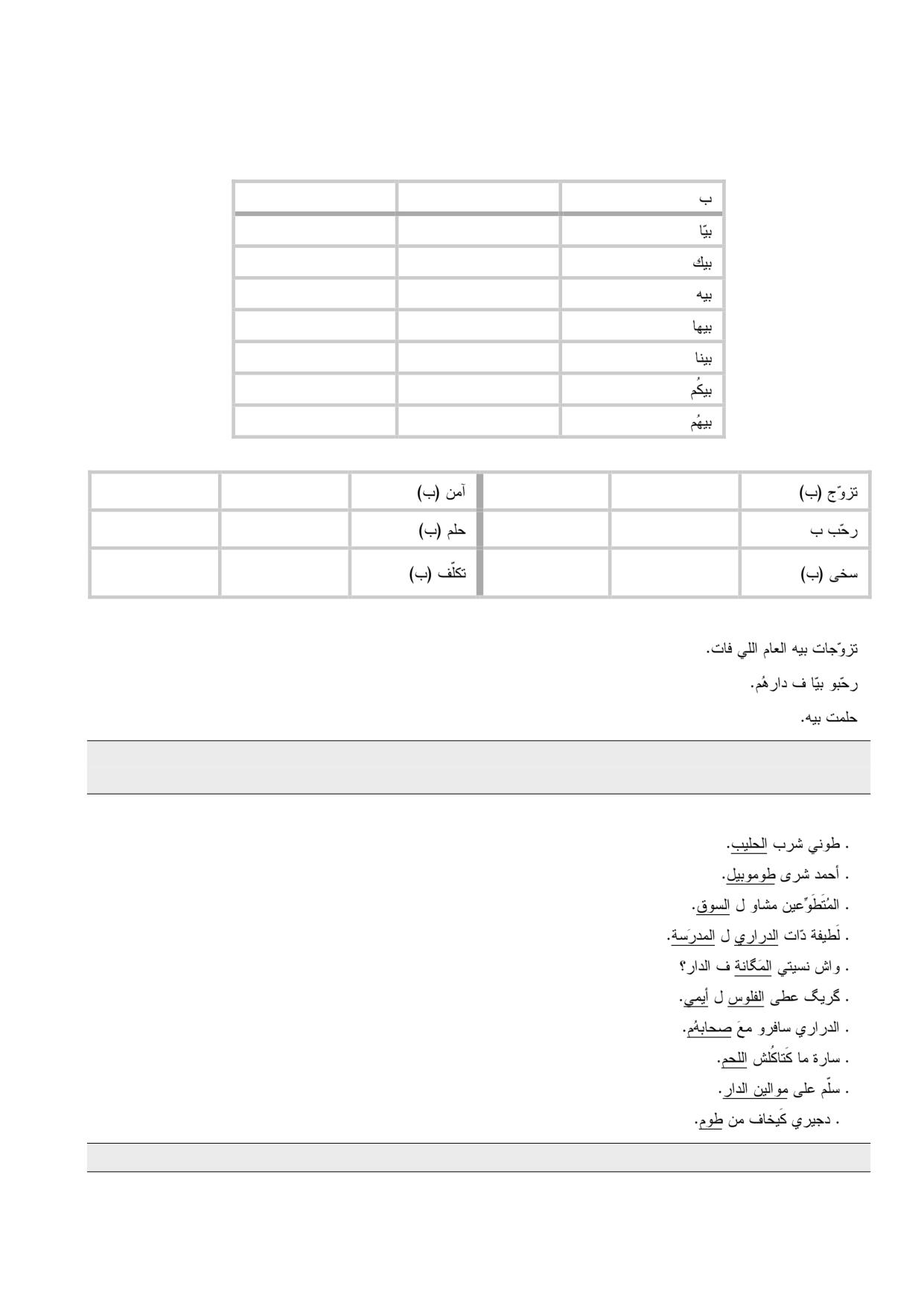
119
The Preposition “b”
The preposition b usually has the meaning of ―with‖ (I eat with my hands), but can also be used for:
―by,‖ ―in,‖ ―about,‖ ―for,‖ and others. With pronouns:
with
b
with me
biya
with you (sing.)
bik
with him
bih
with her
biha
with us
bina
with you (plur.)
bikum
with them
bihum
Some verbs that go with this preposition:
believe (in)
amn (b)
marry (with)
tzuwj (b)
dream (about)
нlm (b)
welcome
rннb b
be responsible
want to be sepa-
tkllf (b)
sxa (b)
(for)
rated (from)
Some examples:
She married (with) him last year.
tzuwjat bih l-عam l-li fat.
They welcomed me into their house. rннbu biya f darhum.
I dreamed about him.
нlmt bih.
Exercise: Replace the underlined nouns with the corresponding pronouns.
Sometimes you will need to use a preposition and pronoun together.
Example: l-qt kla l-нut. l-qt klah.
1. Tony šrb l-нlib.
1
2. Ahmed šra tumubil.
2
3. l-mutatawwiعin mšau l s-suq.
3
4. Latifa ddat d-drari l l-mdrasa.
4
5. weš nsiti l-magana f d-dar?
5
6. Greg عta l-flus l Amy.
6
7. d-drari safru mعa sнabhum.
7
8. Sara ma-kat-akul-š l-lнm.
8
9. sllm عla mwalin d-dar.
9
10. Jerry kay-xaf mn Tom.
10
Exercise: Make all of the above verb forms negative.
120 • Moroccan Arabic
Describing the Peace Corps Mission
Objective: By the end of the chapter, you will be able to:
• talk about the three goals of Peace Corps
• describe your job in Morocco
Peace Corps
Text
šnu hiya hay'at s-salam?
hay'at s-salam munddama amrikiya
kat-sift mutatawwiعin l d-duwal
n-namiya u l-ahdaf dyalha hiya:
1. t-tعawn t-tiqni
1
2. l-mirikanin y-fhmu mzyan š-šuعub
l-li stadfathum u y-عrrfu b dik
2
š-šuعub f mirikan
3. š-šuعub l-mustadifa нtta hiya
t-tعrrf عla l-mirikaniyin.
3
Vocabulary and Expressions
organization
munddama
developing nations
d-duwal n-namiya
goals
ahdaf
technical help
t-tعawn t-tiqni
peoples
š-šuعub
to host
stadf
to inform
عrrf
host (adjective)
mustadif(a)
The Three Goals Of The Peace Corps
1. To help people of interested countries
and areas in meeting their needs for
trained men and women;
2. To help promote a better
understanding of the American people
on the part of the peoples served;
3. To help promote a better
understanding of other peoples on the
part of the American people.
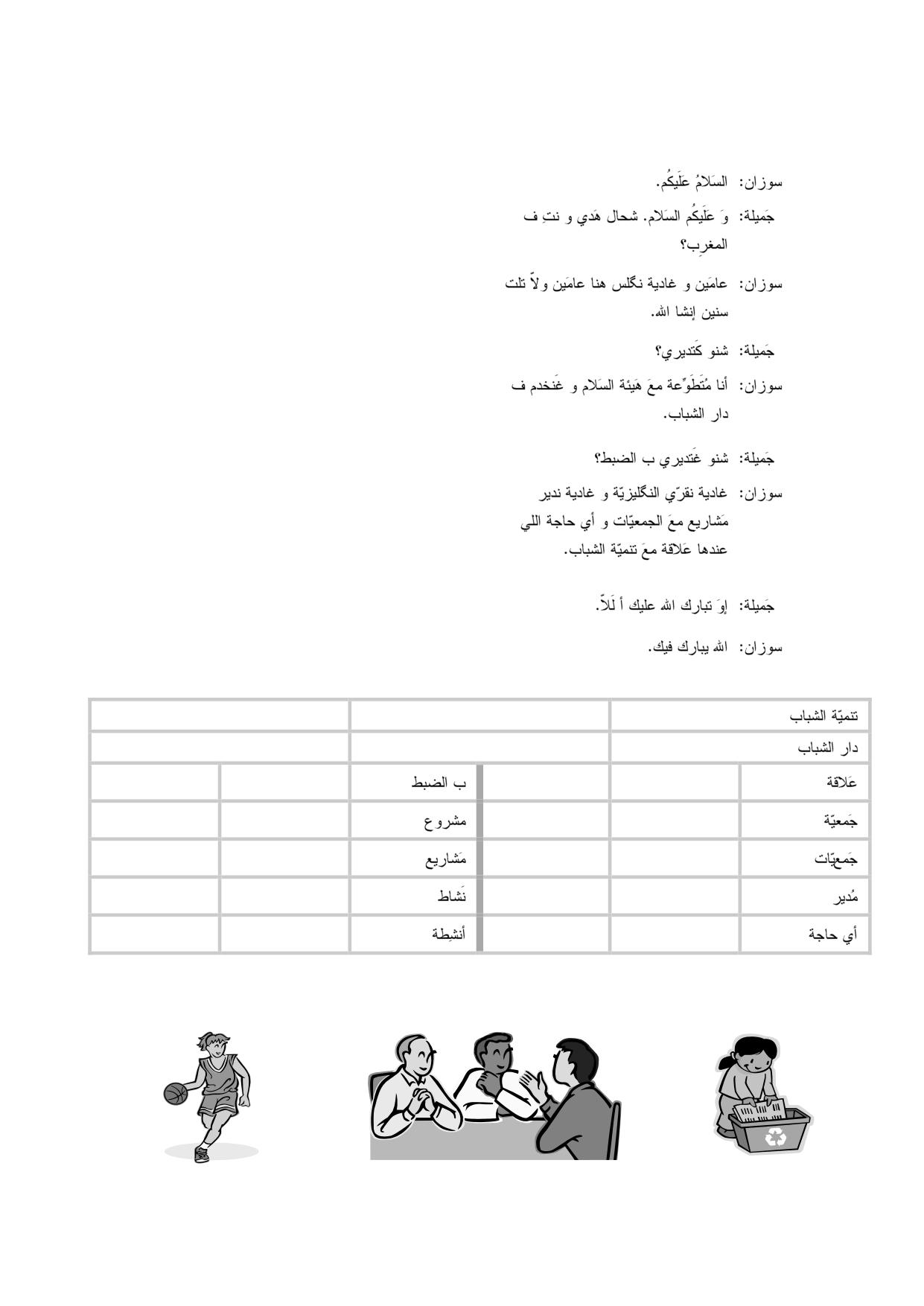
121
Youth Development
Dialogue
Susan: s-salamu عalaykum.
Jamila: wa عalaykum s-salam.
šнal hadi u nti f
l-mġrib?
Susan: عamayn u ġadya n-gls hna
عamayn wlla tlt snin
inšallah.
Jamila: šnu kat-diri?
Susan: ana mutatawwiعa mعa
hay'at s-salam u ġan-xdm
f dar š-šbab.
Jamila: šnu ġat-diri b d-dbt?
Susan: ġadya n-qrri n-ngliziya
u ġadya n-dir mašariع
mعa j-jmعiyat u ay нaja
l-li عndha عalaqa mعa
tnmiyat š-šbab.
Jamila: iwa tbark lla عlik
a lalla.
Susan: lla y-bark fik.
Vocabulary and Expressions
youth development
tnmiyat š-šbab
youth center
dar š-šbab
exactly
b d-dbt
relationship
عalaqa
project*
mšruع
association
jamعiya
projects
mašariع
associations
jamعiyat
activity*
našat
director
mudir
activities
anšita
anything
ay нaja
* In Morocco, the word for ―project‖ suggests to some Moroccans an undertaking that requires money.
The word for ―activity‖ does not have this connotation. You will often be safer, therefore, using the
word for ―activity,‖ since most of what you do will not based upon major grants or fundraising.
122 • Moroccan Arabic
Environment
Text
smiti Judy. ana kan-xdm mعa brnamaj
l-bi'a d hay'at s-salam. l-muhima
dyali hiya n-šuf kifaš n-nas
kay-tعamlu mعa t-tabiعa. kan-gul l
n-nas u t-turis l-li kay-zuru lipark
baš ma-y-luнu-š z-zbl f ay blasa. u
y-нafdu عla l-bi'a mn t-talawut.
u baš n-nas ma-y-qtعu-š š-šjr u
y-нafdu عla l-ġaba. kan-нawl n-šuf
mعahum ši turuq xora baš y-tiybu u
ma-y-sthlku-š bzzaf d l-нtb u
kan-dir mašariع mعa j-jamعiyat f
majal l-muнafada عl l-bi'a u
t-tnmiyat عl l-عumum.
Vocabulary and Expressions
environment
l-bi'a
program
brnamj
forest
ġaba
to deal (with)
tعaml (mعa)
ways
turuq
nature
tabiعa
firewood
l-нtb
trash
z-zbl
field / domain
majal
to protect
нafd عla
in general
عl l-عumum
pollution
t-tulwut
to cut
qtع
trees
š-šjr
to consume
sthlk