Intel 64 and IA-32 Architectures. Software Developer’s Manual (Collection, 2023) - page 31
INSTRUCTION SET REFERENCE, M-U
description of the REP prefix. This instruction is only useful for accessing I/O ports located in the processor’s I/O
address space. See Chapter 19, “Input/Output,” in the Intel® 64 and IA-32 Architectures Software Developer’s
Manual, Volume 1, for more information on accessing I/O ports in the I/O address space.
In 64-bit mode, the default operand size is 32 bits; operand size is not promoted by the use of REX.W. In 64-bit
mode, the default address size is 64 bits, and 64-bit address is specified using RSI by default. 32-bit address using
ESI is support using the prefix 67H, but 16-bit address is not supported in 64-bit mode.
IA-32 Architecture Compatibility
After executing an OUTS, OUTSB, OUTSW, or OUTSD instruction, the Pentium processor ensures that the EWBE#
pin has been sampled active before it begins to execute the next instruction. (Note that the instruction can be
prefetched if EWBE# is not active, but it will not be executed until the EWBE# pin is sampled active.) Only the
Pentium processor family has the EWBE# pin.
For the Pentium 4, Intel® Xeon®, and P6 processor family, upon execution of an OUTS, OUTSB, OUTSW, or OUTSD
instruction, the processor will not execute the next instruction until the data phase of the transaction is complete.
Operation
IF ((PE = 1) and ((CPL > IOPL) or (VM = 1)))
THEN (* Protected mode with CPL > IOPL or virtual-8086 mode *)
IF (Any I/O Permission Bit for I/O port being accessed = 1)
THEN (* I/O operation is not allowed *)
#GP(0);
ELSE (* I/O operation is allowed *)
DEST := SRC; (* Writes to I/O port *)
FI;
ELSE (Real Mode or Protected Mode or 64-Bit Mode with CPL ≤ IOPL *)
DEST := SRC; (* Writes to I/O port *)
FI;
Byte transfer:
IF 64-bit mode
Then
IF 64-Bit Address Size
THEN
IF DF = 0
THEN RSI := RSI RSI + 1;
ELSE RSI := RSI or - 1;
FI;
ELSE (* 32-Bit Address Size *)
IF DF = 0
THEN ESI := ESI + 1;
ELSE
ESI := ESI - 1;
FI;
FI;
ELSE
IF DF = 0
THEN (E)SI := (E)SI + 1;
ELSE (E)SI := (E)SI - 1;
FI;
FI;
Word transfer:
IF 64-bit mode
Then
IF 64-Bit Address Size
OUTS/OUTSB/OUTSW/OUTSD-Output String to Port
Vol. 2B
4-179
INSTRUCTION SET REFERENCE, M-U
THEN
IF DF = 0
THEN RSI := RSI RSI + 2;
ELSE RSI := RSI or - 2;
FI;
ELSE (* 32-Bit Address Size *)
IF DF = 0
THEN ESI := ESI + 2;
ELSE
ESI := ESI - 2;
FI;
FI;
ELSE
IF DF = 0
THEN (E)SI := (E)SI + 2;
ELSE (E)SI := (E)SI - 2;
FI;
FI;
Doubleword transfer:
IF 64-bit mode
Then
IF 64-Bit Address Size
THEN
IF DF = 0
THEN RSI := RSI RSI + 4;
ELSE RSI := RSI or - 4;
FI;
ELSE (* 32-Bit Address Size *)
IF DF = 0
THEN ESI := ESI + 4;
ELSE
ESI := ESI - 4;
FI;
FI;
ELSE
IF DF = 0
THEN (E)SI := (E)SI + 4;
ELSE (E)SI := (E)SI - 4;
FI;
FI;
Flags Affected
None.
Protected Mode Exceptions
#GP(0)
If the CPL is greater than (has less privilege) the I/O privilege level (IOPL) and any of the
corresponding I/O permission bits in TSS for the I/O port being accessed is 1.
If a memory operand effective address is outside the limit of the CS, DS, ES, FS, or GS
segment.
If the segment register contains a NULL segment selector.
#PF(fault-code)
If a page fault occurs.
#AC(0)
If alignment checking is enabled and an unaligned memory reference is made while the
current privilege level is 3.
#UD
If the LOCK prefix is used.
4-180
Vol. 2B
OUTS/OUTSB/OUTSW/OUTSD-Output String to Port
INSTRUCTION SET REFERENCE, M-U
Real-Address Mode Exceptions
#GP
If a memory operand effective address is outside the CS, DS, ES, FS, or GS segment limit.
#SS
If a memory operand effective address is outside the SS segment limit.
#UD
If the LOCK prefix is used.
Virtual-8086 Mode Exceptions
#GP(0)
If any of the I/O permission bits in the TSS for the I/O port being accessed is 1.
#PF(fault-code)
If a page fault occurs.
#AC(0)
If alignment checking is enabled and an unaligned memory reference is made.
#UD
If the LOCK prefix is used.
Compatibility Mode Exceptions
Same as for protected mode exceptions.
64-Bit Mode Exceptions
#SS(0)
If a memory address referencing the SS segment is in a non-canonical form.
#GP(0)
If the CPL is greater than (has less privilege) the I/O privilege level (IOPL) and any of the
corresponding I/O permission bits in TSS for the I/O port being accessed is 1.
If the memory address is in a non-canonical form.
#PF(fault-code)
If a page fault occurs.
#AC(0)
If alignment checking is enabled and an unaligned memory reference is made while the
current privilege level is 3.
#UD
If the LOCK prefix is used.
OUTS/OUTSB/OUTSW/OUTSD-Output String to Port
Vol. 2B
4-181

INSTRUCTION SET REFERENCE, M-U
PABSB/PABSW/PABSD/PABSQ-Packed Absolute Value
Opcode/
Op/
64/32 bit
CPUID
Description
Instruction
En
Mode
Feature
Support
Flag
NP 0F 38 1C /r1
A
V/V
SSSE3
Compute the absolute value of bytes in mm2/m64
and store UNSIGNED result in mm1.
PABSB mm1, mm2/m64
66 0F 38 1C /r
A
V/V
SSSE3
Compute the absolute value of bytes in
xmm2/m128 and store UNSIGNED result in xmm1.
PABSB xmm1, xmm2/m128
NP 0F 38 1D /r1
A
V/V
SSSE3
Compute the absolute value of 16-bit integers in
mm2/m64 and store UNSIGNED result in mm1.
PABSW mm1, mm2/m64
66 0F 38 1D /r
A
V/V
SSSE3
Compute the absolute value of 16-bit integers in
xmm2/m128 and store UNSIGNED result in xmm1.
PABSW xmm1, xmm2/m128
NP 0F 38 1E /r1
A
V/V
SSSE3
Compute the absolute value of 32-bit integers in
mm2/m64 and store UNSIGNED result in mm1.
PABSD mm1, mm2/m64
66 0F 38 1E /r
A
V/V
SSSE3
Compute the absolute value of 32-bit integers in
xmm2/m128 and store UNSIGNED result in xmm1.
PABSD xmm1, xmm2/m128
VEX.128.66.0F38.WIG 1C /r
A
V/V
AVX
Compute the absolute value of bytes in
xmm2/m128 and store UNSIGNED result in xmm1.
VPABSB xmm1, xmm2/m128
VEX.128.66.0F38.WIG 1D /r
A
V/V
AVX
Compute the absolute value of 16- bit integers in
xmm2/m128 and store UNSIGNED result in xmm1.
VPABSW xmm1, xmm2/m128
VEX.128.66.0F38.WIG 1E /r
A
V/V
AVX
Compute the absolute value of 32- bit integers in
xmm2/m128 and store UNSIGNED result in xmm1.
VPABSD xmm1, xmm2/m128
VEX.256.66.0F38.WIG 1C /r
A
V/V
AVX2
Compute the absolute value of bytes in
VPABSB ymm1, ymm2/m256
ymm2/m256 and store UNSIGNED result in ymm1.
VEX.256.66.0F38.WIG 1D /r
A
V/V
AVX2
Compute the absolute value of 16-bit integers in
ymm2/m256 and store UNSIGNED result in ymm1.
VPABSW ymm1, ymm2/m256
VEX.256.66.0F38.WIG 1E /r
A
V/V
AVX2
Compute the absolute value of 32-bit integers in
ymm2/m256 and store UNSIGNED result in ymm1.
VPABSD ymm1, ymm2/m256
EVEX.128.66.0F38.WIG 1C /r
B
V/V
AVX512VL
Compute the absolute value of bytes in
VPABSB xmm1 {k1}{z}, xmm2/m128
AVX512BW
xmm2/m128 and store UNSIGNED result in xmm1
using writemask k1.
EVEX.256.66.0F38.WIG 1C /r
B
V/V
AVX512VL
Compute the absolute value of bytes in
VPABSB ymm1 {k1}{z}, ymm2/m256
AVX512BW
ymm2/m256 and store UNSIGNED result in ymm1
using writemask k1.
EVEX.512.66.0F38.WIG 1C /r
B
V/V
AVX512BW
Compute the absolute value of bytes in
VPABSB zmm1 {k1}{z}, zmm2/m512
zmm2/m512 and store UNSIGNED result in zmm1
using writemask k1.
EVEX.128.66.0F38.WIG 1D /r
B
V/V
AVX512VL
Compute the absolute value of 16-bit integers in
VPABSW xmm1 {k1}{z}, xmm2/m128
AVX512BW
xmm2/m128 and store UNSIGNED result in xmm1
using writemask k1.
EVEX.256.66.0F38.WIG 1D /r
B
V/V
AVX512VL
Compute the absolute value of 16-bit integers in
VPABSW ymm1 {k1}{z}, ymm2/m256
AVX512BW
ymm2/m256 and store UNSIGNED result in ymm1
using writemask k1.
EVEX.512.66.0F38.WIG 1D /r
B
V/V
AVX512BW
Compute the absolute value of 16-bit integers in
VPABSW zmm1 {k1}{z}, zmm2/m512
zmm2/m512 and store UNSIGNED result in zmm1
using writemask k1.
4-182
Vol. 2B
PABSB/PABSW/PABSD/PABSQ-Packed Absolute Value

INSTRUCTION SET REFERENCE, M-U
Opcode/
Op/
64/32 bit
CPUID
Description
Instruction
En
Mode
Feature
Support
Flag
EVEX.128.66.0F38.W0 1E /r
C
V/V
AVX512VL
Compute the absolute value of 32-bit integers in
VPABSD xmm1 {k1}{z}, xmm2/m128/m32bcst
AVX512F
xmm2/m128/m32bcst and store UNSIGNED result
in xmm1 using writemask k1.
EVEX.256.66.0F38.W0 1E /r
C
V/V
AVX512VL
Compute the absolute value of 32-bit integers in
VPABSD ymm1 {k1}{z}, ymm2/m256/m32bcst
AVX512F
ymm2/m256/m32bcst and store UNSIGNED result
in ymm1 using writemask k1.
EVEX.512.66.0F38.W0 1E /r
C
V/V
AVX512F
Compute the absolute value of 32-bit integers in
VPABSD zmm1 {k1}{z}, zmm2/m512/m32bcst
zmm2/m512/m32bcst and store UNSIGNED result
in zmm1 using writemask k1.
EVEX.128.66.0F38.W1 1F /r
C
V/V
AVX512VL
Compute the absolute value of 64-bit integers in
VPABSQ xmm1 {k1}{z}, xmm2/m128/m64bcst
AVX512F
xmm2/m128/m64bcst and store UNSIGNED result
in xmm1 using writemask k1.
EVEX.256.66.0F38.W1 1F /r
C
V/V
AVX512VL
Compute the absolute value of 64-bit integers in
VPABSQ ymm1 {k1}{z}, ymm2/m256/m64bcst
AVX512F
ymm2/m256/m64bcst and store UNSIGNED result
in ymm1 using writemask k1.
EVEX.512.66.0F38.W1 1F /r
C
V/V
AVX512F
Compute the absolute value of 64-bit integers in
VPABSQ zmm1 {k1}{z}, zmm2/m512/m64bcst
zmm2/m512/m64bcst and store UNSIGNED result
in zmm1 using writemask k1.
NOTES:
1. See note in Section 2.5, “Intel® AVX and Intel® SSE Instruction Exception Classification,” in the Intel® 64 and IA-32 Architectures Soft-
ware Developer’s Manual, Volume 2A, and Section 23.25.3, “Exception Conditions of Legacy SIMD Instructions Operating on MMX
Registers,” in the Intel® 64 and IA-32 Architectures Software Developer’s Manual, Volume 3B.
Instruction Operand Encoding
Op/En
Tuple Type
Operand 1
Operand 2
Operand 3
Operand 4
A
N/A
ModRM:reg (w)
ModRM:r/m (r)
N/A
N/A
B
Full Mem
ModRM:reg (w)
ModRM:r/m (r)
N/A
N/A
C
Full
ModRM:reg (w)
ModRM:r/m (r)
N/A
N/A
Description
PABSB/W/D computes the absolute value of each data element of the source operand (the second operand) and
stores the UNSIGNED results in the destination operand (the first operand). PABSB operates on signed bytes,
PABSW operates on signed 16-bit words, and PABSD operates on signed 32-bit integers.
EVEX encoded VPABSD/Q: The source operand is a ZMM/YMM/XMM register, a 512/256/128-bit memory location,
or a 512/256/128-bit vector broadcasted from a 32/64-bit memory location. The destination operand is a
ZMM/YMM/XMM register updated according to the writemask.
EVEX encoded VPABSB/W: The source operand is a ZMM/YMM/XMM register, or a 512/256/128-bit memory loca-
tion. The destination operand is a ZMM/YMM/XMM register updated according to the writemask.
VEX.256 encoded versions: The source operand is a YMM register or a 256-bit memory location. The destination
operand is a YMM register. The upper bits (MAXVL-1:256) of the corresponding register destination are zeroed.
VEX.128 encoded versions: The source operand is an XMM register or 128-bit memory location. The destination
operand is an XMM register. The upper bits (MAXVL-1:128) of the corresponding register destination are zeroed.
128-bit Legacy SSE version: The source operand can be an XMM register or an 128-bit memory location. The desti-
nation is an XMM register. The upper bits (VL_MAX-1:128) of the corresponding register destination are unmodi-
fied.
VEX.vvvv and EVEX.vvvv are reserved and must be 1111b otherwise instructions will #UD.
PABSB/PABSW/PABSD/PABSQ-Packed Absolute Value
Vol. 2B
4-183
INSTRUCTION SET REFERENCE, M-U
Operation
PABSB With 128-bit Operands:
Unsigned DEST[7:0] := ABS(SRC[7: 0])
Repeat operation for 2nd through 15th bytes
Unsigned DEST[127:120] := ABS(SRC[127:120])
VPABSB With 128-bit Operands:
Unsigned DEST[7:0] := ABS(SRC[7: 0])
Repeat operation for 2nd through 15th bytes
Unsigned DEST[127:120] := ABS(SRC[127:120])
VPABSB With 256-bit Operands:
Unsigned DEST[7:0] := ABS(SRC[7: 0])
Repeat operation for 2nd through 31st bytes
Unsigned DEST[255:248] := ABS(SRC[255:248])
VPABSB (EVEX Encoded Versions)
(KL, VL) = (16, 128), (32, 256), (64, 512)
FOR j := 0 TO KL-1
i := j * 8
IF k1[j] OR *no writemask*
THEN
Unsigned DEST[i+7:i] := ABS(SRC[i+7:i])
ELSE
IF *merging-masking*
; merging-masking
THEN *DEST[i+7:i] remains unchanged*
ELSE *zeroing-masking*
; zeroing-masking
DEST[i+7:i] := 0
FI
FI;
ENDFOR;
DEST[MAXVL-1:VL] := 0
PABSW With 128-bit Operands:
Unsigned DEST[15:0] := ABS(SRC[15:0])
Repeat operation for 2nd through 7th 16-bit words
Unsigned DEST[127:112] := ABS(SRC[127:112])
VPABSW With 128-bit Operands:
Unsigned DEST[15:0] := ABS(SRC[15:0])
Repeat operation for 2nd through 7th 16-bit words
Unsigned DEST[127:112] := ABS(SRC[127:112])
VPABSW With 256-bit Operands:
Unsigned DEST[15:0] := ABS(SRC[15:0])
Repeat operation for 2nd through 15th 16-bit words
Unsigned DEST[255:240] := ABS(SRC[255:240])
4-184
Vol. 2B
PABSB/PABSW/PABSD/PABSQ-Packed Absolute Value
INSTRUCTION SET REFERENCE, M-U
VPABSW (EVEX Encoded Versions)
(KL, VL) = (8, 128), (16, 256), (32, 512)
FOR j := 0 TO KL-1
i := j * 16
IF k1[j] OR *no writemask*
THEN
Unsigned DEST[i+15:i] := ABS(SRC[i+15:i])
ELSE
IF *merging-masking*
; merging-masking
THEN *DEST[i+15:i] remains unchanged*
ELSE *zeroing-masking*
; zeroing-masking
DEST[i+15:i] := 0
FI
FI;
ENDFOR;
DEST[MAXVL-1:VL] := 0
PABSD With 128-bit Operands:
Unsigned DEST[31:0] := ABS(SRC[31:0])
Repeat operation for 2nd through 3rd 32-bit double words
Unsigned DEST[127:96] := ABS(SRC[127:96])
VPABSD With 128-bit Operands:
Unsigned DEST[31:0] := ABS(SRC[31:0])
Repeat operation for 2nd through 3rd 32-bit double words
Unsigned DEST[127:96] := ABS(SRC[127:96])
VPABSD With 256-bit Operands:
Unsigned DEST[31:0] := ABS(SRC[31:0])
Repeat operation for 2nd through 7th 32-bit double words
Unsigned DEST[255:224] := ABS(SRC[255:224])
VPABSD (EVEX Encoded Versions)
(KL, VL) = (4, 128), (8, 256), (16, 512)
FOR j := 0 TO KL-1
i := j * 32
IF k1[j] OR *no writemask*
THEN
IF (EVEX.b = 1) AND (SRC *is memory*)
THEN
Unsigned DEST[i+31:i] := ABS(SRC[31:0])
ELSE
Unsigned DEST[i+31:i] := ABS(SRC[i+31:i])
FI;
ELSE
IF *merging-masking*
; merging-masking
THEN *DEST[i+31:i] remains unchanged*
ELSE *zeroing-masking*
; zeroing-masking
DEST[i+31:i] := 0
FI
FI;
ENDFOR;
DEST[MAXVL-1:VL] := 0
PABSB/PABSW/PABSD/PABSQ-Packed Absolute Value
Vol. 2B
4-185
INSTRUCTION SET REFERENCE, M-U
VPABSQ (EVEX Encoded Versions)
(KL, VL) = (2, 128), (4, 256), (8, 512)
FOR j := 0 TO KL-1
i := j * 64
IF k1[j] OR *no writemask*
THEN
IF (EVEX.b = 1) AND (SRC *is memory*)
THEN
Unsigned DEST[i+63:i] := ABS(SRC[63:0])
ELSE
Unsigned DEST[i+63:i] := ABS(SRC[i+63:i])
FI;
ELSE
IF *merging-masking*
; merging-masking
THEN *DEST[i+63:i] remains unchanged*
ELSE *zeroing-masking*
; zeroing-masking
DEST[i+63:i] := 0
FI
FI;
ENDFOR;
DEST[MAXVL-1:VL] := 0
Intel C/C++ Compiler Intrinsic Equivalents
VPABSB__m512i _mm512_abs_epi8 ( __m512i a)
VPABSW__m512i _mm512_abs_epi16 ( __m512i a)
VPABSB__m512i _mm512_mask_abs_epi8 ( __m512i s, __mmask64 m, __m512i a)
VPABSW__m512i _mm512_mask_abs_epi16 ( __m512i s, __mmask32 m, __m512i a)
VPABSB__m512i _mm512_maskz_abs_epi8 (__mmask64 m, __m512i a)
VPABSW__m512i _mm512_maskz_abs_epi16 (__mmask32 m, __m512i a)
VPABSB__m256i _mm256_mask_abs_epi8 (__m256i s, __mmask32 m, __m256i a)
VPABSW__m256i _mm256_mask_abs_epi16 (__m256i s, __mmask16 m, __m256i a)
VPABSB__m256i _mm256_maskz_abs_epi8 (__mmask32 m, __m256i a)
VPABSW__m256i _mm256_maskz_abs_epi16 (__mmask16 m, __m256i a)
VPABSB__m128i _mm_mask_abs_epi8 (__m128i s, __mmask16 m, __m128i a)
VPABSW__m128i _mm_mask_abs_epi16 (__m128i s, __mmask8 m, __m128i a)
VPABSB__m128i _mm_maskz_abs_epi8 (__mmask16 m, __m128i a)
VPABSW__m128i _mm_maskz_abs_epi16 (__mmask8 m, __m128i a)
VPABSD __m256i _mm256_mask_abs_epi32(__m256i s, __mmask8 k, __m256i a);
VPABSD __m256i _mm256_maskz_abs_epi32( __mmask8 k, __m256i a);
VPABSD __m128i _mm_mask_abs_epi32(__m128i s, __mmask8 k, __m128i a);
VPABSD __m128i _mm_maskz_abs_epi32( __mmask8 k, __m128i a);
VPABSD __m512i _mm512_abs_epi32( __m512i a);
VPABSD __m512i _mm512_mask_abs_epi32(__m512i s, __mmask16 k, __m512i a);
VPABSD __m512i _mm512_maskz_abs_epi32( __mmask16 k, __m512i a);
VPABSQ __m512i _mm512_abs_epi64( __m512i a);
VPABSQ __m512i _mm512_mask_abs_epi64(__m512i s, __mmask8 k, __m512i a);
VPABSQ __m512i _mm512_maskz_abs_epi64( __mmask8 k, __m512i a);
VPABSQ __m256i _mm256_mask_abs_epi64(__m256i s, __mmask8 k, __m256i a);
VPABSQ __m256i _mm256_maskz_abs_epi64( __mmask8 k, __m256i a);
VPABSQ __m128i _mm_mask_abs_epi64(__m128i s, __mmask8 k, __m128i a);
VPABSQ __m128i _mm_maskz_abs_epi64( __mmask8 k, __m128i a);
PABSB __m128i _mm_abs_epi8 (__m128i a)
4-186
Vol. 2B
PABSB/PABSW/PABSD/PABSQ-Packed Absolute Value
INSTRUCTION SET REFERENCE, M-U
VPABSB __m128i _mm_abs_epi8 (__m128i a)
VPABSB __m256i _mm256_abs_epi8 (__m256i a)
PABSW __m128i _mm_abs_epi16 (__m128i a)
VPABSW __m128i _mm_abs_epi16 (__m128i a)
VPABSW __m256i _mm256_abs_epi16 (__m256i a)
PABSD __m128i _mm_abs_epi32 (__m128i a)
VPABSD __m128i _mm_abs_epi32 (__m128i a)
VPABSD __m256i _mm256_abs_epi32 (__m256i a)
SIMD Floating-Point Exceptions
None.
Other Exceptions
Non-EVEX-encoded instruction, see Table 2-21, “Type 4 Class Exception Conditions.”
EVEX-encoded VPABSD/Q, see Table 2-49, “Type E4 Class Exception Conditions.”
EVEX-encoded VPABSB/W, see Exceptions Type E4.nb in Table 2-49, “Type E4 Class Exception Conditions.”
PABSB/PABSW/PABSD/PABSQ-Packed Absolute Value
Vol. 2B
4-187

INSTRUCTION SET REFERENCE, M-U
PACKSSWB/PACKSSDW-Pack With Signed Saturation
Opcode/
Op/
64/32 bit
CPUID
Description
Instruction
En
Mode
Feature Flag
Support
NP 0F 63 /r1
A
V/V
MMX
Converts 4 packed signed word integers from mm1
and from mm2/m64 into 8 packed signed byte
PACKSSWB mm1, mm2/m64
integers in mm1 using signed saturation.
66 0F 63 /r
A
V/V
SSE2
Converts 8 packed signed word integers from
xmm1 and from xmm2/m128 into 16 packed
PACKSSWB xmm1, xmm2/m128
signed byte integers in xmm1 using signed
saturation.
NP 0F 6B /r1
A
V/V
MMX
Converts 2 packed signed doubleword integers
from mm1 and from mm2/m64 into 4 packed
PACKSSDW mm1, mm2/m64
signed word integers in mm1 using signed
saturation.
66 0F 6B /r
A
V/V
SSE2
Converts 4 packed signed doubleword integers
from xmm1 and from xmm2/m128 into 8 packed
PACKSSDW xmm1, xmm2/m128
signed word integers in xmm1 using signed
saturation.
VEX.128.66.0F.WIG 63 /r
B
V/V
AVX
Converts 8 packed signed word integers from
xmm2 and from xmm3/m128 into 16 packed
VPACKSSWB xmm1,xmm2, xmm3/m128
signed byte integers in xmm1 using signed
saturation.
VEX.128.66.0F.WIG 6B /r
B
V/V
AVX
Converts 4 packed signed doubleword integers
from xmm2 and from xmm3/m128 into 8 packed
VPACKSSDW xmm1,xmm2, xmm3/m128
signed word integers in xmm1 using signed
saturation.
VEX.256.66.0F.WIG 63 /r
B
V/V
AVX2
Converts 16 packed signed word integers from
ymm2 and from ymm3/m256 into 32 packed
VPACKSSWB ymm1, ymm2, ymm3/m256
signed byte integers in ymm1 using signed
saturation.
VEX.256.66.0F.WIG 6B /r
B
V/V
AVX2
Converts 8 packed signed doubleword integers
from ymm2 and from ymm3/m256 into 16 packed
VPACKSSDW ymm1, ymm2, ymm3/m256
signed word integers in ymm1using signed
saturation.
EVEX.128.66.0F.WIG 63 /r
C
V/V
AVX512VL
Converts packed signed word integers from xmm2
VPACKSSWB xmm1 {k1}{z}, xmm2,
AVX512BW
and from xmm3/m128 into packed signed byte
xmm3/m128
integers in xmm1 using signed saturation under
writemask k1.
EVEX.256.66.0F.WIG 63 /r
C
V/V
AVX512VL
Converts packed signed word integers from ymm2
VPACKSSWB ymm1 {k1}{z}, ymm2,
AVX512BW
and from ymm3/m256 into packed signed byte
ymm3/m256
integers in ymm1 using signed saturation under
writemask k1.
EVEX.512.66.0F.WIG 63 /r
C
V/V
AVX512BW
Converts packed signed word integers from zmm2
VPACKSSWB zmm1 {k1}{z}, zmm2,
and from zmm3/m512 into packed signed byte
zmm3/m512
integers in zmm1 using signed saturation under
writemask k1.
EVEX.128.66.0F.W0 6B /r
D
V/V
AVX512VL
Converts packed signed doubleword integers from
VPACKSSDW xmm1 {k1}{z}, xmm2,
AVX512BW
xmm2 and from xmm3/m128/m32bcst into packed
xmm3/m128/m32bcst
signed word integers in xmm1 using signed
saturation under writemask k1.
4-188
Vol. 2B
PACKSSWB/PACKSSDW-Pack With Signed Saturation
INSTRUCTION SET REFERENCE, M-U
Opcode/
Op/
64/32 bit
CPUID
Description
Instruction
En
Mode
Feature Flag
Support
EVEX.256.66.0F.W0 6B /r
D
V/V
AVX512VL
Converts packed signed doubleword integers from
VPACKSSDW ymm1 {k1}{z}, ymm2,
AVX512BW
ymm2 and from ymm3/m256/m32bcst into packed
ymm3/m256/m32bcst
signed word integers in ymm1 using signed
saturation under writemask k1.
EVEX.512.66.0F.W0 6B /r
D
V/V
AVX512BW
Converts packed signed doubleword integers from
VPACKSSDW zmm1 {k1}{z}, zmm2,
zmm2 and from zmm3/m512/m32bcst into packed
zmm3/m512/m32bcst
signed word integers in zmm1 using signed
saturation under writemask k1.
NOTES:
1. See note in Section 2.5, “Intel® AVX and Intel® SSE Instruction Exception Classification,” in the Intel® 64 and IA-32 Architectures Soft-
ware Developer’s Manual, Volume 2A, and Section 23.25.3, “Exception Conditions of Legacy SIMD Instructions Operating on MMX Reg-
isters,” in the Intel® 64 and IA-32 Architectures Software Developer’s Manual, Volume 3B.
Instruction Operand Encoding
Op/En
Tuple Type
Operand 1
Operand 2
Operand 3
Operand 4
A
N/A
ModRM:reg (r, w)
ModRM:r/m (r)
N/A
N/A
B
N/A
ModRM:reg (w)
VEX.vvvv (r)
ModRM:r/m (r)
N/A
C
Full Mem
ModRM:reg (w)
EVEX.vvvv (r)
ModRM:r/m (r)
N/A
D
Full
ModRM:reg (w)
EVEX.vvvv (r)
ModRM:r/m (r)
N/A
Description
Converts packed signed word integers into packed signed byte integers (PACKSSWB) or converts packed signed
doubleword integers into packed signed word integers (PACKSSDW), using saturation to handle overflow condi-
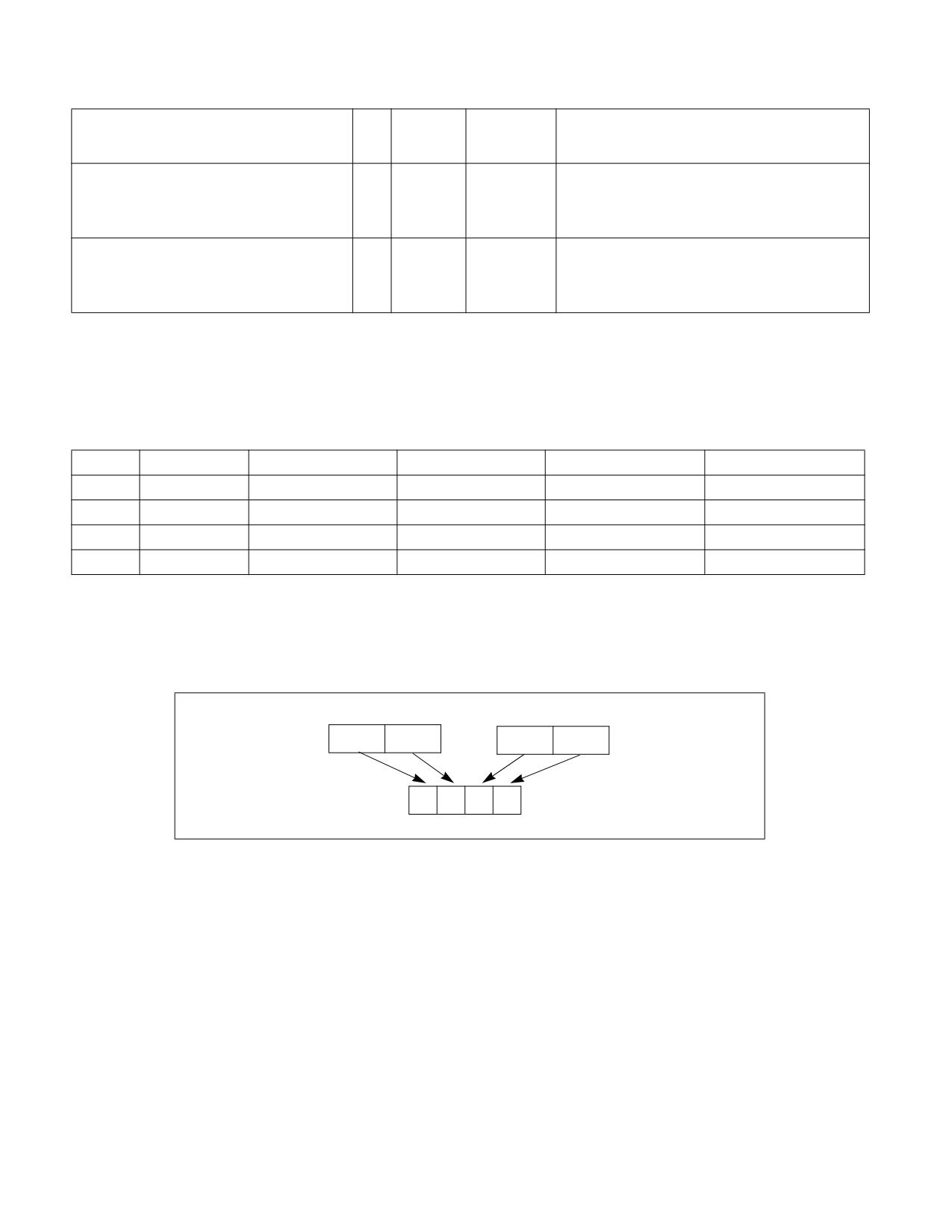
tions. See Figure 4-6 for an example of the packing operation.
64-Bit SRC
64-Bit DEST
D
C
B
A
D’
C’
B’
A’
64-Bit DEST
Figure 4-6. Operation of the PACKSSDW Instruction Using 64-Bit Operands
PACKSSWB converts packed signed word integers in the first and second source operands into packed signed byte
integers using signed saturation to handle overflow conditions beyond the range of signed byte integers. If the
signed word value is beyond the range of a signed byte value (i.e., greater than 7FH or less than 80H), the satu-
rated signed byte integer value of 7FH or 80H, respectively, is stored in the destination. PACKSSDW converts
packed signed doubleword integers in the first and second source operands into packed signed word integers using
signed saturation to handle overflow conditions beyond 7FFFH and 8000H.
EVEX encoded PACKSSWB: The first source operand is a ZMM/YMM/XMM register. The second source operand is a
ZMM/YMM/XMM register or a 512/256/128-bit memory location. The destination operand is a ZMM/YMM/XMM
register, updated conditional under the writemask k1.
EVEX encoded PACKSSDW: The first source operand is a ZMM/YMM/XMM register. The second source operand is a
ZMM/YMM/XMM register, a 512/256/128-bit memory location, or a 512/256/128-bit vector broadcasted from a 32-
PACKSSWB/PACKSSDW-Pack With Signed Saturation
Vol. 2B
4-189
INSTRUCTION SET REFERENCE, M-U
bit memory location. The destination operand is a ZMM/YMM/XMM register, updated conditional under the write-
mask k1.
VEX.256 encoded version: The first source operand is a YMM register. The second source operand is a YMM register
or a 256-bit memory location. The destination operand is a YMM register. The upper bits (MAXVL-1:256) of the
corresponding ZMM register destination are zeroed.
VEX.128 encoded version: The first source operand is an XMM register. The second source operand is an XMM
register or 128-bit memory location. The destination operand is an XMM register. The upper bits (MAXVL-1:128) of
the corresponding ZMM register destination are zeroed.
128-bit Legacy SSE version: The first source operand is an XMM register. The second operand can be an XMM
register or an 128-bit memory location. The destination is not distinct from the first source XMM register and the
upper bits (MAXVL-1:128) of the corresponding ZMM destination register destination are unmodified.
Operation
PACKSSWB Instruction (128-bit Legacy SSE Version)
DEST[7:0] := SaturateSignedWordToSignedByte (DEST[15:0]);
DEST[15:8] := SaturateSignedWordToSignedByte (DEST[31:16]);
DEST[23:16] := SaturateSignedWordToSignedByte (DEST[47:32]);
DEST[31:24] := SaturateSignedWordToSignedByte (DEST[63:48]);
DEST[39:32] := SaturateSignedWordToSignedByte (DEST[79:64]);
DEST[47:40] := SaturateSignedWordToSignedByte (DEST[95:80]);
DEST[55:48] := SaturateSignedWordToSignedByte (DEST[111:96]);
DEST[63:56] := SaturateSignedWordToSignedByte (DEST[127:112]);
DEST[71:64] := SaturateSignedWordToSignedByte (SRC[15:0]);
DEST[79:72] := SaturateSignedWordToSignedByte (SRC[31:16]);
DEST[87:80] := SaturateSignedWordToSignedByte (SRC[47:32]);
DEST[95:88] := SaturateSignedWordToSignedByte (SRC[63:48]);
DEST[103:96] := SaturateSignedWordToSignedByte (SRC[79:64]);
DEST[111:104] := SaturateSignedWordToSignedByte (SRC[95:80]);
DEST[119:112] := SaturateSignedWordToSignedByte (SRC[111:96]);
DEST[127:120] := SaturateSignedWordToSignedByte (SRC[127:112]);
DEST[MAXVL-1:128] (Unmodified)
PACKSSDW Instruction (128-bit Legacy SSE Version)
DEST[15:0] := SaturateSignedDwordToSignedWord (DEST[31:0]);
DEST[31:16] := SaturateSignedDwordToSignedWord (DEST[63:32]);
DEST[47:32] := SaturateSignedDwordToSignedWord (DEST[95:64]);
DEST[63:48] := SaturateSignedDwordToSignedWord (DEST[127:96]);
DEST[79:64] := SaturateSignedDwordToSignedWord (SRC[31:0]);
DEST[95:80] := SaturateSignedDwordToSignedWord (SRC[63:32]);
DEST[111:96] := SaturateSignedDwordToSignedWord (SRC[95:64]);
DEST[127:112] := SaturateSignedDwordToSignedWord (SRC[127:96]);
DEST[MAXVL-1:128] (Unmodified)
4-190
Vol. 2B
PACKSSWB/PACKSSDW-Pack With Signed Saturation
INSTRUCTION SET REFERENCE, M-U
VPACKSSWB Instruction (VEX.128 Encoded Version)
DEST[7:0] := SaturateSignedWordToSignedByte (SRC1[15:0]);
DEST[15:8] := SaturateSignedWordToSignedByte (SRC1[31:16]);
DEST[23:16] := SaturateSignedWordToSignedByte (SRC1[47:32]);
DEST[31:24] := SaturateSignedWordToSignedByte (SRC1[63:48]);
DEST[39:32] := SaturateSignedWordToSignedByte (SRC1[79:64]);
DEST[47:40] := SaturateSignedWordToSignedByte (SRC1[95:80]);
DEST[55:48] := SaturateSignedWordToSignedByte (SRC1[111:96]);
DEST[63:56] := SaturateSignedWordToSignedByte (SRC1[127:112]);
DEST[71:64] := SaturateSignedWordToSignedByte (SRC2[15:0]);
DEST[79:72] := SaturateSignedWordToSignedByte (SRC2[31:16]);
DEST[87:80] := SaturateSignedWordToSignedByte (SRC2[47:32]);
DEST[95:88] := SaturateSignedWordToSignedByte (SRC2[63:48]);
DEST[103:96] := SaturateSignedWordToSignedByte (SRC2[79:64]);
DEST[111:104] := SaturateSignedWordToSignedByte (SRC2[95:80]);
DEST[119:112] := SaturateSignedWordToSignedByte (SRC2[111:96]);
DEST[127:120] := SaturateSignedWordToSignedByte (SRC2[127:112]);
DEST[MAXVL-1:128] := 0;
VPACKSSDW Instruction (VEX.128 Encoded Version)
DEST[15:0] := SaturateSignedDwordToSignedWord (SRC1[31:0]);
DEST[31:16] := SaturateSignedDwordToSignedWord (SRC1[63:32]);
DEST[47:32] := SaturateSignedDwordToSignedWord (SRC1[95:64]);
DEST[63:48] := SaturateSignedDwordToSignedWord (SRC1[127:96]);
DEST[79:64] := SaturateSignedDwordToSignedWord (SRC2[31:0]);
DEST[95:80] := SaturateSignedDwordToSignedWord (SRC2[63:32]);
DEST[111:96] := SaturateSignedDwordToSignedWord (SRC2[95:64]);
DEST[127:112] := SaturateSignedDwordToSignedWord (SRC2[127:96]);
DEST[MAXVL-1:128] := 0;
VPACKSSWB Instruction (VEX.256 Encoded Version)
DEST[7:0] := SaturateSignedWordToSignedByte (SRC1[15:0]);
DEST[15:8] := SaturateSignedWordToSignedByte (SRC1[31:16]);
DEST[23:16] := SaturateSignedWordToSignedByte (SRC1[47:32]);
DEST[31:24] := SaturateSignedWordToSignedByte (SRC1[63:48]);
DEST[39:32] := SaturateSignedWordToSignedByte (SRC1[79:64]);
DEST[47:40] := SaturateSignedWordToSignedByte (SRC1[95:80]);
DEST[55:48] := SaturateSignedWordToSignedByte (SRC1[111:96]);
DEST[63:56] := SaturateSignedWordToSignedByte (SRC1[127:112]);
DEST[71:64] := SaturateSignedWordToSignedByte (SRC2[15:0]);
DEST[79:72] := SaturateSignedWordToSignedByte (SRC2[31:16]);
DEST[87:80] := SaturateSignedWordToSignedByte (SRC2[47:32]);
DEST[95:88] := SaturateSignedWordToSignedByte (SRC2[63:48]);
DEST[103:96] := SaturateSignedWordToSignedByte (SRC2[79:64]);
DEST[111:104] := SaturateSignedWordToSignedByte (SRC2[95:80]);
DEST[119:112] := SaturateSignedWordToSignedByte (SRC2[111:96]);
DEST[127:120] := SaturateSignedWordToSignedByte (SRC2[127:112]);
DEST[135:128] := SaturateSignedWordToSignedByte (SRC1[143:128]);
DEST[143:136] := SaturateSignedWordToSignedByte (SRC1[159:144]);
DEST[151:144] := SaturateSignedWordToSignedByte (SRC1[175:160]);
DEST[159:152] := SaturateSignedWordToSignedByte (SRC1[191:176]);
DEST[167:160] := SaturateSignedWordToSignedByte (SRC1[207:192]);
DEST[175:168] := SaturateSignedWordToSignedByte (SRC1[223:208]);
DEST[183:176] := SaturateSignedWordToSignedByte (SRC1[239:224]);
PACKSSWB/PACKSSDW-Pack With Signed Saturation
Vol. 2B
4-191
INSTRUCTION SET REFERENCE, M-U
DEST[191:184] := SaturateSignedWordToSignedByte (SRC1[255:240]);
DEST[199:192] := SaturateSignedWordToSignedByte (SRC2[143:128]);
DEST[207:200] := SaturateSignedWordToSignedByte (SRC2[159:144]);
DEST[215:208] := SaturateSignedWordToSignedByte (SRC2[175:160]);
DEST[223:216] := SaturateSignedWordToSignedByte (SRC2[191:176]);
DEST[231:224] := SaturateSignedWordToSignedByte (SRC2[207:192]);
DEST[239:232] := SaturateSignedWordToSignedByte (SRC2[223:208]);
DEST[247:240] := SaturateSignedWordToSignedByte (SRC2[239:224]);
DEST[255:248] := SaturateSignedWordToSignedByte (SRC2[255:240]);
DEST[MAXVL-1:256] := 0;
VPACKSSDW Instruction (VEX.256 Encoded Version)
DEST[15:0] := SaturateSignedDwordToSignedWord (SRC1[31:0]);
DEST[31:16] := SaturateSignedDwordToSignedWord (SRC1[63:32]);
DEST[47:32] := SaturateSignedDwordToSignedWord (SRC1[95:64]);
DEST[63:48] := SaturateSignedDwordToSignedWord (SRC1[127:96]);
DEST[79:64] := SaturateSignedDwordToSignedWord (SRC2[31:0]);
DEST[95:80] := SaturateSignedDwordToSignedWord (SRC2[63:32]);
DEST[111:96] := SaturateSignedDwordToSignedWord (SRC2[95:64]);
DEST[127:112] := SaturateSignedDwordToSignedWord (SRC2[127:96]);
DEST[143:128] := SaturateSignedDwordToSignedWord (SRC1[159:128]);
DEST[159:144] := SaturateSignedDwordToSignedWord (SRC1[191:160]);
DEST[175:160] := SaturateSignedDwordToSignedWord (SRC1[223:192]);
DEST[191:176] := SaturateSignedDwordToSignedWord (SRC1[255:224]);
DEST[207:192] := SaturateSignedDwordToSignedWord (SRC2[159:128]);
DEST[223:208] := SaturateSignedDwordToSignedWord (SRC2[191:160]);
DEST[239:224] := SaturateSignedDwordToSignedWord (SRC2[223:192]);
DEST[255:240] := SaturateSignedDwordToSignedWord (SRC2[255:224]);
DEST[MAXVL-1:256] := 0;
VPACKSSWB (EVEX Encoded Versions)
(KL, VL) = (16, 128), (32, 256), (64, 512)
TMP_DEST[7:0] := SaturateSignedWordToSignedByte (SRC1[15:0]);
TMP_DEST[15:8] := SaturateSignedWordToSignedByte (SRC1[31:16]);
TMP_DEST[23:16] := SaturateSignedWordToSignedByte (SRC1[47:32]);
TMP_DEST[31:24] := SaturateSignedWordToSignedByte (SRC1[63:48]);
TMP_DEST[39:32] := SaturateSignedWordToSignedByte (SRC1[79:64]);
TMP_DEST[47:40] := SaturateSignedWordToSignedByte (SRC1[95:80]);
TMP_DEST[55:48] := SaturateSignedWordToSignedByte (SRC1[111:96]);
TMP_DEST[63:56] := SaturateSignedWordToSignedByte (SRC1[127:112]);
TMP_DEST[71:64] := SaturateSignedWordToSignedByte (SRC2[15:0]);
TMP_DEST[79:72] := SaturateSignedWordToSignedByte (SRC2[31:16]);
TMP_DEST[87:80] := SaturateSignedWordToSignedByte (SRC2[47:32]);
TMP_DEST[95:88] := SaturateSignedWordToSignedByte (SRC2[63:48]);
TMP_DEST[103:96] := SaturateSignedWordToSignedByte (SRC2[79:64]);
TMP_DEST[111:104] := SaturateSignedWordToSignedByte (SRC2[95:80]);
TMP_DEST[119:112] := SaturateSignedWordToSignedByte (SRC2[111:96]);
TMP_DEST[127:120] := SaturateSignedWordToSignedByte (SRC2[127:112]);
IF VL >= 256
TMP_DEST[135:128] := SaturateSignedWordToSignedByte (SRC1[143:128]);
TMP_DEST[143:136] := SaturateSignedWordToSignedByte (SRC1[159:144]);
TMP_DEST[151:144] := SaturateSignedWordToSignedByte (SRC1[175:160]);
TMP_DEST[159:152] := SaturateSignedWordToSignedByte (SRC1[191:176]);
TMP_DEST[167:160] := SaturateSignedWordToSignedByte (SRC1[207:192]);
4-192
Vol. 2B
PACKSSWB/PACKSSDW-Pack With Signed Saturation
INSTRUCTION SET REFERENCE, M-U
TMP_DEST[175:168] := SaturateSignedWordToSignedByte (SRC1[223:208]);
TMP_DEST[183:176] := SaturateSignedWordToSignedByte (SRC1[239:224]);
TMP_DEST[191:184] := SaturateSignedWordToSignedByte (SRC1[255:240]);
TMP_DEST[199:192] := SaturateSignedWordToSignedByte (SRC2[143:128]);
TMP_DEST[207:200] := SaturateSignedWordToSignedByte (SRC2[159:144]);
TMP_DEST[215:208] := SaturateSignedWordToSignedByte (SRC2[175:160]);
TMP_DEST[223:216] := SaturateSignedWordToSignedByte (SRC2[191:176]);
TMP_DEST[231:224] := SaturateSignedWordToSignedByte (SRC2[207:192]);
TMP_DEST[239:232] := SaturateSignedWordToSignedByte (SRC2[223:208]);
TMP_DEST[247:240] := SaturateSignedWordToSignedByte (SRC2[239:224]);
TMP_DEST[255:248] := SaturateSignedWordToSignedByte (SRC2[255:240]);
FI;
IF VL >= 512
TMP_DEST[263:256] := SaturateSignedWordToSignedByte (SRC1[271:256]);
TMP_DEST[271:264] := SaturateSignedWordToSignedByte (SRC1[287:272]);
TMP_DEST[279:272] := SaturateSignedWordToSignedByte (SRC1[303:288]);
TMP_DEST[287:280] := SaturateSignedWordToSignedByte (SRC1[319:304]);
TMP_DEST[295:288] := SaturateSignedWordToSignedByte (SRC1[335:320]);
TMP_DEST[303:296] := SaturateSignedWordToSignedByte (SRC1[351:336]);
TMP_DEST[311:304] := SaturateSignedWordToSignedByte (SRC1[367:352]);
TMP_DEST[319:312] := SaturateSignedWordToSignedByte (SRC1[383:368]);
TMP_DEST[327:320] := SaturateSignedWordToSignedByte (SRC2[271:256]);
TMP_DEST[335:328] := SaturateSignedWordToSignedByte (SRC2[287:272]);
TMP_DEST[343:336] := SaturateSignedWordToSignedByte (SRC2[303:288]);
TMP_DEST[351:344] := SaturateSignedWordToSignedByte (SRC2[319:304]);
TMP_DEST[359:352] := SaturateSignedWordToSignedByte (SRC2[335:320]);
TMP_DEST[367:360] := SaturateSignedWordToSignedByte (SRC2[351:336]);
TMP_DEST[375:368] := SaturateSignedWordToSignedByte (SRC2[367:352]);
TMP_DEST[383:376] := SaturateSignedWordToSignedByte (SRC2[383:368]);
TMP_DEST[391:384] := SaturateSignedWordToSignedByte (SRC1[399:384]);
TMP_DEST[399:392] := SaturateSignedWordToSignedByte (SRC1[415:400]);
TMP_DEST[407:400] := SaturateSignedWordToSignedByte (SRC1[431:416]);
TMP_DEST[415:408] := SaturateSignedWordToSignedByte (SRC1[447:432]);
TMP_DEST[423:416] := SaturateSignedWordToSignedByte (SRC1[463:448]);
TMP_DEST[431:424] := SaturateSignedWordToSignedByte (SRC1[479:464]);
TMP_DEST[439:432] := SaturateSignedWordToSignedByte (SRC1[495:480]);
TMP_DEST[447:440] := SaturateSignedWordToSignedByte (SRC1[511:496]);
TMP_DEST[455:448] := SaturateSignedWordToSignedByte (SRC2[399:384]);
TMP_DEST[463:456] := SaturateSignedWordToSignedByte (SRC2[415:400]);
TMP_DEST[471:464] := SaturateSignedWordToSignedByte (SRC2[431:416]);
TMP_DEST[479:472] := SaturateSignedWordToSignedByte (SRC2[447:432]);
TMP_DEST[487:480] := SaturateSignedWordToSignedByte (SRC2[463:448]);
TMP_DEST[495:488] := SaturateSignedWordToSignedByte (SRC2[479:464]);
TMP_DEST[503:496] := SaturateSignedWordToSignedByte (SRC2[495:480]);
TMP_DEST[511:504] := SaturateSignedWordToSignedByte (SRC2[511:496]);
FI;
FOR j := 0 TO KL-1
i := j * 8
IF k1[j] OR *no writemask*
THEN
DEST[i+7:i] := TMP_DEST[i+7:i]
PACKSSWB/PACKSSDW-Pack With Signed Saturation
Vol. 2B
4-193
INSTRUCTION SET REFERENCE, M-U
ELSE
IF *merging-masking*
; merging-masking
THEN *DEST[i+7:i] remains unchanged*
ELSE *zeroing-masking*
; zeroing-masking
DEST[i+7:i] := 0
FI
FI;
ENDFOR;
DEST[MAXVL-1:VL] := 0
VPACKSSDW (EVEX Encoded Versions)
(KL, VL) = (8, 128), (16, 256), (32, 512)
FOR j := 0 TO ((KL/2) - 1)
i := j * 32
IF (EVEX.b == 1) AND (SRC2 *is memory*)
THEN
TMP_SRC2[i+31:i] := SRC2[31:0]
ELSE
TMP_SRC2[i+31:i] := SRC2[i+31:i]
FI;
ENDFOR;
TMP_DEST[15:0] := SaturateSignedDwordToSignedWord (SRC1[31:0]);
TMP_DEST[31:16] := SaturateSignedDwordToSignedWord (SRC1[63:32]);
TMP_DEST[47:32] := SaturateSignedDwordToSignedWord (SRC1[95:64]);
TMP_DEST[63:48] := SaturateSignedDwordToSignedWord (SRC1[127:96]);
TMP_DEST[79:64] := SaturateSignedDwordToSignedWord (TMP_SRC2[31:0]);
TMP_DEST[95:80] := SaturateSignedDwordToSignedWord (TMP_SRC2[63:32]);
TMP_DEST[111:96] := SaturateSignedDwordToSignedWord (TMP_SRC2[95:64]);
TMP_DEST[127:112] := SaturateSignedDwordToSignedWord (TMP_SRC2[127:96]);
IF VL >= 256
TMP_DEST[143:128] := SaturateSignedDwordToSignedWord (SRC1[159:128]);
TMP_DEST[159:144] := SaturateSignedDwordToSignedWord (SRC1[191:160]);
TMP_DEST[175:160] := SaturateSignedDwordToSignedWord (SRC1[223:192]);
TMP_DEST[191:176] := SaturateSignedDwordToSignedWord (SRC1[255:224]);
TMP_DEST[207:192] := SaturateSignedDwordToSignedWord (TMP_SRC2[159:128]);
TMP_DEST[223:208] := SaturateSignedDwordToSignedWord (TMP_SRC2[191:160]);
TMP_DEST[239:224] := SaturateSignedDwordToSignedWord (TMP_SRC2[223:192]);
TMP_DEST[255:240] := SaturateSignedDwordToSignedWord (TMP_SRC2[255:224]);
FI;
IF VL >= 512
TMP_DEST[271:256] := SaturateSignedDwordToSignedWord (SRC1[287:256]);
TMP_DEST[287:272] := SaturateSignedDwordToSignedWord (SRC1[319:288]);
TMP_DEST[303:288] := SaturateSignedDwordToSignedWord (SRC1[351:320]);
TMP_DEST[319:304] := SaturateSignedDwordToSignedWord (SRC1[383:352]);
TMP_DEST[335:320] := SaturateSignedDwordToSignedWord (TMP_SRC2[287:256]);
TMP_DEST[351:336] := SaturateSignedDwordToSignedWord (TMP_SRC2[319:288]);
TMP_DEST[367:352] := SaturateSignedDwordToSignedWord (TMP_SRC2[351:320]);
TMP_DEST[383:368] := SaturateSignedDwordToSignedWord (TMP_SRC2[383:352]);
TMP_DEST[399:384] := SaturateSignedDwordToSignedWord (SRC1[415:384]);
TMP_DEST[415:400] := SaturateSignedDwordToSignedWord (SRC1[447:416]);
TMP_DEST[431:416] := SaturateSignedDwordToSignedWord (SRC1[479:448]);
4-194
Vol. 2B
PACKSSWB/PACKSSDW-Pack With Signed Saturation
INSTRUCTION SET REFERENCE, M-U
TMP_DEST[447:432] := SaturateSignedDwordToSignedWord (SRC1[511:480]);
TMP_DEST[463:448] := SaturateSignedDwordToSignedWord (TMP_SRC2[415:384]);
TMP_DEST[479:464] := SaturateSignedDwordToSignedWord (TMP_SRC2[447:416]);
TMP_DEST[495:480] := SaturateSignedDwordToSignedWord (TMP_SRC2[479:448]);
TMP_DEST[511:496] := SaturateSignedDwordToSignedWord (TMP_SRC2[511:480]);
FI;
FOR j := 0 TO KL-1
i := j * 16
IF k1[j] OR *no writemask*
THEN DEST[i+15:i] := TMP_DEST[i+15:i]
ELSE
IF *merging-masking*
; merging-masking
THEN *DEST[i+15:i] remains unchanged*
ELSE *zeroing-masking*
; zeroing-masking
DEST[i+15:i] := 0
FI
FI;
ENDFOR;
DEST[MAXVL-1:VL] := 0
Intel C/C++ Compiler Intrinsic Equivalents
VPACKSSDW__m512i _mm512_packs_epi32(__m512i m1, __m512i m2);
VPACKSSDW__m512i _mm512_mask_packs_epi32(__m512i s, __mmask32 k, __m512i m1, __m512i m2);
VPACKSSDW__m512i _mm512_maskz_packs_epi32( __mmask32 k, __m512i m1, __m512i m2);
VPACKSSDW__m256i _mm256_mask_packs_epi32( __m256i s, __mmask16 k, __m256i m1, __m256i m2);
VPACKSSDW__m256i _mm256_maskz_packs_epi32( __mmask16 k, __m256i m1, __m256i m2);
VPACKSSDW__m128i _mm_mask_packs_epi32( __m128i s, __mmask8 k, __m128i m1, __m128i m2);
VPACKSSDW__m128i _mm_maskz_packs_epi32( __mmask8 k, __m128i m1, __m128i m2);
VPACKSSWB__m512i _mm512_packs_epi16(__m512i m1, __m512i m2);
VPACKSSWB__m512i _mm512_mask_packs_epi16(__m512i s, __mmask32 k, __m512i m1, __m512i m2);
VPACKSSWB__m512i _mm512_maskz_packs_epi16( __mmask32 k, __m512i m1, __m512i m2);
VPACKSSWB__m256i _mm256_mask_packs_epi16( __m256i s, __mmask16 k, __m256i m1, __m256i m2);
VPACKSSWB__m256i _mm256_maskz_packs_epi16( __mmask16 k, __m256i m1, __m256i m2);
VPACKSSWB__m128i _mm_mask_packs_epi16( __m128i s, __mmask8 k, __m128i m1, __m128i m2);
VPACKSSWB__m128i _mm_maskz_packs_epi16( __mmask8 k, __m128i m1, __m128i m2);
PACKSSWB __m128i _mm_packs_epi16(__m128i m1, __m128i m2)
PACKSSDW __m128i _mm_packs_epi32(__m128i m1, __m128i m2)
VPACKSSWB __m256i _mm256_packs_epi16(__m256i m1, __m256i m2)
VPACKSSDW __m256i _mm256_packs_epi32(__m256i m1, __m256i m2)
SIMD Floating-Point Exceptions
None.
Other Exceptions
Non-EVEX-encoded instruction, see Table 2-21, “Type 4 Class Exception Conditions.”
EVEX-encoded VPACKSSDW, see Table 2-50, “Type E4NF Class Exception Conditions.”
EVEX-encoded VPACKSSWB, see Exceptions Type E4NF.nb in Table 2-50, “Type E4NF Class Exception Conditions.”
PACKSSWB/PACKSSDW-Pack With Signed Saturation
Vol. 2B
4-195

INSTRUCTION SET REFERENCE, M-U
PACKUSDW-Pack With Unsigned Saturation
Opcode/
Op /
64/32 bit
CPUID
Description
Instruction
En
Mode
Feature Flag
Support
66 0F 38 2B /r
A
V/V
SSE4_1
Convert 4 packed signed doubleword integers from xmm1
PACKUSDW xmm1, xmm2/m128
and 4 packed signed doubleword integers from xmm2/m128
into 8 packed unsigned word integers in xmm1 using
unsigned saturation.
VEX.128.66.0F38 2B /r
B
V/V
AVX
Convert 4 packed signed doubleword integers from xmm2
VPACKUSDW xmm1,xmm2,
and 4 packed signed doubleword integers from xmm3/m128
xmm3/m128
into 8 packed unsigned word integers in xmm1 using
unsigned saturation.
VEX.256.66.0F38 2B /r
B
V/V
AVX2
Convert 8 packed signed doubleword integers from ymm2
VPACKUSDW ymm1, ymm2,
and 8 packed signed doubleword integers from ymm3/m256
ymm3/m256
into 16 packed unsigned word integers in ymm1 using
unsigned saturation.
EVEX.128.66.0F38.W0 2B /r
C
V/V
AVX512VL
Convert packed signed doubleword integers from xmm2 and
VPACKUSDW xmm1{k1}{z}, xmm2,
AVX512BW
packed signed doubleword integers from
xmm3/m128/m32bcst
xmm3/m128/m32bcst into packed unsigned word integers in
xmm1 using unsigned saturation under writemask k1.
EVEX.256.66.0F38.W0 2B /r
C
V/V
AVX512VL
Convert packed signed doubleword integers from ymm2 and
VPACKUSDW ymm1{k1}{z}, ymm2,
AVX512BW
packed signed doubleword integers from
ymm3/m256/m32bcst
ymm3/m256/m32bcst into packed unsigned word integers in
ymm1 using unsigned saturation under writemask k1.
EVEX.512.66.0F38.W0 2B /r
C
V/V
AVX512BW
Convert packed signed doubleword integers from zmm2 and
VPACKUSDW zmm1{k1}{z}, zmm2,
packed signed doubleword integers from
zmm3/m512/m32bcst
zmm3/m512/m32bcst into packed unsigned word integers in
zmm1 using unsigned saturation under writemask k1.
Instruction Operand Encoding
Op/En
Tuple Type
Operand 1
Operand 2
Operand 3
Operand 4
A
N/A
ModRM:reg (r, w)
ModRM:r/m (r)
N/A
N/A
B
N/A
ModRM:reg (w)
VEX.vvvv (r)
ModRM:r/m (r)
N/A
C
Full
ModRM:reg (w)
EVEX.vvvv (r)
ModRM:r/m (r)
N/A
Description
Converts packed signed doubleword integers in the first and second source operands into packed unsigned word
integers using unsigned saturation to handle overflow conditions. If the signed doubleword value is beyond the
range of an unsigned word (that is, greater than FFFFH or less than 0000H), the saturated unsigned word integer
value of FFFFH or 0000H, respectively, is stored in the destination.
EVEX encoded versions: The first source operand is a ZMM/YMM/XMM register. The second source operand is a
ZMM/YMM/XMM register, a 512/256/128-bit memory location, or a 512/256/128-bit vector broadcasted from a 32-
bit memory location. The destination operand is a ZMM register, updated conditionally under the writemask k1.
VEX.256 encoded version: The first source operand is a YMM register. The second source operand is a YMM register
or a 256-bit memory location. The destination operand is a YMM register. The upper bits (MAXVL-1:256) of the
corresponding ZMM register destination are zeroed.
VEX.128 encoded version: The first source operand is an XMM register. The second source operand is an XMM
register or 128-bit memory location. The destination operand is an XMM register. The upper bits (MAXVL-1:128) of
the corresponding ZMM register destination are zeroed.
4-196
Vol. 2B
PACKUSDW-Pack With Unsigned Saturation
INSTRUCTION SET REFERENCE, M-U
128-bit Legacy SSE version: The first source operand is an XMM register. The second operand can be an XMM
register or an 128-bit memory location. The destination is not distinct from the first source XMM register and the
upper bits (MAXVL-1:128) of the corresponding destination register destination are unmodified.
Operation
PACKUSDW (Legacy SSE Instruction)
TMP[15:0] := (DEST[31:0] < 0) ? 0 : DEST[15:0];
DEST[15:0] := (DEST[31:0] > FFFFH) ? FFFFH : TMP[15:0] ;
TMP[31:16] := (DEST[63:32] < 0) ? 0 : DEST[47:32];
DEST[31:16] := (DEST[63:32] > FFFFH) ? FFFFH : TMP[31:16] ;
TMP[47:32] := (DEST[95:64] < 0) ? 0 : DEST[79:64];
DEST[47:32] := (DEST[95:64] > FFFFH) ? FFFFH : TMP[47:32] ;
TMP[63:48] := (DEST[127:96] < 0) ? 0 : DEST[111:96];
DEST[63:48] := (DEST[127:96] > FFFFH) ? FFFFH : TMP[63:48] ;
TMP[79:64] := (SRC[31:0] < 0) ? 0 : SRC[15:0];
DEST[79:64] := (SRC[31:0] > FFFFH) ? FFFFH : TMP[79:64] ;
TMP[95:80] := (SRC[63:32] < 0) ? 0 : SRC[47:32];
DEST[95:80] := (SRC[63:32] > FFFFH) ? FFFFH : TMP[95:80] ;
TMP[111:96] := (SRC[95:64] < 0) ? 0 : SRC[79:64];
DEST[111:96] := (SRC[95:64] > FFFFH) ? FFFFH : TMP[111:96] ;
TMP[127:112] := (SRC[127:96] < 0) ? 0 : SRC[111:96];
DEST[127:112] := (SRC[127:96] > FFFFH) ? FFFFH : TMP[127:112] ;
DEST[MAXVL-1:128] (Unmodified)
PACKUSDW (VEX.128 Encoded Version)
TMP[15:0] := (SRC1[31:0] < 0) ? 0 : SRC1[15:0];
DEST[15:0] := (SRC1[31:0] > FFFFH) ? FFFFH : TMP[15:0] ;
TMP[31:16] := (SRC1[63:32] < 0) ? 0 : SRC1[47:32];
DEST[31:16] := (SRC1[63:32] > FFFFH) ? FFFFH : TMP[31:16] ;
TMP[47:32] := (SRC1[95:64] < 0) ? 0 : SRC1[79:64];
DEST[47:32] := (SRC1[95:64] > FFFFH) ? FFFFH : TMP[47:32] ;
TMP[63:48] := (SRC1[127:96] < 0) ? 0 : SRC1[111:96];
DEST[63:48] := (SRC1[127:96] > FFFFH) ? FFFFH : TMP[63:48] ;
TMP[79:64] := (SRC2[31:0] < 0) ? 0 : SRC2[15:0];
DEST[79:64] := (SRC2[31:0] > FFFFH) ? FFFFH : TMP[79:64] ;
TMP[95:80] := (SRC2[63:32] < 0) ? 0 : SRC2[47:32];
DEST[95:80] := (SRC2[63:32] > FFFFH) ? FFFFH : TMP[95:80] ;
TMP[111:96] := (SRC2[95:64] < 0) ? 0 : SRC2[79:64];
DEST[111:96] := (SRC2[95:64] > FFFFH) ? FFFFH : TMP[111:96] ;
TMP[127:112] := (SRC2[127:96] < 0) ? 0 : SRC2[111:96];
DEST[127:112] := (SRC2[127:96] > FFFFH) ? FFFFH : TMP[127:112];
DEST[MAXVL-1:128] := 0;
VPACKUSDW (VEX.256 Encoded Version)
TMP[15:0] := (SRC1[31:0] < 0) ? 0 : SRC1[15:0];
DEST[15:0] := (SRC1[31:0] > FFFFH) ? FFFFH : TMP[15:0] ;
TMP[31:16] := (SRC1[63:32] < 0) ? 0 : SRC1[47:32];
DEST[31:16] := (SRC1[63:32] > FFFFH) ? FFFFH : TMP[31:16] ;
TMP[47:32] := (SRC1[95:64] < 0) ? 0 : SRC1[79:64];
DEST[47:32] := (SRC1[95:64] > FFFFH) ? FFFFH : TMP[47:32] ;
TMP[63:48] := (SRC1[127:96] < 0) ? 0 : SRC1[111:96];
DEST[63:48] := (SRC1[127:96] > FFFFH) ? FFFFH : TMP[63:48] ;
TMP[79:64] := (SRC2[31:0] < 0) ? 0 : SRC2[15:0];
DEST[79:64] := (SRC2[31:0] > FFFFH) ? FFFFH : TMP[79:64] ;
PACKUSDW-Pack With Unsigned Saturation
Vol. 2B
4-197
INSTRUCTION SET REFERENCE, M-U
TMP[95:80] := (SRC2[63:32] < 0) ? 0 : SRC2[47:32];
DEST[95:80] := (SRC2[63:32] > FFFFH) ? FFFFH : TMP[95:80] ;
TMP[111:96] := (SRC2[95:64] < 0) ? 0 : SRC2[79:64];
DEST[111:96] := (SRC2[95:64] > FFFFH) ? FFFFH : TMP[111:96] ;
TMP[127:112] := (SRC2[127:96] < 0) ? 0 : SRC2[111:96];
DEST[127:112] := (SRC2[127:96] > FFFFH) ? FFFFH : TMP[127:112] ;
TMP[143:128] := (SRC1[159:128] < 0) ? 0 : SRC1[143:128];
DEST[143:128] := (SRC1[159:128] > FFFFH) ? FFFFH : TMP[143:128] ;
TMP[159:144] := (SRC1[191:160] < 0) ? 0 : SRC1[175:160];
DEST[159:144] := (SRC1[191:160] > FFFFH) ? FFFFH : TMP[159:144] ;
TMP[175:160] := (SRC1[223:192] < 0) ? 0 : SRC1[207:192];
DEST[175:160] := (SRC1[223:192] > FFFFH) ? FFFFH : TMP[175:160] ;
TMP[191:176] := (SRC1[255:224] < 0) ? 0 : SRC1[239:224];
DEST[191:176] := (SRC1[255:224] > FFFFH) ? FFFFH : TMP[191:176] ;
TMP[207:192] := (SRC2[159:128] < 0) ? 0 : SRC2[143:128];
DEST[207:192] := (SRC2[159:128] > FFFFH) ? FFFFH : TMP[207:192] ;
TMP[223:208] := (SRC2[191:160] < 0) ? 0 : SRC2[175:160];
DEST[223:208] := (SRC2[191:160] > FFFFH) ? FFFFH : TMP[223:208] ;
TMP[239:224] := (SRC2[223:192] < 0) ? 0 : SRC2[207:192];
DEST[239:224] := (SRC2[223:192] > FFFFH) ? FFFFH : TMP[239:224] ;
TMP[255:240] := (SRC2[255:224] < 0) ? 0 : SRC2[239:224];
DEST[255:240] := (SRC2[255:224] > FFFFH) ? FFFFH : TMP[255:240] ;
DEST[MAXVL-1:256] := 0;
VPACKUSDW (EVEX Encoded Versions)
(KL, VL) = (8, 128), (16, 256), (32, 512)
FOR j := 0 TO ((KL/2) - 1)
i := j * 32
IF (EVEX.b == 1) AND (SRC2 *is memory*)
THEN
TMP_SRC2[i+31:i] := SRC2[31:0]
ELSE
TMP_SRC2[i+31:i] := SRC2[i+31:i]
FI;
ENDFOR;
TMP[15:0] := (SRC1[31:0] < 0) ? 0 : SRC1[15:0];
DEST[15:0] := (SRC1[31:0] > FFFFH) ? FFFFH : TMP[15:0] ;
TMP[31:16] := (SRC1[63:32] < 0) ? 0 : SRC1[47:32];
DEST[31:16] := (SRC1[63:32] > FFFFH) ? FFFFH : TMP[31:16] ;
TMP[47:32] := (SRC1[95:64] < 0) ? 0 : SRC1[79:64];
DEST[47:32] := (SRC1[95:64] > FFFFH) ? FFFFH : TMP[47:32] ;
TMP[63:48] := (SRC1[127:96] < 0) ? 0 : SRC1[111:96];
DEST[63:48] := (SRC1[127:96] > FFFFH) ? FFFFH : TMP[63:48] ;
TMP[79:64] := (TMP_SRC2[31:0] < 0) ? 0 : TMP_SRC2[15:0];
DEST[79:64] := (TMP_SRC2[31:0] > FFFFH) ? FFFFH : TMP[79:64] ;
TMP[95:80] := (TMP_SRC2[63:32] < 0) ? 0 : TMP_SRC2[47:32];
DEST[95:80] := (TMP_SRC2[63:32] > FFFFH) ? FFFFH : TMP[95:80] ;
TMP[111:96] := (TMP_SRC2[95:64] < 0) ? 0 : TMP_SRC2[79:64];
DEST[111:96] := (TMP_SRC2[95:64] > FFFFH) ? FFFFH : TMP[111:96] ;
TMP[127:112] := (TMP_SRC2[127:96] < 0) ? 0 : TMP_SRC2[111:96];
DEST[127:112] := (TMP_SRC2[127:96] > FFFFH) ? FFFFH : TMP[127:112] ;
IF VL >= 256
4-198
Vol. 2B
PACKUSDW-Pack With Unsigned Saturation
INSTRUCTION SET REFERENCE, M-U
TMP[143:128] := (SRC1[159:128] < 0) ? 0 : SRC1[143:128];
DEST[143:128] := (SRC1[159:128] > FFFFH) ? FFFFH : TMP[143:128] ;
TMP[159:144] := (SRC1[191:160] < 0) ? 0 : SRC1[175:160];
DEST[159:144] := (SRC1[191:160] > FFFFH) ? FFFFH : TMP[159:144] ;
TMP[175:160] := (SRC1[223:192] < 0) ? 0 : SRC1[207:192];
DEST[175:160] := (SRC1[223:192] > FFFFH) ? FFFFH : TMP[175:160] ;
TMP[191:176] := (SRC1[255:224] < 0) ? 0 : SRC1[239:224];
DEST[191:176] := (SRC1[255:224] > FFFFH) ? FFFFH : TMP[191:176] ;
TMP[207:192] := (TMP_SRC2[159:128] < 0) ? 0 : TMP_SRC2[143:128];
DEST[207:192] := (TMP_SRC2[159:128] > FFFFH) ? FFFFH : TMP[207:192] ;
TMP[223:208] := (TMP_SRC2[191:160] < 0) ? 0 : TMP_SRC2[175:160];
DEST[223:208] := (TMP_SRC2[191:160] > FFFFH) ? FFFFH : TMP[223:208] ;
TMP[239:224] := (TMP_SRC2[223:192] < 0) ? 0 : TMP_SRC2[207:192];
DEST[239:224] := (TMP_SRC2[223:192] > FFFFH) ? FFFFH : TMP[239:224] ;
TMP[255:240] := (TMP_SRC2[255:224] < 0) ? 0 : TMP_SRC2[239:224];
DEST[255:240] := (TMP_SRC2[255:224] > FFFFH) ? FFFFH : TMP[255:240] ;
FI;
IF VL >= 512
TMP[271:256] := (SRC1[287:256] < 0) ? 0 : SRC1[271:256];
DEST[271:256] := (SRC1[287:256] > FFFFH) ? FFFFH : TMP[271:256] ;
TMP[287:272] := (SRC1[319:288] < 0) ? 0 : SRC1[303:288];
DEST[287:272] := (SRC1[319:288] > FFFFH) ? FFFFH : TMP[287:272] ;
TMP[303:288] := (SRC1[351:320] < 0) ? 0 : SRC1[335:320];
DEST[303:288] := (SRC1[351:320] > FFFFH) ? FFFFH : TMP[303:288] ;
TMP[319:304] := (SRC1[383:352] < 0) ? 0 : SRC1[367:352];
DEST[319:304] := (SRC1[383:352] > FFFFH) ? FFFFH : TMP[319:304] ;
TMP[335:320] := (TMP_SRC2[287:256] < 0) ? 0 : TMP_SRC2[271:256];
DEST[335:304] := (TMP_SRC2[287:256] > FFFFH) ? FFFFH : TMP[79:64] ;
TMP[351:336] := (TMP_SRC2[319:288] < 0) ? 0 : TMP_SRC2[303:288];
DEST[351:336] := (TMP_SRC2[319:288] > FFFFH) ? FFFFH : TMP[351:336] ;
TMP[367:352] := (TMP_SRC2[351:320] < 0) ? 0 : TMP_SRC2[315:320];
DEST[367:352] := (TMP_SRC2[351:320] > FFFFH) ? FFFFH : TMP[367:352] ;
TMP[383:368] := (TMP_SRC2[383:352] < 0) ? 0 : TMP_SRC2[367:352];
DEST[383:368] := (TMP_SRC2[383:352] > FFFFH) ? FFFFH : TMP[383:368] ;
TMP[399:384] := (SRC1[415:384] < 0) ? 0 : SRC1[399:384];
DEST[399:384] := (SRC1[415:384] > FFFFH) ? FFFFH : TMP[399:384] ;
TMP[415:400] := (SRC1[447:416] < 0) ? 0 : SRC1[431:416];
DEST[415:400] := (SRC1[447:416] > FFFFH) ? FFFFH : TMP[415:400] ;
TMP[431:416] := (SRC1[479:448] < 0) ? 0 : SRC1[463:448];
DEST[431:416] := (SRC1[479:448] > FFFFH) ? FFFFH : TMP[431:416] ;
TMP[447:432] := (SRC1[511:480] < 0) ? 0 : SRC1[495:480];
DEST[447:432] := (SRC1[511:480] > FFFFH) ? FFFFH : TMP[447:432] ;
TMP[463:448] := (TMP_SRC2[415:384] < 0) ? 0 : TMP_SRC2[399:384];
DEST[463:448] := (TMP_SRC2[415:384] > FFFFH) ? FFFFH : TMP[463:448] ;
TMP[475:464] := (TMP_SRC2[447:416] < 0) ? 0 : TMP_SRC2[431:416];
DEST[475:464] := (TMP_SRC2[447:416] > FFFFH) ? FFFFH : TMP[475:464] ;
TMP[491:476] := (TMP_SRC2[479:448] < 0) ? 0 : TMP_SRC2[463:448];
DEST[491:476] := (TMP_SRC2[479:448] > FFFFH) ? FFFFH : TMP[491:476] ;
TMP[511:492] := (TMP_SRC2[511:480] < 0) ? 0 : TMP_SRC2[495:480];
DEST[511:492] := (TMP_SRC2[511:480] > FFFFH) ? FFFFH : TMP[511:492] ;
FI;
FOR j := 0 TO KL-1
i := j * 16
IF k1[j] OR *no writemask*
PACKUSDW-Pack With Unsigned Saturation
Vol. 2B
4-199
INSTRUCTION SET REFERENCE, M-U
THEN
DEST[i+15:i] := TMP_DEST[i+15:i]
ELSE
IF *merging-masking*
; merging-masking
THEN *DEST[i+15:i] remains unchanged*
ELSE *zeroing-masking*
; zeroing-masking
DEST[i+15:i] := 0
FI
FI;
ENDFOR;
DEST[MAXVL-1:VL] := 0
Intel C/C++ Compiler Intrinsic Equivalents
VPACKUSDW__m512i _mm512_packus_epi32(__m512i m1, __m512i m2);
VPACKUSDW__m512i _mm512_mask_packus_epi32(__m512i s, __mmask32 k, __m512i m1, __m512i m2);
VPACKUSDW__m512i _mm512_maskz_packus_epi32( __mmask32 k, __m512i m1, __m512i m2);
VPACKUSDW__m256i _mm256_mask_packus_epi32( __m256i s, __mmask16 k, __m256i m1, __m256i m2);
VPACKUSDW__m256i _mm256_maskz_packus_epi32( __mmask16 k, __m256i m1, __m256i m2);
VPACKUSDW__m128i _mm_mask_packus_epi32( __m128i s, __mmask8 k, __m128i m1, __m128i m2);
VPACKUSDW__m128i _mm_maskz_packus_epi32( __mmask8 k, __m128i m1, __m128i m2);
PACKUSDW__m128i _mm_packus_epi32(__m128i m1, __m128i m2);
VPACKUSDW__m256i _mm256_packus_epi32(__m256i m1, __m256i m2);
SIMD Floating-Point Exceptions
None.
Other Exceptions
Non-EVEX-encoded instruction, see Table 2-21, “Type 4 Class Exception Conditions.”
EVEX-encoded instruction, see Table 2-50, “Type E4NF Class Exception Conditions.”
4-200
Vol. 2B
PACKUSDW-Pack With Unsigned Saturation

INSTRUCTION SET REFERENCE, M-U
PACKUSWB-Pack With Unsigned Saturation
Opcode/
Op/
64/32 bit
CPUID
Description
Instruction
En
Mode
Feature Flag
Support
NP 0F 67 /r1
A
V/V
MMX
Converts 4 signed word integers from mm and
4 signed word integers from mm/m64 into 8
PACKUSWB mm, mm/m64
unsigned byte integers in mm using unsigned
saturation.
66 0F 67 /r
A
V/V
SSE2
Converts 8 signed word integers from xmm1
and 8 signed word integers from xmm2/m128
PACKUSWB xmm1, xmm2/m128
into 16 unsigned byte integers in xmm1 using
unsigned saturation.
VEX.128.66.0F.WIG 67 /r
B
V/V
AVX
Converts 8 signed word integers from xmm2
and 8 signed word integers from xmm3/m128
VPACKUSWB xmm1, xmm2, xmm3/m128
into 16 unsigned byte integers in xmm1 using
unsigned saturation.
VEX.256.66.0F.WIG 67 /r
B
V/V
AVX2
Converts 16 signed word integers from ymm2
and 16signed word integers from ymm3/m256
VPACKUSWB ymm1, ymm2, ymm3/m256
into 32 unsigned byte integers in ymm1 using
unsigned saturation.
EVEX.128.66.0F.WIG 67 /r
C
V/V
AVX512VL
Converts signed word integers from xmm2 and
VPACKUSWB xmm1{k1}{z}, xmm2, xmm3/m128
AVX512BW
signed word integers from xmm3/m128 into
unsigned byte integers in xmm1 using unsigned
saturation under writemask k1.
EVEX.256.66.0F.WIG 67 /r
C
V/V
AVX512VL
Converts signed word integers from ymm2 and
VPACKUSWB ymm1{k1}{z}, ymm2, ymm3/m256
AVX512BW
signed word integers from ymm3/m256 into
unsigned byte integers in ymm1 using unsigned
saturation under writemask k1.
EVEX.512.66.0F.WIG 67 /r
C
V/V
AVX512BW
Converts signed word integers from zmm2 and
VPACKUSWB zmm1{k1}{z}, zmm2, zmm3/m512
signed word integers from zmm3/m512 into
unsigned byte integers in zmm1 using unsigned
saturation under writemask k1.
NOTES:
1. See note in Section 2.5, “Intel® AVX and Intel® SSE Instruction Exception Classification,” in the Intel® 64 and IA-32 Architectures Soft-
ware Developer’s Manual, Volume 2A, and Section 23.25.3, “Exception Conditions of Legacy SIMD Instructions Operating on MMX
Registers,” in the Intel® 64 and IA-32 Architectures Software Developer’s Manual, Volume 3B.
Instruction Operand Encoding
Op/En
Tuple Type
Operand 1
Operand 2
Operand 3
Operand 4
A
N/A
ModRM:reg (r, w)
ModRM:r/m (r)
N/A
N/A
B
N/A
ModRM:reg (w)
VEX.vvvv (r)
ModRM:r/m (r)
N/A
C
Full Mem
ModRM:reg (w)
EVEX.vvvv (r)
ModRM:r/m (r)
N/A
Description
Converts 4, 8, 16, or 32 signed word integers from the destination operand (first operand) and 4, 8, 16, or 32
signed word integers from the source operand (second operand) into 8, 16, 32 or 64 unsigned byte integers and
stores the result in the destination operand. (See Figure 4-6 for an example of the packing operation.) If a signed
word integer value is beyond the range of an unsigned byte integer (that is, greater than FFH or less than 00H), the
saturated unsigned byte integer value of FFH or 00H, respectively, is stored in the destination.
EVEX.512 encoded version: The first source operand is a ZMM register. The second source operand is a ZMM
register or a 512-bit memory location. The destination operand is a ZMM register.
PACKUSWB-Pack With Unsigned Saturation
Vol. 2B
4-201
INSTRUCTION SET REFERENCE, M-U
VEX.256 and EVEX.256 encoded versions: The first source operand is a YMM register. The second source operand
is a YMM register or a 256-bit memory location. The destination operand is a YMM register. The upper bits (MAXVL-
1:256) of the corresponding ZMM register destination are zeroed.
VEX.128 and EVEX.128 encoded versions: The first source operand is an XMM register. The second source operand
is an XMM register or 128-bit memory location. The destination operand is an XMM register. The upper bits (MAXVL-
1:128) of the corresponding register destination are zeroed.
128-bit Legacy SSE version: The first source operand is an XMM register. The second operand can be an XMM
register or an 128-bit memory location. The destination is not distinct from the first source XMM register and the
upper bits (MAXVL-1:128) of the corresponding register destination are unmodified.
Operation
PACKUSWB (With 64-bit Operands)
DEST[7:0] := SaturateSignedWordToUnsignedByte DEST[15:0];
DEST[15:8] := SaturateSignedWordToUnsignedByte DEST[31:16];
DEST[23:16] := SaturateSignedWordToUnsignedByte DEST[47:32];
DEST[31:24] := SaturateSignedWordToUnsignedByte DEST[63:48];
DEST[39:32] := SaturateSignedWordToUnsignedByte SRC[15:0];
DEST[47:40] := SaturateSignedWordToUnsignedByte SRC[31:16];
DEST[55:48] := SaturateSignedWordToUnsignedByte SRC[47:32];
DEST[63:56] := SaturateSignedWordToUnsignedByte SRC[63:48];
PACKUSWB (Legacy SSE Instruction)
DEST[7:0] := SaturateSignedWordToUnsignedByte (DEST[15:0]);
DEST[15:8] := SaturateSignedWordToUnsignedByte (DEST[31:16]);
DEST[23:16] := SaturateSignedWordToUnsignedByte (DEST[47:32]);
DEST[31:24] := SaturateSignedWordToUnsignedByte (DEST[63:48]);
DEST[39:32] := SaturateSignedWordToUnsignedByte (DEST[79:64]);
DEST[47:40] := SaturateSignedWordToUnsignedByte (DEST[95:80]);
DEST[55:48] := SaturateSignedWordToUnsignedByte (DEST[111:96]);
DEST[63:56] := SaturateSignedWordToUnsignedByte (DEST[127:112]);
DEST[71:64] := SaturateSignedWordToUnsignedByte (SRC[15:0]);
DEST[79:72] := SaturateSignedWordToUnsignedByte (SRC[31:16]);
DEST[87:80] := SaturateSignedWordToUnsignedByte (SRC[47:32]);
DEST[95:88] := SaturateSignedWordToUnsignedByte (SRC[63:48]);
DEST[103:96] := SaturateSignedWordToUnsignedByte (SRC[79:64]);
DEST[111:104] := SaturateSignedWordToUnsignedByte (SRC[95:80]);
DEST[119:112] := SaturateSignedWordToUnsignedByte (SRC[111:96]);
DEST[127:120] := SaturateSignedWordToUnsignedByte (SRC[127:112]);
PACKUSWB (VEX.128 Encoded Version)
DEST[7:0] := SaturateSignedWordToUnsignedByte (SRC1[15:0]);
DEST[15:8] := SaturateSignedWordToUnsignedByte (SRC1[31:16]);
DEST[23:16] := SaturateSignedWordToUnsignedByte (SRC1[47:32]);
DEST[31:24] := SaturateSignedWordToUnsignedByte (SRC1[63:48]);
DEST[39:32] := SaturateSignedWordToUnsignedByte (SRC1[79:64]);
DEST[47:40] := SaturateSignedWordToUnsignedByte (SRC1[95:80]);
DEST[55:48] := SaturateSignedWordToUnsignedByte (SRC1[111:96]);
DEST[63:56] := SaturateSignedWordToUnsignedByte (SRC1[127:112]);
DEST[71:64] := SaturateSignedWordToUnsignedByte (SRC2[15:0]);
DEST[79:72] := SaturateSignedWordToUnsignedByte (SRC2[31:16]);
DEST[87:80] := SaturateSignedWordToUnsignedByte (SRC2[47:32]);
DEST[95:88] := SaturateSignedWordToUnsignedByte (SRC2[63:48]);
DEST[103:96] := SaturateSignedWordToUnsignedByte (SRC2[79:64]);
DEST[111:104] := SaturateSignedWordToUnsignedByte (SRC2[95:80]);
4-202
Vol. 2B
PACKUSWB-Pack With Unsigned Saturation
INSTRUCTION SET REFERENCE, M-U
DEST[119:112] := SaturateSignedWordToUnsignedByte (SRC2[111:96]);
DEST[127:120] := SaturateSignedWordToUnsignedByte (SRC2[127:112]);
DEST[MAXVL-1:128] := 0;
VPACKUSWB (VEX.256 Encoded Version)
DEST[7:0] := SaturateSignedWordToUnsignedByte (SRC1[15:0]);
DEST[15:8] := SaturateSignedWordToUnsignedByte (SRC1[31:16]);
DEST[23:16] := SaturateSignedWordToUnsignedByte (SRC1[47:32]);
DEST[31:24] := SaturateSignedWordToUnsignedByte (SRC1[63:48]);
DEST[39:32] := SaturateSignedWordToUnsignedByte (SRC1[79:64]);
DEST[47:40] := SaturateSignedWordToUnsignedByte (SRC1[95:80]);
DEST[55:48] := SaturateSignedWordToUnsignedByte (SRC1[111:96]);
DEST[63:56] := SaturateSignedWordToUnsignedByte (SRC1[127:112]);
DEST[71:64] := SaturateSignedWordToUnsignedByte (SRC2[15:0]);
DEST[79:72] := SaturateSignedWordToUnsignedByte (SRC2[31:16]);
DEST[87:80] := SaturateSignedWordToUnsignedByte (SRC2[47:32]);
DEST[95:88] := SaturateSignedWordToUnsignedByte (SRC2[63:48]);
DEST[103:96] := SaturateSignedWordToUnsignedByte (SRC2[79:64]);
DEST[111:104] := SaturateSignedWordToUnsignedByte (SRC2[95:80]);
DEST[119:112] := SaturateSignedWordToUnsignedByte (SRC2[111:96]);
DEST[127:120] := SaturateSignedWordToUnsignedByte (SRC2[127:112]);
DEST[135:128] := SaturateSignedWordToUnsignedByte (SRC1[143:128]);
DEST[143:136] := SaturateSignedWordToUnsignedByte (SRC1[159:144]);
DEST[151:144] := SaturateSignedWordToUnsignedByte (SRC1[175:160]);
DEST[159:152] := SaturateSignedWordToUnsignedByte (SRC1[191:176]);
DEST[167:160] := SaturateSignedWordToUnsignedByte (SRC1[207:192]);
DEST[175:168] := SaturateSignedWordToUnsignedByte (SRC1[223:208]);
DEST[183:176] := SaturateSignedWordToUnsignedByte (SRC1[239:224]);
DEST[191:184] := SaturateSignedWordToUnsignedByte (SRC1[255:240]);
DEST[199:192] := SaturateSignedWordToUnsignedByte (SRC2[143:128]);
DEST[207:200] := SaturateSignedWordToUnsignedByte (SRC2[159:144]);
DEST[215:208] := SaturateSignedWordToUnsignedByte (SRC2[175:160]);
DEST[223:216] := SaturateSignedWordToUnsignedByte (SRC2[191:176]);
DEST[231:224] := SaturateSignedWordToUnsignedByte (SRC2[207:192]);
DEST[239:232] := SaturateSignedWordToUnsignedByte (SRC2[223:208]);
DEST[247:240] := SaturateSignedWordToUnsignedByte (SRC2[239:224]);
DEST[255:248] := SaturateSignedWordToUnsignedByte (SRC2[255:240]);
VPACKUSWB (EVEX Encoded Versions)
(KL, VL) = (16, 128), (32, 256), (64, 512)
TMP_DEST[7:0] := SaturateSignedWordToUnsignedByte (SRC1[15:0]);
TMP_DEST[15:8] := SaturateSignedWordToUnsignedByte (SRC1[31:16]);
TMP_DEST[23:16] := SaturateSignedWordToUnsignedByte (SRC1[47:32]);
TMP_DEST[31:24] := SaturateSignedWordToUnsignedByte (SRC1[63:48]);
TMP_DEST[39:32] := SaturateSignedWordToUnsignedByte (SRC1[79:64]);
TMP_DEST[47:40] := SaturateSignedWordToUnsignedByte (SRC1[95:80]);
TMP_DEST[55:48] := SaturateSignedWordToUnsignedByte (SRC1[111:96]);
TMP_DEST[63:56] := SaturateSignedWordToUnsignedByte (SRC1[127:112]);
TMP_DEST[71:64] := SaturateSignedWordToUnsignedByte (SRC2[15:0]);
TMP_DEST[79:72] := SaturateSignedWordToUnsignedByte (SRC2[31:16]);
TMP_DEST[87:80] := SaturateSignedWordToUnsignedByte (SRC2[47:32]);
TMP_DEST[95:88] := SaturateSignedWordToUnsignedByte (SRC2[63:48]);
TMP_DEST[103:96] := SaturateSignedWordToUnsignedByte (SRC2[79:64]);
TMP_DEST[111:104] := SaturateSignedWordToUnsignedByte (SRC2[95:80]);
PACKUSWB-Pack With Unsigned Saturation
Vol. 2B
4-203
INSTRUCTION SET REFERENCE, M-U
TMP_DEST[119:112] := SaturateSignedWordToUnsignedByte (SRC2[111:96]);
TMP_DEST[127:120] := SaturateSignedWordToUnsignedByte (SRC2[127:112]);
IF VL >= 256
TMP_DEST[135:128] := SaturateSignedWordToUnsignedByte (SRC1[143:128]);
TMP_DEST[143:136] := SaturateSignedWordToUnsignedByte (SRC1[159:144]);
TMP_DEST[151:144] := SaturateSignedWordToUnsignedByte (SRC1[175:160]);
TMP_DEST[159:152] := SaturateSignedWordToUnsignedByte (SRC1[191:176]);
TMP_DEST[167:160] := SaturateSignedWordToUnsignedByte (SRC1[207:192]);
TMP_DEST[175:168] := SaturateSignedWordToUnsignedByte (SRC1[223:208]);
TMP_DEST[183:176] := SaturateSignedWordToUnsignedByte (SRC1[239:224]);
TMP_DEST[191:184] := SaturateSignedWordToUnsignedByte (SRC1[255:240]);
TMP_DEST[199:192] := SaturateSignedWordToUnsignedByte (SRC2[143:128]);
TMP_DEST[207:200] := SaturateSignedWordToUnsignedByte (SRC2[159:144]);
TMP_DEST[215:208] := SaturateSignedWordToUnsignedByte (SRC2[175:160]);
TMP_DEST[223:216] := SaturateSignedWordToUnsignedByte (SRC2[191:176]);
TMP_DEST[231:224] := SaturateSignedWordToUnsignedByte (SRC2[207:192]);
TMP_DEST[239:232] := SaturateSignedWordToUnsignedByte (SRC2[223:208]);
TMP_DEST[247:240] := SaturateSignedWordToUnsignedByte (SRC2[239:224]);
TMP_DEST[255:248] := SaturateSignedWordToUnsignedByte (SRC2[255:240]);
FI;
IF VL >= 512
TMP_DEST[263:256] := SaturateSignedWordToUnsignedByte (SRC1[271:256]);
TMP_DEST[271:264] := SaturateSignedWordToUnsignedByte (SRC1[287:272]);
TMP_DEST[279:272] := SaturateSignedWordToUnsignedByte (SRC1[303:288]);
TMP_DEST[287:280] := SaturateSignedWordToUnsignedByte (SRC1[319:304]);
TMP_DEST[295:288] := SaturateSignedWordToUnsignedByte (SRC1[335:320]);
TMP_DEST[303:296] := SaturateSignedWordToUnsignedByte (SRC1[351:336]);
TMP_DEST[311:304] := SaturateSignedWordToUnsignedByte (SRC1[367:352]);
TMP_DEST[319:312] := SaturateSignedWordToUnsignedByte (SRC1[383:368]);
TMP_DEST[327:320] := SaturateSignedWordToUnsignedByte (SRC2[271:256]);
TMP_DEST[335:328] := SaturateSignedWordToUnsignedByte (SRC2[287:272]);
TMP_DEST[343:336] := SaturateSignedWordToUnsignedByte (SRC2[303:288]);
TMP_DEST[351:344] := SaturateSignedWordToUnsignedByte (SRC2[319:304]);
TMP_DEST[359:352] := SaturateSignedWordToUnsignedByte (SRC2[335:320]);
TMP_DEST[367:360] := SaturateSignedWordToUnsignedByte (SRC2[351:336]);
TMP_DEST[375:368] := SaturateSignedWordToUnsignedByte (SRC2[367:352]);
TMP_DEST[383:376] := SaturateSignedWordToUnsignedByte (SRC2[383:368]);
TMP_DEST[391:384] := SaturateSignedWordToUnsignedByte (SRC1[399:384]);
TMP_DEST[399:392] := SaturateSignedWordToUnsignedByte (SRC1[415:400]);
TMP_DEST[407:400] := SaturateSignedWordToUnsignedByte (SRC1[431:416]);
TMP_DEST[415:408] := SaturateSignedWordToUnsignedByte (SRC1[447:432]);
TMP_DEST[423:416] := SaturateSignedWordToUnsignedByte (SRC1[463:448]);
TMP_DEST[431:424] := SaturateSignedWordToUnsignedByte (SRC1[479:464]);
TMP_DEST[439:432] := SaturateSignedWordToUnsignedByte (SRC1[495:480]);
TMP_DEST[447:440] := SaturateSignedWordToUnsignedByte (SRC1[511:496]);
TMP_DEST[455:448] := SaturateSignedWordToUnsignedByte (SRC2[399:384]);
TMP_DEST[463:456] := SaturateSignedWordToUnsignedByte (SRC2[415:400]);
TMP_DEST[471:464] := SaturateSignedWordToUnsignedByte (SRC2[431:416]);
TMP_DEST[479:472] := SaturateSignedWordToUnsignedByte (SRC2[447:432]);
TMP_DEST[487:480] := SaturateSignedWordToUnsignedByte (SRC2[463:448]);
TMP_DEST[495:488] := SaturateSignedWordToUnsignedByte (SRC2[479:464]);
4-204
Vol. 2B
PACKUSWB-Pack With Unsigned Saturation
INSTRUCTION SET REFERENCE, M-U
TMP_DEST[503:496] := SaturateSignedWordToUnsignedByte (SRC2[495:480]);
TMP_DEST[511:504] := SaturateSignedWordToUnsignedByte (SRC2[511:496]);
FI;
FOR j := 0 TO KL-1
i := j * 8
IF k1[j] OR *no writemask*
THEN
DEST[i+7:i] := TMP_DEST[i+7:i]
ELSE
IF *merging-masking*
; merging-masking
THEN *DEST[i+7:i] remains unchanged*
ELSE *zeroing-masking*
; zeroing-masking
DEST[i+7:i] := 0
FI
FI;
ENDFOR;
DEST[MAXVL-1:VL] := 0
Intel C/C++ Compiler Intrinsic Equivalents
VPACKUSWB __m512i _mm512_packus_epi16(__m512i m1, __m512i m2);
VPACKUSWB __m512i _mm512_mask_packus_epi16(__m512i s, __mmask64 k, __m512i m1, __m512i m2);
VPACKUSWB __m512i _mm512_maskz_packus_epi16(__mmask64 k, __m512i m1, __m512i m2);
VPACKUSWB __m256i _mm256_mask_packus_epi16(__m256i s, __mmask32 k, __m256i m1, __m256i m2);
VPACKUSWB __m256i _mm256_maskz_packus_epi16(__mmask32 k, __m256i m1, __m256i m2);
VPACKUSWB __m128i _mm_mask_packus_epi16(__m128i s, __mmask16 k, __m128i m1, __m128i m2);
VPACKUSWB __m128i _mm_maskz_packus_epi16(__mmask16 k, __m128i m1, __m128i m2);
PACKUSWB __m64 _mm_packs_pu16(__m64 m1, __m64 m2)
(V)PACKUSWB __m128i _mm_packus_epi16(__m128i m1, __m128i m2)
VPACKUSWB __m256i _mm256_packus_epi16(__m256i m1, __m256i m2);
Flags Affected
None.
SIMD Floating-Point Exceptions
None.
Other Exceptions
Non-EVEX-encoded instruction, see Table 2-21, “Type 4 Class Exception Conditions.”
EVEX-encoded instruction, see Exceptions Type E4NF.nb in Table 2-50, “Type E4NF Class Exception Conditions.”
PACKUSWB-Pack With Unsigned Saturation
Vol. 2B
4-205

INSTRUCTION SET REFERENCE, M-U
PADDB/PADDW/PADDD/PADDQ-Add Packed Integers
Opcode/
Op /
64/32 bit
CPUID
Description
Instruction
En
Mode
Feature Flag
Support
NP 0F FC /r1
A
V/V
MMX
Add packed byte integers from mm/m64 and mm.
PADDB mm, mm/m64
NP 0F FD /r1
A
V/V
MMX
Add packed word integers from mm/m64 and mm.
PADDW mm, mm/m64
NP 0F FE /r1
A
V/V
MMX
Add packed doubleword integers from mm/m64 and
PADDD mm, mm/m64
mm.
NP 0F D4 /r1
A
V/V
MMX
Add packed quadword integers from mm/m64 and mm.
PADDQ mm, mm/m64
66 0F FC /r
A
V/V
SSE2
Add packed byte integers from xmm2/m128 and
PADDB xmm1, xmm2/m128
xmm1.
66 0F FD /r
A
V/V
SSE2
Add packed word integers from xmm2/m128 and
PADDW xmm1, xmm2/m128
xmm1.
66 0F FE /r
A
V/V
SSE2
Add packed doubleword integers from xmm2/m128
PADDD xmm1, xmm2/m128
and xmm1.
66 0F D4 /r
A
V/V
SSE2
Add packed quadword integers from xmm2/m128 and
PADDQ xmm1, xmm2/m128
xmm1.
VEX.128.66.0F.WIG FC /r
B
V/V
AVX
Add packed byte integers from xmm2, and
VPADDB xmm1, xmm2, xmm3/m128
xmm3/m128 and store in xmm1.
VEX.128.66.0F.WIG FD /r
B
V/V
AVX
Add packed word integers from xmm2, xmm3/m128
VPADDW xmm1, xmm2, xmm3/m128
and store in xmm1.
VEX.128.66.0F.WIG FE /r
B
V/V
AVX
Add packed doubleword integers from xmm2,
VPADDD xmm1, xmm2, xmm3/m128
xmm3/m128 and store in xmm1.
VEX.128.66.0F.WIG D4 /r
B
V/V
AVX
Add packed quadword integers from xmm2,
VPADDQ xmm1, xmm2, xmm3/m128
xmm3/m128 and store in xmm1.
VEX.256.66.0F.WIG FC /r
B
V/V
AVX2
Add packed byte integers from ymm2, and
VPADDB ymm1, ymm2, ymm3/m256
ymm3/m256 and store in ymm1.
VEX.256.66.0F.WIG FD /r
B
V/V
AVX2
Add packed word integers from ymm2, ymm3/m256
VPADDW ymm1, ymm2, ymm3/m256
and store in ymm1.
VEX.256.66.0F.WIG FE /r
B
V/V
AVX2
Add packed doubleword integers from ymm2,
VPADDD ymm1, ymm2, ymm3/m256
ymm3/m256 and store in ymm1.
VEX.256.66.0F.WIG D4 /r
B
V/V
AVX2
Add packed quadword integers from ymm2,
VPADDQ ymm1, ymm2, ymm3/m256
ymm3/m256 and store in ymm1.
EVEX.128.66.0F.WIG FC /r
C
V/V
AVX512VL
Add packed byte integers from xmm2, and
VPADDB xmm1 {k1}{z}, xmm2,
AVX512BW
xmm3/m128 and store in xmm1 using writemask k1.
xmm3/m128
EVEX.128.66.0F.WIG FD /r
C
V/V
AVX512VL
Add packed word integers from xmm2, and
VPADDW xmm1 {k1}{z}, xmm2,
AVX512BW
xmm3/m128 and store in xmm1 using writemask k1.
xmm3/m128
EVEX.128.66.0F.W0 FE /r
D
V/V
AVX512VL
Add packed doubleword integers from xmm2, and
VPADDD xmm1 {k1}{z}, xmm2,
AVX512F
xmm3/m128/m32bcst and store in xmm1 using
xmm3/m128/m32bcst
writemask k1.
EVEX.128.66.0F.W1 D4 /r
D
V/V
AVX512VL
Add packed quadword integers from xmm2, and
VPADDQ xmm1 {k1}{z}, xmm2,
AVX512F
xmm3/m128/m64bcst and store in xmm1 using
xmm3/m128/m64bcst
writemask k1.
4-206
Vol. 2B
PADDB/PADDW/PADDD/PADDQ-Add Packed Integers

INSTRUCTION SET REFERENCE, M-U
Opcode/
Op /
64/32 bit
CPUID
Description
Instruction
En
Mode
Feature Flag
Support
EVEX.256.66.0F.WIG FC /r
C
V/V
AVX512VL
Add packed byte integers from ymm2, and
VPADDB ymm1 {k1}{z}, ymm2,
AVX512BW
ymm3/m256 and store in ymm1 using writemask k1.
ymm3/m256
EVEX.256.66.0F.WIG FD /r
C
V/V
AVX512VL
Add packed word integers from ymm2, and
VPADDW ymm1 {k1}{z}, ymm2,
AVX512BW
ymm3/m256 and store in ymm1 using writemask k1.
ymm3/m256
EVEX.256.66.0F.W0 FE /r
D
V/V
AVX512VL
Add packed doubleword integers from ymm2,
VPADDD ymm1 {k1}{z}, ymm2,
AVX512F
ymm3/m256/m32bcst and store in ymm1 using
ymm3/m256/m32bcst
writemask k1.
EVEX.256.66.0F.W1 D4 /r
D
V/V
AVX512VL
Add packed quadword integers from ymm2,
VPADDQ ymm1 {k1}{z}, ymm2,
AVX512F
ymm3/m256/m64bcst and store in ymm1 using
ymm3/m256/m64bcst
writemask k1.
EVEX.512.66.0F.WIG FC /r
C
V/V
AVX512BW
Add packed byte integers from zmm2, and zmm3/m512
VPADDB zmm1 {k1}{z}, zmm2,
and store in zmm1 using writemask k1.
zmm3/m512
EVEX.512.66.0F.WIG FD /r
C
V/V
AVX512BW
Add packed word integers from zmm2, and
VPADDW zmm1 {k1}{z}, zmm2,
zmm3/m512 and store in zmm1 using writemask k1.
zmm3/m512
EVEX.512.66.0F.W0 FE /r
D
V/V
AVX512F
Add packed doubleword integers from zmm2,
VPADDD zmm1 {k1}{z}, zmm2,
zmm3/m512/m32bcst and store in zmm1 using
zmm3/m512/m32bcst
writemask k1.
EVEX.512.66.0F.W1 D4 /r
D
V/V
AVX512F
Add packed quadword integers from zmm2,
VPADDQ zmm1 {k1}{z}, zmm2,
zmm3/m512/m64bcst and store in zmm1 using
zmm3/m512/m64bcst
writemask k1.
NOTES:
1. See note in Section 2.5, “Intel® AVX and Intel® SSE Instruction Exception Classification,” in the Intel® 64 and IA-32 Architectures Soft-
ware Developer’s Manual, Volume 2A, and Section 23.25.3, “Exception Conditions of Legacy SIMD Instructions Operating on MMX Reg-
isters,” in the Intel® 64 and IA-32 Architectures Software Developer’s Manual, Volume 3B.
Instruction Operand Encoding
Op/En
Tuple Type
Operand 1
Operand 2
Operand 3
Operand 4
A
N/A
ModRM:reg (r, w)
ModRM:r/m (r)
N/A
N/A
B
N/A
ModRM:reg (w)
VEX.vvvv (r)
ModRM:r/m (r)
N/A
C
Full Mem
ModRM:reg (w)
EVEX.vvvv (r)
ModRM:r/m (r)
N/A
D
Full
ModRM:reg (w)
EVEX.vvvv (r)
ModRM:r/m (r)
N/A
Description
Performs a SIMD add of the packed integers from the source operand (second operand) and the destination
operand (first operand), and stores the packed integer results in the destination operand. See Figure 9-4 in the
Intel® 64 and IA-32 Architectures Software Developer’s Manual, Volume 1, for an illustration of a SIMD operation.
Overflow is handled with wraparound, as described in the following paragraphs.
The PADDB and VPADDB instructions add packed byte integers from the first source operand and second source
operand and store the packed integer results in the destination operand. When an individual result is too large to
be represented in 8 bits (overflow), the result is wrapped around and the low 8 bits are written to the destination
operand (that is, the carry is ignored).
The PADDW and VPADDW instructions add packed word integers from the first source operand and second source
operand and store the packed integer results in the destination operand. When an individual result is too large to
PADDB/PADDW/PADDD/PADDQ-Add Packed Integers
Vol. 2B
4-207
INSTRUCTION SET REFERENCE, M-U
be represented in 16 bits (overflow), the result is wrapped around and the low 16 bits are written to the destination
operand (that is, the carry is ignored).
The PADDD and VPADDD instructions add packed doubleword integers from the first source operand and second
source operand and store the packed integer results in the destination operand. When an individual result is too
large to be represented in 32 bits (overflow), the result is wrapped around and the low 32 bits are written to the
destination operand (that is, the carry is ignored).
The PADDQ and VPADDQ instructions add packed quadword integers from the first source operand and second
source operand and store the packed integer results in the destination operand. When a quadword result is too
large to be represented in 64 bits (overflow), the result is wrapped around and the low 64 bits are written to the
destination operand (that is, the carry is ignored).
Note that the (V)PADDB, (V)PADDW, (V)PADDD and (V)PADDQ instructions can operate on either unsigned or
signed (two's complement notation) packed integers; however, it does not set bits in the EFLAGS register to indi-
cate overflow and/or a carry. To prevent undetected overflow conditions, software must control the ranges of
values operated on.
EVEX encoded VPADDD/Q: The first source operand is a ZMM/YMM/XMM register. The second source operand is a
ZMM/YMM/XMM register, a 512/256/128-bit memory location or a 512/256/128-bit vector broadcasted from a
32/64-bit memory location. The destination operand is a ZMM/YMM/XMM register updated according to the write-
mask.
EVEX encoded VPADDB/W: The first source operand is a ZMM/YMM/XMM register. The second source operand is a
ZMM/YMM/XMM register, a 512/256/128-bit memory location. The destination operand is a ZMM/YMM/XMM
register updated according to the writemask.
VEX.256 encoded version: The first source operand is a YMM register. The second source operand is a YMM register
or a 256-bit memory location. The destination operand is a YMM register. the upper bits (MAXVL-1:256) of the
destination are cleared.
VEX.128 encoded version: The first source operand is an XMM register. The second source operand is an XMM
register or 128-bit memory location. The destination operand is an XMM register. The upper bits (MAXVL-1:128) of
the corresponding ZMM register destination are zeroed.
128-bit Legacy SSE version: The first source operand is an XMM register. The second operand can be an XMM
register or an 128-bit memory location. The destination is not distinct from the first source XMM register and the
upper bits (MAXVL-1:128) of the corresponding ZMM register destination are unmodified.
Operation
PADDB (With 64-bit Operands)
DEST[7:0] := DEST[7:0] + SRC[7:0];
(* Repeat add operation for 2nd through 7th byte *)
DEST[63:56] := DEST[63:56] + SRC[63:56];
PADDW (With 64-bit Operands)
DEST[15:0] := DEST[15:0] + SRC[15:0];
(* Repeat add operation for 2nd and 3th word *)
DEST[63:48] := DEST[63:48] + SRC[63:48];
PADDD (With 64-bit Operands)
DEST[31:0] := DEST[31:0] + SRC[31:0];
DEST[63:32] := DEST[63:32] + SRC[63:32];
PADDQ (With 64-Bit Operands)
DEST[63:0] := DEST[63:0] + SRC[63:0];
4-208
Vol. 2B
PADDB/PADDW/PADDD/PADDQ-Add Packed Integers
INSTRUCTION SET REFERENCE, M-U
PADDB (Legacy SSE Instruction)
DEST[7:0] := DEST[7:0] + SRC[7:0];
(* Repeat add operation for 2nd through 15th byte *)
DEST[127:120] := DEST[127:120] + SRC[127:120];
DEST[MAXVL-1:128] (Unmodified)
PADDW (Legacy SSE Instruction)
DEST[15:0] := DEST[15:0] + SRC[15:0];
(* Repeat add operation for 2nd through 7th word *)
DEST[127:112] := DEST[127:112] + SRC[127:112];
DEST[MAXVL-1:128] (Unmodified)
PADDD (Legacy SSE Instruction)
DEST[31:0] := DEST[31:0] + SRC[31:0];
(* Repeat add operation for 2nd and 3th doubleword *)
DEST[127:96] := DEST[127:96] + SRC[127:96];
DEST[MAXVL-1:128] (Unmodified)
PADDQ (Legacy SSE Instruction)
DEST[63:0] := DEST[63:0] + SRC[63:0];
DEST[127:64] := DEST[127:64] + SRC[127:64];
DEST[MAXVL-1:128] (Unmodified)
VPADDB (VEX.128 Encoded Instruction)
DEST[7:0] := SRC1[7:0] + SRC2[7:0];
(* Repeat add operation for 2nd through 15th byte *)
DEST[127:120] := SRC1[127:120] + SRC2[127:120];
DEST[MAXVL-1:128] := 0;
VPADDW (VEX.128 Encoded Instruction)
DEST[15:0] := SRC1[15:0] + SRC2[15:0];
(* Repeat add operation for 2nd through 7th word *)
DEST[127:112] := SRC1[127:112] + SRC2[127:112];
DEST[MAXVL-1:128] := 0;
VPADDD (VEX.128 Encoded Instruction)
DEST[31:0] := SRC1[31:0] + SRC2[31:0];
(* Repeat add operation for 2nd and 3th doubleword *)
DEST[127:96] := SRC1[127:96] + SRC2[127:96];
DEST[MAXVL-1:128] := 0;
VPADDQ (VEX.128 Encoded Instruction)
DEST[63:0] := SRC1[63:0] + SRC2[63:0];
DEST[127:64] := SRC1[127:64] + SRC2[127:64];
DEST[MAXVL-1:128] := 0;
VPADDB (VEX.256 Encoded Instruction)
DEST[7:0] := SRC1[7:0] + SRC2[7:0];
(* Repeat add operation for 2nd through 31th byte *)
DEST[255:248] := SRC1[255:248] + SRC2[255:248];
PADDB/PADDW/PADDD/PADDQ-Add Packed Integers
Vol. 2B
4-209
INSTRUCTION SET REFERENCE, M-U
VPADDW (VEX.256 Encoded Instruction)
DEST[15:0] := SRC1[15:0] + SRC2[15:0];
(* Repeat add operation for 2nd through 15th word *)
DEST[255:240] := SRC1[255:240] + SRC2[255:240];
VPADDD (VEX.256 Encoded Instruction)
DEST[31:0] := SRC1[31:0] + SRC2[31:0];
(* Repeat add operation for 2nd and 7th doubleword *)
DEST[255:224] := SRC1[255:224] + SRC2[255:224];
VPADDQ (VEX.256 Encoded Instruction)
DEST[63:0] := SRC1[63:0] + SRC2[63:0];
DEST[127:64] := SRC1[127:64] + SRC2[127:64];
DEST[191:128] := SRC1[191:128] + SRC2[191:128];
DEST[255:192] := SRC1[255:192] + SRC2[255:192];
VPADDB (EVEX Encoded Versions)
(KL, VL) = (16, 128), (32, 256), (64, 512)
FOR j := 0 TO KL-1
i := j * 8
IF k1[j] OR *no writemask*
THEN DEST[i+7:i] := SRC1[i+7:i] + SRC2[i+7:i]
ELSE
IF *merging-masking*
; merging-masking
THEN *DEST[i+7:i] remains unchanged*
ELSE *zeroing-masking*
; zeroing-masking
DEST[i+7:i] = 0
FI
FI;
ENDFOR;
DEST[MAXVL-1:VL] := 0
VPADDW (EVEX Encoded Versions)
(KL, VL) = (8, 128), (16, 256), (32, 512)
FOR j := 0 TO KL-1
i := j * 16
IF k1[j] OR *no writemask*
THEN DEST[i+15:i] := SRC1[i+15:i] + SRC2[i+15:i]
ELSE
IF *merging-masking*
; merging-masking
THEN *DEST[i+15:i] remains unchanged*
ELSE *zeroing-masking*
; zeroing-masking
DEST[i+15:i] = 0
FI
FI;
ENDFOR;
DEST[MAXVL-1:VL] := 0
4-210
Vol. 2B
PADDB/PADDW/PADDD/PADDQ-Add Packed Integers
INSTRUCTION SET REFERENCE, M-U
VPADDD (EVEX Encoded Versions)
(KL, VL) = (4, 128), (8, 256), (16, 512)
FOR j := 0 TO KL-1
i := j * 32
IF k1[j] OR *no writemask*
THEN
IF (EVEX.b = 1) AND (SRC2 *is memory*)
THEN DEST[i+31:i] := SRC1[i+31:i] + SRC2[31:0]
ELSE DEST[i+31:i] := SRC1[i+31:i] + SRC2[i+31:i]
FI;
ELSE
IF *merging-masking*
; merging-masking
THEN *DEST[i+31:i] remains unchanged*
ELSE *zeroing-masking*
; zeroing-masking
DEST[i+31:i] := 0
FI
FI;
ENDFOR;
DEST[MAXVL-1:VL] := 0
VPADDQ (EVEX Encoded Versions)
(KL, VL) = (2, 128), (4, 256), (8, 512)
FOR j := 0 TO KL-1
i := j * 64
IF k1[j] OR *no writemask*
THEN
IF (EVEX.b = 1) AND (SRC2 *is memory*)
THEN DEST[i+63:i] := SRC1[i+63:i] + SRC2[63:0]
ELSE DEST[i+63:i] := SRC1[i+63:i] + SRC2[i+63:i]
FI;
ELSE
IF *merging-masking*
; merging-masking
THEN *DEST[i+63:i] remains unchanged*
ELSE *zeroing-masking*
; zeroing-masking
DEST[i+63:i] := 0
FI
FI;
ENDFOR;
DEST[MAXVL-1:VL] := 0
Intel C/C++ Compiler Intrinsic Equivalents
VPADDB__m512i _mm512_add_epi8 ( __m512i a, __m512i b)
VPADDW__m512i _mm512_add_epi16 ( __m512i a, __m512i b)
VPADDB__m512i _mm512_mask_add_epi8 ( __m512i s, __mmask64 m, __m512i a, __m512i b)
VPADDW__m512i _mm512_mask_add_epi16 ( __m512i s, __mmask32 m, __m512i a, __m512i b)
VPADDB__m512i _mm512_maskz_add_epi8 (__mmask64 m, __m512i a, __m512i b)
VPADDW__m512i _mm512_maskz_add_epi16 (__mmask32 m, __m512i a, __m512i b)
VPADDB__m256i _mm256_mask_add_epi8 (__m256i s, __mmask32 m, __m256i a, __m256i b)
VPADDW__m256i _mm256_mask_add_epi16 (__m256i s, __mmask16 m, __m256i a, __m256i b)
VPADDB__m256i _mm256_maskz_add_epi8 (__mmask32 m, __m256i a, __m256i b)
VPADDW__m256i _mm256_maskz_add_epi16 (__mmask16 m, __m256i a, __m256i b)
VPADDB__m128i _mm_mask_add_epi8 (__m128i s, __mmask16 m, __m128i a, __m128i b)
VPADDW__m128i _mm_mask_add_epi16 (__m128i s, __mmask8 m, __m128i a, __m128i b)
PADDB/PADDW/PADDD/PADDQ-Add Packed Integers
Vol. 2B
4-211
INSTRUCTION SET REFERENCE, M-U
VPADDB__m128i _mm_maskz_add_epi8 (__mmask16 m, __m128i a, __m128i b)
VPADDW__m128i _mm_maskz_add_epi16 (__mmask8 m, __m128i a, __m128i b)
VPADDD __m512i _mm512_add_epi32( __m512i a, __m512i b);
VPADDD __m512i _mm512_mask_add_epi32(__m512i s, __mmask16 k, __m512i a, __m512i b);
VPADDD __m512i _mm512_maskz_add_epi32( __mmask16 k, __m512i a, __m512i b);
VPADDD __m256i _mm256_mask_add_epi32(__m256i s, __mmask8 k, __m256i a, __m256i b);
VPADDD __m256i _mm256_maskz_add_epi32( __mmask8 k, __m256i a, __m256i b);
VPADDD __m128i _mm_mask_add_epi32(__m128i s, __mmask8 k, __m128i a, __m128i b);
VPADDD __m128i _mm_maskz_add_epi32( __mmask8 k, __m128i a, __m128i b);
VPADDQ __m512i _mm512_add_epi64( __m512i a, __m512i b);
VPADDQ __m512i _mm512_mask_add_epi64(__m512i s, __mmask8 k, __m512i a, __m512i b);
VPADDQ __m512i _mm512_maskz_add_epi64( __mmask8 k, __m512i a, __m512i b);
VPADDQ __m256i _mm256_mask_add_epi64(__m256i s, __mmask8 k, __m256i a, __m256i b);
VPADDQ __m256i _mm256_maskz_add_epi64( __mmask8 k, __m256i a, __m256i b);
VPADDQ __m128i _mm_mask_add_epi64(__m128i s, __mmask8 k, __m128i a, __m128i b);
VPADDQ __m128i _mm_maskz_add_epi64( __mmask8 k, __m128i a, __m128i b);
PADDB __m128i _mm_add_epi8 (__m128i a,__m128i b );
PADDW __m128i _mm_add_epi16 ( __m128i a, __m128i b);
PADDD __m128i _mm_add_epi32 ( __m128i a, __m128i b);
PADDQ __m128i _mm_add_epi64 ( __m128i a, __m128i b);
VPADDB __m256i _mm256_add_epi8 (__m256ia,__m256i b );
VPADDW __m256i _mm256_add_epi16 ( __m256i a, __m256i b);
VPADDD __m256i _mm256_add_epi32 ( __m256i a, __m256i b);
VPADDQ __m256i _mm256_add_epi64 ( __m256i a, __m256i b);
PADDB __m64 _mm_add_pi8(__m64 m1, __m64 m2)
PADDW __m64 _mm_add_pi16(__m64 m1, __m64 m2)
PADDD __m64 _mm_add_pi32(__m64 m1, __m64 m2)
PADDQ __m64 _mm_add_si64(__m64 m1, __m64 m2)
SIMD Floating-Point Exceptions
None.
Other Exceptions
Non-EVEX-encoded instruction, see Table 2-21, “Type 4 Class Exception Conditions.”
EVEX-encoded VPADDD/Q, see Table 2-49, “Type E4 Class Exception Conditions.”
EVEX-encoded VPADDB/W, see Exceptions Type E4.nb in Table 2-49, “Type E4 Class Exception Conditions.”
4-212
Vol. 2B
PADDB/PADDW/PADDD/PADDQ-Add Packed Integers

INSTRUCTION SET REFERENCE, M-U
PADDSB/PADDSW-Add Packed Signed Integers with Signed Saturation
Opcode/
Op/
64/32 bit
CPUID
Description
Instruction
En
Mode
Feature
Support
Flag
NP 0F EC /r1
A
V/V
MMX
Add packed signed byte integers from
mm/m64 and mm and saturate the results.
PADDSB mm, mm/m64
66 0F EC /r
A
V/V
SSE2
Add packed signed byte integers from
xmm2/m128 and xmm1 saturate the results.
PADDSB xmm1, xmm2/m128
NP 0F ED /r1
A
V/V
MMX
Add packed signed word integers from
mm/m64 and mm and saturate the results.
PADDSW mm, mm/m64
66 0F ED /r
A
V/V
SSE2
Add packed signed word integers from
xmm2/m128 and xmm1 and saturate the
PADDSW xmm1, xmm2/m128
results.
VEX.128.66.0F.WIG EC /r
B
V/V
AVX
Add packed signed byte integers from
VPADDSB xmm1, xmm2, xmm3/m128
xmm3/m128 and xmm2 saturate the results.
VEX.128.66.0F.WIG ED /r
B
V/V
AVX
Add packed signed word integers from
xmm3/m128 and xmm2 and saturate the
VPADDSW xmm1, xmm2, xmm3/m128
results.
VEX.256.66.0F.WIG EC /r
B
V/V
AVX2
Add packed signed byte integers from ymm2,
VPADDSB ymm1, ymm2, ymm3/m256
and ymm3/m256 and store the saturated
results in ymm1.
VEX.256.66.0F.WIG ED /r
B
V/V
AVX2
Add packed signed word integers from ymm2,
and ymm3/m256 and store the saturated
VPADDSW ymm1, ymm2, ymm3/m256
results in ymm1.
EVEX.128.66.0F.WIG EC /r
C
V/V
AVX512VL
Add packed signed byte integers from xmm2,
VPADDSB xmm1 {k1}{z}, xmm2, xmm3/m128
AVX512BW
and xmm3/m128 and store the saturated
results in xmm1 under writemask k1.
EVEX.256.66.0F.WIG EC /r
C
V/V
AVX512VL
Add packed signed byte integers from ymm2,
VPADDSB ymm1 {k1}{z}, ymm2, ymm3/m256
AVX512BW
and ymm3/m256 and store the saturated
results in ymm1 under writemask k1.
EVEX.512.66.0F.WIG EC /r
C
V/V
AVX512BW
Add packed signed byte integers from zmm2,
VPADDSB zmm1 {k1}{z}, zmm2, zmm3/m512
and zmm3/m512 and store the saturated
results in zmm1 under writemask k1.
EVEX.128.66.0F.WIG ED /r
C
V/V
AVX512VL
Add packed signed word integers from xmm2,
VPADDSW xmm1 {k1}{z}, xmm2, xmm3/m128
AVX512BW
and xmm3/m128 and store the saturated
results in xmm1 under writemask k1.
EVEX.256.66.0F.WIG ED /r
C
V/V
AVX512VL
Add packed signed word integers from ymm2,
VPADDSW ymm1 {k1}{z}, ymm2, ymm3/m256
AVX512BW
and ymm3/m256 and store the saturated
results in ymm1 under writemask k1.
EVEX.512.66.0F.WIG ED /r
C
V/V
AVX512BW
Add packed signed word integers from zmm2,
VPADDSW zmm1 {k1}{z}, zmm2, zmm3/m512
and zmm3/m512 and store the saturated
results in zmm1 under writemask k1.
NOTES:
1. See note in Section 2.5, “Intel® AVX and Intel® SSE Instruction Exception Classification,” in the Intel® 64 and IA-32 Architectures Soft-
ware Developer’s Manual, Volume 2A, and Section 23.25.3, “Exception Conditions of Legacy SIMD Instructions Operating on MMX Reg-
isters,” in the Intel® 64 and IA-32 Architectures Software Developer’s Manual, Volume 3B.
PADDSB/PADDSW-Add Packed Signed Integers with Signed Saturation
Vol. 2B
4-213
INSTRUCTION SET REFERENCE, M-U
Instruction Operand Encoding
Op/En
Tuple Type
Operand 1
Operand 2
Operand 3
Operand 4
A
N/A
ModRM:reg (r, w)
ModRM:r/m (r)
N/A
N/A
B
N/A
ModRM:reg (w)
VEX.vvvv (r)
ModRM:r/m (r)
N/A
C
Full Mem
ModRM:reg (w)
EVEX.vvvv (r)
ModRM:r/m (r)
N/A
Description
Performs a SIMD add of the packed signed integers from the source operand (second operand) and the destination
operand (first operand), and stores the packed integer results in the destination operand. See Figure 9-4 in the
Intel® 64 and IA-32 Architectures Software Developer’s Manual, Volume 1, for an illustration of a SIMD operation.
Overflow is handled with signed saturation, as described in the following paragraphs.
(V)PADDSB performs a SIMD add of the packed signed integers with saturation from the first source operand and
second source operand and stores the packed integer results in the destination operand. When an individual byte
result is beyond the range of a signed byte integer (that is, greater than 7FH or less than 80H), the saturated value
of 7FH or 80H, respectively, is written to the destination operand.
(V)PADDSW performs a SIMD add of the packed signed word integers with saturation from the first source operand
and second source operand and stores the packed integer results in the destination operand. When an individual
word result is beyond the range of a signed word integer (that is, greater than 7FFFH or less than 8000H), the satu-
rated value of 7FFFH or 8000H, respectively, is written to the destination operand.
EVEX encoded versions: The first source operand is an ZMM/YMM/XMM register. The second source operand is an
ZMM/YMM/XMM register or a memory location. The destination operand is an ZMM/YMM/XMM register.
VEX.256 encoded version: The first source operand is a YMM register. The second source operand is a YMM register
or a 256-bit memory location. The destination operand is a YMM register.
VEX.128 encoded version: The first source operand is an XMM register. The second source operand is an XMM
register or 128-bit memory location. The destination operand is an XMM register. The upper bits (MAXVL-1:128) of
the corresponding register destination are zeroed.
128-bit Legacy SSE version: The first source operand is an XMM register. The second operand can be an XMM
register or an 128-bit memory location. The destination is not distinct from the first source XMM register and the
upper bits (MAXVL-1:128) of the corresponding register destination are unmodified.
Operation
PADDSB (With 64-bit Operands)
DEST[7:0] := SaturateToSignedByte(DEST[7:0] + SRC (7:0]);
(* Repeat add operation for 2nd through 7th bytes *)
DEST[63:56] := SaturateToSignedByte(DEST[63:56] + SRC[63:56] );
PADDSB (With 128-bit Operands)
DEST[7:0] := SaturateToSignedByte (DEST[7:0] + SRC[7:0]);
(* Repeat add operation for 2nd through 14th bytes *)
DEST[127:120] := SaturateToSignedByte (DEST[111:120] + SRC[127:120]);
VPADDSB (VEX.128 Encoded Version)
DEST[7:0] := SaturateToSignedByte (SRC1[7:0] + SRC2[7:0]);
(* Repeat subtract operation for 2nd through 14th bytes *)
DEST[127:120] := SaturateToSignedByte (SRC1[111:120] + SRC2[127:120]);
DEST[MAXVL-1:128] := 0
VPADDSB (VEX.256 Encoded Version)
DEST[7:0] := SaturateToSignedByte (SRC1[7:0] + SRC2[7:0]);
(* Repeat add operation for 2nd through 31st bytes *)
DEST[255:248] := SaturateToSignedByte (SRC1[255:248] + SRC2[255:248]);
4-214
Vol. 2B
PADDSB/PADDSW-Add Packed Signed Integers with Signed Saturation
INSTRUCTION SET REFERENCE, M-U
VPADDSB (EVEX Encoded Versions)
(KL, VL) = (16, 128), (32, 256), (64, 512)
FOR j := 0 TO KL-1
i := j * 8
IF k1[j] OR *no writemask*
THEN DEST[i+7:i] := SaturateToSignedByte (SRC1[i+7:i] + SRC2[i+7:i])
ELSE
IF *merging-masking*
; merging-masking
THEN *DEST[i+7:i] remains unchanged*
ELSE *zeroing-masking*
; zeroing-masking
DEST[i+7:i] = 0
FI
FI;
ENDFOR;
DEST[MAXVL-1:VL] := 0
PADDSW (with 64-bit operands)
DEST[15:0] := SaturateToSignedWord(DEST[15:0] + SRC[15:0] );
(* Repeat add operation for 2nd and 7th words *)
DEST[63:48] := SaturateToSignedWord(DEST[63:48] + SRC[63:48] );
PADDSW (with 128-bit operands)
DEST[15:0] := SaturateToSignedWord (DEST[15:0] + SRC[15:0]);
(* Repeat add operation for 2nd through 7th words *)
DEST[127:112] := SaturateToSignedWord (DEST[127:112] + SRC[127:112]);
VPADDSW (VEX.128 Encoded Version)
DEST[15:0] := SaturateToSignedWord (SRC1[15:0] + SRC2[15:0]);
(* Repeat subtract operation for 2nd through 7th words *)
DEST[127:112] := SaturateToSignedWord (SRC1[127:112] + SRC2[127:112]);
DEST[MAXVL-1:128] := 0
VPADDSW (VEX.256 Encoded Version)
DEST[15:0] := SaturateToSignedWord (SRC1[15:0] + SRC2[15:0]);
(* Repeat add operation for 2nd through 15th words *)
DEST[255:240] := SaturateToSignedWord (SRC1[255:240] + SRC2[255:240])
VPADDSW (EVEX Encoded Versions)
(KL, VL) = (8, 128), (16, 256), (32, 512)
FOR j := 0 TO KL-1
i := j * 16
IF k1[j] OR *no writemask*
THEN DEST[i+15:i] := SaturateToSignedWord (SRC1[i+15:i] + SRC2[i+15:i])
ELSE
IF *merging-masking*
; merging-masking
THEN *DEST[i+15:i] remains unchanged*
ELSE *zeroing-masking*
; zeroing-masking
DEST[i+15:i] = 0
FI
FI;
ENDFOR;
DEST[MAXVL-1:VL] := 0
PADDSB/PADDSW-Add Packed Signed Integers with Signed Saturation
Vol. 2B
4-215
INSTRUCTION SET REFERENCE, M-U
Intel C/C++ Compiler Intrinsic Equivalents
PADDSB __m64 _mm_adds_pi8(__m64 m1, __m64 m2)
(V)PADDSB __m128i _mm_adds_epi8 ( __m128i a, __m128i b)
VPADDSB __m256i _mm256_adds_epi8 ( __m256i a, __m256i b)
PADDSW __m64 _mm_adds_pi16(__m64 m1, __m64 m2)
(V)PADDSW __m128i _mm_adds_epi16 ( __m128i a, __m128i b)
VPADDSW __m256i _mm256_adds_epi16 ( __m256i a, __m256i b)
VPADDSB __m512i _mm512_adds_epi8 ( __m512i a, __m512i b)
VPADDSW __m512i _mm512_adds_epi16 ( __m512i a, __m512i b)
VPADDSB __m512i _mm512_mask_adds_epi8 ( __m512i s, __mmask64 m, __m512i a, __m512i b)
VPADDSW __m512i _mm512_mask_adds_epi16 ( __m512i s, __mmask32 m, __m512i a, __m512i b)
VPADDSB __m512i _mm512_maskz_adds_epi8 (__mmask64 m, __m512i a, __m512i b)
VPADDSW __m512i _mm512_maskz_adds_epi16 (__mmask32 m, __m512i a, __m512i b)
VPADDSB __m256i _mm256_mask_adds_epi8 (__m256i s, __mmask32 m, __m256i a, __m256i b)
VPADDSW __m256i _mm256_mask_adds_epi16 (__m256i s, __mmask16 m, __m256i a, __m256i b)
VPADDSB __m256i _mm256_maskz_adds_epi8 (__mmask32 m, __m256i a, __m256i b)
VPADDSW __m256i _mm256_maskz_adds_epi16 (__mmask16 m, __m256i a, __m256i b)
VPADDSB __m128i _mm_mask_adds_epi8 (__m128i s, __mmask16 m, __m128i a, __m128i b)
VPADDSW __m128i _mm_mask_adds_epi16 (__m128i s, __mmask8 m, __m128i a, __m128i b)
VPADDSB __m128i _mm_maskz_adds_epi8 (__mmask16 m, __m128i a, __m128i b)
VPADDSW __m128i _mm_maskz_adds_epi16 (__mmask8 m, __m128i a, __m128i b)
Flags Affected
None.
SIMD Floating-Point Exceptions
None.
Other Exceptions
Non-EVEX-encoded instruction, see Table 2-21, “Type 4 Class Exception Conditions.”
EVEX-encoded instruction, see Exceptions Type E4.nb in Table 2-49, “Type E4 Class Exception Conditions.”
4-216
Vol. 2B
PADDSB/PADDSW-Add Packed Signed Integers with Signed Saturation

INSTRUCTION SET REFERENCE, M-U
PADDUSB/PADDUSW-Add Packed Unsigned Integers With Unsigned Saturation
Opcode/
Op/
64/32 bit
CPUID
Description
Instruction
En
Mode
Feature Flag
Support
NP 0F DC /r1
A
V/V
MMX
Add packed unsigned byte integers from
mm/m64 and mm and saturate the results.
PADDUSB mm, mm/m64
66 0F DC /r
A
V/V
SSE2
Add packed unsigned byte integers from
xmm2/m128 and xmm1 saturate the results.
PADDUSB xmm1, xmm2/m128
NP 0F DD /r1
A
V/V
MMX
Add packed unsigned word integers from
mm/m64 and mm and saturate the results.
PADDUSW mm, mm/m64
66 0F DD /r
A
V/V
SSE2
Add packed unsigned word integers from
xmm2/m128 to xmm1 and saturate the results.
PADDUSW xmm1, xmm2/m128
VEX.128.660F.WIG DC /r
B
V/V
AVX
Add packed unsigned byte integers from
xmm3/m128 to xmm2 and saturate the results.
VPADDUSB xmm1, xmm2, xmm3/m128
VEX.128.66.0F.WIG DD /r
B
V/V
AVX
Add packed unsigned word integers from
xmm3/m128 to xmm2 and saturate the results.
VPADDUSW xmm1, xmm2, xmm3/m128
VEX.256.66.0F.WIG DC /r
B
V/V
AVX2
Add packed unsigned byte integers from ymm2,
VPADDUSB ymm1, ymm2, ymm3/m256
and ymm3/m256 and store the saturated
results in ymm1.
VEX.256.66.0F.WIG DD /r
B
V/V
AVX2
Add packed unsigned word integers from ymm2,
VPADDUSW ymm1, ymm2, ymm3/m256
and ymm3/m256 and store the saturated
results in ymm1.
EVEX.128.66.0F.WIG DC /r
C
V/V
AVX512VL
Add packed unsigned byte integers from xmm2,
VPADDUSB xmm1 {k1}{z}, xmm2, xmm3/m128
AVX512BW
and xmm3/m128 and store the saturated
results in xmm1 under writemask k1.
EVEX.256.66.0F.WIG DC /r
C
V/V
AVX512VL
Add packed unsigned byte integers from ymm2,
VPADDUSB ymm1 {k1}{z}, ymm2, ymm3/m256
AVX512BW
and ymm3/m256 and store the saturated
results in ymm1 under writemask k1.
EVEX.512.66.0F.WIG DC /r
C
V/V
AVX512BW
Add packed unsigned byte integers from zmm2,
VPADDUSB zmm1 {k1}{z}, zmm2, zmm3/m512
and zmm3/m512 and store the saturated
results in zmm1 under writemask k1.
EVEX.128.66.0F.WIG DD /r
C
V/V
AVX512VL
Add packed unsigned word integers from xmm2,
VPADDUSW xmm1 {k1}{z}, xmm2, xmm3/m128
AVX512BW
and xmm3/m128 and store the saturated
results in xmm1 under writemask k1.
EVEX.256.66.0F.WIG DD /r
C
V/V
AVX512VL
Add packed unsigned word integers from ymm2,
VPADDUSW ymm1 {k1}{z}, ymm2, ymm3/m256
AVX512BW
and ymm3/m256 and store the saturated
results in ymm1 under writemask k1.
EVEX.512.66.0F.WIG DD /r
C
V/V
AVX512BW
Add packed unsigned word integers from zmm2,
VPADDUSW zmm1 {k1}{z}, zmm2, zmm3/m512
and zmm3/m512 and store the saturated
results in zmm1 under writemask k1.
NOTES:
1. See note in Section 2.5, “Intel® AVX and Intel® SSE Instruction Exception Classification,” in the Intel® 64 and IA-32 Architectures Soft-
ware Developer’s Manual, Volume 2A, and Section 23.25.3, “Exception Conditions of Legacy SIMD Instructions Operating on MMX
Registers,” in the Intel® 64 and IA-32 Architectures Software Developer’s Manual, Volume 3B.
PADDUSB/PADDUSW-Add Packed Unsigned Integers With Unsigned Saturation
Vol. 2B
4-217
INSTRUCTION SET REFERENCE, M-U
Instruction Operand Encoding
Op/En
Tuple Type
Operand 1
Operand 2
Operand 3
Operand 4
A
N/A
ModRM:reg (r, w)
ModRM:r/m (r)
N/A
N/A
B
N/A
ModRM:reg (w)
VEX.vvvv (r)
ModRM:r/m (r)
N/A
C
Full Mem
ModRM:reg (w)
EVEX.vvvv (r)
ModRM:r/m (r)
N/A
Description
Performs a SIMD add of the packed unsigned integers from the source operand (second operand) and the destina-
tion operand (first operand), and stores the packed integer results in the destination operand. See Figure 9-4 in the
Intel® 64 and IA-32 Architectures Software Developer’s Manual, Volume 1, for an illustration of a SIMD operation.
Overflow is handled with unsigned saturation, as described in the following paragraphs.
(V)PADDUSB performs a SIMD add of the packed unsigned integers with saturation from the first source operand
and second source operand and stores the packed integer results in the destination operand. When an individual
byte result is beyond the range of an unsigned byte integer (that is, greater than FFH), the saturated value of FFH
is written to the destination operand.
(V)PADDUSW performs a SIMD add of the packed unsigned word integers with saturation from the first source
operand and second source operand and stores the packed integer results in the destination operand. When an
individual word result is beyond the range of an unsigned word integer (that is, greater than FFFFH), the saturated
value of FFFFH is written to the destination operand.
EVEX encoded versions: The first source operand is an ZMM/YMM/XMM register. The second source operand is an
ZMM/YMM/XMM register or a 512/256/128-bit memory location. The destination is an ZMM/YMM/XMM register.
VEX.256 encoded version: The first source operand is a YMM register. The second source operand is a YMM register
or a 256-bit memory location. The destination operand is a YMM register.
VEX.128 encoded version: The first source operand is an XMM register. The second source operand is an XMM
register or 128-bit memory location. The destination operand is an XMM register. The upper bits (MAXVL-1:128) of
the corresponding destination register destination are zeroed.
128-bit Legacy SSE version: The first source operand is an XMM register. The second operand can be an XMM
register or an 128-bit memory location. The destination is not distinct from the first source XMM register and the
upper bits (MAXVL-1:128) of the corresponding register destination are unmodified.
Operation
PADDUSB (With 64-bit Operands)
DEST[7:0] := SaturateToUnsignedByte(DEST[7:0] + SRC (7:0] );
(* Repeat add operation for 2nd through 7th bytes *)
DEST[63:56] := SaturateToUnsignedByte(DEST[63:56] + SRC[63:56]
PADDUSB (With 128-bit Operands)
DEST[7:0] := SaturateToUnsignedByte (DEST[7:0] + SRC[7:0]);
(* Repeat add operation for 2nd through 14th bytes *)
DEST[127:120] := SaturateToUnSignedByte (DEST[127:120] + SRC[127:120]);
VPADDUSB (VEX.128 Encoded Version)
DEST[7:0] := SaturateToUnsignedByte (SRC1[7:0] + SRC2[7:0]);
(* Repeat subtract operation for 2nd through 14th bytes *)
DEST[127:120] := SaturateToUnsignedByte (SRC1[111:120] + SRC2[127:120]);
DEST[MAXVL-1:128] := 0
4-218
Vol. 2B
PADDUSB/PADDUSW-Add Packed Unsigned Integers With Unsigned Saturation
INSTRUCTION SET REFERENCE, M-U
VPADDUSB (VEX.256 Encoded Version)
DEST[7:0] := SaturateToUnsignedByte (SRC1[7:0] + SRC2[7:0]);
(* Repeat add operation for 2nd through 31st bytes *)
DEST[255:248] := SaturateToUnsignedByte (SRC1[255:248] + SRC2[255:248]);
PADDUSW (With 64-bit Operands)
DEST[15:0] := SaturateToUnsignedWord(DEST[15:0] + SRC[15:0] );
(* Repeat add operation for 2nd and 3rd words *)
DEST[63:48] := SaturateToUnsignedWord(DEST[63:48] + SRC[63:48] );
PADDUSW (With 128-bit Operands)
DEST[15:0] := SaturateToUnsignedWord (DEST[15:0] + SRC[15:0]);
(* Repeat add operation for 2nd through 7th words *)
DEST[127:112] := SaturateToUnSignedWord (DEST[127:112] + SRC[127:112]);
VPADDUSW (VEX.128 Encoded Version)
DEST[15:0] := SaturateToUnsignedWord (SRC1[15:0] + SRC2[15:0]);
(* Repeat subtract operation for 2nd through 7th words *)
DEST[127:112] := SaturateToUnsignedWord (SRC1[127:112] + SRC2[127:112]);
DEST[MAXVL-1:128] := 0
VPADDUSW (VEX.256 Encoded Version)
DEST[15:0] := SaturateToUnsignedWord (SRC1[15:0] + SRC2[15:0]);
(* Repeat add operation for 2nd through 15th words *)
DEST[255:240] := SaturateToUnsignedWord (SRC1[255:240] + SRC2[255:240])
VPADDUSB (EVEX Encoded Versions)
(KL, VL) = (16, 128), (32, 256), (64, 512)
FOR j := 0 TO KL-1
i := j * 8
IF k1[j] OR *no writemask*
THEN DEST[i+7:i] := SaturateToUnsignedByte (SRC1[i+7:i] + SRC2[i+7:i])
ELSE
IF *merging-masking*
; merging-masking
THEN *DEST[i+7:i] remains unchanged*
ELSE *zeroing-masking*
; zeroing-masking
DEST[i+7:i] = 0
FI
FI;
ENDFOR;
DEST[MAXVL-1:VL] := 0
PADDUSB/PADDUSW-Add Packed Unsigned Integers With Unsigned Saturation
Vol. 2B
4-219
INSTRUCTION SET REFERENCE, M-U
VPADDUSW (EVEX Encoded Versions)
(KL, VL) = (8, 128), (16, 256), (32, 512)
FOR j := 0 TO KL-1
i := j * 16
IF k1[j] OR *no writemask*
THEN DEST[i+15:i] := SaturateToUnsignedWord (SRC1[i+15:i] + SRC2[i+15:i])
ELSE
IF *merging-masking*
; merging-masking
THEN *DEST[i+15:i] remains unchanged*
ELSE *zeroing-masking*
; zeroing-masking
DEST[i+15:i] = 0
FI
FI;
ENDFOR;
DEST[MAXVL-1:VL] := 0
Intel C/C++ Compiler Intrinsic Equivalents
PADDUSB __m64 _mm_adds_pu8(__m64 m1, __m64 m2)
PADDUSW __m64 _mm_adds_pu16(__m64 m1, __m64 m2)
(V)PADDUSB __m128i _mm_adds_epu8 ( __m128i a, __m128i b)
(V)PADDUSW __m128i _mm_adds_epu16 ( __m128i a, __m128i b)
VPADDUSB __m256i _mm256_adds_epu8 ( __m256i a, __m256i b)
VPADDUSW __m256i _mm256_adds_epu16 ( __m256i a, __m256i b)
VPADDUSB __m512i _mm512_adds_epu8 ( __m512i a, __m512i b)
VPADDUSW __m512i _mm512_adds_epu16 ( __m512i a, __m512i b)
VPADDUSB __m512i _mm512_mask_adds_epu8 ( __m512i s, __mmask64 m, __m512i a, __m512i b)
VPADDUSW __m512i _mm512_mask_adds_epu16 ( __m512i s, __mmask32 m, __m512i a, __m512i b)
VPADDUSB __m512i _mm512_maskz_adds_epu8 (__mmask64 m, __m512i a, __m512i b)
VPADDUSW __m512i _mm512_maskz_adds_epu16 (__mmask32 m, __m512i a, __m512i b)
VPADDUSB __m256i _mm256_mask_adds_epu8 (__m256i s, __mmask32 m, __m256i a, __m256i b)
VPADDUSW __m256i _mm256_mask_adds_epu16 (__m256i s, __mmask16 m, __m256i a, __m256i b)
VPADDUSB __m256i _mm256_maskz_adds_epu8 (__mmask32 m, __m256i a, __m256i b)
VPADDUSW __m256i _mm256_maskz_adds_epu16 (__mmask16 m, __m256i a, __m256i b)
VPADDUSB __m128i _mm_mask_adds_epu8 (__m128i s, __mmask16 m, __m128i a, __m128i b)
VPADDUSW __m128i _mm_mask_adds_epu16 (__m128i s, __mmask8 m, __m128i a, __m128i b)
VPADDUSB __m128i _mm_maskz_adds_epu8 (__mmask16 m, __m128i a, __m128i b)
VPADDUSW __m128i _mm_maskz_adds_epu16 (__mmask8 m, __m128i a, __m128i b)
Flags Affected
None.
Numeric Exceptions
None.
Other Exceptions
Non-EVEX-encoded instruction, see Table 2-21, “Type 4 Class Exception Conditions.”
EVEX-encoded instruction, see Exceptions Type E4.nb in Table 2-49, “Type E4 Class Exception Conditions.”
4-220
Vol. 2B
PADDUSB/PADDUSW-Add Packed Unsigned Integers With Unsigned Saturation

INSTRUCTION SET REFERENCE, M-U
PALIGNR-Packed Align Right
Opcode/
Op/
64/32 bit
CPUID
Description
Instruction
En
Mode
Feature
Support
Flag
NP 0F 3A 0F /r ib1
A
V/V
SSSE3
Concatenate destination and source operands, extract
byte-aligned result shifted to the right by constant
PALIGNR mm1, mm2/m64, imm8
value in imm8 into mm1.
66 0F 3A 0F /r ib
A
V/V
SSSE3
Concatenate destination and source operands, extract
byte-aligned result shifted to the right by constant
PALIGNR xmm1, xmm2/m128, imm8
value in imm8 into xmm1.
VEX.128.66.0F3A.WIG 0F /r ib
B
V/V
AVX
Concatenate xmm2 and xmm3/m128, extract byte
aligned result shifted to the right by constant value in
VPALIGNR xmm1, xmm2, xmm3/m128,
imm8 and result is stored in xmm1.
imm8
VEX.256.66.0F3A.WIG 0F /r ib
B
V/V
AVX2
Concatenate pairs of 16 bytes in ymm2 and
ymm3/m256 into 32-byte intermediate result, extract
VPALIGNR ymm1, ymm2, ymm3/m256,
byte-aligned, 16-byte result shifted to the right by
imm8
constant values in imm8 from each intermediate result,
and two 16-byte results are stored in ymm1.
EVEX.128.66.0F3A.WIG 0F /r ib
C
V/V
AVX512VL
Concatenate xmm2 and xmm3/m128 into a 32-byte
VPALIGNR xmm1 {k1}{z}, xmm2,
AVX512BW
intermediate result, extract byte aligned result shifted
xmm3/m128, imm8
to the right by constant value in imm8 and result is
stored in xmm1.
EVEX.256.66.0F3A.WIG 0F /r ib
C
V/V
AVX512VL
Concatenate pairs of 16 bytes in ymm2 and
VPALIGNR ymm1 {k1}{z}, ymm2,
AVX512BW
ymm3/m256 into 32-byte intermediate result, extract
ymm3/m256, imm8
byte-aligned, 16-byte result shifted to the right by
constant values in imm8 from each intermediate result,
and two 16-byte results are stored in ymm1.
EVEX.512.66.0F3A.WIG 0F /r ib
C
V/V
AVX512BW
Concatenate pairs of 16 bytes in zmm2 and
VPALIGNR zmm1 {k1}{z}, zmm2,
zmm3/m512 into 32-byte intermediate result, extract
zmm3/m512, imm8
byte-aligned, 16-byte result shifted to the right by
constant values in imm8 from each intermediate result,
and four 16-byte results are stored in zmm1.
NOTES:
1. See note in Section 2.5, “Intel® AVX and Intel® SSE Instruction Exception Classification,” in the Intel® 64 and IA-32 Architectures Soft-
ware Developer’s Manual, Volume 2A, and Section 23.25.3, “Exception Conditions of Legacy SIMD Instructions Operating on MMX Reg-
isters,” in the Intel® 64 and IA-32 Architectures Software Developer’s Manual, Volume 3B.
Instruction Operand Encoding
Op/En
Tuple Type
Operand 1
Operand 2
Operand 3
Operand 4
A
N/A
ModRM:reg (r, w)
ModRM:r/m (r)
imm8
N/A
B
N/A
ModRM:reg (w)
VEX.vvvv (r)
ModRM:r/m (r)
imm8
C
Full Mem
ModRM:reg (w)
EVEX.vvvv (r)
ModRM:r/m (r)
imm8
Description
(V)PALIGNR concatenates the destination operand (the first operand) and the source operand (the second
operand) into an intermediate composite, shifts the composite at byte granularity to the right by a constant imme-
diate, and extracts the right-aligned result into the destination. The first and the second operands can be an MMX,
XMM or a YMM register. The immediate value is considered unsigned. Immediate shift counts larger than the 2L
(i.e., 32 for 128-bit operands, or 16 for 64-bit operands) produce a zero result. Both operands can be MMX regis-
ters, XMM registers or YMM registers. When the source operand is a 128-bit memory operand, the operand must
be aligned on a 16-byte boundary or a general-protection exception (#GP) will be generated.
PALIGNR-Packed Align Right
Vol. 2B
4-221
INSTRUCTION SET REFERENCE, M-U
In 64-bit mode and not encoded by VEX/EVEX prefix, use the REX prefix to access additional registers.
128-bit Legacy SSE version: Bits (MAXVL-1:128) of the corresponding YMM destination register remain unchanged.
EVEX.512 encoded version: The first source operand is a ZMM register and contains four 16-byte blocks. The
second source operand is a ZMM register or a 512-bit memory location containing four 16-byte block. The destina-
tion operand is a ZMM register and contain four 16-byte results. The imm8[7:0] is the common shift count
used for each of the four successive 16-byte block sources. The low 16-byte block of the two source operands
produce the low 16-byte result of the destination operand, the high 16-byte block of the two source operands
produce the high 16-byte result of the destination operand and so on for the blocks in the middle.
VEX.256 and EVEX.256 encoded versions: The first source operand is a YMM register and contains two 16-byte
blocks. The second source operand is a YMM register or a 256-bit memory location containing two 16-byte block.
The destination operand is a YMM register and contain two 16-byte results. The imm8[7:0] is the common shift
count used for the two lower 16-byte block sources and the two upper 16-byte block sources. The low 16-byte
block of the two source operands produce the low 16-byte result of the destination operand, the high 16-byte block
of the two source operands produce the high 16-byte result of the destination operand. The upper bits (MAXVL-
1:256) of the corresponding ZMM register destination are zeroed.
VEX.128 and EVEX.128 encoded versions: The first source operand is an XMM register. The second source operand
is an XMM register or 128-bit memory location. The destination operand is an XMM register. The upper bits (MAXVL-
1:128) of the corresponding ZMM register destination are zeroed.
Concatenation is done with 128-bit data in the first and second source operand for both 128-bit and 256-bit
instructions. The high 128-bits of the intermediate composite 256-bit result came from the 128-bit data from the
first source operand; the low 128-bits of the intermediate result came from the 128-bit data of the second source
operand.
127
0
127
0
SRC1
SRC2
Imm8[7:0]*8
255
128
255
128
SRC1
SRC2
Imm8[7:0]*8
255
128
127
0
DEST
DEST
Figure 4-7. 256-bit VPALIGN Instruction Operation
Operation
PALIGNR (With 64-bit Operands)
temp1[127:0] = CONCATENATE(DEST,SRC)>>(imm8*8)
DEST[63:0] = temp1[63:0]
PALIGNR (With 128-bit Operands)
temp1[255:0] := ((DEST[127:0] << 128) OR SRC[127:0])>>(imm8*8);
DEST[127:0] := temp1[127:0]
DEST[MAXVL-1:128] (Unmodified)
4-222
Vol. 2B
PALIGNR-Packed Align Right
INSTRUCTION SET REFERENCE, M-U
VPALIGNR (VEX.128 Encoded Version)
temp1[255:0] := ((SRC1[127:0] << 128) OR SRC2[127:0])>>(imm8*8);
DEST[127:0] := temp1[127:0]
DEST[MAXVL-1:128] := 0
VPALIGNR (VEX.256 Encoded Version)
temp1[255:0] := ((SRC1[127:0] << 128) OR SRC2[127:0])>>(imm8[7:0]*8);
DEST[127:0] := temp1[127:0]
temp1[255:0] := ((SRC1[255:128] << 128) OR SRC2[255:128])>>(imm8[7:0]*8);
DEST[MAXVL-1:128] := temp1[127:0]
VPALIGNR (EVEX Encoded Versions)
(KL, VL) = (16, 128), (32, 256), (64, 512)
FOR l := 0 TO VL-1 with increments of 128
temp1[255:0] := ((SRC1[l+127:l] << 128) OR SRC2[l+127:l])>>(imm8[7:0]*8);
TMP_DEST[l+127:l] := temp1[127:0]
ENDFOR;
FOR j := 0 TO KL-1
i := j * 8
IF k1[j] OR *no writemask*
THEN DEST[i+7:i] := TMP_DEST[i+7:i]
ELSE
IF *merging-masking*
; merging-masking
THEN *DEST[i+7:i] remains unchanged*
ELSE *zeroing-masking*
; zeroing-masking
DEST[i+7:i] = 0
FI
FI;
ENDFOR;
DEST[MAXVL-1:VL] := 0
Intel C/C++ Compiler Intrinsic Equivalents
PALIGNR __m64 _mm_alignr_pi8 (__m64 a, __m64 b, int n)
(V)PALIGNR __m128i _mm_alignr_epi8 (__m128i a, __m128i b, int n)
VPALIGNR __m256i _mm256_alignr_epi8 (__m256i a, __m256i b, const int n)
VPALIGNR __m512i _mm512_alignr_epi8 (__m512i a, __m512i b, const int n)
VPALIGNR __m512i _mm512_mask_alignr_epi8 (__m512i s, __mmask64 m, __m512i a, __m512i b, const int n)
VPALIGNR __m512i _mm512_maskz_alignr_epi8 ( __mmask64 m, __m512i a, __m512i b, const int n)
VPALIGNR __m256i _mm256_mask_alignr_epi8 (__m256i s, __mmask32 m, __m256i a, __m256i b, const int n)
VPALIGNR __m256i _mm256_maskz_alignr_epi8 (__mmask32 m, __m256i a, __m256i b, const int n)
VPALIGNR __m128i _mm_mask_alignr_epi8 (__m128i s, __mmask16 m, __m128i a, __m128i b, const int n)
VPALIGNR __m128i _mm_maskz_alignr_epi8 (__mmask16 m, __m128i a, __m128i b, const int n)
SIMD Floating-Point Exceptions
None.
Other Exceptions
Non-EVEX-encoded instruction, see Table 2-21, “Type 4 Class Exception Conditions.”
EVEX-encoded instruction, see Exceptions Type E4NF.nb in Table 2-50, “Type E4NF Class Exception Conditions.”
PALIGNR-Packed Align Right
Vol. 2B
4-223

INSTRUCTION SET REFERENCE, M-U
PAND-Logical AND
Opcode/
Op/
64/32 bit
CPUID
Description
Instruction
En
Mode
Feature Flag
Support
NP 0F DB /r1
A
V/V
MMX
Bitwise AND mm/m64 and mm.
PAND mm, mm/m64
66 0F DB /r
A
V/V
SSE2
Bitwise AND of xmm2/m128 and xmm1.
PAND xmm1, xmm2/m128
VEX.128.66.0F.WIG DB /r
B
V/V
AVX
Bitwise AND of xmm3/m128 and xmm.
VPAND xmm1, xmm2, xmm3/m128
VEX.256.66.0F.WIG DB /r
B
V/V
AVX2
Bitwise AND of ymm2, and ymm3/m256 and store
result in ymm1.
VPAND ymm1, ymm2, ymm3/.m256
EVEX.128.66.0F.W0 DB /r
C
V/V
AVX512VL
Bitwise AND of packed doubleword integers in
VPANDD xmm1 {k1}{z}, xmm2,
AVX512F
xmm2 and xmm3/m128/m32bcst and store result
xmm3/m128/m32bcst
in xmm1 using writemask k1.
EVEX.256.66.0F.W0 DB /r
C
V/V
AVX512VL
Bitwise AND of packed doubleword integers in
VPANDD ymm1 {k1}{z}, ymm2,
AVX512F
ymm2 and ymm3/m256/m32bcst and store result
ymm3/m256/m32bcst
in ymm1 using writemask k1.
EVEX.512.66.0F.W0 DB /r
C
V/V
AVX512F
Bitwise AND of packed doubleword integers in
VPANDD zmm1 {k1}{z}, zmm2,
zmm2 and zmm3/m512/m32bcst and store result
zmm3/m512/m32bcst
in zmm1 using writemask k1.
EVEX.128.66.0F.W1 DB /r
C
V/V
AVX512VL
Bitwise AND of packed quadword integers in xmm2
VPANDQ xmm1 {k1}{z}, xmm2,
AVX512F
and xmm3/m128/m64bcst and store result in
xmm3/m128/m64bcst
xmm1 using writemask k1.
EVEX.256.66.0F.W1 DB /r
C
V/V
AVX512VL
Bitwise AND of packed quadword integers in ymm2
VPANDQ ymm1 {k1}{z}, ymm2,
AVX512F
and ymm3/m256/m64bcst and store result in
ymm3/m256/m64bcst
ymm1 using writemask k1.
EVEX.512.66.0F.W1 DB /r
C
V/V
AVX512F
Bitwise AND of packed quadword integers in zmm2
VPANDQ zmm1 {k1}{z}, zmm2,
and zmm3/m512/m64bcst and store result in
zmm3/m512/m64bcst
zmm1 using writemask k1.
NOTES:
1. See note in Section 2.5, “Intel® AVX and Intel® SSE Instruction Exception Classification,” in the Intel® 64 and IA-32 Architectures Soft-
ware Developer’s Manual, Volume 2A, and Section 23.25.3, “Exception Conditions of Legacy SIMD Instructions Operating on MMX
Registers,” in the Intel® 64 and IA-32 Architectures Software Developer’s Manual, Volume 3B.
Instruction Operand Encoding
Op/En
Tuple Type
Operand 1
Operand 2
Operand 3
Operand 4
A
N/A
ModRM:reg (r, w)
ModRM:r/m (r)
N/A
N/A
B
N/A
ModRM:reg (w)
VEX.vvvv (r)
ModRM:r/m (r)
N/A
C
Full
ModRM:reg (w)
EVEX.vvvv (r)
ModRM:r/m (r)
N/A
Description
Performs a bitwise logical AND operation on the first source operand and second source operand and stores the
result in the destination operand. Each bit of the result is set to 1 if the corresponding bits of the first and second
operands are 1, otherwise it is set to 0.
In 64-bit mode and not encoded with VEX/EVEX, using a REX prefix in the form of REX.R permits this instruction to
access additional registers (XMM8-XMM15).
4-224
Vol. 2B
PAND-Logical AND
INSTRUCTION SET REFERENCE, M-U
Legacy SSE instructions: The source operand can be an MMX technology register or a 64-bit memory location. The
destination operand can be an MMX technology register.
128-bit Legacy SSE version: The first source operand is an XMM register. The second operand can be an XMM
register or an 128-bit memory location. The destination is not distinct from the first source XMM register and the
upper bits (MAXVL-1:128) of the corresponding ZMM register destination are unmodified.
EVEX encoded versions: The first source operand is a ZMM/YMM/XMM register. The second source operand can be
a ZMM/YMM/XMM register, a 512/256/128-bit memory location or a 512/256/128-bit vector broadcasted from a
32/64-bit memory location. The destination operand is a ZMM/YMM/XMM register conditionally updated with write-
mask k1 at 32/64-bit granularity.
VEX.256 encoded versions: The first source operand is a YMM register. The second source operand is a YMM
register or a 256-bit memory location. The destination operand is a YMM register. The upper bits (MAXVL-1:256) of
the corresponding ZMM register destination are zeroed.
VEX.128 encoded versions: The first source operand is an XMM register. The second source operand is an XMM
register or 128-bit memory location. The destination operand is an XMM register. The upper bits (MAXVL-1:128) of
the corresponding ZMM register destination are zeroed.
Operation
PAND (64-bit Operand)
DEST := DEST AND SRC
PAND (128-bit Legacy SSE Version)
DEST := DEST AND SRC
DEST[MAXVL-1:128] (Unmodified)
VPAND (VEX.128 Encoded Version)
DEST := SRC1 AND SRC2
DEST[MAXVL-1:128] := 0
VPAND (VEX.256 Encoded Instruction)
DEST[255:0] := (SRC1[255:0] AND SRC2[255:0])
DEST[MAXVL-1:256] := 0
VPANDD (EVEX Encoded Versions)
(KL, VL) = (4, 128), (8, 256), (16, 512)
FOR j := 0 TO KL-1
i := j * 32
IF k1[j] OR *no writemask*
THEN
IF (EVEX.b = 1) AND (SRC2 *is memory*)
THEN DEST[i+31:i] := SRC1[i+31:i] BITWISE AND SRC2[31:0]
ELSE DEST[i+31:i] := SRC1[i+31:i] BITWISE AND SRC2[i+31:i]
FI;
ELSE
IF *merging-masking*
; merging-masking
THEN *DEST[i+31:i] remains unchanged*
ELSE
; zeroing-masking
DEST[i+31:i] := 0
FI
FI;
ENDFOR
DEST[MAXVL-1:VL] := 0
PAND-Logical AND
Vol. 2B
4-225
INSTRUCTION SET REFERENCE, M-U
VPANDQ (EVEX Encoded Versions)
(KL, VL) = (2, 128), (4, 256), (8, 512)
FOR j := 0 TO KL-1
i := j * 64
IF k1[j] OR *no writemask*
THEN
IF (EVEX.b = 1) AND (SRC2 *is memory*)
THEN DEST[i+63:i] := SRC1[i+63:i] BITWISE AND SRC2[63:0]
ELSE DEST[i+63:i] := SRC1[i+63:i] BITWISE AND SRC2[i+63:i]
FI;
ELSE
IF *merging-masking*
; merging-masking
THEN *DEST[i+63:i] remains unchanged*
ELSE
; zeroing-masking
DEST[i+63:i] := 0
FI
FI;
ENDFOR
DEST[MAXVL-1:VL] := 0
Intel C/C++ Compiler Intrinsic Equivalents
VPANDD __m512i _mm512_and_epi32( __m512i a, __m512i b);
VPANDD __m512i _mm512_mask_and_epi32(__m512i s, __mmask16 k, __m512i a, __m512i b);
VPANDD __m512i _mm512_maskz_and_epi32( __mmask16 k, __m512i a, __m512i b);
VPANDQ __m512i _mm512_and_epi64( __m512i a, __m512i b);
VPANDQ __m512i _mm512_mask_and_epi64(__m512i s, __mmask8 k, __m512i a, __m512i b);
VPANDQ __m512i _mm512_maskz_and_epi64( __mmask8 k, __m512i a, __m512i b);
VPANDND __m256i _mm256_mask_and_epi32(__m256i s, __mmask8 k, __m256i a, __m256i b);
VPANDND __m256i _mm256_maskz_and_epi32( __mmask8 k, __m256i a, __m256i b);
VPANDND __m128i _mm_mask_and_epi32(__m128i s, __mmask8 k, __m128i a, __m128i b);
VPANDND __m128i _mm_maskz_and_epi32( __mmask8 k, __m128i a, __m128i b);
VPANDNQ __m256i _mm256_mask_and_epi64(__m256i s, __mmask8 k, __m256i a, __m256i b);
VPANDNQ __m256i _mm256_maskz_and_epi64( __mmask8 k, __m256i a, __m256i b);
VPANDNQ __m128i _mm_mask_and_epi64(__m128i s, __mmask8 k, __m128i a, __m128i b);
VPANDNQ __m128i _mm_maskz_and_epi64( __mmask8 k, __m128i a, __m128i b);
PAND __m64 _mm_and_si64 (__m64 m1, __m64 m2)
(V)PAND __m128i _mm_and_si128 ( __m128i a, __m128i b)
VPAND __m256i _mm256_and_si256 ( __m256i a, __m256i b)
Flags Affected
None.
Numeric Exceptions
None.
Other Exceptions
Non-EVEX-encoded instruction, see Table 2-21, “Type 4 Class Exception Conditions.”
EVEX-encoded instruction, see Table 2-49, “Type E4 Class Exception Conditions.”
4-226
Vol. 2B
PAND-Logical AND

INSTRUCTION SET REFERENCE, M-U
PANDN-Logical AND NOT
Opcode/
Op/
64/32 bit
CPUID
Description
Instruction
En
Mode
Feature
Support
Flag
NP 0F DF /r1
A
V/V
MMX
Bitwise AND NOT of mm/m64 and mm.
PANDN mm, mm/m64
66 0F DF /r
A
V/V
SSE2
Bitwise AND NOT of xmm2/m128 and xmm1.
PANDN xmm1, xmm2/m128
VEX.128.66.0F.WIG DF /r
B
V/V
AVX
Bitwise AND NOT of xmm3/m128 and xmm2.
VPANDN xmm1, xmm2, xmm3/m128
VEX.256.66.0F.WIG DF /r
B
V/V
AVX2
Bitwise AND NOT of ymm2, and ymm3/m256
and store result in ymm1.
VPANDN ymm1, ymm2, ymm3/m256
EVEX.128.66.0F.W0 DF /r
C
V/V
AVX512VL
Bitwise AND NOT of packed doubleword
VPANDND xmm1 {k1}{z}, xmm2,
AVX512F
integers in xmm2 and xmm3/m128/m32bcst
xmm3/m128/m32bcst
and store result in xmm1 using writemask k1.
EVEX.256.66.0F.W0 DF /r
C
V/V
AVX512VL
Bitwise AND NOT of packed doubleword
VPANDND ymm1 {k1}{z}, ymm2,
AVX512F
integers in ymm2 and ymm3/m256/m32bcst
ymm3/m256/m32bcst
and store result in ymm1 using writemask k1.
EVEX.512.66.0F.W0 DF /r
C
V/V
AVX512F
Bitwise AND NOT of packed doubleword
VPANDND zmm1 {k1}{z}, zmm2,
integers in zmm2 and zmm3/m512/m32bcst
zmm3/m512/m32bcst
and store result in zmm1 using writemask k1.
EVEX.128.66.0F.W1 DF /r
C
V/V
AVX512VL
Bitwise AND NOT of packed quadword
VPANDNQ xmm1 {k1}{z}, xmm2,
AVX512F
integers in xmm2 and xmm3/m128/m64bcst
xmm3/m128/m64bcst
and store result in xmm1 using writemask k1.
EVEX.256.66.0F.W1 DF /r
C
V/V
AVX512VL
Bitwise AND NOT of packed quadword
VPANDNQ ymm1 {k1}{z}, ymm2,
AVX512F
integers in ymm2 and ymm3/m256/m64bcst
ymm3/m256/m64bcst
and store result in ymm1 using writemask k1.
EVEX.512.66.0F.W1 DF /r
C
V/V
AVX512F
Bitwise AND NOT of packed quadword
VPANDNQ zmm1 {k1}{z}, zmm2,
integers in zmm2 and zmm3/m512/m64bcst
zmm3/m512/m64bcst
and store result in zmm1 using writemask k1.
NOTES:
1. See note in Section 2.5, “Intel® AVX and Intel® SSE Instruction Exception Classification,” in the Intel® 64 and IA-32 Architectures Soft-
ware Developer’s Manual, Volume 2A, and Section 23.25.3, “Exception Conditions of Legacy SIMD Instructions Operating on MMX Reg-
isters,” in the Intel® 64 and IA-32 Architectures Software Developer’s Manual, Volume 3B.
Instruction Operand Encoding
Op/En
Tuple Type
Operand 1
Operand 2
Operand 3
Operand 4
A
N/A
ModRM:reg (r, w)
ModRM:r/m (r)
N/A
N/A
B
N/A
ModRM:reg (w)
VEX.vvvv (r)
ModRM:r/m (r)
N/A
C
Full
ModRM:reg (w)
EVEX.vvvv (r)
ModRM:r/m (r)
N/A
Description
Performs a bitwise logical NOT operation on the first source operand, then performs bitwise AND with second
source operand and stores the result in the destination operand. Each bit of the result is set to 1 if the corre-
sponding bit in the first operand is 0 and the corresponding bit in the second operand is 1, otherwise it is set to 0.
In 64-bit mode and not encoded with VEX/EVEX, using a REX prefix in the form of REX.R permits this instruction to
access additional registers (XMM8-XMM15).
PANDN-Logical AND NOT
Vol. 2B
4-227
INSTRUCTION SET REFERENCE, M-U
Legacy SSE instructions: The source operand can be an MMX technology register or a 64-bit memory location. The
destination operand can be an MMX technology register.
128-bit Legacy SSE version: The first source operand is an XMM register. The second operand can be an XMM
register or an 128-bit memory location. The destination is not distinct from the first source XMM register and the
upper bits (MAXVL-1:128) of the corresponding ZMM register destination are unmodified.
EVEX encoded versions: The first source operand is a ZMM/YMM/XMM register. The second source operand can be
a ZMM/YMM/XMM register, a 512/256/128-bit memory location or a 512/256/128-bit vector broadcasted from a
32/64-bit memory location. The destination operand is a ZMM/YMM/XMM register conditionally updated with write-
mask k1 at 32/64-bit granularity.
VEX.256 encoded versions: The first source operand is a YMM register. The second source operand is a YMM
register or a 256-bit memory location. The destination operand is a YMM register. The upper bits (MAXVL-1:256) of
the corresponding ZMM register destination are zeroed.
VEX.128 encoded versions: The first source operand is an XMM register. The second source operand is an XMM
register or 128-bit memory location. The destination operand is an XMM register. The upper bits (MAXVL-1:128) of
the corresponding ZMM register destination are zeroed.
Operation
PANDN (64-bit Operand)
DEST := NOT(DEST) AND SRC
PANDN (128-bit Legacy SSE Version)
DEST := NOT(DEST) AND SRC
DEST[MAXVL-1:128] (Unmodified)
VPANDN (VEX.128 Encoded Version)
DEST := NOT(SRC1) AND SRC2
DEST[MAXVL-1:128] := 0
VPANDN (VEX.256 Encoded Instruction)
DEST[255:0] := ((NOT SRC1[255:0]) AND SRC2[255:0])
DEST[MAXVL-1:256] := 0
VPANDND (EVEX Encoded Versions)
(KL, VL) = (4, 128), (8, 256), (16, 512)
FOR j := 0 TO KL-1
i := j * 32
IF k1[j] OR *no writemask*
THEN
IF (EVEX.b = 1) AND (SRC2 *is memory*)
THEN DEST[i+31:i] := ((NOT SRC1[i+31:i]) AND SRC2[31:0])
ELSE DEST[i+31:i] := ((NOT SRC1[i+31:i]) AND SRC2[i+31:i])
FI;
ELSE
IF *merging-masking*
; merging-masking
THEN *DEST[i+31:i] remains unchanged*
ELSE
; zeroing-masking
DEST[i+31:i] := 0
FI
FI;
ENDFOR
DEST[MAXVL-1:VL] := 0
4-228
Vol. 2B
PANDN-Logical AND NOT
INSTRUCTION SET REFERENCE, M-U
VPANDNQ (EVEX Encoded Versions)
(KL, VL) = (2, 128), (4, 256), (8, 512)
FOR j := 0 TO KL-1
i := j * 64
IF k1[j] OR *no writemask*
THEN
IF (EVEX.b = 1) AND (SRC2 *is memory*)
THEN DEST[i+63:i] := ((NOT SRC1[i+63:i]) AND SRC2[63:0])
ELSE DEST[i+63:i] := ((NOT SRC1[i+63:i]) AND SRC2[i+63:i])
FI;
ELSE
IF *merging-masking*
; merging-masking
THEN *DEST[i+63:i] remains unchanged*
ELSE
; zeroing-masking
DEST[i+63:i] := 0
FI
FI;
ENDFOR
DEST[MAXVL-1:VL] := 0
Intel C/C++ Compiler Intrinsic Equivalents
VPANDND __m512i _mm512_andnot_epi32( __m512i a, __m512i b);
VPANDND __m512i _mm512_mask_andnot_epi32(__m512i s, __mmask16 k, __m512i a, __m512i b);
VPANDND __m512i _mm512_maskz_andnot_epi32( __mmask16 k, __m512i a, __m512i b);
VPANDND __m256i _mm256_mask_andnot_epi32(__m256i s, __mmask8 k, __m256i a, __m256i b);
VPANDND __m256i _mm256_maskz_andnot_epi32( __mmask8 k, __m256i a, __m256i b);
VPANDND __m128i _mm_mask_andnot_epi32(__m128i s, __mmask8 k, __m128i a, __m128i b);
VPANDND __m128i _mm_maskz_andnot_epi32( __mmask8 k, __m128i a, __m128i b);
VPANDNQ __m512i _mm512_andnot_epi64( __m512i a, __m512i b);
VPANDNQ __m512i _mm512_mask_andnot_epi64(__m512i s, __mmask8 k, __m512i a, __m512i b);
VPANDNQ __m512i _mm512_maskz_andnot_epi64( __mmask8 k, __m512i a, __m512i b);
VPANDNQ __m256i _mm256_mask_andnot_epi64(__m256i s, __mmask8 k, __m256i a, __m256i b);
VPANDNQ __m256i _mm256_maskz_andnot_epi64( __mmask8 k, __m256i a, __m256i b);
VPANDNQ __m128i _mm_mask_andnot_epi64(__m128i s, __mmask8 k, __m128i a, __m128i b);
VPANDNQ __m128i _mm_maskz_andnot_epi64( __mmask8 k, __m128i a, __m128i b);
PANDN __m64 _mm_andnot_si64 (__m64 m1, __m64 m2)
(V)PANDN __m128i _mm_andnot_si128 ( __m128i a, __m128i b)
VPANDN __m256i _mm256_andnot_si256 ( __m256i a, __m256i b)
Flags Affected
None.
Numeric Exceptions
None.
Other Exceptions
Non-EVEX-encoded instruction, see Table 2-21, “Type 4 Class Exception Conditions.”
EVEX-encoded instruction, see Table 2-49, “Type E4 Class Exception Conditions.”
PANDN-Logical AND NOT
Vol. 2B
4-229
INSTRUCTION SET REFERENCE, M-U
PAUSE-Spin Loop Hint
Opcode
Instruction
Op/
64-Bit
Compat/
Description
En
Mode
Leg Mode
F3 90
PAUSE
ZO
Valid
Valid
Gives hint to processor that improves
performance of spin-wait loops.
Instruction Operand Encoding
Op/En
Operand 1
Operand 2
Operand 3
Operand 4
ZO
N/A
N/A
N/A
N/A
Description
Improves the performance of spin-wait loops. When executing a “spin-wait loop,” processors will suffer a severe
performance penalty when exiting the loop because it detects a possible memory order violation. The PAUSE
instruction provides a hint to the processor that the code sequence is a spin-wait loop. The processor uses this hint
to avoid the memory order violation in most situations, which greatly improves processor performance. For this
reason, it is recommended that a PAUSE instruction be placed in all spin-wait loops.
An additional function of the PAUSE instruction is to reduce the power consumed by a processor while executing a
spin loop. A processor can execute a spin-wait loop extremely quickly, causing the processor to consume a lot of
power while it waits for the resource it is spinning on to become available. Inserting a pause instruction in a spin-
wait loop greatly reduces the processor’s power consumption.
This instruction was introduced in the Pentium 4 processors, but is backward compatible with all IA-32 processors.
In earlier IA-32 processors, the PAUSE instruction operates like a NOP instruction. The Pentium 4 and Intel Xeon
processors implement the PAUSE instruction as a delay. The delay is finite and can be zero for some processors.
This instruction does not change the architectural state of the processor (that is, it performs essentially a delaying
no-op operation).
This instruction’s operation is the same in non-64-bit modes and 64-bit mode.
Operation
Execute_Next_Instruction(DELAY);
Numeric Exceptions
None.
Exceptions (All Operating Modes)
#UD
If the LOCK prefix is used.
4-230
Vol. 2B
PAUSE-Spin Loop Hint

INSTRUCTION SET REFERENCE, M-U
PAVGB/PAVGW-Average Packed Integers
Opcode/
Op/
64/32 bit
CPUID
Description
Instruction
En
Mode
Feature
Support
Flag
NP 0F E0 /r1
A
V/V
SSE
Average packed unsigned byte integers from
mm2/m64 and mm1 with rounding.
PAVGB mm1, mm2/m64
66 0F E0, /r
A
V/V
SSE2
Average packed unsigned byte integers from
xmm2/m128 and xmm1 with rounding.
PAVGB xmm1, xmm2/m128
NP 0F E3 /r1
A
V/V
SSE
Average packed unsigned word integers from
mm2/m64 and mm1 with rounding.
PAVGW mm1, mm2/m64
66 0F E3 /r
A
V/V
SSE2
Average packed unsigned word integers from
xmm2/m128 and xmm1 with rounding.
PAVGW xmm1, xmm2/m128
VEX.128.66.0F.WIG E0 /r
B
V/V
AVX
Average packed unsigned byte integers from
xmm3/m128 and xmm2 with rounding.
VPAVGB xmm1, xmm2, xmm3/m128
VEX.128.66.0F.WIG E3 /r
B
V/V
AVX
Average packed unsigned word integers from
xmm3/m128 and xmm2 with rounding.
VPAVGW xmm1, xmm2, xmm3/m128
VEX.256.66.0F.WIG E0 /r
B
V/V
AVX2
Average packed unsigned byte integers from
ymm2, and ymm3/m256 with rounding and
VPAVGB ymm1, ymm2, ymm3/m256
store to ymm1.
VEX.256.66.0F.WIG E3 /r
B
V/V
AVX2
Average packed unsigned word integers from
VPAVGW ymm1, ymm2, ymm3/m256
ymm2, ymm3/m256 with rounding to ymm1.
EVEX.128.66.0F.WIG E0 /r
C
V/V
AVX512VL
Average packed unsigned byte integers from
VPAVGB xmm1 {k1}{z}, xmm2, xmm3/m128
AVX512BW
xmm2, and xmm3/m128 with rounding and
store to xmm1 under writemask k1.
EVEX.256.66.0F.WIG E0 /r
C
V/V
AVX512VL
Average packed unsigned byte integers from
VPAVGB ymm1 {k1}{z}, ymm2, ymm3/m256
AVX512BW
ymm2, and ymm3/m256 with rounding and
store to ymm1 under writemask k1.
EVEX.512.66.0F.WIG E0 /r
C
V/V
AVX512BW
Average packed unsigned byte integers from
VPAVGB zmm1 {k1}{z}, zmm2, zmm3/m512
zmm2, and zmm3/m512 with rounding and
store to zmm1 under writemask k1.
EVEX.128.66.0F.WIG E3 /r
C
V/V
AVX512VL
Average packed unsigned word integers from
VPAVGW xmm1 {k1}{z}, xmm2, xmm3/m128
AVX512BW
xmm2, xmm3/m128 with rounding to xmm1
under writemask k1.
EVEX.256.66.0F.WIG E3 /r
C
V/V
AVX512VL
Average packed unsigned word integers from
VPAVGW ymm1 {k1}{z}, ymm2, ymm3/m256
AVX512BW
ymm2, ymm3/m256 with rounding to ymm1
under writemask k1.
EVEX.512.66.0F.WIG E3 /r
C
V/V
AVX512BW
Average packed unsigned word integers from
VPAVGW zmm1 {k1}{z}, zmm2, zmm3/m512
zmm2, zmm3/m512 with rounding to zmm1
under writemask k1.
NOTES:
1. See note in Section 2.5, “Intel® AVX and Intel® SSE Instruction Exception Classification,” in the Intel® 64 and IA-32 Architectures Soft-
ware Developer’s Manual, Volume 2B, and Section 23.25.3, “Exception Conditions of Legacy SIMD Instructions Operating on MMX Reg-
isters,” in the Intel® 64 and IA-32 Architectures Software Developer’s Manual, Volume 3B.
PAVGB/PAVGW-Average Packed Integers
Vol. 2B
4-231
INSTRUCTION SET REFERENCE, M-U
Instruction Operand Encoding
Op/En
Tuple Type
Operand 1
Operand 2
Operand 3
Operand 4
A
N/A
ModRM:reg (r, w)
ModRM:r/m (r)
N/A
N/A
B
N/A
ModRM:reg (w)
VEX.vvvv (r)
ModRM:r/m (r)
N/A
C
Full Mem
ModRM:reg (w)
EVEX.vvvv (r)
ModRM:r/m (r)
N/A
Description
Performs a SIMD average of the packed unsigned integers from the source operand (second operand) and the
destination operand (first operand), and stores the results in the destination operand. For each corresponding pair
of data elements in the first and second operands, the elements are added together, a 1 is added to the temporary
sum, and that result is shifted right one bit position.
The (V)PAVGB instruction operates on packed unsigned bytes and the (V)PAVGW instruction operates on packed
unsigned words.
In 64-bit mode and not encoded with VEX/EVEX, using a REX prefix in the form of REX.R permits this instruction to
access additional registers (XMM8-XMM15).
Legacy SSE instructions: The source operand can be an MMX technology register or a 64-bit memory location. The
destination operand can be an MMX technology register.
128-bit Legacy SSE version: The first source operand is an XMM register. The second operand can be an XMM
register or an 128-bit memory location. The destination is not distinct from the first source XMM register and the
upper bits (MAXVL-1:128) of the corresponding register destination are unmodified.
EVEX.512 encoded version: The first source operand is a ZMM register. The second source operand is a ZMM
register or a 512-bit memory location. The destination operand is a ZMM register.
VEX.256 and EVEX.256 encoded versions: The first source operand is a YMM register. The second source operand
is a YMM register or a 256-bit memory location. The destination operand is a YMM register.
VEX.128 and EVEX.128 encoded versions: The first source operand is an XMM register. The second source operand
is an XMM register or 128-bit memory location. The destination operand is an XMM register. The upper bits (MAXVL-
1:128) of the corresponding register destination are zeroed.
Operation
PAVGB (With 64-bit Operands)
DEST[7:0] := (SRC[7:0] + DEST[7:0] + 1) >> 1; (* Temp sum before shifting is 9 bits *)
(* Repeat operation performed for bytes 2 through 6 *)
DEST[63:56] := (SRC[63:56] + DEST[63:56] + 1) >> 1;
PAVGW (With 64-bit Operands)
DEST[15:0] := (SRC[15:0] + DEST[15:0] + 1) >> 1; (* Temp sum before shifting is 17 bits *)
(* Repeat operation performed for words 2 and 3 *)
DEST[63:48] := (SRC[63:48] + DEST[63:48] + 1) >> 1;
PAVGB (With 128-bit Operands)
DEST[7:0] := (SRC[7:0] + DEST[7:0] + 1) >> 1; (* Temp sum before shifting is 9 bits *)
(* Repeat operation performed for bytes 2 through 14 *)
DEST[127:120] := (SRC[127:120] + DEST[127:120] + 1) >> 1;
PAVGW (With 128-bit Operands)
DEST[15:0] := (SRC[15:0] + DEST[15:0] + 1) >> 1; (* Temp sum before shifting is 17 bits *)
(* Repeat operation performed for words 2 through 6 *)
DEST[127:112] := (SRC[127:112] + DEST[127:112] + 1) >> 1;
4-232
Vol. 2B
PAVGB/PAVGW-Average Packed Integers
INSTRUCTION SET REFERENCE, M-U
VPAVGB (VEX.128 Encoded Version)
DEST[7:0] := (SRC1[7:0] + SRC2[7:0] + 1) >> 1;
(* Repeat operation performed for bytes 2 through 15 *)
DEST[127:120] := (SRC1[127:120] + SRC2[127:120] + 1) >> 1
DEST[MAXVL-1:128] := 0
VPAVGW (VEX.128 Encoded Version)
DEST[15:0] := (SRC1[15:0] + SRC2[15:0] + 1) >> 1;
(* Repeat operation performed for 16-bit words 2 through 7 *)
DEST[127:112] := (SRC1[127:112] + SRC2[127:112] + 1) >> 1
DEST[MAXVL-1:128] := 0
VPAVGB (VEX.256 Encoded Instruction)
DEST[7:0] := (SRC1[7:0] + SRC2[7:0] + 1) >> 1; (* Temp sum before shifting is 9 bits *)
(* Repeat operation performed for bytes 2 through 31)
DEST[255:248] := (SRC1[255:248] + SRC2[255:248] + 1) >> 1;
VPAVGW (VEX.256 Encoded Instruction)
DEST[15:0] := (SRC1[15:0] + SRC2[15:0] + 1) >> 1; (* Temp sum before shifting is 17 bits *)
(* Repeat operation performed for words 2 through 15)
DEST[255:14]) := (SRC1[255:240] + SRC2[255:240] + 1) >> 1;
VPAVGB (EVEX encoded versions)
(KL, VL) = (16, 128), (32, 256), (64, 512)
FOR j := 0 TO KL-1
i := j * 8
IF k1[j] OR *no writemask*
THEN DEST[i+7:i] := (SRC1[i+7:i] + SRC2[i+7:i] + 1) >> 1; (* Temp sum before shifting is 9 bits *)
ELSE
IF *merging-masking*
; merging-masking
THEN *DEST[i+7:i] remains unchanged*
ELSE *zeroing-masking*
; zeroing-masking
DEST[i+7:i] = 0
FI
FI;
ENDFOR;
DEST[MAXVL-1:VL] := 0
VPAVGW (EVEX Encoded Versions)
(KL, VL) = (8, 128), (16, 256), (32, 512)
FOR j := 0 TO KL-1
i := j * 16
IF k1[j] OR *no writemask*
THEN DEST[i+15:i] := (SRC1[i+15:i] + SRC2[i+15:i] + 1) >> 1
; (* Temp sum before shifting is 17 bits *)
ELSE
IF *merging-masking*
; merging-masking
THEN *DEST[i+15:i] remains unchanged*
ELSE *zeroing-masking*
; zeroing-masking
DEST[i+15:i] = 0
FI
FI;
ENDFOR;
DEST[MAXVL-1:VL] := 0
PAVGB/PAVGW-Average Packed Integers
Vol. 2B
4-233
INSTRUCTION SET REFERENCE, M-U
Intel C/C++ Compiler Intrinsic Equivalents
VPAVGB __m512i _mm512_avg_epu8( __m512i a, __m512i b);
VPAVGW __m512i _mm512_avg_epu16( __m512i a, __m512i b);
VPAVGB __m512i _mm512_mask_avg_epu8(__m512i s, __mmask64 m, __m512i a, __m512i b);
VPAVGW __m512i _mm512_mask_avg_epu16(__m512i s, __mmask32 m, __m512i a, __m512i b);
VPAVGB __m512i _mm512_maskz_avg_epu8( __mmask64 m, __m512i a, __m512i b);
VPAVGW __m512i _mm512_maskz_avg_epu16( __mmask32 m, __m512i a, __m512i b);
VPAVGB __m256i _mm256_mask_avg_epu8(__m256i s, __mmask32 m, __m256i a, __m256i b);
VPAVGW __m256i _mm256_mask_avg_epu16(__m256i s, __mmask16 m, __m256i a, __m256i b);
VPAVGB __m256i _mm256_maskz_avg_epu8( __mmask32 m, __m256i a, __m256i b);
VPAVGW __m256i _mm256_maskz_avg_epu16( __mmask16 m, __m256i a, __m256i b);
VPAVGB __m128i _mm_mask_avg_epu8(__m128i s, __mmask16 m, __m128i a, __m128i b);
VPAVGW __m128i _mm_mask_avg_epu16(__m128i s, __mmask8 m, __m128i a, __m128i b);
VPAVGB __m128i _mm_maskz_avg_epu8( __mmask16 m, __m128i a, __m128i b);
VPAVGW __m128i _mm_maskz_avg_epu16( __mmask8 m, __m128i a, __m128i b);
PAVGB __m64 _mm_avg_pu8 (__m64 a, __m64 b)
PAVGW __m64 _mm_avg_pu16 (__m64 a, __m64 b)
(V)PAVGB __m128i _mm_avg_epu8 ( __m128i a, __m128i b)
(V)PAVGW __m128i _mm_avg_epu16 ( __m128i a, __m128i b)
VPAVGB __m256i _mm256_avg_epu8 ( __m256i a, __m256i b)
VPAVGW __m256i _mm256_avg_epu16 ( __m256i a, __m256i b)
Flags Affected
None.
Numeric Exceptions
None.
Other Exceptions
Non-EVEX-encoded instruction, see Table 2-21, “Type 4 Class Exception Conditions.”
EVEX-encoded instruction, see Exceptions Type E4.nb in Table 2-49, “Type E4 Class Exception Conditions.”
4-234
Vol. 2B
PAVGB/PAVGW-Average Packed Integers
INSTRUCTION SET REFERENCE, M-U
PBLENDVB-Variable Blend Packed Bytes
Opcode/
Op/
64/32 bit
CPUID
Description
Instruction
En
Mode
Feature
Support
Flag
66 0F 38 10 /r
RM
V/V
SSE4_1
Select byte values from xmm1 and xmm2/m128
PBLENDVB xmm1, xmm2/m128, <XMM0>
from mask specified in the high bit of each byte
in XMM0 and store the values into xmm1.
VEX.128.66.0F3A.W0 4C /r /is4
RVMR
V/V
AVX
Select byte values from xmm2 and xmm3/m128
VPBLENDVB xmm1, xmm2, xmm3/m128, xmm4
using mask bits in the specified mask register,
xmm4, and store the values into xmm1.
VEX.256.66.0F3A.W0 4C /r /is4
RVMR
V/V
AVX2
Select byte values from ymm2 and ymm3/m256
VPBLENDVB ymm1, ymm2, ymm3/m256, ymm4
from mask specified in the high bit of each byte
in ymm4 and store the values into ymm1.
Instruction Operand Encoding
Op/En
Operand 1
Operand 2
Operand 3
Operand 4
RM
ModRM:reg (r, w)
ModRM:r/m (r)
<XMM0>
N/A
RVMR
ModRM:reg (w)
VEX.vvvv (r)
ModRM:r/m (r)
imm8[7:4]
Description
Conditionally copies byte elements from the source operand (second operand) to the destination operand (first
operand) depending on mask bits defined in the implicit third register argument, XMM0. The mask bits are the
most significant bit in each byte element of the XMM0 register.
If a mask bit is “1", then the corresponding byte element in the source operand is copied to the destination, else
the byte element in the destination operand is left unchanged.
The register assignment of the implicit third operand is defined to be the architectural register XMM0.
128-bit Legacy SSE version: The first source operand and the destination operand is the same. Bits (MAXVL-1:128)
of the corresponding YMM destination register remain unchanged. The mask register operand is implicitly defined
to be the architectural register XMM0. An attempt to execute PBLENDVB with a VEX prefix will cause #UD.
VEX.128 encoded version: The first source operand and the destination operand are XMM registers. The second
source operand is an XMM register or 128-bit memory location. The mask operand is the third source register, and
encoded in bits[7:4] of the immediate byte(imm8). The bits[3:0] of imm8 are ignored. In 32-bit mode, imm8[7] is
ignored. The upper bits (MAXVL-1:128) of the corresponding YMM register (destination register) are zeroed. VEX.L
must be 0, otherwise the instruction will #UD. VEX.W must be 0, otherwise, the instruction will #UD.
VEX.256 encoded version: The first source operand and the destination operand are YMM registers. The second
source operand is an YMM register or 256-bit memory location. The third source register is an YMM register and
encoded in bits[7:4] of the immediate byte(imm8). The bits[3:0] of imm8 are ignored. In 32-bit mode, imm8[7] is
ignored.
VPBLENDVB permits the mask to be any XMM or YMM register. In contrast, PBLENDVB treats XMM0 implicitly as the
mask and do not support non-destructive destination operation. An attempt to execute PBLENDVB encoded with a
VEX prefix will cause a #UD exception.
Operation
PBLENDVB (128-bit Legacy SSE Version)
MASK := XMM0
IF (MASK[7] = 1) THEN DEST[7:0] := SRC[7:0];
ELSE DEST[7:0] := DEST[7:0];
IF (MASK[15] = 1) THEN DEST[15:8] := SRC[15:8];
ELSE DEST[15:8] := DEST[15:8];
IF (MASK[23] = 1) THEN DEST[23:16] := SRC[23:16]
PBLENDVB-Variable Blend Packed Bytes
Vol. 2B
4-235
INSTRUCTION SET REFERENCE, M-U
ELSE DEST[23:16] := DEST[23:16];
IF (MASK[31] = 1) THEN DEST[31:24] := SRC[31:24]
ELSE DEST[31:24] := DEST[31:24];
IF (MASK[39] = 1) THEN DEST[39:32] := SRC[39:32]
ELSE DEST[39:32] := DEST[39:32];
IF (MASK[47] = 1) THEN DEST[47:40] := SRC[47:40]
ELSE DEST[47:40] := DEST[47:40];
IF (MASK[55] = 1) THEN DEST[55:48] := SRC[55:48]
ELSE DEST[55:48] := DEST[55:48];
IF (MASK[63] = 1) THEN DEST[63:56] := SRC[63:56]
ELSE DEST[63:56] := DEST[63:56];
IF (MASK[71] = 1) THEN DEST[71:64] := SRC[71:64]
ELSE DEST[71:64] := DEST[71:64];
IF (MASK[79] = 1) THEN DEST[79:72] := SRC[79:72]
ELSE DEST[79:72] := DEST[79:72];
IF (MASK[87] = 1) THEN DEST[87:80] := SRC[87:80]
ELSE DEST[87:80] := DEST[87:80];
IF (MASK[95] = 1) THEN DEST[95:88] := SRC[95:88]
ELSE DEST[95:88] := DEST[95:88];
IF (MASK[103] = 1) THEN DEST[103:96] := SRC[103:96]
ELSE DEST[103:96] := DEST[103:96];
IF (MASK[111] = 1) THEN DEST[111:104] := SRC[111:104]
ELSE DEST[111:104] := DEST[111:104];
IF (MASK[119] = 1) THEN DEST[119:112] := SRC[119:112]
ELSE DEST[119:112] := DEST[119:112];
IF (MASK[127] = 1) THEN DEST[127:120] := SRC[127:120]
ELSE DEST[127:120] := DEST[127:120])
DEST[MAXVL-1:128] (Unmodified)
VPBLENDVB (VEX.128 Encoded Version)
MASK := SRC3
IF (MASK[7] = 1) THEN DEST[7:0] := SRC2[7:0];
ELSE DEST[7:0] := SRC1[7:0];
IF (MASK[15] = 1) THEN DEST[15:8] := SRC2[15:8];
ELSE DEST[15:8] := SRC1[15:8];
IF (MASK[23] = 1) THEN DEST[23:16] := SRC2[23:16]
ELSE DEST[23:16] := SRC1[23:16];
IF (MASK[31] = 1) THEN DEST[31:24] := SRC2[31:24]
ELSE DEST[31:24] := SRC1[31:24];
IF (MASK[39] = 1) THEN DEST[39:32] := SRC2[39:32]
ELSE DEST[39:32] := SRC1[39:32];
IF (MASK[47] = 1) THEN DEST[47:40] := SRC2[47:40]
ELSE DEST[47:40] := SRC1[47:40];
IF (MASK[55] = 1) THEN DEST[55:48] := SRC2[55:48]
ELSE DEST[55:48] := SRC1[55:48];
IF (MASK[63] = 1) THEN DEST[63:56] := SRC2[63:56]
ELSE DEST[63:56] := SRC1[63:56];
IF (MASK[71] = 1) THEN DEST[71:64] := SRC2[71:64]
ELSE DEST[71:64] := SRC1[71:64];
IF (MASK[79] = 1) THEN DEST[79:72] := SRC2[79:72]
ELSE DEST[79:72] := SRC1[79:72];
IF (MASK[87] = 1) THEN DEST[87:80] := SRC2[87:80]
ELSE DEST[87:80] := SRC1[87:80];
IF (MASK[95] = 1) THEN DEST[95:88] := SRC2[95:88]
4-236
Vol. 2B
PBLENDVB-Variable Blend Packed Bytes
INSTRUCTION SET REFERENCE, M-U
ELSE DEST[95:88] := SRC1[95:88];
IF (MASK[103] = 1) THEN DEST[103:96] := SRC2[103:96]
ELSE DEST[103:96] := SRC1[103:96];
IF (MASK[111] = 1) THEN DEST[111:104] := SRC2[111:104]
ELSE DEST[111:104] := SRC1[111:104];
IF (MASK[119] = 1) THEN DEST[119:112] := SRC2[119:112]
ELSE DEST[119:112] := SRC1[119:112];
IF (MASK[127] = 1) THEN DEST[127:120] := SRC2[127:120]
ELSE DEST[127:120] := SRC1[127:120])
DEST[MAXVL-1:128] := 0
VPBLENDVB (VEX.256 Encoded Version)
MASK := SRC3
IF (MASK[7] == 1) THEN DEST[7:0] := SRC2[7:0];
ELSE DEST[7:0] := SRC1[7:0];
IF (MASK[15] == 1) THEN DEST[15:8] := SRC2[15:8];
ELSE DEST[15:8] := SRC1[15:8];
IF (MASK[23] == 1) THEN DEST[23:16] := SRC2[23:16]
ELSE DEST[23:16] := SRC1[23:16];
IF (MASK[31] == 1) THEN DEST[31:24] := SRC2[31:24]
ELSE DEST[31:24] := SRC1[31:24];
IF (MASK[39] == 1) THEN DEST[39:32] := SRC2[39:32]
ELSE DEST[39:32] := SRC1[39:32];
IF (MASK[47] == 1) THEN DEST[47:40] := SRC2[47:40]
ELSE DEST[47:40] := SRC1[47:40];
IF (MASK[55] == 1) THEN DEST[55:48] := SRC2[55:48]
ELSE DEST[55:48] := SRC1[55:48];
IF (MASK[63] == 1) THEN DEST[63:56] := SRC2[63:56]
ELSE DEST[63:56] := SRC1[63:56];
IF (MASK[71] == 1) THEN DEST[71:64] := SRC2[71:64]
ELSE DEST[71:64] := SRC1[71:64];
IF (MASK[79] == 1) THEN DEST[79:72] := SRC2[79:72]
ELSE DEST[79:72] := SRC1[79:72];
IF (MASK[87] == 1) THEN DEST[87:80] := SRC2[87:80]
ELSE DEST[87:80] := SRC1[87:80];
IF (MASK[95] == 1) THEN DEST[95:88] := SRC2[95:88]
ELSE DEST[95:88] := SRC1[95:88];
IF (MASK[103] == 1) THEN DEST[103:96] := SRC2[103:96]
ELSE DEST[103:96] := SRC1[103:96];
IF (MASK[111] == 1) THEN DEST[111:104] := SRC2[111:104]
ELSE DEST[111:104] := SRC1[111:104];
IF (MASK[119] == 1) THEN DEST[119:112] := SRC2[119:112]
ELSE DEST[119:112] := SRC1[119:112];
IF (MASK[127] == 1) THEN DEST[127:120] := SRC2[127:120]
ELSE DEST[127:120] := SRC1[127:120])
IF (MASK[135] == 1) THEN DEST[135:128] := SRC2[135:128];
ELSE DEST[135:128] := SRC1[135:128];
IF (MASK[143] == 1) THEN DEST[143:136] := SRC2[143:136];
ELSE DEST[[143:136] := SRC1[143:136];
IF (MASK[151] == 1) THEN DEST[151:144] := SRC2[151:144]
ELSE DEST[151:144] := SRC1[151:144];
IF (MASK[159] == 1) THEN DEST[159:152] := SRC2[159:152]
ELSE DEST[159:152] := SRC1[159:152];
IF (MASK[167] == 1) THEN DEST[167:160] := SRC2[167:160]
PBLENDVB-Variable Blend Packed Bytes
Vol. 2B
4-237
INSTRUCTION SET REFERENCE, M-U
ELSE DEST[167:160] := SRC1[167:160];
IF (MASK[175] == 1) THEN DEST[175:168] := SRC2[175:168]
ELSE DEST[175:168] := SRC1[175:168];
IF (MASK[183] == 1) THEN DEST[183:176] := SRC2[183:176]
ELSE DEST[183:176] := SRC1[183:176];
IF (MASK[191] == 1) THEN DEST[191:184] := SRC2[191:184]
ELSE DEST[191:184] := SRC1[191:184];
IF (MASK[199] == 1) THEN DEST[199:192] := SRC2[199:192]
ELSE DEST[199:192] := SRC1[199:192];
IF (MASK[207] == 1) THEN DEST[207:200] := SRC2[207:200]
ELSE DEST[207:200] := SRC1[207:200]
IF (MASK[215] == 1) THEN DEST[215:208] := SRC2[215:208]
ELSE DEST[215:208] := SRC1[215:208];
IF (MASK[223] == 1) THEN DEST[223:216] := SRC2[223:216]
ELSE DEST[223:216] := SRC1[223:216];
IF (MASK[231] == 1) THEN DEST[231:224] := SRC2[231:224]
ELSE DEST[231:224] := SRC1[231:224];
IF (MASK[239] == 1) THEN DEST[239:232] := SRC2[239:232]
ELSE DEST[239:232] := SRC1[239:232];
IF (MASK[247] == 1) THEN DEST[247:240] := SRC2[247:240]
ELSE DEST[247:240] := SRC1[247:240];
IF (MASK[255] == 1) THEN DEST[255:248] := SRC2[255:248]
ELSE DEST[255:248] := SRC1[255:248]
Intel C/C++ Compiler Intrinsic Equivalent
(V)PBLENDVB __m128i _mm_blendv_epi8 (__m128i v1, __m128i v2, __m128i mask);
VPBLENDVB __m256i _mm256_blendv_epi8 (__m256i v1, __m256i v2, __m256i mask);
Flags Affected
None.
SIMD Floating-Point Exceptions
None.
Other Exceptions
See Table 2-21, “Type 4 Class Exception Conditions,” additionally:
#UD
If VEX.W = 1.
4-238
Vol. 2B
PBLENDVB-Variable Blend Packed Bytes