FANUC Robotics SYSTEM R-30iA and R-30iB Controller. KAREL Reference Manual - page 29
MARRC75KR07091E Rev D
E. SYNTAX DIAGRAMS
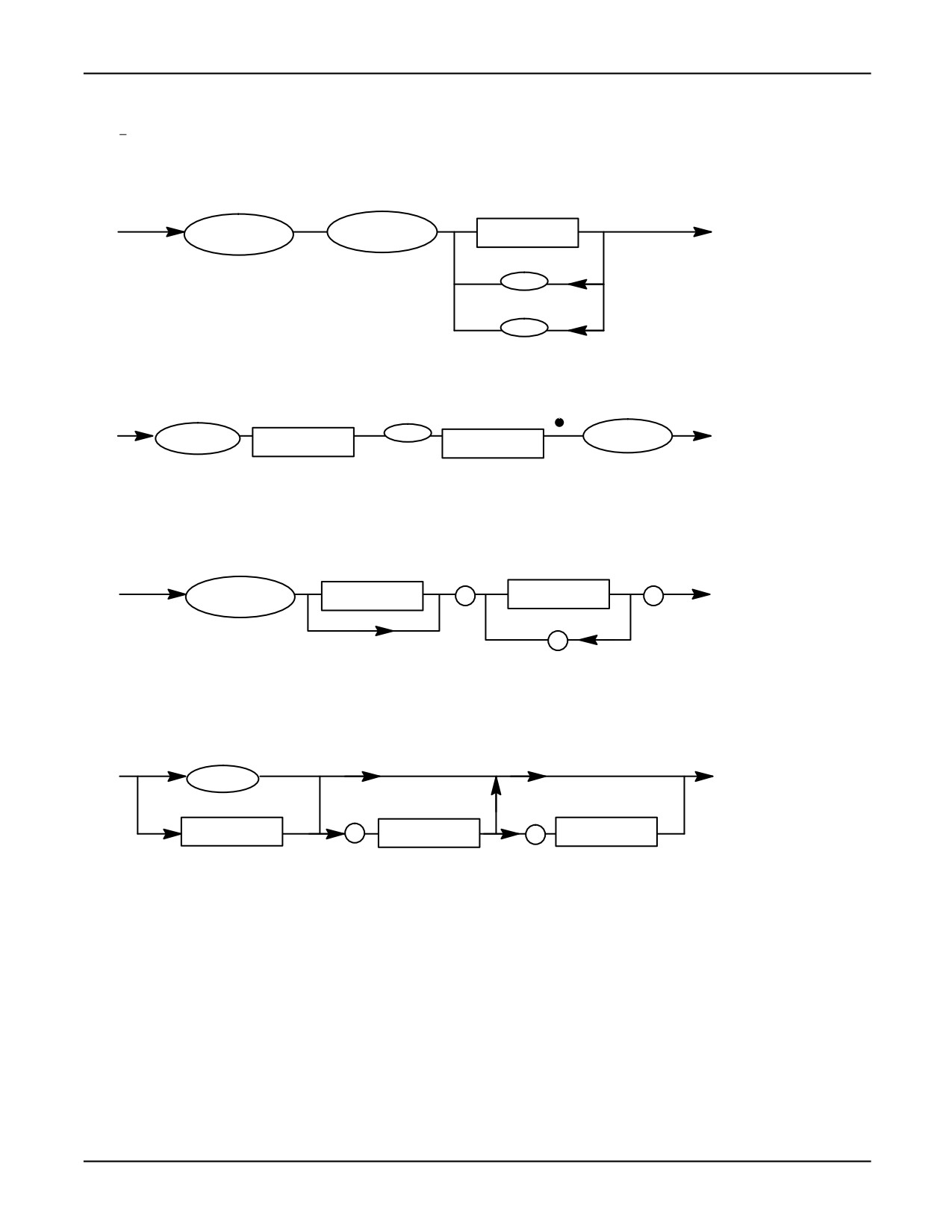
Figure E-19.
WAIT
- statement
global
WAIT
FOR
condition
^
AND
OR
WHILE
- statement
loop body
WHILE
(boolean)
statement
ENDWHILE
expression
list
^ DO
WRITE
- statement
file variable
variable
write
WRITE
(
)
access
item
^
,
write item
CR
1st format
2nd format
spec
spec
(integer)
(integer)
expression
::
::
expression
expression
E-21
E. SYNTAX DIAGRAMS
MARRC75KR07091E Rev D
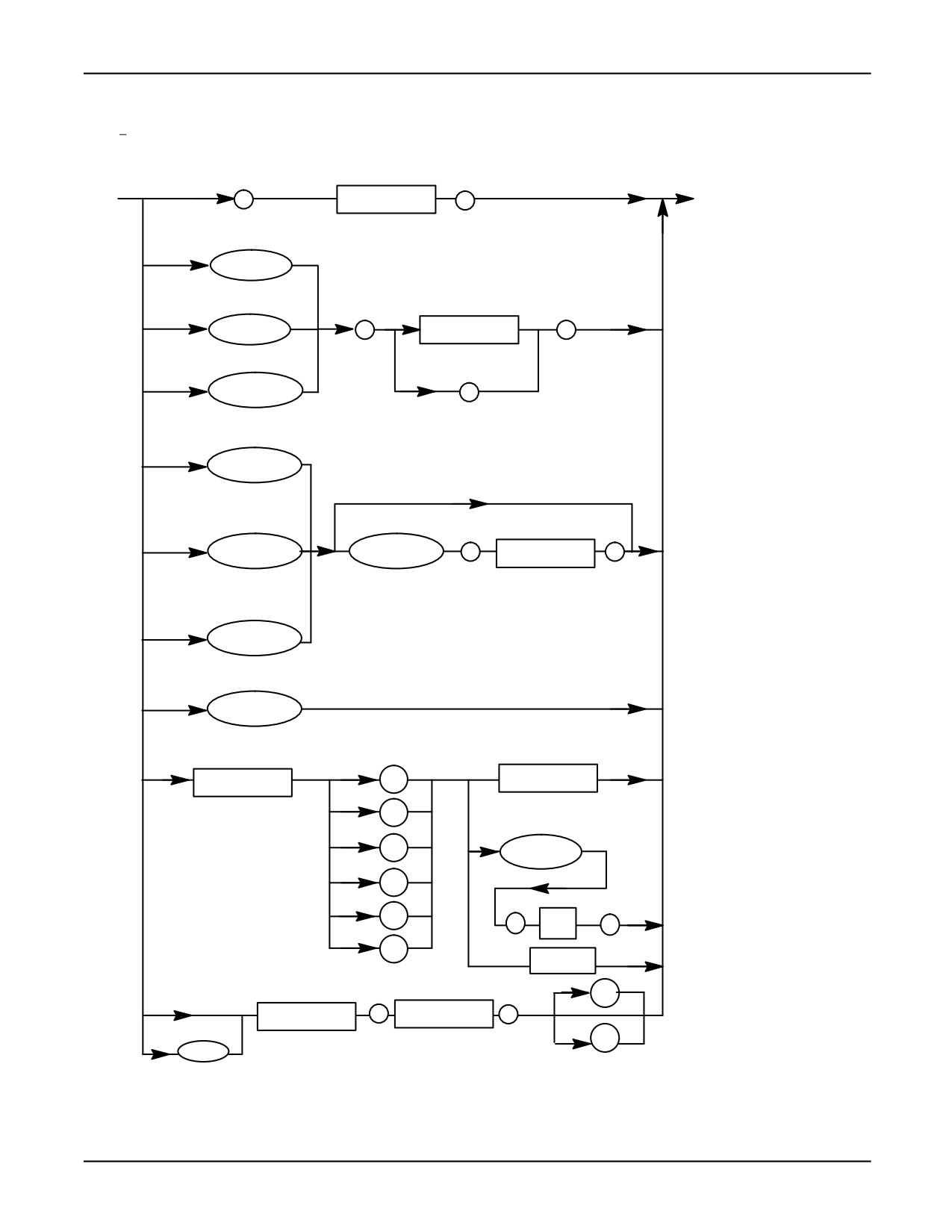
Figure E-20.
global condition
global
(
)
condition
^
ERROR
error/event/sema-
phore number
(integer)
EVENT
[
]
expression
SEMAPHORE
* only allowed on error condition
ABORT
task number
PAUSE
PROGRAM
[
(integer)
]
expression
CONTINUE
POWERUP
variable
variable
=
access
access
^
<>
<
EVAL
<=
>
(
exp
)
>=
constant
port array
port index
+
(integer)
name
[
]
expression
identifier
NOT
^
E-22
MARRC75KR07091E Rev D
E. SYNTAX DIAGRAMS
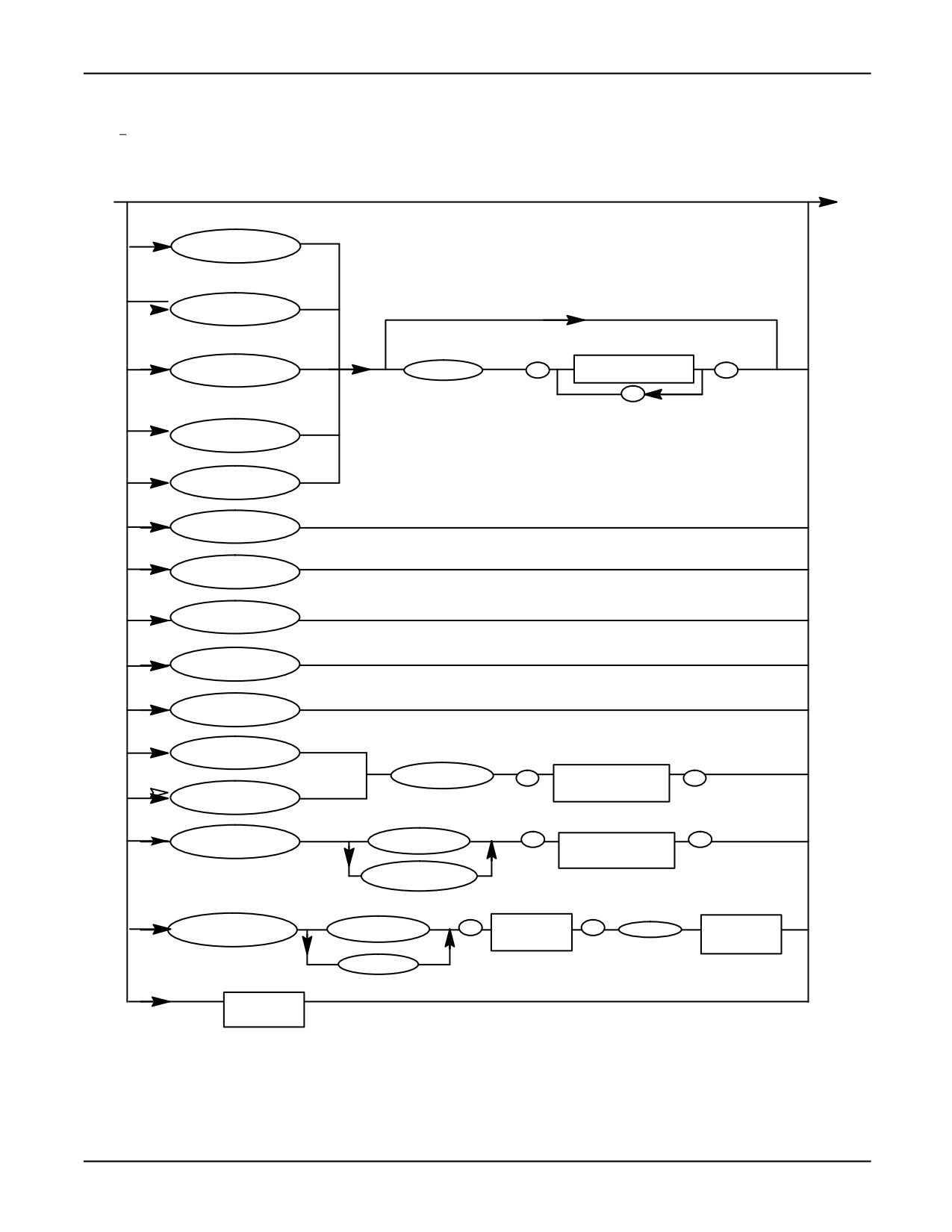
Figure E-21.
condition handler action
HOLD
UNHOLD
(integer)
RESUME
GROUP
[
]
contstant
,
STOP
CANCEL
NOABORT
NOPAUSE
UNPAUSE
NOMESSAGE
RESTORE
ENABLE
condition handler number
CONDITION
[
(integer)
]
expression
DISABLE
event/semaphore number
SIGNAL
EVENT
[
]
(integer)
expression
SEMAPHORE
port
index
time spec (ms)
[
(integer)
]
(integer)
PULSE
DOUT
FOR
expression
expression
^
RDO
procedure name
identifier
E-23
E. SYNTAX DIAGRAMS
MARRC75KR07091E Rev D
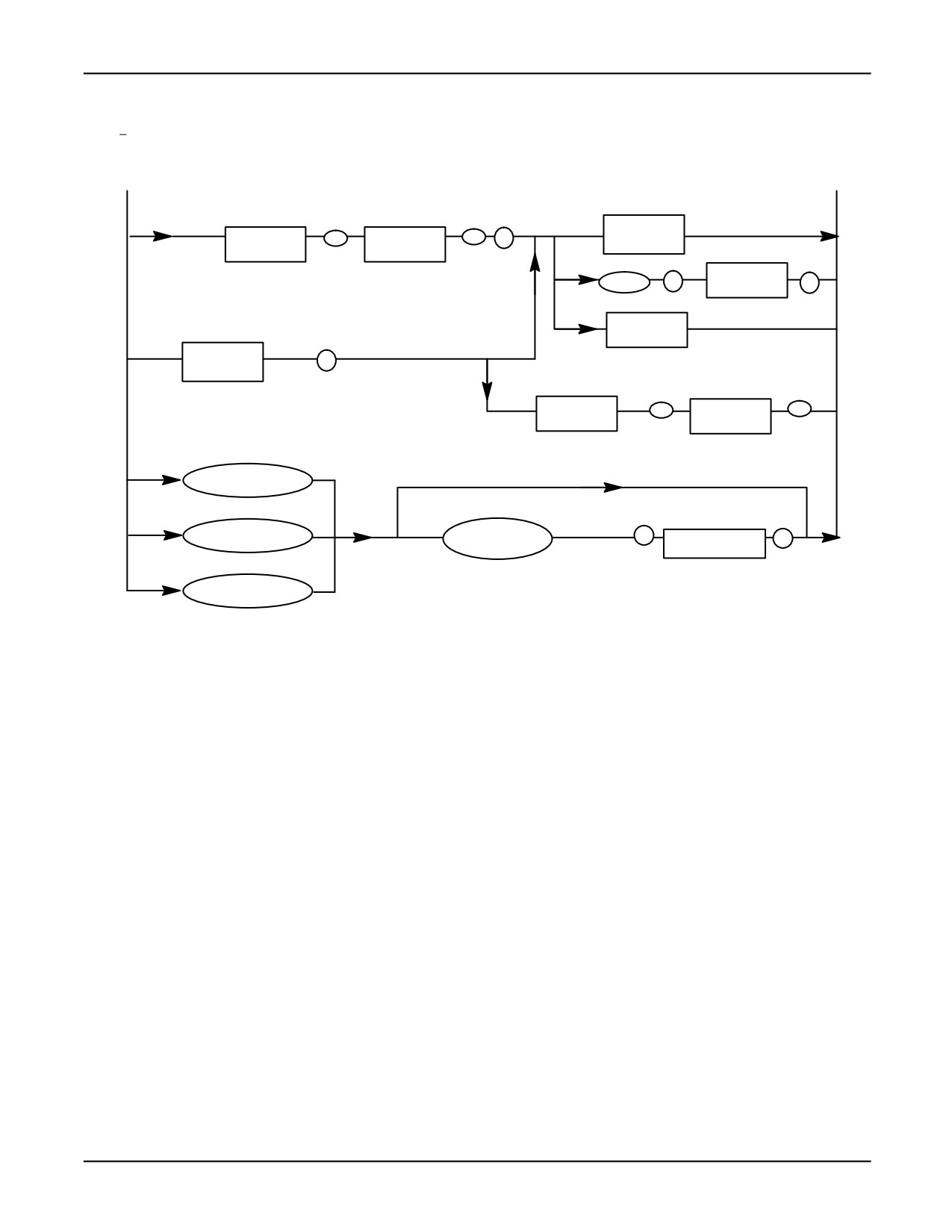
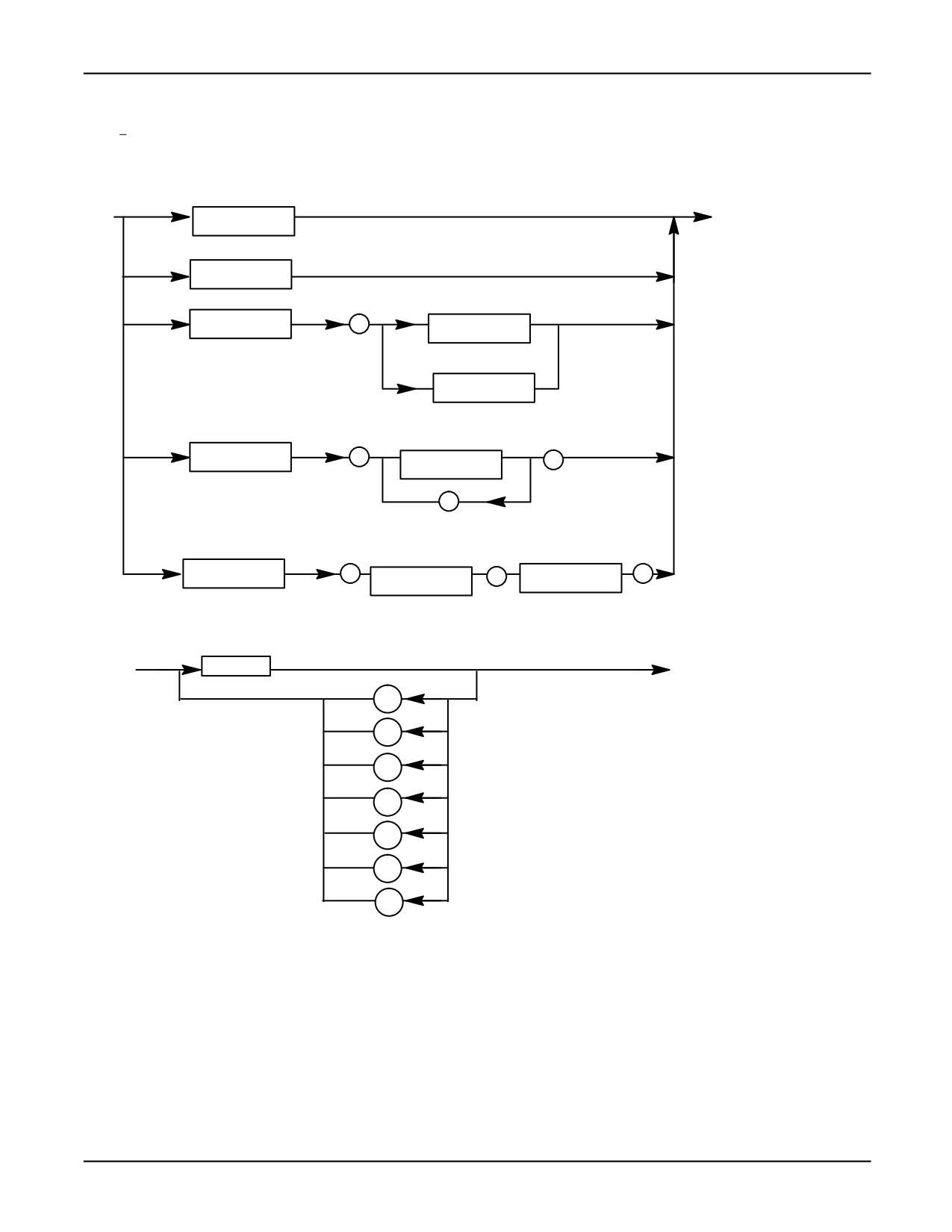
Figure E-22.
condition handler action continued
port variable name
port index
variable
[
(integer)
]
=
identifier
access
expression
^
exp
(integer)
EVAL
(
)
expression
^
constant
variable
=
access
^
port variable name
port index
[
(integer)
]
identifier
expression
ABORT
task number
CONTINUE
[
PROGRAM
(integer)
]
expression
PAUSE
E-24
MARRC75KR07091E Rev D
E. SYNTAX DIAGRAMS
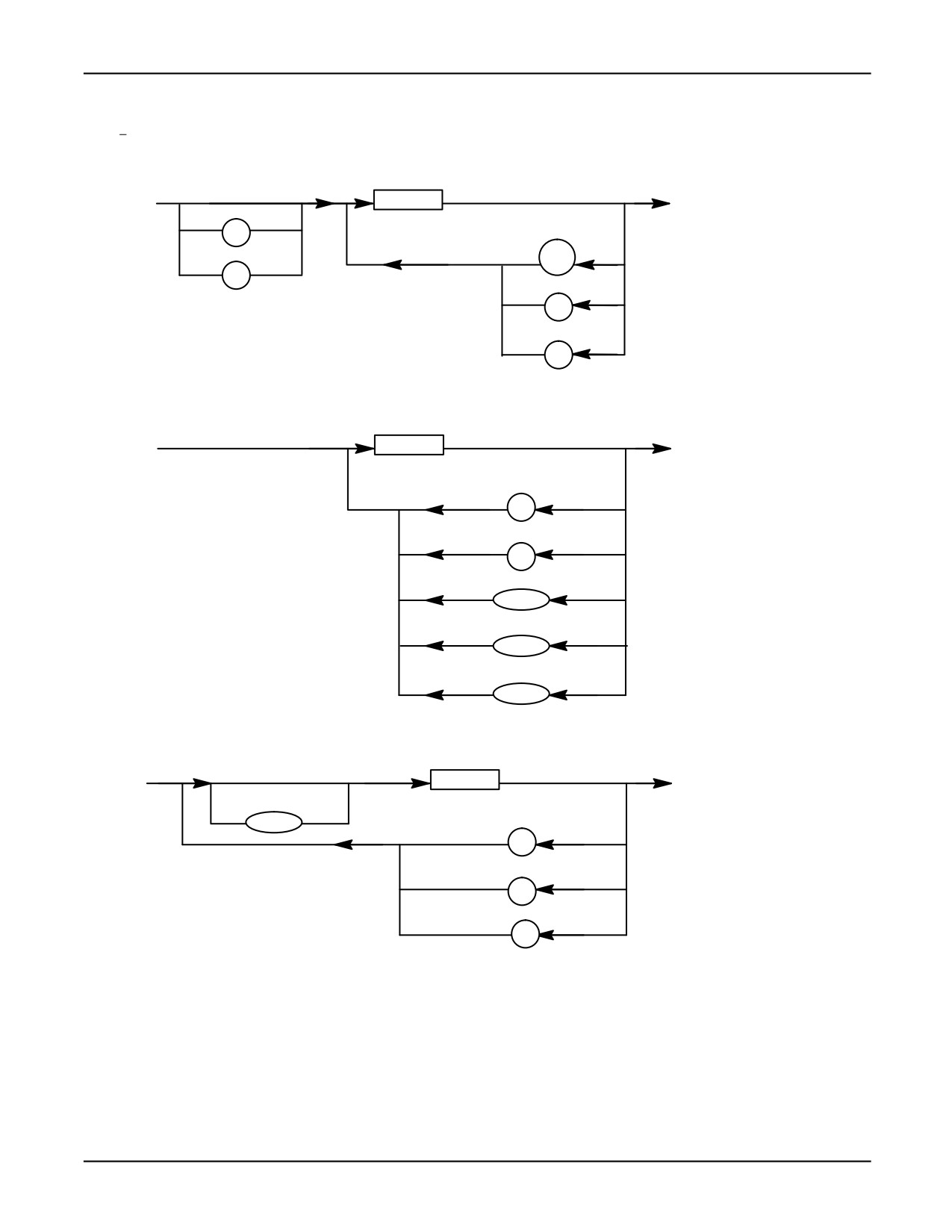
Figure E-23.
variable access
var/port/field/param name
identifier
system var or field name
system identifier
field name
variable access
identifier
field name
system identifier
array index
variable access
[
(integer)
]
expression
,
^
path name
start node index
end node index
[
(integer)
]
variable access
(integer)
expression
expression
expression
sum
=
<>
<
<=
>
>=
>=<
E-25
E. SYNTAX DIAGRAMS
MARRC75KR07091E Rev D
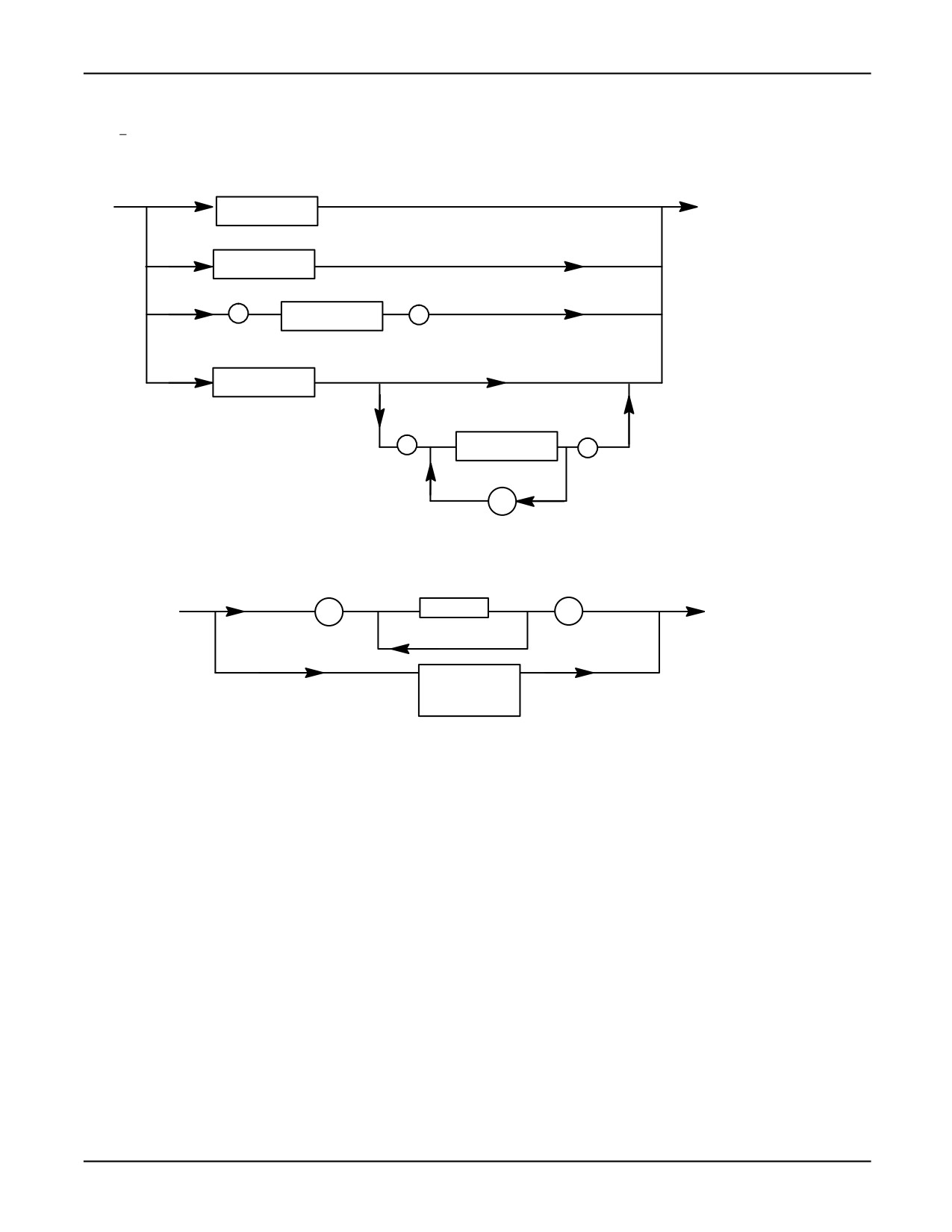
Figure E-24.
sum
product
^
+
OR
^
+
product
factor
^
/
AND
DIV
MOD
factor
primary
NOT
^
:
^
@
#
E-26
MARRC75KR07091E Rev D
E. SYNTAX DIAGRAMS
Figure E-25.
primary
variable access
constant
(
)
expression
^
function name
identifier
actual parameter
(
expression
)
^
,
literal
character
unsigned
numeric
value
E-27
MARRC75KR07091E Rev D
Glossary
Glossary
A
abort
Abnormal termination of a computer program caused by hardware or software malfunction or
operator cancellation.
absolute pulse code system
A positional information system for servomotors that relies on battery-backed RAM to store encoder
pulse counts when the robot is turned off. This system is calibrated when it is turned on.
A/D value
An analog to digital-value. Converts a multilevel analog electrical system pattern into a digital bit.
AI
Analog input.
AO
Analog output.
alarm
The difference in value between actual response and desired response in the performance of a
controlled machine, system or process. Alarm=Error.
algorithm
A fixed step-by-step procedure for accomplishing a given result.
alphanumeric
Data that are both alphabetical and numeric.
E-28
Glossary
MARRC75KR07091E Rev D
AMPS
Amperage amount.
analog
The representation of numerical quantities by measurable quantities such as length, voltage or
resistance. Also refers to analog type I/O blocks and distinguishes them from discrete I/O blocks.
Numerical data that can vary continuously, for example, voltage levels that can vary within the
range of -10 to +10 volts.
AND
An operation that places two contacts or groups of contacts in series. All contacts in series control the
resulting status and also mathematical operator.
ANSI
American National Standard Institute, the U.S. government organization with responsibility for the
development and announcement of technical data standards.
APC
See absolute pulse code system.
APC motor
See servomotor.
application program
The set of instructions that defines the specific intended tasks of robots and robot systems to make
them reprogrammable and multifunctional. You can initiate and change these programs.
arm
A robot component consisting of an interconnecting set of links and powered joints that move and
support the wrist socket and end effector.
articulated arm
A robot arm constructed to simulate the human arm, consisting of a series of rotary motions and
joints, each powered by a motor.
ASCII
Abbreviation for American Standard Code for Information Interchange. An 8-level code (7 bits plus
1
parity bit) commonly used for the exchange of data.
automatic mode
The robot state in which automatic operation can be initiated.
automatic operation
The time during which robots are performing programmed tasks through unattended program
execution.
E-29
MARRC75KR07091E Rev D
Glossary
axis
1. A straight line about which a robot joint rotates or moves. 2. One of the reference lines or a
coordinate system. 3. A single joint on the robot arm.
B
backplane
A group of connectors mounted at the back of a controller rack to which printed circuit boards are
mated.
BAR
A unit of pressure equal to 100,000 pascals.
barrier
A means of physically separating persons from the restricted work envelope; any physical boundary
to a hazard or electrical device/component.
battery low alarm
A programmable value (in engineering units) against which the analog input signal automatically
is compared on Genius I/O blocks. A fault is indicated if the input value is equal to or less than
the low alarm value.
baud
A unit of transmission speed equal to the number of code elements (bits) per second.
big-endian
The adjectives big-endian and little-endian refer to which bytes are most significant in multi-byte data
types and describe the order in which a sequence of bytes is stored in a computer’s memory. In a
big-endian system, the most significant value in the sequence is stored at the lowest storage address
(i.e., first). In a little-endian system, the least significant value in the sequence is stored first.
binary
A numbering system that uses only 0 and 1.
bit
Contraction of binary digit. 1. The smallest unit of information in the binary numbering system,
represented by a 0 or 1. 2. The smallest division of a programmable controller word.
bps
Bits per second.
buffer
A storage area in the computer where data is held temporarily until the computer can process it.
bus
A channel along which data can be sent.
E-30
Glossary
MARRC75KR07091E Rev D
bus controller
A Genius bus interface board for a programmable controller.
bus scan
One complete communications cycle on the serial bus.
Bus Switching Module
A device that switches a block cluster to one bus or the other of a dual bus.
byte
A sequence of binary digits that can be used to store a value from 0 to 255 and usually operated upon
as a unit. Consists of eight bits used to store two numeric or one alpha character.
C
calibration
The process whereby the joint angle of each axis is calculated from a known reference point.
Cartesian coordinate system
A coordinate system whose axes (x, y, and z) are three intersecting perpendicular straight lines. The
origin is the intersection of the axes.
Cartesian coordinates
A set of three numbers that defines the location of a point within a rectilinear coordinate system and
consisting of three perpendicular axes (x, y, z).
cathode ray tube
A device, like a television set, for displaying information.
central processing unit
The main computer component that is made up of a control section and an arithmetic-logic section.
The other basic units of a computer system are input/output units and primary storage.
channel
The device along which data flow between the input/output units of a computer and primary storage.
character
One of a set of elements that can be arranged in ordered groups to express information. Each character
has two forms: 1. a man-intelligible form, the graphic, including the decimal digits 0-9, the letters
A-Z, punctuation marks, and other formatting and control symbols; 2. a computer intelligible form,
the code, consisting of a group of binary digits (bits).
circular
A MOTYPE option in which the robot tool center point moves in an arc defined by three points.
These points can be positions or path nodes.
E-31
MARRC75KR07091E Rev D
Glossary
clear
To replace information in a storage unit by zero (or blank, in some machines).
closed loop
A control system that uses feedback. An open loop control system does not use feedback.
C-MOS RAM
Complementary metal-oxide semiconductor random-access memory. A read/write memory in
which the basic memory cell is a pair of MOS (metal-oxide semiconductor) transistors. It is an
implementation of S-RAM that has very low power consumption, but might be less dense than
other S-RAM implementations.
coaxial cable
A transmission line in which one conductor is centered inside and insulated from an outer metal tube
that serves as the second conductor. Also known as coax, coaxial line, coaxial transmission line,
concentric cable, concentric line, concentric transmission line.
component
An inclusive term used to identify a raw material, ingredient, part or subassembly that goes into a
higher level of assembly, compound or other item.
computer
A device capable of accepting information, applying prescribed processes to the information, and
supplying the results of these processes.
configuration
The joint positions of a robot and turn number of wrist that describe the robot at a specified position.
Configuration is designated by a STRING value and is included in positional data.
continuous path
A trajectory control system that enables the robot arm to move at a constant tip velocity through a
series of predefined locations. A rounding effect of the path is required as the tip tries to pass through
these locations.
continuous process control
The use of transducers (sensors) to monitor a process and make automatic changes in operations
through the design of appropriate feedback control loops. While such devices historically have been
mechanical or electromechanical, microcomputers and centralized control is now used, as well.
continuous production
A production system in which the productive equipment is organized and sequenced according to the
steps involved to produce the product. Denotes that material flow is continuous during the production
process. The routing of the jobs is fixed and set-ups are seldom changed.
controlled stop
A controlled stop controls robot deceleration until it stops. When a safety stop input such as a safety
fence signal is opened, the robot decelerates in a controlled manner and then stops. After the robot
stops, the Motor Control Contactor opens and drive power is removed.
E-32
Glossary
MARRC75KR07091E Rev D
controller
A hardware unit that contains the power supply, operator controls, control circuitry, and memory
that directs the operation and motion of the robot and communications with external devices. See
control unit.
controller memory
A medium in which data are retained. Primary storage refers to the internal area where the data and
program instructions are stored for active use, as opposed to auxiliary or external storage (magnetic
tape, disk, diskette, and so forth.)
control, open-loop
An operation where the computer applies control directly to the process without manual intervention.
control unit
The portion of a computer that directs the automatic operation of the computer, interprets computer
instructions, and initiates the proper signals to the other computer circuits to execute instructions.
coordinate system
See Cartesian coordinate system.
CPU
See central processing unit.
CRT
See cathode ray tube.
cps (viscosity)
Centipoises per second.
CRT/KB
Cathode ray tube/keyboard. An optional interface device for the robot system. The CRT/KB is used
for some robot operations and for entering programs. It can be a remote device that attaches to
the robot via a cable.
cycle
1. A sequence of operations that is repeated regularly. The time it takes for one such sequence to
occur. 2. The interval of time during which a system or process, such as seasonal demand or a
manufacturing operation, periodically returns to similar initial conditions. 3. The interval of time
during which an event or set of events is completed. In production control, a cycle is the length of
time between the release of a manufacturing order and shipment to the customer or inventory.
cycle time
1. In industrial engineering, the time between completion of two discrete units of production. 2. In
materials management, the length of time from when material enters a production facility until it
exits. See throughput.
E-33
MARRC75KR07091E Rev D
Glossary
cursor
An indicator on a teach pendant or CRT display screen at which command entry or editing occurs.
The indicator can be a highlighted field or an arrow (> or ^).
cylindrical
Type of work envelope that has two linear major axes and one rotational major axis. Robotic device
that has a predominantly cylindrical work envelope due to its design. Typically has fewer than 6 joints
and typically has only 1 linear axis.
D
D/A converter
A digital-to-analog converter. A device that transforms digital data into analog data.
D/A value
A digital-to-analog value. Converts a digital bit pattern into a multilevel analog electrical system.
daisy chain
A means of connecting devices (readers, printers, etc.) to a central processor by party-line input/output
buses that join these devices by male and female connectors. The last female connector is shorted by
a suitable line termination.
daisy chain configuration
A communications link formed by daisy chain connection of twisted pair wire.
data
A collection of facts, numeric and alphabetical characters, or any representation of information that
is suitable for communication and processing.
data base
A data file philosophy designed to establish the independence of computer program from data files.
Redundancy is minimized and data elements can be added to, or deleted from, the file designs without
changing the existing computer programs.
DC
Abbreviation for direct current.
DEADMAN switch
A control switch on the teach pendant that is used to enable servo power. Pressing the DEADMAN
switch while the teach pendant is on activates servo power and releases the robot brakes; releasing
the switch deactivates servo power and applies the robot brakes.
debugging
The process of detecting, locating and removing mistakes from a computer program, or manufacturing
control system. See diagnostic routine.
E-34
Glossary
MARRC75KR07091E Rev D
deceleration tolerance
The specification of the percentage of deceleration that must be completed before a motion is
considered finished and another motion can begin.
default
The value, display, function or program automatically selected if you have not specified a choice.
deviation
Usually, the absolute difference between a number and the mean of a set of numbers, or between
a forecast value and the actual data.
device
Any type of control hardware, such as an emergency-stop button, selector switch, control pendant,
relay, solenoid valve, or sensor.
diagnostic routine
A test program used to detect and identify hardware/software malfunctions in the controller and
its associated I/O equipment. See debugging.
diagnostics
Information that permits the identification and evaluation of robot and peripheral device conditions.
digital
A description of any data that is expressed in numerical format. Also, having the states On and Off
only.
digital control
The use of a digital computer to perform processing and control tasks in a manner that is more
accurate and less expensive than an analog control system.
digital signal
A single point control signal sent to or from the controller. The signal represents one of two states:
ON (TRUE, 1. or OFF (FALSE, 0).
directory
A listing of the files stored on a device.
discrete
Consisting of individual, distinct entities such as bits, characters, circuits, or circuit components. Also
refers to ON/OFF type I/O blocks.
disk
A secondary memory device in which information is stored on a magnetically sensitive, rotating disk.
disk memory
A non-programmable, bulk-storage, random-access memory consisting of a magnetized coating on
one or both sides of a rotating thin circular plate.
E-35
MARRC75KR07091E Rev D
Glossary
drive power
The energy source or sources for the robot servomotors that produce motion.
DRAM
Dynamic Random Access Memory. A read/write memory in which the basic memory cell is a
capacitor. DRAM (or D-RAM) tends to have a higher density than SRAM (or S-RAM). Due to the
support circuitry required, and power consumption needs, it is generally impractical to use. A battery
can be used to retain the content upon loss of power.
E
edit
1. A software mode that allows creation or alteration of a program. 2. To modify the form or format
of data, for example, to insert or delete characters.
emergency stop
The operation of a circuit using hardware-based components that overrides all other robot controls,
removes drive power from the actuators, and causes all moving parts of to stop. The operator panel
and teach pendant are each equipped with EMERGENCY STOP buttons.
enabling device
A manually operated device that, when continuously activated, permits motion. Releasing the device
stops the motion of the robot and associated equipment that might present a hazard.
encoder
1. A device within the robot that sends the controller information about where the robot is. 2. A
transducer used to convert position data into electrical signals. The robot system uses an incremental
optical encoder to provide position feedback for each joint. Velocity data is computed from the
encoder signals and used as an additional feedback signal to assure servo stability.
end effector
An accessory device or tool specifically designed for attachment to the robot wrist or tool mounting
plate to enable the robot to perform its intended tasks. Examples include gripper, spot weld gun,
arc weld gun, spray paint gun, etc.
end-of-arm tooling
Any of a number of tools, such as welding guns, torches, bells, paint spraying devices, attached to the
faceplate of the robot wrist. Also called end effector or EOAT.
engineering units
Units of measure as applied to a process variable, for example, psi, Degrees F., etc.
envelope, maximum
The volume of space encompassing the maximum designed movements of all robot parts including
the end effector, workpiece, and attachments.
E-36
Glossary
MARRC75KR07091E Rev D
EOAT
See end of arm tooling, tool.
EPROM
Erasable Programmable Read Only Memory. Semiconductor memory that can be erased and
reprogrammed. A non-volatile storage memory.
error
The difference in value between actual response and desired response in the performance of a
controlled machine, system or process. Alarm=Error.
error message
A numbered message, displayed on the CRT/KB and teach pendant, that indicates a system problem
or warns of a potential problem.
Ethernet
A Local Area Network (LAN) bus-oriented, hardware technology that is used to connect computers,
printers, terminal concentrators (servers), and many other devices together. It consists of a master
cable and connection devices at each machine on the cable that allow the various devices to "talk" to
each other. Software that can access the Ethernet and cooperate with machines connected to the cable
is necessary. Ethernets come in varieties such as baseband and broadband and can run on different
media, such as coax, twisted pair and fiber. Ethernet is a trademark of Xerox Corporation.
execute
To perform a specific operation, such as one that would be accomplished through processing one
statement or command, a series of statements or commands, or a complete program or command
procedure.
extended axis
An optional, servo-controlled axis that provides extended reach capability for a robot, including
in-booth rail, single- or double-link arm, also used to control motion of positioning devices.
F
faceplate
The tool mounting plate of the robot.
feedback
1. The signal or data fed back to a commanding unit from a controlled machine or process to
denote its response to the command signal. The signal representing the difference between actual
response and desired response that is used by the commanding unit to improve performance of the
controlled machine or process. 2. The flow of information back into the control system so that actual
performance can be compared with planned performance, for instance in a servo system.
E-37
MARRC75KR07091E Rev D
Glossary
field
A specified area of a record used for a particular category of data. 2. A group of related items that
occupy the same space on a CRT/KB screen or teach pendant LCD screen. Field name is the name of
the field; field items are the members of the group.
field devices
User-supplied devices that provide information to the PLC (inputs: push buttons, limit switches, relay
contacts, an so forth) or perform PLC tasks (outputs: motor starters, solenoids, indicator lights, and
so forth.)
file
1. An organized collection of records that can be stored or retrieved by name. 2. The storage device
on which these records are kept, such as bubble memory or disk.
filter
A device to suppress interference that would appear as noise.
Flash File Storage
A portion of FROM memory that functions as a separate storage device. Any file can be stored on
the FROM disk.
Flash ROM
Flash Read Only Memory. Flash ROM is not battery-backed memory but it is non-volatile. All data in
Flash ROM is saved even after you turn off and turn on the robot.
flow chart
A systems analysis tool to graphically show a procedure in which symbols are used to represent
operations, data, flow, and equipment. See block diagram, process chart.
flow control
A specific production control system that is based primarily on setting production rates and feeding
work into production to meet the planned rates, then following it through production to make sure that
it is moving. This concept is most successful in repetitive production.
format
To set up or prepare a memory card or floppy disk (not supported with version 7.20 and later) so it
can be used to store data in a specific system.
FR
See Flash ROM.
F-ROM
See Flash ROM.
FROM disk
See Flash ROM.
E-38
Glossary
MARRC75KR07091E Rev D
G
general override stat
A percentage value that governs the maximum robot jog speed and program run speed.
Genius I/O bus
The serial bus that provides communications between blocks, controllers, and other devices in the
system especially with respect to GE FANUC Genius I/O.
gripper
The "hand" of a robot that picks up, holds and releases the part or object being handled. Sometimes
referred to as a manipulator. See EOAT, tool.
group signal
An input/output signal that has a variable number of digital signals, recognized and taken as a group.
gun
See applicator.
H
Hand Model.
Used in Interference Checking, the Hand Model is the set of virtual model elements (spheres and
cylinders) that are used to represent the location and shape of the end of arm tooling with respect to
the robot’s faceplate.
hardware
1. In data processing, the mechanical, magnetic, electrical and electronic devices of which a computer,
controller, robot, or panel is built. 2. In manufacturing, relatively standard items such as nuts, bolts,
washers, clips, and so forth.
hard-wire
To connect electric components with solid metallic wires.
hard-wired
1. Having a fixed wired program or control system built in by the manufacturer and not subject to
change by programming. 2. Interconnection of electrical and electronic devices directly through
physical wiring.
hazardous motion
Unintended or unexpected robot motion that can cause injury.
hexadecimal
A numbering system having 16 as the base and represented by the digits 0 through 9, and A through F.
E-39
MARRC75KR07091E Rev D
Glossary
hold
A smoothly decelerated stopping of all robot movement and a pause of program execution. Power is
maintained on the robot and program execution generally can be resumed from a hold.
HTML.
Hypertext Markup Language. A markup language that is used to create hypertext and hypermedia
documents incorporating text, graphics, sound, video, and hyperlinks.
http.
Hypertext transfer protocol. The protocol used to transfer HTML files between web servers.
I
impedance
A measure of the total opposition to current flow in an electrical circuit.
incremental encoder system
A positional information system for servomotors that requires calibrating the robot by moving it to a
known reference position (indicated by limit switches) each time the robot is turned on or calibration
is lost due to an error condition.
index
An integer used to specify the location of information within a table or program.
index register
A memory device containing an index.
industrial robot
A reprogrammable multifunctional manipulator designed to move material, parts, tools, or specialized
devices through variable programmed motions in order to perform a variety of tasks.
industrial robot system
A system that includes industrial robots, end effectors, any equipment devices and sensors required
for the robot to perform its tasks, as well as communication interfaces for interlocking, sequencing, or
monitoring the robot.
information
The meaning derived from data that have been arranged and displayed in a way that they relate to that
which is already known. See data.
initialize
1. Setting all variable areas of a computer program or routine to their desired initial status, generally
done the first time the code is executed during each run. 2. A program or hardware circuit that returns
a program a system, or hardware device to an original state. See startup, initial.
E-40
Glossary
MARRC75KR07091E Rev D
input
The data supplied from an external device to a computer for processing. The device used to
accomplish this transfer of data.
input device
A device such as a terminal keyboard that, through mechanical or electrical action, converts data from
the form in which it has been received into electronic signals that can be interpreted by the CPU or
programmable controller. Examples are limit switches, push buttons, pressure switches, digital
encoders, and analog devices.
input processing time
The time required for input data to reach the microprocessor.
input/output
Information or signals transferred between devices, discreet electrical signals for external control.
input/output control
A technique for controlling capacity where the actual output from a work center is compared with the
planned output developed by CRP. The input is also monitored to see if it corresponds with plans so
that work centers will not be expected to generate output when jobs are not available to work on.
integrated circuit
A solid-state micro-circuit contained entirely within a chip of semiconductor material, generally
silicon. Also called chip.
interactive
Refers to applications where you communicate with a computer program via a terminal by entering
data and receiving responses from the computer.
interface
1. A concept that involves the specifications of the inter-connection between two equipments having
different functions. 2. To connects a PLC with the application device, communications channel, and
peripherals through various modules and cables. 3. The method or equipment used to communicate
between devices.
interference zone
An area that falls within the work envelope of a robot, in which there is the potential for the robot
motion to coincide with the motion of another robot or machine, and for a collision to occur.
interlock
An arrangement whereby the operation of one control or mechanism brings about, or prevents, the
operations of another.
interrupt
A break in the normal flow of a system or program that occurs in a way that the flow can be resumed
from that point at a later time. Interrupts are initiated by two types of signals: 1. signals originating
within the computer system to synchronize the operation of the computer system with the outside
E-41
MARRC75KR07091E Rev D
Glossary
world; 2. signals originating exterior to the computer system to synchronize the operation of the
computer system with the outside world.
I/O
Abbreviation for input/output or input/output control.
I/O block
A microprocessor-based, configurable, rugged solid state device to which field I/O devices are
attached.
I/O electrical isolation
A method of separating field wiring from logic level circuitry. This is typically done through optical
isolation devices.
I/O module
A printed circuit assembly that is the interface between user devices and the Series Six PLC.
I/O scan
A method by which the CPU monitors all inputs and controls all outputs within a prescribed time. A
period during which each device on the bus is given a turn to send information and listen to all of the
broadcast data on the bus.
ISO
The International Standards Organization that establishes the ISO interface standards.
isolation
1. The ability of a logic circuit having more than one inputs to ensure that each input signal is not
affected by any of the others. 2. A method of separating field wiring circuitry from logic level
circuitry, typically done optically.
item
1. A category displayed on the teach pendant on a menu. 2. A set of adjacent digits, bits, or characters
that is treated as a unit and conveys a single unit of information. 3. Any unique manufactured or
purchased part or assembly: end product, assembly, subassembly, component, or raw material.
J
jog coordinate systems
Coordinate systems that help you to move the robot more effectively for a specific application. These
systems include JOINT, WORLD, TOOL, and USER.
JOG FRAME
A jog coordinate system you define to make the robot jog the best way possible for a specific
application. This can be different from world coordinate frame.
jogging
Pressing special keys on the teach pendant to move the robot.
E-42
Glossary
MARRC75KR07091E Rev D
jog speed
Is a percentage of the maximum speed at which you can jog the robot.
joint
1. A single axis of rotation. There are up to six joints in a robot arm (P-155 swing arm has 8). 2.
A jog coordinate system in which one axis is moved at a time.
JOINT
A motion type in which the robot moves the appropriate combination of axes independently to reach a
point most efficiently. (Point to point, non-linear motion).
joint interpolated motion
A method of coordinating the movement of the joints so all joints arrive at the desired location at the
same time. This method of servo control produces a predictable path regardless of speed and results in
the fastest cycle time for a particular move. Also called joint motion.
K
K
Abbreviation for kilo, or exactly 1024 in computer jargon. Related to 1024 words of memory.
KAREL
The programming language developed for robots by the FANUC Robotics America, Inc.
L
label
An ordered set of characters used to symbolically identify an instruction, a program, a quantity, or a
data area.
LCD
See liquid crystal display.
lead time
The span of time needed to perform an activity. In the production and inventory control context, this
activity is normally the procurement of materials and/or products either from an outside supplier or
from one’s own manufacturing facility. Components of lead time can include order preparation time,
queue time, move or transportation time, receiving and inspection time.
LED
See Light Emitting Diode.
LED display
An alphanumeric display that consists of an array of LEDs.
Light Emitting Diode
A solid-state device that lights to indicate a signal on electronic equipment.
E-43
MARRC75KR07091E Rev D
Glossary
limiting device
A device that restricts the work envelope by stopping or causing to stop all robot motion and that is
independent of the control program and the application programs.
limit switch
A switch that is actuated by some part or motion of a machine or equipment to alter the electrical
circuit associated with it. It can be used for position detection.
linear
A motion type in which the appropriate combination of axes move in order to move the robot TCP
in a straight line while maintaining tool center point orientation.
liquid crystal display
A digital display on the teach pendant that consists of two sheets of glass separated by a sealed-in,
normally transparent, liquid crystal material. Abbreviated LCD.
little-endian
The adjectives big-endian and little-endian refer to which bytes are most significant in multi-byte data
types and describe the order in which a sequence of bytes is stored in a computer’s memory. In a
big-endian system, the most significant value in the sequence is stored at the lowest storage address
(i.e., first). In a little-endian system, the least significant value in the sequence is stored first.
load
1. The weight (force) applied to the end of the robot arm. 2. A device intentionally placed in a circuit
or connected to a machine or apparatus to absorb power and convert it into the desired useful form. 3.
To copy programs or data into memory storage.
location
1. A storage position in memory uniquely specified by an address. 2. The coordinates of an object
used in describing its x, y, and z position in a Cartesian coordinate system.
lockout/tagout
The placement of a lock and/or tag on the energy isolating device (power disconnecting device) in the
off or open position. This indicates that the energy isolating device or the equipment being controlled
will not be operated until the lock/tag is removed.
log
A record of values and/or action for a given function.
logic
A fixed set of responses (outputs) to various external conditions (inputs). Also referred to as the
program.
loop
The repeated execution of a series of instructions for a fixed number of times, or until interrupted
by the operator.
E-44
Glossary
MARRC75KR07091E Rev D
M
mA
See milliampere.
machine language
A language written in a series of bits that are understandable by, and therefore instruct, a computer.
This is a "first level" computer language, as compared to a "second level" assembly language, or a
"third level" compiler language.
machine lock
A test run option that allows the operator to run a program without having the robot move.
macro
A source language instruction from which many machine-language instructions can be generated.
magnetic disk
A metal or plastic floppy disk (not supported on version 7.10 and later) that looks like a phonograph
record whose surface can store data in the form of magnetized spots.
magnetic disk storage
A storage device or system consisting of magnetically coated metal disks.
magnetic tape
Plastic tape, like that used in tape recorder, on which data is stored in the form of magnetized spots.
maintenance
Keeping the robots and system in their proper operating condition.
MC
See memory card.
mechanical unit
The robot arm, including auxiliary axis, and hood/deck and door openers.
medium
plural media . The physical substance upon which data is recorded, such as a memory card (or floppy
disk which is not supported on version 7.10 and later).
memory
A device or media used to store information in a form that can be retrieved and is understood
by the computer or controller hardware. Memory on the controller includes C-MOS RAM, Flash
ROM and D-RAM.
memory card
A C-MOS RAM memory card or a flash disk-based PC card.
E-45
MARRC75KR07091E Rev D
Glossary
menu
A list of options displayed on the teach pendant screen.
message
A group of words, variable in length, transporting an item of information.
microprocessor
A single integrated circuit that contains the arithmetic, logic, register, control and memory elements of
a computer.
microsecond
One millionth (0.000001) of a second
milliampere
One one-thousandth of an ampere. Abbreviated mA.
millisecond
One thousandth of a second. Abbreviated msec.
module
A distinct and identifiable unit of computer program for such purposes as compiling, loading, and
linkage editing. It is eventually combined with other units to form a complete program.
motion type
A feature that allows you to select how you want the robot to move from one point to the next.
MOTYPES include joint, linear, and circular.
mode
1. One of several alternative conditions or methods of operation of a device. 2. The most common or
frequent value in a group of values.
N
network
1. The interconnection of a number of devices by data communication facilities. "Local networking"
is the communications network internal to a robot."Global networking" is the ability to provide
communications connections outside of the robot’s internal system. 2. Connection of geographically
separated computers and/or terminals over communications lines. The control of transmission
is managed by a standard protocol.
non-volatile memory
Memory capable of retaining its stored information when power is turned off.
O
E-46
Glossary
MARRC75KR07091E Rev D
Obstacle Model.
Used in Interference Checking, the Obstacle Model is the set of virtual model elements (spheres,
cylinders, and planes) that are used to represent the shape and the location of a given obstacle in space.
off-line
Equipment or devices that are not directly connected to a communications line.
off-line operations
Data processing operations that are handled outside of the regular computer program. For example,
the computer might generate a report off-line while the computer was doing another job.
off-line programming
The development of programs on a computer system that is independent of the "on-board" control of
the robot. The resulting programs can be copied into the robot controller memory.
offset
The count value output from a A/D converter resulting from a zero input analog voltage. Used to
correct subsequent non-zero measurements also incremental position or frame adjustment value.
on-line
A term to describe equipment or devices that are connected to the communications line.
on-line processing
A data processing approach where transactions are entered into the computer directly, as they occur.
operating system
Lowest level system monitor program.
operating work envelope
The portion of the restricted work envelope that is actually used by the robot while it is performing its
programmed motion. This includes the maximum the end-effector, the workpiece, and the robot itself.
operator
A person designated to start, monitor, and stop the intended productive operation of a robot or robot
system.
operator box
A control panel that is separate from the robot and is designed as part of the robot system. It consists
of the buttons, switches, and indicator lights needed to operate the system.
operator panel
A control panel designed as part of the robot system and consisting of the buttons, switches, and
indicator lights needed to operate the system.
optional features
Additional capabilities available at a cost above the base price.
E-47
MARRC75KR07091E Rev D
Glossary
OR
An operation that places two contacts or groups of contacts in parallel. Any of the contacts can control
the resultant status, also a mathematical operation.
orientation
The attitude of an object in space. Commonly described by three angles: rotation about x (w), rotation
about y (p), and rotation about z (r).
origin
The point in a Cartesian coordinate system where axes intersect; the reference point that defines
the location of a frame.
OT
See overtravel.
output
Information that is transferred from the CPU for control of external devices or processes.
output device
A device, such as starter motors, solenoids, that receive data from the programmable controller.
output module
An I/O module that converts logic levels within the CPU to a usable output signal for controlling a
machine or process .
outputs
Signals, typically on or off, that controls external devices based upon commands from the CPU.
override
See general override.
overtravel
A condition that occurs when the motion of a robot axis exceeds its prescribed limits.
overwrite
To replace the contents of one file with the contents of another file when copying.
P
parity
The anticipated state, odd or even, of a set of binary digits.
parity bit
A binary digit added to an array of bits to make the sum of all bits always odd or always even.
parity check
A check that tests whether the number of ones (or zeros) in an array of binary digits is odd or even.
E-48
Glossary
MARRC75KR07091E Rev D
parity error
A condition that occurs when a computed parity check does not agree with the parity bit.
part
A material item that is used as a component and is not an assembly or subassembly.
pascal
A unit of pressure in the meter-kilogram-second system equivalent to one newton per square meter.
path
1. A variable type available in the KAREL system that consists of a list of positions. Each node
includes positional information and associated data. 2. The trajectory followed by the TCP in a move.
PCB
See printed circuit board.
PC Interface
The PC Interface software uses Ethernet connections to provide file transfer protocol (FTP) functions,
PC send macros, telnet interface, TCP/IP interface web server functions, and host communications.
pendant
See teach pendant.
PLC
See programmable logic controller or cell controller.
PMC
The programmable machine controller (PMC) functions provide a ladder logic programming
environment to create PMC functions. This provides the capability to use the robot I/O system to run
PLC programs in the background of normal robot operations. This function can be used to control
bulk supply systems, fixed automation that is part of the robot workcell, or other devices that would
normally require basic PLC controls.
printed circuit board
A flat board whose front contains slots for integrated circuit chips and connections for a variety of
electronic components, and whose back is printed with electrically conductive pathways between
the components.
production mode
See automatic mode.
program
1. A plan for the solution of a problem. A complete program includes plans for the transcription
of data, coding for the computer, and plans for the absorption of the results into the system. 2. A
sequence of instructions to be executed by the computer or controller to control a robot/robot system.
3. To furnish a computer with a code of instructions. 4. To teach a robot system a specific set of
movements and instructions to do a task.
E-49
MARRC75KR07091E Rev D
Glossary
programmable controller
See programmable logic controller or cell controller.
programmable logic controller
A solid-state industrial control device that receives inputs from user-supplied control devices, such
as switches and sensors, implements them in a precise pattern determined by ladder diagram-based
programs stored in the user memory, and provides outputs for control of processes or user-supplied
devices such as relays and motor starters.
Program ToolBox
The Program ToolBox software provides programming utilities such as mirror image and flip wrist
editing capabilities.
protocol
A set of hardware and software interfaces in a terminal or computer that allows it to transmit over a
communications network, and that collectively forms a communications language.
psi
Pounds per square inch.
Q
queue.
1. Waiting lines resulting from temporary delays in providing service. 2. The amount of time a job
waits at a work center before set-up or work is performed on the job. See also job queue.
R
RAM
See Random Access Memory.
random access
A term that describes files that do not have to be searched sequentially to find a particular record
but can be addressed directly.
Random Access Memory
1. Volatile, solid-state memory used for storage of programs and locations; battery backup is required.
2. The working memory of the controller. Programs and variable data must be loaded into RAM
before the program can execute or the data can be accessed by the program.
range
1. A characterization of a variable or function. All the values that a function can possess. 2. In
statistics, the spread in a series of observations. 3. A programmable voltage or current spectrum of
values to which input or output analog signals can be limited.
RI
Robot input.
E-50
Glossary
MARRC75KR07091E Rev D
RO
Robot output.
read
To copy, usually from one form of storage to another, particularly from external or secondary storage
to internal storage. To sense the meaning of arrangements of hardware. To sense the presence of
information on a recording medium.
Read Only Memory
A digital memory containing a fixed pattern of bits that you cannot alter.
record
To store the current set or sets of information on a storage device.
recovery
The restoration of normal processing after a hardware or software malfunction through detailed
procedures for file backup, file restoration, and transaction logging.
register
1. A special section of primary storage in a computer where data is held while it is being worked on.
2. A memory device capable of containing one or more computer bits or words.
remote/local
A device connection to a given computer, with remote devices being attached over communications
lines and local devices attached directly to a computer channel; in a network, the computer can be a
remote device to the CPU controlling the network.
repair
To restore robots and robot systems to operating condition after damage, malfunction, or wear.
repeatability
The closeness of agreement among the number of consecutive movements made by the robot arm to
a specific point.
reset
To return a register or storage location to zero or to a specified initial condition.
restricted work envelope
That portion of the work envelope to which a robot is restricted by limiting devices that establish
limits that will not be exceeded in the event of any reasonably foreseeable failure of the robot or its
controls. The maximum distance the robot can travel after the limited device is actuated defines the
restricted work envelope of the robot.
RIA
Robotic Industries Association Subcommittee of the American National Standards Institute, Inc.
E-51