Kubota tractor (BX25DLB-AU, LA240A, LA240A, AU-SG, BT602). OPERATOR'S MANUAL - part 25
 

  Index      Tractors     Kubota tractor (BX25DLB-AU, LA240A, LA240A, AU-SG, BT602). OPERATOR'S MANUAL


Search            copyright infringement  


Content   ..  23  24  25  26   ..


Kubota tractor (BX25DLB-AU, LA240A, LA240A, AU-SG, BT602). OPERATOR'S MANUAL - part 25


69

OPERATING THE BACKHOE

OPERATING THE BACKHOE

OPERATING SPEED

To avoid personal injury:

A

Use care when operating on slopes to avoid tip
over. Travel at speed compatible with safe
operation, especially when operating in uneven
terrain, crossing ditches or while turning. 

1. This backhoe can be operated at any engine speed

from about 75% of rated rpm to factory rated rpm. The
backhoe is most efficient at rated engine speed. 
However, in special digging condition, for optimal fuel
economy, or in residential neighborhood where noise
may be a consideration, the engine speed can be
lowered to about 75% of rated rpm.

2. When operating in temperature below 0 C (32 F), run

the tractor engine below about 50% of rated rpm until
the oil temperature exceeds 0 C (32 F).

BACKHOE CONTROLS

To avoid personal injury:

A

For all excavation work, operate the backhoe from
the backhoe operator's seat only.

A

Do not tamper with any backhoe control valve
relief pressure setting.
The relief valve is preset at the factory.  Changing
the setting can cause overloading of the backhoe
and the tractor and serious personal injury may
result.

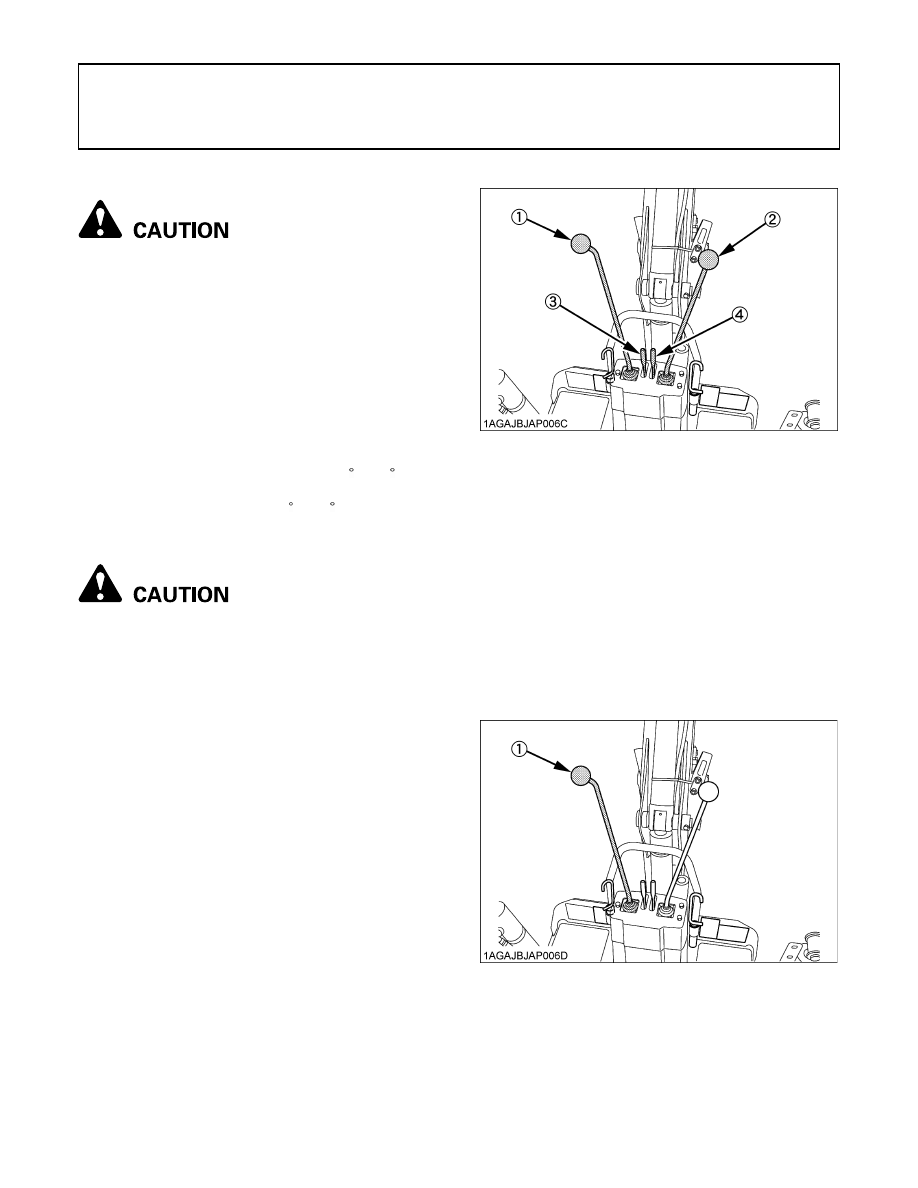
The backhoe is controlled by using the 2 lever "joystick"
system.  The left lever controls the boom and swing
circuits, and the right lever controls the dipperstick and
bucket circuits.  The further the levers are moved from
"NEUTRAL", the faster the component will move.  Learn
the "feature" of the controls for smooth and precise
component movement.

B

Boom & Swing Lever

Pushing the lever forward will lower the boom, and pulling
it back will raise it.
Movement of the lever to the left will swing the bucket to
the left, and right lever movement will swing to the right.
By moving the lever out of the plus "+" position ; into an
"X" relationship, it is possible to raise or lower and swing
at the same time.

(1) Boom and swing lever
(2) Dipperstick and bucket lever
(3) Stabilizer control lever, left
(4) Stabilizer control lever, right

(1) Boom and swing lever

OPERATING THE BACKHOE

70

B

Dipperstick & Bucket Lever

Pushing the lever forward will crowd out the dipperstick
and the bucket out and pulling it back will crowd them in.
Lever movement to the left will curl the bucket to fill it, and
right lever movement will dump the bucket.
Again, movement into an "X" relationship will crowd in and
fill the bucket, or crowd out and dump the bucket.
With experience, the combination of both "joystick" levers
will allow lift, swing, crowd out and spoil dumping, all in
one smooth movement, or lowering, swing, crowd in and
bucket filling with reverse movement.

B

Stabilizer Control Levers

The stabilizers are the only controls that may be operated
from out of the backhoe operator's seat over then only for
the purpose of mounting or dismounting backhoe from
tractor.
Be sure to stay well clear of stabilizers, arms and pads
during installation or removal process. This is necessary
because the mounting step moves up and down in
conjunction with the stabilizer cylinder.
Moving the levers downward will lower the stabilizers, and
upward lever movement will raise them.

PLACING THE STABILIZERS

To avoid personal injury:

A

When working on slopes, one stabilizer may be
lower than the other.

A

When digging on a hillside, always dump the
bucket on the uphill side of excavation.

A

To reduce the risk of overturn on a slope, place the
spoil to the high side of the excavation.

1. Lower the stabilizers and remove the weight of the

backhoe from the rear wheels. However, one or both
rear tires should remain in light contact with the
ground. This will give the backhoe the widest possible
stance and the lowest center of gravity.
If the rear wheels are raised too high, digging depth
will be reduced and undue stress will be exerted on the
backhoe frame components.
If the slope is unusually steep, cut a level surface with
the loader and pile the spoil on the downhill side. Back
drag and pack the spoil so it will support the stabilizer
on the low side. This procedure is recommended when
a wall, tree line or other obstruction prevents placing
backhoe spoil on the high side of the excavation.

2. The loader bucket should be lowered to give the

backhoe unit a "tri-pod" stance. With the loader bucket
in ground contact, front tire bounce will not be a factor
in overall control. When possible, the loader bucket
cutting edge should be lowered vertically into the
ground surface. This will assist the stabilizers, not
allowing the unit to shift, while excavating. However,
on a slope, the bottom of the bucket should be used,
and only the side that contacts the uneven terrain. Too
much loader down pressure, on a slope, will restrict
the unit from being correctly leveled and will place an
undue twist through the loader bucket and lift arms.

(1) Dipperstick and bucket lever

(1) Stabilizer control lever, left
(2) Stabilizer control lever, right

71

OPERATING THE BACKHOE

GENERAL BACKHOE OPERATION

To avoid personal injury:

A

Do not dig under the stabilizer or tractor,
especially in soft or sandy condition. 
Take extra precaution in wet or thawing ground.
These conditions can become unstable very
quickly and may collapse under the weight of the
machine and may tip over.

A

Use care for buried material such as electrical,
telephone, gas and water lines. When in doubt,
contact local utility companies for their buried
location.

A

Do not use the tractor to pull out tree stumps with the
boom dipper extended and the bucket in its crowded
position.

B

Dipperstick Digging

Lower the bucket to the ground, the same as with bucket
digging, then curl until the bucket teeth are flat on the
ground.
Using only the crowd cylinder, retract the dipperstick,
dragging the bucket through the trench until it is
approximately half full. Begin to curl the bucket in while
continuing to crowd in, until the bucket is completely full.
Raise and swing the boom and dump the bucket in the
spoil area on the high side of the trench or excavation.

B

Spoil Pile Location

To avoid personal injury:

A

Do not place spoil close to the edge of the
excavation where its weight could cause a cave-in.

Carefully preplan the location for the spoil that will be
removed from the excavation. The location will vary
depending on the excavation being dug.
The height of spoil pile can be controlled without moving
the tractor. Approach the pile with the backhoe bucket full
and ready to empty. Instead of dumping on top, lower the
full bucket into the top of the pile. Begin dumping and
crowding out at the same time. As the bucket opens and
dumps, the bottom of the bucket will push the top of the
pile off and behind its location, safely away from the
excavation.

B

Straight Wall or Cemetery Digging

Strip the top soil off the ground, within the confines of the
straight hole or grave to be dug.  Clean out as much
material, within the same confines, as possible with
normal digging methods.
Finish the far wall by crowding out while forcing the bucket
down with the boom.
Curl the bucket out to keep the bottom of the bucket
vertical while making the down cut.

OPERATING THE BACKHOE

72

To finish the near wall, raise the boom while crowding in.
The bucket will have to be curled in to keep the cutting
edge horizontal with the wall during the up cut.

When finishing straight wall, or digging graves, in sandy
soil, use a platform under the rear tires and stabilizers.
The platform distributes the backhoe load over a large
area and lessens the possibility of a cave-in.

B

Stabilizer pads (Standard)

B

Stabilizer pads (Option)

The stabilizer pads can be reversed without the use of
tools. Change the pads depending on the job.

C

When operating in dirt to prevent slippage.

C

When operating on street to prevent damage to work
area. 

(1) Stabilizer pads

(1) Rubber shoes 


Content   ..  23  24  25  26   ..