Physics For Scientists And Engineers 6E - part 38
 

  Index      Production     Physics For Scientists And Engineers 6E


Search            


Content   ..  36  37  38  39   ..


Physics For Scientists And Engineers 6E - part 38


Problems

149

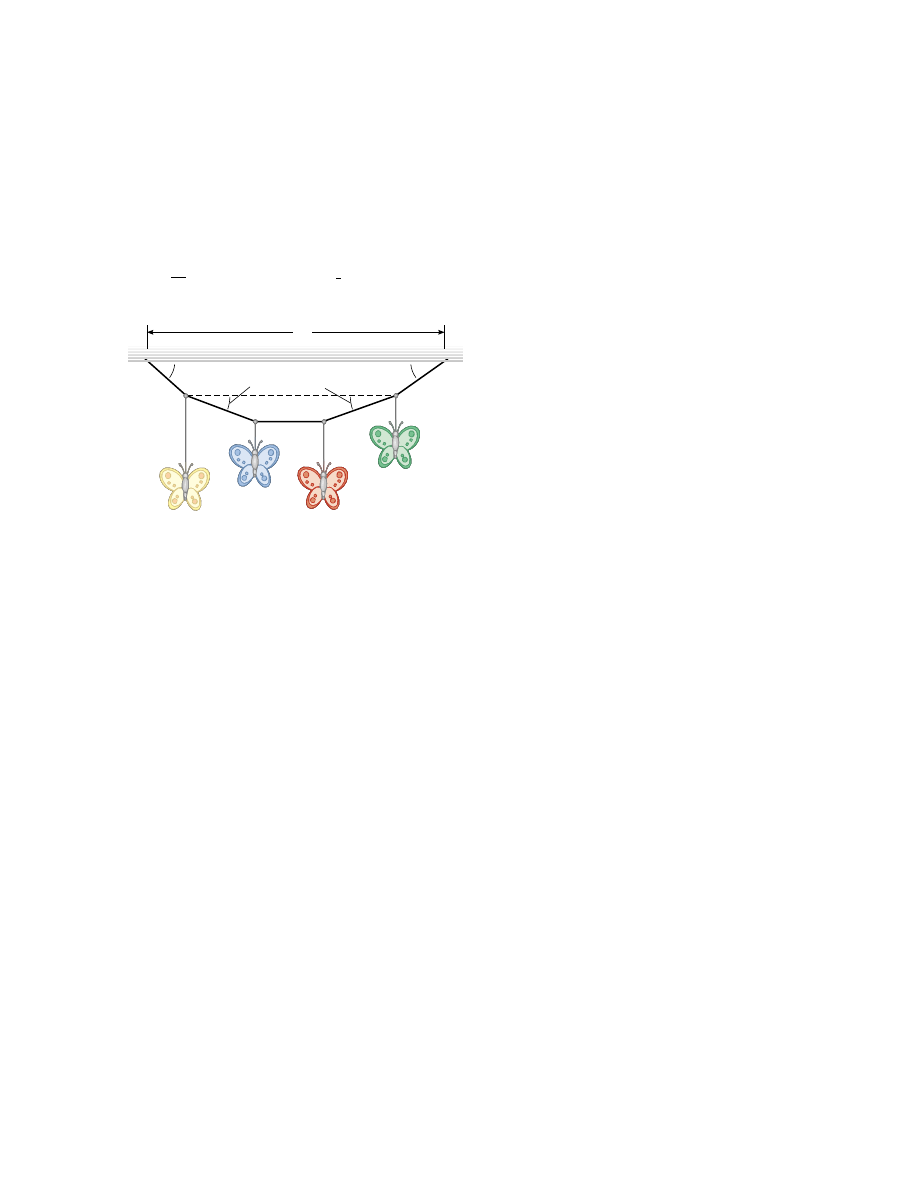
73.

A mobile is formed by supporting four metal butterflies of
equal mass from a string of length L. The points of sup-
port are evenly spaced a distance ! apart as shown in Fig-
ure P5.73. The string forms an angle !

1

with the ceiling at

each end point. The center section of string is horizontal.
(a) Find the tension in each section of string in terms of
!

1

m, and g. (b) Find the angle !

2

, in terms of !

1

, that the

sections  of  string  between  the  outside  butterflies  and  the
inside  butterflies  form  with  the  horizontal.  (c)  Show  that
the distance between the end points of the string is

"

L

5


(2


cos


!

1

$

2


cos


 [tan

#

1

(

1

2


tan


!

1

)] $ 1)

"

"

"

"

D

1

2

"

m

m

m

m

= 5"

θ

1

θ

θ

2

θ

Figure P5.73

Answers to Quick Quizzes

5.1 (d). Choice (a) is true. Newton’s first law tells us that mo-

tion requires no force: an object in motion continues to
move  at  constant  velocity  in  the  absence  of  external
forces.  Choice  (b)  is  also  true.  A  stationary  object  can
have several forces acting on it, but if the vector sum of
all these external forces is zero, there is no net force and
the object remains stationary.

5.2 (a).  If  a  single  force  acts,  this  force  constitutes  the  net

force and there is an acceleration according to Newton’s
second law.

5.3 (c).  Newton’s  second  law  relates  only  the  force  and  the

acceleration. Direction of motion is part of an object’s ve-
locity, 
and force determines the direction of acceleration,
not that of velocity.

5.4 (d). With twice the force, the object will experience twice

the acceleration. Because the force is constant, the accel-

eration is constant, and the speed of the object (starting
from rest) is given by at. With twice the acceleration,
the object will arrive at speed at half the time.

5.5 (a). The gravitational force acts on the ball at all points in

its trajectory.

5.6 (b). Because the value of is smaller on the Moon than

on  the  Earth,  more  mass  of  gold  would  be  required  to
represent  1  newton  of  weight  on  the  Moon.  Thus,  your
friend on the Moon is richer, by about a factor of 6!

5.7 (c).  In  accordance  with  Newton’s  third  law,  the  fly  and

bus  experience  forces  that  are  equal  in  magnitude  but
opposite in direction.

5.8 (a).  Because  the  fly  has  such  a  small  mass,  Newton’s

second law tells us that it undergoes a very large accelera-
tion. The huge mass of the bus means that it more effec-
tively resists any change in its motion and exhibits a small
acceleration.

5.9 (c). The reaction force to your weight is an upward gravi-

tational force on the Earth due to you.

5.10 (b). Remember the phrase “free-body.” You draw one body

(one  object),  free  of  all  the  others  that  may  be  interact-
ing, and draw only the forces exerted on that object.

5.11 (b).  The  friction  force  acts  opposite  to  the  gravitational

force  on  the  book  to  keep  the  book  in  equilibrium.  Be-
cause  the  gravitational  force  is  downward,  the  friction
force must be upward.

5.12 (b).  The  crate  accelerates  to  the  east.  Because  the  only

horizontal force acting on it is the force of static friction
between its bottom surface and the truck bed, that force
must also be directed to the east.

5.13 (b).  At  the  angle  at  which  the  book  breaks  free,  the

component  of  the  gravitational  force  parallel  to  the
board  is  approximately  equal  to  the  maximum  static
friction force. Because the kinetic coefficient of friction
is  smaller  than  the  static  coefficient,  at  this  angle,  the
component  of  the  gravitational  force  parallel  to  the
board  is  larger  than  the  kinetic  friction  force.  Thus,
there  is  a  net  downhill  force  parallel  to  the  board  and
the book speeds up.

5.14 (b). When pulling with the rope, there is a component of

your applied force that is upward. This reduces the normal
force between the sled and the snow. In turn, this reduces
the friction force between the sled and the snow, making it
easier to move. If you push from behind, with a force with
a  downward  component,  the  normal  force  is  larger,  the
friction force is larger, and the sled is harder to move.

Chapter 6

Circular Motion and Other

Applications of Newton’s Laws

C H A P T E R   O U T L I N E

6.1 Newton’s Second Law Applied

to Uniform Circular Motion

6.2 Nonuniform Circular Motion

6.3 Motion in Accelerated Frames

6.4 Motion in the Presence of

Resistive Forces

6.5 Numerical Modeling in

Particle Dynamics

The London Eye, a ride on the River Thames in downtown London. Riders travel in a

large vertical circle for a breathtaking view of the city. In this chapter, we will study the forces
involved in circular motion. (© Paul Hardy/CORBIS)

150

I

n the preceding chapter we introduced Newton’s laws of motion and applied them to

situations involving linear motion. Now we discuss motion that is slightly more compli-
cated. For example, we shall apply Newton’s laws to objects traveling in circular paths.
Also,  we  shall  discuss  motion  observed  from  an  accelerating  frame  of  reference  and
motion of an object through a viscous medium. For the most part, this chapter consists
of a series of examples selected to illustrate the application of Newton’s laws to a wide
variety of circumstances.

6.1 Newton’s Second Law Applied 

to Uniform Circular Motion

In Section 4.4 we found that a particle moving with uniform speed in a circular path
of radius experiences an acceleration that has a magnitude

The acceleration is called centripetal acceleration because

a

c

is directed toward the center

of the circle. Furthermore, 

a

c

is always perpendicular to 

v. (If there were a component

of acceleration parallel to 

v, the particle’s speed would be changing.)

Consider a ball of mass that is tied to a string of length and is being whirled at

constant speed in a horizontal circular path, as illustrated in Figure 6.1. Its weight is
supported  by  a  frictionless  table.  Why  does  the  ball  move  in  a  circle?  According  to
Newton’s first law, the ball tends to move in a straight line; however, the string prevents

a

c

!

v

2

r

m

F

r

F

r

r

Figure 6.1 Overhead view of a ball moving in a

circular path in a horizontal plane. A force 

F

r

directed toward the center of the circle keeps

the ball moving in its circular path.

An athlete in the process of

throwing the hammer at the 1996

Olympic Games in Atlanta, Georgia.

The force exerted by the chain

causes the centripetal acceleration

of the hammer. Only when the

athlete releases the hammer will it

move along a straight-line path

tangent to the circle.

Mike Powell / Allsport / Getty Images

151

152

CHAPTE R 6 •  Circular Motion and Other Applications of Newton’s Laws

motion along a straight line by exerting on the ball a radial force 

F

r

that makes it fol-

low the circular path. This force is directed along the string toward the center of the
circle, as shown in Figure 6.1. 

If  we  apply  Newton’s  second  law  along  the  radial  direction,  we  find  that  the  net

force causing the centripetal acceleration can be evaluated:

(6.1)

A force causing a centripetal acceleration acts toward the center of the circular path
and causes a change in the direction of the velocity vector. If that force should van-
ish,  the  object  would  no  longer  move  in  its  circular  path;  instead,  it  would  move
along a straight-line path tangent to the circle. This idea is illustrated in Figure 6.2
for the ball whirling at the end of a string in a horizontal plane. If the string breaks
at some instant, the ball moves along the straight-line path tangent to the circle at
the point where the string breaks.

!


ma

c

!

m

v

2

r

Force causing centripetal

acceleration

r

Active Figure 6.2 An overhead view of a ball

moving in a circular path in a horizontal plane.

When the string breaks, the ball moves in the

direction tangent to the circle.

Quick Quiz 6.1

You are riding on a Ferris wheel (Fig. 6.3) that is rotating

with  constant  speed.  The  car  in  which  you  are  riding  always  maintains  its  correct
upward orientation—it does not invert. What is the direction of your centripetal ac-
celeration when you are at the top of the wheel? (a) upward (b) downward (c) im-
possible  to  determine.  What  is  the  direction  of  your  centripetal  acceleration
when you are at the bottom of the wheel? (d) upward (e) downward (f) impossible to
determine.

Quick Quiz 6.2

You are riding on the Ferris wheel of Quick Quiz 6.1. What is

the direction of the normal force exerted by the seat on you when you are at the top of
the wheel? (a) upward (b) downward (c) impossible to determine. What is the direc-
tion of the normal force exerted by the seat on you when you are at the bottom of the
wheel? (d) upward (e) downward (f) impossible to determine.

Figure 6.3 (Quick Quiz 6.1 and

6.2) A Ferris wheel located on the

Navy Pier in Chicago, Illinois.

©

Tom Carroll/Index Stock Imagery/PictureQuest

PITFALL PREVENTION

6.1 Direction of Travel

When the String is Cut

Study  Figure  6.2  very  carefully.
Many  students  (wrongly)  think
that  the  ball  will  move  radially
away from the center of the circle
when the string is cut. The veloc-
ity of the ball is tangent to the cir-
cle. By Newton’s first law, the ball
continues  to  move  in  the  direc-
tion  that  it  is  moving  just  as  the
force  from  the  string  disappears.

At the Active Figures link

at http://www.pse6.com, you

can “break” the string yourself

and observe the effect on the

ball’s motion.


Content   ..  36  37  38  39   ..