Lockheed Martin SERVICE NEWS (September 1980)
A SERVICE PUBLICATION OF
LOCKHEED-GEORGIA COMPANY
A DIVISION OF
LOCKHEED CORPORATION
Editor
Charles 1. Gale
Associate Editors
James A.Loftin
Steve Palmer
William H. Shepherd
Patricia A. Thomas
Vol. 7, No. 3, July - September 1980
C. H. Dallas
CONTENTS
2 Focal Point
C. H. Dallas
The successful operation, maintenance, and overhaul of our products is dependent upon the infor-
Chief Design Engineer
mation provided by our technical manuals. The support of our products is of utmost importance
to us at the Lockheed-Georgia Company, and our Engineering Service Publications Division is a
3 C-130 Technical Publications
vital part of this support. We are dedicated to bringing to our customers accurate, complete, and
How the Lockheed technical manuals
easily understood information for operation and maintenance at all levels.
are prepared, and what publications are
available to Commercial and Military
Preparing and maintaining all of the engineering service publications for our aircraft and equip-
Hercules aircraft operators.
ment is a substantial task. Some concept of the scope of our activity can be obtained by being
aware of the number of volumes and pager required for the C-130, L-100, C-141, C-5, and the
10 MLG Manual Gearbox
JetStar aircraft. The service publications for these aircraft consist of 4960 volumes of more than
Proper operating technique in the
1,000,000 pages of text and illustrations. During the past four years, we have been computerizing
all the new and changed manuals in order to reduce the cost of preparation and updating. We ex-
shifting process.
pect that this will enable us to better serve you -our customer.
13 Shock Strut Servicing
Beginning on page 3 of this issue, there is an article about our technical publications group, and
New charts, and changes in methods
what is involved in producing technical material. In future Service News issues, there are plans to
of servicing.
include short articles on how to use these manuals and other technical publications.
19 StarTip
We welcome your inputs concerning the service publications at any time, either directly to our
Another Crease Great Improvement
Engineering Service Publications Division, or through our Lockheed Field Service Representa-
tives.
Sincerely,
Cover: This Indonesian Hercules aircraft is used
to support the government’s transmigration pro-
gram. The Hercules transports thousands of people
C. H. Dallas
from the larger cities to the less populated islands
Chief Engineer - Design
of Indonesia.
Published by Lockheed-Georgia Company, a Division of
Lockheed Corporation. Information contained in this
issue is considered by Lockheed-Georgia Company to be
accurate and authoritative; it should not be assumed, how-
ever, that this material has received approval from any
governmental agency or military service unless it is
specifically noted. This publication is for planning and
T. J. Cleland
Director
information purposes only, and it is not to be construed
as authority for making changes on aircraft or equipment,
or as superseding any established operational or main-
tenance procedures or policies. The following marks are
CUSTOMER
INTEGRATED
CUSTOMER
registered and owned by Lockheed Corporation:
SERVICE
LOGISTICS SUPPORT
SUPPLY
“
",
“Lockheed”, “Hercules”, and “JetStar”.
DIVISION
DIVISION
Written permission must be obtained from Lockheed-
DIVISION
Georgia Company before republishing any material in this
periodical. Address all communications to Editor, Service
0. L. BRAUND
J. L. THURMOND
M. M. HODNETT
News, Department 64-22, Zone 278, Lockheed-Georgia
DIRECTOR
DlRECTOR
DlRECTOR
Company, Marietta, Georgia,
30063. Copyright
1980
Lockheed Corporation.
Prepared to provide the customer with detailed instructions on the safest and most efficient methods
of operating and maintaining the Hercules aircraft.
by W. H. Hoeing, Manager,
Aircraft Publications Department
Manuals of various types are provided to a customer who
we are dedicated to the preparation of high-quality publi-
buys a new car, a tractor, or a bicycle. These manuals tell
cations. Our technical writers have a wealth of experience
the customer how to operate, maintain, and inspect the
and training in engineering and in the techniques required
product. When spare parts are available, information is
for the proper field operation and maintenance of our air-
supplied on how to order the parts.
planes. The artists who prepare our illustrations are also
equally skilled. We provide a mixture of text material and
Lockheed feels very strongly that with an air vehicle
illustrations in our manuals that we feel will best present
which is, by comparison, much more complex and costly,
to the user the descriptive and procedural information
our C-130 Hercules customers must be given the best that
that he needs.
3
we can produce in the way of technical manuals to sup-
port the airplane. Explicit instructions detailing the safest
In the process of preparing a new manual, our technical
and most efficient methods of operating and maintaining
writers make use of all the engineering drawings, and asso-
the airplane are what you expect to be provided, and the
ciated interim data that are used by our factory personnel
reputation of the C-130 depends on your having that in-
to produce and check out the airplane. A good deal of the
formation
- current with delivery of your airplane. It is
information that is needed in the manuals, however,
our intent to prepare technical manuals that will provide
doesn’t appear in any of the engineering documentation.
all of the information necessary to achieve that.
For this reason our writers have to maintain close con-
tact and coordination with the people in other organi-
On a few occasions we have received inquiries about trans-
zations who are specialists in the various disciplines of
lating our technical manuals into foreign languages. It is
airplane systems in such areas as design, the development
our current policy not to undertake such translations.
of ground support equipment, human engineering, safety,
While we understand that many of our customers need to
flight operations, structures, loads, aerodynamics, etc.
have manuals written in their native language, we feel that
they can do a more thorough job of translation than we
After the initial writing and illustrating phase of a new or
could. Each of our customers is far better able than we to
updated manual has been completed, it is checked to
translate our manuals into the language usage of his own
assure that it is technically accurate, and that none of the
people. If we attempted translations, we would also be
information necessary for the customer to adequately
concerned about the possibility of losing, or altering,
maintain the airplane has been overlooked. Each of our
some of the technical meaning of the material.
flight manuals is subjected to a detailed and critical review
by a committee which is composed of design, aerody-
Some Insights on How Publications Are Prepared
namics, and flight operations experts who are most capa-
ble of determining whether or not the manual will give the
Just by way of providing you with a bit of background
customer’s flight crew the best possible basis for safe and
about our Engineering Service Publications Division, our
efficient operation of the airplane. The aircraft manuals
sole purpose is to prepare and obtain the technical data
that cover maintenance, inspection, structural repair, car-
that is needed to support the products of Lockheed-
go loading, etc., are reviewed by the appropriate system
Georgia. The experience level of our people is extensive -
designers who review them for accuracy and complete-
most have been with Lockheed 20 years or more - and
ness.
The technical writers gather all the information necessary to prepare the text of the manuals.
The quality assurance process doesn’t stop there. After
We have been talking generally about the
“airframe”
any needed technical corrections resulting from the review
manuals - those that are used to operate the airplane and
of the manuals have been made by the technical writer,
perform flight line maintenance. Much the same process is
the publications are systematically reviewed by our team
followed in developing for our customers manuals that are
of technical editors. Their review is to make sure that
necessary for shop maintenance and repair of airplane sys-
nothing has been missed by the writer or the reviewers
tems, for overhaul of airplane system components, and for
that might cause doubt or misunderstanding.
operation, maintenance, repair and overhaul of ground
support equipment. In those instances where manuals of
Finally, the procedural information, such as removal and
this nature have been prepared for the U. S. Air Force or
replacement, operational checkout, adjustment, and rig-
Navy, we buy copies of the manuals and make them avail-
ging is actually used on an airplane to prove that the job
able to our customers. If the system, component, or
4
can be done in the way it is described in the instructions.
ground support equipment is not used by the U. S. Mili-
tary services, then we either obtain commercial publi-
The material, which has been in draft form thus far, is
cations from the equipment manufacturer or, if the hard-
now ready for the conversion to printed manuals and de-
ware is designed and built by Lockheed, prepare the man-
livery to the customer. This in itself is a somewhat in-
uals ourselves. Regardless of the source of the data, it is
volved task, during which continuing checks are made of
not delivered to one of our customers until we have re-
the material when it is typed in final form to ensure that
viewed it and satisfied ourselves that it is suitable for its
errors are not introduced and that the quality of the print-
intended purpose.
ed material is up to our standards. In this process we are
making increasing use of computers, and we expect that
There is one other very important publication
- the
this evolutionary process will continue as we find newer
Service Bulletin. Service Bulletins describe inspections
and better ways to get our job done.
that are required and provide information on how to
Technical artists use their talents to best illustrate the written text.
The editing and publishing group now uses the most up-to-date
computerized equipment to prepare the manual
material for printing.
change your airplane or airplane associated equipment. If
it is urgent that the information in the Service Bulletin get
to you as rapidly as possible, it is identified as an “Alert”
bulletin. The Alert Bulletin is first sent out by teletype
(TWX). It is then replaced with a printed copy which is
printed on blue paper so that it is easily recognizable.
Some examples of the types of things that result in the
Inspection-type Service Bulletins tell you why the inspec-
need for continuing changes to technical manuals are:
tion needs to be made, what airplanes or equipment are
After closely observing Hercules operations over a
to be inspected, how soon you should do it, what to look
long period of time in areas that are normally very hot,
for, and what to do if you fmd something that needs to be
sandy and dusty, we realized the need to develop oper-
5
corrected.
ating techniques that would minimize the wear and tear
on engines, propellers, air conditioning systems, flight
Modification-type Service Bulletins provide you with all
controls, etc. This information has been included in the
the information needed to make some change in the con-
current versions of our flight manuals. Use of these pro-
figuration of your airplane or equipment. These bulletins
cedures will result in longer airplane life and lower main-
may be either “detailed” or “record”. The detailed bulle-
tenance costs if you are in those atmospheric conditions
tin includes all of the step-by-step instructions with illus-
with any degree of frequency.
trations necessary for making the change. Record bulletins
include a list of the engineering drawings, a list of the nec-
We recognized that the procedures in the mainte-
essary parts, and other related documentation that is
nance manuals for bleeding the hydraulic systems were
needed to accomplish the modification.
too complicated and time-consuming. The procedures
have been simplified and can be accomplished in less time.
Why Publications Should Be Maintained
A novice in this business might think that once a set of
Some of our customers told us that certain of our
technical manuals has been prepared to cover a customer’s
structural repairs could only be accomplished by highly
airplane, or airplanes, it would be good forever. We know,
qualified personnel and required materials and shop fa-
however, that such is not the case. Even though the
cilities that were not readily available to them. This led
Hercules has now been in operation for more than twenty-
us to revise SMP 583, Structural Repair Manual, to give
five years, we learn something new about it almost every
alternate repairs wherever possible that will eliminate the
day. At the time of publication of this article, there will
problems.
be forty-six countries around the world in which the
Hercules is in use. Experience has taught us that we are
Every now and then we find that suppliers of compo-
apt to learn something new about the airplane with each
nents, such as valves, pumps, actuators, instruments, etc.
new customer and the variety of missions that it is used
decide not to manufacture that component any longer.
for. This educational process involves not just the flight
Or, we may find a source for a better or equally good but
manual, but the maintenance manuals, repair manuals and
less expensive substitute. While operation and mainte-
all others as well. Much of the knowledge we gain needs to
nance of the system with the new component installed
be passed along to all our customers in the form of
may not be any different, your Illustrated Parts Catalog
changes and revisions to manuals previously published.
should be updated to show the new part number as an
alternate replacement part, or preferred spare. Also, dif-
Commercial Airplane Publications
ferent technical manuals need to be provided for repair
and overhaul of the new component.
We provide a different set of technical manuals for the
operators of our commercial airplanes than those that are
Modernization and Hardware Improvements
used for our foreign military customers. This is because:
While the Hercules aircraft that just came off the produc-
The commercial airplane is different in many respects
tion line may be very similar in outward appearance to the
from the military airplane.
very first one, they are very different airplanes. Lockheed
The manuals for the commercial airplanes are for-
is continually looking for ways to modernize and improve
matted in general accordance with Air Transport Associa-
the airplane. As changes are decided upon, they are intro-
tion (ATA) specifications. The military airplane manuals
duced into the continuing production “baseline” airplane.
are more closely related to U.S. military specification
These hardware changes also require that the technical
manuals.
manuals be changed to agree with the airplane so that
when you buy a new airplane, the manuals that you get
The manuals that are currently furnished to the buyer of a
with it accurately reflect the airplane configuration. Some
commercial airplane are:
of the changes that are made in production are also suit-
able to be installed on airplanes that have been delivered
AFM 382/E/G - This is the FAA-approved Airplane
to our earlier customers. A little more discussion of this
Flight Manual for 382, 382E, and 3826 airplanes. The
lets us revert to the subject of Service Bulletins, and of the
manual includes airplane operating limitations, normal
need to make corresponding changes in your technical
operating procedures, emergency operating procedures
manuals.
and performance data for takeoff and landing. It is a
serialized manual that is applicable to all airplanes of these
Some time ago we made a change in production airplanes
models.
to replace the 20-cubic inch hydraulic fuse in the emer-
gency brake line with a 10-cubic inch fuse and also to in-
*OM 382E (or OM 382G) - XXC - These are airplane Op-
stall a IO-cubic inch fuse in the normal hydraulic brake
erating Manuals, which contain an expanded normal oper-
line. This was done to limit the hydraulic fluid loss in the
ating checklist, system descriptions and system operation.
event that a hose or brake assembly developed a leak. The
Separate, tailored, Operating Manuals are prepared for
change was suitable for installation on airplanes that had
each customer to provide the information needed for his
6
already been delivered to our customers, so Customer
airplane configurations. We use this approach to avoid the
Engineering Change Proposal (CECP) Number 262 was
need for the flight crew to sift through a mass of various
sent to all our customers to advise them of the availability
airplane serialized material that is not applicable to the
of kits to modify their airplanes. The proposal letters in-
airplane being flown.
cluded the price for the kits and Service Bulletin and a
separate price for the manuals changes that needed to be
SMP 1118 - This manual provides the 382E and 382G
made to show the modified systems. In this particular
airplane performance data for climb, cruise, and descent.
case the Flight Manuals, Maintenance Manuals and Illu-
strated Parts Catalogs were affected, and the manuals
SMP 515 - The maintenance Program Plan gives the
needed to be available to the flight crews and maintenance
Lockheed recommended, and FAA approved, inspection
people for use on modified airplanes.
and overhaul periods for baseline airplanes. Part I of the
manual provides the inspection requirements for
“A”,
Sometimes you receive Service Bulletins that may require
“B”, and “C” inspection intervals. Part II comprises the
that inspections be made on your airplanes or that recom-
component maintenance program. This part of the manual
mend a modification be made for which Lockheed does
gives the overhaul and inspection check periods for major
not furnish the parts. These Service Bulletins are sent to
aircraft components. Part III is the structural inspection
all of our customers at no cost. If these Service Bulletins
program, which defines the major structural inspection re-
affect our standard baseline airplane manuals (as opposed
quirements to be performed each
12,600 flying hours.
to customer peculiar technical manuals), these manuals
Part IV lists maintenance checks and special inspections
are changed as necessary and copies of the altered pages
which are dictated by special or unusual conditions. Part
are sent to any customer to whom we are contractually
V includes component data, such as overhaul times, ven-
obligated to furnish such material.
dor and part number, quantity per airplane, location, de-
scription, function, etc.
The foregoing is a thumbnail sketch of the types of things
that cause technical manuals to change and Service Bulle-
SMP 515 covers all the commercial models of the
tins to be issued. As I’m sure you can see, technical publi-
Hercules.
cations are dynamic, and the safety and efficiency of your
operation is related to a great degree on the currency of
SMP 515A - The Inspection Procedures Manual gives the
your publications.
sequential steps for performing “A”, “B”, and “C” inspec-
* The Xs indicate numbers to be assigned to specific customers.
tions. It also provides the procedures for the structural in-
SMP 583 - This is the Structural Repair Manual which
spection to be performed at
3400,
6300,
9450, and
illustrates and defines the airplane structure and provides
12,600 flying hours.
both general repair procedures and specific repair proce-
dures as applicable to various structural areas.
This manual is applicable to all the commercial models of
SMP 850 - The Overhaul Manual is a compilation of indi-
the Hercules.
vidual overhaul manuals which are applicable to repairable
components of the airplane.
SMP 515C - The Progressive Inspection Procedures Man-
ual is provided to our foreign operators of commercial
SMP 1203 - This manual provides the instructions for in-
certificated airplanes.
stallation, rigging, maintenance and inspection of the car-
go handling systems.
Besides including inspections and checks to be performed
on a daily basis and at turnaround, the manual includes 24
SMP 1206 - This is the Illustrated Parts Catalog for the
inspection work packages, each of which is to be done at
cargo handling systems.
7
the expiration of 37% flying hours, so that all 24 packages
are completed every 900 flying hours. The inspections
* SMP (XXXX) - This is an Illustrated Parts Catalog for the
may be used on an isochronal (calendar span) basis.
airplane. The manual illustrates all of the replaceable parts
of the airplane and gives the ordering data necessary to
The manual also includes the procedures for structural
obtain parts. The manual is customized for each customer
inspections to be performed at
3400, 6300, 9450, and
and carries a distinctive number.
12,600 flying hours and special inspections which are to
be performed under special or unusual conditions.
Foreign Military Airplane Publications
SMP 515E - This is an Illustrated Tool and Equipment
During the early years of sales of the C-130 to foreign mil-
Manual which identities all of the special tools and test
itary customers we relied on U. S. Air Force Technical
equipment required for maintenance and inspection of
Orders
(T.0.s) to provide all of the technical manuals
the airplane. The manual is arranged in accordance with
coverage for these airplanes. Years ago, we saw the need
the chapter sequence under Specification ATA 100.
to provide Lockheed-developed manuals to replace most
of the U.S. Air Force T.O.‘s. The reason was twofold:
SMP 521 - The Weight and Balance Manual gives the in-
The Air Force T.O.'s are in a constant state of change
structions that are necessary to calculate the weight and
to reflect serialized coverage for later version airplanes and
balance of the airplane as modifications to the airplane are
modifications that may or may not be applicable to our
made or as equipment is removed, installed or re-located.
foreign customer’s airplanes.
SMP 581 - The Hercules Maintenance Manual provides
After all Air Force airplanes have been modified to
the maintenance procedures required for the airplane. The
incorporate a certain change the obsolete data is removed
manual is prepared in the chapter sequence dictated by
from the T.O.S. Our foreign customers who rely on the
Specification ATA 100 and it is a serialized manual that is
continuing Air Force T.O. changes could thus unknowing-
applicable to all the commercial airplanes.
ly delete coverage from their sets of T.O.'s that is still
applicable to their airplanes which were not modified.
SMP 582 - The Wiring Diagram Manual includes all of the
wiring diagrams that are applicable to all commercial air-
We feel that the Lockheed manuals are much better suited
planes.
for use by our military customers than are the Air Force
T.O.'s, and we’re continuing the conversion process; but
sand and dust on airplanes that are normally operated in
more about that later.
that kind of an atmosphere.
These are the manuals that we now use to support foreign
SMP 583 - This is the Structural Repair Manual which
military aircraft programs:
illustrates and defines the airplane structure and provides
both general repair procedures and specific repair pro-
*FM 382C-(X)D - This is the Lockheed Flight Manual that
cedures as applicable to various structural areas.
is used for our foreign military customers. The manual
provides all of the information,except performance data,
TM 382C-9 - This manual gives the instructions for the
that is necessary for the flight crew to safely and effi-
rigging, inspection and maintenance of the cargo handling
ciently operate the airplane. A separate, customized man-
system. It also provides the procedures for onloading,
ual is prepared for each customer so that he will not have
tying down and aerial delivery or off-loading of cargo, as
to separate the information that is applicable to his air-
well as the procedures for paradrop of personnel.
planes from coverage of systems and equipment that he
does not have.
TM 382C-18B-01 - This manual lists all of the publica-
tions that are available for operation, flight line mainte-
* FM 382C-(X)D-CL-l,
-2, and -3 - These arc the pocket-
nance, field level maintenance and overhaul of the base-
size flight crew checklists for the pilots, navigators and
line airplane and the equipment installed on the airplane.
loadmasters. They include the step-by-step sequence of
It also lists manuals that are applicable to the airplane
operational steps required for both normal and emergency
support equipment.
conditions.
TM 382C-(X)D-01
- This manual supplements TM 382C-
SMP 777 - This manual includes all of the airplane per-
18B-01. It lists the publications that are applicable to the
formance data necessary to satisfactorily plan and accom-
systems that are installed on a customer’s airplane that are
plish an airplane mission.
different from those on a baseline airplane.
SMP 515C - The Progressive Inspection Manual includes
* SMP (XXXX) - This is the Illustrated Parts Catalog for
the inspections and checks to be performed on a daily
the airplane. The manual illustrates all of the replaceable
basis and at turnaround. It also includes
24 inspection
parts of the airplane and gives the ordering data necessary
work packages, each of which is to be done at the expira-
to obtain parts. The manual is customized for each cus-
8
tion of 37% flying hours, so that all 24 packages are com-
tomer.
pleted every 900 flying hours. The inspections may be
used on an isochronal (calendar span) basis. The manual
Air Force T.O.’s Used With Foreign Military Airplanes
also includes the procedures for structural inspections to
be performed at
3400,
6300,
9450 and 12,600 flying
All of the manuals that have been described above have
hours and special inspections which are to be performed
been prepared by Lockheed for the use of our foreign
under special or unusual conditions.
military customers. There arc some instances, however,
where we still use the Air Force T.O.'s, and supply copies
SMP 515E - This is an Illustrated Tool and Equipment
of these manuals with the airplanes. Some of these Air
Manual which identifies all of the special tools and test
Force manuals will be replaced with Lockheed manuals as
equipment required for maintenance and inspection of the
we set up programs for the conversion. As an example, in
airplane.
July of this year we expect to publish a Power Package
Buildup Manual, TM 382C-10, to replace the Air Force
TM 382C-2-1 through TM 382C-2-13 - The maintenance
T.O. lC-130(H)H-10 that is now being used for this
manuals are serialized, so that they apply to all airplanes
purpose.
and all customers. The individual volumes of the manuals
each deal with a different type ‘of airplane system, such
Listed below are the Air Force T.O.'s that are currently
as power plant, hydraulic system, flight controls, etc.
being furnished to our foreign military customers:
TM 382C-2-13 deals with the tanker version of the air-
plane and its aerial refueling system, so this manual is only
T.O. lC-130(H)H-10 - The Power Package Buildup Man-
given to those customers who operate tanker airplanes.
ual gives the step-by-step procedures to follow to start
*TM 382C-(X)D - This is a separate, customized, mainte-
with a “bare” engine as manufactured by Detroit Diesel
nance manual that is prepared for each customer to give
Allison and install all of the components to arrive at a
the maintenance procedures needed for systems installed
Quick Engine Change (QEC) unit ready for installation
on a customer’s airplane that are different from those on
on the airplane.
a baseline airplane.
The manual also includes an Illustrated Parts Catalog
SMP 1223 - This manual supplies maintenance tech-
for the QEC and a numerical listing of all of the com-
niques to be applied to combat the corrosive effects of
ponent parts.
T.O. lC-130A-06 - The Work Unit Code Manual estab-
their airplanes or have a critical impact on maintenance
lishes a system of code identifications that can be used for
procedures. As we have explained earlier in this article,
any type of maintenance action on the airplane, its in-
however, there is an abundance of new operation and
stalled systems, or components. By accumulating mainte-
maintenance data that becomes available for inclusion in
nance data based on the work unit codes, the customer
the technical manuals that is not of a safety- or mainte-
can gather data as necessary to tell him the time being
nance-critical nature. In order to have the means for sup-
used for various maintenance functions, system reliability,
plying this material to our customers, we offer all our
parts usage, etc.
customers a technical manual revision service. The service
can be contracted for on either a one-year or two-year
T.O. lC-130A-21
~ The Equipment Inventory List pro-
basis, whichever best suits your needs. During the period
vides the basis for a customer system to track the items of
of the contract you will automatically receive changes
equipment that are installed on, or have been removed
and revisions to your technical manuals to keep them
from, an individual airplane. It gives a method for contin-
up-to-date. The revision service proposals are individually
uously monitoring the configuration of the airplanes and
prepared to address themselves to your manuals, and we
for maintaining an inventory of the parts that comprise
believe that the service is the best and most practical way
the airplane systems.
to assure yourself that you have current data available.
T.O. 1C-130A-23 - The Corrosion Control Manual gives
If you have not yet received one of our Technical Manual
the information necessary for treatment of the airplane to
Revision Service proposals, and would be interested in
prevent corrosion or to remove corrosion that has already
such a service, drop a note to:
occurred.
Service Publications Division
Lockheed-Georgia Company
T.O. lC-130B-6CF-1
- The Functional Checkflight Pro-
86 South Cobb Drive
cedures Manual provides the method for performing a
Marietta, Georgia, 30063
functional checkflight of an airplane as might be required
Let Us Know
after certain types of maintenance have been performed.
The functional checkflight is for the purpose of determin-
There are several ways in which you can help us to help
ing that the airplane systems that were disturbed have
you. If you have any suggestions, comments, recommen-
been returned to an acceptable condition.
dations for changes or questions, we want to know about
them. We know that those of you who live with the air-
9
T.O.
1C-130B-6CL-l - The Functional Checkflight
plane on a day-to-day basis have a lot to offer in the way
Checklist is used to record data obtained in the process
of first-hand experience, and we welcome your input.
of performing a functional checkflight.
If you have a Lockheed Field Service Representative,
T.O. 1C-130B-6WC-3 - These are work cards, set up to
give him your input and he’ll see that your queries get
define the work to be performed by each mechanic in
back to us. If no rep is available, use the same address
assigned work areas, for engine buildup, installation and
that’s given above for Revision Service inquiries.
inspection.
We are also anxious to know that you received Service
T.O. lC-130E-5 - The Basic Weight Checklist and Load-
Bulletins that have been mailed to you and when you have
ing Data Manual gives the instructions that are necessary
completed a Service Bulletin modification or inspection
to calculate the weight and balance of the airplane as
on any of your airplanes. These Service Bulletins provide
modifications to the airplane are made or as equipment is
you with information we believe you need to have and it
removed, installed or relocated.
makes us uncomfortable when we don’t receive confirma-
tion that you have received them. As far as letting us
Publications Revision Service
know about your compliance with a Service Bulletin is
concerned, we need to keep track of the configurations
All of our airplane production contracts include require-
of airplanes after they are delivered. This information is
ments for providing all the types of technical manuals to
frequently necessary to us when considering the design of
be furnished with the airplanes and the number of copies
additional modifications that may be appropriate for the
of each manual that the customer requires. The contract
same area of the airplane.
also defines the period of time during which the manuals
will be maintained. This is usually in terms of months
Also, please let us know of any errors we may have in the
after delivery of the airplane, or after delivery of the last
addresses that we use for mailing publications to you, or
airplane.
of address changes that take place. Data that winds up
in the Dead Letter Office, or that gets returned to us by
It is our policy to make sure that our customers are
the Postal Service, isn’t doing anybody any good, and
immediately notified of any information that comes to
something that you didn’t get might hurt you.
our attention that could affect the safety of flight of
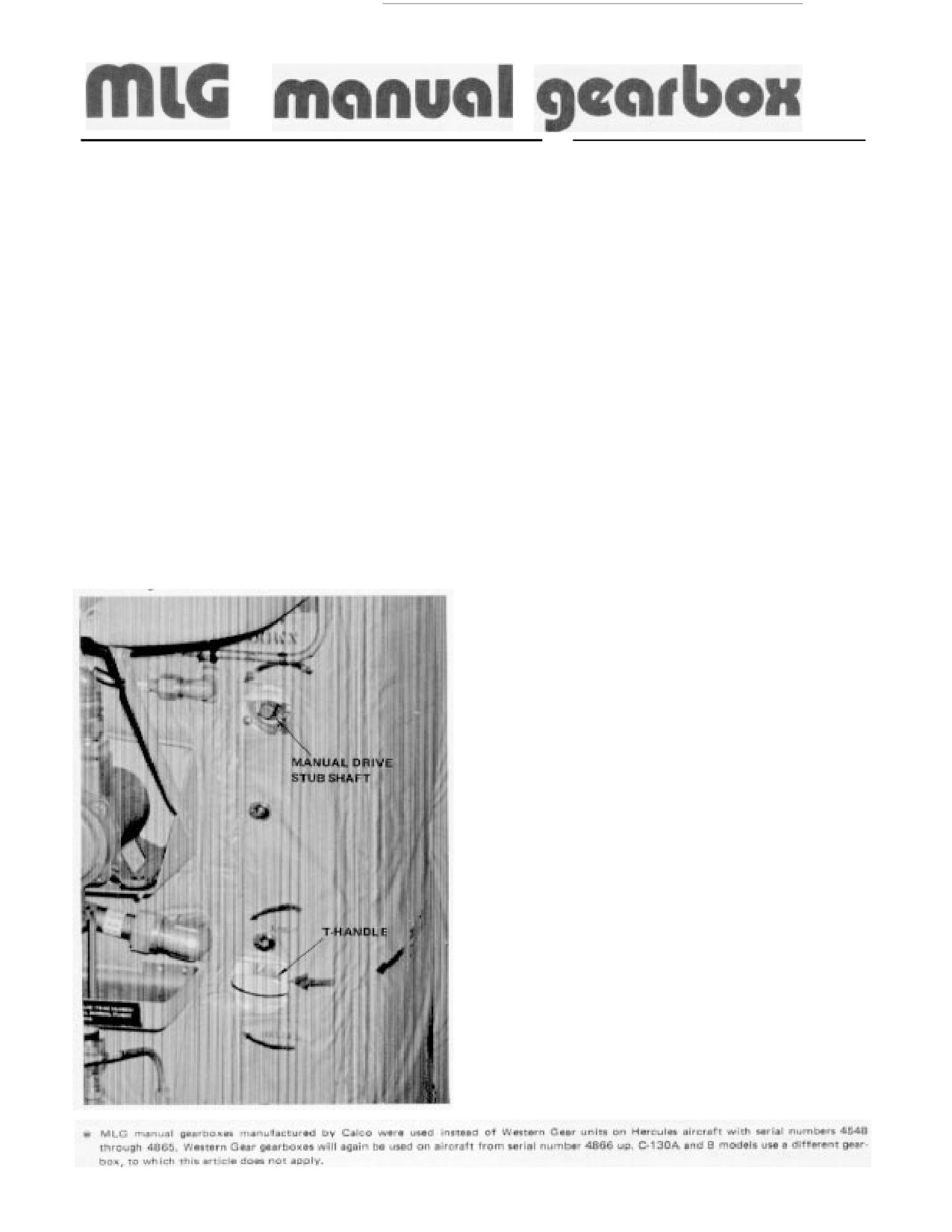
by C. R. Bush, Design Engineer Specialist
Good operator technique is a crucial ingredient in the
for selecting normal hydraulic drive or manual handcrank
proper operation of the main landing gear (MLG) manual
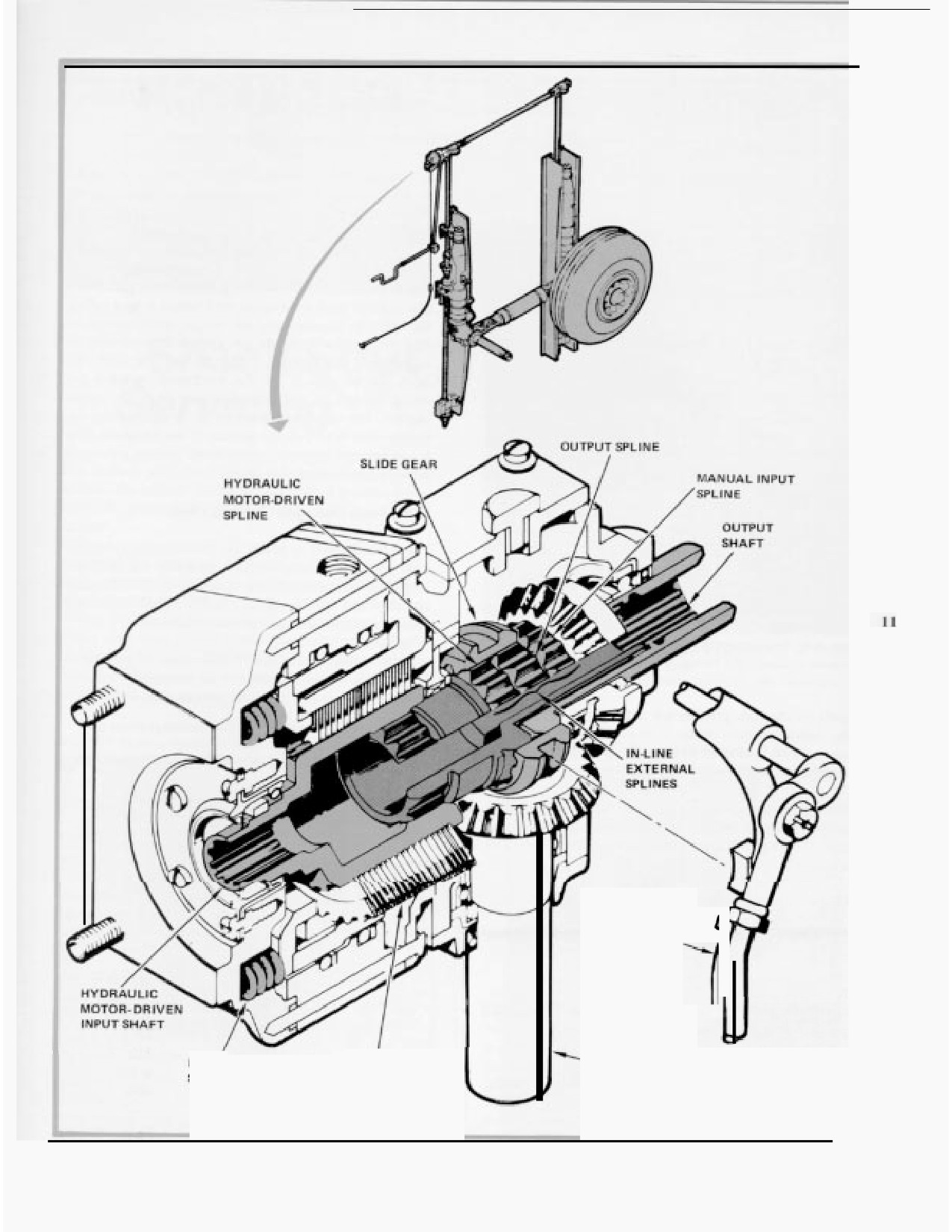
drive to activate the main landing gear (Figure 1).
gearbox on Hercules aircraft. Burred and distorted teeth
on the input shaft and slide gear of the manual gearbox
The shift mechanism is composed of three in-line exter-
have been experienced recently on several C-130E and
nal splines and a slide gear with an internal spline. The
later model aircraft. Gearboxes manufactured both by
slide gear couples the center output spline with either the
Calco and Western Gear Corporation have been Involved*,
hydraulically driven Input spline or the manual input
and in nearly all cases the damage has been attributed to
spline .
improper operator technique in the shifting process be-
tween manual and hydraulic drive.
In the normal hydraulic drive position, the slide gear
couples the output spline with the hydraulically driven
Let us take a look at the shift mechanism and its opera-
input spline, the manual T-handle and engage cable are
tion to see how this kind of damage may occur.
positioned
“in”, and engagement is maintained by a com-
pression spring in the shift linkage on the Calco gearbox,
The manual gearbox contains a hydraulically released,
and a tension spring on the Western Gear gearbox.
spring applied, uplock brake, and a shift mechanism used
Shifting From Hydraulic To Manual Drive
Here is the proper sequence of events which occurs when
changing from hydraulic to manual drive: When the hy-
View
of
rinht-hand wheel
well
forward
bulkhead,
draulic pressure is depleted, the brake springs engage the
10
brake, locking the hydraulic input shaft to the case.
The manual drive engage T-handle, located on the forward
wheel-well bulkhead, is rotated counterclockwise to its
stop and then pulled straight out until it locks. This pulls
the gearbox lever down, compresses or stretches (depend-
ing on the design) the spring in the linkage, and shifts the
slide gear so that the output spline is coupled to the
manual input spline.
It may be necessary to rotate the manual drive stub shaft
(adjacent to the T-handle) to align the spline teeth so that
the T-handle can be pulled out and the shift accom-
plished.
CAUTION: The T-handle must not be forced out. To do
so may result in damage to the system.
Shifting From Manual To Hydraulic Drive
In order to shift from manual to hydraulic drive, the
following technique is recommended: The T-handle is un-
locked by rotating it slightly clockwise with light finger
pressure, then pushed in. This slacks the cable to the gear-
box lever and permits the spring in the shift linkage to
shift the slide gear so that the output spline is coupled to
the hydraulic motor-driven input spline. However, if the
MANUAL DRIVE
SHIFT LINKAGE
BRAKE
BRAKE ASSEMBLY
M A N U A L DRIVE
SPRING
SHAFT
Figure 1. MAIN LANDING GEAR GEARBOX AND UPLOCK BRAKE
1. Stopping Q free-falling gear by pushing in the T-
handle-The results are the same as before. The only differ-
ence is that the output spline and slide gear are turning
and the hydraulic input spline is stationary.
2. Pulling the T-handle while the aircraft is on the
ground- During normal gear extension, the gear is driven
down until the hydraulic motor stalls out. This generates
a slight amount of wrap-up in the torque shafts. When the
aircraft lands, the friction washers lock the ballscrews and
also lock in the wrap-up of the torque shafts. When hy-
draulic pressure is depleted, the gearbox brake applies and
also locks in shaft wrap-up. If the T-handle is then pulled,
the brake is bypassed and the torque shafts unwrap so
that the splined teeth are not aligned for hydraulic re-
engagement. By applying torque to the stub shaft, the
teeth can be aligned, but the mechanism spring is not
strong enough to shift the slide gear with this torque
applied. The only positive means of re-engaging the hy-
draulic drive is to jack the aircraft. If the hydraulic drive
is not engaged properly, spline tooth damage will occur
when hydraulic pressure is restored.
MLG Manual Engagement T-handle Check
The T-handle used to engage the MLG manual extension
drive is also subject to mechanical binding due to corro-
sion. This corrosion buildup occurs in the flexible cable
assembly and is prone to accumulate rapidly in aircraft
12
operating in adverse environmental conditions.
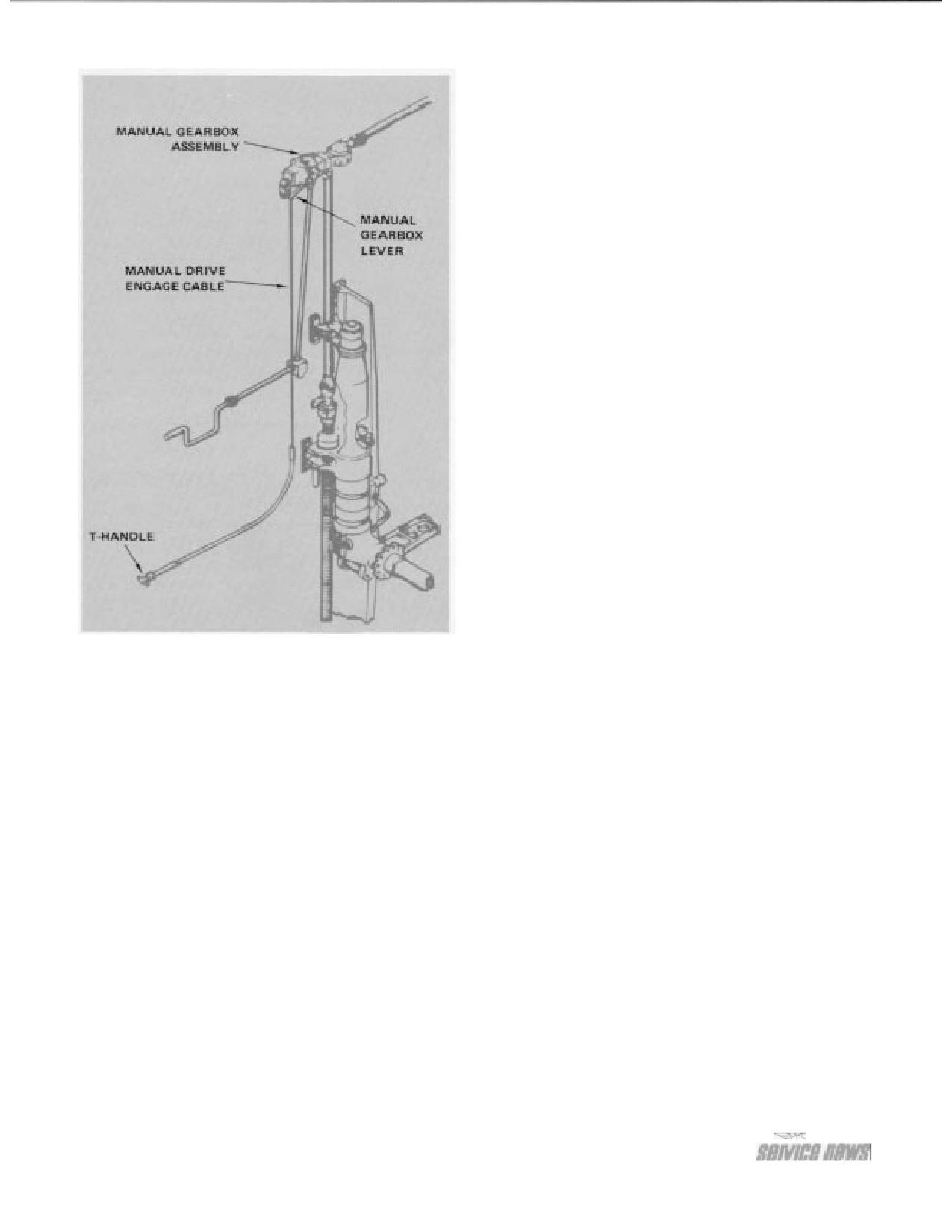
Figure2.
T-HANDLE
CHECK
In order to ensure that the T-handle cable is free to shift
the gearbox to manual drive in an emergency, periodic
checks may be conducted as follows (see Figure 2):
teeth on the slide gear are not aligned with
the teeth
of
the hydraulic input spline, it is necessary to rotate the
1.
Disconnect the cable from the manual gearbox lever.
manual drive stub shaft to align the teeth and permit the
2.
Operate the T-handle several times to ensure freedom
spring to accomplish the shift.
of operation.
Completion of the shift to hydraulic drive is then verified
3.
Reconnect the cable to the manual gearbox lever.
by turning the stub shaft one turn in each direction. The
shaft should turn smoothly and very little force should be
NOTE: Do not operate the main landing gear manual sys-
required.
T-handle when the aircraft is resting on the main
landing gear without first disconnecting the cable from
Hydraulic pressure can then be restored.
the manual gearbox lever. The aircraft must be on jacks
for ground operation of the manual T-handle with the
CAUTION: Restoring hydraulic pressure prior to shift
cable attached to the manual gearbox lever.
completion can result in damage to the spline teeth.
Binding cable assemblies should be replaced since there is
If the shift has not been completed (indicated by free ro-
no provision for lubrication of a defective cable assembly.
tation of the stub shaft noted above) before hydraulic
Consult the appropriate Hercules maintenance manual for
pressure is restored to the landing gear motor, the brake
removal and installation of MLG manual emergency ca-
will be released and the hydraulic input spline will spin
bles.
while the slide gear is pressed against it by force of the
spring. This will cause a ratcheting noise and burrs and de-
Using the techniques outlined in this article and a little
formation of the spline teeth. If damage is severe enough,
care in the shift process, you can help make the MLG
hydraulic drive engagement may not be possible. Two
manual gearbox last practically the life of the aircraft.
other conditions can also lead to this type of damage:
A quick check chart is included in the new servicing in-
formation to enable maintenance personnel to determine
quickly and without a pressure gage if a main landing
gear (MLG) strut requires servicing. This type of chart
works well for the MLG, since it is relatively insensitive to
cg location, but is not practical for the nose gear.
The landing gear shock struts are designed to properly
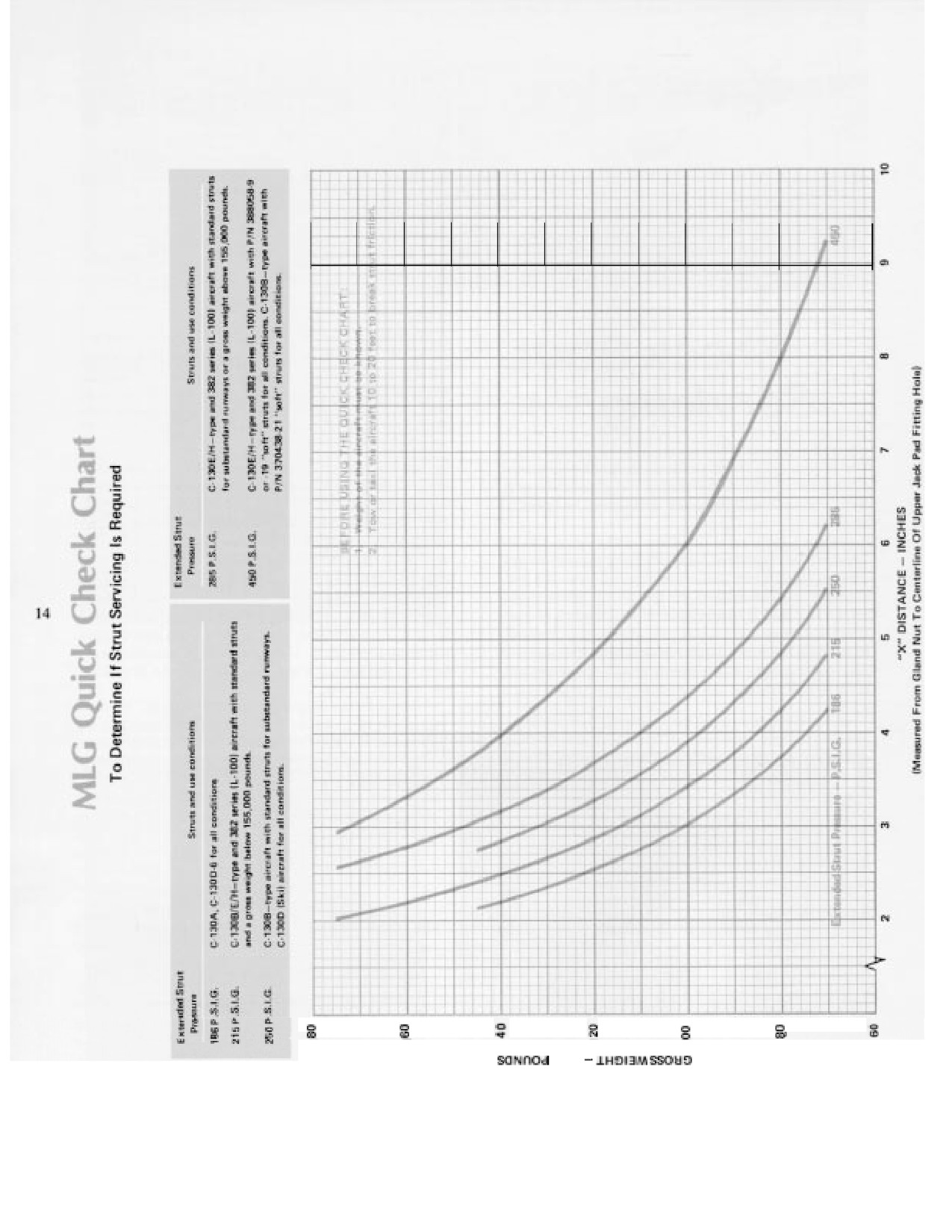
To use the MLG quick check chart (Figure 1), determine
cushion the aircraft during landing and all ground opera-
the gross weight of the aircraft. Next, select the curve that
tions. To accomplish this, the struts must be properly
corresponds to the applicable extended strut pressure for
serviced.
the particular aircraft. Use this curve to find where the
curve intersects the selected gross weight line. Locate the
Lockheed has responded to questions from Hercules air-
correct “X” distance directly below the intersecting point
craft operators about the proper servicing of landing gear
at the bottom of the chart. The “X” distance (Photo A)
struts by making in-depth studies of the problems in-
is the distance between the bottom of the strut gland nut
volved. Our studies have resulted in the adoption of new
and the center of the MLG jack pad fitting upper hole.
13
charts and changes in the preferred and alternate methods
If the difference between the “X” distance as indicated on
of servicing the struts. The Hercules maintenance manuals
the quick check chart, and the actual “X” distance meas-
have recently been revised to include the new charts and
ured on the aircraft is less than l/8 inch, the strut does
servicing instructions.
not require servicing.
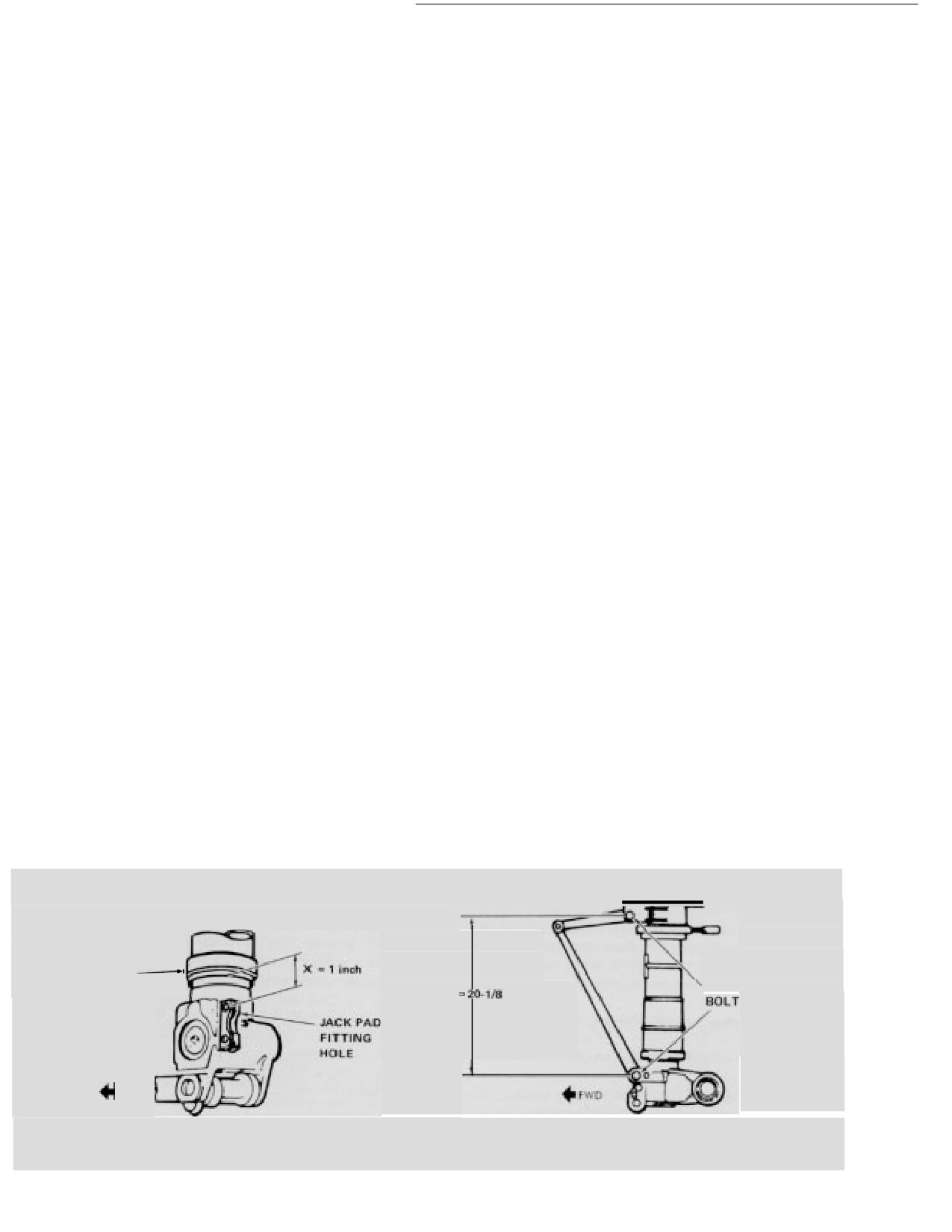
The “X” distance measurements discussed in this article are taken at the points indicated below in photographs A and 6.
0001
Figure 1. MLG QUICK CHECK CHART
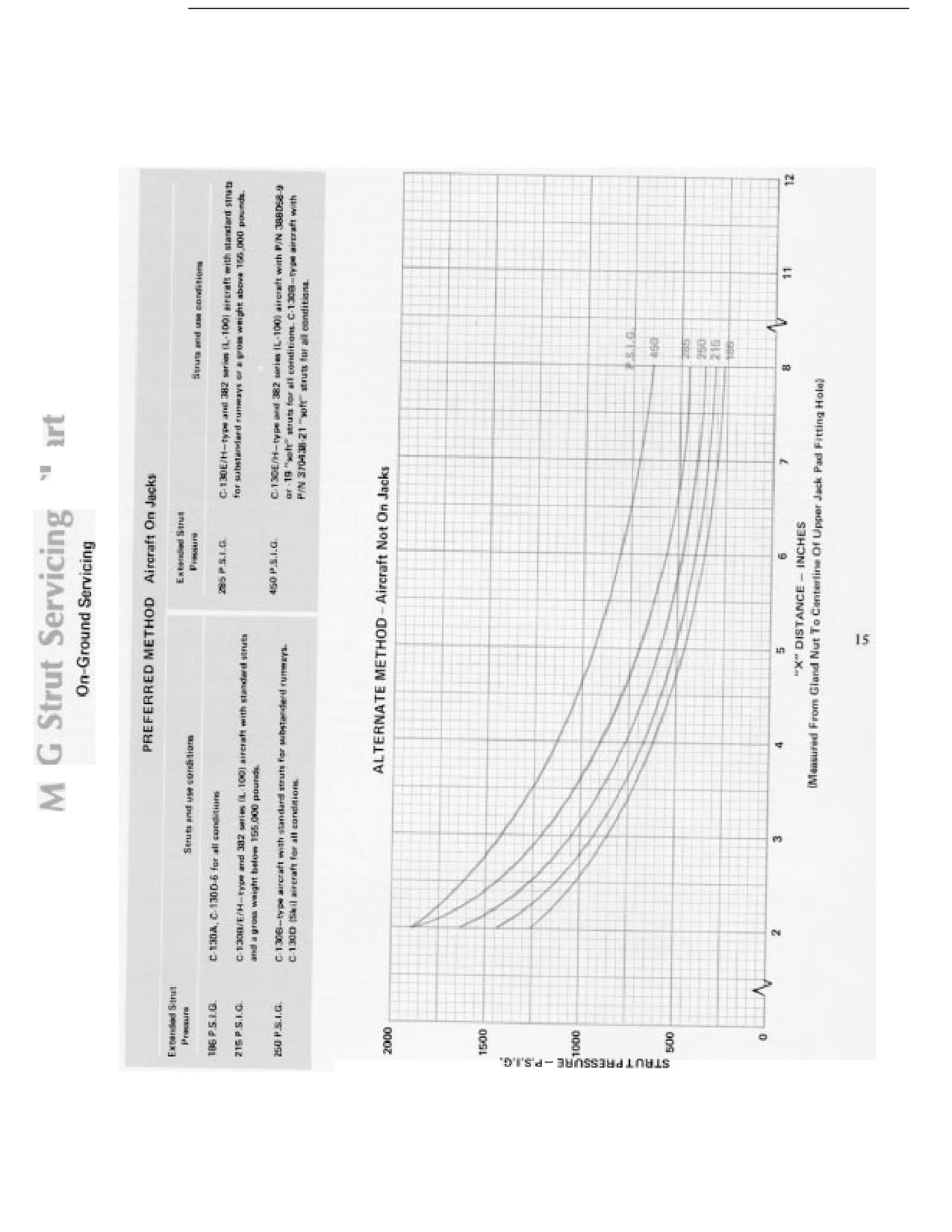
Figure2. MLG STRUT SERVICING CHART -On-Ground Servicing
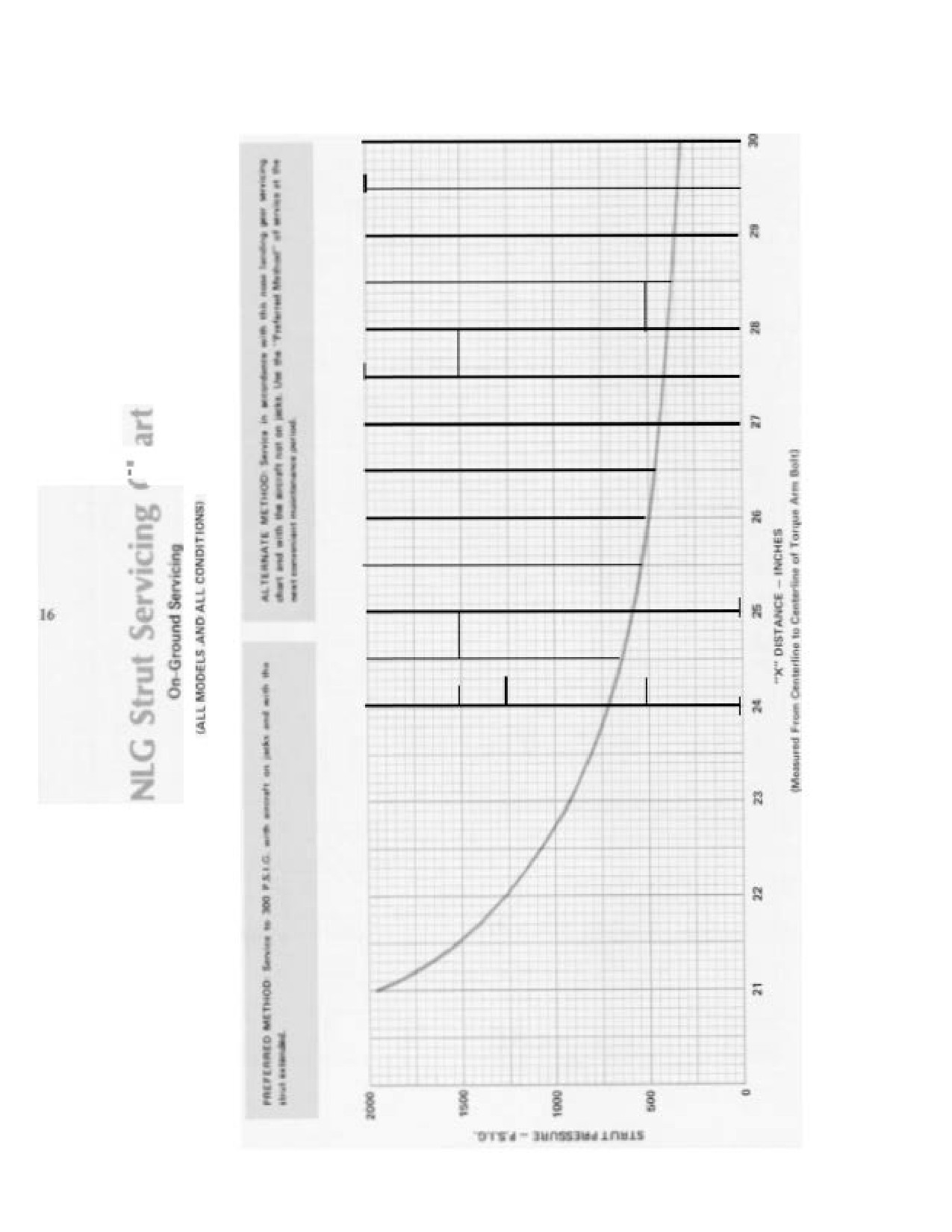
Figure 3. NLG STRUT SERVICING CHART - On-Ground Servicing
NEW SERVICING CHARTS
aircraft under all conditions. This chart is used in the same
manner as the MLG strut servicing chart for on-ground
MLG Strut Servicing Chart for On-Ground Servicing
servicing.
A new chart for on-ground servicing has been developed
THE PREFERRED METHOD - Aircraft on Jacks
to allow direct readings of strut pressure and “X” distance
without the double interpolation required when using the
Servicing the Hercules MLG struts with the aircraft on
strut placards. This chart (Figure 2) is used to determine
jacks is preferred because this method eliminates the in-
which of the extended strut pressures would be correct
flation errors caused by static friction that sometimes
for the particular combination of Hercules aircraft model,
occur when the struts are serviced with the aircraft on the
strut type, and condition involved. Note that the main
ground.
strut pressures for C-13OB-type aircraft have been in-
creased to prevent strut bottoming problems. The chart is
NOTE: All cautions and warnings of the maintenance
also used to determine the recommended MLG strut pres-
manual must be followed.
sure and “X” distance for servicing the MLG struts with
the Hercules on the ground.
Strut Deflation
To use the MLG strut servicing chart for on-ground serv-
Jack the aircraft in accordance with the applicable mainte-
icing, determine from the chart the recommended ex-
nance manual until the wheels are free of the ground.
tended strut pressure for the applicable Hercules. Find the
Clean the servicing valves to prevent entry of dirt, and de-
curve corresponding to the selected extended strut pres-
flate the struts in accordance with the applicable mainte-
sure. Service the MLG shock strut to a pressure and "X”
nance manual. After the air pressure is depleted, remove
distance that corresponds to the curve.
the servicing valve from the strut and fully compress the
strut with an axle jack. The approximate “X” distance
Example: For a C-130A, the 186 psig curve would be the
with the strut fully compressed is 1 inch for the main gear
correct one to use. If the particular C-130A being checked
strut, and
20-l/8 inches for the nose gear strut, as illu-
has a strut pressure of 1000 psig, its “X” distance should
strated in Figures 4 and 5.
be 2-l/2 inches +-l/8 inch.
Filling the Strut
17
NLG Strut Servicing Chart for On-Ground Servicing
With the servicing valve removed, fill the struts with
A nose landing gear (NLG) strut servicing chart (Figure 3),
approved hydraulic fluid as required until the fluid is
has been developed. In this chart, a single curve is used to
level with the servicing hole.
find the recommended strut pressure and “X” distance for
on-ground servicing of NLG struts of any Hercules air-
Replace the servicing valve, taking care to avoid thread
craft. A single curve is used since an extended strut pres-
damage. Torque to the proper value specified in the appli-
sure of 300 psig is applicable for the NLG of all Hercules
cable maintenance manual.
Figure 4
Figure 5
STRUT
GLAND
NUT
TORQUE ARM
X
inches
FWD
MAIN LANDING GEAR
NOSE LANDING GEAR
inches
NOSE LANDING GEAR
MAIN LANDING GEAR
Figure 6
Figure 7
Lower, and then remove the axle jacks to allow the shock
jacks
(the preferred method) at the next convenient
strut pistons to extend.
maintenance period.
Strut Inflation
Strut Deflation
Before proceeding with shock strut deflation, make
After checking the shock strut fluid level and adding
certain that personnel and equipment are clear of the air-
hydraulic fluid as needed, strut inflation can be accom-
18
craft. This will prevent the possible damage or injury in
plished. Inflate the NLG strut to 300 psig
+/-
10 pounds
case of sudden collapse of a strut.
with the strut fully extended, using a P/N EIST34T684
air-filling chuck, and a P/N 7CAD-337110 gage assembly
Tow or taxi the aircraft in a straight line 10 to 20 feet
or its equivalent.
prior to parking and deflating shock struts (unless this was
accomplished before the aircraft was parked). Failure to
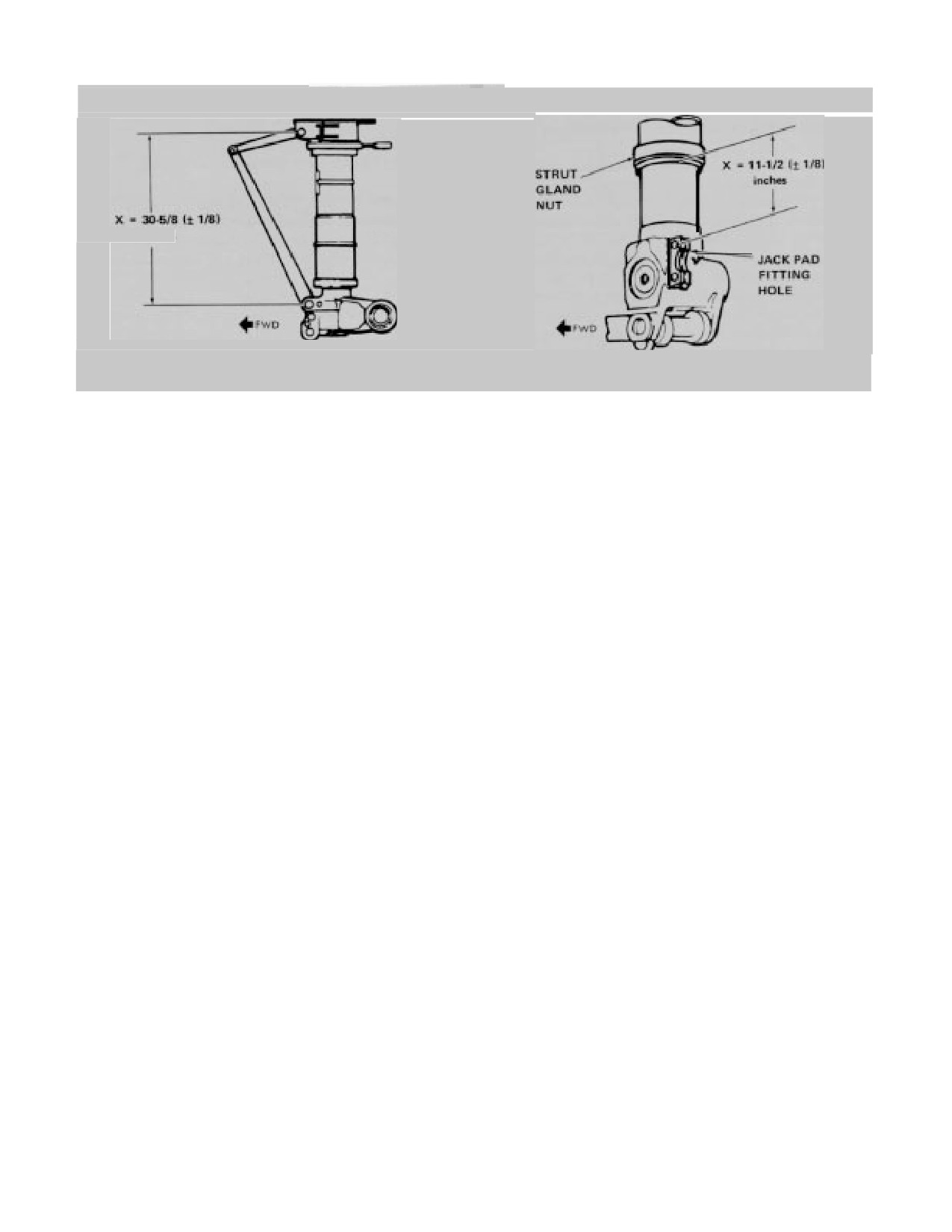
After strut inflation, the NLG
“X” distance should be
do this can result in binding struts, which can affect serv-
30-5/8 inches +/- l/8 inch, measured between the center
icing accuracy.
lines of the torque arm bolts, as illustrated in Figure 6.
Clean the servicing valve to prevent dirt or other materials
Inflate the main gear struts to the appropriate extended
from entering and deflate the shock strut.
strut pressure for the applicable aircraft type, struts, and
conditions as listed in Figure 2. The inflated “X” distance
Filling the Strut
for the MLG strut should be
11-l/2 inches +/- l/8 inch,
measured between the bottom of the gland nut and the
Remove the servicing valve from the shock strut. Be cer-
centerline of the jack pad fitting upper hole, as shown in
tain not to remove the filler standpipe from the NLG
Figure 7.
strut or the standpipe adapter from a soft-type main gear
strut. If it has been removed, reinstall before servicing
After inflating the landing gear shock strut, make certain
the strut with oil. The
“X” distance with the strut de-
that the servicing valve is properly closed and torqued.
flated is 1 inch for the MLG strut and 20-l/8 inches for
Tighten the servicing valve cap securely using your fingers.
the NLG strut, as previously shown in Figures 4 and 5.
Service the shock strut with approved hydraulic fluid as
Lower the aircraft and remove the jacks and jack fittings.
required until the fluid is level with the servicing hole,
A L T E R N A T E M E T H O D - Aircraft on Ground
and carefully replace the servicing valve to avoid thread
damage. Torque the servicing valve as specified in the
maintenance manual.
The aircraft -on-ground method of servicing landing gear
struts is the alternate method because of possible inflation
Strut Inflation
errors due to strut static friction. For this reason, the
aircraft should be reserviced with the aircraft on
After making certain that the strut fluid level is correct,
attach an approved air-filling chuck and gage assembly.
To prevent strut contamination, the filler valve area
Inflate the strut, using an approved high-pressure dry air
of the strut should be cleaned before the struts are serv-
or dry nitrogen source.
iced.
Nose Landing Gear - The NLG strut is to be inflated to
All safety precautions outlined in the technical man-
the pressure and “X” distance indicated in the Nose Gear
ual should be observed when servicing the shock struts.
Strut Servicing Chart for On-Ground Servicing (Figure 3).
This will help prevent damage to equipment and injury
The NLG strut ‘X” distance, as previously discussed, is
to personnel.
measured between the center lines of the torque arm
bolts.
Under no circumstances should the strut air servicing
valve be removed prior to completely exhausting the air
Main Landing Gear - After selecting the extended strut
pressure from the strut.
pressure curve that is applicable to the type of aircraft,
struts, and conditions, use the curve to determine the
Some soft-type main gear struts use a standpipe
specific recommended strut pressure and
“X” distance.
adapter between the strut and the servicing valve to con-
trol the oil level. This adapter should not be removed
Inflate the MLG strut to the correct pressure and
‘X”
when servicing the strut with oil.
distance indicated in the Main Gear Servicing Chart for
On-Ground Servicing
(Figure
2) . The MLG strut “X”
When servicing the shock struts using the aircraft-on-
distance, as previously noted, is measured from bottom
ground method, the aircraft should be moved 10 to 20
of the gland nut to the center line of the jack fitting
feet in a straight line prior to parking. This will help pre-
upper hole.
vent binding or torsional loads that could alter servicing.
The strut pressure tolerance is +- 10 psig, although for the
The proper use of the new shock strut servicing informa-
sake of simplicity this is not shown on the strut servicing
tion and procedures should ensure Hercules operators of
charts.
increased success in landing gear shock strut servicing,
while decreasing aircraft downtime.
Following inflation of the strut, make sure that the serv-
icing valve is closed properly and that the valve cap is
19
tightened securely (finger tight).
SERVICING TIPS
The following landing gear shock strut servicing tips
should be helpful.
CORRECT10
Another Grease - Great Improvement
In the
“Tools for Panelocs” article, V7N2, there is an
error on page 18. Figure 2 should show that l/4 inch is
There have been quite a few comments that
to be taken off the type of screwdriver illustrated, rather
MIL-G-23827A grease was not only lubricating
than l/8 inch as indicated. n
the surface to which it was applied, but was
also causing the paint to dissolve. Another grease
is now recommended, MIL-G-81322, which will
not strip the paint or cause corrosion. Nor will
this grease cause the O-rings to swell, which has
been one of the characteristics of the other
grease. The MIL-G-81322 grease has reportedly
saved many man-hours previously used to apply
new paint to parts of the aircraft.