Price setting and price regulation in health care Lessons for advancing Universal Health Coverage (2019)
Price setting and price
regulation in health care
Lessons for advancing Universal
Health Coverage
Sarah L Barber, Luca Lorenzoni and Paul Ong
Price setting and price regulation in health care:
lessons for advancing Universal Health Coverage
Sarah L Barber, Luca Lorenzoni, Paul Ong
ISBN 978-92-4-151592-4 (WHO)
WHO/WKC-OECD/K18014
and Development, 2019
Some rights reserved. This work is available under the Creative Commons
Attribution-NonCommercial-ShareAlike 3.0 IGO licence (CC BY-NC-SA 3.0 IGO;
Under the terms of this licence, you may copy, redistribute and adapt the work for
non-commercial purposes, provided the work is appropriately cited, as indicated
below. In any use of this work, there should be no suggestion that the World
Health Organization (WHO) and the Organisation for Economic Co-operation and
Development (OECD) endorse any specific organization, products or services. The
use of the WHO or OECD logo is not permitted. If you create a translation of this
work, you should add the following disclaimer along with the suggested citation:
“This translation was not created by the World Health Organization (WHO) and the
Organisation for Economic Co-operation and Development (OECD). WHO and OECD
are not responsible for the content or accuracy of this translation. The original
English edition shall be the binding and authentic edition”.
Any mediation relating to disputes arising under the licence shall be conducted
in accordance with the mediation rules of the World Intellectual Property
Organization (http://www.wipo.int/amc/en/mediation/rules).
Suggested citation. Barber SL, Lorenzoni L, Ong P. Price setting and price regulation
in health care: lessons for advancing Universal Health Coverage. Geneva: World
Health Organization, Organisation for Economic Co-operation and Development;
2019. Licence: CC BY-NC-SA 3.0 IGO.
Cataloguing-in-Publication (CIP) data. CIP data are available at http://apps.who.
int/iris.
Sales, rights and licensing. To purchase WHO publications, see http://apps.who.
int/bookorders. To submit requests for commercial use and queries on rights and
licensing, see http://www.who.int/about/licensing.
Third-party materials. If you wish to reuse material from this work that is
attributed to a third party, such as tables, figures or images, it is your responsibility
to determine whether permission is needed for that reuse and to obtain permission
from the copyright holder. The risk of claims resulting from infringement of any
third-party-owned component in the work rests solely with the user.
WHO Photographs. WHO photographs are copyrighted and are not to be
reproduced in any medium without obtaining prior written permission. Requests
for permission to reproduce WHO photographs should be addressed to: http://
General disclaimers. The designations employed and the presentation of the
material in this publication do not imply the expression of any opinion whatsoever
on the part of WHO and OECD concerning the legal status of any country, territory,
city or area or of its authorities, or concerning the delimitation of its frontiers or
boundaries. Dotted lines on maps represent approximate border lines for which
there may not yet be full agreement.
The mention of specific companies or of certain manufacturers’ products does not
imply that they are endorsed or recommended by WHO and OECD in preference to
others of a similar nature that are not mentioned. Errors and omissions excepted,
the names of proprietary products are distinguished by initial capital letters.
All reasonable precautions have been taken by WHO and OECD to verify the
information contained in this publication. However, the published material is
being distributed without warranty of any kind, either expressed or implied. The
responsibility for the interpretation and use of the material lies with the reader. In
no event shall WHO and OECD be liable for damages arising from its use.
The opinions expressed and arguments employed herein do not necessarily reflect
the official views of the OECD member countries, or those of WHO.
The named authors alone are responsible for the views expressed in this
publication.
Designed and artworked in United Kingdom. Printed in Japan.
Price setting and price regulation in health care:
Lessons for advancing Universal Health Coverage
Foreword and Acknowledgments
vii
Glossary and Abbreviations
viii
Executive summary
x
1.
Why pricing is important
1
1.1.
How does pricing fit within the commitments for
Universal Health Coverage?
2
1.2.
Why intervene in pricing?
3
1.3.
Relevance to low- and middle-income settings
4
2.
Comparison of case studies
8
Contents
2.1.
Demographics and health resources
9
2.2.
Health care coverage
10
2.3.
Health system characteristics
13
3.
Payment methods
15
3.1.
The base for payments
16
3.2.
Primary care and outpatient specialists
20
3.3.
Inpatient care
22
3.4.
Long-term care
23
4.
Process by which price is determined
28
4.1.
Individual negotiations
29
4.2.
Collective negotiations
30
4.3.
Unilateral price setting
31
4.4.
Process of price setting by base for payment
33
5.
Technical process of setting the price per unit
of payment
39
5.1.
Costing methods
40
5.2.
Process of collecting information
43
5.3.
From cost submission to price setting for
hospital services
46
5.4.
Changing the cost structure
47
6.
Aligning pricing with overall policy goals
49
6.1.
Adjustments and add-ons to ensure payment
adequacy and fairness
50
6.2.
Expenditure control mechanisms
52
6.3.
Balance billing limitations and financial
protection
54
6.4.
Bundled payments
57
6.5.
Incentives for quality
58
v
7.
Infrastructure for costing and pricing
60
7.1. Institutional entities
61
7.2. Formal stakeholder consultation
64
7.3. Investments in data collection
65
7.4. Information disclosure
68
8.
Best practices for low- and middle-
income settings
71
8.1. Investing in data infrastructure
72
8.2. Building institutional capacities
73
8.3. Planning sequenced implementation
74
8.4. Establishing prices that approximate the most
efficient way of delivering care
76
8.5. Using prices as instruments to promote value
for health spending
77
8.6. Strengthening the national role in setting prices
77
8.7. Establishing systems of ongoing revision,
monitoring and evaluation
78
References
79
Annexes: Case studies
Australia:
Jane Hall, Maryam Naghsh Nejad, Kees Van Gool and
Michael Woods
England:
Sue Nowak and Alberto Marino
France:
Zeynep Or and Coralie Gandré
Germany:
Jonas Schreyögg and Ricarda Milstein
Japan:
Naoki Ikegami
Malaysia:
Chiu Wan Ng
Republic of Korea:
Soonman Kwon
Thailand:
Viroj Tangcharoensathien, Walaiporn Patcharanarumol,
Taweesri Greetong, Waraporn Suwanwela,
Nantawan Kesthom, Shaheda Viriyathorn,
Nattadhanai Rajatanavin, Woranan Witthayapipopsakul
United States of America and Maryland:
Luca Lorenzoni
vi
Under international commitments to Universal Health Coverage,
the Member States of the World Health Organization are
obligated to strengthen their financing systems to ensure that
all people have access to health services and are protected
against financial hardship in paying for these services. While
payment methods have received a great deal of attention
among policy-makers and practitioners, less attention has been
paid to price setting and how it can also contribute to broader
system objectives. However, if prices are set too high or too
low, they can easily overshadow the incentives in payment
mechanisms.
The objectives of this study are to describe experiences in price
setting and how pricing has been used to attain better
coverage, quality, financial protection, and health outcomes. It
builds on newly commissioned case studies and lessons
learned in calculating prices, negotiating with providers, and
monitoring changes. Recognizing that no single model is
Foreword and
applicable to all settings, the study aimed to generate best
practices and identify areas for future research, particularly in
Acknowledgments
low- and middle-income settings.
The World Health Organization (WHO) and the Organisation for
Economic Co-operation and Development (OECD) have been
collaborating since 2014 to study health care pricing policies.
The research was guided by Sarah L. Barber, Paul Ong, and
Tomas Roubal from WHO, and Luca Lorenzoni from OECD, who
established the scope and framework for the analysis in
consultation with global and regional experts. We thank the
authors of the case studies for their research and useful
comments on the summary. These authors include Jane Hall,
Maryam Naghsh Nejad, Kees Van Gool and Michael Woods
(Australia); Sue Nowak and Alberto Marino (England); Zeynep Or
and Coralie Gandré (France); Jonas Schreyögg and Ricarda
Milstein (Germany); Naoki Ikegami (Japan); Chiu Wan Ng
(Malaysia); Soonman Kwon (Republic of Korea); and Viroj
Tangcharoensathien, Walaiporn Patcharanarumol, Taweesri
Greetong, Waraporn Suwanwela, Nantawan Kesthom, Shaheda
Viriyathorn, Nattadhanai Rajatanavin, and Woranan
Witthayapipopsakul (Thailand). Professor Naoki Ikegami assisted
with the review of the case studies. Jain Nishant, Indo-German
Social Security Programme, wrote the text box for India. The
case studies were discussed with the research teams, and the
outline for this study was developed at a meeting in Yokohama,
Japan, in January 2019. At this meeting, WHO experts provided
support and guidance, including Peter Cowley, Jon Cylus, Tamas
Evetovits, Tomas Roubal, and Liviu Vedrasco. Lluis Torres Vinals
provided useful comments; Tessa Edejer and Xu Ke provided
statistical review. This document was produced with the
financial assistance of the Kobe Group, and the Yokohama
meeting was supported by Kanagawa Prefecture, Japan.
vii
Glossary and
Abbreviations
Term
Abbreviation
Definition
Balance billing
-
When a health care provider bills a patient for a price beyond what is
reimbursable from the patient’s health insurance.
Base for payment
-
The base or unit of activity on which prices are set. Common base for
payments are fee-for-service, diagnosis related groups, per diem, and
capitation, for example.
Base rate
-
The standardized payment amount that a provider receives for covered
services. The rate could be adjusted by differences in the cost of living or
other factors.
Bundled payment
-
A single payment covering a bundle of distinct goods and services
required for the treatment of a given medical condition based on clinical
practice guidelines.
Capitation (also per capita
CAP
Prospective fixed lump-sum payment per person enrolled for care with a
payment)
provider within a given period (typically one year) covering a defined set
of services, independent of whether the services are provided.
Charge
-
The amount that a provider sets for services before applying any
discounts. The charge can be different from the amount paid.
Coinsurance
-
Percentage that the insurer pays after the individual deductible is
exceeded, with the intention of joint risk sharing between the insured
individual and the insurer.
Copayment
-
Fixed payment paid by an individual for health care services at the point
of seeking care, which is not covered by insurance, regardless of the kind
of services provided during the visit.
Contributory health coverage
-
Coverage paid through employee payroll contributions with employer
cost sharing.
Cost
-
(For the provider), the total amount incurred in providing a service,
including procedures, therapies, and medications. The actual cost is
typically lower than the price paid.
Cost based reimbursement
-
Retrospective payments to health care providers based on the cost of
care provided to patients and allowable covered costs.
Cost centre
-
A defined entity to which direct costs are assigned and indirect costs are
allocated (i.e., organizational or management unit).
Cost object (also cost objective)
-
A defined entity for which cost information is sought (i.e., patient, service,
department).
Diagnosis Related Group
DRG
Payment paid to hospitals per admission or discharge, whereby patients
payment (also case-based
are classified into groups (DRGs) based on diagnosis and procedures.
payment)
viii
Price setting and price regulation in health care
Term
Abbreviation
Definition
Extra billing
-
Billing for services or drugs that are not included in the benefits package.
This differs from balance billing, where the amount billed for covered
service is higher than the regulated price.
Fee-for-service
FFS
Fixed payment for each unit of service without regard to outcomes. It is
typically paid retrospectively by billing for each individual service or
patient contact.
Global budget
-
Prospective lump-sum payment to a health care provider to cover
aggregate costs over a specific period for a set of services independent
of the actual volume provided.
Line-item budget
-
Fixed payment to a health care provider to cover specific input costs (i.e.,
personnel, utilities, medicines, supplies, etc.) for a specific period.
Long-term care
LTC
Activities undertaken to ensure that people can maintain levels of
functional ability consistent with basic rights, fundamental freedoms, and
human dignity.
Multiple payer system
-
A system in which multiple entities set prices to pay health care
providers.
Pay for performance (also
P4P
Payments to health care providers for meeting specific performance
results based financing)
targets, such as process quality or efficiency measures, or penalties for
poor outcomes, such as medical errors or avoidable readmissions.
Payment for procedure or
-
Fixed payment for each unit of service or procedure, whereby
service
adjustments to prices may reflect substantial additional work as
measured by increased intensity, time, technical difficulty of the
procedure, severity of the patient condition, or physical and mental
effort required.
Per diem
-
Fixed amount per day for inpatient stay, which may vary by department,
patient, clinical characteristics, or other factors.
Price (also fee, rate, tariff)
-
Financial amount that a purchaser (i.e., health insurer) or individual pays
to a provider to deliver a service.
Price discrimination
-
Occurs when an identical service is sold to different consumers at
different prices.
Price schedule (also fee
-
Detailed list of prices for all providers and hospitals, usually by a coding
schedule)
system, i.e., Healthcare Common Procedure Coding System in the United
States of America, by diagnosis-related groups (DRGs).
Residence based coverage
-
Coverage based on legal residence financed with general tax revenues.
Resource based relative value
RBRV
A unit of measure that indicates the value of procedures conducted by
physicians, midlevel and other health care providers.
Single payer system
-
A system in which one entity (the single payer) set prices to pay health
care providers. The payer is typically government.
United States of America
USA
Abbreviation of the official World Health Organization member state
name for the United States of America.
Universal Health Coverage
UHC
Commitment made by United Nations Member States to extend coverage
to needed health care services for the whole population, without people
suffering from high health care payments or poverty because of getting
the health care that they need.
User fee (also user charges,
-
Payment made by a patient to access a service or facility.
cost-sharing)
Voluntary Health Insurance
VHI
Insurance plans where the decision to join and the payment of a
premium is voluntary. Coverage may be complementary or
supplementary to the basic (primary) benefit package or duplicate it.
Sources: Cashin, 2015; OECD, 2016; WHO, 2017; Le Grand and Bartlett,
1993; authors.
Price setting and price regulation in health care
ix
This study was carried out to support countries in meeting
international commitments towards Universal Health Coverage.
It aims to gather experiences in price setting and regulation,
generate best practices, and identify areas for future research.
There is a special focus on the implications for middle-income
settings, which represent more than 70% of the world’s
population. The share of public spending on health in these
settings doubled between 2000 and 2016. This increase in
public spending has been accompanied by new ways of
financing, organizing, and delivering health care. A key question
is how to make use of all health resources - from both private
and public sources - to attain health-related goals.
Health care is far from being a classic market for goods and
services. Individuals are usually represented by a purchasing
agent (i.e., health insurers) instead of operating by themselves,
and do not have complete information. This makes people less
sensitive to prices. However, prices provide important signals to
health care providers, given that they determine the level of
Executive summary
financial resources to deliver health care services.
Provider payment systems consist of one or more payment
methods and their supporting systems such as contracting and
reporting mechanisms, which are used to create economic
signals and incentives that influence behaviour. Any payment
method has three dimensions: the base upon which prices are
defined and set; the level of payment per unit of the chosen
base; and the administrative and economic process by which
that price level is determined. This study focuses on these key
dimensions.
Among the case studies reported, the base for payment for
primary care is primarily fee-for-service and capitation; fee-for-
service is typically used in outpatient settings; and diagnosis
related groups are commonly used in hospital settings.1
Increasingly, payment methods have been combined with
specific performance-based rewards or penalties; they have
also been combined across providers to facilitate a more
coordinated and flexible approach to care. All payment models
have strengths and weaknesses; therefore, the impact of each
depends not only on the method chosen but also the price
paid. The price not only ensures that the costs of delivering
services are covered, but also provides incentives for health
care providers. Price adjustments are typically made to ensure
coverage and access, for example, to health care providers in
rural and remote areas; those treating disproportionately high
numbers of low-income or high-cost patients to ensure
coverage and quality; and for facilities providing medical
education. Prices are also adjusted to attain broader health-
related goals.
1
In this study, we use the term “base for payment” for the unit of activity upon which
prices are set (i.e., fee-for-service, diagnosis related groups, per diem, and capitation).
This differs from the “base rate” or the standardized payment that a hospital receives for
covered services.
x
Price setting and price regulation in health care
The study generates lessons learned in price setting,
particularly for low- and middle-income settings. They include:
Investing in data infrastructure. In setting the level of
payment, the ways of calculating prices are linked with the
strength of data collection systems about input costs, output
volumes, and outcomes. Low- and middle-income settings can
initiate payment reforms while also building critical capacities
in health information systems and data collection. Where data
are limited, information can be used from available sources
while also investing in data infrastructure.
Building institutional capacities. In several settings,
specialized institutions have been established to separate the
technical task of determining costs from the more political
exercise of negotiating how much to pay for services. In some
cases, such institutions commission or collect data to estimate
The price not only
the cost of providing services upon which prices are then
ensures that the costs
based. Whether an independent entity or designated
of delivering services
institution, characteristics of successful systems include
are covered. Price
political independence, formal systems of communication with
stakeholders, and freedom from conflicts of interest. Given
adjustments are made
finite resources for health, price regulatory systems can be
to ensure coverage and
used to promote greater efficiency and attain value for health
access, for example, to
spending for resources from both public and private sources.
health care providers in
Planning sequenced implementation. Particularly for settings
that employ line-item budgets, substantial long-term planning
rural and remote areas.
is needed to change payment systems, estimate costs, and use
prices and payment systems to reach policy goals. For any
payment reform, the starting point is developing a classification
system of the services that are currently being delivered. Given
that the strength of health systems can affect the speed and
quality of implementation of reforms, continued investments in
broader capacities should receive greater attention including,
for example, clinical guidelines, regulatory frameworks, and
strengthening professional associations.
Establishing prices that approximate the most efficient way
of delivering care. Prices should approximate the cost of
delivering services in the most efficient way that enables
quality and health outcomes. This minimizes incentives for
inappropriate and low value care and enables accurate budget
projections. Costing exercises can be useful if they reveal
information about the underlying cost structure of service
delivery and enable the development of alternative scenarios
about models of service delivery that offer high levels of
efficiency and quality.
Using prices as instruments to promote value for health
spending. Pricing is not only about covering costs but also
providing the right incentives. Pricing, payment systems, and
their regulatory frameworks can be powerful tools to drive
broader health system goals. For example, in some settings,
balance billing is prohibited, and patients are fully reimbursed
for covered services to ensure affordability and access.
Price setting and price regulation in health care
xi
Strengthening the national role in setting prices. To align
prices with policy goals, a strong national role is required.
While the methods for price setting vary, we conclude that
unilateral price setting by a regulator eliminates price
discrimination and performs better in controlling growth in
health care costs. In contrast, individual negotiations between
buyers and sellers are the weakest along these same
parameters. Both collective negotiations and unilateral
administrative price setting also have the potential to improve
quality better than individual negotiations.
Establishing systems of ongoing revision, monitoring and
evaluation. Flexibility is needed to adjust to the evolution of
pricing and payment methods, factors outside of the control of
providers and changes in market structure. Many experiments
are underway to adjust prices to achieve broader health policy
goals, such as better coverage, quality, financial protection, and
health outcomes. It is not always clear whether the price set
will result in the intended provider behaviours - or unintended
consequences will occur. Yet, few of these initiatives have been
fully evaluated for impact. This limits the lessons learned both
within and across countries. More systematic testing and
evaluation is critical to inform about the impact of such
initiatives and determine the feasibility of scale-up within a
given setting, and replicability elsewhere.
Policies about pricing and purchasing health care services are
grounded in institutional history and the level of resources for
health. As such, there is no ideal price level or payment
mechanism. Each country has implemented approaches that
help address broader system objectives within a given setting.
Ultimately, it is these objectives that guide policy choices.
Lessons from other settings should be viewed considering their
feasibility and responsiveness to unique contexts.
xii
Price setting and price regulation in health care
1/
Why pricing
is important
Price setting and price regulation in health care
1
1.1
How does pricing fit within the
commitments for Universal Health
Coverage?
In 2015, United Nations member states reiterated their
commitment to universal health coverage (UHC) so that all
people have access to quality health care without exposure to
financial hardship (WHO, 2019a). Implementing UHC reflects
three dimensions of coverage: who is covered, what services
are covered, and how much will be paid. In this report, we focus
on the price of health services but omit the prices of
pharmaceuticals and health insurance. Pharmaceutical prices
are covered in detail elsewhere (OECD, 2018; WHO, 2015a).
Pricing health services is a key component in purchasing the
benefits package (the covered services) within the overall
financing system (Evetovits, 2019). Pricing and payment
methods are important instruments in purchasing that provide
incentives for health care providers to deliver quality care. A
second instrument is contracting, in which the conditions for
the payment of services are defined, and prices can be used as
signals to providers. A third is performance monitoring. Where
health care providers are rewarded based on the outcomes
they achieve, these payments also must be priced correctly to
provide the right incentives.
If the price set is too high or too low, it can easily overshadow
the incentives in payment mechanisms. Prices should reflect
actual costs and take into consideration broader health system
goals and health outcomes. If not, unintended negative
consequences could arise. In example, if prices are set too low
for capitation payments, this could result in low quality care,
provider selection of healthier patients, or referral of complex
cases that require a higher intensity of services to another
service provider. Where the FFS payment is low, providers may
try to compensate by increasing volume and providing
additional (unnecessary) services. If prices are not fair, service
quality, efficiency, and sustainability also suffer. In some
settings, low prices that do not sufficiently reward health care
providers are blamed for informal fees to patients, in which the
financial burden falls on individuals and society.
In the case of balance billing, health care providers are
permitted to bill patients at prices higher than the regulated
rates, and the difference is paid by the patient. Under balance
billing, services could be underprovided where patients are
unable to pay - even though the services are part of the
benefits package and valued by communities and societies. In
this case, the government’s commitment to deliver on UHC
would shift some of the financial burden to individuals.
2
Price setting and price regulation in health care
1.2
Why intervene in pricing?
To attain their commitments to UHC, governments are obligated
to take reasonable regulatory and other measures, within
available resources, to achieve the progressive realization of
the right to health care. This is particularly important in health
care markets, which are characterized by such failures as
information asymmetry, lack of information on prices and
quality that preclude consumer choice, adverse selection, and
moral hazard (Arrow, 1963).
For most commodities, pricing is determined based on supply
and demand. Unlike other commodities, payers and consumers
of health care usually know far less than the “seller” (i.e., the
health care provider), who advises about which treatments or
medicines are the best options - while concurrently having a
financial interest in the ultimate decision on what option to use.
For many commodities, consumers assess the price and value of
goods; in health, insurance insulates consumers from the full
price. Given that accurate comparable information about prices
and technical quality are frequently unavailable, the value of
health services is difficult to assess. At the same time, demand
for acute care and hospital services provided in times of health
need is less responsive to price. Information asymmetry is also
present in health insurance markets, since insurers do not know
what health conditions consumers have - thus leading health
insurance companies (where unregulated) to implement policies
to reduce their risks of accepting high risk patients.
Important externalities exist in health, implying that
investments have broad benefits for communities and the
public. Successfully treating someone with tuberculosis, for
example, benefits not only the patient but also the community
in which s/he lives. In this instance, price setting (among other
tools) can be used to ensure adequate funding for public
health goods, such as uncompensated hospital care that benefit
communities; thus, prices should reflect the value of services to
individuals and society. This is particularly important given that
hospitals are, in many cases, obligated to serve all patients with
medical need regardless of ability to pay.
As such, health markets differ from conventional markets in
several key ways (Clarke, 2016). Consumer purchasing power is
either centralized in a single purchasing agency or allocated to
users in the form of vouchers rather than cash. This change in
consumer purchasing power makes consumers less sensitive to
price signals. Non-profit organizations compete for public
contracts, sometimes in competition with for-profit
organizations. Consumers are represented in the market by
agents instead of operating by themselves. In addition, the
price signals that connect purchasers and providers operate in
a rather different way, as prices are not formed directly by the
interplay of demand and supply, but rather are administered,
collectively negotiated or individually negotiated.
Price setting and price regulation in health care
3
Controlling the growth of health care spending while
maintaining or increasing access is a major policy priority of
most governments. Generally, health care spending increases at
rates higher than general inflation. This is a function of both
volumes of care and prices. In the USA, high prices alone are
estimated to account for half or more of the growth in health
care spending (Martin et al., 2014). Wide price variation can be
seen both across countries and within the same country across
regions and facilities (Cooper et al., 2018). Increases in both
prices and volumes can be attributed to the adoption of new
technologies, increases in income, insurance design and
demographics. The demand for health and social services are
expected to increase with population ageing (European
Commission, 2018). In this context, price setting serves as an
instrument to reduce or increase volumes of certain services or
treatment modalities to control costs (Anderson et al., 2003;
Many OECD countries
Anderson, Hussey and Petrosen, 2019).
have established price
The progressive realization of UHC implies that all countries
schedules enabling
strive to extend or ensure coverage while facing technological
them to purchase
progress, ageing populations, and increasing expectations for
services from the
good quality health care. Rising health care spending has
pressured policy-makers to maximize all available health
private sector.
resources towards meeting these expectations. Governments
frequently draw on the private sector to promote sustainability,
optimal use of resources, and increased choice of care. In doing
so, policy-makers face the challenge of harnessing resources
and efficiency gains while addressing the market failures and
equity concerns associated with the private financing of health
care. Many OECD countries have established price schedules
enabling them to draw on private sector facilities to expand
access to care. This is used to purchase services from the
private sector, provide benchmarks for private insurers, and
negotiate with private insurers and facilities. These experiences
may be informative for low- and middle-income settings.
1.3
Relevance to low- and middle-income
settings
Low- and middle-income countries represent a diverse group of
nations. The 34 poorest countries in the world differ greatly
from high-income countries. Low-income countries focus on
extending access to basic services and, in some cases, rely on
external funding for health (WHO, 2018). Experimentation in
financing health services is also being done as a part of donor
contributions. Health systems challenges in middle-income
countries are similar to those in high-income settings. Middle-
income countries with a gross national income between
US$1006 and $12,235 per capita represent more than 70% of
the world’s population and a large share of the disease burden
(World Bank, 2019). Increases in public spending on health2 are
2
For ease of reading, we refer in this paper to spending by government and compulsory
health insurance as “public” spending on health.
4
Price setting and price regulation in health care
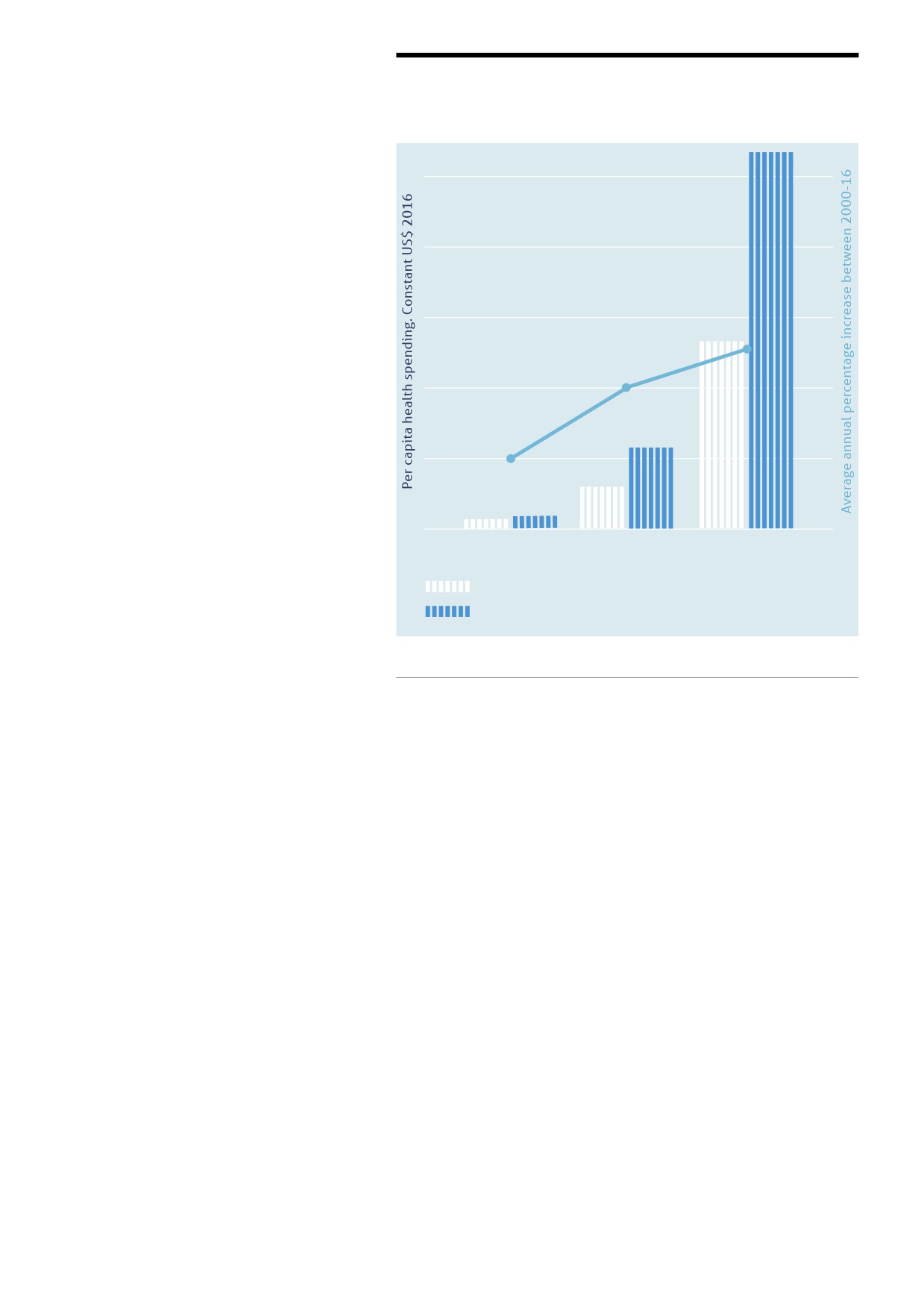
Figure 1
Per capita public spending on health, 2000-16, constant US$
2016, low- and middle-income countries
250
10%
200
8%
150
6%
100
Annual average
4%
percentage
increase
50
2%
0
0
Low income
Lower middle
Upper middle
2000
2016
Source: WHO, 2018.
occurring across all countries (WHO, 2018), whereby spending
on health rises with per capita income. However, the share of
public spending on health doubled between 2000 and 2016 in
middle-income countries (Figure 1).
Within the increase in public spending on health, countries are
striving to establish well-functioning health systems towards
attaining UHC. In doing so, they are paying more attention to
value for public spending on health, and the decisions about
how to channel funding and organize services to respond to
people’s needs. This is particularly true for inpatient services
and curative outpatient care, which accounts for 70% of total
public spending on health on average globally (WHO, 2018). As
health systems mature, policies take on greater importance in
ensuring financial protection. Policy decisions about the
services covered, payments to providers, and the conditions for
these payments become the determining factors in driving
patient costs -and far overwhelm any individual care-seeking
behaviours (Getzen, 2006).
In response to these opportunities, many countries are
introducing new ways to finance, organize, and deliver health
care. Understanding the methods for price setting takes on a
higher level of importance where systems are rapidly changing
to account for increasing levels of resources and changing
Price setting and price regulation in health care
5
patient needs. To more strongly align payment with the costs
that health care providers incur in delivery different types of
services, countries are modifying the basis for payment for
health care providers from line-item budgets to alternatives
such as FFS, per diem, and diagnosis related groups (DRGs), and
determining how to price these services. Substantial numbers
of low- and middle-income countries have already established
DRG-based payment systems to pay for acute inpatient care
(Mathauer and Wittenbecher, 2013). Such a move enables
countries to take an active strategic approach in defining what
services are purchased and paid for, and how to link payments
with quality and performance. Further this move allows
purchasers to shift from being a “price and quality taker” to a
“price and quality maker” (Figure 2).
In some low- and middle-income settings, a large share of
health care utilization is in the private health care sector, which
can range from unregulated pharmacies to specialized tertiary
care hospitals. A key question is how to make use of all health
resources - from both private and public sources - to attain
health-related goals. In middle-income settings, high prices in
the private sector can undermine UHC objectives by draining
resources from the public sector where most of the population
accesses services (Barber et al., 2018). Where prices and
premiums are unaffordable for most people, the private sector
does not contribute to improving population health
commensurate with its share of resources. Accordingly,
governments are obligated to address high prices because of
their implications for equal access to health services.
Figure 2
Moving from passive to strategic purchasing
Passive purchaser
Strategic purchaser
Resource allocation
Performance based
using norms
contracting
No selection of providers
Selective contracting
No quality monitoring
Quality improvements
and rewards
Price and quality taker
Price and quality maker
Source: Evetovits, 2019.
6
Price setting and price regulation in health care
Some aspects of health systems in low- and middle-income
countries should be considered when implementing changes in
financing systems. There are higher rates of poverty; middle-
income countries are home to 73% of the world’s poor (World
Bank, 2019), which underscores the importance of protection
from catastrophic health spending and promoting equitable
access to services. These settings tend to have less robust
regulatory environments for controlling quality in health care
facilities (public and private) and medical products, and less
advanced professional associations (Clarke, 2016). In settings
with weaker professional associations, changes in the base for
payment to capitation has resulted in an under-provision of
services (Mills et al., 2000). Some level of hospital autonomy is
needed to ensure that hospitals have decision-making
authority to respond to incentives for efficiency. Moreover,
purchasing arrangements assume a level of managerial
Middle-income countries
capacity, including financial management, systems of
are home to 73% of
information about health, utilization, and expenditures, and the
the world’s poor. This
ability to enforce contracts. Experience from high-income
countries shows that DRG-based payments are complex and
underscores the
require careful monitoring of care quality as well as volumes.
importance of protection
Systems are needed to monitor and adjust prices to align with
from catastrophic health
system-wide objectives. These institutional factors affect the
speed in which changes in purchasing can be implemented.
spending and promoting
However, the process of change is both incremental and
equitable access to
dynamic - and many countries implement changes in financing
services.
while also building critical capacities in health systems during
implementation (Mathauer and Wittenbecher, 2013).
Price setting and price regulation in health care
7
2/
Comparison of
case studies
8
Price setting and price regulation in health care
2.1
Demographics and health resources
Context and institutions are key factors in determining the
choice of payment systems. A range of middle and high-income
settings were selected for the study (Figure 3). Seven are OECD
member states. Thailand and Malaysia are both upper middle-
income countries. In three of these countries, more than one
quarter of the population is 60 years or older (Japan, Germany,
and France). In three other settings (Maryland, Thailand, and
Malaysia), the population is relatively young.
Figure 3
Characteristics of case study settings
Inputs per 1000 population
Setting
Population 2015
% of population
GDP per capita,
Physicians
Nurses and
Hospital
>=60 years
US$ 2016
midwives
beds
Australia
23,799,556
21
54,069
3.5
12.4
3.8
England
55,670,000
23
31,200
2.8
8.4
2.6
France
64,457,201
26
36,826
3.2
10.6
6.5
Germany
81,707,789
28
42,456
4.2
13.8
8.3
Japan
127,974,958
33
38,640
2.4
11.2
13.4
Malaysia
30,723,155
10
9,508
1.5
4.1
1.9
Republic of Korea
50,593,662
20
27,785
2.3
6.9
11.5
Thailand
68,657,600
17
5,911
0.5
2.3
2.1
Maryland, USA
6,042,718
15
55,404
2.6
NA
2.5
Sources: UN, 2017, 2019; United States Census Bureau, 2019; World Bank,
2019.
Wealth is correlated with the level of inputs to the health
sector. Decisions about the allocation of resources is subject to
aggregate constraints, whereby the first step is determined by
the total resources available (Getzen, 2006). The total amount
of resources for health varies widely across these settings.
Current health expenditure as a share of GDP ranges from 17%
in the USA to less than 4% in Malaysia and Thailand (Figure 4).
The source of most spending in all settings is compulsory
(i.e., set aside by the government for certain health programs or
initiatives), except for Malaysia, where public compulsory and
private voluntary expenditures are reported as equal shares.
Price setting and price regulation in health care
9
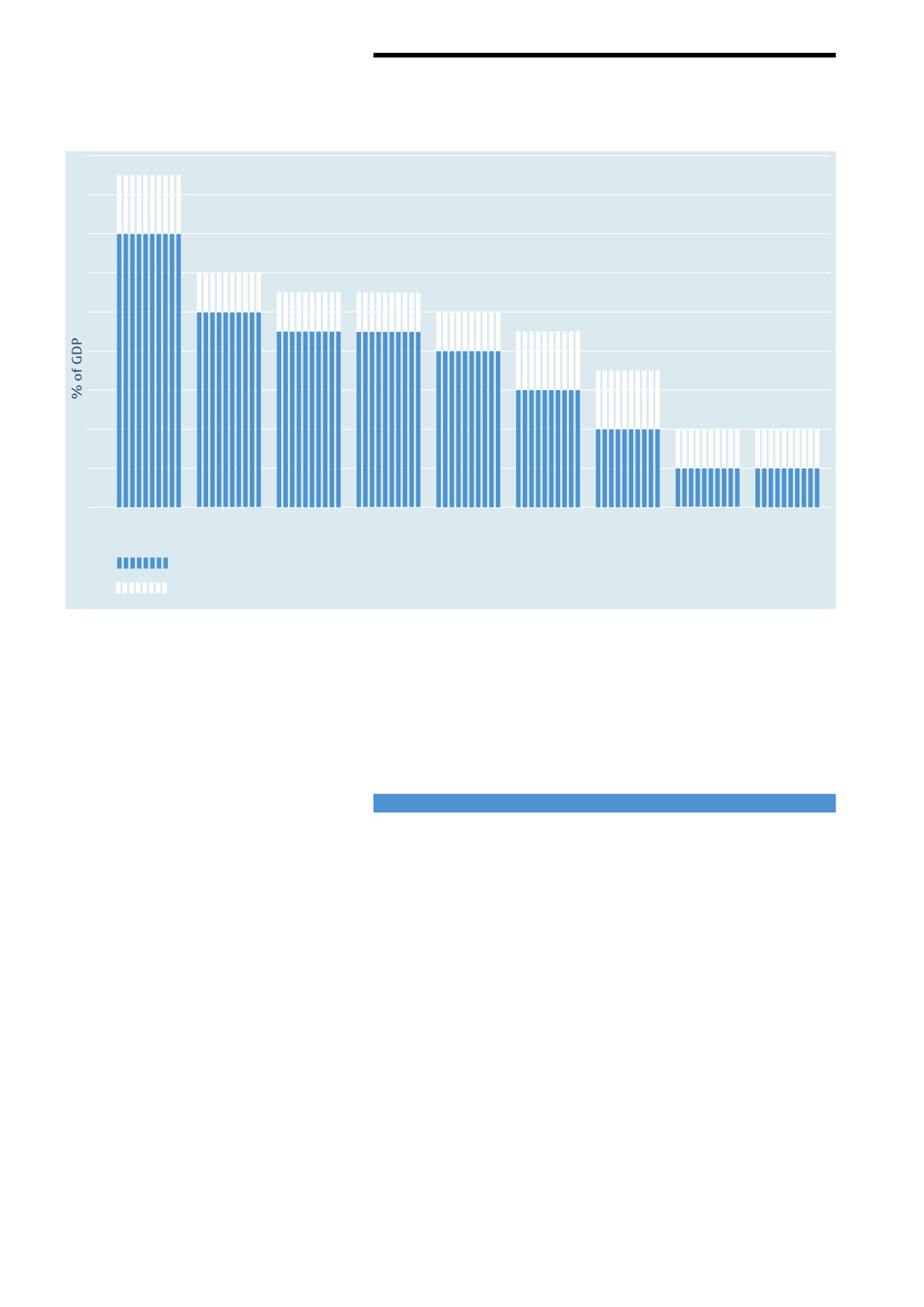
Figure 4
Current health expenditures as a share of Gross Domestic
Product (GDP), 2016 or most recent year
16
14
12
10
8
6
4
2
0
USA
France
Germany
Japan
United
Australia
Republic
Thailand
Malaysia
Kingdom
of Korea
compulsory
voluntary
Source: WHO, 2019b. Note: Compulsory or mandatory refers to the mode
of participation, whereby coverage of the population is automatic or
universal, and participation is mandatory by law including social health
insurce or compulsory private health insurance. Voluntary refers to
coverage obtained at the discretion of individuals or firms, including
voluntary private health insurance. Spending on capital items is not
included.
2.2
Health care coverage
The nine settings included in the study each represent
variations in the main source of health care coverage. Australia,
Malaysia, England, and Thailand’s Universal Coverage Scheme
have systems of health coverage based on residence or
citizenship. The other settings have employment-based
contributory health coverage and vary by the number of payers.
In the Republic of Korea, there is a single payer system,
whereas in France and Japan, multiple payers exist with
automatic (compulsory) affiliation. In Germany and the USA,
multiple payers exist with choice of affiliation (Figure 5).
10
Price setting and price regulation in health care
Figure 5
Main source of health care coverage for case study settings
Main source of basic
Country
health care coverage
Citizen entitlement
Australia, Malaysia,
Thailand (UCS, CSMBS),
England
Employment-based
Single payer
Republic of Korea,
converage
Thailand (SHI)
Multiple payers with
France, Japan
automatic affiliation
Multiple payers with
Germany, USA
choice
Sources: Paris, Devaux and Wei, 2010; Jongudomsuk et al., 2015. Note:
UCS: Universal Coverage Scheme; CSMBS: Civil Servant Medical Benefits
Scheme; SHI: Social Health Insurance.
Among the settings studied here, voluntary health insurance
(VHI) plays different roles (Figure 6). VHI can generate
additional financial resources for the health care system. It
should be noted that private funding is not equal to private
provision, and private insurance can pay for covered services.
At the same time, it can contribute to cost escalation, given that
many cost-control measures used in the public sector - such as
price regulation and global budgets - are not typically
employed in the private sector.
In France, Germany, Republic of Korea and Japan, private
insurers focus on covering the gap between public
reimbursements and actual fees, as well as providing access to
additional services (complementary insurance). In Germany, a
share of the population opts out of the public social insurance
program and obtains care from private insurers. In Japan, VHI
developed as a supplement to life insurance and offers
additional income in the case of illness (The Commonwealth
Fund, 2019). In Australia, Malaysia, and Thailand, VHI also
provides coverage for additional services. In the United
Kingdom, people can purchase VHI to reimburse care in a
private facility, which may offer quicker access for elective
services (supplementary insurance).
Price setting and price regulation in health care
11
Figure 6
Spending on private voluntary health insurance, population
and services covered, categorized by insurance role
Setting
% of total
% of
Services covered
health
population
spending
covered
A. Complementary: covers user fees
France
13
95
Covers copayments for services included in the social insurance basket
based on regulated prices; varying coverage of extra billing and extra
services. Deductibles cannot be covered.
Germany
9
27
Outpatient care, per diem cash benefits for hospitalization.
Republic of
7
>70
Copayment for public insurance and payment for uninsured services.
Korea
B. Complementary: covers additional services
Germany
8.9
27
Dental and eye care, more extensive ranges of services not covered by
social health insurance; in addition to full coverage for self-employed.
United
3.4
5
Dental care, complementary and alternative medicines, more rapid and
Kingdom
convenient access to care, especially for elective hospital procedures.
Japan
2
88.5
Copayments; lump-sum payments when insured persons are hospitalized
or diagnosed with cancer or another specified chronic disease, or through
payment of daily amounts during hospitalization over a defined period.
USA
50
14.6
Persons eligible for public benefits, i.e., Medicare can purchase VHI for
additional coverage including long-term care; spending figures also
include primary care for people covered through employers.
C. Supplementary: amenities, choice, faster access
United
3.4
9
Faster access, choice of private provider and of specialist acting in a
Kingdom
private capacity, better amenities.
Australia
9
47 (hospital)
Choice of providers (particularly in hospitals), faster access for
56 (general
nonemergency services, and rebates for selected services.
treatment)
Malaysia
10
NA
Private hospital access, faster access.
Thailand
7
24
Exclusion of prior conditions and older persons; private hospital and
faster access although more expensive.
Sources: Sagan and Thomas, 2016; Commonwealth Fund, 2019; case
studies (see annexes).
The extent of government regulation of private health insurance
varies. Factors contributing to stronger regulation include the
presence of private insurers, insurance policies about access,
and level of premiums. Experience suggests that price setting
for the private sector alone can create incentives for providers
to shift care to other providers that are not subject to regulation.
This can inhibit greater coverage, efficiency, and health
outcomes (Kumar et al., 2014). Experience from France shows
that the private insurance market can be effectively regulated
with financial incentives (i.e., fiscal rebates) to reduce patient
selection and price escalation.
12
Price setting and price regulation in health care
2.3
Health system characteristics
Price setting and systems of purchasing are dependent on key
features of health systems that vary considerably across
settings. For example, the OECD countries in this study have
robust regulatory systems. This affects the degree of
competition among purchasers and providers and choice of
payment and price negotiation methods. The strength of
professional associations affects systems of education and
self-regulation. Strong professional associations enable formal
systems of representation for price negotiations. In addition,
market concentration is an important determinant of
negotiating power, as seen in the USA, which can affect prices.
Figure 7
Mechanisms to nudge values towards Universal Health Coverage
Mechanism
Instrument
Rationale
Command and Control
Health Law
Prohibition on unlicensed care
Command and Control
Minimum Facility Requirements
Indicator of Accreditation
Command and Control
Clinical guidelines and standards
Standard of care usually not complete
Command and Control
Issuance of license
Can be based on geographical location and
needs
Command and Control
Accreditation
Done by professional body and tie to health
insurance payment eligibility
Financial Incentives
Funding to private general practitioners,
Will need mechanism to monitor if service is
(including price control)
hospitals, labs, pharmacies, etc.
of good quality
Self Regulation
Professional subcommittee function
Professional associations provide training,
empowerment, etc.
Source: Cowley, 2019.
Figure 7 illustrates key instruments used across the WHO
Western Pacific Region, and places price regulation within the
broader context of attaining the goal of UHC. The capacity of the
health purchaser is a key determinant of the choice of payment
methods, given that complex systems require higher capacity to
collect and analyse information, and ensure standards of quality
care. In some low- and middle-income settings, health laws may
be weak or poorly enforced, which can result in technically
substandard care. Formal systems of accreditation, which are
assumed for high-income countries, may not exist or operate as
focused accreditation for specific services or categories of
facilities. The foundation for payment systems, particularly for
bundled payments, is clinical care pathways that may not be
implemented in all settings. The absence of these mechanisms
limits choices; however, these supporting policies and
instruments can be developed over time.
Price setting and price regulation in health care
13
Weak information systems are particularly challenging in many
countries. Mills (2011) analysed the impact of weak information
systems on financing in four low- and middle-income countries
(Ghana, Zimbabwe, India, and Sri Lanka). She reported poorly
developed cost accounting systems in hospitals, limited data to
cost public services, and lack of information about private
facilities and activities. These factors represent capacities that
affect the speed of implementation of payment mechanisms.
14
Price setting and price regulation in health care
3/
Payment methods
Price setting and price regulation in health care
15
Price setting is central to establishing sound payment systems
for health and hospital services. Factors contributing to
determining price levels include the total amount of public
money spent on health, service delivery costs, wages for
specialists and other health workers, as well as the burden of
disease and its complexity. This paper focuses on the subset of
settings described in the nine case studies to assess how price
setting is integrated into provider payment systems.
Reinhardt (2006, 2011, 2012a) identified three main
dimensions of payment methods for health care:
__
The base or unit of activity upon which prices are defined
and set.
__
The level of the payment or price per unit of the chosen
base.
__
The administrative and economic process by which that price
level is determined.
Each of these dimensions is important in aligning payment
systems with the goals that health systems are trying to achieve
and balancing the interests and financial risk taken by patients,
health providers, payers, and communities. This section focuses
on the base for payment, or the unit of activity upon which
prices are defined and set.
3.1
The base for payments
Building on existing studies (Berenson et al., 2016, Miller,
2007), the base for payments are described by the main
category of payment and the extent to which they contribute to
(or detract from) broader health systems objectives (Figure 8).
Budget-based line item and global payments are typical in
many low- and middle-income settings, but these are gradually
being replaced by other methods (Mathauer and Wittenbecher,
2013). This is because such methods are not strongly aligned
with the costs that health care providers may incur in delivering
different types of services; as such, they may provide incentives
for under-provision of needed care. Line item budgets specify
detailed amounts for each line item (i.e., personnel, medicines,
supplies, etc.) based on the previous year’s budget allocation.
The advantages of line-item budgets are predictability and
control. At the same time, they are not linked to the type and
volume of services provided, nor do they provide any
incentives for efficiency or quality. Global budgeting has
replaced line-item budgeting in many settings that rely on
regulation to control health spending. A global budget provides
fixed funding for a specific population group and offers more
flexibility in allocating resources. Like line-item budgets, global
budgets are commonly based on prior years’ allocations,
although capitation and other methods can be used (Berensen
et al., 2016; Miller, 2007).
16
Price setting and price regulation in health care
Figure 8
Main categories of base for payments, and whether they could
contribute to (+) or detract from (-) health system objectives
Health system outcomes
Base for payment
Increasing
Increasing
Controlling
Promoting
Promoting
Administrative
Transparency
utilization
volume
expenditures
efficiency
quality of
ease
(number of
(number of
care
cases)
services)
Budget
Line item budget
-
-
+
-
unclear
+
+
Global budget
-
-
+
unclear
unclear
+
-
Activity based
Fee-for-service
+
+
-
-
unclear
+
+
Per diem
+
+
-
-
unclear
+
-
Diagnosis Related
+
-
unclear
+
unclear
-
+
Groups (DRG)
Population based
Capitation
-
-
+
+
unclear
+
-
Consolidated
Bundled episode
unclear
+
unclear
+
unclear
-
-
Global capitation
-
-
+
unclear
unclear
+
-
Incremental
Pay for performance
+
+
unclear
unclear
unclear
-
+
Sources: Geissler et al., 2011; Berenson et al., 2016; authors.
Payment methods directly linked to activities include FFS, per
diem, and DRGs. These approaches require a well-defined
planned episode of care and strong evidence that such care
will achieve the desired outcomes. FFS is typically based on a
schedule that lists the prices for individual services, with the
definition of services based on established classification codes,
such as the Current Procedural Terminology.3 Fees are
developed using relative weights or relative value units. One
example is the resource-based relative value scale (RBRVS). The
RBRVS was initially developed in the 1990s for the Medicare
program in the USA and is now commonly used in other
settings. It assigns a relative value to every physician procedure
or service based on two main variables: the relative amount of
physician time, level of skill, training, and intensity in providing
a given service, and the costs of maintaining a practice
including rent, equipment, supplies, and non-physician staff
costs. The relative value is multiplied by a fixed conversion
3
The Current Procedural Terminology is a numeric coding system used primarily to identify
medical services and procedures furnished by physicians and other health care
professionals (AMA, 2019).
Price setting and price regulation in health care
17
factor (the base rate) to determine the price. The limitations in
RBRVS include values inflated for specialist payment services
and insufficiently valuing time and effort required to manage
patients with complex conditions and multi-morbidities
(Berenson and Goodson, 2016).
The FFS method rewards activity. It tends to result in an over-
provision of services because of the incentives for volume
regardless of patient need. Per diem payments offer a fixed
amount per day of hospital or residential care regardless of
care provided or costs incurred. In many settings, per diem
payments are adjusted for case mix or estimated for each
hospital ward or specialty. They are administratively simple but
provide incentives for longer lengths of stay. In contrast, DRGs
provide strong incentives for reducing length of stay. DRG
payments group patients with similar clinical characteristics,
A growing number of
use cost information to determine weights based on average
treatment costs, and apply a conversion factor to generate a
provider payment
price for each DRG. In comparison with FFS, DRGs help to
mechanisms are
contain costs by bundling all goods and services provided
emerging that explicitly
during hospitalization into one unit (base) for payment (Annear
seek to align payment
and Huntington, 2015). In many settings, DRGs have replaced
global budgets in order to reward hospital activity (Berenson et
incentives with health
al., 2016). A key drawback is administrative complexity.
system objectives.
Capitation is a population-based payment, whereby a fixed
Ongoing evaluations
payment is made prospectively for a defined benefits package
are essential.
per person for a period, regardless of the services provided.
Capitation typically adjust for age and gender but not for health
status. Primary care capitation generally requires a system in
which a gatekeeper or a medical home provides routine care
and approves referrals to other health care providers. With a
fixed amount, the doctor has a financial incentive to reduce
unnecessary care and thus control costs. At the same time,
there is an incentive for an under-provision of care and
referring complex patients to other health care providers.
The level of aggregation of the services included in the price is
a factor in determining the level of financial risk sharing
between the payer and provider. FFS payments are the most
highly disaggregated (the least bundled) and the global budget
is the most aggregated (the most bundled). In the case of FFS
payments, health care providers can bill more individual
services to cover their costs. Therefore, risk sharing is in favor
of the providers, and the payers bear the financial risk. In the
case of global budgets and capitation payments, the price is
highly aggregated. For example, a capitation payment could be
expected to cover many kinds of services for a given person
over the course of a year. In this case, the health care providers
receive one payment regardless of the services provided.
18
Price setting and price regulation in health care
Therefore, the payer faces limited financial risks linked to the
type and amount of services provided, because there is
certainty about the expenditure per person covered.
Figure 9
Predominant base for payment for primary care, by type of
provider
Setting
Remuneration of provider setting
Remuneration of
physicians
FFS
P4P
Global
Cap
Other
Salary
FFS
budget
A. Private practice group
Australia
x
x
x
Japan
x
x
x
USA
x
x
B. Private solo practices
France
x
x
x
x
x
x
Germany
x
x
x
England
x
x
Republic of Korea
x
x
x
Thailand (SHI)
x
x
Thailand (UHC)
x
x
C. Public clinics
Thailand
x
x
Malaysia
x
x
Sources: case studies (see annexes). Note: FFS: fee-for-service; P4P: pay for
performance; Cap: capitation; SHI: Social health insurance; UCS: Universal
Coverage Scheme. Primary care and outpatient specialists are not
differentiated in Japan or the Republic of Korea. In England, block contracts
are still the predominant payment mechanism for the community sector
and mental health sector. In Thailand, SHI FFS refers to subcontractors; for
UHC and public clinics, capitation is inclusive of salaries.
Integrated approaches attempt to combine payments across
sectors to facilitate a more coordinated and flexible approach
to care. Such integration can balance the objectives of
maximizing beneficial incentives and minimizing potential
unintended consequences of different methods (Cashin, 2015).
Several kinds of consolidated base for payments exist, such as
bundled episode payments and global capitation. A bundled
payment methodology involves combining, or blending, the
payments for physicians, hospitals, and other health care
provider services into a single amount. Bundled episode
payments provide a single amount for all services that cover
care provided over one episode from beginning to end.
Price setting and price regulation in health care
19
Extending the definition of an episode beyond discharge to
follow-up care has been done to motivate health care providers
to improve care coordination, communication, reduce costs, and
ultimately improve quality of care in addition to lowering costs
and utilization. Unintended consequences may include
incentives for more cases and procedures that may not be
clinically warranted to make up for lost revenues and the
under-provision of patient care. Further, administrative costs
may be high, not all procedures can be bundled together into
one package, and risk-adjustment is needed for high-cost,
high-need patients. Evidence about bundled payments is quite
limited and the impact to date is mixed (Bertko and Effros,
2011; Delbanco, 2018).
Under global capitation, one payment is made to an integrated
health system that is responsible for delivering the primary and
referral service package to a relatively large defined population.
Payments are typically adjusted for age, sex, and health status.
The provider has an incentive for efficiency and cost control, and
the payment method promotes integrated care and coordination.
However, similar to bundled payments, the needs of high-cost,
high-need patients may not be sufficiently covered.
Traditional ways of paying health care providers - such as FFS
and capitation - do not explicitly reward providers for
delivering better quality care. A growing number of new
provider payment mechanisms are therefore emerging that
explicitly seek to align payment incentives with health system
objectives by rewarding the achievement of targeted
performance measures. Mixed impact of these incentives has
been reported, however, and ongoing evaluations are essential
(Eijkenaar et al., 2013). Studies have not consistently found
associations between the amount of the incentive payments
and behavioural change (Scott, Lui and Yong, 2018).
3.2
Primary care and outpatient specialists
The most common means of purchasing primary care services is
through capitation and FFS; and outpatient services are
commonly purchased through FFS, in which health care
providers are reimbursed for the activities that they carry out
(Figures 9 and 10). FFS schedules are used in France, Japan,
Australia, Republic of Korea, the Thai Social Health Insurance
scheme, and the USA. In Germany, physicians (especially
general practitioners) receive a capitation or lump-sum
payment per patient. In countries such as Germany and the
USA, the schedule may vary by payer or region.
To counter the disadvantages of FFS (such as lack of incentives
for quality and incentives for volume), it can be combined with
other mechanisms to promote efficiency and cost control. FFS
has been combined with pay for performance (P4P) in France
and the Republic of Korea, and capitation in Australia, France,
and England. Under Medicaid in the USA, states commonly
20
Price setting and price regulation in health care
make incentive payments to physicians, including those
practicing at academic health centres, those participating in
primary care coordination and management, home health care;
and pay for performance initiatives.
Figure 10
Predominant base for payment for outpatient specialist care,
by type of provider
Setting
Remuneration of provider setting
Remuneration of
physicians
FFS
P4P
Global
Cap
Other
Salary
FFS
budget
A. Private practice group
Australia
x
x
Japan
x
x
x
USA
x
x
x
x
B. Private solo practices
France
x
x
x
Germany
x
x
x
England
x
x
Republic of Korea
x
x
x
Thailand (SHI)
x
x
C. Outpatient department of public hospitals
Australia
x
x
Thailand (UCS)
x
x
x
Malaysia
x
x
Source: case studies (see annexes). Note: FFS: fee-for-service; P4P: pay for
performance; Cap: capitation; SHI: Social health insurance, UCH: Universal
coverage scheme. In Thailand, capitation payments are inclusive of salary.
In Japan, payment is made to the facility and not to individual physicians.
In England capitation payments are used for primary care, and
FFS is applied for outpatient specialists. It can be noted that the
general practitioner funding formula for capitation payments in
England do adjust for morbidity and mortality. In Malaysian
public facilities, global budget is used for both primary care
and outpatient specialists, whereby a prospective lump-sum
payment is made to health care providers to coverage
aggregate costs. In Thailand, the Universal Coverage Scheme
that provides care for most of the population uses capitation as
base for payment for primary and outpatient specialist care,
with the capitation payment inclusive of salary. Malaysia
remunerates physicians in the public sector through salary
payments. In France, an increasing number of general
practitioners working in primary care practice are salaried.
Price setting and price regulation in health care
21
3.3
Inpatient care
In many settings, inpatient payment methods in public hospitals
employ DRGs as the base for payment (Figure 11). Implementing
DRGs requires classifying health care services and patient
case-mix from the most to least complex and assigning prices to
them. The financial incentives in the DRG payment have
provided strong incentives for changing hospital behaviours.
Figure 11
Predominant base for payment for acute inpatient hospital
services, by type of provider
Setting
Public hospitals
Private non-profit
Private for profit
Australia
DRG
Procedure/service
Procedure/service
England
DRG
Procedure/service
Procedure/service
France
DRG, bundled payments for
DRG, bundled payments for public
DRG, P4P
public health services, P4P
health services, P4P
Germany
DRG
DRG
DRG
Japan
Case-weighted per diem
Case-weighted per diem (non-
Case-weighted per diem (non-
(non-acute); Diagnosis
acute); Diagnosis procedure
acute); Diagnosis procedure
procedure combination (acute);
combination (acute); FFS
combination (acute); FFS
FFS (Outpatient)
(Outpatient)
(Outpatient)
Malaysia
Global budget
FFS
FFS
Republic of
FFS
FFS
FFS
Korea
Thailand (UCS)
DRG, global budget,
DRG, global budget, central
DRG, global budget,
central reimbursement
reimbursement
central reimbursement
USA (public)
DRG, per diem
DRG, per diem
DRG, per diem
Source: case studies (see annexes). Note: DRG: Diagnosis Related Group;
FFS: fee-for-service; P4P: pay for performance.
The Republic of Korea primarily uses FFS for both public and
private hospitals, with limited use of DRGs. Malaysia also uses
FFS in private hospitals. Japan uses diagnosis procedure
combination for acute care and case-weighted per diem for
non-acute care in both public and private hospitals, which can
be combined with FFS. By bundling together hospital and
physician payments into one unit, Japan addresses the problem
of volume and substitution (Ikegami and Anderson, 2012).
Other predominant base for payments include combinations
such as DRGs, bundled payments for public health services and
P4P in France; DRGs, global budget, central reimbursement in
Thailand; and global budget in Malaysian public hospitals. In
settings that use global budgets, prices are similarly estimated
for budget allocations.
22
Price setting and price regulation in health care
3.4
Long-term care
The demand for long-term care (LTC) services is increasing, as
well as its importance in health care and social spending (de la
Maisonneuve and Martins, 2014; WHO, 2017). This is related to
the size and growth of older population groups, many of whom
require not only medical care but also assistance with activities
in daily living, such as washing, dressing, cleaning and cooking.
LTC encompasses both kinds of support in most settings. The
base for payment method varies by setting and categories of
facility (Figure 12). For most of the settings in this study,
assessments are in place that restrict access to government
benefits and determine the financial amount for which
beneficiaries are eligible. The common thread is the adjustment
of the payment level based on level of the complexity of the
health condition, physical functioning and medical needs.
In Australia, the federal government subsidizes non-medical
care and support for older persons. The subsidies are held by
consumers (for home care) or providers (for long-term
residential care). Older persons contribute to the cost of their
care and accommodation based on means testing, and
government subsidies are available for those with low incomes
and assets. Annual and lifetime caps are in place to limit the
level of means-tested care fees that residents pay. In Australia,
the level of funding to the provider is determined by the Aged
Care Financing Instrument (ACFI), which consists of 12 sets of
questions about care needs and two diagnosis sections.
Australia established in 1997 the position of the Aged Care
Pricing Commissioner. The Commissioner is an independent
statutory office holder who reports to the Minister. The
Commissioner’s role is to increase the level of transparency in
the pricing of residential aged care services and ensure that
aged care recipients are charged appropriately through
approval of prices beyond the maximum set by the federal
government. In addition, the Aged Care Financing Authority
(ACFA) is a committee of experts who provide independent
advice to the government on funding and financing issues.
Price setting and price regulation in health care
23
Figure 12
Payment methods for long-term care and the basis of
adjustment for health need
Setting
Facility
Payment method
Basis of adjustment for health need
type
Australia
Nursing
A means tested medical care fee is applied based on the
The ACFI consists of 12 sets of
home
Aged Care Financing Instrument (ACFI) to determine
questions and two diagnostics sections
need. Payments are covered by residents with
to determine the overall care profiles
government subsidies, including a basic daily fee for
and the average cost per stay per
residential services (covered by residents),
person.
accomodation fees (paid by residents and government),
and fees for any additional services (paid by residents).
England
Nursing
All costs are covered for those with long term conditions
The NHS Continuing Health Care
home
determined as eligible for National Health Service (NHS)
assessment measures breathing,
Continuing Health Care. A weekly contribution is made
nutrition, continence, skin, mobility,
for those who don’t meet these requirements but
communication, cognition, behaviour
require some nursing care (£158.16 per week). Other
and other dimensions.
nursing home costs are means tested. For those on very
low incomes, the local authority pays.
France
Long term
All facilities (private or public) are paid for under the
GMPS measures 238 condition-profiles
residential
care package, including long-term care. The case-based
by evaluating 50 clinical conditions
care
payment is adjusted for patient need based on scores
and 12 profiles of care. For each
using the iso-weighted care group (GPMS). Accomodation
condition-profile, eight resource
is paid by the patients.
groups are delineated. These groups
define the social care plan, based on
Home care
Health care prices are fixed by the social health
an assessment of the dependency
insurance fund with fees for services. Prices for social
calculated using the Gerontology
care services are unregulated. Reference prices are used
Autonomy and Iso-Resource Groups
to calculate subsidies (based on the level of autonomy).
model, which measures activities in
daily living.
Germany
Outpatient
Care is covered by compulsory long-term care (LTC)
Financial contributions by LTC
and home
insurance. All outpatients receive a monthly lump sum
insurance depends on the enrollee’s
care
for short-term inpatient care, semi-inpatient services at
need for nursing care. Patient needs
night, or services to support relatives. Additional
are evaluated based on an assessment
monthly contributions are provided if all services are
of physical, medical, cognitive and
done at home, for professional outpatient services, and
psychological needs, and the person’s
for inpatient services.
ability to live independently and social
interactions. Patients are graded on a
Nursing
Nursing care charges are negotiated individually
scale from 0 to 100 and allocated to
home
between a nursing home, welfare organisations and the
one of five stages.
LTC funds, whose enrollees contribute at least 5% of
the nursing home’s days. Patients in nursing homes
contribute to nursing home costs in five different ways:
fixed copayment; payment for housing, utilities, and
meals; investment costs; training levy set by the state;
and other additional services.
Japan
Health
Case based payments are adjusted for patient needs,
Seven eligibility levels are based on
facility for
and financed from compulsory LTC insurance. The
functional capacity.
elders
maximum cash entitlement is determined by functional
capacity, and ranges from $50 to $350 per month.
Beneficiaries must pay coinsurance ranging from 10%
to 30% based on household income. Compulsory LTC
insurance covers home helper visits and visiting nurse
services; day care; loan of wheelchairs; care provided
prior to going to health facilities; and LTC medical
facilities.
24
Price setting and price regulation in health care
Setting
Facility
Payment method
Basis of adjustment for health need
type
Republic
Long term
A per-diem case-based payment is determined by
Five different functional levels.
of Korea
care
medical need. Public LTC insurance is provided. The
hospitals
benefits package includes home and institutional care;
home-visit care; nursing; bathing; and assistive devices
such as wheelchair, walker, and bath chair, etc. for home
care services; aged care facilities; and housing for
institutional services. The benefits ceiling per month
for residential care depends on five different functional
levels determined by a health needs assessment.
USA
Skilled
A predetermined per diem payment is paid based on
The PDPM uses five case-mix adjusted
(Medicare)
nursing
patient needs. The payment is expected to cover all
components: physical therapy,
facilities
operating and capital costs, with high-cost, low-
occupational therapy, speech-language
probability ancillary services (i.e., magnetic resonance
pathology, non-therapy ancillary, and
imaging and radiation therapy) paid separately.
nursing. Each resident is classified into
Adjustments are made for geographic differences in
one group for each component.
labour costs and case mix. In 2019, the Patient Drive
Payment Model (PDPM) will be used that classifies
residents into a separate group for each case-mix
adjusted component and each has their own case-mix
indexes and per diem rates.
Thailand
Home visit
Fixed fee per patient.
-
Source: case studies (see annexes). Note: LTC: Long-term care; P4P: pay for
performance; NHS: National Health Service.
In England, all costs are covered for those with long-term
conditions assessed as eligible based on a Continuing Health
Care assessment, measuring basic physical and cognitive
functioning, whether at home or in long-term residential care.
A weekly contribution is made for those who don’t meet these
requirements in residential care but who require some nursing
care. All nursing home costs are means tested. Non-medical care
costs for low-income patients are covered by the local authority.
In France, nursing home facilities, whether private or public, are
funded by case-based payments. There is a three-part tariff
comprised of a care package paid by social health insurance, a
long-term care (or dependency) bundle paid by the local
authorities, and an accommodation fee paid by the patient. The
care package for each patient is calculated based on the
iso-weighted care group (GPMS) scores, which generate 238
condition-profiles corresponding with the average care needs
and dependency level of people living in the facility. The
average level of resources required for the 238 profiles was
defined by specialists and reported as points per cost item. The
dependency level is determined by the Gerontology Autonomy
and iso-resource Groups. This instrument uses ten variables
measuring physical and mental capacities and seven variables
for domestic and social activities (i.e., cooking, household tasks,
mobility). For people living at home, medical and social care
services are provided and paid for separately. Health care is
financed under regulated health insurance prices. Social care
Price setting and price regulation in health care
25
services are provided by other public and private entities, and
prices are not regulated. However, reference prices are used by
the government to calculate the amount of the subsidies, and
these reference rates vary by local authority (département)
(from 13 EUR to 24 EUR per hour).
In Germany, LTC insurance is compulsory, and financial
contributions vary based on the need for nursing care.
Evaluations of patient need are based on physical, medical,
cognitive and psychological assessments, and the ability to live
independently. These assessments are graded on a scale from 0
to 100, which is divided into five stages of need. All people
who receive care in an outpatient setting receive a monthly
lump-sum contribution for short-term inpatient care, semi-
inpatient services at night or for services that support relatives.
In addition, they receive a monthly contribution of between
In Japan, LTC insurance
EUR 316 to 901, if services are entirely provided by the family
and relatives at home; EUR 689 to EUR 1995 for professional
is compulsory for
outpatient services; and EUR 700 to EUR 2005 for inpatient
everyone 40 years and
services.
older. The fees have
For nursing homes, prices are calculated on a per diem basis.
been revised to align
If the monthly sum of nursing care charges is higher than the
with policy goals.
monthly lump-sum payment, residents pay the difference
irrespective of their level of need. Nursing care charges are
negotiated individually between a nursing home, welfare
organizations and LTC funds, whose enrollees contribute at
least 5% of the nursing home’s nursing days. During these
negotiations, nursing homes explain any increase in fees.
Nursing home cost data are benchmarked based on size, and
those with costs in the lower one-third are deemed cost-
efficient. Patients contribute to nursing care charges by paying
a fixed copayment based on the monthly average of nursing
care charges, after deducting monthly LTC contributions and
divided by the number of residents. Patients also cover costs
for housing, utilities, and meals; investment costs of nursing
homes (i.e., building, equipment and maintenance); a training
levy; and additional costs, such as wellness services, superior
housing and individual meal plans.
In Japan, LTC insurance is compulsory for everyone 40 years of
age and older. Benefits are restricted to services, and the
maximum cash equivalent is determined by seven eligibility
levels. The levels are based on functional capacity and range
from about US$50 to $350 per month. Beneficiaries must pay
coinsurance, ranging from 10% to 30% based on household
income level. The fee schedule has the same structure as that
of the health insurance. The fees and conditions of billing have
been revised to align with policy goals. For example, bonus
payments for home care agencies are given to employ more
experienced workers. The fee schedule is revised every three
years, and the base rates differ according to geographic
adjustments (with Tokyo as the highest at 11.4% above the
base rate).
26
Price setting and price regulation in health care
The Republic of Korea introduced public insurance for LTC,
managed by the National Health Insurance Service. The benefits
package includes home and institutional care, home-visits for
activities in daily living; assistive devices; aged care facilities
and institutional services. The benefits ceiling for residential
care depends on the need assessment. The payment for
residential LTC facilities is per diem adjusted for case mix using
a health assessment of five functional levels of the beneficiary.
The fee is determined by the insurance service, with no
negotiation of fees with providers, based on an analysis of
provider activity and cost data.
Starting in 2019, the Medicare program in the USA will apply
per diem case-mix adjusted payments for nursing homes using
the Patient-Driven Payment Model (PDPM). Five case-mix
adjusted components are used: Physical Therapy (PT),
Occupational Therapy (OT), Speech-Language Pathology (SLP),
Non-Therapy Ancillary (NTA), and nursing. Each resident is
classified into one group for each of the five components,
mainly based on the primary diagnosis clinical category, and
function and cognitive levels. A resident may be assigned to
one of 16 PT groups, 16 OT groups, 12 SLP groups, 6 NTA
groups, and 25 nursing groups. Each component has their own
associated case-mix index and per diem rate. Additionally, the
PDPM applies per diem payment adjustments to three
components (PT, OT, and NTA) to account for variations in
resource use. The adjusted PT, OT, and NTA per diem rates are
then added together with the unadjusted SLP, nursing
component rates and the non-case-mix component to
determine the full per diem rate for a given resident.
Price setting and price regulation in health care
27
4/
Process by
which price is
determined
28
Price setting and price regulation in health care
Once the base for payment is established, there is an
administrative process or negotiation by which prices are
determined. These processes can be grouped into three main
methods:
__
Individual negotiations between providers and payers.
__
Negotiation between associations of providers and payers.
__
Unilateral administrative price setting.
In this section, we review each in turn, discuss implementation
issues, and then present practical examples.
4.1
Individual negotiations
Under individual negotiations, prices are agreed upon through
negotiations between individual health insurers or self-paying
patients and individual providers of health care services.
Transaction prices are the result of many discrete negotiations
often unknown to final consumers and to the public, and the
results may be treated as commercially sensitive (Reinhardt,
2006). In the USA, this is changing with recent pressures to
increase price transparency and promote consumer sensitivity
to prices (CMS, 2018).
There are several key features of individual negotiations. Like
the negotiation of any good, prices reflect the parties’
respective bargaining positions. Those parties with stronger
market power, for example, will have stronger bargaining power.
Under individual negotiations, a concentration of purchasers
and providers will have stronger bargaining power. In theory, if
an insurer covers a large share of the population, beneficiaries
can be guided to use “in-network” providers with which it
contracts. Under such a system, providers may agree to accept
relatively lower rates from the insurer to ensure patient volume
and capture guaranteed revenue. The use of macro-level
budgeting tools in some countries limits expenditure growth
even under individual price setting methods (Shut and
Verkevisser, 2017). However, in practice, providers with good
reputations or brands, specialized services, or those
representing the largest or sole provider in the region have
strong leverage to demand higher rates from insurers and can
control price changes over time (Berenson et al., 2015; Baker et
al., 2014).
Under individual negotiations, there will be price
discrimination, in which identical services can be purchased by
different payers at different prices. The US private health care
market commonly reports variations in prices for the same
services that bear little relation to the cost of providing
services, its quality or patient severity. Published reports across
the USA (i.e., Massachusetts, New York, Rhode Island, Vermont,
and New Hampshire) cite wide provider price variation and
conclude that high prices are correlated with a provider’s
Price setting and price regulation in health care
29
position within the health care market, defined by size,
competitive position and/or brand (Commonwealth of
Massachusetts, 2017). For example, Massachusetts reported
differentials of 2.5 to 3.4 between the hospitals with the
highest and lowest prices for the same set of services (ibid).
In addition, administrative costs are high because of
expenditures on health insurance marketing and
administration, and on billing activities. These administrative
costs represent a loss to society, whereby large sums of money
are dedicated to administrative procedures that do not promote
health and welfare.
4.2
Collective negotiations
Under collective negotiations, associations of payers (i.e.,
health insurers) negotiate with associations of hospitals doctors
or other health providers. The outcome of these negotiations
would typically be a uniform fee schedule that would apply to
all payers and providers. In some settings, overall growth in
health care spending is constrained by using macro-economic
metrics, i.e., economic growth rates, expected payroll increases,
inflation rates, increases in health care utilization, and
population growth and ageing (Reinhardt 2012b).
There are wide differences in the objects and levels of
negotiation. Frequently negotiations take place when
determining payment levels to health care professionals, where
the objective is to ensure an optimum income. For physician
services, among countries in this study, price negotiation takes
place at central level between third party payers and insurers
(Japan, Republic of Korea, France), at local level on point value
following central level negotiations on resource based relative
value scales (Germany), or at central level for capitation
payments (England). In some settings, negotiations can take
place at local level for prices (i.e., Canada, New Zealand), or
capitation payments (Sweden) (Paris, Devaux and Wei, 2010).
There are several key features of collective negotiations. Price
discrimination present in individual negotiations is eliminated,
given that an identical service is purchased at the same price.
Collective negotiations also face much lower administrative
costs in comparison with individual negotiations, given that
substantially fewer resources must be dedicated to billing and
marketing. At the same time, the level of conflict among the
different stakeholder groups participating in the negotiation
may increase as the space and the scope of negotiations
widens.
30
Price setting and price regulation in health care
4.3
Unilateral price setting
The third method of determining price levels is unilateral
administrative price setting by a regulator. When prices are
administered, a form of non-price yardstick competition rewards
a given firm depending on its standing vis-a-vis benchmarking
(Shleifer, 1985).4 Setting national prices based on average costs
through yardstick competition gives incentives to higher-cost
providers to improve efficiency and reduce cost.5 Providers with
below-average costs have incentives to keep prices below the
average to retain the marginal difference.
Like collective negotiations, the unilateral administrative
method eliminates price discrimination, given that a fixed price
Unilateral price setting
is established. In comparison with individual negotiations,
eliminates price
unilateral administrative price setting incurs lower
administrative costs by insurers and health systems, but
discrimination. Prices for
additional relatively smaller regulatory expenses may apply
hospital services are
(Anderson and Herring, 2014). Prices for hospital services are
often set unilaterally
often set unilaterally and may include add-on payments to
and may include add-on
ensure broader public health goals such as equity and access. A
unilateral, administrative price-setting system requires
payments to ensure
information including cost, volume, and outcome given that
equity and access.
prices are usually cost-based (average, marginal) or normative
(efficient). Adjustment factors are used by the provider or by
service to account for features that impact the cost of
production. Examples of such loadings include hospital type or
size, location, patient complexity and teaching activities.6
Where prices are regulated, providers compete on volume and
service quality rather than price to attract consumers. As such,
pressures to reduce costs could result in efficiency gains rather
than reduced quality. In Maryland, the all-payer approach
resulted in closing smaller facilities and high-cost hospitals,
resulting in efficiency gains and improvements in patient flows
(Murray and Berenson 2015).7 The Medicare and Maryland
unilateral price setting approaches have been combined with
quality incentives that promote evidence-based clinical
guidelines and provide incentives for reducing hospital
readmissions and nosocomial infections. As a result, quality
improvements were reported (Calikoglu, Murray, and Feeney
2012). Studies conducted in the USA generally conclude that
price setting by a regulator also improved hospital financial
stability (Murray and Berenson, 2015; Murray 2009).
4
This benchmark (or shadow firm) may be set by averaging the choice among other firms in
the group. Each firm is thus forced to compete with its shadow firm. If firms are identical
or if heterogeneity is accounted for correctly and completely, the equilibrium outcome is
efficient.
5
Strictly speaking, collective negotiations and agreements prices may also follow a form of
yardstick competition.
6
These loadings may also apply to collective negotiations/agreements.
7
The all-payer approach refers to a hospital payment system in which all payers (both
public and private) pay the same rates.
Price setting and price regulation in health care
31
Fixed price systems allow transferring the treatment risk from
the insurer to the provider (Kumar et al., 2014). For instance, if
the patient requires a certain treatment that is only partially
covered by the fixed price, the provider must bear the additional
cost. Under unilateral systems, formal consultations can ensure
that health care providers are consulted in determining the
prices for which they are compensated and that the decision-
making is perceived as fair and transparent to all parties.
Figure 13
Methods of determining price levels by base for payment and
how they may contribute to health systems objectives
Method for
Controlling
Avoiding price
Improving
Expanding
Increasing price
Reducing
determining
price levels
discrimination
quality
choice
transparency/
administrative
price levels
information
costs
Individual
0
0
?
+
0
0
negotiations
Collective
+
+
?
+
+
+
negotiations
Unilateral
++
++
?
+
+
+
administrative
Source: Authors. 0: little/no impact; +: positive impact; ++: strong positive
impact; ?: inconsistent evidence.
Each of these three methods can be described in terms of how
they may contribute to broad health systems goals (Figure 13).
In the late 1960s and early 1970s in the USA, at least 30 states
had implemented approaches to either review or directly
regulate hospital rates and budgets (McDonough, 1997). This
allows a comparison of the methods of price setting. Where
properly structured and evaluated, unilateral price setting by a
regulator performed better in reducing cost growth and/or
improving access in comparison with market-based systems
(Anderson, 1991, Atkinson, 2009; Sommers, White and
Ginsburg, 2012; Murray and Berenson, 2015). Robinson and
Luft (1988) estimate that, between 1982 and 1986, state rate
setting approaches by regulators reduced growth in hospital
expenditures by as much as 16.3% in Massachusetts and
15.4% in Maryland, in comparison with a control group of
hospitals in 43 states.
Using 2011 insurance claims data covering 38% of people with
employer-sponsored health insurance in the USA, Cooper et al.
(2018) compared hospital prices, negotiated rates (conducted
through individual negotiations), and Medicare reimbursements
(set unilaterally) for a series of risk-adjusted conditions. For
inpatient care on average, the negotiated price was US$
14,020; the full hospital price was 207% of the negotiated
price, and Medicare payments were 45% of the negotiated
price. Ironically, those with the least bargaining power and
ability to pay (self-payers and the uninsured) are subject to
paying the full charges (Tompkins et al., 2006; Anderson, 2007).
Similar patterns were reported for hip and knee replacements,
32
Price setting and price regulation in health care
where the Medicare payments were 55% of the negotiated
price. Selden et al (2015) report that private insurance
payments rates in 2012 were 75% greater than Medicare
payments, and suggested that this gap has increased over time.
From an international perspective, the comparative price level
index for hospital services is lower in France where 83% of
revenues are controlled under regulated prices as compared
with the USA (Lorenzoni and Koechlin, 2017). Sizable
differences in total health spending in the USA compared with
the OECD median are attributed in part to the way in which
prices are set in the private health care sector (Anderson et al.,
2003; Anderson, Hussey and Petrosyan, 2019). In the hospital
sector, competition for quality is more likely to occur in markets
with fixed prices, although evidence is mixed (Allen, Fichera
and Sutton, 2016; Anderson, 1991; Gaynor, Moreno-Serra and
Propper, 2013; Gaynor and Town, 2011).
Based on the evidence available in comparing the three
methods, unilateral price setting eliminates price discrimination
and has performed better in controlling the growth of health
care costs. Both collective negotiations and unilateral
administrative price setting have the potential to improve
quality better than individual negotiations.
4.4
Process of price setting by base for payment
Using the base for payment as the starting point, Figure 14
illustrates the relationships between the base for payment and
the three administrative and economic processes by which the
price level is determined. Using this framework, we can identify
examples from the case studies and elsewhere to illustrate the
process of price setting.
Figure 14
Method of determining price levels by base for payment
Method of determining
Base for payment
price level
FFS
Per case
Capitation
Per diem
Individual negotiations
between providers and
A
B
C
D
payers
Collective negotiations
between associations
E
F
G
H
of providers and payers
Unilateral administrative
I
J
K
L
price setting
Sources: Adapted from Reinhardt, 2012b. Note: FFS: fee-for-service.
Price setting and price regulation in health care
33
Individual negotiations between providers and payers (A-D)
Private health care in the USA is theoretically a conventional
market with individual negotiations for FFS payment to
outpatient clinics and hospitals, and per diem payment for
inpatient services (Figure 15). However, both hospital and
insurer markets have become so concentrated that consumer
choice is often very limited, and physician markets are also
becoming more consolidated. Significant premium increases
and the profits of the health insurance industry in recent years
suggest that little, if any, of the benefits of insurer bargaining
power are being passed to consumers (Gaynor and Town,
2011). On average, prices in the private health care market
have been reported as approximately 50% higher than average
hospital costs; they are frequently 50% or more of Medicare
payment rates (Cooper et al., 2018; Medicare Payment Advisory
Private insurers in the
Commission 2018).
USA utilize government
It should be noted that private insurers in the USA utilize
(Medicare) payment
government (Medicare) payment rates and relative values as a
starting point for their individual price negotiations. As such
rates as a starting point
Medicare has significant influence over the prices that private
for individual
insurers pay (Clemens and Gottlieb, 2016). Prices for private
negotiations. As such,
hospitals in Thailand are also negotiated individually for certain
Medicare has significant
services.
influence over the prices
In Germany’s LTC system, agreements are made between the
that private insurers pay.
state associations of LTC funds (both public and private) and
state associations of nursing home providers. The provision of
care is supervised by the respective state authority (the Ministry
of Social Affairs or Ministry of Health). Prices are negotiated
individually between nursing homes and LTC funds. Nursing
homes that wish to provide care reimbursable under these
agreements can negotiate a contract with sickness funds to
provide nursing care for their enrollees. This applies to both
social health and public health insurance funds. In return,
nursing homes must adhere to quality criteria, such as staffing
ratios. Per diem payments are made for nursing care (a lump-sum
payment from LTC funds), and patient copayments cover housing
and meals, infrastructure, training and additional services.
While the Netherlands is not included in the report, an example
of price setting is included for completeness. In the
Netherlands, health insurers can negotiate contracts with
individual hospitals for many services (the “B-segment”)
(Kroneman et al., 2016; Shut and Verkevisser, 2017). Some
insurers negotiate a lump-sum budget while others negotiate
on price and/or volume for individual treatments. Furthermore,
health insurers negotiate with multidisciplinary groups for a
single bundled payment for diabetes, chronic obstructive
pulmonary disease, and asthma. In turn, care groups negotiate
with general practitioners about the share of the total price that
will be paid for their services. For the remainder of hospital
production (the “A-segment”), including more complex cases,
prices are unilaterally set by the Dutch health authority.
34
Price setting and price regulation in health care
Collective negotiations between associations of providers
and payers (E-H)
In the Republic of Korea, the National Health Insurance Policy
Deliberation Committee determines the scope of the benefits
package and the level of cost sharing. The National Health
Insurance Corporation and provider representatives then
negotiate the prices and payment conditions annually. All
provider associations contract with the insurance corporation,
although the terms of the contracts may differ. The RBRV, or the
value of procedures carried out by health care providers, is
established centrally, and negotiations are done on point value
for blended FFS and case-based payments in public hospitals.
In Japan, FFS payments are negotiated at central level with
medical associations and third-party payers for outpatient and
primary care. A Diagnosis Procedure Combination (DPC) per
diem payment system is used to pay for over half of beds for
acute hospital care. At the same time, FFS continues to be used
for surgical procedures, endoscopic examinations, rehabilitation
therapy, devices, and pharmaceuticals given on the day of
surgery. The per diem rate differs according to four groups,
reflecting variations in the length of stay, and weighted by
different coefficients. For example, efficiency coefficients reward
hospitals with shorter lengths of stay after adjusting for case-
mix. The complexity coefficient rewards hospitals that have
more complex patients. Hospitals have reacted to the incentives
in the DPC payment by transferring services to outpatient
departments where they could be billed using FFS or
discharging patients earlier so that they would receive higher
per diem payments. On the positive side, incentives for quality
increased leading to more extensive use of clinical treatment
guidelines.
In Germany, the cost weights for federal base prices are
negotiated centrally; the DRG base rates for states are then
negotiated between sickness funds and hospitals within a
given range to set prices. Subsequently, at local level, budget
negotiations take place between individual hospitals and larger
sickness funds. For hospital inpatients, the social health
insurance (SHI) state associations contract all hospitals that
have an agreement with the state (the majority of all hospitals).
In the public health insurance (PHI) system, patients can access
all hospitals and claim reimbursement from their PHI fund.
Hospitals are reimbursed almost exclusively based on DRGs.
Prices are mostly calculated at the federal level. States can
deviate from the overall price level within a predefined range.
The budget of a hospital is negotiated between an individual
hospital and the SHI and PHI funds.
In the outpatient sector in Germany, state associations of SHI
funds have closed collective agreements with their state’s
associations of SHI physicians (KV) and consequently contract
all physicians who are licensed by the KV. Physicians are
reimbursed by the SHI funds and must adhere to location
restrictions and quality controls by their KV. Physicians are
Price setting and price regulation in health care
35
reimbursed by a mixture of FFS and lump sum payments. Like
the inpatient sector, prices are set at the federal level and
tailored to specificities at the state level. In contrast to the
inpatient sector, services are budgeted. SHI funds pay an
aggregate budget to their state’s KV, and the KV distributes the
budget among its SHI physicians. Services to PHI patients are
reimbursed differently, albeit by a FFS system. Patients can
receive services from all physicians who hold a medical
licensure to practice and claim reimbursement by the PHI fund
depending on their health plan. As opposed to the SHI system,
services are not budgeted. It can be noted that there is no
quality control or supervision.
In France, primary and outpatient specialist services are
currently funded on a negotiated FFS basis, although this may
change in the foreseeable future with the introduction of a
pay-for-performance scheme and bundled payments. The fees
are set through formal negotiations between the unions of
statutory health insurance funds (UNCAM), the government, and
unions of health professionals. This leads to a collective
national agreement or a contract that aims to regulate the cost
and activity of the ambulatory sector.
In England, primary care services are primarily funded through
capitation payments for four primary care contractor groups
(medical, dental, eye health and pharmacy). The capitated
funding is based on each practice’s registered list size with a
fixed, nationally agreed price per patient, and the actual
amount paid is calculated practice-by-practice. Price
negotiations are carried out between National Health Service
(NHS) England and the General Practitioners Committee of the
British Medical Association on the General Medical Services
contract. For secondary care, national tariffs are centrally
calculated based on cost information submitted by providers.
There is a statutory consultation on the methodology used to
determine the prices and any changes to the payment rules,
and scope of the tariff. Should an objection threshold be
breached, the methodology is reviewed. An informal
consultation takes place in advance on key proposals, and
adjustments made as required before the statutory
consultation. Expert clinical groups review the draft prices, and
manual adjustments can be made.
Thailand uses capitation payments for primary health care
centres and DRG payments for hospitals through collective
negotiations. Working group members for negotiations include
both public and private providers, who review and negotiate
unit costs and concur with the utilization rates. The final figures
are constrained by annual fiscal capacity, which is a political
decision based on the costs required for service provision for
Universal Coverage Scheme members in a given year. The
Universal Coverage Scheme sets the global budget for the
maximum total payment for inpatient services, while the other
two schemes (Social Health Insurance and Civil Servant Medical
Benefits Schemes) do not use global budgeting.
36
Price setting and price regulation in health care
Figure 15
Method of determining price levels by base for payment,
by setting
Method of
Base payment
determining price
level
FFS
Per case
Capitation
Per diem
Individual negotiations
USA (private health
The Netherlands:
USA (private health
between providers and
care): outpatient
hospitals. B-segment
care): inpatient
payers
clinics, hospitals
activity
services
Thailand: private
The Netherlands: GPs.
Germany: nursing care
for-profit hospitals for
(Bundled payments for
certain conditions
diabetes, COPD and
asthma)
Collective negotiations
Japan, Republic of
Germany: hospitals for
England: primary care
Japan: hospitals
between associations
Korea, France:
local rates (after DRG
(medical, dental, eye
(diagnosis procedure
of providers and payers
outpatient and primary
weights are set
health and pharmacy)
combination+ fee-for-
care
unilaterally)
service)
Republic of Korea:
England: hospitals
Thailand: primary
hospitals (blended
health care
fee-for-service and
case-based payments)
England: outpatient
France: acute care
care
hospitals
Germany: outpatient
Thailand: hospitals
care (FFS+ lump sum)
Unilateral
USA (Medicare,
USA (Medicare):
USA (Medicaid):
USA (Medicare and
administrative price
Medicaid): primary care
hospital inpatient and
managed care
Medicaid): skilled
setting
outpatient care, and
nursing facilities
ambulatory surgical
centres
Australia: outpatient
Maryland (preferred
and primary care
providers): hospital
inpatient and
outpatient care
The Netherlands:
Germany: hospitals
general practitioner
(DRG-weights)
payments
Australia and France:
public hospitals and
private patients in
public hospitals
The Netherlands:
hospitals. A-segment
activity (more complex
cases)
Source: case studies (see annexes), authors. Note: GP: general
practitioners; OP: outpatient; COPD: chronic obstructive pulmonary
disease; FFS: fee-for-service; G-DRG: German Diagnosis Related Group.
Price setting and price regulation in health care
37
Unilateral administrative price setting (I-L)
In the USA, where hospital market consolidation has resulted in
higher prices, unilateral price setting has been used to control
spending growth and avoid inequalities in the Medicare
program for preferred providers and in the state of Maryland.
Medicare fees are set centrally, and prices administered for the
entire country. The Medicare program establishes prices per
case (DRGs) for hospitals and pays hospitals a bundled
payment to cover the resources needed based on the
estimated costs incurred by a hospital with average efficiency
in managing that case. The Medicare and Medicaid programs
also unilaterally set the per diem fees for skilled nursing
facilities, which is adjusted for patient case mix. Since 2014,
Maryland operates an all-payer system for both inpatient and
outpatient care at hospitals, with price levels determined by a
In Australia, general
commission of stakeholders.
practitioners are paid by
In Australia, general practitioners are paid by FFS based on the
fee-for-service based on
Medicare Benefits Schedule (MBS) determined by the
government. When the MBS list was first introduced, the fees
the Medicare Benefits
were based on the Australian Medical Association’s (AMA) list of
Schedule. Patients are
“most common fees” charged. At that time, the AMA fees
entitled to a rebate from
reflected a market-based price based on a practice costs and
eligible providers, and
patient willingness to pay. At present the MBS fees for primary
care consultations have been indexed to the wage-price index
the MBS rebate acts as a
and the consumer price index. Patients are entitled to a rebate
floor price for fees.
for treatment from eligible providers, and the MBS rebate acts
as a floor price for fees. If the fee charged is equal to the MBS
rebate, the patient faces no co-payment.
Funding of Australian hospitals reflects federal-state financial
relationships and public and private interests. State
governments own and operate public hospitals but are reliant
on financial transfers from the federal government for
financing. Until 2011, specific bilateral agreements for public
hospital funding were negotiated every five years. After 2011,
under the National Health Reform Agreement, the federal
government provided shares of federal funding based on the
growth in public hospital activity (measured by DRG weights)
and hospital costs based on the national efficient price. Federal
government funding was paid directly to the local hospital
network. States and territories covered the funding balance,
and thus they were designated as the system managers with
the responsibility for managing volume growth. In France,
hospital prices are set unilaterally by the Minister of Health.
In comparison, prices are set by the Dutch health care authority
based on FFS for general practitioners, whereby the maximum
price for FFS payments is established, accounting for 75-80%
of general practitioner earnings. The Dutch authority also
establishes per case price setting for hospitals for more
complex cases.
38
Price setting and price regulation in health care
5/
Technical process
of setting the
price per unit of
payment
Price setting and price regulation in health care
39
From a societal perspective, the price is the amount that must
be paid to elicit from providers the supply of health care
services that the society wishes to have and is willing to pay
for. In determining the tools and processes for price setting,
several common objectives can guide the process (Waters and
Hussey, 2004). These include ensuring that:
__
Prices accurately reflect the actual costs of delivering a
given service.
__
Health care providers are reimbursed fairly.
__
The pricing structure supports broader health system goals,
i.e., coverage, quality, financial protection, and health
outcomes.
When setting prices at an appropriate level, elements that
should be factored in include the unit costs of providing
services, economies of scale and scope, high entry and capital
costs, and marginal benefits of quality. To estimate unit costs,
purchasers use different costing methodologies to structure the
information collection systems and verification.
5.1
Costing methods
Price levels that are too low or too high create incentives for
over- or under-utilization. This gives an incentive for purchasers
to estimate prices that reflect the actual costs of the given
service across a set of providers. There are different kinds of
costing such as activity-based costing, average costing,
standard costing, economic methods, and others. The
methodology chosen is based on the context and information
needs. For example, cost accounting methods use accounting
principles to classify and measure all costs incurred in carrying
out an activity. For provider payment purposes, decisions
usually require total or average cost information - and thus cost
accounting methods are typically applied (Cashin, 2015).
The cost accounting approach follows a process (Cashin, 2015).
The total resources used by a cost centre are identified and
measured. The cost of resources used directly by all cost
centres are calculated and the costs are assigned to each
individual cost centre. The cost of resources used indirectly by
all cost centres is generated, and a share is allocated to each
cost centre based on the centre’s estimated use of resources.
From this information, average unit costs are generated based
on units of service (i.e., discharged patients, bed-days, or
outpatient visits).
Two kinds of cost accounting methods are used most frequently
to inform provider payment rate setting: gross costing and
micro-costing. The choice depends on the level of accuracy
needed, scope of the exercise, and cost objects (i.e., patient,
service, hospital department, or unit from which costs are
sought).
40
Price setting and price regulation in health care
Gross costing first calculates the total costs of the service at the
organizational, provider, or departmental level, then
disaggregates the total costs to the cost centres (departments
or units to which costs are assigned), depending on the richness
of the available data and the homogeneity of the services
provided. This method is also called the average costing
approach or departmental costing, and it represents a top-down
approach resulting in average costs per category.
In micro-costing, all relevant components are defined at the
most detailed level. This approach records resource utilization
at the level of the patient or individual service, and aggregates
patient or service utilization data to identify the types of
resources used and measure their utilization to calculate the
costs of specific services. Micro-costing results in patient
specific costs. It can be either retrospective (through collection
Price levels that are too
of existing data from medical records) or prospective (through
medical record review or specific studies such as direct
low or too high create
observation).
incentives for over- or
Micro-costing exercises face methodological challenges, given
under-utilization.
that it is not possible to develop detailed costing for each
service or patient. Aggregating cost estimates for individual
services typically leads to heavily inflated total cost estimates
that almost always exceed available resources and prove
difficult in matching funding flows with service priorities. The
top-down approach (gross costing) uses the total facility cost,
disaggregates the expenditures to cost centres (departments or
units to which costs are assigned), and divides the department
by the number of patients to generate the cost per patient visit
or discharge. Top-down exercises are retrospective given that
they rely on data from existing financial accounts documenting
aggregate resource use. Either top-down or micro-costing can
be used for different base for payments. The common thread
across both is the allocation of costs to cost centres. Accuracy
relies on the correct allocation of direct costs (medicines and
supplies) and indirect costs (administrative and support
activities) (Özaltın and Cashin, 2014).
Activity-Based Costing or Funding (ABC or ABF) is an approach
used to calculate the unit costs of health services in the USA;
subsequently it was applied in other countries (Waters and
Hussey, 2004; Özaltın and Cashin, 2014). Instead of allocating
indirect costs in proportion to the volume of units or to direct
costs, ABC assigns indirect costs based on the main activities
within an organization. It seeks to define the principal activities
of the individuals who work within the organization, and then
traces costs first to these activities and then from the activities
to products and services. Allocation of personnel time among
the activities is used for indirect costs. This method aims to
develop more accurate measures of indirect costs, by
attributing support costs based on the actual consumption
measured by time allocation. Where data on personnel time are
absent, another approach is to apply top-down costing to
allocate costs derived from line-item budgets across inpatient
departments.
Price setting and price regulation in health care
41
Figure 16
Process of data collection for hospital costs
Setting
Scope
Grouping
Costs
Source of
Frequency of
Share of
excluded
information
revision
revenue
controlled
under fee
schedule
Australia
Inpatient care,
Expenditures are grouped
Federal
All public
Every 1-2 years
70
sub-acute,
across five services: admitted
programs
hospitals
emergency and
acute, emergency, non-
paid directly
participate. A
outpatient
admitted, sub-acute and
(i.e., highly
separate
services
non-acute. The National
specialised
system of data
Efficient Price is based on the
medicines,
collection is
average cost of an admission.
blood supply)
undertaken
Case mix is adjusted by the
from 91 (out
National Weighted Activity
of 630) private
Unit.
hospitals on a
voluntary
basis
England
Acute inpatient
>2800 Healthcare Resource
Education
All 232
Annually
47
and outpatient
Groups costed for treatments
and research
National
care excluding
with similar cost implications
Health Service
psychiatric
for a given condition from
providers in
services,
admissions to discharge.
England (80
emergency care
Average cost per HRG is
NHS trusts and
and
generated. Costs for
152 NHS
rehabilitation
outpatient appointments and
foundation
procedures collected on the
trusts)
same basis.
France
Acute inpatient
2,680 GHM (Groupe
Education,
135 hospitals
Annually
83
and outpatient
Homogène de Malades) are
research and
(voluntary
care excluding
generated, with four levels of
expensive
participation)
psychiatric
case severity applied to most
medicines
services,
groups, using information on
emergency care,
length of stay (LOS), secondary
rehabilitation
diagnoses and age.
Germany
Medical
1,292 DRGs and 205 add-on
Nursing costs,
Approximately
Annually
90
treatment,
payments are generated based
education,
300 hospitals
nursing care,
on patient diagnoses,
research,
(voluntary
pharmaceuticals
procedures, length of stay,
expensive
participation)
and therapeutic
ventilation hours, age, gender,
medicines,
devices, board
birthweight, medical unit and
capital costs
and
type of discharge. Each DRG
and interest,
accommodation,
can be split into up to five
allowance for
and excluding
subcategories depending on
bad debts,
intensive and
patient severity. Cost weights
taxes, charges
emergency care
are generated to reflect the
and insurance
average expenditures of a
sample of hospitals.
Japan
Inpatient and
The global revision rate (global
Normal
Revenues and
Every 2 years for
90
outpatient
budget for expenditures) is
delivery,
expenditures
service fees,
services,
established, prices for
preventive
are collected
annually for
pharmaceutical
pharmaceuticals and devices
services such
from Health
pharmaceuticals
and medical
revised, and service fees
as health
Economic
devices
revised. Physician and hospital
screening,
Survey of
services are classified into 14
education
facilities.
categories. Instead of detailed
and research
Volume is
cost studies, the focus is on
collected from
revenues and expenditures of
the National
clinical departments to decide
Claims
which departments should be
Database
expanded or reduced.
42
Price setting and price regulation in health care
Setting
Scope
Grouping
Costs
Source of
Frequency of
Share of
excluded
information
revision
revenue
controlled
under fee
schedule
Republic of
Inpatient and
Bottom-up approach with
Education
Participating
Annual
90
Korea
outpatient
micro-costing is conducted.
and research
providers
services
Diagnosis related groupings
are applied to 6 disease
categories.
Thailand
All operating
Cost centre approach is used,
Public health
Initially 20
Periodically
74
(UCS)
costs for
in which simultaneous
programs
and now 900
inpatient and
equation modeling is applied
administered
public
outpatient
to allocate indirect costs from
directly by
hospitals
services,
transient cost centres to
national
including
absorbing cost centres
government,
staffing,
(outpatient, patients),
education
medicines,
generating a unit cost per
and research
diagnostics,
admission.
and capital
depreciation
costs
USA
Inpatient and
Medicare severity diagnosis
Education
Participating
Annually
40
(Medicare)
outpatient
related groups are generated
and research
providers
services
for patients with similar
clinical problems. Each has a
relative weight that reflects
the expected cost of inpatient
treatment for the group.
Sources: case studies (see annexes). Note: DRG: Diagnosis related group;
NHS: National Health Service; UCS: Universal Coverage Scheme in
Thailand. Information for Thailand covers hospitals and other settings.
5.2
Process of collecting information
The process of data collection for hospital activity and costs
varies widely across settings in terms of the scope of the
exercise, grouping of clinical conditions, definition of costs for
inclusion and exclusion, and sample size and frequency of data
collection (Figure 16).
In Australia, substantial investments have been made in clinical
costing systems that monitor hospital activity. The National
Hospital Cost Data Collection is conducted by the national
regulatory authority (IHPA) through the states and territories.
This is the main data collection mechanism used to develop the
National Efficient Price (NEP). It is an annual and voluntary
collection of public hospital data that undergoes validation,
quality assurance checks, and reporting to allow benchmarking.
For Round 21 (2016-2017), cost data were submitted from 451
hospitals (65% of total hospitals) across all jurisdictions. The
NEP is revised annually and based on cost and activity data
from three years prior (as an example, the 2019-2020 pricing
model is based on 2016-2017 data).
Price setting and price regulation in health care
43
In England, all NHS providers are required to report their costs
annually to NHS Improvement, based on a set of mandatory
costing standards. Funding for hospital-based care follows the
patient, with the aim of enabling competition for patients
based on quality rather than price. Costs are submitted for
more than 2800 Healthcare Resource Groups, which forms the
reference cost collection. In 2009, a voluntary patient-level
information and costing system (PLICS) was piloted, which
determines the cost of each medical case informed by the
actual medical records and services provided (micro-costing
approach). The 2018/19 cost collection from acute providers
will be based solely on PLICS, and these data will be used to
determine prices in the future.
In France, a national cost study for the public sector was
introduced in 1995, with 35 public hospitals participating on a
voluntary basis. Until 2006, the French hospital cost database
covered only public hospitals (40 hospitals representing 3% of
total public hospitals). Since 2006, cost information has been
collected annually from a sample of voluntarily participating
private hospitals. In 2018, the cost study covered 135 hospitals,
of which 52 are private-for-profit. The cost study includes acute
inpatient and outpatient care and excludes psychiatric services,
emergency care, and rehabilitation. Costs are calculated at the
level of the patient episode. They are allocated primarily based
on the length of stay (for inpatients) and a relative cost index
that reflects the cost of the treatment process (for technical cost
centres such as laboratories or imaging). The costs for public
hospitals cover all expenditures linked to the stay (including
medical personnel, and all the tests and procedures provided
and overheads). Those for the private sector exclude medical
fees to doctors (who are paid on a FFS basis) and the cost of
biological and imaging tests, which are billed separately.
The guiding principle for the provision of health care services
in Germany is transparency and efficiency. Costing is based on
individual patient episodes and on actual resource utilization.
Some 1,292 DRGs and 205 add-on payments are generated
based on patient diagnosis, procedures, length of stay, and
other key factors. Each DRG can be split into up to five
subcategories depending on patient severity.
In Japan, a fee schedule establishes the payment rates for
every covered service. First, the global revision rate is
established. Subsequently a line-by-line revision of the fee
schedule is undertaken, based on the global budget constraint
and changes in volume and prices. The fee schedule groups
physician and hospital service items into one of 14 categories.
The 2018 version lists about 4,000 items and conditions of
billing, and separate manuals are prepared for the Diagnosis
and Procedure Combination, the Japanese version of the DRG.
Data are used from the Health Economic Survey of Healthcare
Facilities, and information available from the National Claims
Database that compiles all provider claims. Revisions are
undertaken every two years for service fees and annually for
pharmaceuticals.
44
Price setting and price regulation in health care
In the Republic of Korea, the bottom-up approach cost
accounting model is used based on information submitted from
providers about the provision of insured services. Providers
participate voluntarily, only a small number of hospitals
participate, and the sample changes each year. This results in
controversy over the representativeness of cost data.
Adjustments are made for different levels of providers to
account for differences in input costs, including add-on
payments of 15% for physician clinics, 20% for hospitals,
25% for general hospitals, and 30% for tertiary hospitals.
Other adjustments are made to provide incentives to reduce
the length of stay for LTC. Sophisticated monitoring and review
systems are in place.
In Thailand, under the Universal Coverage Scheme, a cost
centre approach is applied, in which simultaneous equation
In Thailand, under the
modeling is used to allocate indirect costs to absorbing cost
centres (i.e., patients), generating a unit cost per admission.
Universal Coverage
Data collection efforts started with 20 public hospitals and now
Scheme, a cost centre
includes 900 hospitals; data are collected about all operating
approach is applied, in
costs for outpatient and inpatient services. The cost per
which simultaneous
outpatient visit equal to expenditure is divided by total
outputs, where the numerator is the total annual operating
equation modeling is
expenditure and the denominator is the total annual outpatient
used to allocate direct
visits plus total hospital admissions, weighted by a factor of 16
costs to absorbing cost
for districts and 19 for provincial hospitals. The weight is
generated from conventional costing studies, which are
centres.
adjusted from time to time.
In the USA, prices are established for DRGs for the Medicare
program primarily based on data about charges from individual
cost centres and costs obtained from participating accredited
providers (approximately 88% of hospitals and 40% of all
health care providers). The acute inpatient prospective
payment system pays per discharge rates based on two
national base for payment rates covering operating and capital
expenses, adjusted for patient condition and treatment
strategy. From these data, the cost per charge unit can be
generated for cost- and charge-based weights. The final cost
depends on the cost and the hospital’s ratio of cost to charges.
The DRG weights are recalibrated annually, without affecting
overall payments, based on standardized costs for all cases in
each grouping. Wage adjustments are based on market
conditions among other factors.
Under the Maryland all-payer model, an annual global budget is
established and agreed upon with each hospital, adjusted for
hospital cost inflation, changes in demographics and market
share, rising costs of new outpatient drugs and other factors.
The model guarantees a fixed revenue annually regardless of
the services provided, given that the hospital agrees on service
commitments to the community. Rates are then set for services
billed so that total payments for expected utilization match the
global budget. This provides hospitals with the incentive not to
exceed their budget.
Price setting and price regulation in health care
45
5.3
From cost submission to price setting for
hospital services
Australia established a national system of activity-based
funding for funding hospitals in the public sector to determine
a national efficient price by collecting information on each
patient episode from all public hospitals. Activity is measured
by DRG weights, and the costing of each DRG is based on cost
data for a representative number of patient episodes. The cost
of each patient episode is calculated from actual data about
the treatment process. A reference cost is first derived by
rebasing average cost to exclude changes in case mix between
years. Then, an annual indexation rate is used to inflate the
reference cost over three years based on an annual scaling
factor modeled using the prior five years of cost data. Prices are
also adjusted for variations in the cost of delivering health
services including to remote regions, among other factors.
In England, there is a three-year lag between hospitals
submitting cost data and these data being converted into prices.
The average cost is estimated for each healthcare resource group
(HRG), by admission type across all hospitals. Several
adjustments are made that impact on the actual amounts
received by a provider. A market forces factor is used to
compensate for unavoidable cost differences in providing health
care driven by geographical variations in the costs of land, labour
and buildings. The delay between the collection of cost data and
price calculation results in changes in wages, prices and other
inputs over which providers have limited control; as such, an
inflationary adjustment (cost uplift) is made to each healthcare
resource group. This inflationary adjustment is offset by a
deflating efficiency requirement. For 2018-2019, for example,
the average inflationary adjustment was 2.1%, and the deflating
efficiency requirement is -2%. In addition, top-up payments are
made to providers offering highly specialized services, which are
not adequately reimbursed through the HRG design. For prices
traditionally calculated on average reference costs, there are a
number of “best practice tariffs” that are structured and priced to
encourage fast adoption of best practice.
In France, the hospital technical agency updates the reference
prices annually based on information from the hospital cost
database, and controls and supervises the cost accounts of all
hospitals participating voluntarily. There is always a time lag of
two years between the year of the data and the year of the
application of prices in hospitals. For example, hospital costs
data from 2013, 2014, and 2015 were averaged over the same
three years to calculate reference costs in 2016, to set prices
for hospital services in 2017. Prices are set at the national level
based on average reference costs by case-mix patient groups
(GHM) calculated separately for public and private hospitals.
Therefore, there are two different sets of tariffs: one for public
(including private non-profit) hospitals and one for private
46
Price setting and price regulation in health care
for-profit hospitals. The tariffs for public hospitals cover all the
costs linked to a stay (including medical personnel), whereas
those for the private sector do not cover doctors’ fees or
biological and imaging tests, which are billed separately.
In Germany, the regulatory authority calculates cost weights by
DRG annually. They reflect the average expenditures of a
sample of 300 hospitals, which participate on a voluntary basis.
These data include patient-level data on the major diagnosis
and other diagnoses, clinical interventions (i.e., medical
procedures), patient characteristics (specifically age, gender,
and weight of newborn children), cause of hospital admission
and discharge, as well as accompanying cost data as measured
by workforce and technical resources and pharmaceuticals.
Based on that information, cases are assigned to DRGs, and cost
weights are set for each DRG. There is a two-year lag between
The value in costing
hospitals submitting cost data and these data being converted
into relative weights and prices. The catalogue of cost weights
studies is in
is approved, and the growth rate of the federal base rate is
demonstrating
negotiated annually by the associations for statutory health
information about the
insurance, private health insurance providers, and hospital
underlying cost
federation. The three negotiating parties are obliged to
mandate the regulatory authority to calculate the federal base
structure. A good costing
rate. These calculations are based on the state base rates, the
exercise can help
total expenditures, and the case mix of the preceding year. The
identify the costs of
growth rate of the federal base rate is based on two
parameters: the average change rate of contributions by SHI
different service delivery
enrollees and the average change rate of hospital costs. The
configurations.
latter is calculated annually by the German Federal Statistical
Office. If the change rate in contributions is higher than the cost
increase, this rate is chosen automatically. If costs increase at a
higher rate, the three negotiating parties (representing
statutory health insurance, private health insurance providers,
and hospitals) determine an increase in the rate, which must
fall within the range between both rates.
5.4
Changing the cost structure
Cost accounting exercises have limitations. They result in an
estimate of the average cost of service production under the
assumption that cost and production functions for health
services are fixed. They reflect how efficiently services are
being produced, existing prices, and the level of capacity and
utilization at one point in time. However, the unit costs reflect
one point on a cost curve that is unobserved. Therefore, the
“true” costs cannot be known. What may be observed is an
estimate of unit cost at one point along a function.
That point also embodies how efficiently services are being
produced, existing prices, and the level of capacity utilization.
Point estimates will not provide any certainty about the “right”
level of resource requirements. Costing exercises also reflect
the existing service delivery systems, including their
Price setting and price regulation in health care
47
inefficiencies and quality. Bottom-up costing based on
inefficient delivery structures may include inappropriate
technologies, services, or level of care. If the purchaser uses
average costs to inform payment rates, these rates will reflect
the current clinical practices in the health system -and fail to
reward efficient behaviours (Özaltın and Cashin, 2014).
Therefore, the value of costing studies is in demonstrating
information about the underlying cost structure. A good costing
exercise can help delineate service delivery scenarios and
assumptions to identify the relative costs of different service
delivery configurations (WHO, 2015b). Such an analysis of the
different options facilitates decision-making about optimal
ways to deliver services and contributes to building a strong
purchasing system to drive efficiency and quality.
Take the primary care approach, for example. Evidence suggests
that it will cost less to deliver a large share of the basic benefits
package by doctors at the primary care level, rather than by
specialists working out of hospitals. A useful costing exercise
could provide an estimate of the investments needed to
strengthen the primary care level to change the cost structure
in other parts of the health system. Costing of specific steps
can be valuable, such as cost accounting to set provider
payment rates or costing of specific investments to produce
reform - in this example, investments in primary care facilities.
Other examples of policies that can change the cost structure
include those that influence the demand for health services
and products, including pharmaceutical price controls,
regulation of private health care providers, and health
promotion and prevention. Ultimately, costing exercises are
useful beyond the estimation of unit costs in demonstrating
service delivery alternatives that improve efficiency, quality,
and promote the appropriate volumes of care.
48
Price setting and price regulation in health care
6/
Aligning pricing
with overall
policy goals
Price setting and price regulation in health care
49
6.1
Adjustments and add-ons to ensure payment
adequacy and fairness
Price adjustments and add-on payments are common when
prices are set unilaterally or negotiated collectively, to ensure
that specific services or caring for specific populations are
covered, particularly where there are additional costs of
providing care or it is considered unprofitable.
Geographical price adjustments are common to ensure that
health facilities are adequately reimbursed and compensated
for factors outside their control. For example, Thailand and
Australia adjust prices for remote or rural facilities to ensure
adequate funding of operations. In England and the USA
(Medicare), adjustments are made for variations in input costs
across geographic regions, which are expected to be higher in
urban areas (Figure 17). Germany uses geographical add-on
payments for hospitals in financial deficit that provide basic
surgery for inhabitants of low-density areas.
Prices are also adjusted to promote greater coverage of specific
services or access for specific populations. In 2003, Australia
introduced financial incentives for general practitioners to
provide greater access to services through lower copayments
for specific patient groups. Australia, England and the USA
(Medicare) adjust for long-term or costly patient stays or
specialized services. In addition, adjustments are made for
goods that broadly benefit society and communities, such as
medical education (USA Medicare) and public health activities
(Australia and England). In France, regulated prices are modified
for activities related to education, research, and innovation as
well as national priorities including cancer treatment and
palliative care.
Pricing policies in Japan provide incentives to physicians to
deliver services in line with policy goals such as providing
end-of-life care at the patient’s home, and LTC and community
care. This is primarily done by establishing the conditions of
billing that set forth human resource and facility standards as a
condition of the payment. Bonus payments are also made to
provide additional incentives, for example, to nursing homes
for delivering end-of-life care within the facility rather than
transferring residents to hospitals.
Germany uses financial penalties. For example, hospitals
receive a deduction if they refuse to provide emergency care
(EUR 60 per case), if they fail to submit requested data, or if the
data are of insufficient quality. However, the effect of these
deductions is limited because the financial penalties are lower
than implementation costs, i.e., hiring additional staff for
submitting data.
50
Price setting and price regulation in health care
Figure 17
Adjustments to ensure payment adequacy and fairness
Setting
Geographic adjustments
Outlier payments
Public health goods
Australia
Adjustments are made for
Adjustments are made for
For population based services that
approximately 400 hospitals
long-stays receiving a per diem
are not described in terms of
serving small, rural or remote
rate.
activity, block funding is directed to
populations based on size, location
states and territories to allocate to
and type of services.
hospitals.
England
Costs are multipled by nationally
Adjustments are made for long or
Adjustments are made to support
determined market forces factor
short stays and specialised
specific policy goals, such as
(MFF), which is unique to each
services.
providing care that is compliant with
provider and reflects relative
best practices.
costs of care across the country.
Providers in London attract the
highest MFF.
France
Geographic adjustments are made
Adjustments are made both for
Add-on payments are made for
only for the Parisian area (Ile-de-
long and very short stays and
medical education, research, and
France) and for overseas territories.
specialised services.
investments for improving quality of
care. Add-on payments are also
made for local public policy goals,
such as prevention, out-reach to
populations in need, etc.
Germany
Recently, the government has
Since 2018, 205 add-on
Add-on payments are made for
initiated add-on payments to
payments were made for patients
medical education, specialised units
hospitals if they are located in
with high needs for nursing care,
and medical centres, and the
financially unattractive regions
or the provision of additional
delivery of care to medically
but are vital to providing medical
services and pharmaceuticals,
demanding patients.
services to the region.
which are not included in the
DRG system yet.
Japan
None.
Adjustments are made for long
None. Public health goods are
stays.
funded from different sources (i.e.,
screening is funded by health plans
directly contracting providers, and
public health and immunizations
while funded directly by
government and through user
charges).
Republic
None.
Adjustments are made for long
Information not available.
of Korea
stays.
Thailand
Adjustments are made for districts
No adjustment for outliers are
No adjustments are made. Such
(UCS)
having higher unit costs due to
made.
services are mostly funded by the
sparse populations such as
Ministry of Public Health.
mountainous areas or island
districts to ensure adequate
funding for operations.
USA
The Medicare Wage Index accounts
Outlier payments are added for
Operating and capital payment rates
(Medicare)
for local market conditions, by
cases that are extraordinarily
are increased for facilities that
adjusting national base payment
costly.
operate an approved resident
rates to reflect the relative input-
training program (on the basis of
price level in the local market.
hospital’s teaching intensity), or that
treat a disproportionate share of
low-income patients.
Sources: case studies (see annexes). Note: UCS: Universal coverage
scheme.
Price setting and price regulation in health care
51
6.2
Expenditure control mechanisms
Ultimately, the amount of money that the government spends
on health care is determined by the amount available to spend
(Getzen, 2006). While costing exercises are useful in
understanding the cost structure, particularly where the sample
sizes are sufficiently large, prices are also influenced by the
budget envelope representing the available funds. Therefore,
expenditure ceilings have been used to link prices to the
overall available budget, primarily to control costs. Moreover,
regulated prices can be combined with additional instruments
to control volumes. As illustrated previously, in settings that
have adopted DRGs as the main method of payment method
for inpatient care, they have also used DRGs with global
budgets as an overall volume constraint (Busse et al., 2011).
In France, ONDAM (National Goal of Health Insurance Spending)
is used to control overall hospital expenditure (with price
volume adjustments) and in negotiations for controlling prices
in the ambulatory sector. The growth in activity volumes are not
regulated at the individual hospital level but at the aggregate
level (separately for the public and private sectors). National-
level expenditure targets for acute care are set by the
Parliament each year to contain hospital expenditures. If the
actual growth in total hospital volume exceeds the target,
prices are reduced the following year. In practice, the activity
level has been higher than the targets, and prices have been
adjusted downwards regularly since 2006. The French Ministry
of Health also introduced a volume-price control mechanism at
the individual hospital level. For high volume and fast growing
DRGs (including knee prosthesis and cataract surgery), the
Ministry sets a threshold based on the growth rate for that
activity nationally. If the hospital’s caseload grows faster than
the threshold, the price is reduced by 20%. The impact of this
pricing policy is being monitored.
In Germany, hospitals face financial pressures to increase the
volumes of care provided beyond what is medically necessary
to finance infrastructure costs that are only partially covered by
the states. Some one-half of the total number of DRGs are
driven by one or more medical procedures, which provide
strong incentives for volume and surgical interventions.
Deductions are therefore used to incentivize hospitals not to
deviate from the negotiated budget. If a hospital performs
more services than agreed upon, it receives only 35% of the
reimbursement price; if a hospital performs fewer services than
negotiated, it receives a reimbursement of 20% for the
services it should have theoretically performed. Since 2017,
hospitals also face a 35% deduction on DRGs that are subject
to economies of scale, such as hip and knee replacements. This
deduction applies to additional negotiated services between
the individual hospital and its sickness funds and aims to
discourage hospitals to request budget increases.
52
Price setting and price regulation in health care
In Japan, the Prime Minister establishes the global revision rate,
or the de facto global budget for health expenditures, based on
an evaluation of the political and economic situation. Factors
considered include information from the survey of
pharmaceutical prices and data about the revenues and
expenditures in health care facilities. Subsequently a line-by-
line revision of the fee schedule is undertaken based on the
global budget constraint and changes in volume and prices. The
government contains expenditure increases by lowering the
fees of items that have had rapid increases in volume and/or
can be delivered at lower costs by providers. For example,
physician FFS payment for an initial visit is four-times higher
than for a repeat visit.
In the Republic of Korea, copayments are used to decrease
demand. Copayments for outpatient care range from 30% to
60% depending on the level of the system (from primary to
tertiary level). This is done to prevent patients from overusing
services at private hospitals. In the Republic of Korea, for LTC
hospitals, the national health insurance reduces its price by 5%
for stays over six months and by 10% for stays over one year to
encourage hospitals not to keep patients for long stays. The
impact of these policies has yet to be evaluated. In Thailand,
the base for payment varies based on the total number of cases
to keep within the budget framework.
Under the Maryland all-payer model, an annual global budget is
established during a base period (2013) and adjusted for
subsequent years factors such as hospital cost inflation rates,
approved changes in the hospital volume based on changes in
population demographics and market share, rising costs of new
outpatient drugs, and additional adjustments related to
reductions in potentially avoidable utilization and quality
performance (Health Services Cost Review Commission (HSCRC),
2018). The global budget establishes a ceiling on hospital
revenues. This provides hospitals have an incentive to ensure
that revenues do not fall short of or exceed their budgets.
The HSCRC sets an agreement with each hospital in Maryland
following the Global Budget Revenue model. This model is a
revenue constraint and quality improvement system to provide
hospitals with strong financial incentives to manage their
resources efficiently and effectively and to slow growth in
health care costs. Hospitals that adopt the model receive a
fixed amount of revenue each year (Approved Regulated
Revenue) -regardless of the number of Maryland residents they
treat or the amount of services they deliver - provided that
they also meet their obligations to serve the health care needs
of their communities in an efficient, high quality manner on a
continuous basis.
Price setting and price regulation in health care
53
6.3
Balance billing limitations and financial
protection
A key question for pricing policy is whether the prices are
binding for providers or whether the providers are permitted to
charge patients more than the regulated price for covered
services. In the case of balance billing, health care providers
can charge patients for amounts higher than the amount
reimbursed based on the fixed or negotiated prices. In this
case, the patient should pay the difference. Where balance
billing is permitted, some groups of patients may be excluded
from the prices determined and face additional out-of-pocket
fees. The policy of fully reimbursing regulated prices influences
the affordability of health care services to individuals.
Among the settings in this study, several prohibit balance billing,
Where balance billing is
including Malaysia, Japan, the Republic of Korea, Germany,
permitted, some groups
Thailand, and the USA Medicare program and state of Maryland
of patients may face
for preferred providers. Thailand strictly enforces laws to
prohibit balance billing and hospitals are legally required to
additional out-of-pocket
return the amount to patients should any cases occur.
fees.
Under the USA Medicare program, balance billing is generally
prohibited for preferred providers within the insurance
network. Similarly, in Maryland, preferred providers are not
permitted to balance bill. Additional protections apply to
low-income beneficiaries enrolled in the Qualified Medicare
Beneficiary program. Enrollees do not pay cost sharing (i.e.,
deductibles, copayments, and coinsurance), which is covered
by the Medicaid program in the beneficiary’s state. Out-of-
network providers can balance bill patients, but they are
limited to the Health Services Cost Review Commission-
approved hospital rate in Maryland.
The Republic of Korea does not permit balance billing for
covered services; however, physicians can provide both insured
and uninsured services in one episode and bill for uninsured
services to compensate for lower payments for covered
services. In Japan, physicians are prohibited from balance
billing. The exception is nursing care facilities, where the rules
restricting balance billing are more relaxed because equity is
considered less problematic in LTC. A separate practice of extra
billing can occur, in which services and pharmaceuticals not
listed in the Japanese Fee Schedule are billed together with
those listed in certain conditions. This practice is mainly limited
to new technology under development by hospitals. Before
being permitted to extra bill, hospitals must submit a request to
the Ministry of Health, Labour, and Welfare to carry out clinical
trials on efficacy and safety, with the objective of including the
technology in the revision of the fee schedule.
54
Price setting and price regulation in health care
Figure 18
Conditions of balance billing in Australia, England, France, and
the USA
Setting
Conditions of balance billing
Australia
Doctors can charge any fee to any patient at any time with
the gap between the regulated fee and the actual price
paid by the patient. In most cases, the fees charged by
general practitioners are equal to the established fees and
the patient incurs no out-of-pocket payments. For
specialists, fees are higher than regulated prices for 59%
of services.
England
Published mandated prices for hospital-based care must
be used unless providers have agreed to an alternative
price, payment approach, or to a different service delivery
model. In very exceptional circumstances, providers can
make an application to National Health Service
Improvement for an increase to a nationally determined
price. Only one application has been approved to date.
France
Physicians and dentists working as sector 2 contractors can
balance bill or charge higher than the regulated fees based
on their level and experience. In some cases (but not all)
the amount above the regulated price can be covered by
private complementary health insurance. Balance billing is
prohibited for emergency care and low-income patients.
USA
Health providers participating in Medicare cannot balance-
bill. Non-participating providers are allowed to balance-bill
beneficiaries, but the amount cannot exceed 15% of the
Medicare-approved payment amount for non-participating
providers for each service (95% of the Medicare fee
schedule amount). For privately insured individuals, in 29
states and the District of Columbia, there are no state laws
or regulations that protect individuals from balance billing
by out-of-network providers in emergency departments or
in-network hospitals.
Source: case studies (see annexes)
In other settings, balance billing is permitted (Figure 18). In
Australia, doctors can charge any fee to any patient at any time
with the gap being paid by the patient. If the doctor charges a
fee equal to the reimbursement level, the patient faces no
copayment. Although doctors have full discretion over their
fees, in practice, the fees charged by doctors tend to be equal
to the regulated fee (“bulk-billing”). In 2017/18, 86% of all
primary care consultations were bulk-billed, indicating that the
fee schedule acts as a floor price. The high rate of bulk billing
was the result of a major reform in incentive payments to
doctors. General practitioners were given bonus payments if
they bulk-billed (charged zero copayments to) patients who
hold a concession card (for low-income families and
pensioners) or are 16 years or younger. The payment amounted
to an extra AUS $5 for metropolitan areas, and AUS $7.50 for
rural, remote, and some outer metropolitan areas. Whereas bulk
billing is not routine in practice and concession-card holders
are more likely to have zero copayment, other types of patients
are more likely to experience an increase in their copayment.
Such price discrimination, where an identical service can be
Price setting and price regulation in health care
55
purchased by different payers at different prices, became more
of a problem with primary care (Wong et al., 2016). Government
control over specialist prices is more limited. For specialists,
fees are higher than regulated prices for 59% of services.
In England, prices paid can exceed the schedule in certain
extenuating circumstances. Published mandated prices for
hospital-based care must be paid by commissioners unless
providers have agreed to an alternative price or payment
approach, or to a different service delivery model. In very
exceptional circumstances, providers can make an application
to NHS Improvement for an increase to a nationally determined
price when it cannot be locally agreed. Only one such
application has been approved. Patients are not financially
impacted by such decisions.
France permits balance billing for a certain category of health
workers (sector two). In the 1980s, sector two contractors were
allowed to reduce the cost of social contributions for the social
health insurance fund. Those physicians and dentists allowed
to work in sector two can charge prices higher than the
regulated fees based on their level and experience. Prices set
by sector two providers above the regulated fees may or may
not be covered by private complementary health insurance.
Patients without private complementary insurance can face
high out-of-pocket payments, which raises concerns on equity
of access to care. This practice may also drive growth in total
health expenditures since unregulated prices could be highly
inflationary. Regulations prohibit balance billing for emergency
care and low-income patients and, where applied, must be
“reasonable,” which is defined as less than three to four times
the regulated fee.
In the USA, balance billing may be permitted where the patient
selects an out-of-network provider. Six states provide
comprehensive consumer protection, including prohibiting
balance billing and protecting patients from financial liability.8
In contrast, no state laws or regulations exist in 29 states and
the District of Columbia that protect privately insured
consumers from balance billing by out-of-network providers in
emergency departments or in-network hospitals (Lucia et al.,
2017). One survey comparing charges billed by out-of-network
providers to Medicare fees reported that members were
routinely billed 10 to 20 times Medicare rates for out-of-
network care (NASI, 2015). Given that many insurance plans
have very minimal or no out-of-network coverage, exposure to
balance billing in the USA is a major concern for financial
protection (Hempstead, 2018). Recently, federal legislation has
been proposed that prohibits balance billing completely or
allows it only under consent (Dekhne et al., 2019).
8
Comprehensive protection was defined as applying consumer protection to both
emergency department and in-network hospitals settings, as well as to health
maintenance organization and preferred provider organizations. It also includes
protecting consumers by “holding them harmless” from liability of extra provider charges;
prohibiting balance billing; and adopting adequate payment standards or dispute
resolution processes between providers and insurers (Lucia et al., 2017).
56
Price setting and price regulation in health care
6.4
Bundled payments
A bundled payment method involves combining the payments
for physicians, hospitals, and other health care provider
services into a single amount. Bundled payments can refer to
clinical pathways (i.e., maternity), to clinical episodes or to
blending inpatient and outpatient care.
A persistent challenge with the Medicare program in the USA is
that the payments are fragmented, focusing on a category of
care or provider. This allows providers to shift costs to another
part of the care system in response to cost containment
pressures (Frankford and Rosenbaum, 2017). To address this
challenge, Medicare is testing is a new voluntary episode
England adjusts
payment model, the Bundled Payments for Care Improvement
regulated prices to
Advanced (BPCI Advanced). It generates a single retrospective
bundled payment for 32 clinical episodes (29 inpatient and
encourage health care
three outpatient clinical episodes), which begins at inpatient
providers to comply
stay or outpatient procedure for 90 days starting on the day of
with best practices. Best
discharge or the completion of the outpatient procedure.
practice tariffs focus on
Payment is tied to performance on quality measures, and
payments based on target prices are provided in advance.
50 procedures with the
Retrospective reconciliation is done with actual Medicare FFS
greatest potential
expenditures for a clinical episode, which results in a positive
impact on outcome.
or a negative balance based on the target price and adjusted
for quality. Positive balances are returned to the participating
facilities, and negative balances must be repaid. The first cohort
of participants started their participation on October 2018, and
the initiative will run through the end of 2023.
The Maternity Pathway Payment System was first introduced in
2012-13 by NHS England and replaced FFS arrangements for
birth and block grants for community midwifery services. The
scheme involves a single prospective national price (tariff)
provided to a NHS commissioner, which pays providers for an
integrated package of care offered to all pregnant women and
their newborns. The pathway consists of three integrated
packages of care covering the antenatal, birth, and postnatal
phases (Department of Health, 2016). The purpose of the
scheme is to give providers the financial flexibility to focus on
providing high quality, coordinated care. A new patient level
activity data set for maternity care was also introduced. The
tariff is based on the average cost of a stage of care and allows
for different levels of payment depending on the risk and
complexity profile of the woman. Her risk and complexity
profile is determined prospectively within the first few booking
appointments. The tariff for the antenatal and postnatal phase
is split into standard, intermediate, and intensive pathways,
while the tariff for the birth episode has seven payment levels,
six related to clinical complexity, and one specifically for home
births (NHS Improvement and NHS England, 2019).
Price setting and price regulation in health care
57
6.5
Incentives for quality
Any of the payment methods can be combined with explicit
specific performance-based rewards or penalties (results-based
financing or pay for performance) to promote quality and
performance.
England adjusts regulated prices to encourage health care
providers to comply with best practices (Best Practice Tariffs
(BPTs)). BPTs focus on 50 procedures with the greatest potential
impact (i.e., high volume care, significant unexplained variation
in practice, or significant clinical impact of best practice on
outcomes), strong evidence base, and clinical consensus.
Regulated prices are adjusted upwards or downwards based on
national average costs. The price differential between best
practice and usual care is calculated to ensure that the
anticipated costs of undertaking best practice are reimbursed
while creating an incentive for providers to shift from usual
care to best practice. BPTs apply to all providers of NHS-funded
care for hospital admissions related to hip fracture, stroke,
cholecystectomy, and cataract surgery. Early evidence suggests
that the impact was positive for some conditions. Among
participating hospitals, two-fifths of episodes receive the BPT
for hip fracture. Those receiving BPT reported a larger decrease
in mortality rate (by 0.7%) and a 2.1 % higher increase in the
share of patients discharged within 56 days (Marshall et al.,
2014). Evaluators also noted the importance of the conditions
of payment, differences in quality trends, and ongoing quality
improvement initiatives (McDonald et al., 2012).
In Australia from June 2017, the pricing authority has been
working with another independent body, the Australian
Commission on Health Care Safety and Quality, to adjust prices
with the objective of promoting safety and quality. For example,
hospital admissions that include a sentinel event (i.e., serious
medical errors or hospital-acquired infections) are not paid.
Prices are adjusted downward for hospital-acquired
complications after adjusting for patient characteristics.
Discussions are underway about how to adjust prices for
avoidable hospital admissions. In the USA, all states have
non-payment polices for health care-acquired conditions such
as retaining a foreign object surgery, stage III and IV pressure
ulcers, and surgical or other invasive procedures performed on
the wrong body part. Evaluations of zero reimbursement for
sentinel events in the USA did not demonstrate an impact on
their incidence (Lee et al., 2012). Instead, such policies resulted
in perverse incentives for coding practices -implying that such
events would more likely go unreported (Kawai et al., 2015).
In the USA, the Quality Payment Program mandates incentives
for value and outcomes for eligible health care providers
through a Merit-based Incentive Payment System (MIPS) and
Advanced Alternative Payment Models (AAPMs). Under MIPS,
the performance of eligible clinicians is scored in four areas:
58
Price setting and price regulation in health care
quality (six measures of performance that reflect the scope of
practice); improvement activities (activities appropriate to each
practice related to enhancing care coordination, shared clinical
decision-making, and expansion of practice access); promoting
interoperability (sharing information with other clinicians or the
patient); and total cost of care (CMS, 2019b). In 2019, final
scores above a fixed threshold receive a 7% positive payment
adjustment, while those below the threshold receive a 7%
negative payment adjustment. APMs give bonus payments to
provide high quality and cost-efficient care for specific clinical
conditions, care episodes, or populations.
In 2019, Maryland implemented the 10-year Total Cost of Care
Model to promote better coordination across hospital and
non-hospital settings, including mental health and LTC. The
model sets a per capita limit on Medicare total cost of care.
All-payer hospital cost growth will be limited to 3.6% per capita,
a limit set in 2014 based on long-term economic growth. Each
hospital receives a population-based payment amount to cover
all hospital services provided during the year. Hospitals can
make incentive payments to non-hospital health care providers
who perform care redesign activities to improve quality. A
participating hospital may only make incentive payments if it
has attained certain savings under its fixed global budget, and
the total incentive payments cannot exceed such savings. In
addition, primary care providers receive an additional per
beneficiary per month payment directly. These performance-
based incentives are intended to reduce hospitalizations and
improve quality (CMS, 2019a, 2019b, 2019c).
Price setting and price regulation in health care
59
7/
Infrastructure
for costing and
pricing
60
Price setting and price regulation in health care
7.1
Institutional entities
In some settings, the task of price setting is located directly
under the responsibilities of the government ministry (Figure
19). This occurs in England, Japan, Republic of Korea, and
Thailand. In England, the NHS responsibilities for price setting
are shared by NHS Improvement and NHS England who are
working under a joint operating model since April 2019. In
Japan, the Bureau of Medical Affairs sets forth the biennial
revision of the fee schedules and authorizes negotiations
between the Japanese Medical Association and other
stakeholders with the Ministry of Health, Labour and Welfare.
In the Republic of Korea, the Health Insurance Review and
Assessment costs and analyses provider behaviour related
to pricing.
The Thai National Health Security Board is a state agency under
the supervision of the Public Health Minister and works
towards implementation of the Universal Health Coverage
Scheme. A sub-committee on financing analyses unit costs,
utilization rates, high cost interventions, and all other
benefit packages as approved by the Board and proposes a
capitation budget. The benefits of this approach are the
linkages between payment systems for primary and inpatient
care, and the close alignment between payment systems and
government goals.
Others have set up independent agencies that are responsible
for developing and updating hospital prices and DRG
schedules. This has occurred in Australia, France, and Maryland
(Figure 20). In Australia, the Independent Hospital Pricing
Agency reports to a board chosen by the national and state and
territory governments. It has broad responsibilities for activity-
based costing, the classification system, data collection, and
calculating costs. It employed 42 staff in 2017/18, and its
operating budget was AUS$ 17.9 million. In France, the
Technical Information Agency of Hospitalization (ATIH) was
created in 2002 as an independent public administrative
institution, which is co-funded by the government and the
national health insurance funds. It collects data and categorizes
DRGs. In 2017, it employed 118 staff, and its budget was
approximately EUR 29.4 million.
Price setting and price regulation in health care
61
Figure 19
Technical agencies mandated for price setting, where located
within the government
Setting
Institution responsible
Tasks
Resources
England
National Health Service
NHS Improvement regulates resource use,
NHS England and NHS
(NHS) Improvement, NHS
financial levers and operational performance
Improvement employs
England
using a shared definition of quality and efficiency
approximately 7500 staff, and
by the Care Quality Commission. Their
some 75 staff work in the two
responsibilities include commissioning health
pricing teams.
care services in England; contracting for general
practitioners, pharmacists, and dentists;
supporting Clinical Commissioning Groups that
plan and pay for local services such as hospitals
and ambulance services; and calcuating prices.
Japan
Ministry of Health,
The Prime Minister sets the global revision rate
Staff in the Medical Affairs
Labour and Welfare
in the bieenial revision of fees and the
Division number 84 in total,
(MoHLW), under the
conditions of billing that establish the human
including 20 physicians, 2
Bureau of Medical Affairs
resource requirements and patient conditions.
dentists, 2 pharmacists, 2 nurses,
The Bureau of Health Insurance serves as the
and 12 career bureaucrats, with
secretariat to ensure that the cumulative effect
the rest being administrative
on item revisions are made equal to the global
staff.
budget. It negotiates with the Japanese Medical
Associations, hospital associations, and specialist
groups about the details of the revisions.
Republic
National Health
The HIRA costs and analyses provider behaviour
The NHIS has about 14,000
of Korea
Insurance Corporation
related to pricing. One of the key institutions
workers. HIRA has about 2500
(NHIS), Health Insurance
under HIRA is the Healthcare Review and
staff, one headquarters (22
Review and Assessment
Assessment Committee, which plays an
departments), one research
(HIRA), Insurance Policy
important role in the benefits design, review, and
institute, and seven regional
Deliberation Committee
assessment. The HIPDC approves major decisions
offices. The Health care Review
(HIPDC), National Health
about health insurance, including contribution
and Assessment Committee
Insurance Service (HIRA),
rates, benefit packages, pricing, etc. The HIRA
consists of approximately 1,050
Ministry of Health
and each provider association (for physicians,
members, with a maximum 50
hospitals, pharmacists, etc) negotiate fees.
full-time members. HIRA also has
various expert committees to
support technical decisions.
Thailand
National Health Security
The NHSO is a state agency under the
NHSO has 881 staff (464 in the
Office (NHSO), National
supervision of the Public Health Minister,
HQ office, and 467 in 13 regional
Health Security Board
working towards the implementation of the
offices). Staff generate the annual
(NHSB)
Universal Coverage Scheme. The sub committee
budget, monitor and purchase
on financing under the NHSB analyses the unit
services, improve access and
costs, utilization rates, high cost interventions
financial risk protection to its 47
and all other benefit packages as approved by
million members. The total
the NHSB, and proposes a capitation budget.
administrative cost is 1.49% of
total budget (average 2003-19).
Sources: case studies (see annexes).
62
Price setting and price regulation in health care
Figure 20
Technical agencies established for hospital
price setting
Setting
Entity
Responsibilities
Resources
Australia
Independent
The IHPA’s role is price determination. It takes responsibility for the
For the financial year
Hospital
ongoing development of the component parts required by activity-
2017/18, the IHPA’s total
Pricing
based costing, the classification system (AR-DRGs and for sub-acute
expenses were AUS
Authority
and non-acute services in the Australian National Sub-acute and
$17.9 million and 42
(IHPA)
Non-Acute Patient Classification), data collection on activity (the
staff were employed.
National Hospital Data Collection), calculating costs (with a standard
framework for costing activities, i.e., the Australian Hospital Patient
Costing Standards).
France
Technical
The ATIH is an independent public administrative institution
For the financial year
Agency for
co-funded by the government and national health insurance funds,
2017, the ATIH employed
Hospital
under the control of the Social and Finance Ministries. It collects
118 staff and its
Information
data on hospital activity in order to establish a national schedule,
expenses amounted to
(ATIH)
and undertakes financial analysis of health care facilities and of the
EUR 29.4 million.
health system.
Germany
Institute for
The INEK is jointly supported by the Federal Association of Sickness
All hospitals pay a DRG
the Hospital
Funds, the Association of Private Health Insurance, and the German
system contribution per
Remuneration
Hospital Federation. It receives data from hospitals annually to
hospital case, and the
System (INEK)
develop the Case Fee Catalogue for the following year. A total of
InEK receives 1/3rd of
253 hospitals (13% of the total) share data that follow a
the total contribution to
standardized cost accounting approach to calculate the costs of
fund their activities. In
treating individual patients. Participating hospitals receive a fixed
2017, the INEK’s
allowance for sharing the cost accounting data.
estimated budget was
EUR 5 million. It employs
approximately 50 staff.
Maryland,
Health
The HSCRC works closely with the Maryland Department of Health,
The HSCRC employs 39
USA
Services Cost
and its seven commissioners are appointed by the Maryland
full-time staff, with a
Review
governor. It is authorized to establish hospital rates to promote cost
budget of $14.1 million
Commission
containment, access to care, equity, financial stability and hospital
funded by fees collected
(HSCRC)
accountability. It is given broad responsibility regarding the public
from hospitals.
disclosure of hospital data. All Maryland hospitals are paid on the
basis of the rates established by the HSCRC. These rates are
updated each year based on multiple factors, including the
Medicare “market basket” forecast, economic conditions,
productivity improvements, changes in case mix and the previous
year’s performance.
Sources: case studies (see annexes).
In Germany, the Federal Association of Sickness Funds, the
Association of Private Health Insurance, and the German
Hospital Federation established the Institute for the Payment
system in Hospitals (InEK). It is not an independent entity, but a
public entity supervised by the three parties. To fund the
operations of the Institute, the three parties negotiate annually
an amount in which hospitals pay a DRG system contribution
per case. Participating hospitals receive two-thirds of the
contribution, whereas the InEK receives one-third. In 2017 and
2018, the contributions amounted to EUR 1.30 and EUR 1.31
per case, respectively. Given that the number of cases
amounted to over 19 million in 2017, this implies that the InEK
received a budget of EUR 5 million. Generally, these institutes
are responsible for the technical details of price determination,
including establishing common frameworks for price estimation
and collecting directly or commissioning the collection of data.
Price setting and price regulation in health care
63
Notably, the InEK neither collects or commissions data. It
employs approximately 50 staff.
Maryland established the Health Services and Cost Review
Commission in 1976 to regulate hospital fees for all hospitals,
based on a list of approved fees for specific services and
departments. It works closely with the Maryland Department of
Health and its seven commissioners are appointed by the
Maryland governor. The agency is thus independent, and its
decisions are not reviewed by the legislative or executive
branches. The Commission is responsible for updating the rates
annually and publicly disclosing hospital data. It employs some
39 staff and has a budget of US$ 14.1 million funded by
hospital fees.
While situations vary, independent agencies may have more
freedom from conflicts of interest, and the political standing to
resist industry and regulatory capture. The establishment of
national independent agencies can help to promote
comparability and harmonization of clinical classifications
across hospitals. In some settings, such harmonization applies
across both public and private sectors, whether through the
contracting of services or price benchmarking.
7.2
Formal stakeholder consultation
Many stakeholders have an interest in the outcomes of price
setting and regulation, particularly medical doctors and health
care provider associations. Lack of formal consultation and
stakeholder engagement can lead to stalemates in the price
setting process. In the case of the USA, political challenges led
to the downfall of price regulation in many states in the 1980s,
despite the positive impact of fixed prices on cost savings
(Hadley and Swartz, 1989). Feedback from health care
providers involved in care provisions may ensure acceptability
of the regulated fees. A balance must be found between
maintaining dialogue with stakeholders, including the health
industry, while also observing objectivity and independence. To
address this challenge, formal consultation processes have
been implemented that involve stakeholders in the discussion
of the base price and the cost elements that it covers.
The Maryland Health Services Review Commission has an
Advisory Committee and technical working groups that conduct
formal expert technical consultation. In Australia, consultation
and stakeholder feedback is an integral part of the price setting
processes. The pricing authority works with a Jurisdictional
Advisory Committee and a Clinical Advisory Committee in
developing its systems and analyzing data. Its pricing framework
establishes various principles, including transparency, and the
framework itself is reviewed annually in consultation with the
federal government, states, and territories. There is also a period
of public consultation, and the studies are published on the
authority’s website, including the list of prices.
64
Price setting and price regulation in health care
Japan’s consultation process takes place within the Central
Social Medical Care Council, which is composed of seven
members from payer groups (including social health insurance,
business, and labour), seven members from provider groups, six
members who represent public interests, and ten specialists
representing professional associations and industry. In the
Republic of Korea, the Health Insurance Policy Deliberation
Committee consists of 25 members, chaired by the Vice
Minister of Health and Welfare. Eight members represent
payers (including labour unions, employer associations, civic
groups, consumer associations, farmers associations, and
self-employment associations), eight from health care
professional associations (representing medical doctors,
hospitals, traditional medicine practitioners, dentists,
pharmacists, nurses, and pharmaceutical manufacturers); and
eight experts and public agency representatives (from
Ministries of Health, Strategy and Finance, Health insurance,
and independent experts). In Thailand, the proposed budget for
the Universal Coverage Scheme is evaluated by all relevant
actors including the Ministry of Finance, Bureau of Budget,
technical experts, and health care provider representatives.
In England, public consultation on the price-setting
methodology is formalized with internal stakeholders, as well
as the external clinical community, NHS service providers, and
Clinical Commissioning Groups to ensure that new proposals
make clinical sense and are practical to implement. If more than
66% of commissioners or providers object, the regulated prices
must be referred to the Competition and Markets Authority or a
new consultation is conducted.
7.3
Investments in data collection
The determination of the payment method and the collection
of data for costing is closely linked with the information that is
available. Each approach to costing requires different
information and inputs (Figure 21). Top-down costing
approaches, for example, require the availability of health
provider cost information by department and major categories
(i.e., salaries and medicines). The availability and accuracy of
this information is a determinant of how costs and prices are
calculated. Recognizing the incentives inherent in the
traditional line-item budgets, and to be able to modify payment
methods over time, investments have been made into data
collection systems to collect input costs, output volumes, and
outcomes.
Price setting and price regulation in health care
65
Figure 21
Data management capacities required by base for payment
Capacities
Line-item
Global
Capitation
Fee-for-
Case-based
budget
budget
service
payment
Basic accounting
x
x
x
x
x
Management of enrolment database
x
Ability to project revenues and expenditures
x
x
x
Programming of DRG grouper
x
x
x
Automated claims processing
x
x
Cost accounting system to calcuate relative
x
x
case weights
Source: Adapted from Cashin, 2015.
Özaltın and Cashin (2014) identify a few lessons for middle-
income settings about developing the required minimum
dataset for implementing payment systems. They recommend
focusing on large expenditure items and data that are feasible
to collect. Detailed information that is difficult to collect and
does not improve the quality of the results should be omitted
from the data collection efforts. Similarly, collecting only the
data needed can avoid time spent collecting extra information
that does not inform the costing analysis. Towards this effort,
costing instruments should be pretested, reviewed and
simplified after the initial data collection efforts.
Being imperfect can be a starting point. In many settings,
pricing work can start even though only skeletal data sets are
available. In such cases, initial information can be used from
available information - whether collected from settings with
similar cost structures, historical reimbursements, or regional
price averages from commercial health insurer databases, for
example. At the same time, the minimum datasets needed can
be identified, and processes can be put into place to
continually review and improve on data infrastructure.
This is the experience of the National Health Insurance Scheme
in India, which targets over 500 million poor and vulnerable
people (Figure 22). Established under a very short time frame,
the government of India set reimbursement rates without
complete costing data by using available information, while
also putting into place a review mechanism to modify and
improve over time.
66
Price setting and price regulation in health care
Figure 22
Pricing of Services under the National Health Insurance
Scheme of India (PM-JAY)
The Government of India launched a mega health program called
Ayushman Bharat, which focuses on primary, secondary and tertiary care
through two separate components. The first component aims to set up
approximately 150,000 health and wellness centres that will provide
comprehensive primary care. The second component is a new National
Health Insurance Scheme called Pradhan Mantri - Jan Arogya Yojana
(PM-JAY), which provides a cover of Rupees 500,000 (approximately US$
7143) per family per year for secondary and tertiary care conditions. The
scheme targets more than 500 million poor and vulnerable people across
the country, making it the largest completely government funded scheme
in the world. PM-JAY replaces an earlier scheme called Rashtriya
Swasthya Bima Yojana.
One of the critical decisions in the new scheme is the decision about
provider payment mechanisms. The government decided to use a system
of package rates, whereby a fixed rate for each procedure is paid to the
hospital. The rate is fixed by the government in advance, and hospitals
are not allowed to charge any other money from the patient. No cash is
exchanged as a part of obtaining care. For medical conditions, a fixed per
day rate is paid. Similar provider payment mechanisms have been used in
India across many government funded health insurance schemes.
Currently almost 1400 packages and their rates have been fixed in
advance by the National Health Authority, an independent agency under
the Ministry of Health and Family Welfare (MoHFW) that was set up to
manage PM-JAY.
For preparing these packages and their rates, MoHFW formed a
committee comprising various stakeholders under the chairmanship of
the Director General of Health Services. This committee formed various
sub-committees for each of the specialties. The sub-committees also
collected data about the packages and their rates for RSBY and various
other state government funded health insurance schemes. Data related
to the costs of treatment in both public and private providers was also
collected. Based on the data collected, inputs from various experts and
cost estimations, the final list of packages and their prices was prepared
by each of the sub-committees. The committee collated the packages and
rates and then finalized the list with their rates. These rates were then
shared for peer review with the think tank of the Government of India
(NITI Aayog). NITI Aayog further analysed these rates and discussed with
various industry associations, medical associations and hospitals. Based
on these discussions and other inputs, NITI Aayog provided their final
recommendations to MoHFW. Using these recommendations, the list of
packages with their rates was finalized and are now being used in the
scheme.
To address the differences in quality across various hospitals and
accommodate those in the package rates, the scheme guidelines also has
a provision for a fixed percentage incentive over the package rates to the
hospitals that are accredited. In addition, teaching hospitals and hospitals
located in rural districts (called aspirational districts) are also provided a
fixed incentive over and above the package rates.
This system of package rates is a simplistic one but, at the same time, it
prevents the huge variations in prices charged by the health care
providers and keeps the cost of the scheme under the control of the
government. The government is now working on further refining these
rates and creating a mechanism for regular feedback with respect to the
list and rates. This will ensure that the rates are in sync with market
conditions. In addition, new conditions are added regularly through a
systematic process and conditions that are not required are removed.
Source: Jain Nishant, Indo-German Social Security Programmme
Price setting and price regulation in health care
67
7.4
Information disclosure
Price transparency, or publishing service prices charged by
health care providers, is one means to help consumers make
informed choices. Price and quality information also inform
active purchasers of health care and can, in some cases, control
overall spending and reduce price variation for routine services.
Depending on the health care markets, publishing prices could
also stimulate price competition on the supply side and force
high-priced providers to lower their prices so that they remain
competitive. Many initiatives publish average or median within-
hospital prices for individual services, and some report total
and out-of-pocket costs for care episodes (Figure 23).
Australia publishes both price and quality information for the
public (IHPA, 2019; AIHW 2019). Maryland publishes an online
price guide and a hospital performance evaluation guide
(HSCRC, 2019). The Health Insurance Review and Assessment in
the Republic of Korea publishes online its regulated prices and
quality measures. The Ministry of Health, Labour, and Social
Welfare in Japan publish their reports surveying patient
satisfaction indicators nationally (MoHLW, 2019b). In the USA,
the Centres for Medicare and Medicaid Services has developed
an online physician fee look-up tool (CMS, 2019d) for more than
10,000 physician services and their associated relative value
units. A companion site also describes hospital measures of
quality (CMS, 2019e). Many individual states also now have their
own initiatives for providing information to consumers about
hospital prices (Sinaiko and Rosenthal, 2011). All costing and
price information is in the public domain in England, and an
impact assessment is published alongside each national tariff.
68
Price setting and price regulation in health care
Figure 23
Public release of information about price schedules and quality
Setting
Published prices
Scope of information reported
Published quality information
Australia
National Hospital Cost Data
Detailed and average costs per episode
National Indicators of Safety and
Collection Cost Reports
for acute care admissions, emergency
Quality in Health Care
department, non-admitted patient
expeditures, sub-acute and other
publications)
au/our-work/indicators/)
products, and the pricing framework
England
National Tariff Payment
Costs from all secondary care providers
Individual provider level reports and
System and Published Costs
against currencies where they exist;
broader reports from the Care
National prices for acute services and
Quality Commission
local pricing rules for services without
resources/national-
national prices in secondary care
tariff-1719/)
France
DRG prices, reimbursement
DRG prices for public and private
Quality, satisfaction and safety
rates for ambulatory services,
hospitals for acute (non-psychiatric)
indicators collected from all
and average prices charged by
care, and range of prices and most
hospitals and published by the
hospital/health professionals
frequent amounts for out-of-pocket
national health authority (HAS)
costs (before complementary health
insurance coverage) for each hospital
tarifs-mco-et-had)
and health professionals
Germany
Public reporting of DRGs,
For hospital prices: relative weights
All hospitals are required to
hospital base rates, hospital
per condition, average length of stay,
document quality information on
add-on payments, physician
outlier adjustments and add-on
250 selected indicators
fee schedules, and nursing
payments; for physician fees: the
home rates reports on
points and eurocents per service,
de/#/search)
websites of each nursing
definition, detailed information on
home
minimum required services and
billing restrictions
Japan
Outline of Health Care
(In English), published descriptions
Patient satisfaction indicators are
Insurance Systems, Ministry
include patient co-payments, medical
collected from all hospitals and
of Health, Labour and Social
care benefits, cash benefits, premium
clinics and published by the Ministry
Welfare
rates and government subsidies
of Health, Labour, and Welfare
english/wp/wp-hw6/dl/02e.
saikin/hw/jyuryo/17/dl/kakutei-
pdf)
kekka-gaiyo.pdf)
Maryland
Price Transparency, Maryland
Average hospital price per case,
Maryland Health Care Quality
state, USA
Health Care Commission’s
average length of stay in the hospital,
Reports
(MHCC) consumer website
average hospital charges by certain
types of payers (i.e., Medicare,
maryland.gov)
Medicaid, Commercial, and other)
mhcc.maryland.gov)
USA
Physician Fee Schedule
Provides information for >10,000
Measure Management System,
Look-up, Centres for Medicare
physician services, relative value units,
Centres for Medicare and Medicaid
and Medicaid Services
fee schedule status indicator, and
indicators needed for payment
maryland.gov)
adjustment. Prices are adjusted to
physician-fee-schedule/
reflect regional variations
overview.aspx)
Republic
Health Insurance and Review
-
Health Insurance and Review
of Korea
Assessment Service
Assessment Service
Thailand
Guidelines for obtaining
Price, fee schedule, central price for
Annual consumer satisfaction survey
health care expenses in
reimbursements
by Academic Network for Community
Universal Health Coverage
Happiness Observation and
Scheme published annually
Research, Assumption University of
by NHSO in the Thai language
Thailand; NHSO Annual Fiscal Report
on accessibility and quality
Sources: IHPA, 2019; AIHW, 2019; CMS, 2019d, 2019e; MHCC 2019;
MHLW, 2019a, 2019b; case studies (see annexes).
Price setting and price regulation in health care
69
The impact of publishing prices and quality depends on many
factors. Publishing information about both quality and prices
helps overcome consumer difficulty in evaluating technical
quality. Where quality information does not accompany prices,
consumers may equate price with quality and thus choose
higher priced services - despite weak associations between
price and quality for routine care (Sinaiko and Rosenthal, 2011).
Patients may rely on information from their health care
providers about where to obtain health care and also consider
other factors such as convenience, relationships and amenities.
Insured patients are insulated from prices and therefore are
less cost conscious (Cooper et al., 2018). Even in the case
where patients want to compare prices, the patient will face
information asymmetry and time constraints for evaluating
information - constraints that would be prohibitive for
emergency care (Bai and Anderson, 2015).
Generally, common procedures performed in different settings
and prescription medicines may be appropriate for price
comparisons, particularly where co-payments result in high out-
of-pocket costs. In terms of interpretation, average unit costs
are the most readily available; however, cost per episode may
be more meaningful to patients. Quality information
must be reported alongside prices so that patients and
purchasers can make sound decisions. In the USA, some
employers offer their employees meaningful incentives to
choose higher-value providers, such as higher reimbursements
or bonuses for providers offering quality care for lower prices
(McCluskey, 2016).
70
Price setting and price regulation in health care
8/
Best practices for
low- and middle-
income settings
Price setting and price regulation in health care
71
We conclude the paper with lessons learned, particularly for
low- and middle-income settings that are increasing their
public funding to health and looking to other settings for useful
experiences. While this study included many highly developed
health care settings, it is notable that all policy-makers
continue to strive to align payment levels with incentives for
quality care. The lessons learned from these settings include
investing in data infrastructure and institutional capacities,
planning sequenced implementation of changes, using prices
as instruments to drive health policy goals, and establishing
systems of monitoring and evaluation to systematically identify
adjustments and modifications needed to attain health
objectives.
8.1
Investing in data infrastructure
Sound pricing and payment systems require accurate
information about costs, utilization, and quality of care.
Information systems can be one of the most important barriers
to the implementation of provider payment mechanisms in
low- and middle-income settings. DRG-based financing for
public hospitals requires substantial investments in data
collection and hospital coding. Data collection infrastructure,
coding of key information, including procedures and diagnoses,
and skilled human resources in hospitals are needed
investments for generating the minimum dataset required for
accurate analysis.
Yet, having only rudimentary data should not prevent attempts
to initiate reforms in pricing policy. In many settings, pricing
work can start even though only skeletal data sets are available.
Where data infrastructure is not yet in place, information can
be used from available sources initially. This may include
information from settings with similar cost structures, historical
reimbursements, or regional price averages from commercial
health insurer databases, for example. At the same time, the
minimum datasets required can be identified. This may focus
on large expenditure items and data that are feasible to collect.
Figure 24 is an example of this process underway in Malaysia.
72
Price setting and price regulation in health care
Figure 24
Costing health services in Malaysia
The Ministry of Health (MoH) in Malaysia, including the Institute for
Health Systems Research (IHSR), initiated costing exercises to estimate
the budget requirements for delivering health service in government
facilities. To calculate the costs for hospital discharges, outpatient visits,
and daycare visits, the IHSR research team collected data using provider
questionnaires and estimated the share of organization-level expenditure
by departments.
One public clinic that uses electronic medical records was selected to
conduct a costing exercise to determine the cost per visit for patients
with specific conditions. Four people developed a costing template for
each service using the patient as the cost object and collected data about
staffing medicines, medical and non-medical consumables, and
equipment and devices. The team calculated the cost of 310 separate
services grouped into 11 visit categories. The visit categories were acute
upper respiratory tract infection, prenatal care, routine child health
examination, primary care for hypertension and Type 2 diabetes, dental
exam, dental caries, fever, contraceptive management, nail removal, and
dengue rapid test. They added up the costs of services in each category
to arrive at an average cost per patient visit per category. Included in the
costs were services and supplies, assets, grants and fixed charges,
building, and land. Overhead costs were distributed by assuming average
resource use across patient types, and personnel costs were assigned
based on the average staff time spent on specific procedures.
For establishing DRGs in hospitals, the team costed all hospital inpatient
cases using a top-down approach to measure and value personnel,
medical products, overheads, and capital resource use. They plan to cost
intensive care unit stays because those stays are known to be
heterogeneous in their resource use. The team also plans to use the
bottom-up approach to cost expensive laboratory tests and radiological
interventions. Between 12 to 50 staff at ten hospitals were required to
complete the exercise over a four-month period, including one month for
verification.
Source: Adapted from Özaltın & Cashin, 2014.
8.2
Building institutional capacities
Given the technical and political complexities of price
regulation, in several settings, entities with the legal authority
to set up and control payment rates have been established. The
mandate of these agencies is to develop a credible price
schedule. This includes grouping and ordering services based
on their complexity, taking into consideration the available
health resources, burden of disease, and clinical protocols and
pathways.
Whether an independent entity or designated institution,
characteristics of successful systems include political
independence, formal systems of communication with
stakeholders, freedom from conflicts of interest, and political
standing to resist both industry capture and political pressures.
In some cases, such entities have independent sources of
funding that are separate from general revenues. Clearly
delineating the technical task of establishing the price schedule
Price setting and price regulation in health care
73
from the political process of negotiating payments to health
care providers has also been recommended (Kumar et al., 2014).
There are multiple stakeholders involved in price setting and
regulation, and systems have failed in the past when they faced
political challenges (Barber et al., 2018). Critical to the work of
price setting is a process that also involves stakeholders to
establish a base price and identify the cost elements that are
covered by the unit of payment. To do this objectively, it is
important to establish formal systems of collaboration with
medical doctors and specialists, health care providers, and
payers. Formal and transparent systems can help establish a
balance between maintaining dialogue with stakeholders while
also observing objectivity and independence.
Appropriate institutional oversight can help insulate the
authority from external influences. Mechanisms for price
setting are instruments to achieve broader system goals. Where
clear policy goals and priorities have been articulated, they can
be used to guide action and may avoid overly complex
implementation processes. Regular public reporting on
performance standards and targets linked to the overarching
policy priorities can increase accountability. Such mechanisms
also allow for modifying processes that have become overly
complex that inhibit performance and responsiveness.
An important issue for low- and middle-income settings is how
to make use of all health resources available to attain coverage
and financial protection. Price setting for only one part of the
health system (either public or private) could create incentives
for providers to shift care to other settings that are not subject
to price regulation (Frakt, 2011). This would diminish the impact
of pricing policies on coverage and desired outcomes. A
comprehensive price setting system could be used to create a
level playing field and eliminate the fragmentation across
public and private sectors. In this sense, price schedules are a
public good, whereby private health plans can use prices set by
the government as benchmarks. Given finite resources for
health, price regulation can be used to promote greater value
for all payers, and both public and private health spending.
8.3
Planning sequenced implementation
Particularly for settings that employ line-item budgets,
substantial long-term planning is needed to change payment
systems, estimate prices, and use prices and payment systems
to reach policy goals. Figure 25 illustrates an example of a
planning exercise to implement such changes over a period
of a few years including investing in institutional capacities
to sustain changes in how providers are paid (Özaltın and
Cashin, 2014).
74
Price setting and price regulation in health care
Figure 25
Hypothetical example of sequencing the change in payment
methods
Preparation
Initiation
Strengthening implementation
Planning
Analyse utilization of health
Plan new formula for setting budget
Establish caps and budgets based
activities
services across providers.
caps that gradually introduces
on data about activities and
volumes.
population.
Plan to gradually consolidate and
Begin consolidating and reducing
Flexibility given to providers to
reducing budget line items.
line items for budget formulation
move budgets across line items.
and implementation.
Primary
Estimate population for capitation.
Introduce new formula for
Initiate electronic registration for
health care
calculating base payment.
population database for capitation.
capitation
Conduct cost analysis of PHC
Introduce mechanisms to account
Expand incentives for health
benefits package to estimate base
for mobile and migrating
promotion and disease prevention.
payment.
populations.
Estimates adjustments for different
Apply geographic adjustments.
regions.
Outpatient
Analyse volumes and delivery for
Explore bundled payment options
Introduce bundled payments with
bundled
acute outpatient services: day
for episodes of care among different
a cap, and incentives for the
payments
surgery, dialysis, cancer.
providers.
management of chronic conditions.
Hospital
Analyse current case-based
Develop new case groups and
Expand number of groups, adjust
payments
groupings and cost per case
adjustable base payments.
for severity and comorbidities.
(based on
distribution within each group.
DRGs)
Conduct simulations.
Source: Adapted from Cashin, 2015.
For any payment reform, the starting point is developing a
classification system of the services that are currently being
delivered. This involves an analysis of utilization and costs for
the different categories of care and facilities, and a plan to
consolidate budget line items. Subsequently, new formulas for
setting budget caps can be initiated to gradually introduce
volumes. The budget formulation process can utilize
consolidated line items for implementation, and data collected
in the first stage can be used to calculate base for payments
while incorporating adjustments for payment adequacy by
region. During implementation, the budget planning process
can be based on data about activities and population, and
greater flexibility given to providers to move budgets across
line items. Investments in health information systems could
allow for electronic registration of the population to create the
database for capitation. Finally, monitoring systems could
inform adjustments in prices and payment systems to expand
on incentives for important public health goals, such as quality
care and disease prevention.
This is not to endorse any one payment or pricing method,
which should be determined based on local needs and
capacities. For example, should there be a plan to implement
capitation, in many settings, the first task would be to decrease
balance billing for covered services that may lead to
catastrophic spending.
Price setting and price regulation in health care
75
Low- and middle-income settings typically initiate payment
reforms while also building critical capacities in health systems.
Given that the strength of these fundamental capacities can
affect the speed and quality of implementation, continued
investments in broader health systems capacities should
receive greater attention. Unbiased clinical care standards
and treatment pathways are the basis of purchasing and
pricing. Managerial capacities at central and health facility
levels are needed to analyse and implement changes and
manage contracts. Strong professional associations can
establish systems of self-regulation and enable participation
in negotiation processes. The strength of professionals
representing primary care, for example, may affect the extent
to which primary care is recognized and rewarded. Hospital
autonomy can ensure that hospitals have decision-making
authority to respond to incentives for efficiency. Policy-makers
can shape the health care market through trade and
competition policies, which can influence hospital mergers
and acquisitions that affect prices.
8.4
Establishing prices that approximate the
most efficient way of delivering care
Prices should approximate the cost of delivering services in the
most efficient way that enables quality and health outcomes.
This minimizes incentives for inappropriate levels of care and
enables accurate budget projections. Costing aims to collect
information that reveals the costs of delivering services and
providing quality patient care. To do this, different
methodologies have been used to approximate the costs of
health services and allocate indirect costs. Costing studies
should be sufficiently large to capture cost variations. In
instances where unit costs are not available, other options
include using information and experiences from other settings.
Costing studies have important limitations in reflecting costs
at one point in time within existing service delivery structures,
including their inefficiencies. Costing exercises can be useful
if they reveal information about the underlying cost structure
of service delivery and enable the development alternative
scenarios about modes of service delivery that offer higher
levels of efficiency and quality. Thus, costing exercises should
not be considered one-off exercises. Costing is a part of an
ongoing process to collect information about the different
alternatives to align resources and service delivery
configurations with the desired outcomes, i.e., coverage,
quality, financial protection, and health (WHO, 2015b).
76
Price setting and price regulation in health care
8.5
Using prices as instruments to promote
value for health spending
We have emphasized that prices should reflect actual costs.
However, the price level not only ensures adequacy in covering
the costs of delivering services but also provides important
incentives for health care providers. In each of the settings
studied, pricing and payment systems are recognized as
powerful tools to drive broader health system goals.
Geographical price adjustments are used to ensure that health
facilities are adequately reimbursed and compensated for
factors outside their control. Prices are also adjusted to
promote greater coverage of certain services or access for
specific populations to attain broader policy objectives. For
example, prices have been adjusted in many settings to ensure
the provision of care in rural and remote areas and for those
providers treating high numbers of low-income or high-cost
patients. Regulated prices are frequently modified to promote
education, research, and innovation in addition to national
health priorities. Pricing policies have been used to control
volumes and overall expenditure levels through reductions in
prices for repeated unplanned outpatient visits or hospital
readmissions. A number of countries prohibit or restrict balance
billing. This ensures that patients are fully reimbursed at
regulated prices and ensure that covered services can be
accessed and remain affordable.
8.6
Strengthening the national role in setting
prices
While the methods for setting prices vary and are grounded in
historical developments, we can conclude that unilateral price
setting by a regulator eliminates price discrimination and
performs better in controlling growth in health care costs. In
contrast, individual negotiations between buyers and sellers
are the weakest along these same parameters. Both collective
negotiations and unilateral administrative price setting also
have the potential to improve quality better than individual
negotiations. Generally, macro-budgeting tools and limits on
the rate of budget growth have provided strong controls on
expenditures under different payment systems.
Where prices are used as instruments to attain policy goals, a
strong central role in guiding the process is required. Among
those settings in this study, including the USA Medicare program
and the Maryland all-payer system, national governments have
played active roles in price setting and price regulation to reach
policy objectives. Across many settings, the price and fee
structures are centrally determined (i.e., France, Japan, the
Republic of Korea, and Australian specialists working privately).
Price setting and price regulation in health care
77
In countries such as Germany, fees can additionally be tailored
to state specificities reflecting the country’s federal structure.
8.7
Establishing systems of ongoing revision,
monitoring and evaluation
Payment systems and price levels are being continuously
revised, particularly because there are many factors driving
prices that are not under control of health care providers such
as input costs. When a new technology is introduced,
evaluations are required to compare its impact with existing
technology. In addition, the total fiscal resources for health
continually change. At the same time, health care providers and
other stakeholders quickly adapt to the incentives (and
disincentives) inherent in each payment mechanism and try to
“game” the system to their benefit.
Flexibility is needed to respond to the evolution of pricing and
payment methods, to identify changes in the market structure
and factors outside of the control of providers, and to adapt to
unintended changes in provider behaviour so that the system
can function as intended. In many settings, systems of
monitoring enable adjustments in response to unintended
consequences or negative incentives. Ongoing reviews can
inform about whether the pricing and payment systems are on
track towards the larger system goals of financial protection,
efficiency, coverage, and quality. Reviews at specific regular
intervals may be better than waiting for a problem to arise.
Given the potential impact on provider behaviours, it is
important to maximize the use of pricing policies to attain
better outcomes. There are many experiments underway to link
pricing and payment systems to quality of care through
bundled payments and value-based purchasing, for example.
Price adjustments and payment reform need to be monitored
and evaluated to dynamically adjust the price level to induce
desirable health care provider behaviours. In addition,
unintended consequences can result. More research is needed,
for example, about the impact of the different methods of price
setting and regulation on quality of care. Systematic testing and
evaluation is critical to inform about the impact of payment
systems on behaviours and determine the feasibility of scale-
up within a given setting and replicability elsewhere.
In conclusion, policies about pricing and purchasing health care
services attempt to overcome the imperfections of health care
markets. They are grounded in each country’s institutional
history, and level of resources dedicated to health. In each
setting, approaches have been implemented that help address
the broader system objectives - whether to promote better
coverage, quality, financial protection, and health outcomes.
Ultimately, it is these objectives that guide policy choices.
78
Price setting and price regulation in health care
Allen T, Fichera E, Sutton M. Can payers use prices to improve
quality? Evidence from English hospitals. Health Economics
2016; 25: 56-70.
American Medical Association (AMA). CPT® (Current Procedural
Terminology); 2019 (https://www.ama-assn.org/amaone/
cpt-current-procedural-terminology, Accessed 24 April, 2019).
Anderson GF. All-payer rate setting: down but not out. Health
Care Financing Review. 1992;1991 (Suppl):35-41.
Anderson GF. From ‘Soak the Rich’ to ‘Soak the Poor:’ Recent
Trends in Hospital Pricing. Health Affairs. 2007; 26(3):780-89.
Anderson G, Herring B. The All-Payer Rate Setting Model for
Pricing Medical Services and Drugs. AMA Journal of Ethics.
2015;17(8):770-775
Anderson GF, Hussey P. Petrosyan V. It’s Still The Prices, Stupid:
Why The US Spends So Much On Health Care, And A Tribute To
References
Uwe Reinhardt. Health Affairs. 2019; 38(1): 87-95.
Anderson GF, Reinhardt, UE, Hussey PS, Petrosyan V. It’s the
prices, stupid: Why the United States is so different from other
countries. Health Affairs. 2003;22(3):89-105.
Annear PL, Huntington D, editors. Case-based payment systems
for hospital funding in Asia: an investigation of current status
and future directions. Manila: World Health Organization; 2015.
Arrow KJ. Uncertainty and the Welfare Economics of Medical
Care. The American Economic Review. 1963;53(5):941-73.
Atkinson G. State Hospital Rate Setting Revisited. Issue Brief.
New York: The Commonwealth Fund. 2009.
Australian Institute on Health and Welfare (AIHW). Health Care
Quality and Performance reports. Australian Government. 2019
overview/health-care-quality-performance/health-
performance-overview , Accessed 13 February 2019).
Bai G, Anderson GF. Extreme Markup: The Fifty US Hospitals
With The Highest Charge-To-Cost Ratios. Health Affairs.
2015;34(6);922-28.
Baker LC, Bundorf MK, Royalty AB, Levin Z. Physician Practice
Competition and Prices Paid by Private Insurers for Office Visits.
JAMA;2014;312(16):1653-62.
Barber SL, Kumar A, Roubal T, Colombo F, Lorenzoni L.
Harnessing the private health sector by using prices as a policy
instrument: Lessons learned from South Africa. Health Policy;
2018.122(5):558-64.
Berenson RA, Ginsburg PB, Christianson JB, Yee T. The Growing
Power Of Some Providers To Win Steep Payment Increases From
Insurers Suggests Policy Remedies May Be Needed. Health
Affairs. 2015; 31(5): 973-81.
Price setting and price regulation in health care
79
Berenson RA, Goodson JD. Finding Value in Unexpected
Places—Fixing the Medicare Physician Fee Schedule.New
England Journal of Medicine. 2016;374 (14): 1306-9.
Berenson RA, Upadhyay DK, Delbanco S, Murray R. A Typology
of Payment Methods. Urban Institute and the Catalyst for
Payment Reform. 2016.
Bertko J, Effros R. Increase the Use of “Bundled” Payment
Approaches. Rand Health Quarterly. 2011; 1(3): 15.
Busse R, Geissler A, Quentin W, Wiley M, editors. Diagnosis-
Related Groups in Europe: Moving towards Transparency,
Efficiency, and Quality in Hospitals. World Health Organization
on Behalf of the European Observatory on Health Systems and
Policies; 2011.
Calikoglu S, Murray R, Feeney D. Hospital Pay-for-Performance
Programs in Maryland Produced Strong Results, Including
Reduced Hospital-Acquired Conditions. Health Affairs. 2012;
31(12): 2649-58.
Cashin C, editor. Assessing Health Provider Payment Systems:
A Practical Guide for Countries Working Toward Universal
Health Coverage. Joint Learning Network for Universal Health
Coverage; 2015.
Centres for Medicare and Medicaid Services (CMS). Medicare
Program; Hospital Inpatient Prospective Payment Systems for
Acute Care Hospitals and the Long-Term Care Hospital
Prospective Payment System and Policy Changes and Fiscal
Year 2019 Rates; Quality Reporting Requirements for Specific
Providers; Medicare and Medicaid Electronic Health Record
(EHR) Incentive Programs (Promoting Interoperability Programs)
Requirements for Eligible Hospitals, Critical Access Hospitals,
and Eligible Professionals; Medicare Cost Reporting
Requirements; and Physician Certification and Recertification of
Claims. 2018; CMS Docket Number CMS-1694-F: 41144-41784
2018-16766/medicare-program-hospital-inpatient-
prospective-payment-systems-for-acute-care-hospitals-and-
the, Accessed 26 April 2019).
Centres for Medicare and Medicaid Services (CMS). Bundled
Payments for Care Improvement Advanced; 2019a (https://
innovation.cms.gov/initiatives/bpci-advanced, Accessed 12
February 2019).
Centres for Medicare and Medicaid Services (CMS). Merit-based
Incentive Payment System (MIPS) Overview; 2019b (https://
qpp.cms.gov/mips/overview, Accessed 12 February 2019).
Centres for Medicare and Medicaid Services (CMS). Maryland
Total Cost of Care Model; 2019c (https://innovation.cms.gov/
initiatives/md-tccm/, Accessed 12 February 2019).
80
Price setting and price regulation in health care
Centres for Medicare and Medicaid Services (CMS). Physician
fee look-up tool; 2019d (https://www.cms.gov/Medicare/
Medicare-Fee-for-Service-Payment/PFSLookup/index.html,
Accessed 12 February 2019).
Centres for Medicare and Medicaid Services (CMS). Measures
inventory tool; 2019e (https://cmit.cms.gov/CMIT_public/
ListMeasures, Accessed 12 February 2019).
Clarke D. Chapter 10. Law, regulation and strategizing for
health. In: Schmets G, Rajan D, Kadandale S, editors. Strategizing
national health in the 21st century: a handbook. Geneva: World
Health Organization; 2016.
Clemens J, Gottlieb H. In the Shadow of a Giant: Medicare’s
Influence on Private Physician Payments. Journal of Political
Economy. 2017; 125 (1): 1-39.
The Commonwealth Fund. Country Profiles; 2019 (https://
international.commonwealthfund.org/countries, Accessed
16 January 2019).
Commonwealth of Massachusetts. Special commission on
provider price variation report; 2017 (http://www.mass.gov/
anf/budget-taxes-and-procurement/oversight-agencies/
health-policy-commission/ppv-report-final.pdf, Accessed 21
March 2019).
Cooper Z, Craig SV, Gaynor M, Reenen JV. The price ain’t right?
Hospitals prices and health spending on the privately insured.
National Bureau of Economic Research Working Paper 21815;
2018.
Cowley P. Achieving UHC and the Values That Underpin the
Type of Health System That a Country Wants. World Health
Organization, Western Pacific Regional Office; 2019.
Dekhne M, Adler L, Sheetz K, Chhabra K. Federal Policy To End
Surprise Billing: Building On Prior Approaches. Health Affairs
Blog; 2019 (https://www.healthaffairs.org/do/10.1377/
hblog20190221.859328/full/, Accessed 27 April 2019).
Delbanco S. The Current Evidence for Bundled Payments.
American Journal of Managed Care; 2018 (https://www.ajmc.
com/contributor/suzanne-delbanco/2018/04/the-current-
evidence-for-bundled-payment, Accessed 12 February 2019).
Department of Health. Maternity Pathway Bundled Payment.
Country Background Note: United Kingdom (England). OECD
Project on Payment Systems; 2016.
Eibner CE, Hussey PS, Ridgely MS, McGlynn EA. Controlling
Health Care Spending in Massachusetts: An Analysis of Options.
RAND Health; 2009.
Eijkenaar F, Emmert M, Scheppach M, Schoffski O. Effects of pay
for performance in health care: a systematic review of
systematic reviews. Health Policy. 2013;110 (2-3):115-30.
Price setting and price regulation in health care
81
European Commission. The 2018 Ageing Report, Economic and
Budgetary Projections for the 28 EU Member States (2016-
2070). Institutional Paper 079; 2018.
Evetovits T. Price setting as a tool for strategic purchasing
and a policy lever for progress towards UHC. World Health
Organization, Regional Office for Europe; 2019.
Frakt A. Simply Put: Price Discrimination and Cost-Shifting.
The Incidental Economist. 11 March 2011 (https://
theincidentaleconomist.com/wordpress/simply-put-price-
discrimination-and-cost-shifting/, Accessed 11 March 2019).
Frankfort D, Rosenbaum S. Taming Health Care Spending: Could
State Rate Setting Work? Health Affairs Blog 2017 (https://
full/ , Accessed 27 April 2019).
Gaynor M, Moreno-Serra R, Propper C. Death by market power:
reform, competition, and patient outcomes in the National
Health Service. American Economic Journal: Economic Policy
2013; 5:134-166.
Gaynor M, Town RJ. Chapter Nine-Competition in Health Care
Markets. In Pauly MV, Mcguire TG, Barros PP, editors. Handbook
of Health Economics, Volume 2, 2011: 499-637.
Geissler A, Quentin W, Scheller-Kreinsen D, Busse R.
Introduction to DRGs in Europe: Common objectives across
different hospital systems. Open University Press; 2011.
Getzen TE. Aggregation and the Measurement of Health Care
Costs. Health Services Research. 2006;41 (5):1938-1954.
Hadley J, Swartz K. The Impacts on Hospital Costs Between 1980
and 1984 of Hospital Rate Regulation, Competition, and Changes
in Health Insurance Coverage. Inquiry. 1989;26(1):35-47.
Health Services Cost Review Commission (HSCRC). Maryland
Hospital Performance Evaluation Guide; 2019 (https://hscrc.
state.md.us/Pages/consumers_hospitalGuide-cfm.aspx,
Accessed 11 February 2019).
Hempstead, K. Marketplace Pulse: Percent of Plans with Out-of-
Network Benefits. The Robert Wood Johnson Foundation; 2018.
Ikegami N, Anderson GF. In Japan, All-Payer Rate Setting under
Tight Government Control Has Proved to Be an Effective
Approach to Containing Costs. Health Affairs. 2012;
31(5):1049-56.
Independent Hospital Pricing Authority (IHPA). Pricing
Framework for Australian Public Hospital Services 2019-20.
Council of Australian Governments; 2019.
Jongudomsuk P, Srithamrongsawat S, Patcharanarumol W,
Limwattananon S, Pannarunothai S, Vapatanavong P, et al. The
Kingdom of Thailand Health System Review. 5(5). Manila: World
Health Organization, Regional Office for the Western Pacific,
2015.
82
Price setting and price regulation in health care
Kawai AT, Calderwood MS, Jin R, Soumerai AB, Vaz LE, Goldmann
D, Lee DM. Impact of the Centres for Medicare and Medicaid
Services Hospital-Acquired Conditions Policy on Billing Rates
for 2 Targeted Healthcare-Associated Infections. Infection
Control And Hospital Epidemiology. 2015;38(8):871-877.
Kroneman M, Boerma W, can den Berg M, Groenewegan P, de
Jong J, can Ginneken E. The Netherlands: health system review.
Health Systems in Transition. 2016;18(2):1-239.
Kumar A, de Lagasnerie G, Maiorano F, Forti A. Pricing and
competition in Specialist Medical Services: An Overview for
South Africa. OECD Health Working Papers, No. 70, OECD
Publishing; 2014.
Le Grand J, Bartlett W, editors. Quasi-markets and Social Policy.
The MacMillan Press LTD Houndmills, Basingstoke, Hampshire
RG21 2XS and London; 1993.
Lorenzoni L, and Koechlin F. International comparisons of
health prices and volumes: New findings. OECD Publishing.
2017.
Lee GM, Kleinman K, Soumerai SB, Tse A, Cole D, Fridkin SK,
Horan T, Platt R, Gay C, Kassler W. Effect of nonpayment for
preventable infections in US hospitals. New England Journal of
Medicine. 2012;367 (15):1428-1437.
Lucia K, Hoadley J, Williams A. Balance Billing by Health Care
Providers: Assessing Consumer Protections Across States. The
Commonwealth Fund. 2017.
de la Maisonneuve C, and Martins JO. The future of health and
long-term care spending. OECD Journal. 2014(1): 61-96.
Marshall L, Charlesworth A, Hurst J. The NHS payment system:
evolving policy and emerging evidence. Research Report.
Nuffield Trust; 2014.
Martin A, Lassman D, Whittle, L, Catlin A. Recession Contributes
to Slowest Annual Rate of Increase in Health Spending in Five
Decades. Health Affairs. 2014;33(1):67-77.
Maryland Health Care Commission (MHCC). Maryland Health
Care Quality Reports. 2019a (https://healthcarequality.mhcc.
maryland.gov/MarylandHospitalCompare/index.html#/
professional/quality-ratings/condition?topic=8&subtopic=18,
Accessed 15 February 2019).
Maryland Health Care Commission’s (MHCC). Price
Transparency. 2019b (https://healthcarequality.mhcc.maryland.
gov/Article/View/f84086b8-f1c2-41f2-b0cb-2d7be92a36ab,
Accessed 15 February 2019).
Mathauer I, and Wittenbecher F. Hospital payment systems
based on diagnosis-related groups: experiences in low- and
middle-income countries. Bulletin of the WHO.
2013;91(10):746-756A.
Price setting and price regulation in health care
83
McCluskey PD. Employers reward workers who shop around for
health care. Boston Globe. 2016 Nov 28 (https://www2.
bostonglobe.com/business/2016/11/27/employers-rewarding-
workers-who-shop-around-for-health-care/JKkmu5BI7q6fNFgb
ZzyZmN/story.html, Accessed 26 April 2019).
McDonough JE. Tracking the demise of state hospital rate
setting. Health Affairs. 1997;16(1):142-149.
McDonald R, Zaidi S, Todd S, Konteh F, Hussain K, Roe J et al. A
Qualitative and Quantitative Evaluation of the Introduction of
Best Practice Tariffs: An evaluation report commissioned by the
Department of Health. Department of Health, 2012.
Medicare Payment Advisory Commission. Report to the
Congress: Medicare payment policy; 2018.
Miller HD. Creating Payment Systems to Accelerate Value:
Driven Health Care: Issues and Options for Policy Reform. New
York: The Commonwealth Fund; 2007.
Mills A. Health systems in low and middle-income countries. In:
Glied D, Smith, P, editors. Oxford Handbook of Health
Economics. Oxford University Press; 2011.
Mills A, Bennett S, Siriwanarangsun P, Tangcharoensathien V.
The response of providers to capitation payment: A case study
from Thailand. Health Policy. 2000;51(3):163-80.
Ministry of Health, Labour, and Social Welfare(MHLW). Outline
of Health Care Insurance Systems. Government of Japan; 2019a
Accessed 15 February 2019).
Ministry of Health, Labour, and Social Welfare. Patient
Satisfaction Survey. Government of Japan; 2019b (https://www.
mhlw.go.jp/toukei/saikin/hw/jyuryo/17/dl/kakutei-kekka-gaiyo.
pdf , Accessed 3 May 2019).
Murray R. Setting hospital rates to control costs and boost
quality: the Maryland experience. Health Affairs.
2009;28(5):1395-1405.
Murray R, Berenson RA. Hospital Rate Setting Revisited. Dumb
Price Fixing or a Smart Solution to Provider Pricing Power and
Delivery Reform? The Urban Institute; 2015.
National Academy of Social Insurance (NASI). Addressing Pricing
Power in Health Care Markets: Principles and Policy Options to
Strengthen and Shape Markets; 2015.
National Health Service (NHS) Improvement and NHS England.
2017/18 and 2018/19 National Tariffs: currencies and prices. A
workbook. Department of Health, England; 2018.
National Health Service (NHS). Continuing Health Care; 2019
money-work-and-benefits/nhs-continuing-healthcare/,
Accessed 28 February 2019).
84
Price setting and price regulation in health care
Organisation for Economic Co-operation and Development
(OECD). Better Ways to Pay for Health Care. OECD Health Policy
Studies. OECD Publishing, Paris; 2016.
Organisation for Economic Co-operation and Development
(OECD). Pharmaceutical Innovation and Access to Medicines.
OECD Health Policy Studies. OECD Publishing, Paris; 2018.
Özaltın A, Cashin C, editors. Costing of Health Services for
Provider Payment: A Practical Manual Based on Country Costing
Challenges, Trade-offs, and Solutions. Joint Learning Network
for Universal Health Coverage; 2014.
Paris V, Devaux M, Wei L. Health Systems Institutional
Characteristics: A Survey of 29 OECD Countries. OECD,
Directorate for Employment, Labour and Social Affairs, OECD
Health Working Papers 50; 2010.
Reinhardt UE. The Pricing Of U.S. Hospital Services: Chaos
Behind A Veil Of Secrecy. Health Affairs. 2006;25(1):57-69.
Reinhardt UE. The many different prices paid to providers and
the flawed theory of cost shifting: is it time for a more rational
all-payer system? Health Affairs. 2011;30(11):2125-33.
Reinhardt UE. The Options for Payment Reform in U.S. Health
Care. Economix -The New York Times; 2012a (https://economix.
blogs.nytimes.com/2012/02/17/the-options-for-payment-
reform-in-u-s-health-care/, Accessed 25 April, 2019).
Reinhardt UE. Determining the Level of Payments in Health
Care. Economix - The New York Times; 2012b (https://
economix.blogs.nytimes.com/2012/03/02/determining-the-
level-of-payments-in-health-care/, Accessed 25 April 2019).
Robinson JC, Luft HS. Competition, Regulation, and Hospital
Costs, 1982 to 1986. Journal of the American Medical
Association. 1988; 260 (18):2676-81.
Sagan A, Thompson S. Voluntary health insurance regulation in
Europe: role and regulation. World Health Organization Regional
Office for Europe on behalf of the European Observatory on
Health Systems and Policies: Copenhagen; 2016.
Scott A, Lui M, Yong J. Financial incentives to encourage value-
based health care. Medical Care Research and Review. 2018;
75(1): 3-32.
Selden TM, Karaca Z, Keenan P, White C, Kronick R. The Growing
Difference Between Public and Private Payment Rates For
Inpatient Hospital Care. Health Affairs. 2015;34(12):2147-2150.
Shleifer A. A Theory of Yardstick Competition. The Rand Journal
of Economics. 1985;16(3):319-327.
Shut FT, Verkevisser M. Competition policy for health care
provision in the Netherlands. Health Policy. 2017;121:126-133.
Sinaiko AD, Rosenthal MB. Increased Price Transparency in
Health Care - Challenges and Potential Effects. New England
Journal of Medicine. 2011;364:891-894.
Price setting and price regulation in health care
85
Sommers A, White C, Ginsburg PB. Addressing hospital pricing
leverage through regulation: state rate setting. Washington DC:
National Institute for Health Care Reform; 2012.
Tompkins CP, Altman SH, Eilat E. The Precarious Pricing System
For Hospital Services. Health Affairs. 2006; 25(1):45-56.
United Nations. Population Division. World Population
Prospects 2017 (https://population.un.org/wpp/, Accessed 22
March 2019).
United Nations. UN Stats (http://data.un.org/, Accessed 22
March 2019).
United States Census Bureau. Quick Facts Maryland. 2019
Accessed 22 March 2019).
Waters H, Hussey P. Pricing Health Services for Purchasers: A
Review of Methods and Experiences. Health Policy.
2004;70(2):175-184.
Wong CY, Greene J, Dolja-Gore X, van Gool V. The Rise and Fall
in Out-of-Pocket Costs in Australia: An Analysis of the
Strengthening Medicare Reforms. Health Economics. 2016;
26(8): 962-979.
World Health Organization (WHO). Guideline on Country
Pharmaceutical Pricing Policies. Geneva: World Health
Organization; 2015a.
World Health Organization (WHO). Costing health care reforms
to move towards Universal Health Coverage (UHC):
Considerations for National Health Insurance in South Africa,
files/pdf/costinguhc_oct19.15_final.pdf, Accessed 12 March
2019).
World Health Organization (WHO). Towards long-term care
systems in sub-Saharan Africa: WHO series on long-term care.
Geneva: World Health Organization, 2017.
World Health Organization (WHO). Public Spending on Health: A
Closer Look at Global Trends. Geneva: World Health
Organization, 2018.
World Health Organization (WHO). 2019a. Sustainable
Development Goals. Goal 3. Ensure healthy lives and promote
well-being for all at all ages (https://www.who.int/sdg/targets/
en/, Accessed 12 March 2019).
World Health Organization (WHO). 2019b. Global Health
Expenditure Database (http://apps.who.int/nha/database/
Select/Indicators/en, Accessed 13 April 2019).
World Bank. Open Data (https://data.worldbank.org/, Accessed
22 February 2019)
86
Price setting and price regulation in health care